
Money and Banking l l Functions of Money
Money and Banking l l Functions of Money 1. Medium of Exchange= an item that sellers accept as payment. 2. Unit of Account= a way to measure the value of goods by comparing their prices. 3. Store of Value= it can be saved, or stored for later use.

Characteristics of Money l l l 1. Durability- strong material 2. Portability-easy to carry 3. Divisibility- easy to break up 4. Uniformity- common 5. Limited Supply- Security Features 6. Acceptability- People want to use it
Sources of Money’s Value l l l Commodity money: An item used as money that also has value of its own (like gold or tobacco ). Representative money: An item that can be exchanged for something else. (A sheet of paper that can be redeemed for currency. ) Fiat money: this money has value because a government “fiat”, or decree states that it has value (like currency= coins and paper bills).

Services Banks Provide l l l Storing Money Saving Money Loans Mortgages Credit Cards
Interest- Simple or Compound? ? ? l l l Simple- Interest paid only on principle. Ex. Borrowing or Saving $100 at 5% a year for 3 years. You would owe or earn $5 every year. Total interest paid would be $15. Compound Interest- Interest paid on principle and accumulated interest.
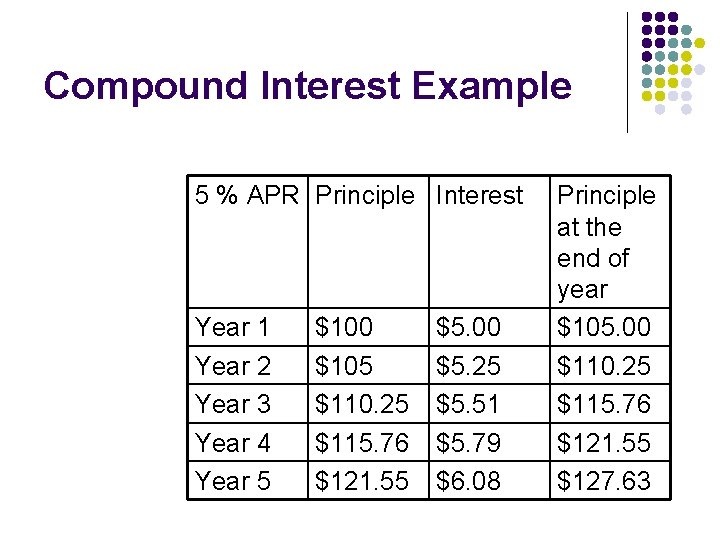
Compound Interest Example 5 % APR Principle Interest Year 1 Year 2 Year 3 Year 4 Year 5 $100 $105 $110. 25 $115. 76 $121. 55 $5. 00 $5. 25 $5. 51 $5. 79 $6. 08 Principle at the end of year $105. 00 $110. 25 $115. 76 $121. 55 $127. 63
- Slides: 6