
MONET PHYSICAL CHARACTERISTICS OF MAIN BELT COMETS Vidojevica
MONET PHYSICAL CHARACTERISTICS OF MAIN BELT COMETS Vidojevica 2011 Ivan Milić Andrej Obuljen Stanislav Milošević
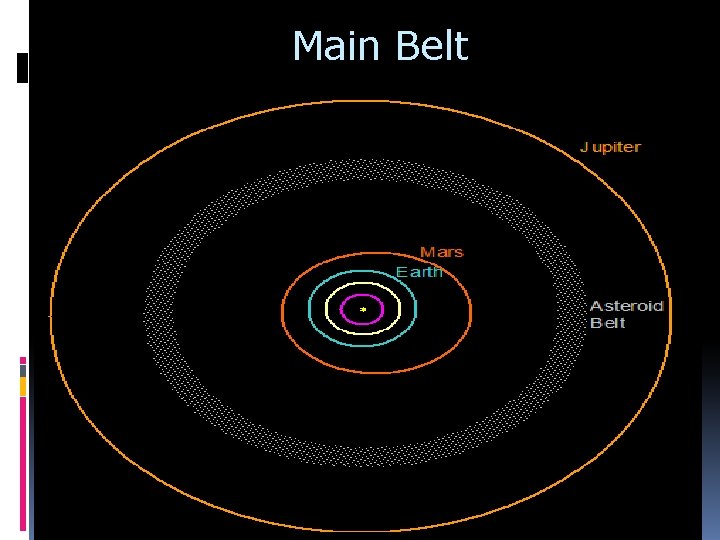
Main Belt The asteroid belt (main belt) is the region of the Solar System located between the orbits of the planets Mars and Jupiter A small group of objects with orbits close to the main asteroid belt are displaying cometary activity
Main Belt
Main Belt Comets originally come from the outer solar system Main belt comets are objects from asteroid belt, which are displaying cometary activity The origin of their cometary activity is not fully explained
Comets and asteroids Comets - a small body in the Solar System that is found to display a diffuse developing coma and that contains a monolithic nucleus consisting of ice and dust grains Asteroids – solid rock Comets-elongated orbits ; asteroids-nearcircular orbits Some intermediate objects – properties that are typical of both categories.
On August 7, 1996 Eric W. Elst discovered intermediate object that showed a cometary tail and was designated as 133 P/Elst-Pizarro, while moving in a typical asteroidal orbit in the MBA. This was the first known “Main Belt Comet”
There are seven objects classified as a Main Belt Comets: 1. 133 P/Elst-Pizarro 2. 176 P/Linear 3. 238 P/Read (P/2005 U 1) 4. P/2008 R 1 (Garradd) 5. P/2010 A 2 (Linear) 6. P/2010 R 2 (La Sagra) 7. 596 Scheila
Our high priority objecrs are: 176 P/Linear, 238 P/Read (P/2005 U 1), P/2010 R 2 (La Sagra) La Sagra is of special interest since it is recently descovered object with only a small amount of collected data
Goals: Collect photometrical data of Main Belt Comets Study their physical characteristics Rotational periods Colors
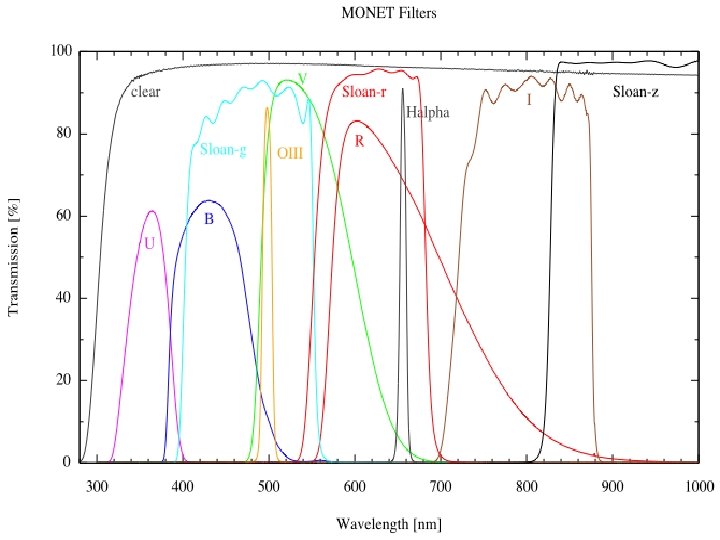
First part of the project was a broad-band color study of these objects By imaging in three different filters we will be able to construct color diagrams Filters are: 1. R (660 nm) 2. V (550 nm)
![Filter Name Description Central Wavelength [nm] FWHM Peak T_max [nm] Wavelength [%] [nm] none](http://slidetodoc.com/presentation_image_h/b496a8efd60ddd2a7155cff763739b9f/image-12.jpg "Filter Name Description Central Wavelength [nm] FWHM Peak T_max [nm] Wavelength [%] [nm] none")
Filter Name Description Central Wavelength [nm] FWHM Peak T_max [nm] Wavelength [%] [nm] none no filter (CCD) clear BG glass (CCD) 97% U Johnson-Bessel uv 360 51 364 62% B Johnson-Bessel blue 440 94 431 66% 109 520 93% 142 600 83% V R Johnson-Bessel 550 visual Johnson-Bessel 660 red I Johnson-Bessel 800 infrared 156 805 94% Sloan g' SDSS green 475 150 492 96% Sloan r' SDSS red 619 132 629 0% Halpha neutral hydrogen 655. 8/656. 2 8. 2 656 0% OIII twice ionized oxygen 498. 20/498. 90 11. 60/11. 80 500 87% Sloan z' SDSS near-IR > 900 95%
Second part of the project will be a study of their rotational periods If the observed object have no developed comas, it should be possible to determine their rotational periods using differential photometry Beside the study of their physical characteristics we will be able to produce new astrometrical follow –up measurements which will be reported to the Minor Planet Center
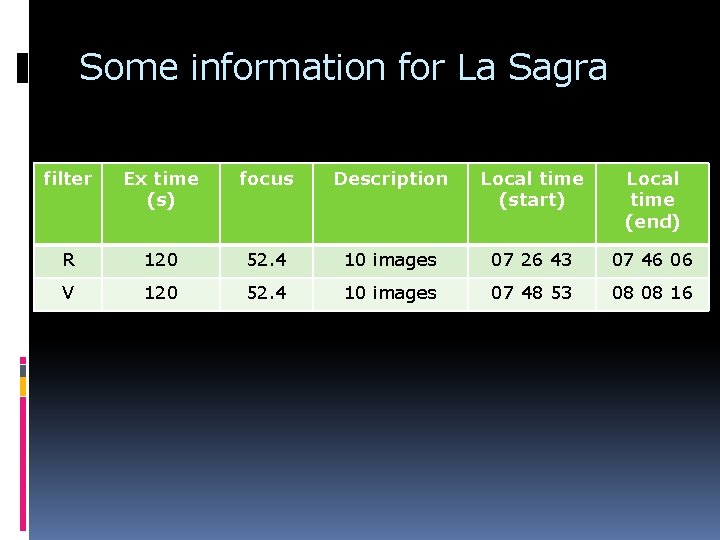
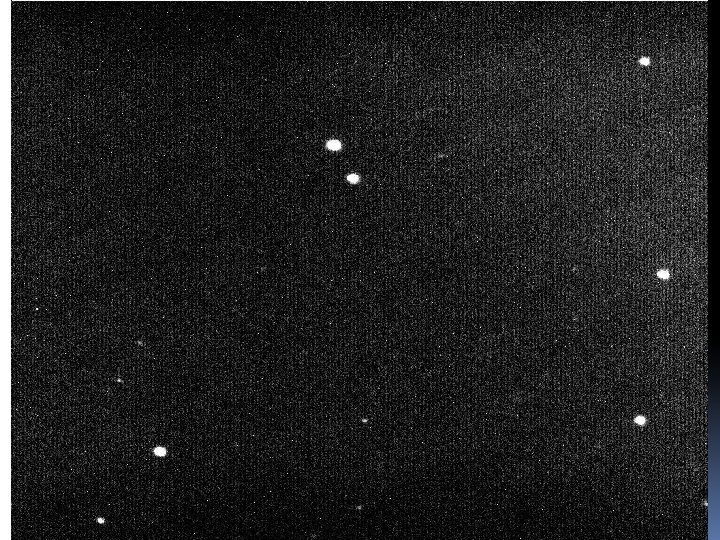
Some information for La Sagra filter Ex time (s) focus Description Local time (start) Local time (end) R 120 52. 4 10 images 07 26 43 07 46 06 V 120 52. 4 10 images 07 48 53 08 08 16
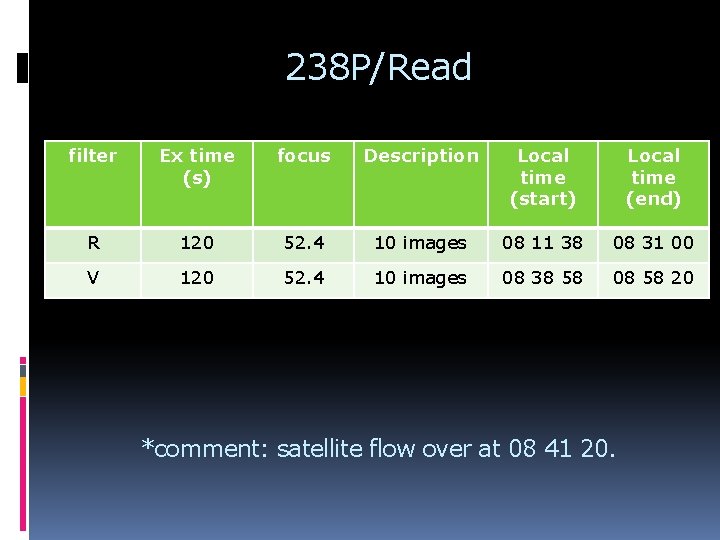
238 P/Read filter Ex time (s) focus Description Local time (start) Local time (end) R 120 52. 4 10 images 08 11 38 08 31 00 V 120 52. 4 10 images 08 38 58 08 58 20 *comment: satellite flow over at 08 41 20.
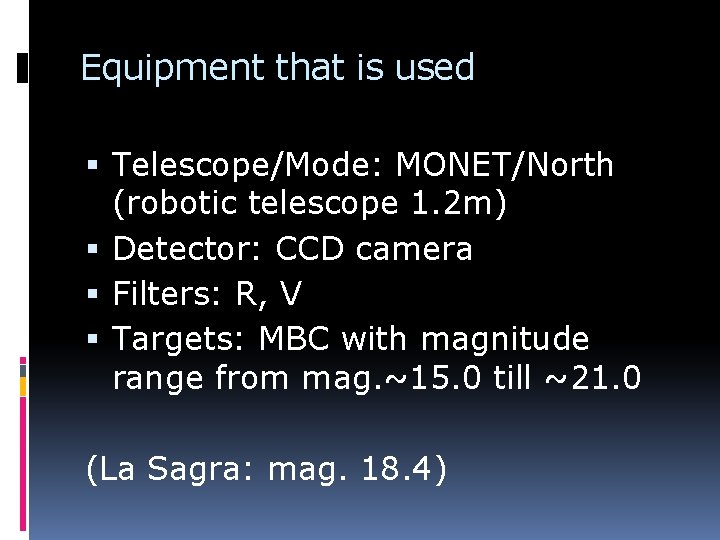
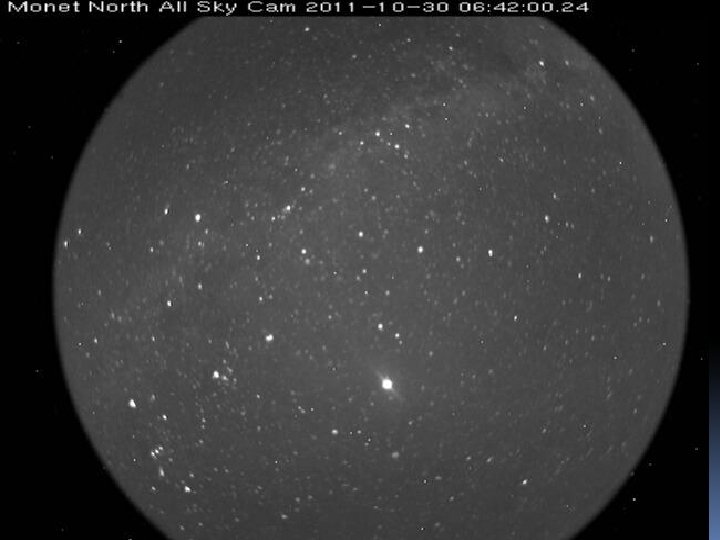
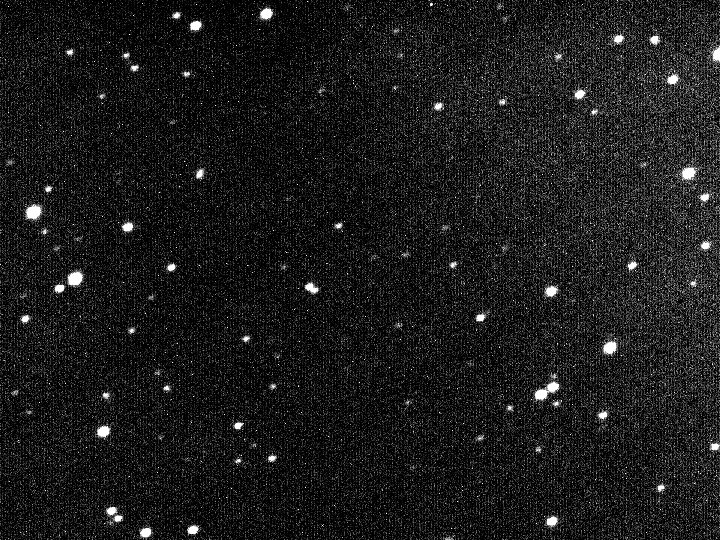
Equipment that is used Telescope/Mode: MONET/North (robotic telescope 1. 2 m) Detector: CCD camera Filters: R, V Targets: MBC with magnitude range from mag. ~15. 0 till ~21. 0 (La Sagra: mag. 18. 4)
We don’t have final results, because the reduction is not finished yet!
Project requirements Training of teachers (student mentors) performed by: Science and Education Center , Višnjan, Croatia Petnica Science Center, Valjevo, Serbia Astronomical Observatory, Belgrade, Serbia Aristotle University of Thessaloniki, Greece High school student projects-carried out by the schools: Vladimir Prelog Scince School, Zagreb, Croatia Petnica Science Center, Valjevo, Serbia Gymnassium of Goumenissa, Kilkis, Greece Second Lyceum of Echedoros, Thessaloniki, Greece
Educational gains Guided a large number of high school students through the process of scientific experiment Educated students about recent technological developments in astronomy, using the example of robotic telescopes and sensitive CCD detectors Exposed students to the importance of databases of astronomical images and measurements International cooperation in science
Thank you for you attention!
- Slides: 23