
Monadic Programming Arvind Computer Science and Artificial Intelligence
![Word Count Program wcs : : String -> Bool -> (Int, Int) wcs []](https://slidetodoc.com/presentation_image/eeb909f715f70711aa0b89019c6bb83c/image-4.jpg "Word Count Program wcs : : String -> Bool -> (Int, Int) wcs []")
![Calling WC main : : IO () main = get. Args >>= [filename] ->](https://slidetodoc.com/presentation_image/eeb909f715f70711aa0b89019c6bb83c/image-8.jpg "Calling WC main : : IO () main = get. Args >>= [filename] ->")
![Properties of programs involving IO put. String [] = return () put. String (c:](https://slidetodoc.com/presentation_image/eeb909f715f70711aa0b89019c6bb83c/image-15.jpg "Properties of programs involving IO put. String [] = return () put. String (c:")

![Base case put. String [] = return () [] = bs ++ bs put.](https://slidetodoc.com/presentation_image/eeb909f715f70711aa0b89019c6bb83c/image-30.jpg "Base case put. String [] = return () [] = bs ++ bs put.")
- Slides: 31
Monadic Programming Arvind Computer Science and Artificial Intelligence Laboratory M. I. T. October 26, 2006 http: //www. csg. csail. mit. edu/6. 827 L 13 -
Outline • IO Monad – Example: wc program – Some properties • Monadic laws • Creating our own monads: – – – October 26, 2006 Id: The simplest monad State Unique name generator Emulating simple I/O Exceptions http: //www. csg. csail. mit. edu/6. 827 L 13 -2
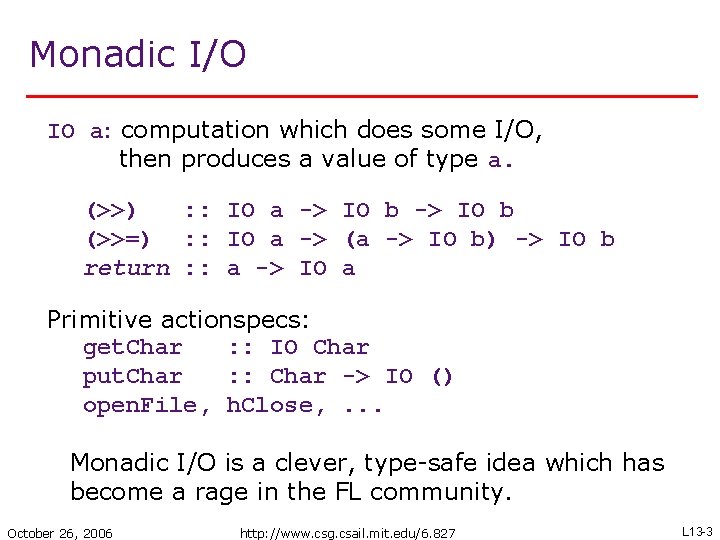
Monadic I/O IO a: computation which does some I/O, then produces a value of type a. (>>) : : IO a -> IO b (>>=) : : IO a -> (a -> IO b) -> IO b return : : a -> IO a Primitive actionspecs: get. Char : : IO Char put. Char : : Char -> IO () open. File, h. Close, . . . Monadic I/O is a clever, type-safe idea which has become a rage in the FL community. October 26, 2006 http: //www. csg. csail. mit. edu/6. 827 L 13 -3
Word Count Program wcs : : String -> Bool -> (Int, Int) wcs [] in. Word (nc, nw, nl) = (nc, nw, nl) wcs (c: cs) in. Word (nc, nw, nl) = if (is. New. Line c) then wcs cs False ((nc+1), nw, (nl+1)) else if (is. Space c) then wcs cs False ((nc+1), nw, nl) else if (not in. Word) then wcs cs True ((nc+1), (nw+1), nl) else wcs cs True ((nc+1), nw, nl) Can we read the string from an input file as needed? October 26, 2006 http: //www. csg. csail. mit. edu/6. 827 L 13 -4
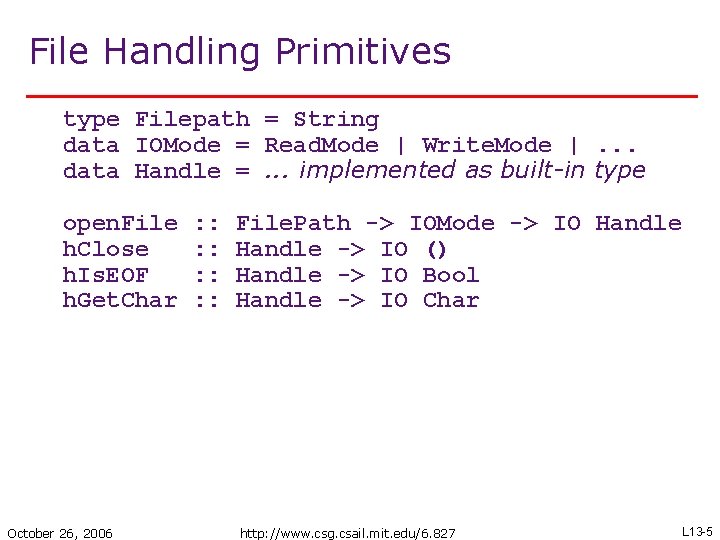
File Handling Primitives type Filepath = String data IOMode = Read. Mode | Write. Mode |. . . data Handle =. . . implemented as built-in type open. File h. Close h. Is. EOF h. Get. Char October 26, 2006 : : : : File. Path -> IOMode -> IO Handle -> IO () Handle -> IO Bool Handle -> IO Char http: //www. csg. csail. mit. edu/6. 827 L 13 -5
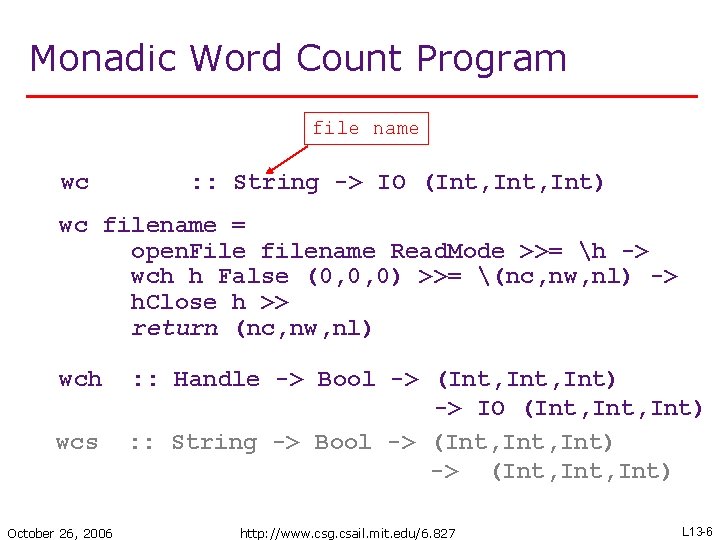
Monadic Word Count Program file name wc : : String -> IO (Int, Int) wc filename = open. File filename Read. Mode >>= h -> wch h False (0, 0, 0) >>= (nc, nw, nl) -> h. Close h >> return (nc, nw, nl) wch wcs October 26, 2006 : : Handle -> Bool -> (Int, Int) -> IO (Int, Int) : : String -> Bool -> (Int, Int) http: //www. csg. csail. mit. edu/6. 827 L 13 -6
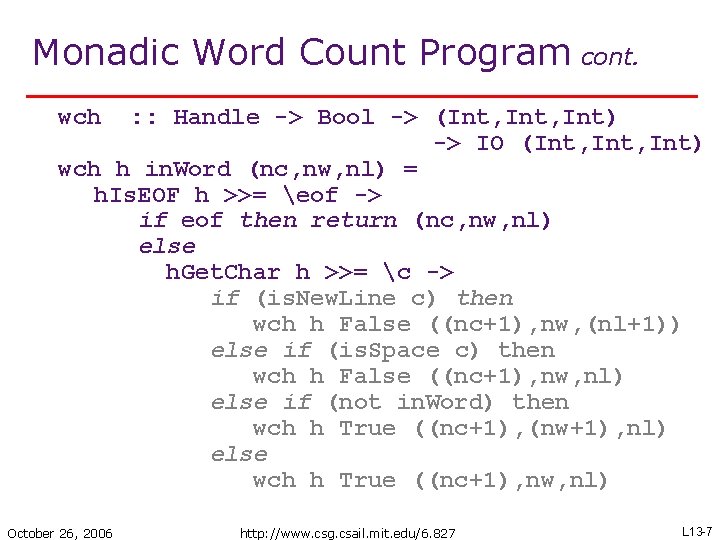
Monadic Word Count Program cont. wch : : Handle -> Bool -> (Int, Int) -> IO (Int, Int) wch h in. Word (nc, nw, nl) = h. Is. EOF h >>= eof -> if eof then return (nc, nw, nl) else h. Get. Char h >>= c -> if (is. New. Line c) then wch h False ((nc+1), nw, (nl+1)) else if (is. Space c) then wch h False ((nc+1), nw, nl) else if (not in. Word) then wch h True ((nc+1), (nw+1), nl) else wch h True ((nc+1), nw, nl) October 26, 2006 http: //www. csg. csail. mit. edu/6. 827 L 13 -7
Calling WC main : : IO () main = get. Args >>= [filename] -> wc filename >>= (nc, nw, nl) -> put. Str “ ” >> put. Str (show nc) >> put. Str “ ” >> put. Str (show nw) >> put. Str “ ” >> put. Str (show nl) >> put. Str “ ” >> put. Str filename >> put. Str “n” Once a value enters the IO monad it cannot leave it! October 26, 2006 http: //www. csg. csail. mit. edu/6. 827 L 13 -8
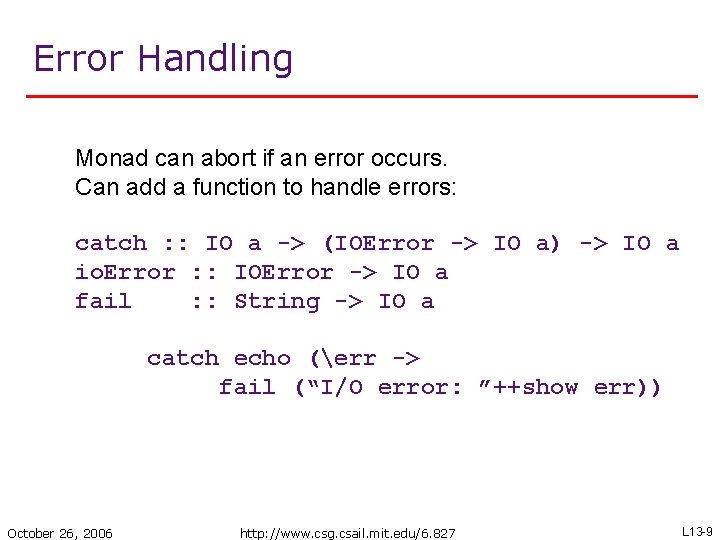
Error Handling Monad can abort if an error occurs. Can add a function to handle errors: catch : : IO a -> (IOError -> IO a) -> IO a io. Error : : IOError -> IO a fail : : String -> IO a catch echo (err -> fail (“I/O error: ”++show err)) October 26, 2006 http: //www. csg. csail. mit. edu/6. 827 L 13 -9
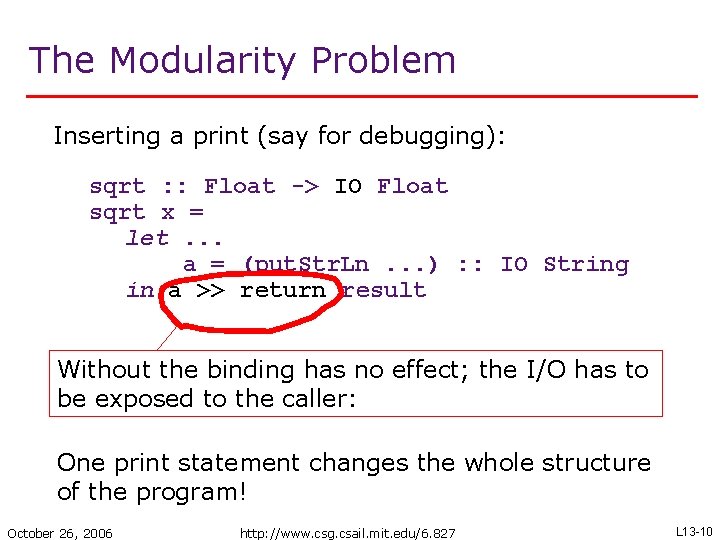
The Modularity Problem Inserting a print (say for debugging): sqrt : : Float -> IO Float sqrt x = let. . . a = (put. Str. Ln. . . ) : : IO String in a >> return result Without the binding has no effect; the I/O has to be exposed to the caller: One print statement changes the whole structure of the program! October 26, 2006 http: //www. csg. csail. mit. edu/6. 827 L 13 -10
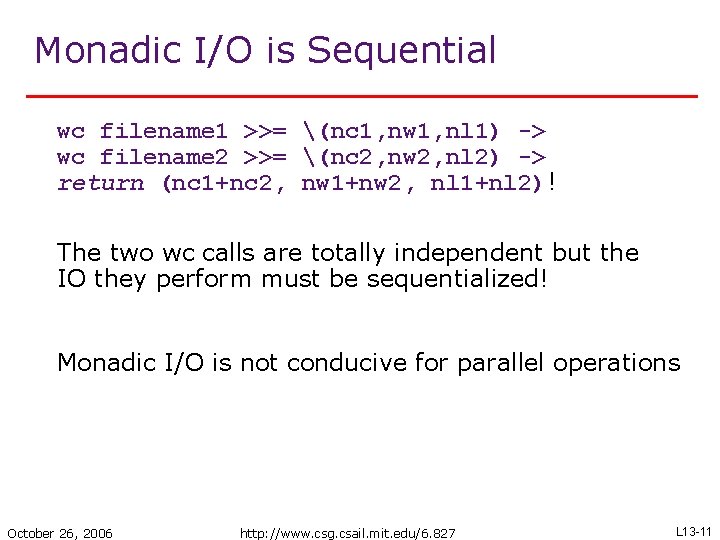
Monadic I/O is Sequential wc filename 1 >>= (nc 1, nw 1, nl 1) -> wc filename 2 >>= (nc 2, nw 2, nl 2) -> return (nc 1+nc 2, nw 1+nw 2, nl 1+nl 2)! The two wc calls are totally independent but the IO they perform must be sequentialized! Monadic I/O is not conducive for parallel operations October 26, 2006 http: //www. csg. csail. mit. edu/6. 827 L 13 -11
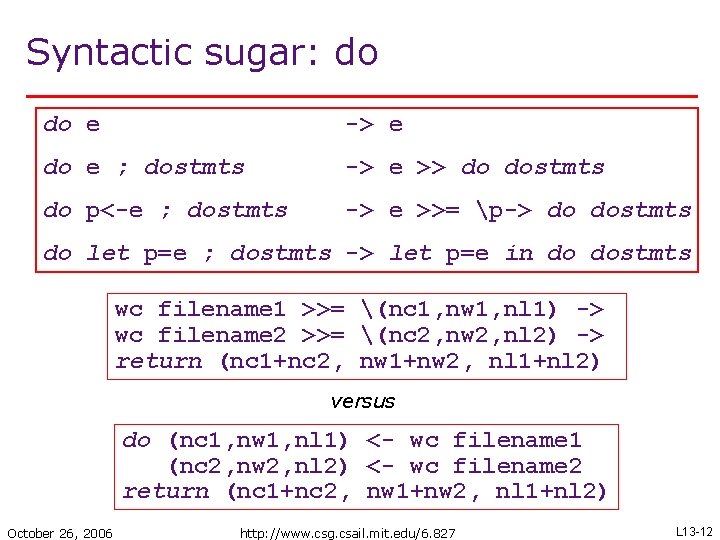
Syntactic sugar: do do e -> e do e ; dostmts -> e >> do dostmts do p<-e ; dostmts -> e >>= p-> do dostmts do let p=e ; dostmts -> let p=e in do dostmts wc filename 1 >>= (nc 1, nw 1, nl 1) -> wc filename 2 >>= (nc 2, nw 2, nl 2) -> return (nc 1+nc 2, nw 1+nw 2, nl 1+nl 2) versus do (nc 1, nw 1, nl 1) <- wc filename 1 (nc 2, nw 2, nl 2) <- wc filename 2 return (nc 1+nc 2, nw 1+nw 2, nl 1+nl 2) October 26, 2006 http: //www. csg. csail. mit. edu/6. 827 L 13 -12
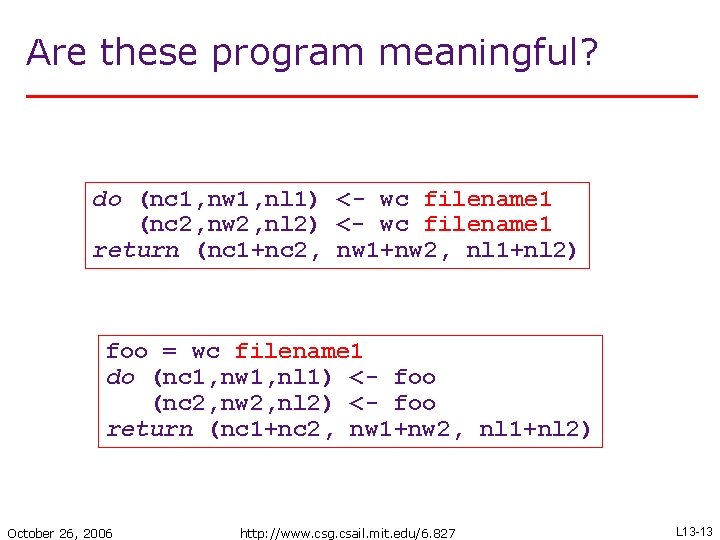
Are these program meaningful? do (nc 1, nw 1, nl 1) <- wc filename 1 (nc 2, nw 2, nl 2) <- wc filename 1 return (nc 1+nc 2, nw 1+nw 2, nl 1+nl 2) foo = wc filename 1 do (nc 1, nw 1, nl 1) <- foo (nc 2, nw 2, nl 2) <- foo return (nc 1+nc 2, nw 1+nw 2, nl 1+nl 2) October 26, 2006 http: //www. csg. csail. mit. edu/6. 827 L 13 -13
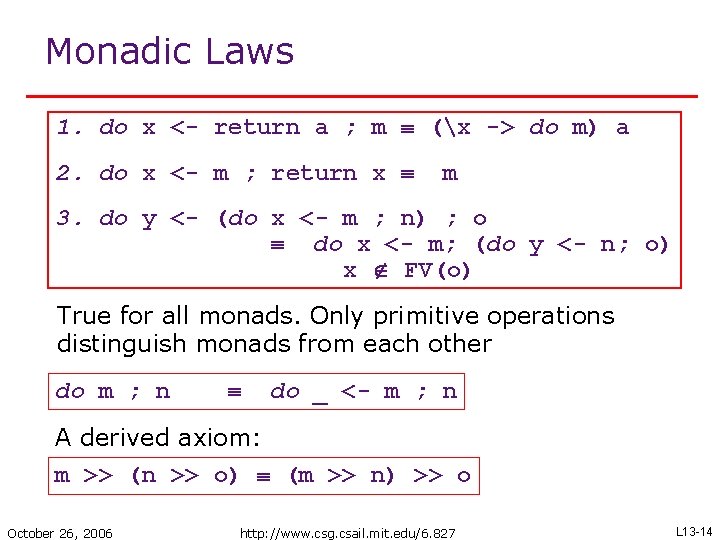
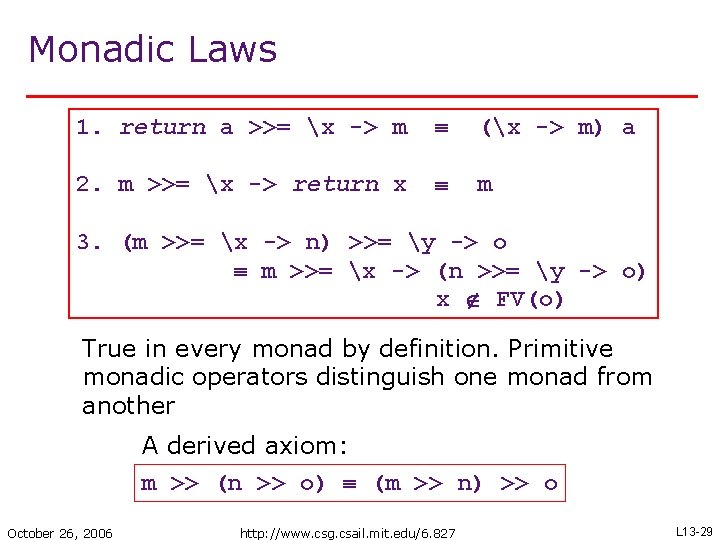
Monadic Laws 1. do x <- return a ; m (x -> do m) a 2. do x <- m ; return x m 3. do y <- (do x <- m ; n) ; o do x <- m; (do y <- n; o) x FV(o) True for all monads. Only primitive operations distinguish monads from each other do m ; n do _ <- m ; n A derived axiom: m >> (n >> o) (m >> n) >> o October 26, 2006 http: //www. csg. csail. mit. edu/6. 827 L 13 -14
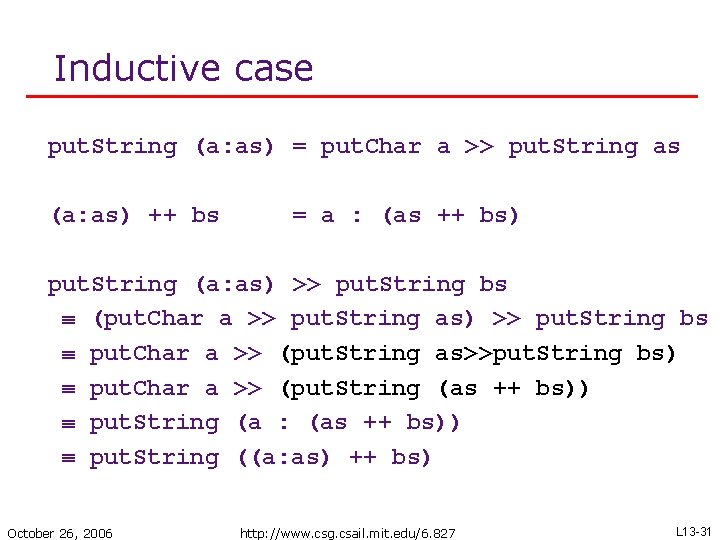
Properties of programs involving IO put. String [] = return () put. String (c: cs) = put. Char c >> put. String cs [] ++ bs (a: as) ++ bs = a : (as ++ bs) put. String as >> put. String bs put. String (as++bs) One can prove this just using monadic laws without involving I/O properties October 26, 2006 http: //www. csg. csail. mit. edu/6. 827 L 13 -15
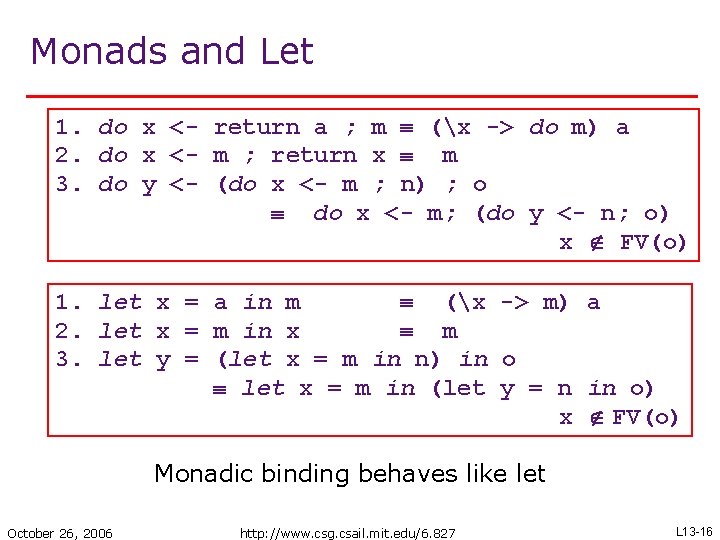
Monads and Let 1. do x <- return a ; m (x -> do m) a 2. do x <- m ; return x m 3. do y <- (do x <- m ; n) ; o do x <- m; (do y <- n; o) x FV(o) 1. let x = a in m (x -> m) a 2. let x = m in x m 3. let y = (let x = m in n) in o let x = m in (let y = n in o) x FV(o) Monadic binding behaves like let October 26, 2006 http: //www. csg. csail. mit. edu/6. 827 L 13 -16
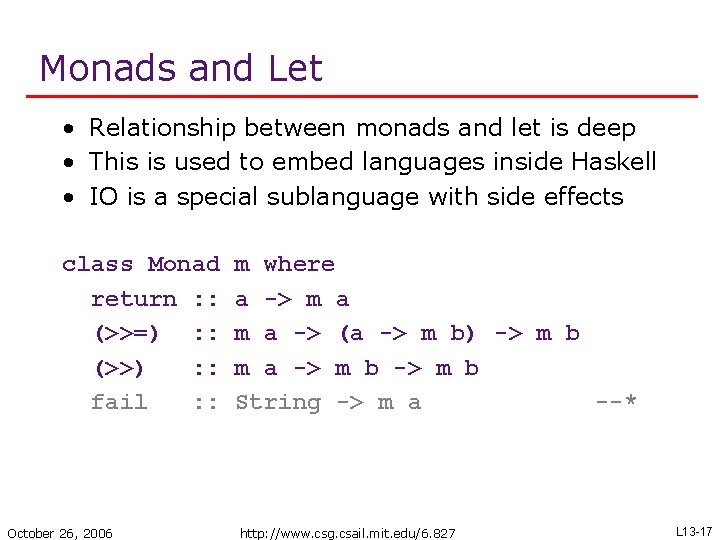
Monads and Let • Relationship between monads and let is deep • This is used to embed languages inside Haskell • IO is a special sublanguage with side effects class Monad return : : (>>=) : : (>>) : : fail : : October 26, 2006 m where a -> m a -> (a -> m b) -> m b m a -> m b String -> m a --* http: //www. csg. csail. mit. edu/6. 827 L 13 -17
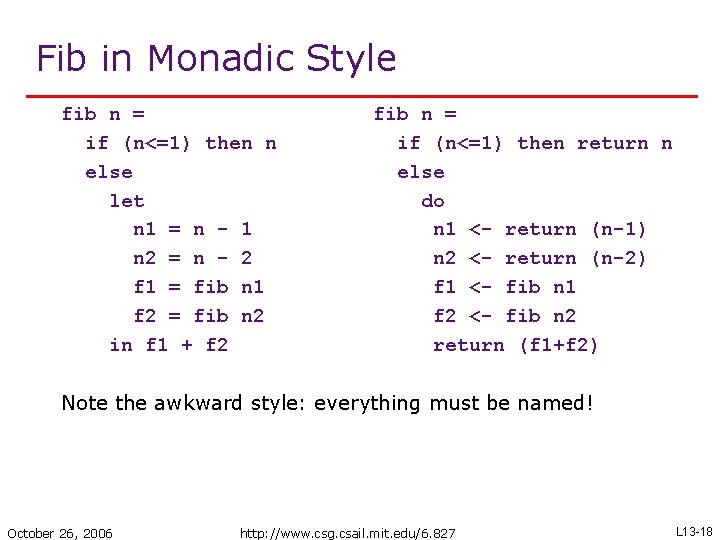
Fib in Monadic Style fib n = if (n<=1) then n else let n 1 = n - 1 n 2 = n - 2 f 1 = fib n 1 f 2 = fib n 2 in f 1 + f 2 fib n = if (n<=1) then return n else do n 1 <- return (n-1) n 2 <- return (n-2) f 1 <- fib n 1 f 2 <- fib n 2 return (f 1+f 2) Note the awkward style: everything must be named! October 26, 2006 http: //www. csg. csail. mit. edu/6. 827 L 13 -18
Outline • IO Monad – Example: wc program – Some properties • Monadic laws • Creating our own monads: – – – October 26, 2006 Id: The simplest monad State Unique name generator Emulating simple I/O Exceptions http: //www. csg. csail. mit. edu/6. 827 L 13 -19
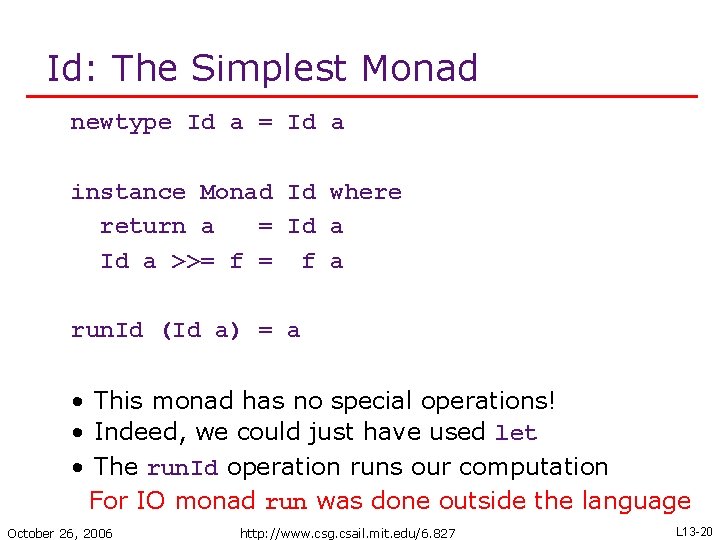
Id: The Simplest Monad newtype Id a = Id a instance Monad Id where return a = Id a >>= f a run. Id (Id a) = a • This monad has no special operations! • Indeed, we could just have used let • The run. Id operation runs our computation For IO monad run was done outside the language October 26, 2006 http: //www. csg. csail. mit. edu/6. 827 L 13 -20
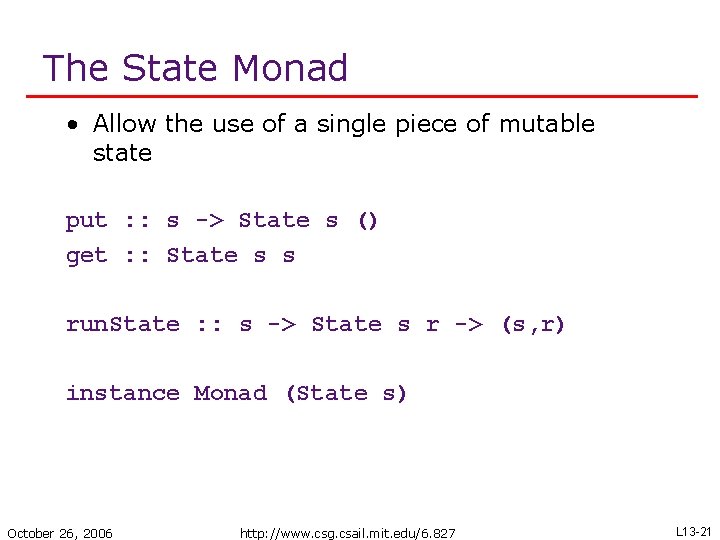
The State Monad • Allow the use of a single piece of mutable state put : : s -> State s () get : : State s s run. State : : s -> State s r -> (s, r) instance Monad (State s) October 26, 2006 http: //www. csg. csail. mit. edu/6. 827 L 13 -21
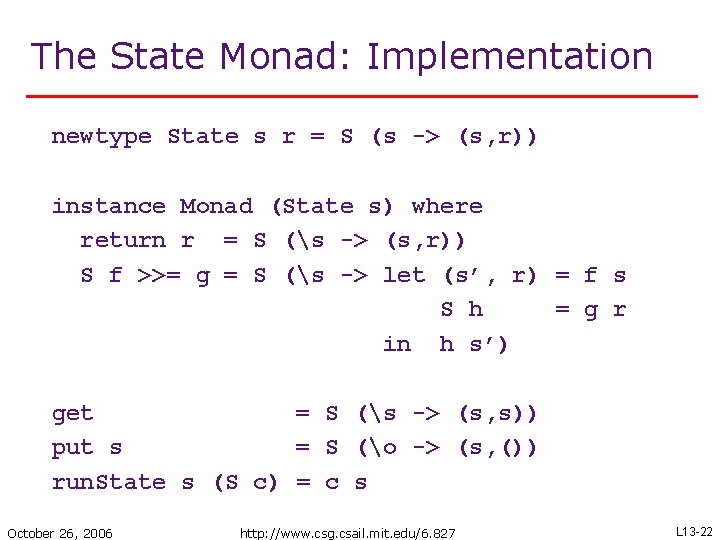
The State Monad: Implementation newtype State s r = S (s -> (s, r)) instance Monad (State s) where return r = S (s -> (s, r)) S f >>= g = S (s -> let (s’, r) = f s S h = g r in h s’) get = S (s -> (s, s)) put s = S (o -> (s, ()) run. State s (S c) = c s October 26, 2006 http: //www. csg. csail. mit. edu/6. 827 L 13 -22
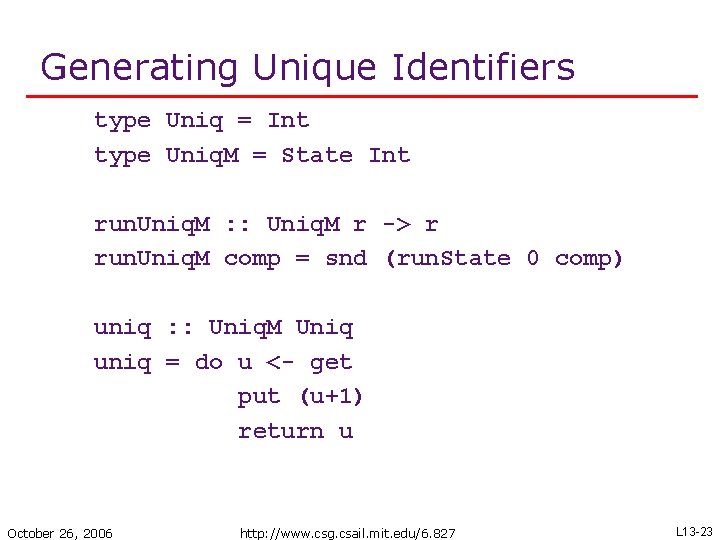
Generating Unique Identifiers type Uniq = Int type Uniq. M = State Int run. Uniq. M : : Uniq. M r -> r run. Uniq. M comp = snd (run. State 0 comp) uniq : : Uniq. M Uniq uniq = do u <- get put (u+1) return u October 26, 2006 http: //www. csg. csail. mit. edu/6. 827 L 13 -23
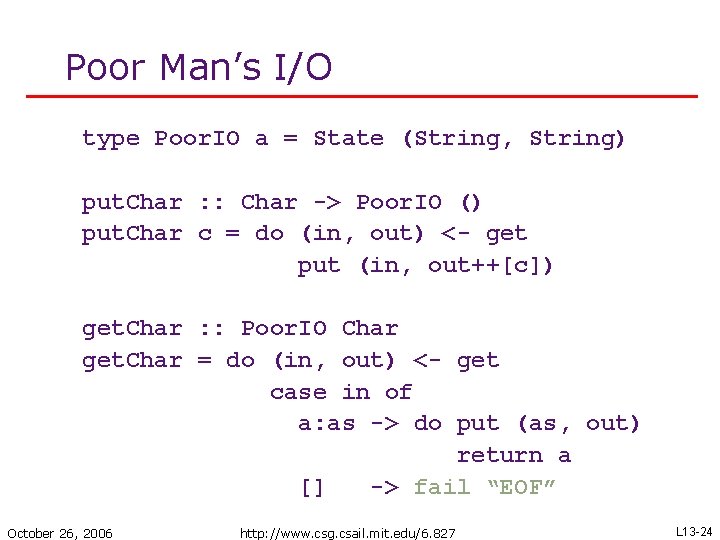
Poor Man’s I/O type Poor. IO a = State (String, String) put. Char : : Char -> Poor. IO () put. Char c = do (in, out) <- get put (in, out++[c]) get. Char : : Poor. IO Char get. Char = do (in, out) <- get case in of a: as -> do put (as, out) return a [] -> fail “EOF” October 26, 2006 http: //www. csg. csail. mit. edu/6. 827 L 13 -24
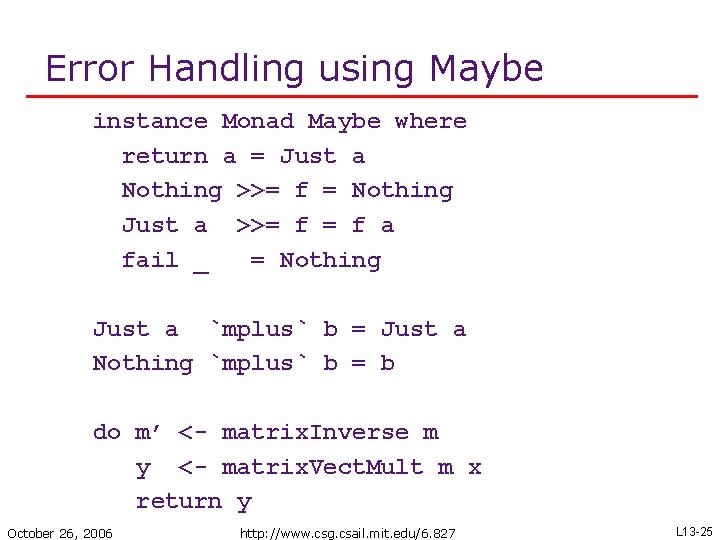
Error Handling using Maybe instance Monad Maybe where return a = Just a Nothing >>= f = Nothing Just a >>= f a fail _ = Nothing Just a `mplus` b = Just a Nothing `mplus` b = b do m’ <- matrix. Inverse m y <- matrix. Vect. Mult m x return y October 26, 2006 http: //www. csg. csail. mit. edu/6. 827 L 13 -25
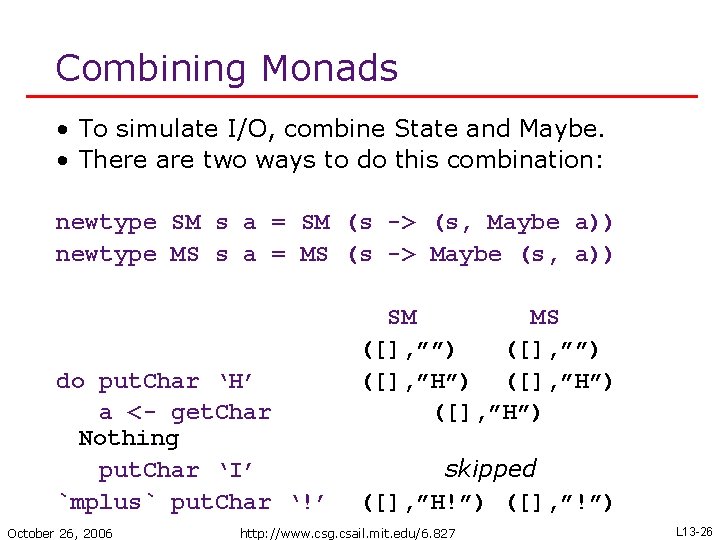
Combining Monads • To simulate I/O, combine State and Maybe. • There are two ways to do this combination: newtype SM s a = SM (s -> (s, Maybe a)) newtype MS s a = MS (s -> Maybe (s, a)) do put. Char ‘H’ a <- get. Char Nothing put. Char ‘I’ `mplus` put. Char ‘!’ October 26, 2006 SM MS ([], ””) ([], ”H”) skipped ([], ”H!”) ([], ”!”) http: //www. csg. csail. mit. edu/6. 827 L 13 -26
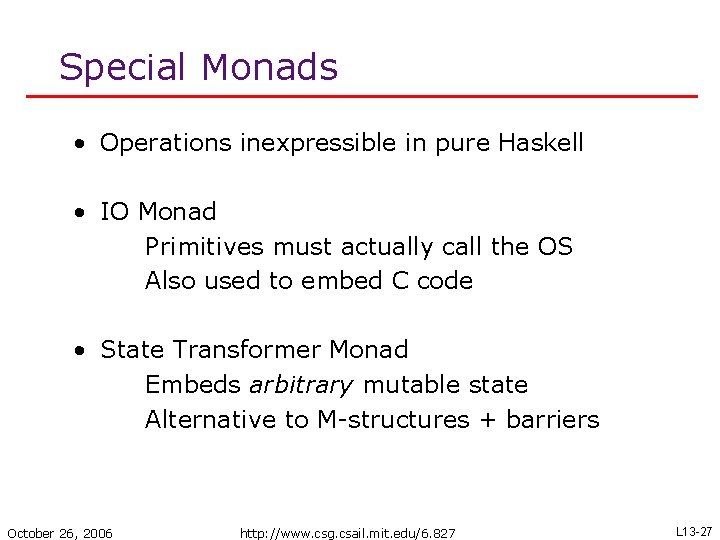
Special Monads • Operations inexpressible in pure Haskell • IO Monad Primitives must actually call the OS Also used to embed C code • State Transformer Monad Embeds arbitrary mutable state Alternative to M-structures + barriers October 26, 2006 http: //www. csg. csail. mit. edu/6. 827 L 13 -27
Extras October 26, 2006 http: //www. csg. csail. mit. edu/6. 827 L 13 -28
Monadic Laws 1. return a >>= x -> m (x -> m) a 2. m >>= x -> return x m 3. (m >>= x -> n) >>= y -> o m >>= x -> (n >>= y -> o) x FV(o) True in every monad by definition. Primitive monadic operators distinguish one monad from another A derived axiom: m >> (n >> o) (m >> n) >> o October 26, 2006 http: //www. csg. csail. mit. edu/6. 827 L 13 -29
Base case put. String [] = return () [] = bs ++ bs put. String [] return () put. String October 26, 2006 >> put. String bs bs ([]++bs) http: //www. csg. csail. mit. edu/6. 827 L 13 -30
Inductive case put. String (a: as) = put. Char a >> put. String as (a: as) ++ bs = a : (as ++ bs) put. String (a: as) >> put. String bs (put. Char a >> put. String as) >> put. String bs put. Char a >> (put. String as>>put. String bs) put. Char a >> (put. String (as ++ bs)) put. String (a : (as ++ bs)) put. String ((a: as) ++ bs) October 26, 2006 http: //www. csg. csail. mit. edu/6. 827 L 13 -31