
Mona Lisa is one of the most famous
- Slides: 20
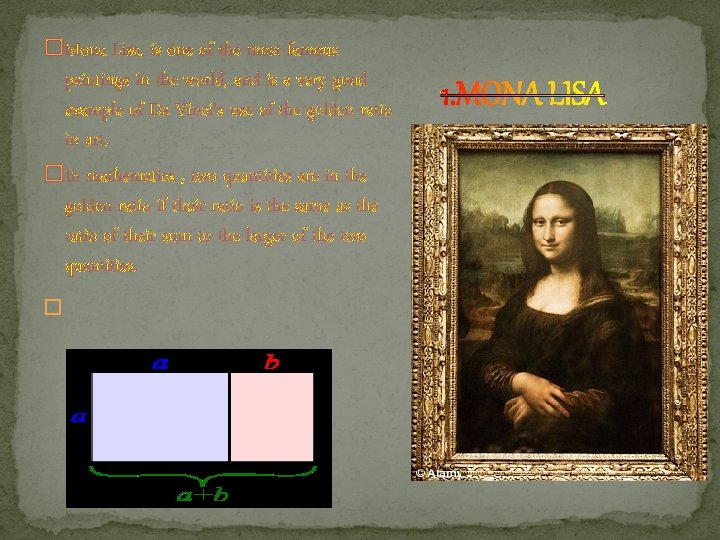
�Mona Lisa, is one of the most famous paintings in the world, and is a very good example of Da Vinci's use of the golden ratio in art. �In mathematics , two quantities are in the golden ratio if their ratio is the same as the ratio of their sum to the larger of the two quantities. �
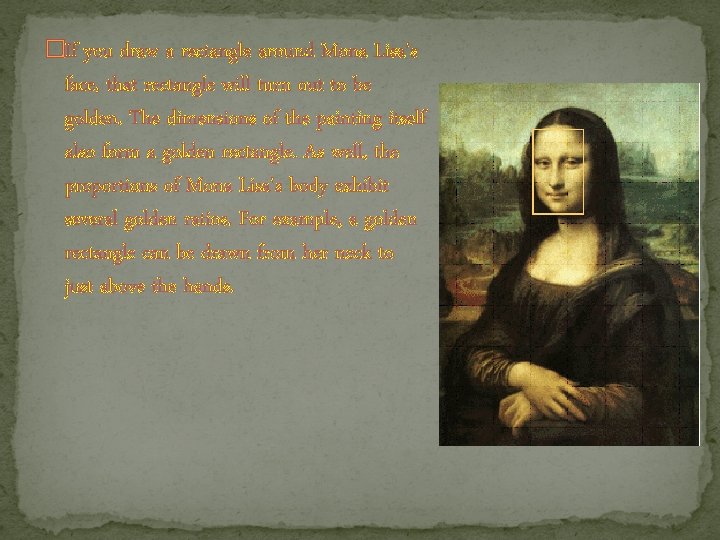
�If you draw a rectangle around Mona Lisa's face, that rectangle will turn out to be golden. The dimensions of the painting itself also form a golden rectangle. As well, the proportions of Mona Lisa's body exhibit several golden ratios. For example, a golden rectangle can be drawn from her neck to just above the hands.
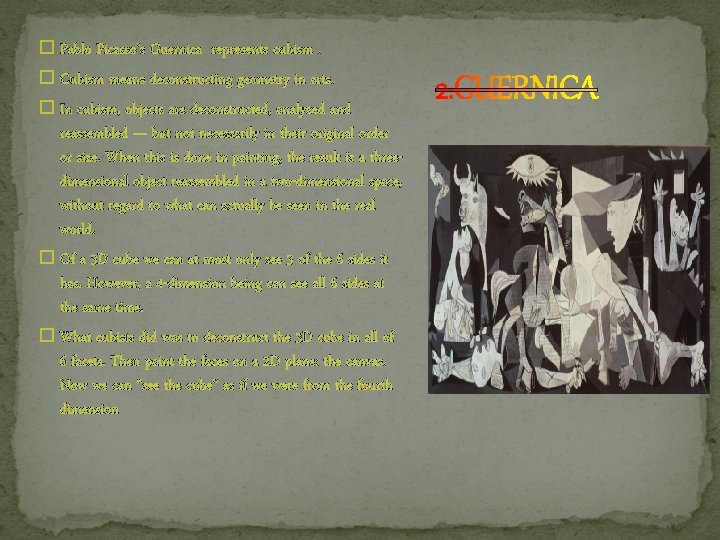
� Pablo Picasso’s Guernica represents cubism. � Cubism means deconstructing geometry in arts. � In cubism, objects are deconstructed, analyzed and reassembled — but not necessarily in their original order or size. When this is done in painting, the result is a threedimensional object reassembled in a two-dimensional space, without regard to what can actually be seen in the real world. � Of a 3 D cube we can at most only see 3 of the 6 sides it has. However, a 4 -dimension being can see all 6 sides at the same time. � What cubists did was to deconstruct the 3 D cube in all of 6 facets. Then paint the faces on a 2 D plane: the canvas. Now we can “see the cube” as if we were from the fourth dimension
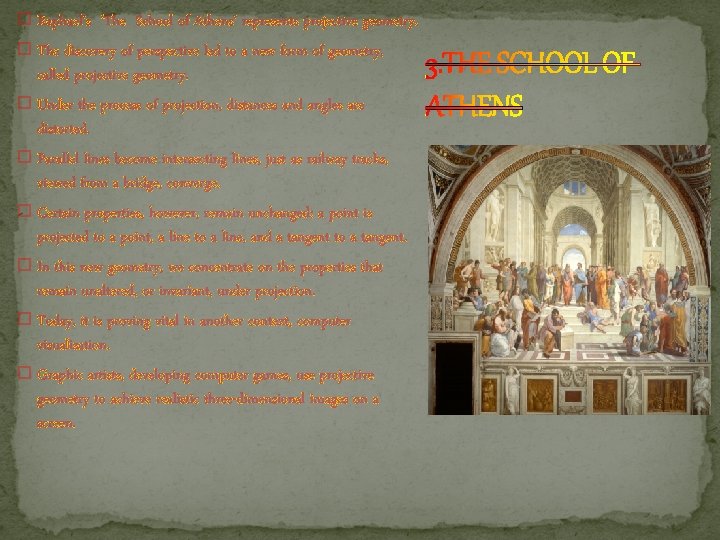
� Raphael’s ‘The School of Athens’ represents projective geometry. � The discovery of perspective led to a new form of geometry, called projective geometry. � Under the process of projection, distances and angles are distorted. � Parallel lines become intersecting lines, just as railway tracks, viewed from a bridge, converge. � Certain properties, however, remain unchanged: a point is projected to a point, a line to a line, and a tangent to a tangent. � In this new geometry, we concentrate on the properties that remain unaltered, or invariant, under projection. � Today, it is proving vital in another context, computer visualisation. � Graphic artists, developing computer games, use projective geometry to achieve realistic three-dimensional images on a screen.
�We may not have rotational symmetry, but we do have another type of symmetry called mirror symmetry. You may have also heard this called line or reflection symmetry. Imagine a line going from the top of your head to the ground between your feet. The left side of your body looks like a mirror image of the right side. You might have a few freckles in the wrong place, but your left arm matches your right arm, your left leg matches your right leg, and so on. We call this imaginary line the line of symmetry.
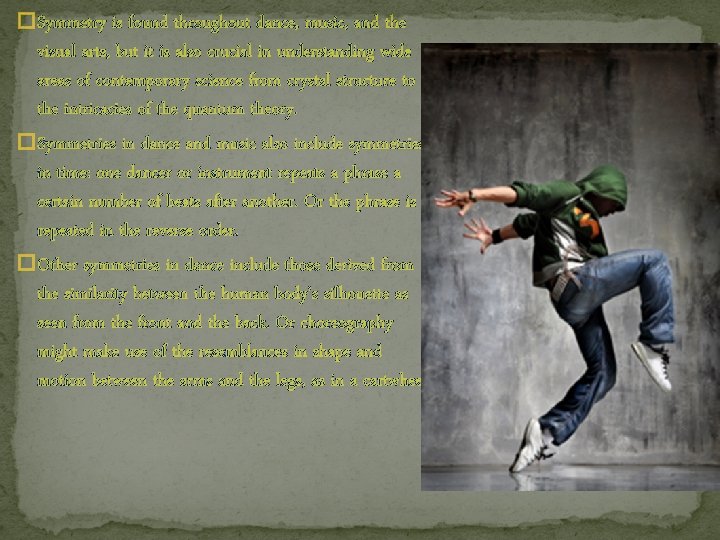
� Symmetry is found throughout dance, music, and the visual arts, but it is also crucial in understanding wide areas of contemporary science from crystal structure to the intricacies of the quantum theory. � Symmetries in dance and music also include symmetries in time: one dancer or instrument repeats a phrase a certain number of beats after another. Or the phrase is repeated in the reverse order. � Other symmetries in dance include those derived from the similarity between the human body's silhouette as seen from the front and the back. Or choreography might make use of the resemblances in shape and motion between the arms and the legs, as in a cartwheel
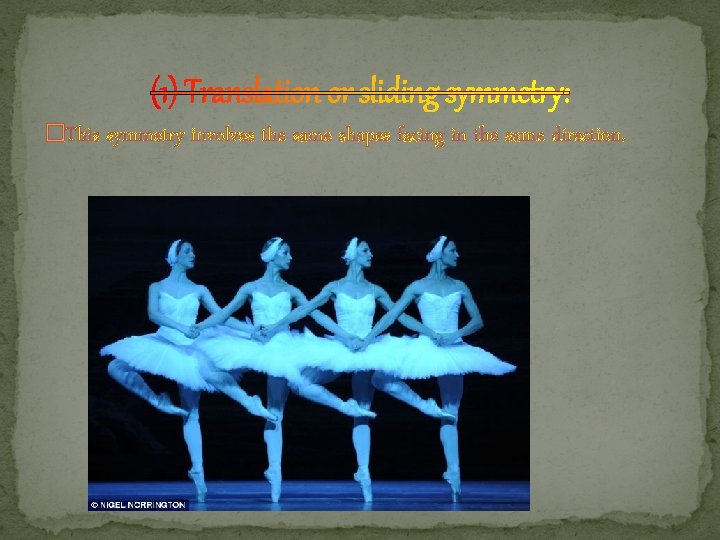
�This symmetry involves the same shapes facing in the same direction.
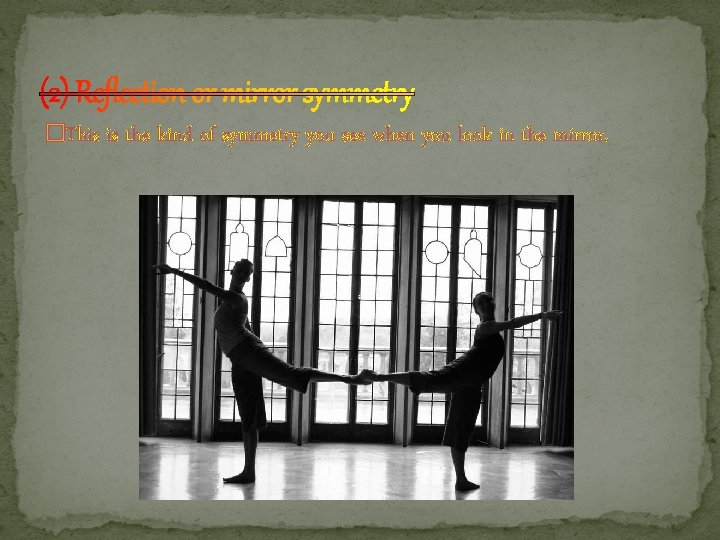
�This is the kind of symmetry you see when you look in the mirror.
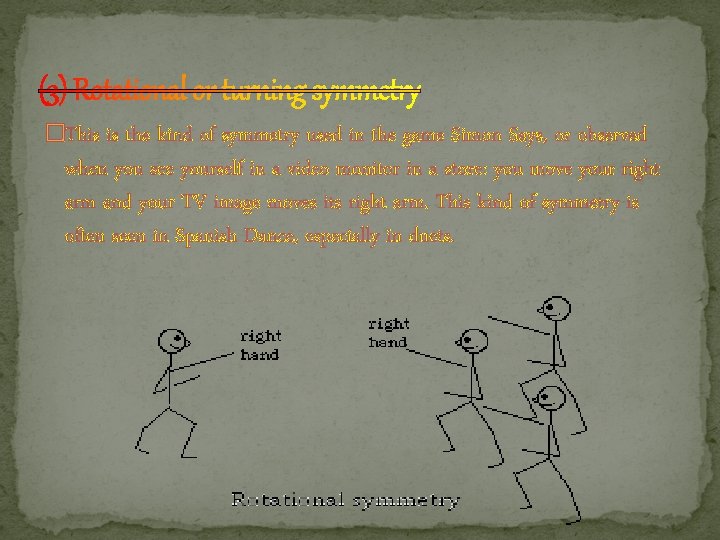
�This is the kind of symmetry used in the game Simon Says, or observed when you see yourself in a video monitor in a store: you move your right arm and your TV image moves its right arm. This kind of symmetry is often seen in Spanish Dance, especially in duets.
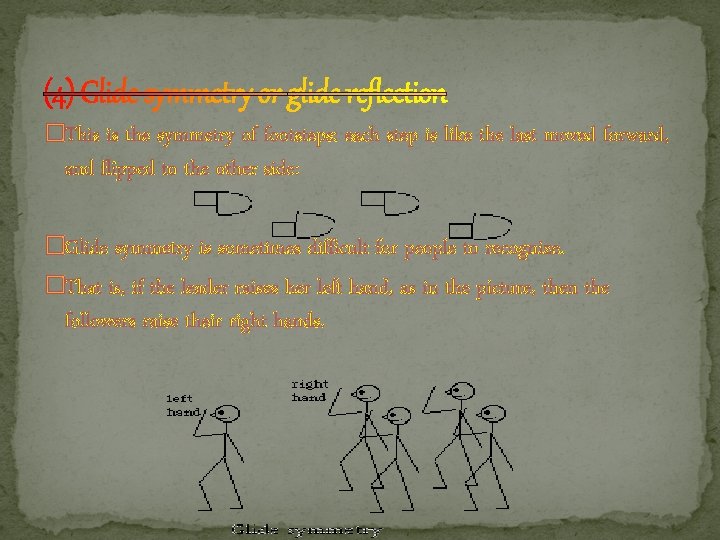
�This is the symmetry of footsteps: each step is like the last moved forward, and flipped to the other side: �Glide symmetry is sometimes difficult for people to recognize. �That is, if the leader raises her left hand, as in the picture, then the followers raise their right hands.
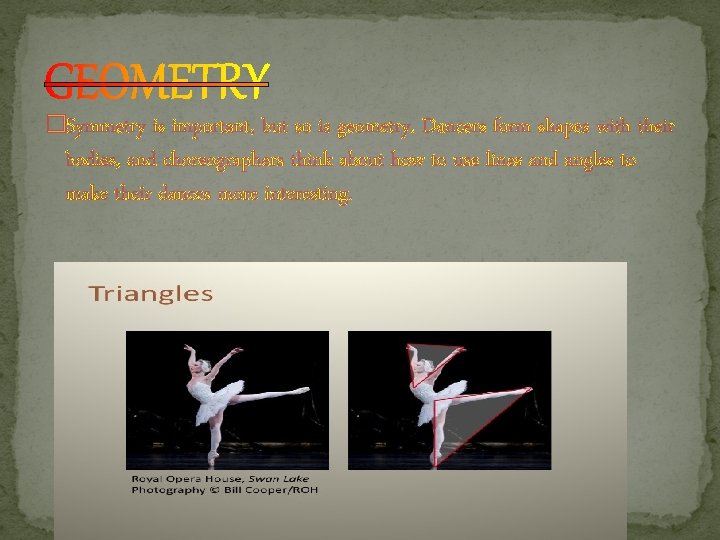
�Symmetry is important, but so is geometry. Dancers form shapes with their bodies, and choreographers think about how to use lines and angles to make their dances more interesting.
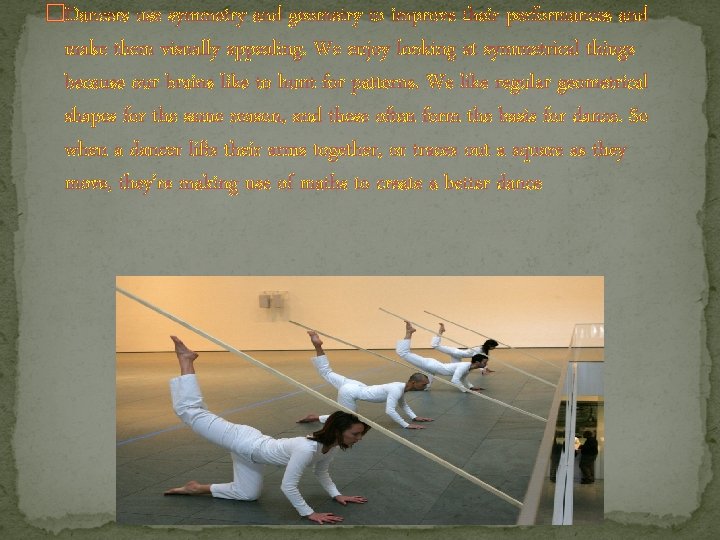
�Dancers use symmetry and geometry to improve their performances and make them visually appealing. We enjoy looking at symmetrical things because our brains like to hunt for patterns. We like regular geometrical shapes for the same reason, and these often form the basis for dance. So when a dancer lifts their arms together, or traces out a square as they move, they’re making use of maths to create a better dance
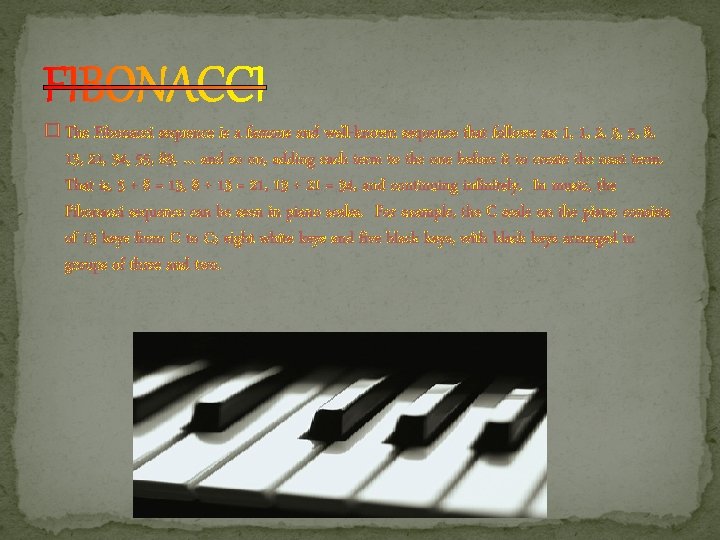
� The Fibonacci sequence is a famous and well-known sequence that follows as: 1, 1, 2, 3, 5, 8, 13, 21, 34, 55, 89, … and so on, adding each term to the one before it to create the next term. That is, 5 + 8 = 13, 8 + 13 = 21, 13 + 21 = 34, and continuing infinitely. In music, the Fibonacci sequence can be seen in piano scales. For example, the C scale on the piano consists of 13 keys from C to C; eight white keys and five black keys, with black keys arranged in groups of three and two.
�It was Pythagoras who realized that different sounds can be made with different weights and vibrations. This led to his discovery that the pitch of a vibrating string is proportional to and can be controlled by its length. Strings that are halved in length are one octave higher than the original. In essence, the shorter the string, the higher the pitch. He also realized that notes of certain frequencies sound best with multiple frequencies of that note. For example, a note of 220 Hz sounds best with notes of 440 Hz, 660 Hz, and so on.
�The closest tie between music and math is patterns. Musical pieces often have repeating choruses or bars, similar to patterns. In mathematics, we look for patterns to explain and predict the unknown. Music uses similar strategies. When looking at a musical piece, musicians look for notes they recognize to find notes that are rare (high or low) and less familiar. In this way, notes relate to each other. Relationships are fundamental to mathematics and create an interesting link between music and math.