
Mon 106 Take out your notes we are


- Slides: 37
Mon, 10/6 Take out your notes – we are going to finish lecture on Ch. 2. Be sure to turn in your annotated article! While you are waiting, respond to the following: 1. 2. In what ways are crime scenes commonly documented? If you were to decide on a search pattern for a crime scene – what factors would you take into consideration?
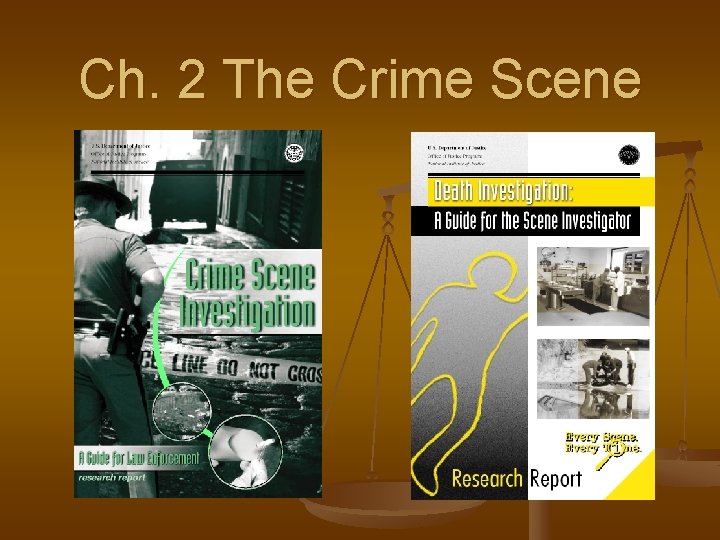
Ch. 2 The Crime Scene
Processing the Crime Scene 1. 2. 3. 4. 5. 1 st officer on the scene Surveying the crime scene Documenting the crime scene Searching the crime scene Collecting physical evidence CHE 113 3
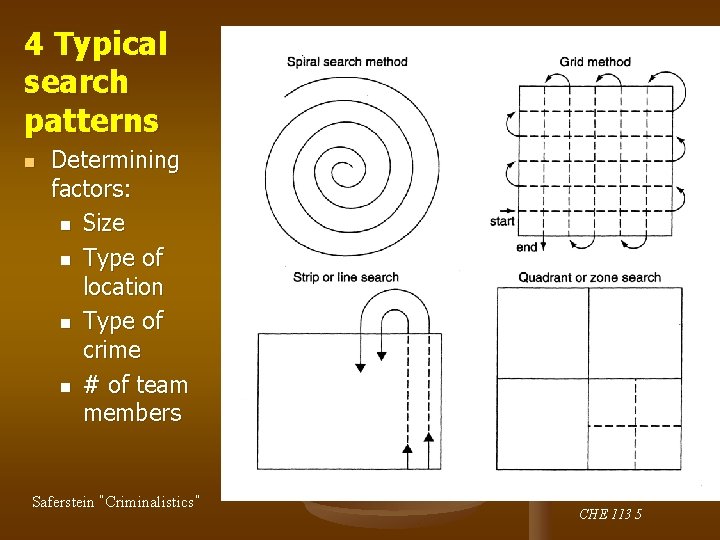
4. Searching the crime scene n n n Thorough and systematic Unbiased and not overlook any relevant evidence Search pattern depends upon locale, area, type of crime and conditions CHE 113 4
4 Typical search patterns n Determining factors: n Size n Type of location n Type of crime n # of team members Saferstein “Criminalistics” CHE 113 5
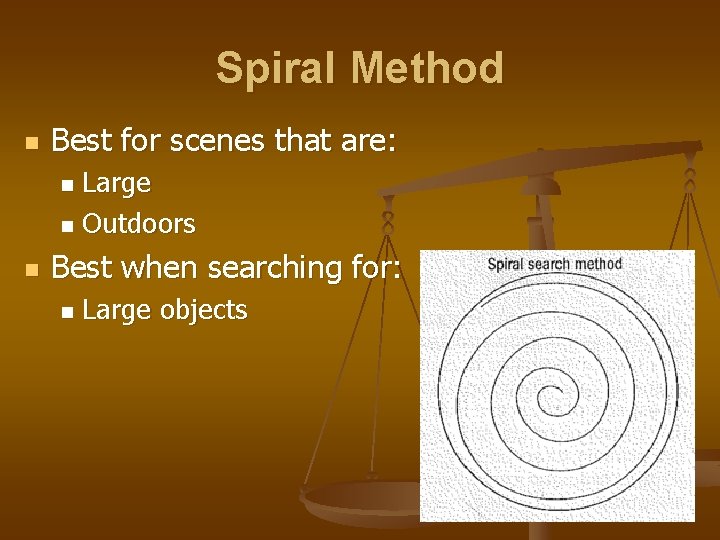
Spiral Method n Best for scenes that are: Large n Outdoors n n Best when searching for: n Large objects CHE 113 6
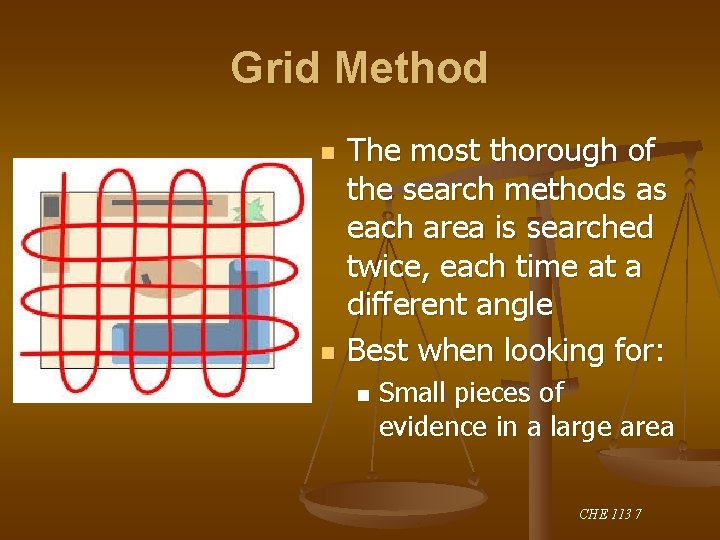
Grid Method n n The most thorough of the search methods as each area is searched twice, each time at a different angle Best when looking for: n Small pieces of evidence in a large area CHE 113 7
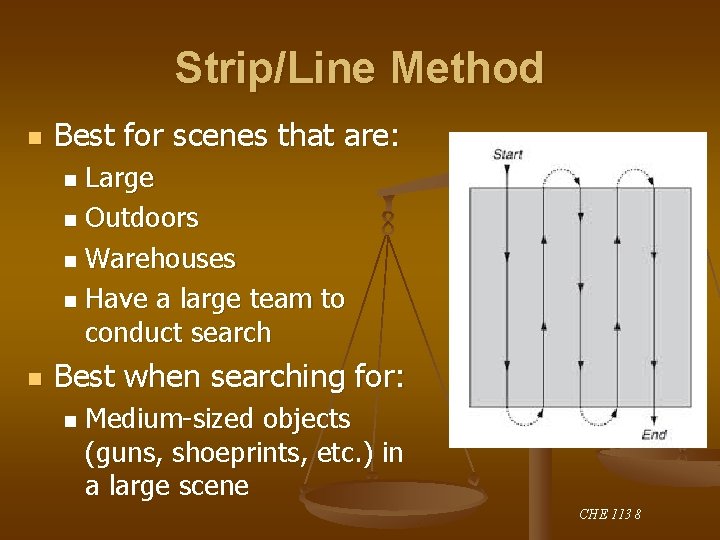
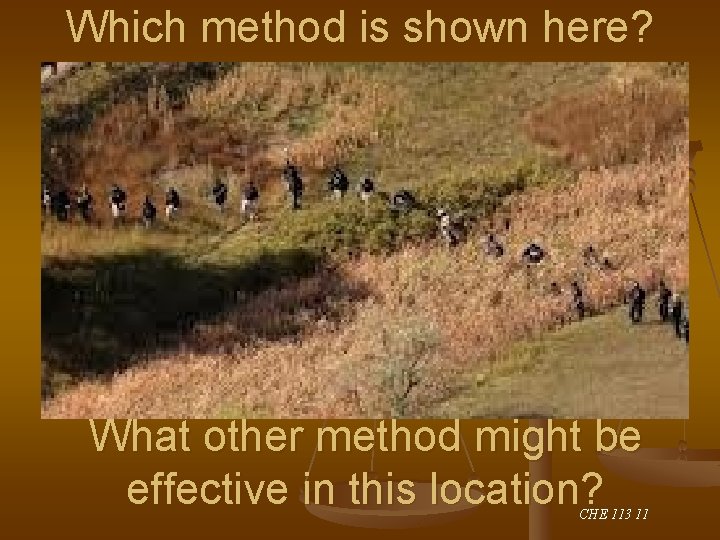
Strip/Line Method n Best for scenes that are: Large n Outdoors n Warehouses n Have a large team to conduct search n n Best when searching for: n Medium-sized objects (guns, shoeprints, etc. ) in a large scene CHE 113 8
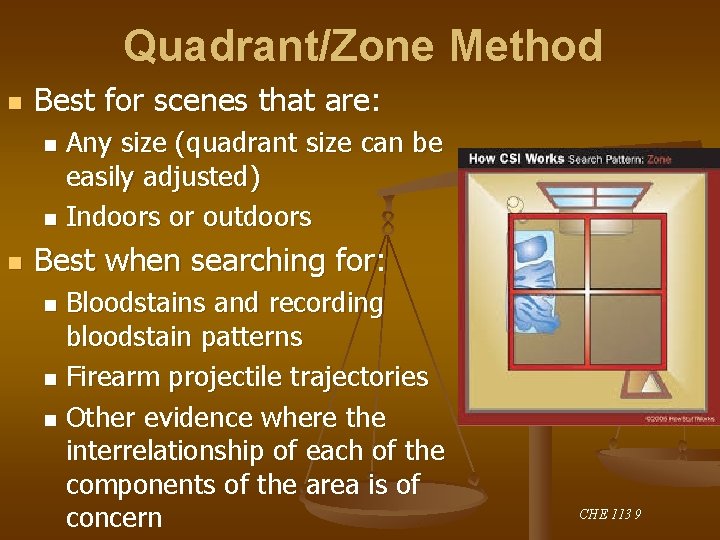
Quadrant/Zone Method n Best for scenes that are: Any size (quadrant size can be easily adjusted) n Indoors or outdoors n n Best when searching for: Bloodstains and recording bloodstain patterns n Firearm projectile trajectories n Other evidence where the interrelationship of each of the components of the area is of concern n CHE 113 9
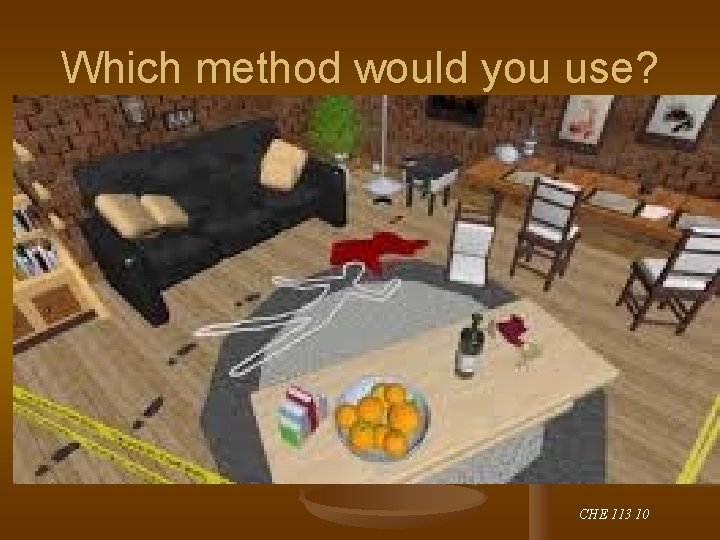
Which method would you use? CHE 113 10
Which method is shown here? What other method might be effective in this location? CHE 113 11
A little bit about physical evidence… n Physical evidence is any object that can: Establish that a crime has been committed n Link a crime and its victim n Link a crime and its perpetrator n n n Is only effective in solving a crime if it is located, properly stored with a properly maintained chain of custody More detail when we cover Ch. 3! CHE 113 12
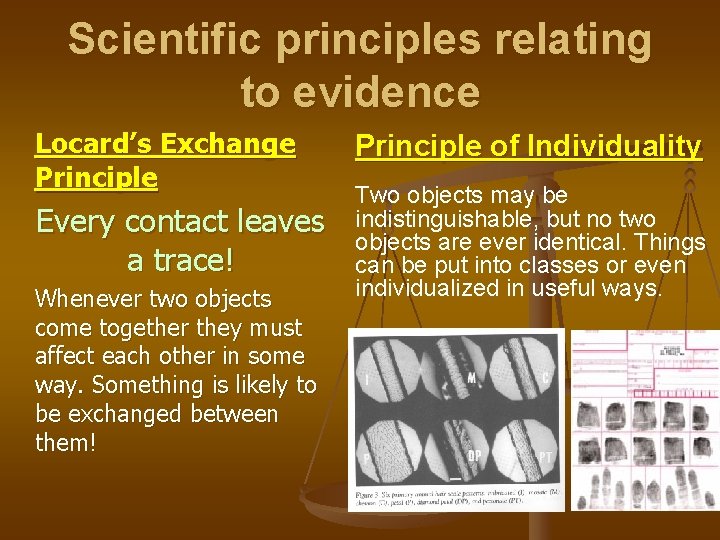
Scientific principles relating to evidence Locard’s Exchange Principle Every contact leaves a trace! Whenever two objects come together they must affect each other in some way. Something is likely to be exchanged between them! Principle of Individuality Two objects may be indistinguishable, but no two objects are ever identical. Things can be put into classes or even individualized in useful ways.
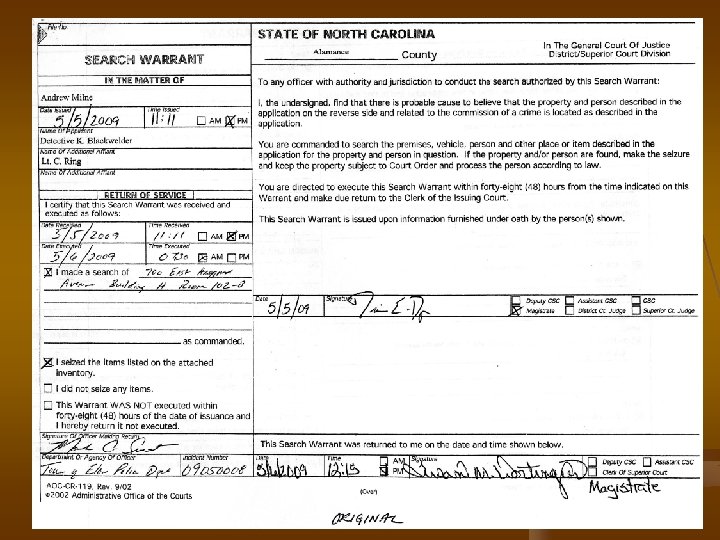
Search and Seizure n Evidence at a Crime Scene n 4 th Ammendment to the Constitution “The right of the people to be secure in their persons, houses, papers and effects, against unreasonable searches and seizures, shall not be violated, and no warrants shall issue, but upon probable cause, supported by oath or affirmation, and particularly describing the place to be searched, and the persons or things to be seized. ” CHE 113 14
CHE 113 15
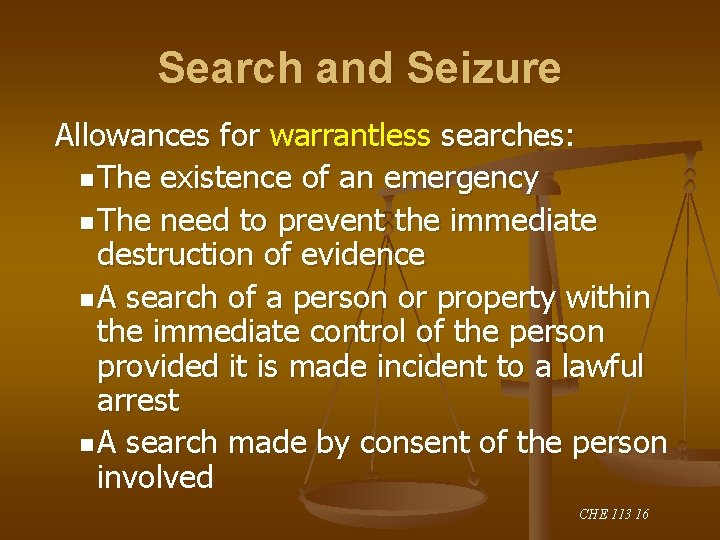
Search and Seizure Allowances for warrantless searches: n The existence of an emergency n The need to prevent the immediate destruction of evidence n A search of a person or property within the immediate control of the person provided it is made incident to a lawful arrest n A search made by consent of the person involved CHE 113 16
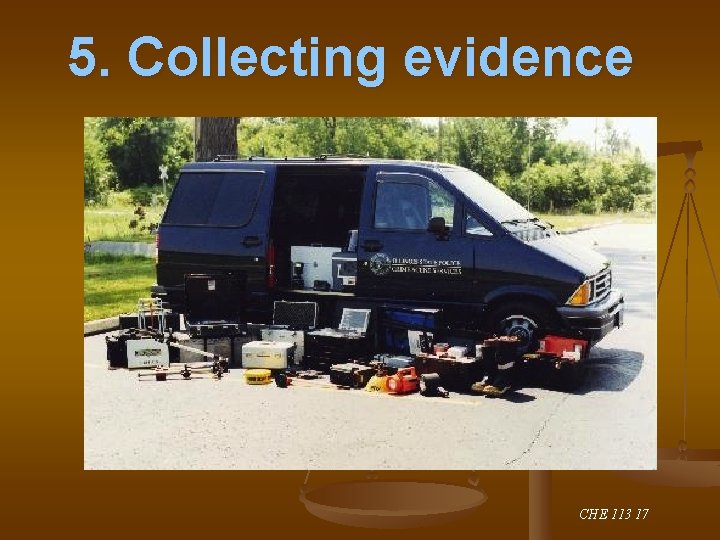
5. Collecting evidence CHE 113 17
Collection of Evidence – Legal Precedent Mincey v. Arizona (U. S. Supreme Court, 1978) Key Point: Evidence taken without proper authority is probably not legally admissible. Case Summary: n Drug bust that went wrong and an undercover police officer was killed. n Police spent 4 days searching and seizing evidence n Mincey arrested and convicted. n Supreme Court ruled evidence collected was inadmissible because it was not from a proper search and seizure. CHE 113 18
Collection of Evidence – Legal Precedent Michigan v. Tyler (U. S. Supreme Court, 1978) Key Point: Supreme Court: “…entry to fight a fire requires no warrant, and that once in the building, officials may remain there for a reasonable time to investigate the cause of the blaze. Thereafter, additional entries to investigate the cause of the fire must be made pursuant to the warrant procedures” Case Summary: n n Building destroyed by fire was put out in early AM. Building left unsecured until 8 AM when a preliminary search was done (for cause of fire). Subsequent searches (at 4, 7, and 25 days) removed additional evidence. Tyler initially convicted of arson, but was overturned. CHE 113 19
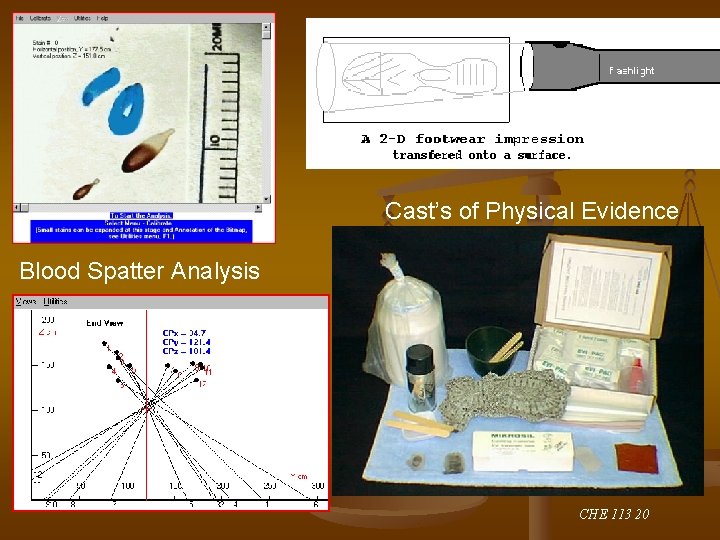
Cast’s of Physical Evidence Blood Spatter Analysis CHE 113 20
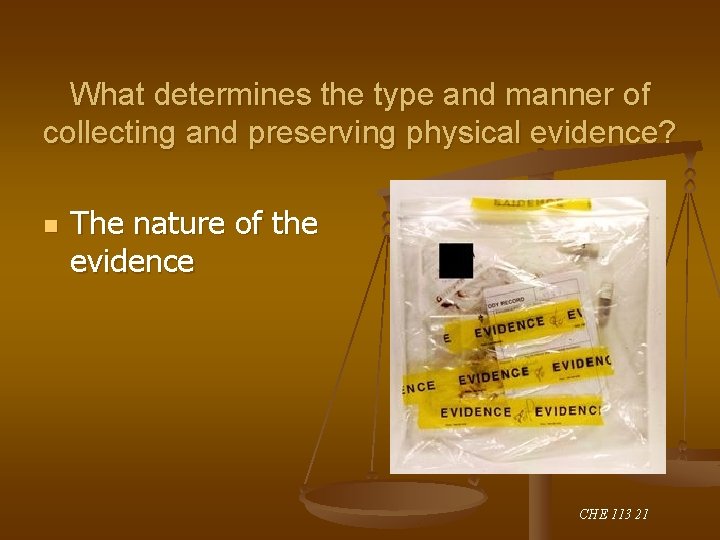
What determines the type and manner of collecting and preserving physical evidence? n The nature of the evidence CHE 113 21
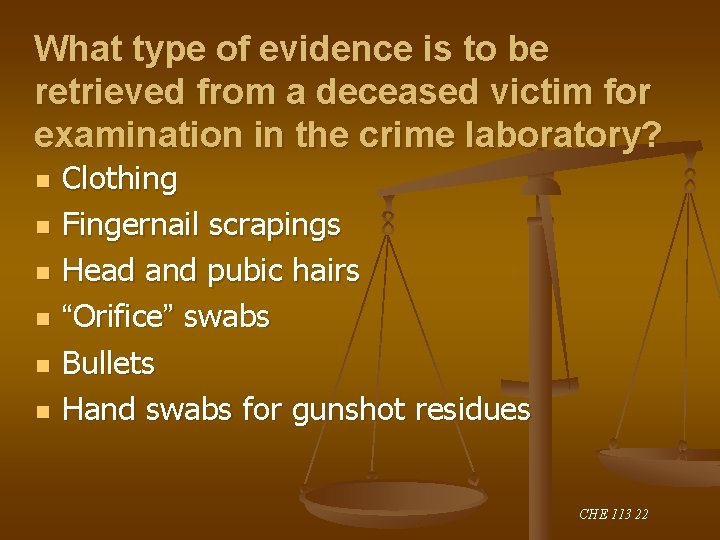
What type of evidence is to be retrieved from a deceased victim for examination in the crime laboratory? n n n Clothing Fingernail scrapings Head and pubic hairs “Orifice” swabs Bullets Hand swabs for gunshot residues CHE 113 22
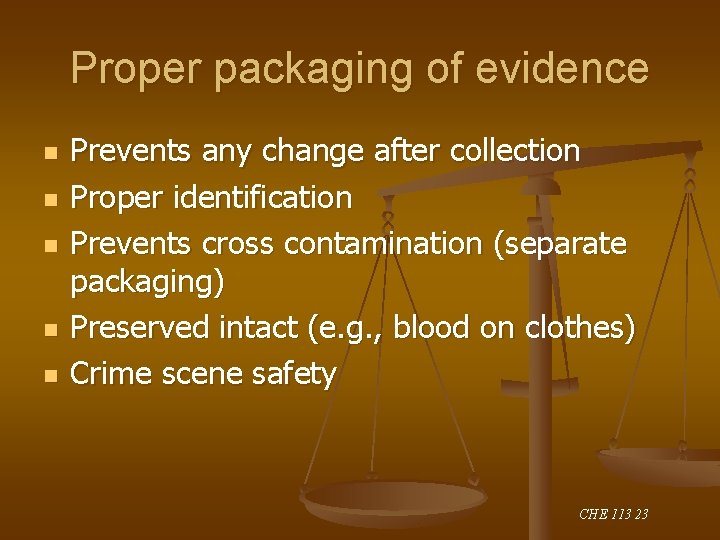
Proper packaging of evidence n n n Prevents any change after collection Proper identification Prevents cross contamination (separate packaging) Preserved intact (e. g. , blood on clothes) Crime scene safety CHE 113 23
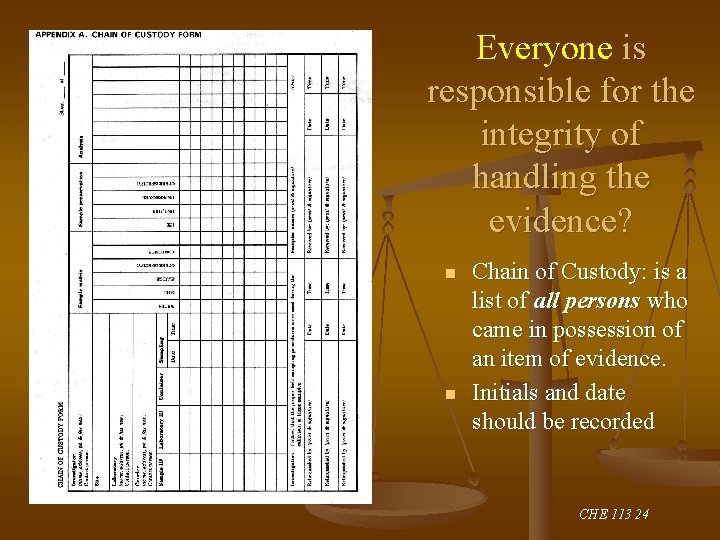
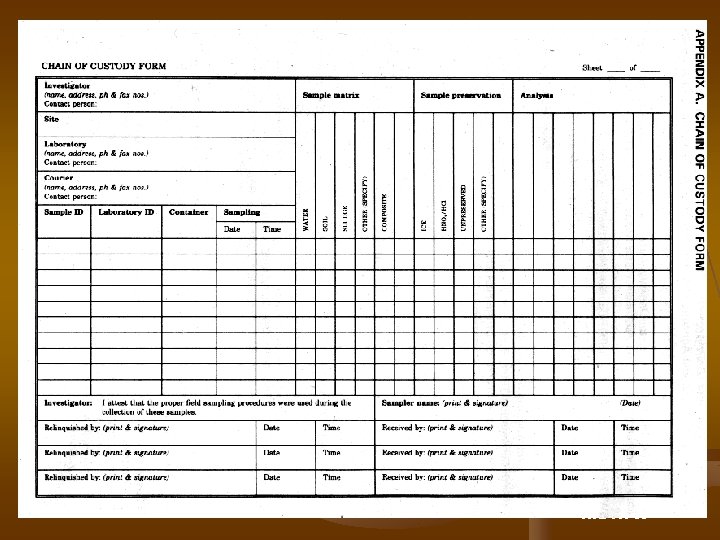
Everyone is responsible for the integrity of handling the evidence? n n Chain of Custody: is a list of all persons who came in possession of an item of evidence. Initials and date should be recorded CHE 113 24
CHE 113 25
Obtaining Reference Samples n Standard/Reference/Known Sample: n n n Physical evidence whose origin is known, such as blood or hair from a suspect, that can be compared to crime-scene evidence. The examination of evidence, whether it is soil, blood, glass, hair, fibers, and so on, often requires comparison with a known standard/reference sample. Although most investigators have little difficulty recognizing and collecting relevant crime-scene evidence, few seem aware of the necessity and importance of providing the crime lab with a thorough sampling of standard/reference/known materials. CHE 113 26
Necessary crime scene personnel n Personnel Duties and Responsibilities Team Leader/Lead Investigator n Photographer and Photographic Log Recorder n Sketch Preparer n Evidence Recorder/Evidence Recovery Personnel n Specialists n CHE 113 27
Personnel Duties and Responsibilities n Team Leader Assume control and access n Determine search pattern and assignments n Coordinate with groups involved n Continuously evaluate work n Release crime scene n CHE 113 28
Personnel Duties and Responsibilities n n Photographer and Photographic Log Recorder Sketch preparer See previous slides CHE 113 29
Personnel Duties and Responsibilities n Evidence Recorder/Evidence Recovery Personnel Have evidence photographed/sketched before collection n Describe evidence and location on container n Package evidence n Maintain chain of custody and evidence log n Ensure proper safety of collection (e. g. , infectious materials) n CHE 113 30
Personnel Duties and Responsibilities n Specialists n May include: Anthropologist n Blood expert n Bomb technicin n Criminalist n Engineer n Entomologist n Medical examiner n Odontologist n Pathology n Surveyor n Etc. n CHE 113 31
Special forensic science services n n Forensic Anthropology is concerned primarily with the identification and examination of human skeletal remains. Forensic Entomology is the study of insects and their relation to a criminal investigation, commonly used to estimate the time of death. CHE 113 32
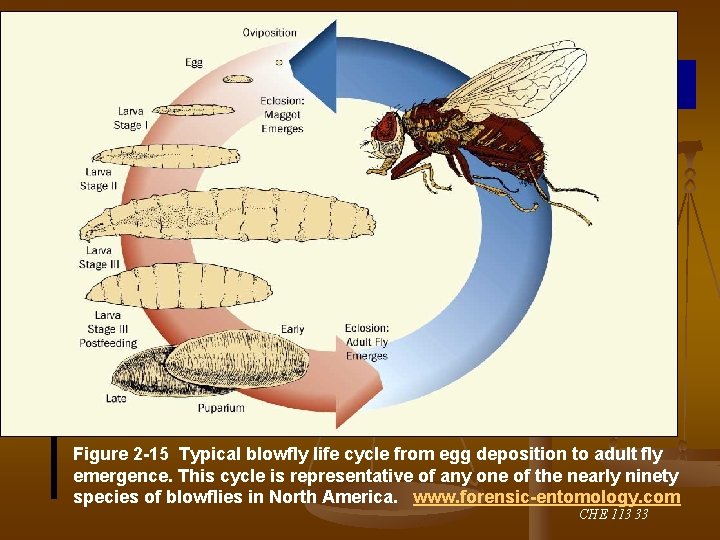
Figure 2 -15 Typical blowfly life cycle from egg deposition to adult fly emergence. This cycle is representative of any one of the nearly ninety species of blowflies in North America. www. forensic-entomology. com CHE 113 33
Special forensic science services n Forensic pathology involves the investigation of unnatural, unexplained, or violent deaths. Forensic pathologists in their role as medical examiners or coroners are charged with determining cause of death. n The forensic pathologist may conduct an autopsy which is the medical dissection and examination of a body in order to determine the cause of death. n CHE 113 34
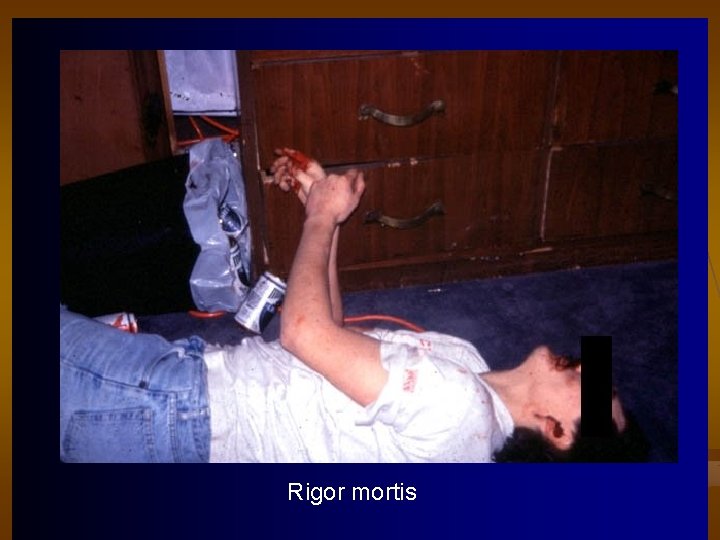
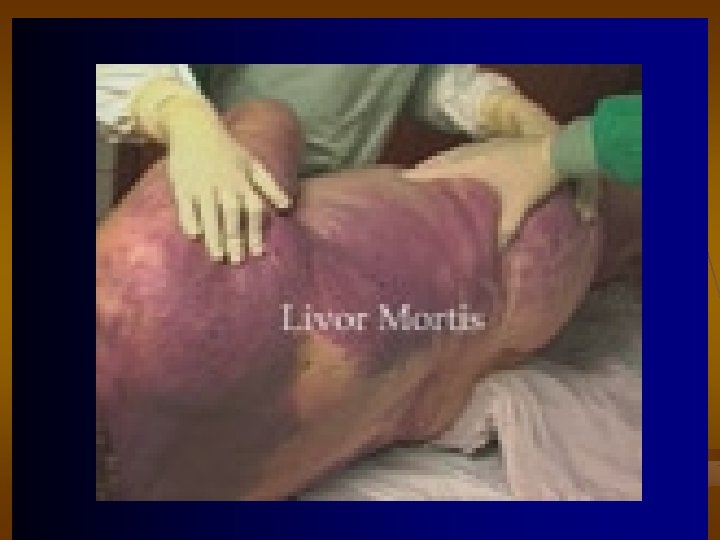
Special forensic science services n After a human body expires there are several stages of death. n n n Rigor mortis results in the shortening of muscle tissue and the stiffening of body parts in the position at death (occurs within the first 24 hrs. and disappears within 36 hrs. ). Livor mortis results in the settling of blood in areas of the body closest to the ground (begins immediately on death and continues up to 12 hrs. ). Algor mortis results in the loss of heat by a body (a general rule, beginning about an hour after death, the body loses heat by 1 to 1 1/2 degrees Fahrenheit per hour until the body reaches the environmental temperature). CHE 113 35
Rigor mortis CHE 113 36
CHE 113 37