
MOMENTUM What is Momentum All moving objects have

MOMENTUM
What is Momentum? • All moving objects have what Newton called a “quantity of motion. ” • Today we call it momentum. • Momentum is a characteristic of a moving object that is related to the mass and the velocity of the object.
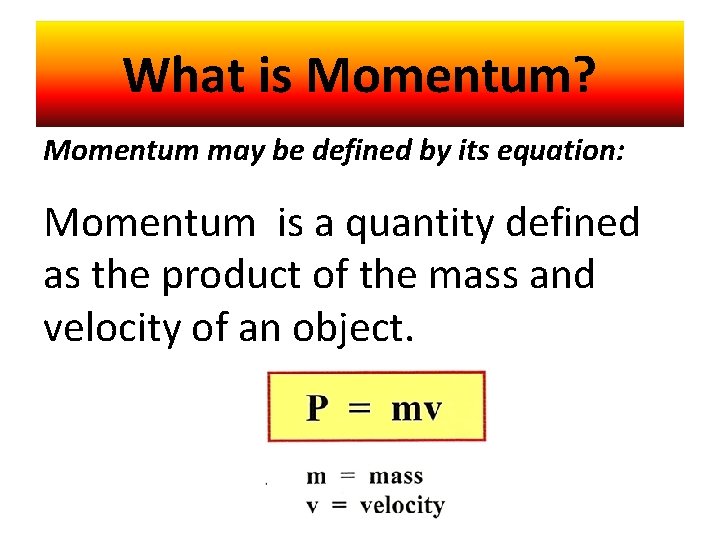
What is Momentum? Momentum may be defined by its equation: Momentum is a quantity defined as the product of the mass and velocity of an object.
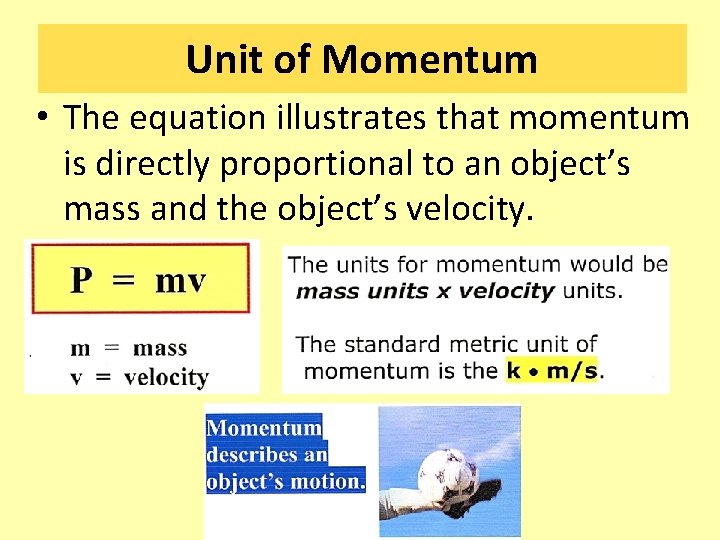
Unit of Momentum • The equation illustrates that momentum is directly proportional to an object’s mass and the object’s velocity.
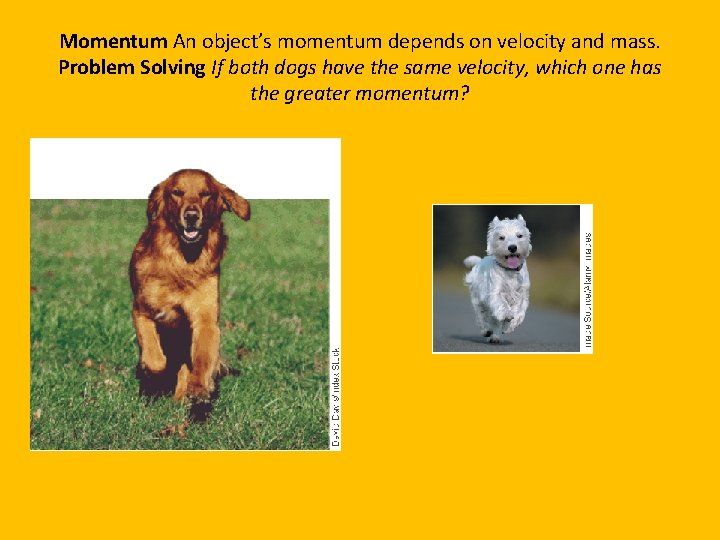
Momentum An object’s momentum depends on velocity and mass. Problem Solving If both dogs have the same velocity, which one has the greater momentum?
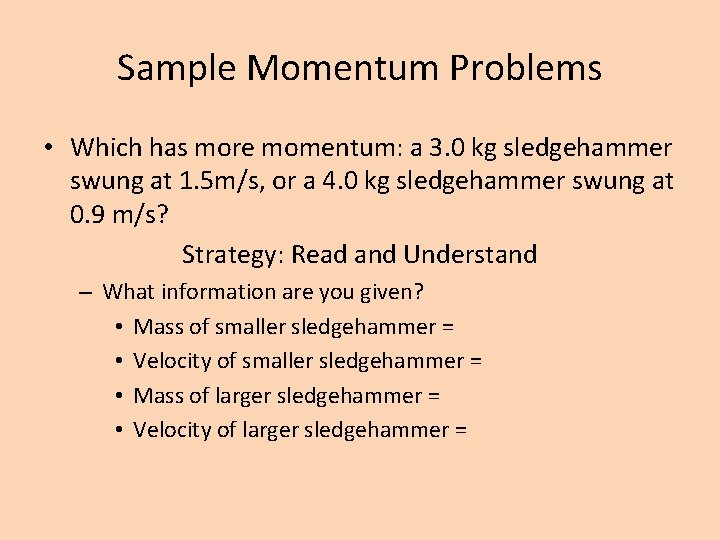
Sample Momentum Problems • Which has more momentum: a 3. 0 kg sledgehammer swung at 1. 5 m/s, or a 4. 0 kg sledgehammer swung at 0. 9 m/s? Strategy: Read and Understand – What information are you given? • Mass of smaller sledgehammer = • Velocity of smaller sledgehammer = • Mass of larger sledgehammer = • Velocity of larger sledgehammer =
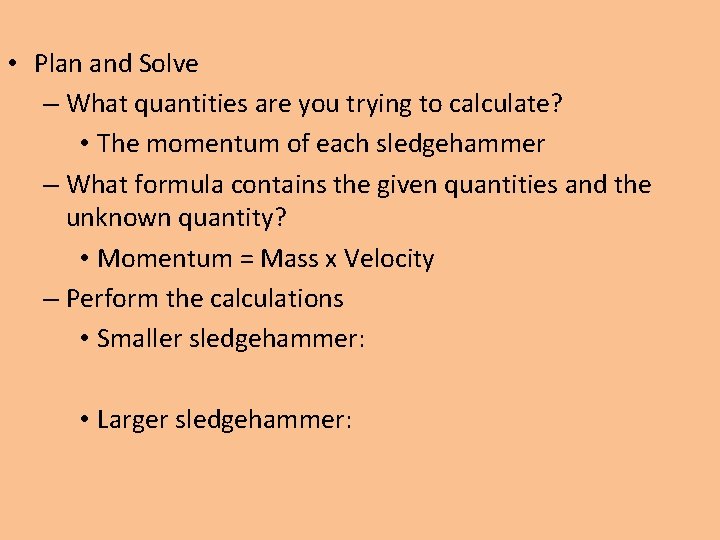
• Plan and Solve – What quantities are you trying to calculate? • The momentum of each sledgehammer – What formula contains the given quantities and the unknown quantity? • Momentum = Mass x Velocity – Perform the calculations • Smaller sledgehammer: • Larger sledgehammer:
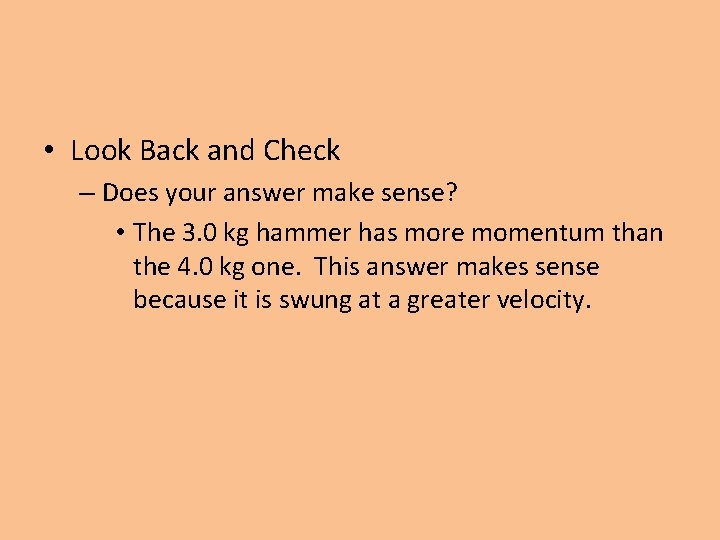
• Look Back and Check – Does your answer make sense? • The 3. 0 kg hammer has more momentum than the 4. 0 kg one. This answer makes sense because it is swung at a greater velocity.
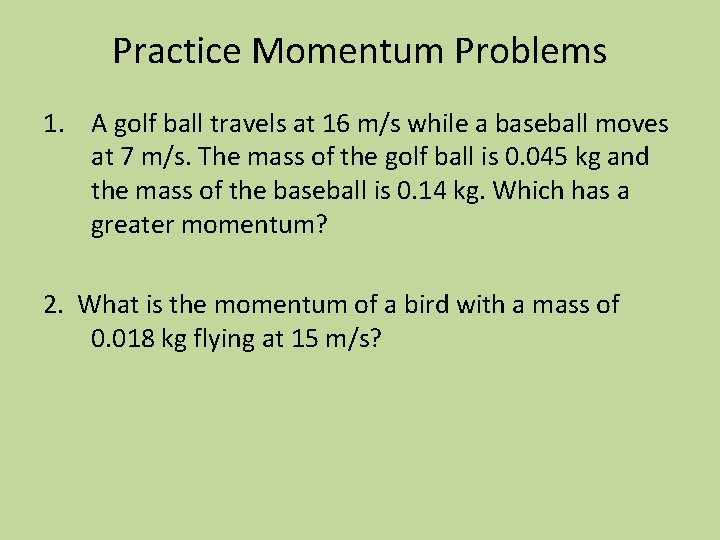
Practice Momentum Problems 1. A golf ball travels at 16 m/s while a baseball moves at 7 m/s. The mass of the golf ball is 0. 045 kg and the mass of the baseball is 0. 14 kg. Which has a greater momentum? 2. What is the momentum of a bird with a mass of 0. 018 kg flying at 15 m/s?
Conservation of Momentum • In everyday language, conservation means saving resources. • You might conserve water or fossil fuels, for example. • The word conservation has a more specific meaning in physical science. • In physics, conservation refers to the conditions before and after some event.
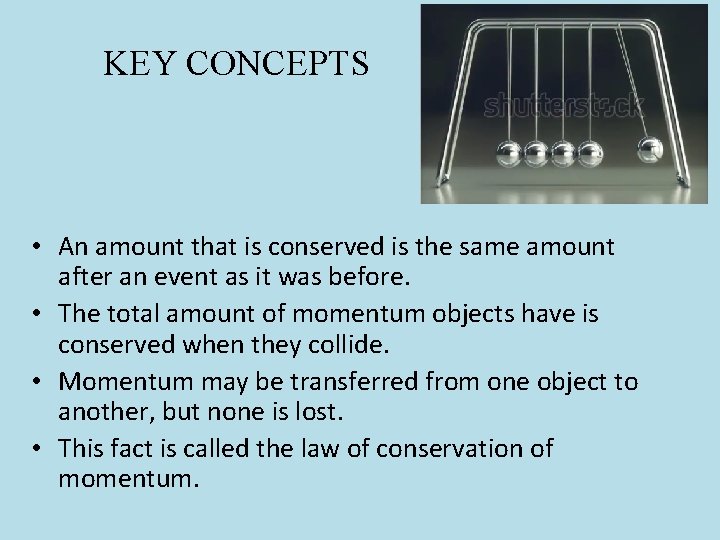
KEY CONCEPTS • An amount that is conserved is the same amount after an event as it was before. • The total amount of momentum objects have is conserved when they collide. • Momentum may be transferred from one object to another, but none is lost. • This fact is called the law of conservation of momentum.
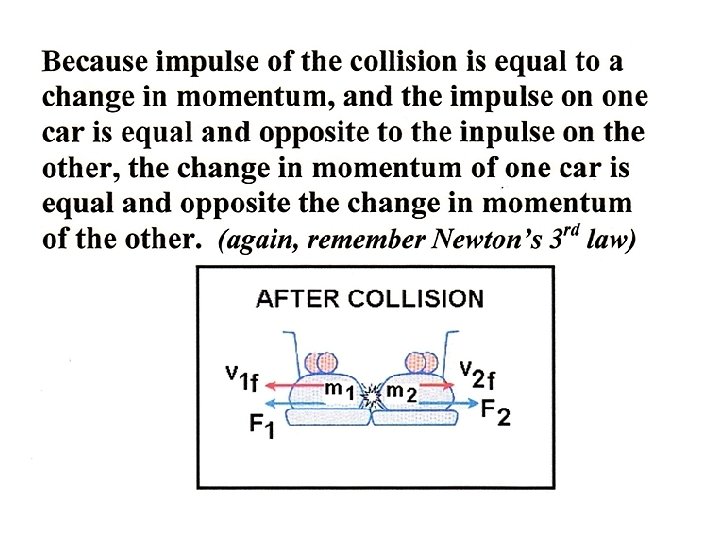
• The law of conservation of momentum states that, in the absence of outside forces, the total momentum of objects that interact does not change. • The amount of momentum is the same before and after they interact. • The total momentum of any group of objects remains the same, or is conserved, unless outside forces act on the objects. • Friction is an example of an outside force.
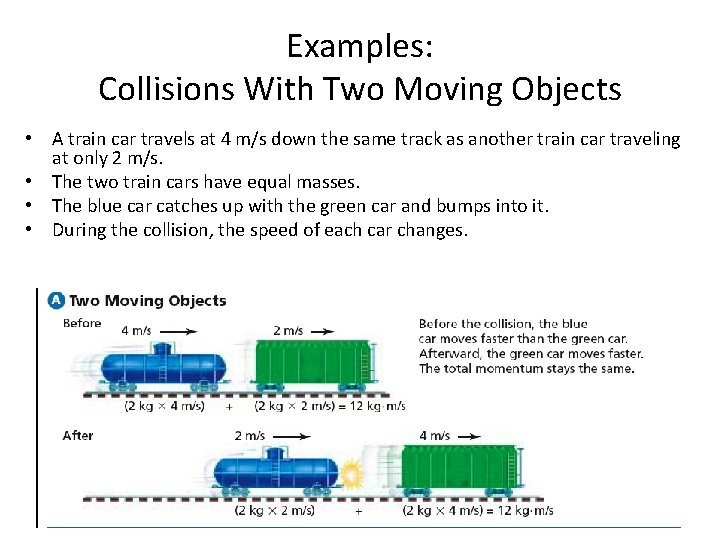
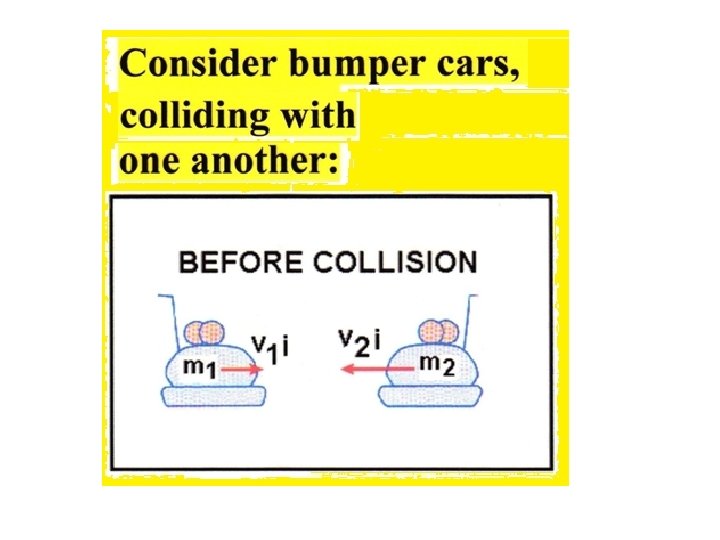
Examples: Collisions With Two Moving Objects • A train car travels at 4 m/s down the same track as another train car traveling at only 2 m/s. • The two train cars have equal masses. • The blue car catches up with the green car and bumps into it. • During the collision, the speed of each car changes.
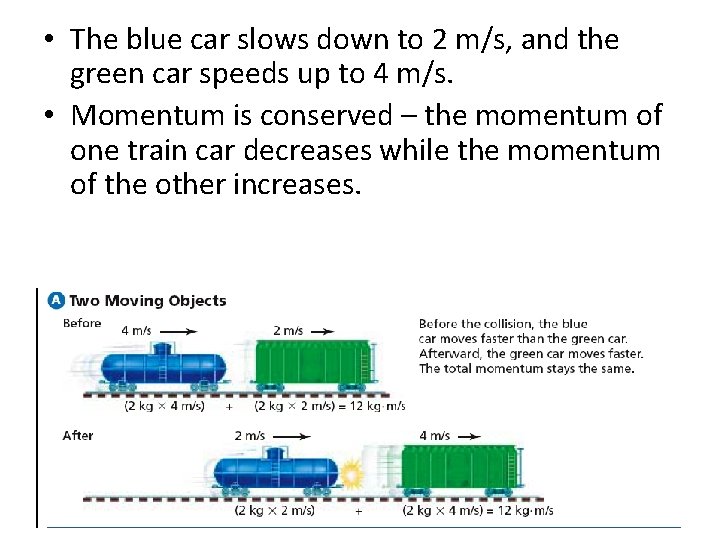
• The blue car slows down to 2 m/s, and the green car speeds up to 4 m/s. • Momentum is conserved – the momentum of one train car decreases while the momentum of the other increases.
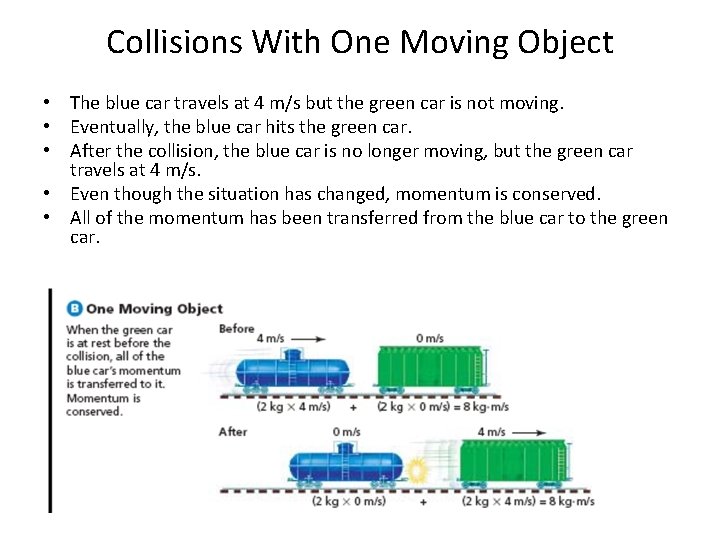
Collisions With One Moving Object • The blue car travels at 4 m/s but the green car is not moving. • Eventually, the blue car hits the green car. • After the collision, the blue car is no longer moving, but the green car travels at 4 m/s. • Even though the situation has changed, momentum is conserved. • All of the momentum has been transferred from the blue car to the green car.
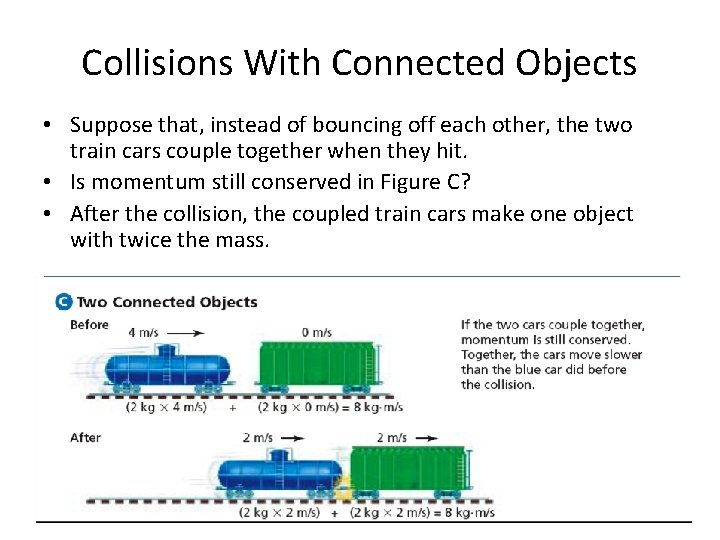
Collisions With Connected Objects • Suppose that, instead of bouncing off each other, the two train cars couple together when they hit. • Is momentum still conserved in Figure C? • After the collision, the coupled train cars make one object with twice the mass.

• The velocity of the coupled trains is 2 m/s – half the initial velocity of the blue car. • Since the mass is doubled and the velocity is divided in half, the total momentum remains the same.
Momentum Recap
Conservation of Momentum Recap The total momentum of all objects interacting with one another remains constant regardless of the nature of the forces between the objects.
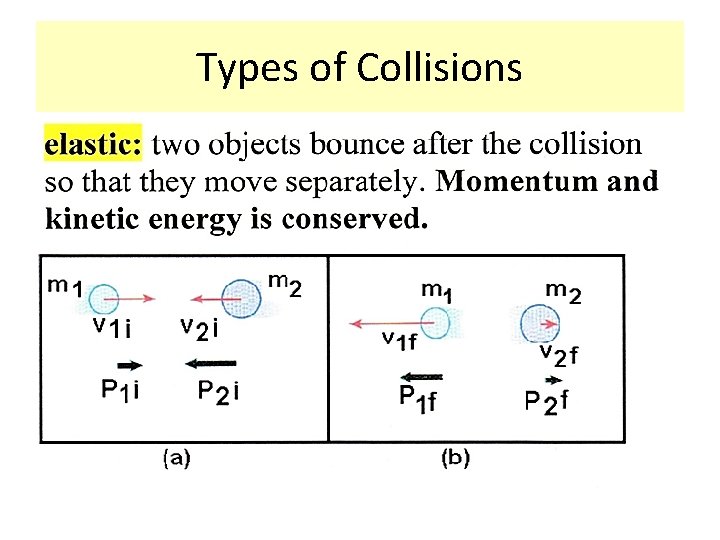
Types of Collisions
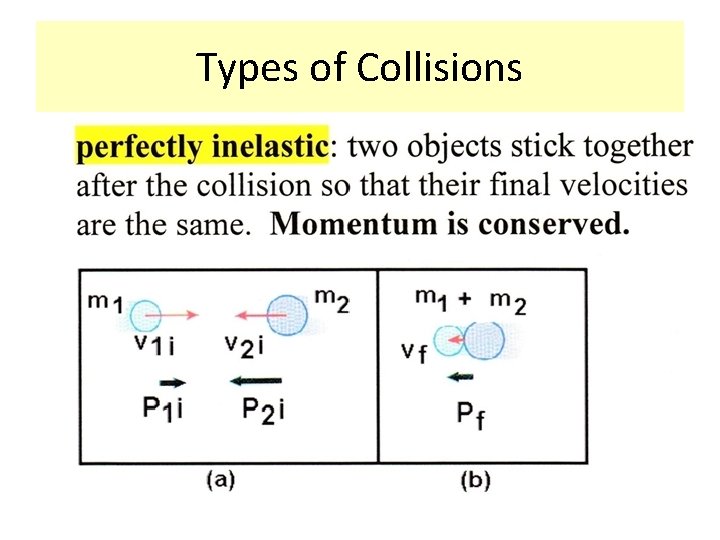
Types of Collisions
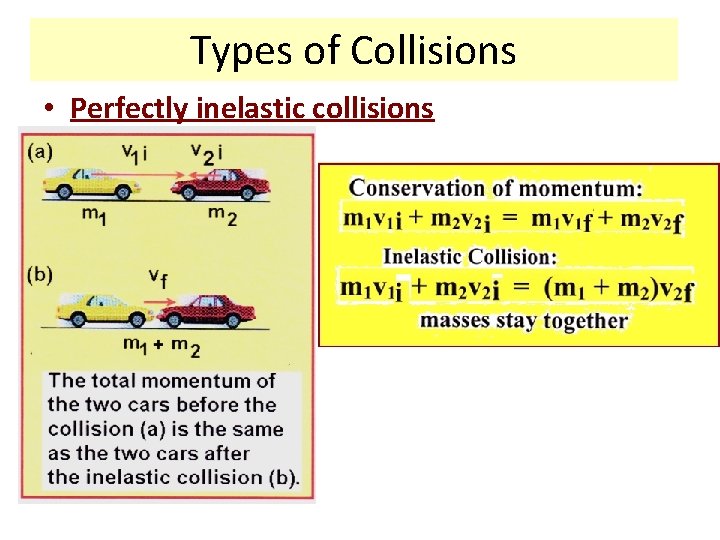
Types of Collisions • Perfectly inelastic collisions

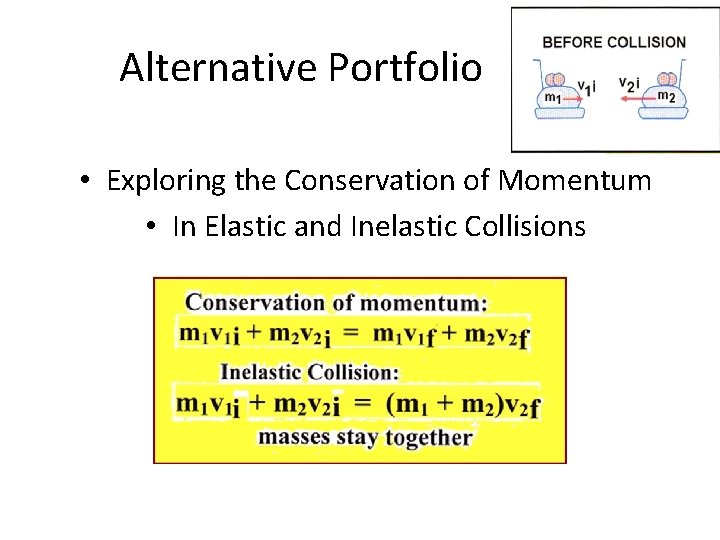
Alternative Portfolio • Exploring the Conservation of Momentum • In Elastic and Inelastic Collisions
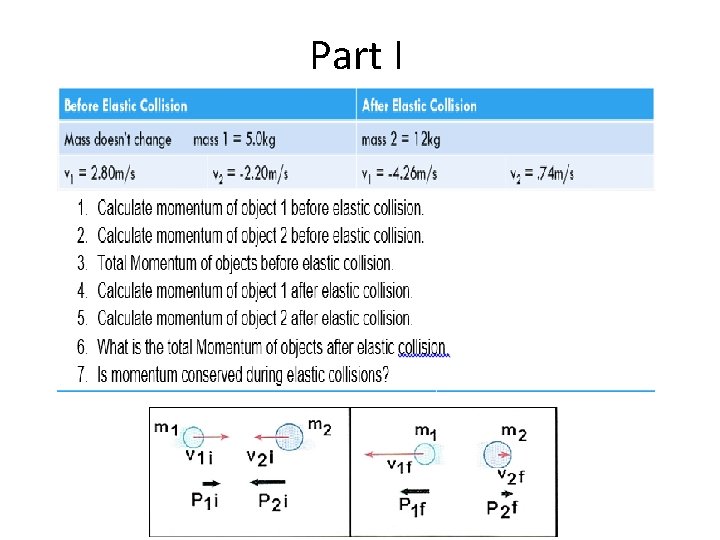
Part I
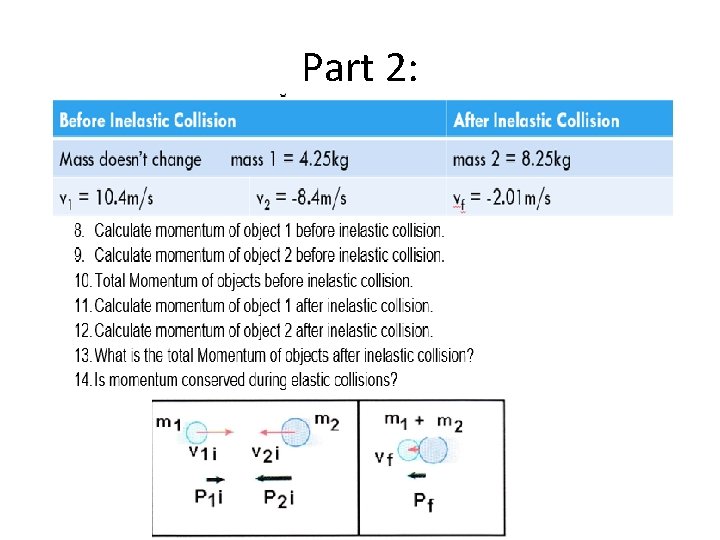
Part 2:

Make it a GREAT DAY! Thanks for coming to our LL today, Feel free to contact me for help: Webmail, Phone, Text 775 -403 -2315
- Slides: 29