
Momentum Equation and its Applications Moving fluid exerting
- Slides: 27
Momentum Equation and its Applications Moving fluid exerting force Ø The lift force on an aircraft is exerted by the air moving over the wing. Ø A jet of water from a hose exerts a force on whatever it hits. q In fluid mechanics the analysis of motion is performed the same way as in solid mechanics by use of Newton's laws of motion. q Properties of fluids considered when in motion
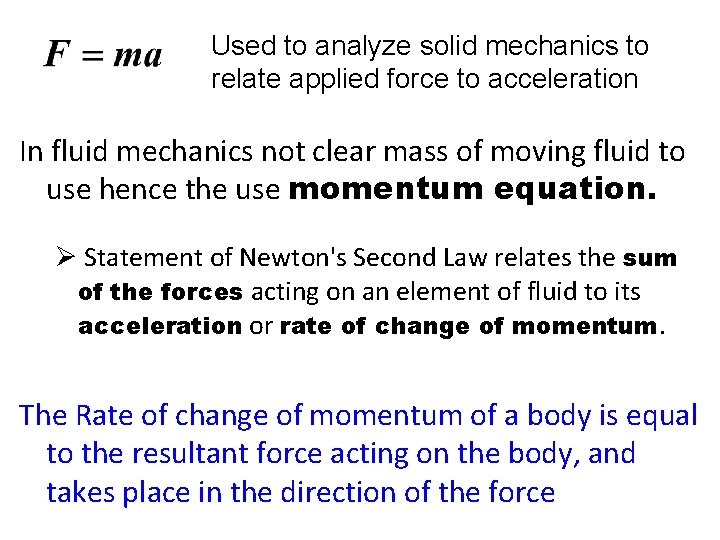
Used to analyze solid mechanics to relate applied force to acceleration In fluid mechanics not clear mass of moving fluid to use hence the use momentum equation. Ø Statement of Newton's Second Law relates the sum of the forces acting on an element of fluid to its acceleration or rate of change of momentum. The Rate of change of momentum of a body is equal to the resultant force acting on the body, and takes place in the direction of the force
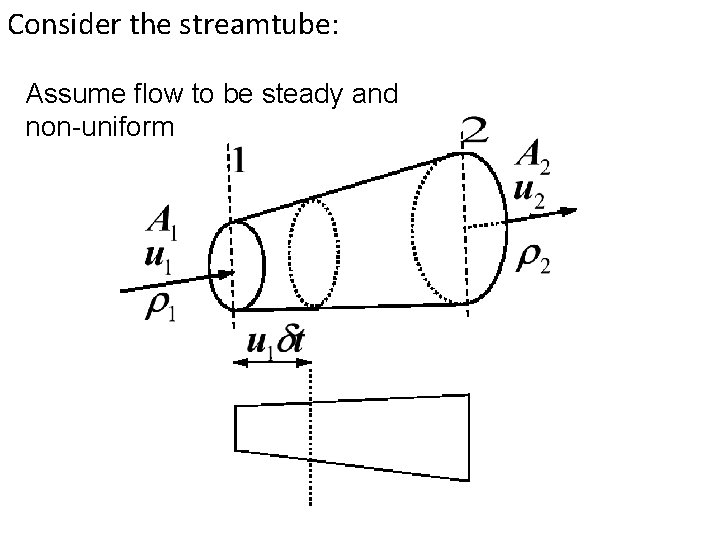
Consider the streamtube: Assume flow to be steady and non-uniform
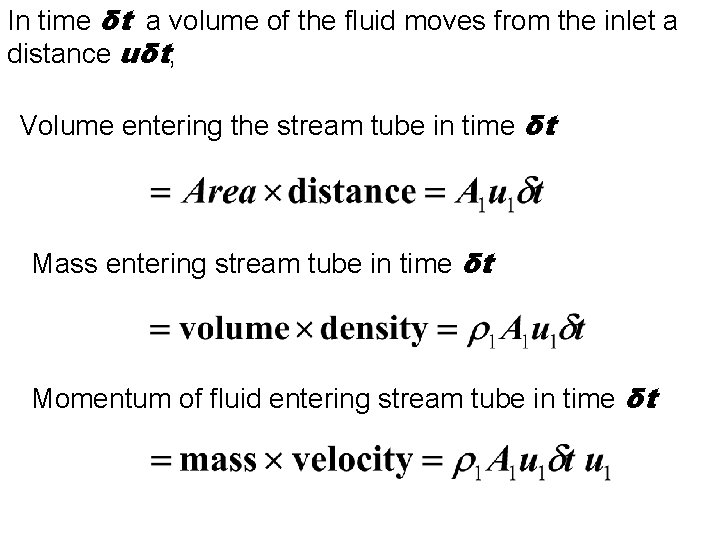
In time δt a volume of the fluid moves from the inlet a distance uδt, Volume entering the stream tube in time δt Mass entering stream tube in time δt Momentum of fluid entering stream tube in time δt
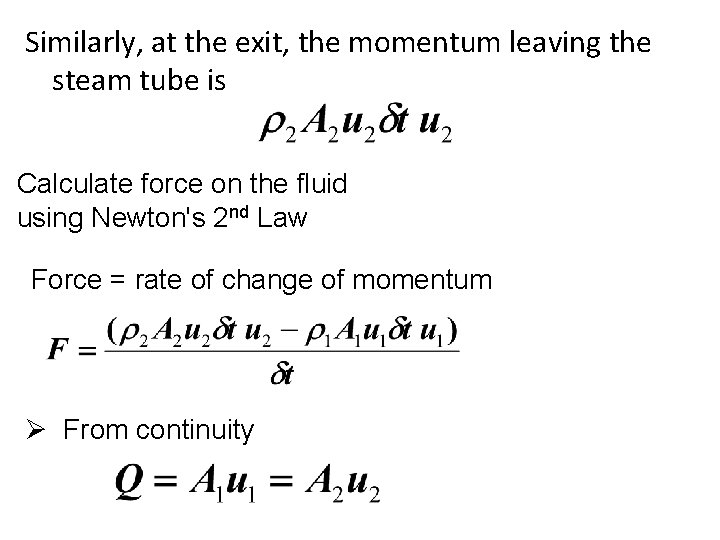
Similarly, at the exit, the momentum leaving the steam tube is Calculate force on the fluid using Newton's 2 nd Law Force = rate of change of momentum Ø From continuity
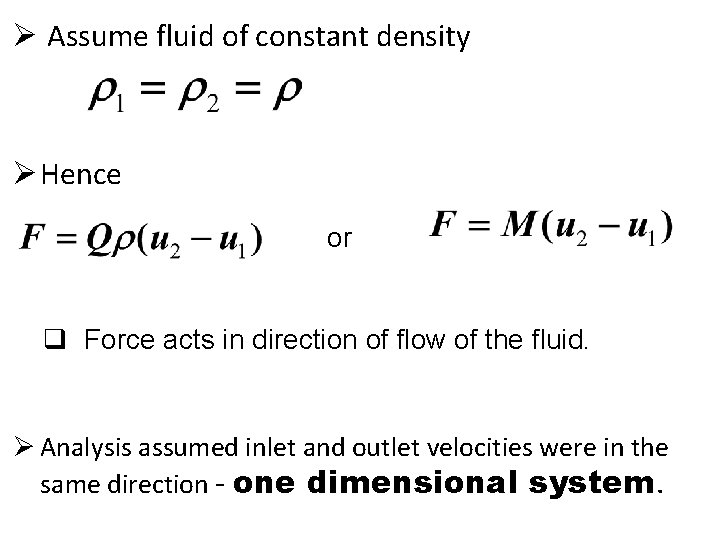
Ø Assume fluid of constant density Ø Hence or q Force acts in direction of flow of the fluid. Ø Analysis assumed inlet and outlet velocities were in the same direction - one dimensional system.
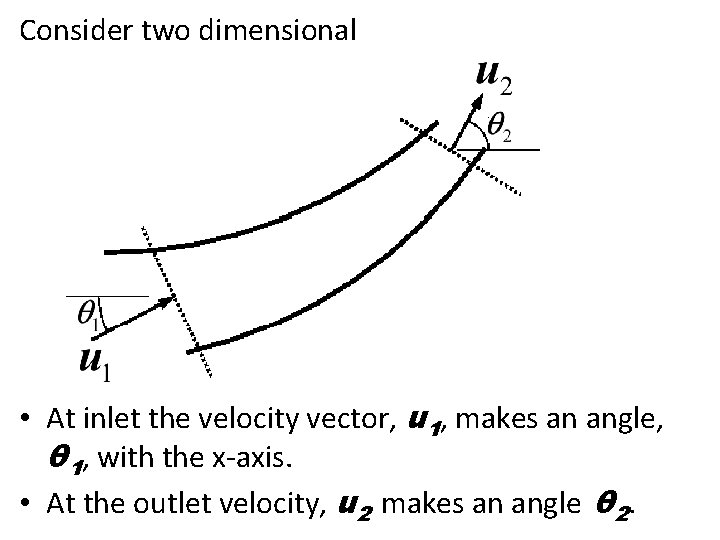
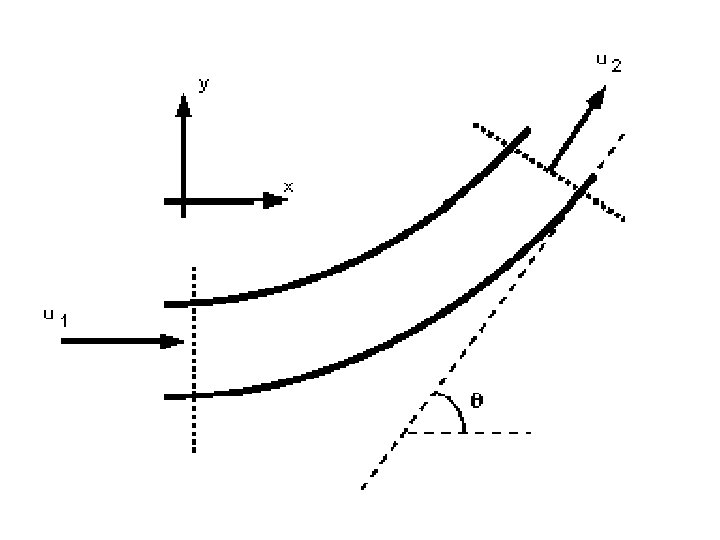
Consider two dimensional • At inlet the velocity vector, u 1, makes an angle, θ 1, with the x-axis. • At the outlet velocity, u 2 makes an angle θ 2.
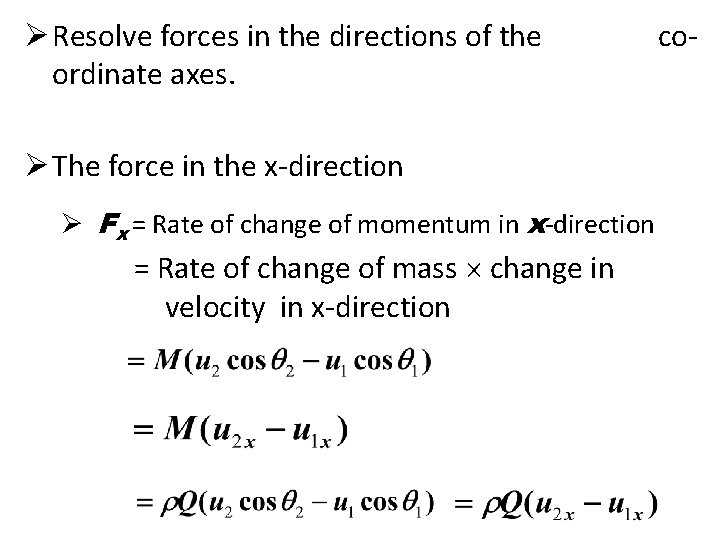
Ø Resolve forces in the directions of the ordinate axes. Ø The force in the x-direction Ø Fx = Rate of change of momentum in x-direction = Rate of change of mass change in velocity in x-direction co-
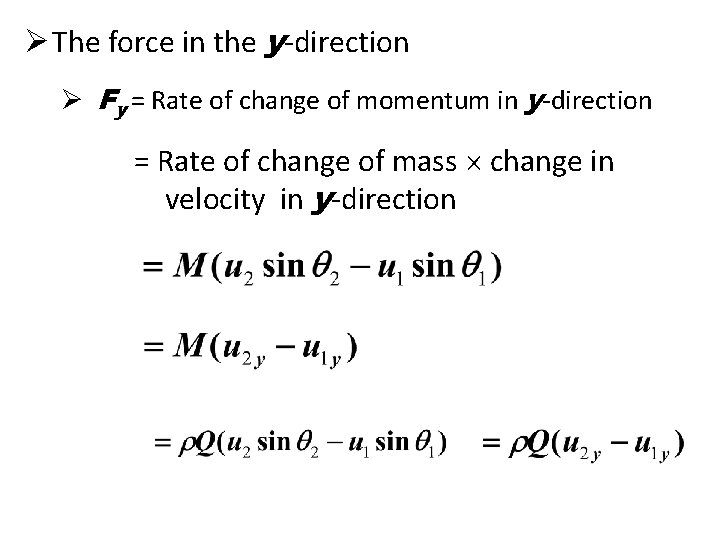
Ø The force in the y-direction Ø Fy = Rate of change of momentum in y-direction = Rate of change of mass change in velocity in y-direction
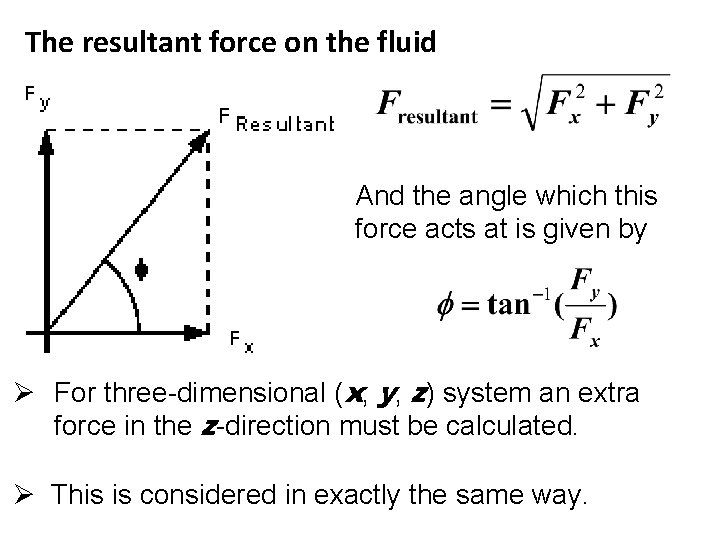
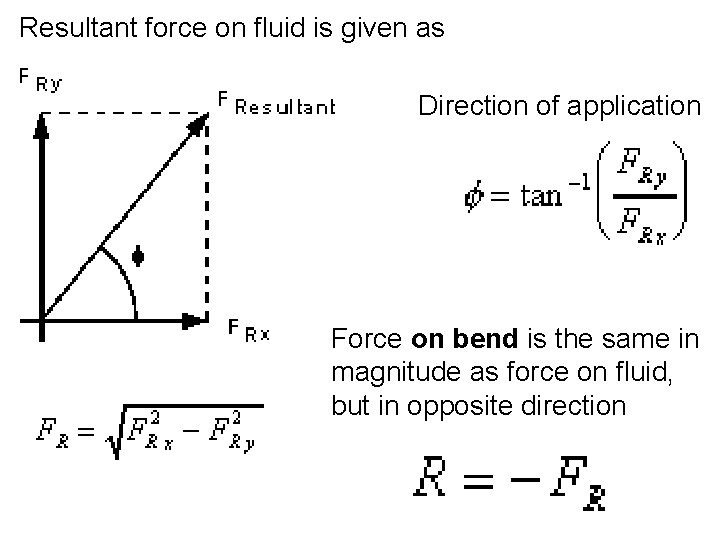
The resultant force on the fluid And the angle which this force acts at is given by Ø For three-dimensional (x, y, z) system an extra force in the z-direction must be calculated. Ø This is considered in exactly the same way.
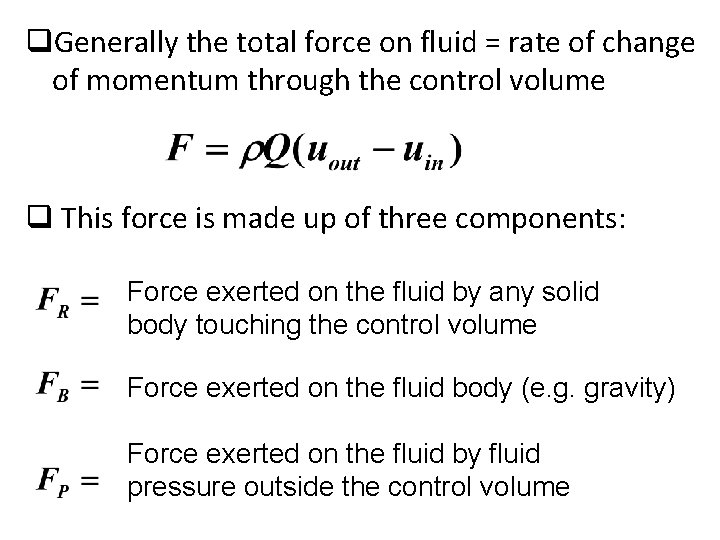
q. Generally the total force on fluid = rate of change of momentum through the control volume q This force is made up of three components: Force exerted on the fluid by any solid body touching the control volume Force exerted on the fluid body (e. g. gravity) Force exerted on the fluid by fluid pressure outside the control volume
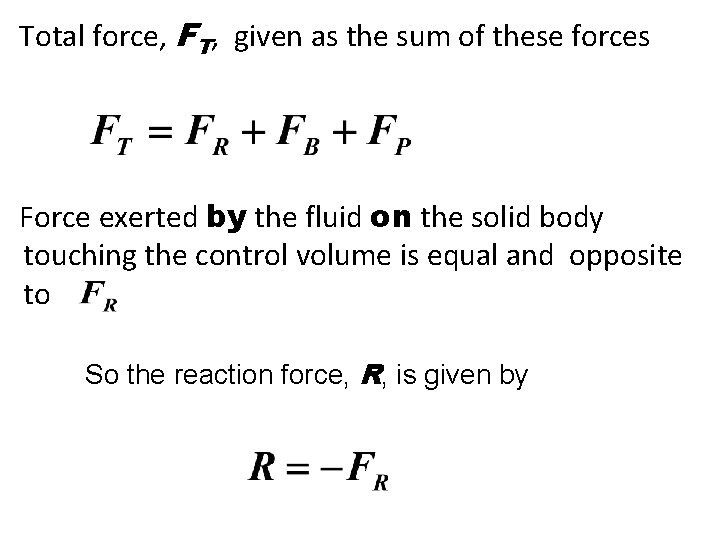
Total force, FT, given as the sum of these forces Force exerted by the fluid on the solid body touching the control volume is equal and opposite to So the reaction force, R, is given by
Application of the Momentum Equation ØForce due to fluid flow round a pipe bend ØForce on a nozzle at the outlet of a pipe. ØImpact of a jet on a plane surface. The force due to fluid flow round a pipe bend Consider a pipe bend with a constant cross section ØLying in the horizontal plane ØTurning through an angle of θ°.
Step in Analysis: 1. Draw a control volume 2. Decide on co-ordinate axis system 3. Calculate the total force 4. Calculate the pressure force 5. Calculate the body force 6. Calculate the resultant force 7. Find force on the fluid
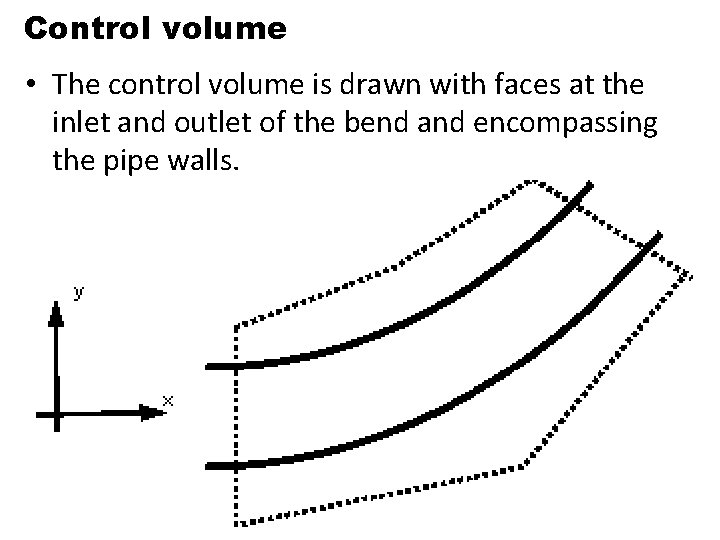
Control volume • The control volume is drawn with faces at the inlet and outlet of the bend and encompassing the pipe walls.
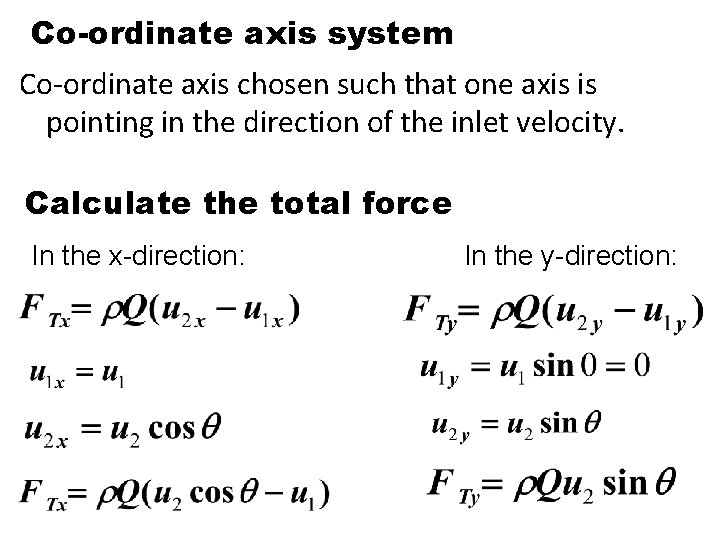
Co-ordinate axis system Co-ordinate axis chosen such that one axis is pointing in the direction of the inlet velocity. Calculate the total force In the x-direction: In the y-direction:
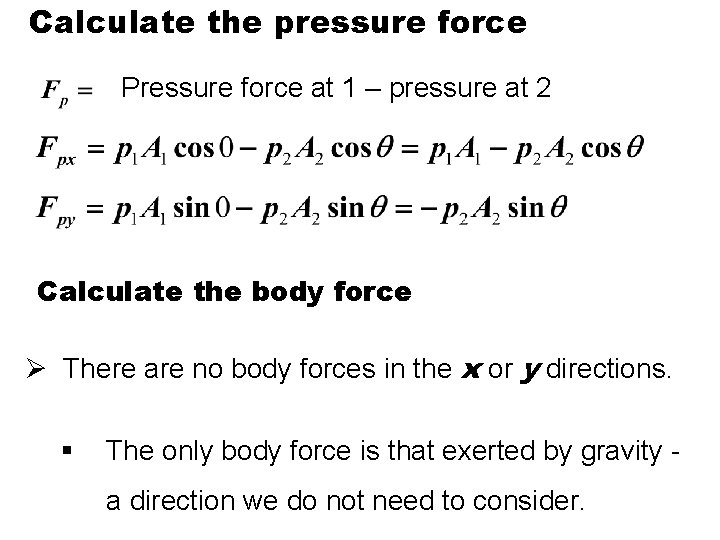
Calculate the pressure force Pressure force at 1 – pressure at 2 Calculate the body force Ø There are no body forces in the x or y directions. § The only body force is that exerted by gravity a direction we do not need to consider.
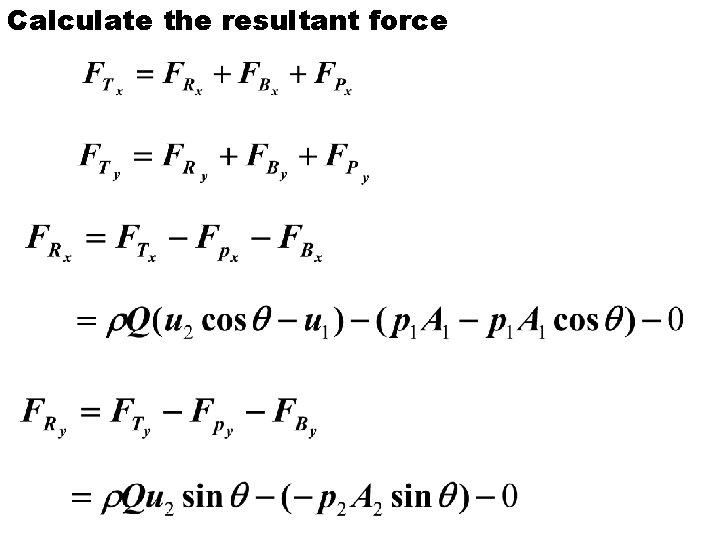
Calculate the resultant force
Resultant force on fluid is given as Direction of application Force on bend is the same in magnitude as force on fluid, but in opposite direction
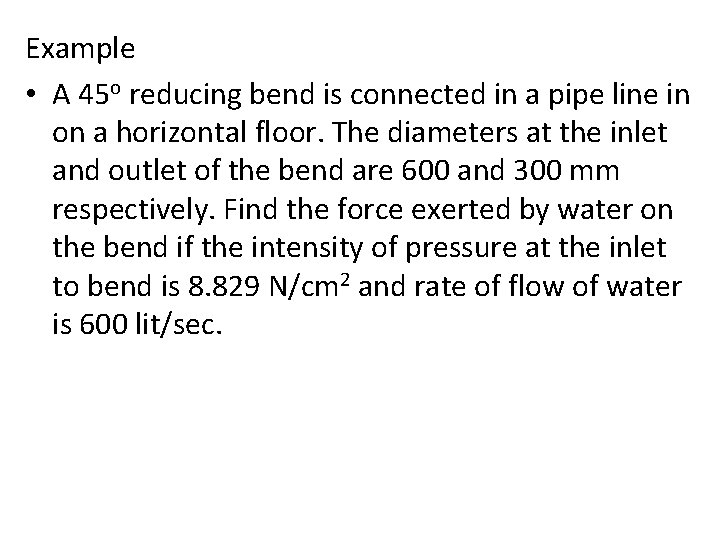
Example • A 45 o reducing bend is connected in a pipe line in on a horizontal floor. The diameters at the inlet and outlet of the bend are 600 and 300 mm respectively. Find the force exerted by water on the bend if the intensity of pressure at the inlet to bend is 8. 829 N/cm 2 and rate of flow of water is 600 lit/sec.
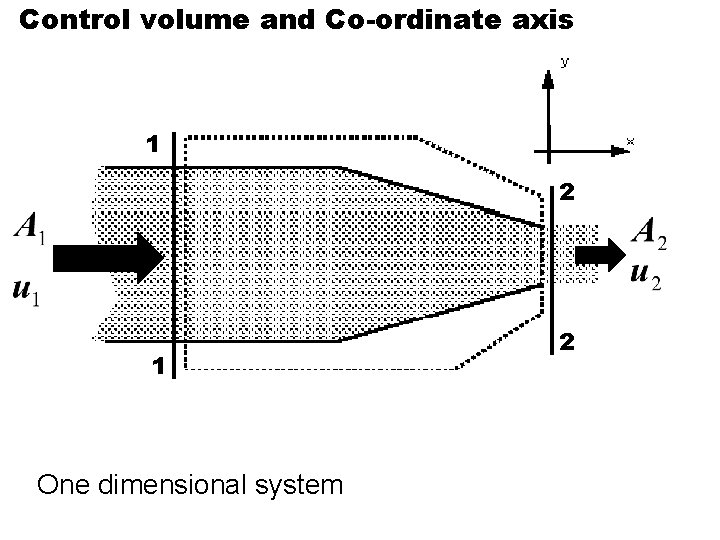
Force on a pipe nozzle Step in Analysis: 1. Draw a control volume 2. Decide on co-ordinate axis system 3. Calculate the total force 4. Calculate the pressure force 5. Calculate the body force 6. Calculate the resultant force 7. Find the force to resist
Control volume and Co-ordinate axis 1 2 1 One dimensional system 2
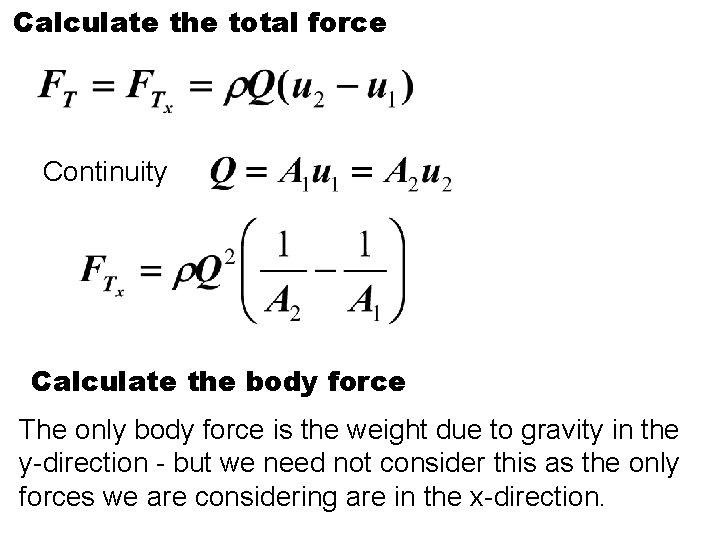
Calculate the total force Continuity Calculate the body force The only body force is the weight due to gravity in the y-direction - but we need not consider this as the only forces we are considering are in the x-direction.
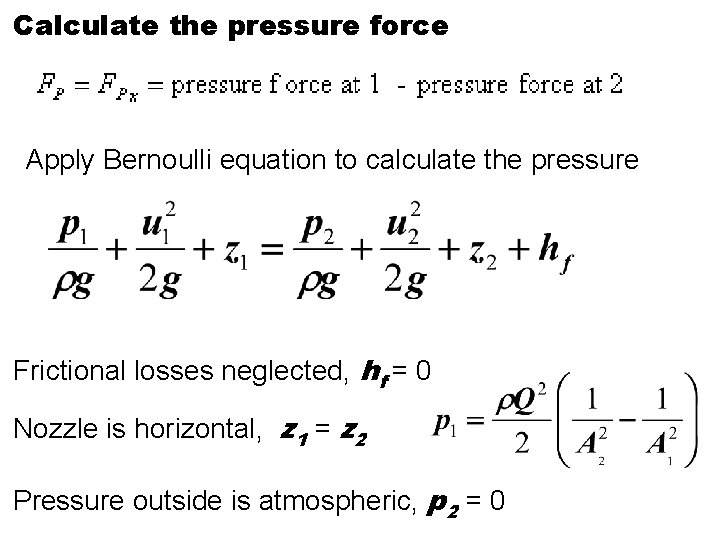
Calculate the pressure force Apply Bernoulli equation to calculate the pressure Frictional losses neglected, hf = 0 Nozzle is horizontal, z 1 = z 2 Pressure outside is atmospheric, p 2 = 0
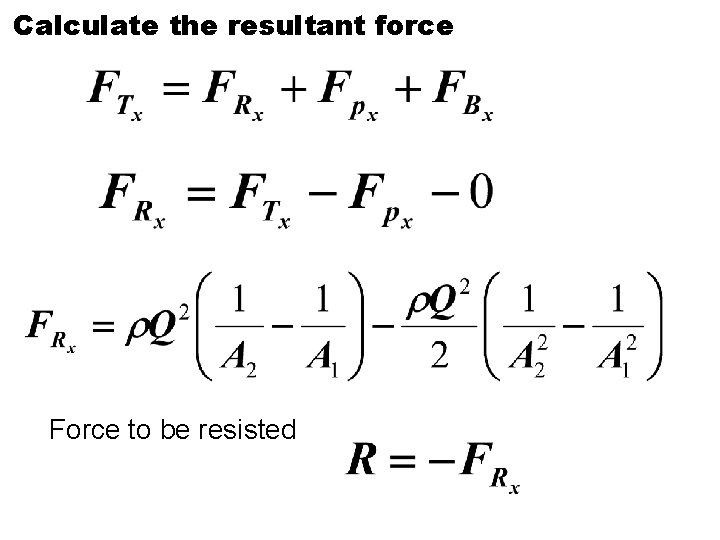
Calculate the resultant force Force to be resisted
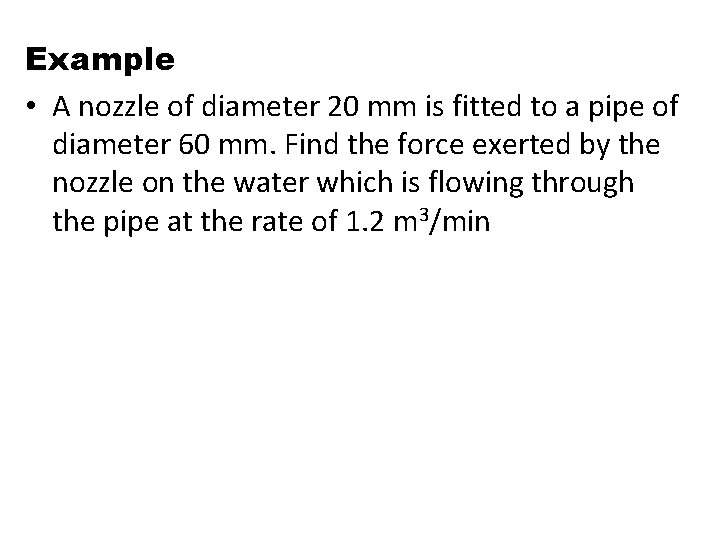
Example • A nozzle of diameter 20 mm is fitted to a pipe of diameter 60 mm. Find the force exerted by the nozzle on the water which is flowing through the pipe at the rate of 1. 2 m 3/min