
MOMENT OF INERTIA Todays Objectives Students will be
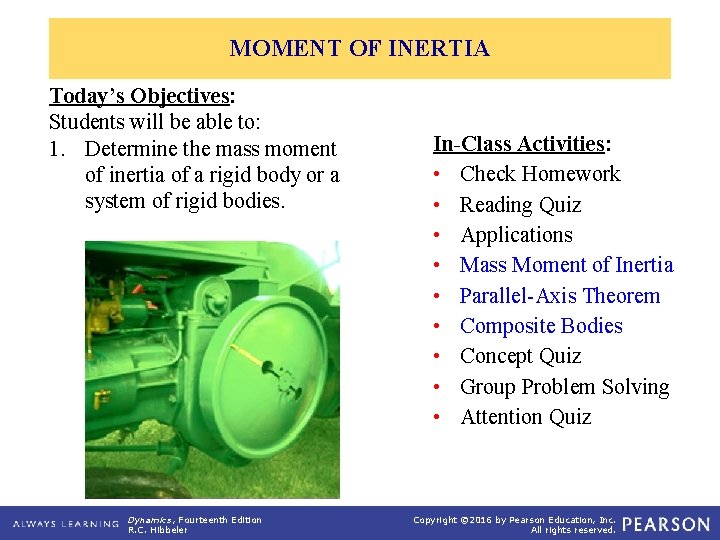
MOMENT OF INERTIA Today’s Objectives: Students will be able to: 1. Determine the mass moment of inertia of a rigid body or a system of rigid bodies. Dynamics, Fourteenth Edition R. C. Hibbeler In-Class Activities: • Check Homework • Reading Quiz • Applications • Mass Moment of Inertia • Parallel-Axis Theorem • Composite Bodies • Concept Quiz • Group Problem Solving • Attention Quiz Copyright © 2016 by Pearson Education, Inc. All rights reserved.
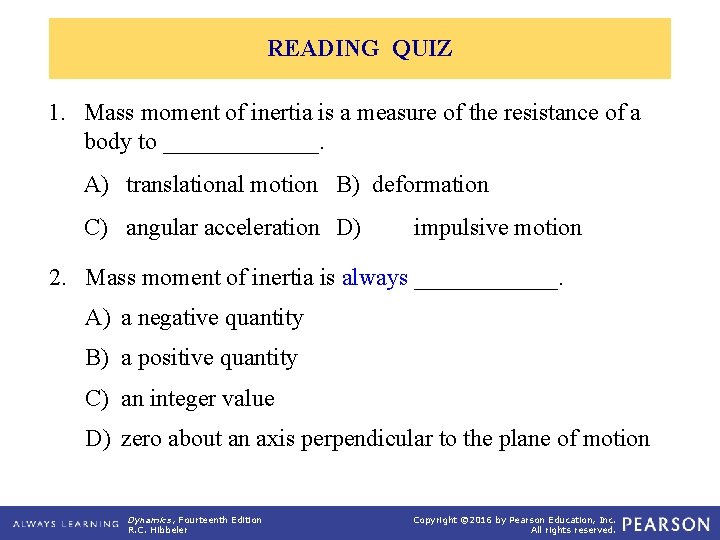
READING QUIZ 1. Mass moment of inertia is a measure of the resistance of a body to _______. A) translational motion B) deformation C) angular acceleration D) impulsive motion 2. Mass moment of inertia is always ______. A) a negative quantity B) a positive quantity C) an integer value D) zero about an axis perpendicular to the plane of motion Dynamics, Fourteenth Edition R. C. Hibbeler Copyright © 2016 by Pearson Education, Inc. All rights reserved.
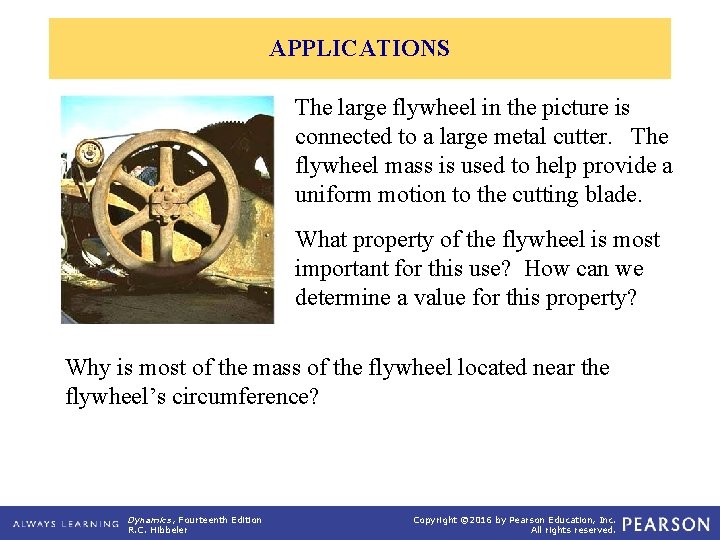
APPLICATIONS The large flywheel in the picture is connected to a large metal cutter. The flywheel mass is used to help provide a uniform motion to the cutting blade. What property of the flywheel is most important for this use? How can we determine a value for this property? Why is most of the mass of the flywheel located near the flywheel’s circumference? Dynamics, Fourteenth Edition R. C. Hibbeler Copyright © 2016 by Pearson Education, Inc. All rights reserved.
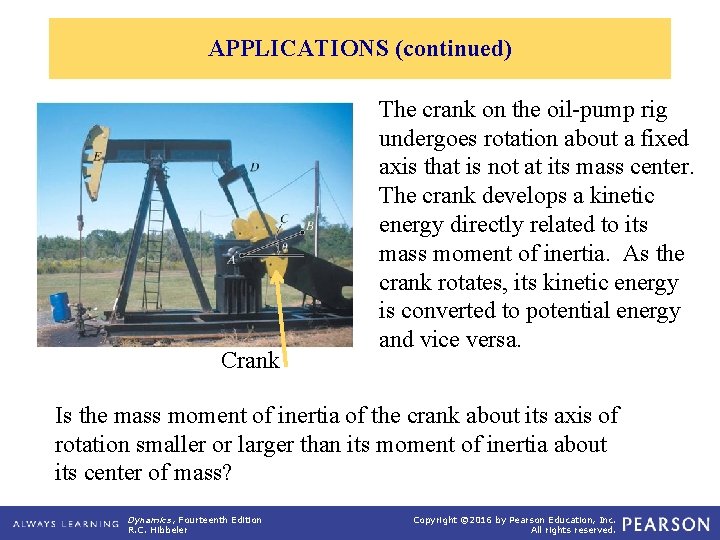
APPLICATIONS (continued) Crank The crank on the oil-pump rig undergoes rotation about a fixed axis that is not at its mass center. The crank develops a kinetic energy directly related to its mass moment of inertia. As the crank rotates, its kinetic energy is converted to potential energy and vice versa. Is the mass moment of inertia of the crank about its axis of rotation smaller or larger than its moment of inertia about its center of mass? Dynamics, Fourteenth Edition R. C. Hibbeler Copyright © 2016 by Pearson Education, Inc. All rights reserved.
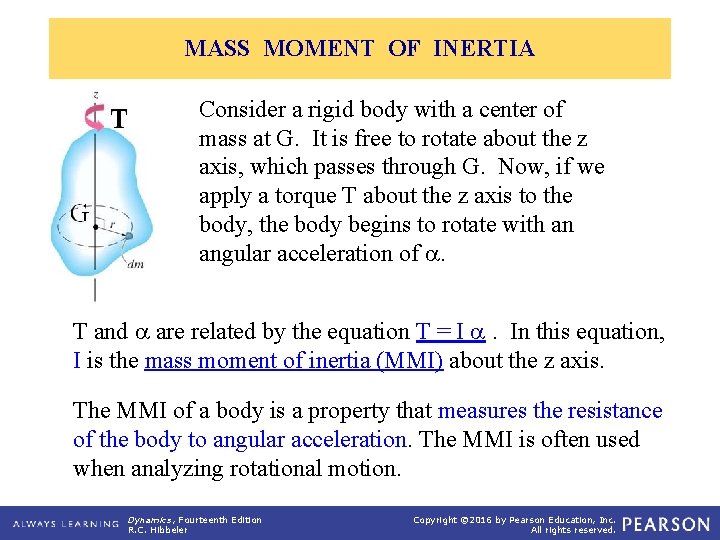
MASS MOMENT OF INERTIA Consider a rigid body with a center of mass at G. It is free to rotate about the z axis, which passes through G. Now, if we apply a torque T about the z axis to the body, the body begins to rotate with an angular acceleration of . T and are related by the equation T = I . In this equation, I is the mass moment of inertia (MMI) about the z axis. The MMI of a body is a property that measures the resistance of the body to angular acceleration. The MMI is often used when analyzing rotational motion. Dynamics, Fourteenth Edition R. C. Hibbeler Copyright © 2016 by Pearson Education, Inc. All rights reserved.
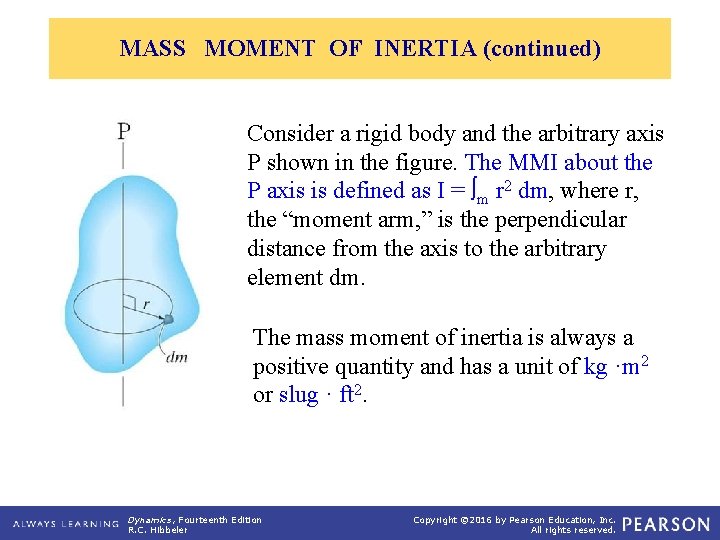
MASS MOMENT OF INERTIA (continued) Consider a rigid body and the arbitrary axis P shown in the figure. The MMI about the P axis is defined as I = m r 2 dm, where r, the “moment arm, ” is the perpendicular distance from the axis to the arbitrary element dm. The mass moment of inertia is always a positive quantity and has a unit of kg ·m 2 or slug · ft 2. Dynamics, Fourteenth Edition R. C. Hibbeler Copyright © 2016 by Pearson Education, Inc. All rights reserved.
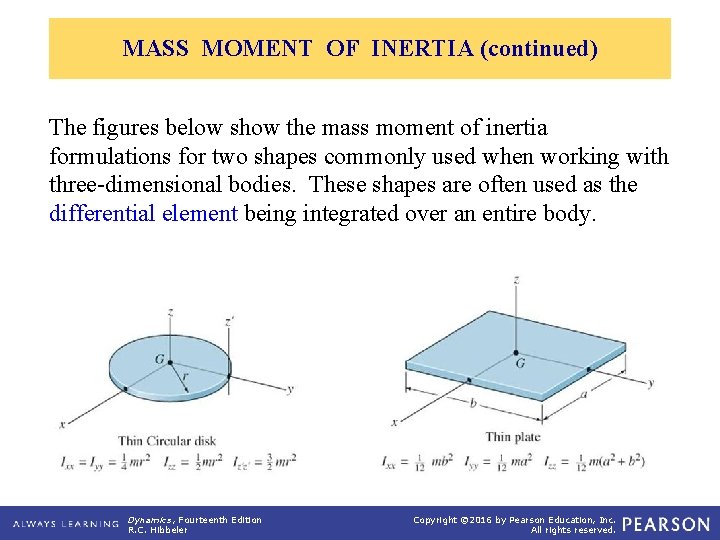
MASS MOMENT OF INERTIA (continued) The figures below show the mass moment of inertia formulations for two shapes commonly used when working with three-dimensional bodies. These shapes are often used as the differential element being integrated over an entire body. Dynamics, Fourteenth Edition R. C. Hibbeler Copyright © 2016 by Pearson Education, Inc. All rights reserved.
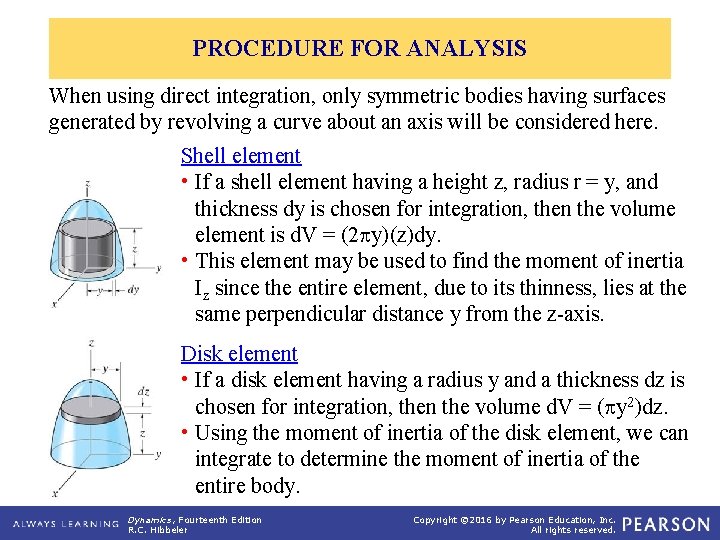
PROCEDURE FOR ANALYSIS When using direct integration, only symmetric bodies having surfaces generated by revolving a curve about an axis will be considered here. Shell element • If a shell element having a height z, radius r = y, and thickness dy is chosen for integration, then the volume element is d. V = (2 py)(z)dy. • This element may be used to find the moment of inertia Iz since the entire element, due to its thinness, lies at the same perpendicular distance y from the z-axis. Disk element • If a disk element having a radius y and a thickness dz is chosen for integration, then the volume d. V = (py 2)dz. • Using the moment of inertia of the disk element, we can integrate to determine the moment of inertia of the entire body. Dynamics, Fourteenth Edition R. C. Hibbeler Copyright © 2016 by Pearson Education, Inc. All rights reserved.
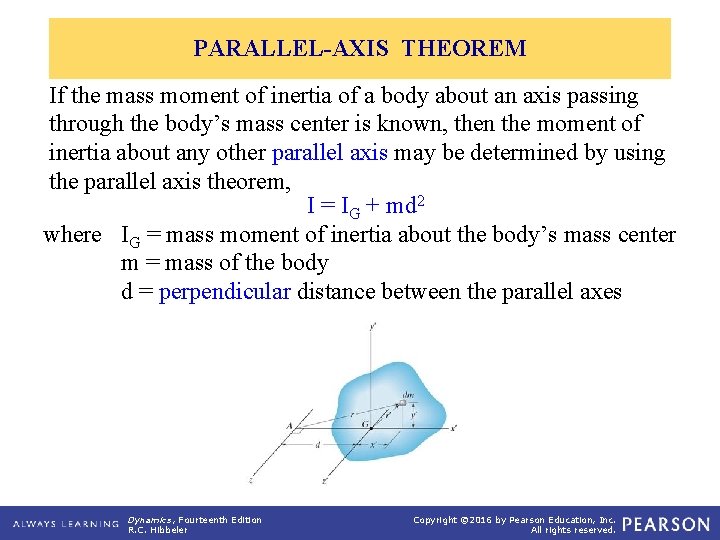
PARALLEL-AXIS THEOREM If the mass moment of inertia of a body about an axis passing through the body’s mass center is known, then the moment of inertia about any other parallel axis may be determined by using the parallel axis theorem, I = IG + md 2 where IG = mass moment of inertia about the body’s mass center m = mass of the body d = perpendicular distance between the parallel axes Dynamics, Fourteenth Edition R. C. Hibbeler Copyright © 2016 by Pearson Education, Inc. All rights reserved.
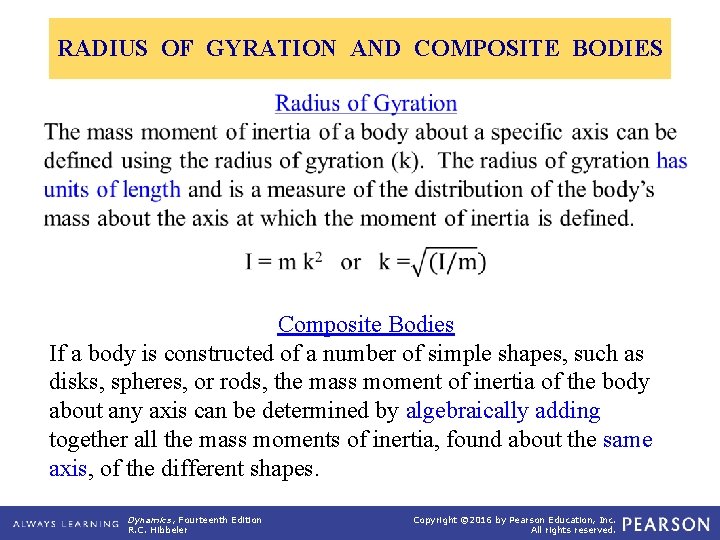
RADIUS OF GYRATION AND COMPOSITE BODIES Composite Bodies If a body is constructed of a number of simple shapes, such as disks, spheres, or rods, the mass moment of inertia of the body about any axis can be determined by algebraically adding together all the mass moments of inertia, found about the same axis, of the different shapes. Dynamics, Fourteenth Edition R. C. Hibbeler Copyright © 2016 by Pearson Education, Inc. All rights reserved.
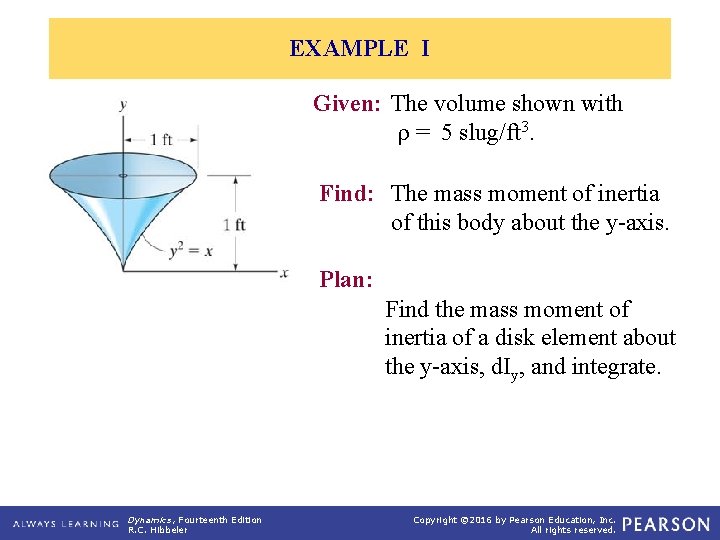
EXAMPLE I Given: The volume shown with r = 5 slug/ft 3. Find: The mass moment of inertia of this body about the y-axis. Plan: Find the mass moment of inertia of a disk element about the y-axis, d. Iy, and integrate. Dynamics, Fourteenth Edition R. C. Hibbeler Copyright © 2016 by Pearson Education, Inc. All rights reserved.
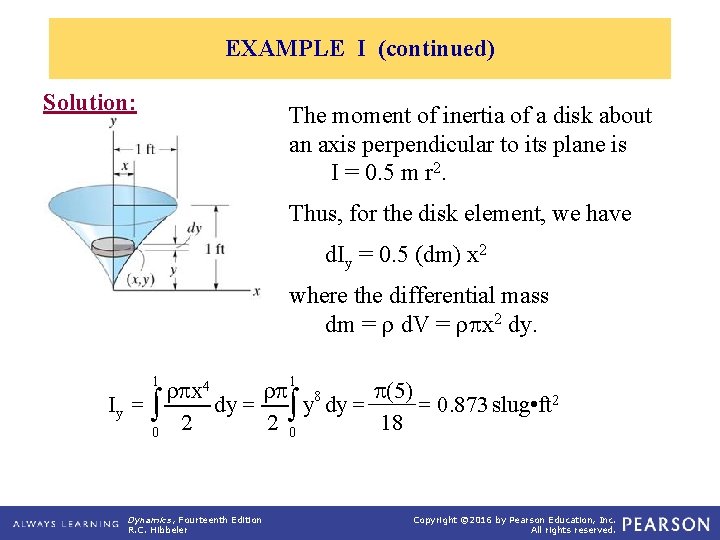
EXAMPLE I (continued) Solution: The moment of inertia of a disk about an axis perpendicular to its plane is I = 0. 5 m r 2. Thus, for the disk element, we have d. Iy = 0. 5 (dm) x 2 where the differential mass dm = r d. V = rpx 2 dy. 1 1 rpx 4 p(5) rp 8 = = 0. 873 slug • ft 2 Iy dy y dy 2 2 0 18 0 Dynamics, Fourteenth Edition R. C. Hibbeler Copyright © 2016 by Pearson Education, Inc. All rights reserved.
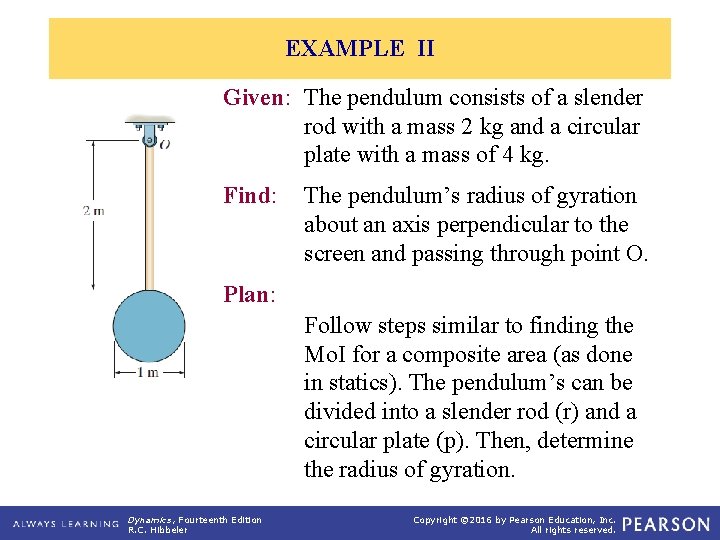
EXAMPLE II Given: The pendulum consists of a slender rod with a mass 2 kg and a circular plate with a mass of 4 kg. Find: The pendulum’s radius of gyration about an axis perpendicular to the screen and passing through point O. Plan: Follow steps similar to finding the Mo. I for a composite area (as done in statics). The pendulum’s can be divided into a slender rod (r) and a circular plate (p). Then, determine the radius of gyration. Dynamics, Fourteenth Edition R. C. Hibbeler Copyright © 2016 by Pearson Education, Inc. All rights reserved.
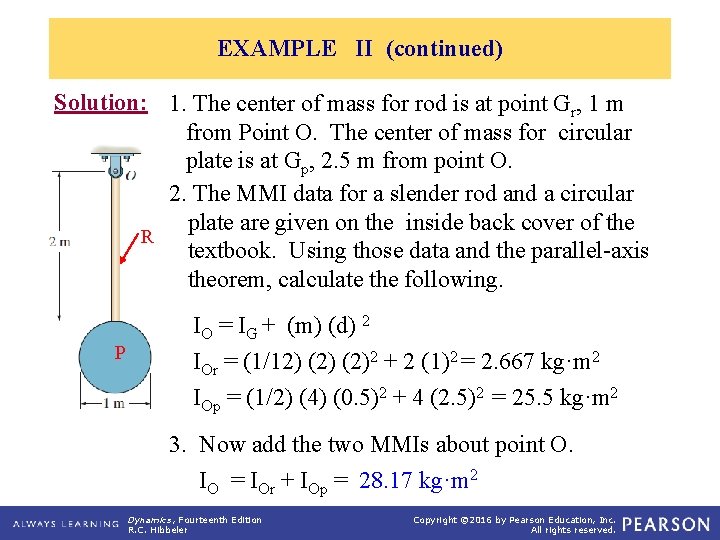
EXAMPLE II (continued) Solution: 1. The center of mass for rod is at point Gr, 1 m from Point O. The center of mass for circular plate is at Gp, 2. 5 m from point O. 2. The MMI data for a slender rod and a circular plate are given on the inside back cover of the R textbook. Using those data and the parallel-axis theorem, calculate the following. P IO = IG + (m) (d) 2 IOr = (1/12) (2)2 + 2 (1)2 = 2. 667 kg·m 2 IOp = (1/2) (4) (0. 5)2 + 4 (2. 5)2 = 25. 5 kg·m 2 3. Now add the two MMIs about point O. IO = IOr + IOp = 28. 17 kg·m 2 Dynamics, Fourteenth Edition R. C. Hibbeler Copyright © 2016 by Pearson Education, Inc. All rights reserved.
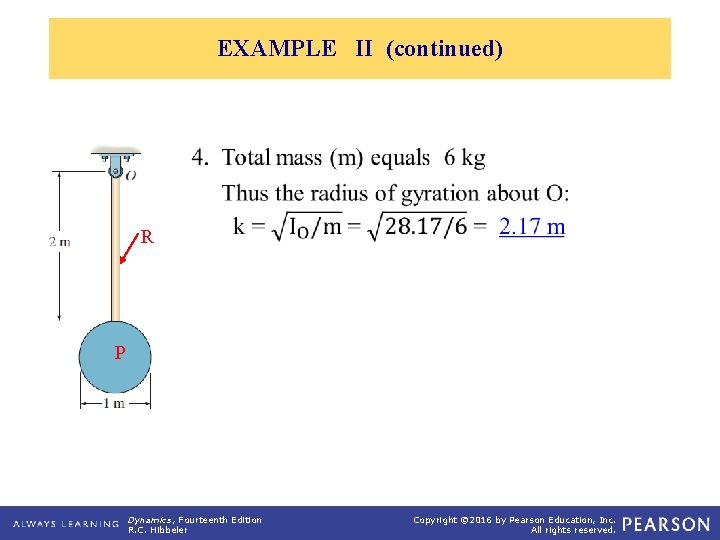
EXAMPLE II (continued) R P Dynamics, Fourteenth Edition R. C. Hibbeler Copyright © 2016 by Pearson Education, Inc. All rights reserved.
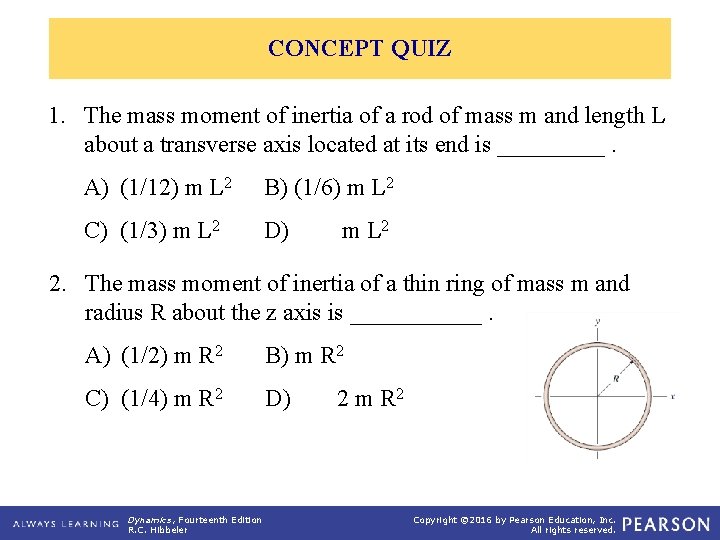
CONCEPT QUIZ 1. The mass moment of inertia of a rod of mass m and length L about a transverse axis located at its end is _____. A) (1/12) m L 2 B) (1/6) m L 2 C) (1/3) m L 2 D) m L 2 2. The mass moment of inertia of a thin ring of mass m and radius R about the z axis is ______. A) (1/2) m R 2 B) m R 2 C) (1/4) m R 2 D) Dynamics, Fourteenth Edition R. C. Hibbeler 2 m R 2 Copyright © 2016 by Pearson Education, Inc. All rights reserved.
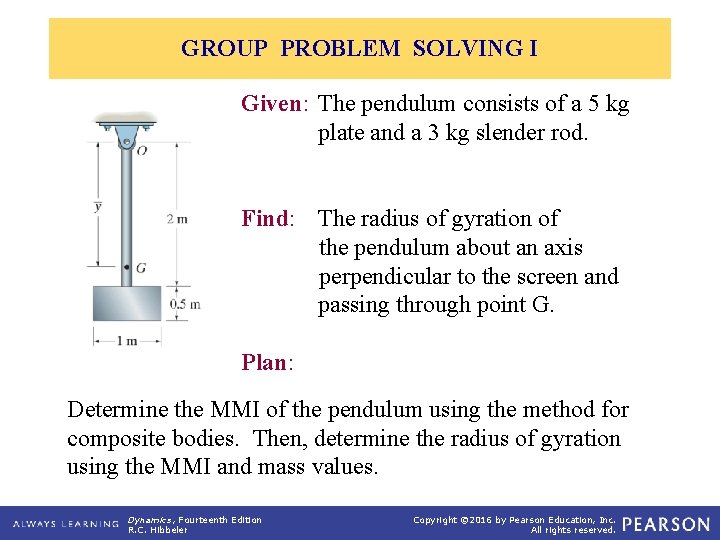
GROUP PROBLEM SOLVING I Given: The pendulum consists of a 5 kg plate and a 3 kg slender rod. Find: The radius of gyration of the pendulum about an axis perpendicular to the screen and passing through point G. Plan: Determine the MMI of the pendulum using the method for composite bodies. Then, determine the radius of gyration using the MMI and mass values. Dynamics, Fourteenth Edition R. C. Hibbeler Copyright © 2016 by Pearson Education, Inc. All rights reserved.
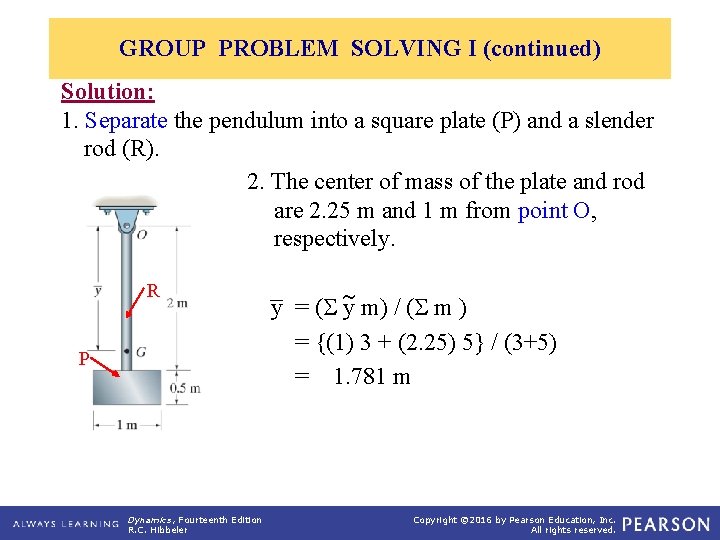
GROUP PROBLEM SOLVING I (continued) Solution: 1. Separate the pendulum into a square plate (P) and a slender rod (R). 2. The center of mass of the plate and rod are 2. 25 m and 1 m from point O, respectively. R P Dynamics, Fourteenth Edition R. C. Hibbeler y = ( y m) / ( m ) = {(1) 3 + (2. 25) 5} / (3+5) = 1. 781 m Copyright © 2016 by Pearson Education, Inc. All rights reserved.
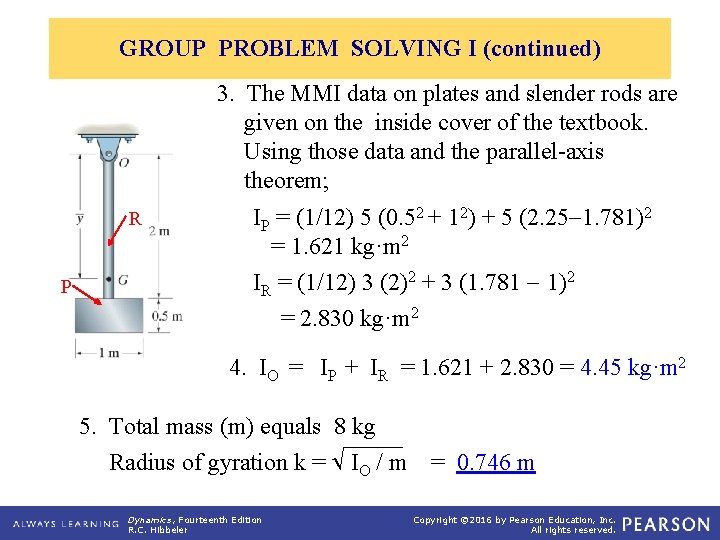
GROUP PROBLEM SOLVING I (continued) 3. The MMI data on plates and slender rods are given on the inside cover of the textbook. Using those data and the parallel-axis theorem; R P IP = (1/12) 5 (0. 52 + 12) + 5 (2. 25 1. 781)2 = 1. 621 kg·m 2 IR = (1/12) 3 (2)2 + 3 (1. 781 1)2 = 2. 830 kg·m 2 4. IO = IP + IR = 1. 621 + 2. 830 = 4. 45 kg·m 2 5. Total mass (m) equals 8 kg Radius of gyration k = IO / m = 0. 746 m Dynamics, Fourteenth Edition R. C. Hibbeler Copyright © 2016 by Pearson Education, Inc. All rights reserved.
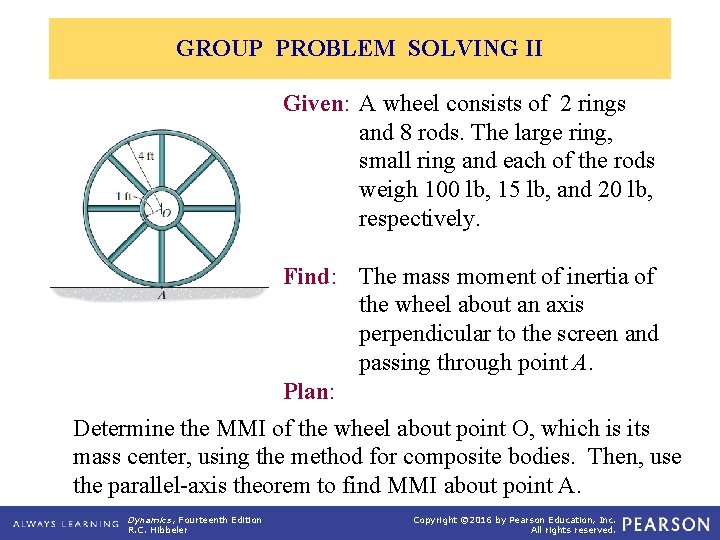
GROUP PROBLEM SOLVING II Given: A wheel consists of 2 rings and 8 rods. The large ring, small ring and each of the rods weigh 100 lb, 15 lb, and 20 lb, respectively. Find: The mass moment of inertia of the wheel about an axis perpendicular to the screen and passing through point A. Plan: Determine the MMI of the wheel about point O, which is its mass center, using the method for composite bodies. Then, use the parallel-axis theorem to find MMI about point A. Dynamics, Fourteenth Edition R. C. Hibbeler Copyright © 2016 by Pearson Education, Inc. All rights reserved.
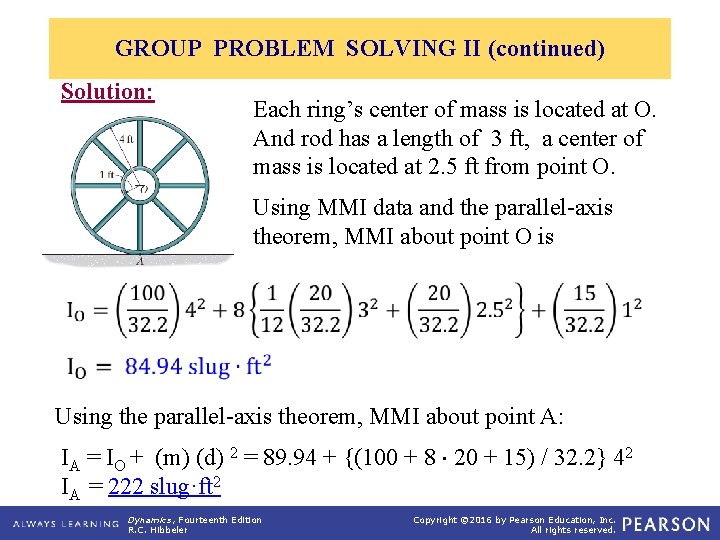
GROUP PROBLEM SOLVING II (continued) Solution: Each ring’s center of mass is located at O. And rod has a length of 3 ft, a center of mass is located at 2. 5 ft from point O. Using MMI data and the parallel-axis theorem, MMI about point O is Using the parallel-axis theorem, MMI about point A: IA = IO + (m) (d) 2 = 89. 94 + {(100 + 8 20 + 15) / 32. 2} 42 IA = 222 slug·ft 2 Dynamics, Fourteenth Edition R. C. Hibbeler Copyright © 2016 by Pearson Education, Inc. All rights reserved.
ATTENTION QUIZ 1. The mass moment of inertia of any body about its center of mass is always ______. A) maximum B) C) zero None of the above D) minimum 2. If the mass of body A and B are equal but k. A = 2 k. B, then ______. A) IA = 2 IB B) IA = (1/2)IB C) IA = 4 IB D) IA = (1/4)IB Dynamics, Fourteenth Edition R. C. Hibbeler Copyright © 2016 by Pearson Education, Inc. All rights reserved.
Dynamics, Fourteenth Edition R. C. Hibbeler Copyright © 2016 by Pearson Education, Inc. All rights reserved.
- Slides: 23