
Molybdenum properties and production Roman Boiko National University
Molybdenum: properties and production Roman Boiko National University of Life and Environmental Sciences of Ukraine, Institute for Nuclear Research, Kyiv, Ukraine

outline • What is molybdenum? • Chemical properties of molybdenum and its compounds • Molybdenum production • Own experience working with molybdenum

What is molybdenum? Mo 1 s 2 2 p 6 3 s 2 3 p 6 3 d 10 4 s 2 4 p 6 4 d 5 5 s 1

What is molybdenum? Atomic Number: 42 Atomic Weight: 95. 96 Period Number: 5 Group Number: 6 Element Classification: Metal, solid grey Phase at Room Temperature: Solid Melting Point: 2623°C (one of the highest melting metals) Boiling Point: 4639°C Density: 10. 2 grams per cubic centimeter Abundance: Univerce: Crustal rocks: 5 ppb by weight (0. 1 ppb by atoms) 1100 ppb by weight (230 ppb by atoms) Naturally Occurring Isotopes Mass Number Natural Abundance, % 92 94 14. 53 9. 15 95 96 15. 84 16. 67 97 98 100 9. 60 24. 39 9. 82

Molybdenum application Uses of produced from mines “new Molybdenum” About 20% of this material is used to make molybdenum grade stainless steel, while constructional steel, tool and high speed steel and cast iron, taken together use an additional 57%. The remaining 23% is used in upgraded products like lubricant grade Mo. S 2, molybdenum metal and molybdenum chemical compounds

Molybdenum application Molybdenum grade stainless steels “Stainless Steel” is a large group of iron-base alloys that contain chromium (at least 10. 5%). The term “stainless” implies a resistance to staining or rusting in air is used only for Cr containing steel. Molybdenum improves the corrosion resistance of all stainless steels.
Molybdenum application Molybdenum grade Alloy Steels & Irons Moly is used efficiently and economically in alloy steel & iron to • improve hardenability • reduce temper embrittlement • resist hydrogen attack & sulphide stress cracking • increase elevated temperature strength • improve weldability, especially in high strength low alloy steels (HSLA)
Molybdenum application Molybdenum grade superalloys Molybdenum is a very important alloying element in high performance nickel-based alloys. These alloys fall into two basic classes: • corrosion-resistant alloys • high temperature alloys: – solid-solution strengthened – age-hardenable

Molybdenum application Molybdenum metal & alloys Moly alloys have excellent strength and mechanical stability at high temperatures (up to 1900°C) • High temperature heating elements, radiation shields, extrusions, forging dies, etc; • Rotating X-ray anodes used in clinical diagnostics; • Glass melting furnace electrodes and components that are resistant to molten glass; • Heat sinks with thermal expansivity matching silicon for semiconductor chip mounts; • Sputtered layers, only Ångstroms (10 -7 mm) thick, for gates and interconnects on integrated circuit chips; • Sprayed coatings on automotive piston rings and machine components to reduce friction and improve wear.
Molybdenum application Molybdenum chemistry & uses The chemistry of molybdenum is extraordinarily versatile: oxidation states from (-II) to (VI), coordination numbers from 4 to 8 a very varied stereochemistry. Materials made from moly chemicals are • Catalysts • Lubricants • Corrosion inhibitors • Paints and surface coatings • Smoke suppressors (or suppressants) • Pigments • Ceramics • Nanomaterials • Agricultural chemicals

Preparative chemistry of molybdenum

Chemical properties of molybdenum and its compounds Oxidation state -2 0 +1 +2 +3 +4 Example Na 2[Mo 2(CO)10] Mo (metal), Mo(CO)6 Na[C 6 H 6 Mo] Mo. Cl 2 Na 3[Mo(CN)]6 Mo. S 2 +5 +6 Mo. Cl 5 Mo. O 3, Na 2 Mo. O 4, (NH 4)6 Mo 7 O 24 …

Metal Molybdenum Mo – stable at room temperature in air, interacts with some nonmetals at high to or with oxidizing agents (mineral acids) Mo + 2 S = Mo. S 2 2 Mo + 3 O 2 = 2 Mo. O 3 2 Mo + 5 Cl 2 = 2 Mo. Cl 5 at 600 -700 o. C at 600 o. C at 40 -100 o. C Mo + 6 HNO 3 = Mo. O 3↓ + 6 NO 2 + 3 H 2 O exothermal Mo + 4 H 2 SO 4 = H 4[Mo(SO 4)O 4] + 3 SO 2 + 2 H 2 O
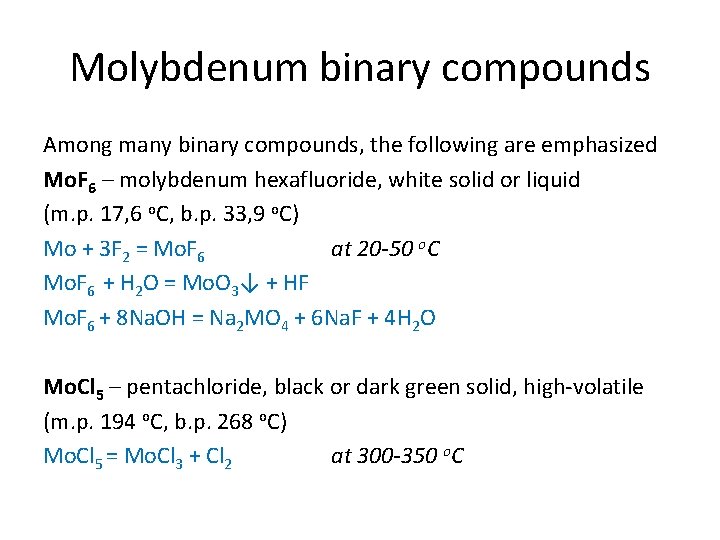
Molybdenum binary compounds Among many binary compounds, the following are emphasized Mo. F 6 – molybdenum hexafluoride, white solid or liquid (m. p. 17, 6 o. C, b. p. 33, 9 o. C) Mo + 3 F 2 = Mo. F 6 at 20 -50 o. C Mo. F 6 + H 2 O = Mo. O 3↓ + HF Mo. F 6 + 8 Na. OH = Na 2 MO 4 + 6 Na. F + 4 H 2 O Mo. Cl 5 – pentachloride, black or dark green solid, high-volatile (m. p. 194 o. C, b. p. 268 o. C) Mo. Cl 5 = Mo. Cl 3 + Cl 2 at 300 -350 o. C
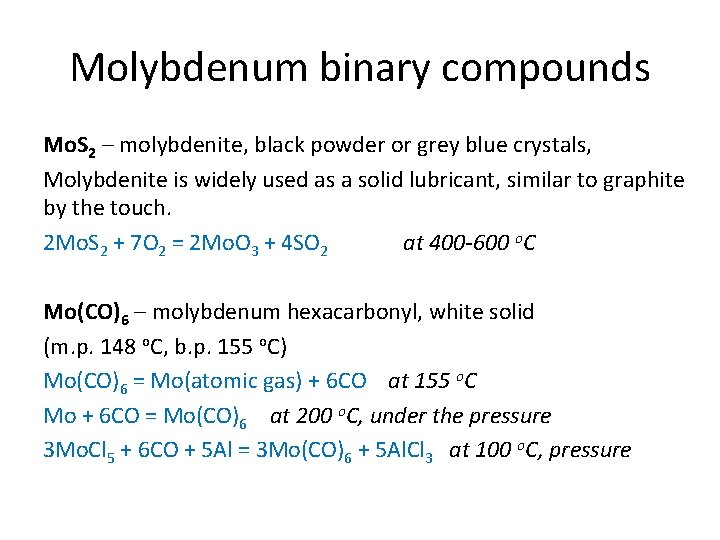
Molybdenum binary compounds Mo. S 2 – molybdenite, black powder or grey blue crystals, Molybdenite is widely used as a solid lubricant, similar to graphite by the touch. 2 Mo. S 2 + 7 O 2 = 2 Mo. O 3 + 4 SO 2 at 400 -600 o. C Mo(CO)6 – molybdenum hexacarbonyl, white solid (m. p. 148 o. C, b. p. 155 o. C) Mo(CO)6 = Mo(atomic gas) + 6 CO at 155 o. C Mo + 6 CO = Mo(CO)6 at 200 o. C, under the pressure 3 Mo. Cl 5 + 6 CO + 5 Al = 3 Mo(CO)6 + 5 Al. Cl 3 at 100 o. C, pressure
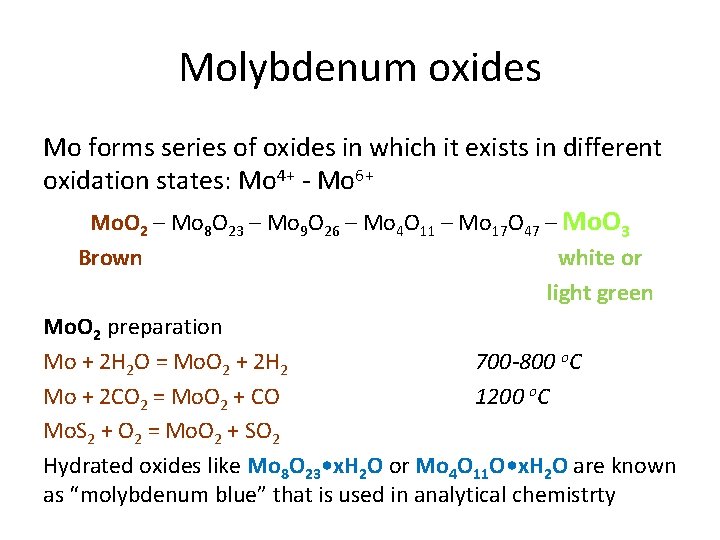
Molybdenum oxides Mo forms series of oxides in which it exists in different oxidation states: Mo 4+ - Mo 6+ Mo. O 2 – Mo 8 O 23 – Mo 9 O 26 – Mo 4 O 11 – Mo 17 O 47 – Mo. O 3 Brown white or light green Mo. O 2 preparation Mo + 2 H 2 O = Mo. O 2 + 2 H 2 700 -800 o. C Mo + 2 CO 2 = Mo. O 2 + CO 1200 o. C Mo. S 2 + O 2 = Mo. O 2 + SO 2 Hydrated oxides like Mo 8 O 23 • x. H 2 O or Mo 4 O 11 O • x. H 2 O are known as “molybdenum blue” that is used in analytical chemistrty

Molybdenum oxides Mo. O 3 – molybdite, white or light green crystalline solid m. p. 795 o. C; b. p. 1155 o. C; very volatile starting from 600 o. C Temperature, o. C 596 700 820 900 1000 1155 Vapor pressure, mm Hg 0, 0046 0, 356 10, 112, 6 53, 9 167, 5 760 Mo. O 3 (solid) →Heating→Sublimation (evaporation)→ Cooling→Comdensing Needle crystals are condensed occupying very large volume
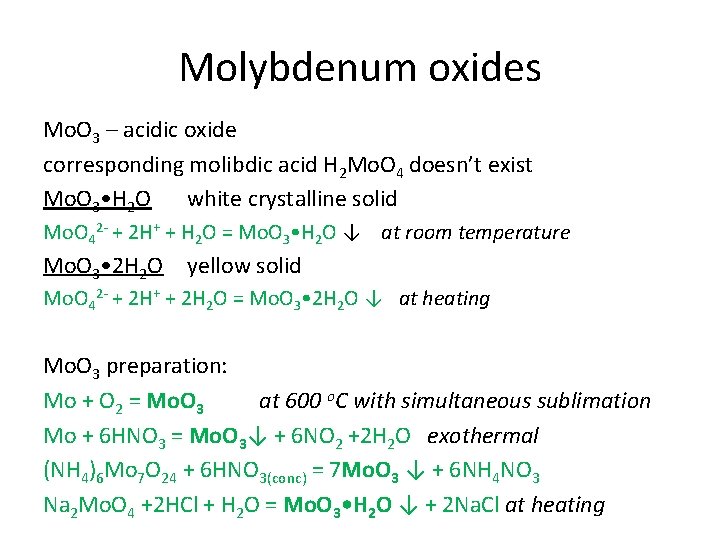
Molybdenum oxides Mo. O 3 – acidic oxide corresponding molibdic acid H 2 Mo. O 4 doesn’t exist Mo. O 3 • H 2 O white crystalline solid Mo. O 42 - + 2 H+ + H 2 O = Mo. O 3 • H 2 O ↓ at room temperature Mo. O 3 • 2 H 2 O yellow solid Mo. O 42 - + 2 H+ + 2 H 2 O = Mo. O 3 • 2 H 2 O ↓ at heating Mo. O 3 preparation: Mo + O 2 = Mo. O 3 at 600 o. C with simultaneous sublimation Mo + 6 HNO 3 = Mo. O 3↓ + 6 NO 2 +2 H 2 O exothermal (NH 4)6 Mo 7 O 24 + 6 HNO 3(conc) = 7 Mo. O 3 ↓ + 6 NH 4 NO 3 Na 2 Mo. O 4 +2 HCl + H 2 O = Mo. O 3 • H 2 O ↓ + 2 Na. Cl at heating

Molybdenum oxides Mo. O 3 properties solubility in water (in form H 2 Mo. O 4), g/L: 2, 05 (20 o) p. H=4. 0 -4. 5 With strong acids (exept HNO 3): Mo. O 3 + HCl(conc) = H 2[Mo. O 2 Cl 4] + H 2 O Mo. O 3 + H 2 SO 4(conc) + H 2 O = H 4[Mo. O 4(SO 4)] With alkali: Mo. O 3 + Na. OH = Na 2 Mo. O 4 Mo. O 3 + 2 NH 3(conc) + H 2 O = (NH 4)2 Mo. O 4 7 Mo. O 3 + 6 NH 3(diluted) + 3 H 2 O = (NH 4)6 Mo 7 O 24 With reducing agents: Mo. O 3 + Zn + HCl = [Mo 8 O 23 • x. H 2 O or Mo 4 O 11 O • x. H 2 O] + Zn. Cl 2
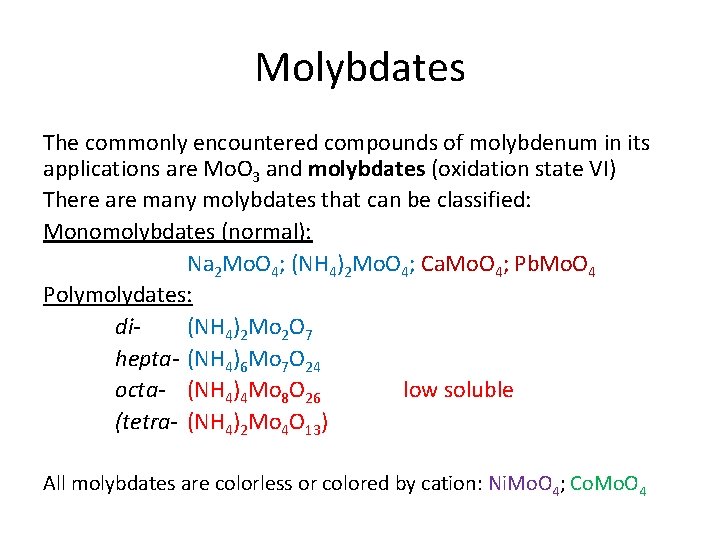
Molybdates The commonly encountered compounds of molybdenum in its applications are Mo. O 3 and molybdates (oxidation state VI) There are many molybdates that can be classified: Monomolybdates (normal): Na 2 Mo. O 4; (NH 4)2 Mo. O 4; Ca. Mo. O 4; Pb. Mo. O 4 Polymolydates: di(NH 4)2 Mo 2 O 7 hepta- (NH 4)6 Mo 7 O 24 octa- (NH 4)4 Mo 8 O 26 low soluble (tetra- (NH 4)2 Mo 4 O 13) All molybdates are colorless or colored by cation: Ni. Mo. O 4; Co. Mo. O 4
![Molybdates Normal molybdate crystals contain the discrete tetrahedral [Mo. O 4]2 - ion while](http://slidetodoc.com/presentation_image_h2/b1984abe0b97ccd2f4aa56b4b342561a/image-21.jpg "Molybdates Normal molybdate crystals contain the discrete tetrahedral [Mo. O 4]2 - ion while")
Molybdates Normal molybdate crystals contain the discrete tetrahedral [Mo. O 4]2 - ion while the structures of the polymolybdates consist of linked polyhedra containing six- and four-, and less commonly five-coordinate Mo 6+ Structure of the polymeric unit of ammonium dimolybdate
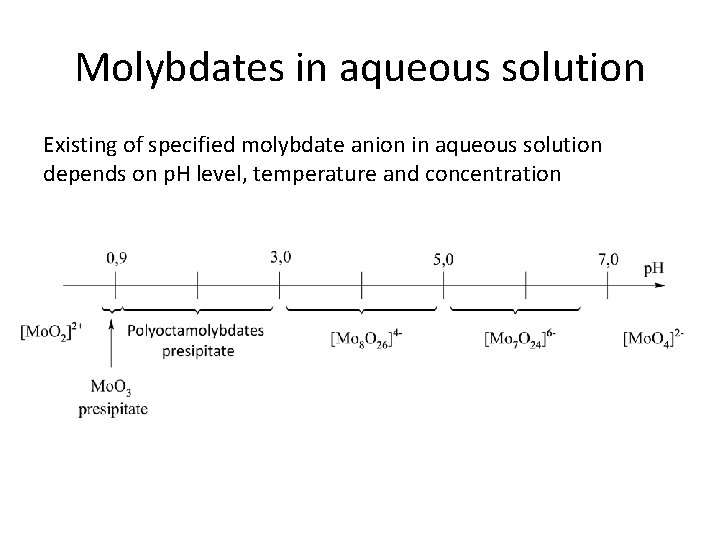
Molybdates in aqueous solution Existing of specified molybdate anion in aqueous solution depends on p. H level, temperature and concentration
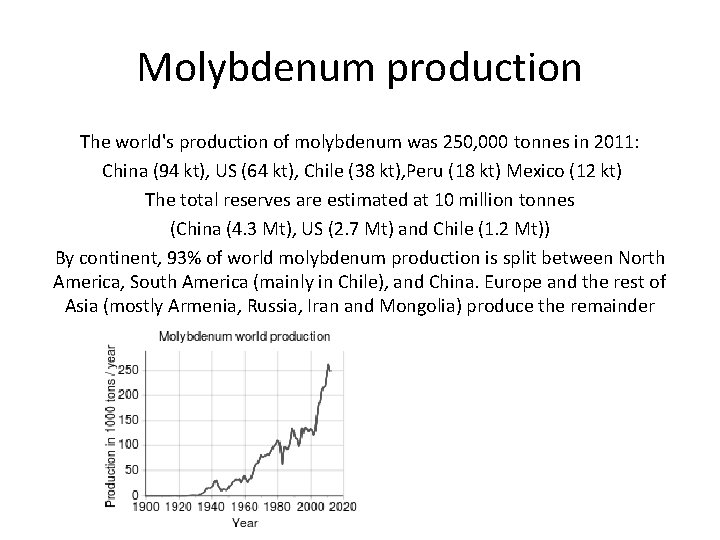
Molybdenum production The world's production of molybdenum was 250, 000 tonnes in 2011: China (94 kt), US (64 kt), Chile (38 kt), Peru (18 kt) Mexico (12 kt) The total reserves are estimated at 10 million tonnes (China (4. 3 Mt), US (2. 7 Mt) and Chile (1. 2 Mt)) By continent, 93% of world molybdenum production is split between North America, South America (mainly in Chile), and China. Europe and the rest of Asia (mostly Armenia, Russia, Iran and Mongolia) produce the remainder

Molybdenum mines Molybdenum is contained in various minerals, but only molybdenite (Mo. S 2) is suitable for the industrial production of marketable molybdenum products. Molybdenite can occur as the sole mineralization in an ore body, but is often associated with the sulphide minerals of other metals, notably copper. The Mo content of viable ore bodies ranges between 0. 01 and 0. 25%. Ores classification: • Primary mines, where the recovery of molybdenite is the sole objective; • By-product mines, where the recovery of copper-bearing ores is the primary objective, and molybdenite recovery provides additional economic value • Co-product mines, where the commercial viability of the mine requires that both molybdenite and copper-bearing minerals be recovered.
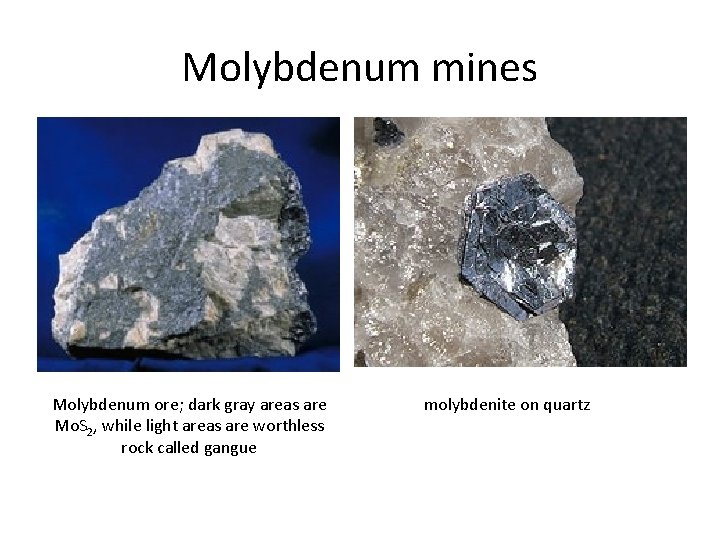
Molybdenum mines Molybdenum ore; dark gray areas are Mo. S 2, while light areas are worthless rock called gangue molybdenite on quartz
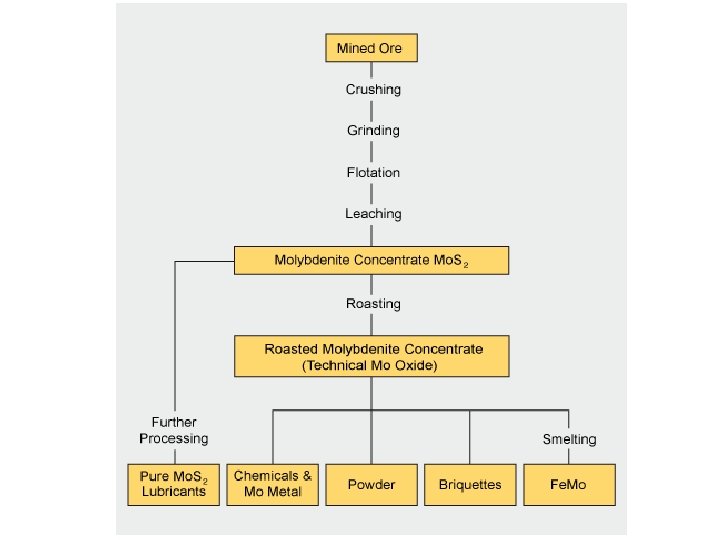
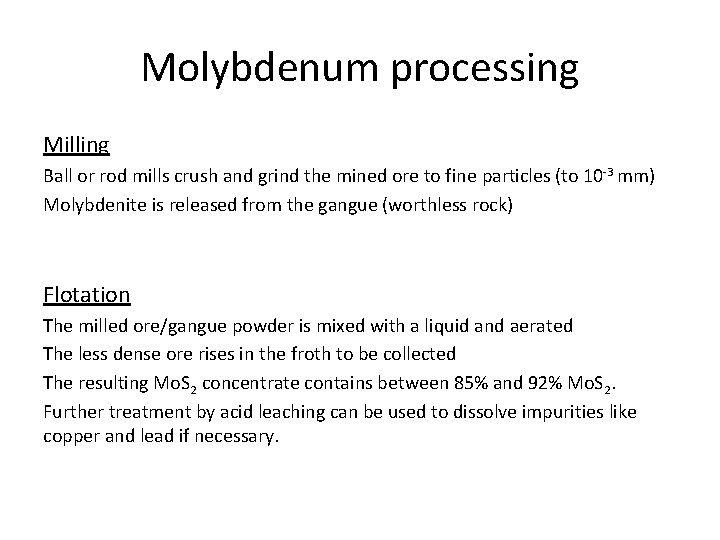
Molybdenum processing Milling Ball or rod mills crush and grind the mined ore to fine particles (to 10 -3 mm) Molybdenite is released from the gangue (worthless rock) Flotation The milled ore/gangue powder is mixed with a liquid and aerated The less dense ore rises in the froth to be collected The resulting Mo. S 2 concentrate contains between 85% and 92% Mo. S 2. Further treatment by acid leaching can be used to dissolve impurities like copper and lead if necessary.
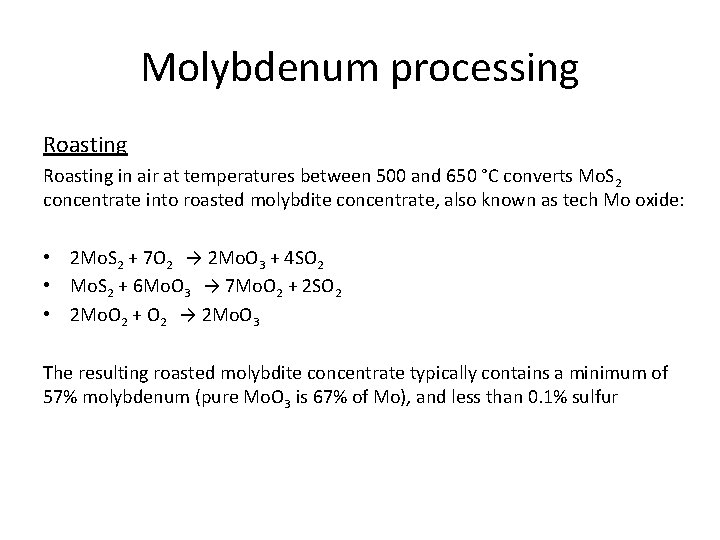
Molybdenum processing Roasting in air at temperatures between 500 and 650 °C converts Mo. S 2 concentrate into roasted molybdite concentrate, also known as tech Mo oxide: • 2 Mo. S 2 + 7 O 2 → 2 Mo. O 3 + 4 SO 2 • Mo. S 2 + 6 Mo. O 3 → 7 Mo. O 2 + 2 SO 2 • 2 Mo. O 2 + O 2 → 2 Mo. O 3 The resulting roasted molybdite concentrate typically contains a minimum of 57% molybdenum (pure Mo. O 3 is 67% of Mo), and less than 0. 1% sulfur

Molybdenum processing Upgrading from Tech Oxide About 25% of the roasted molybdite concentrate produced worldwide is processed into a number of chemical products. Upgrading is performed • by sublimation to produce pure molybdic oxide Mo. O 3 (at 900 -1100 o. C in air flow) • by wet chemical processes to produce a wide range of pure molybdenum chemicals (mainly molybdic oxides and molybdates)

Molybdenum processing
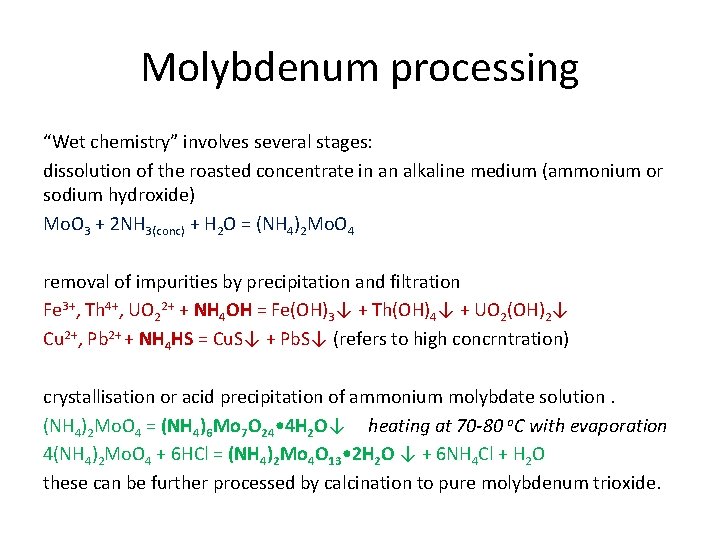
Molybdenum processing “Wet chemistry” involves several stages: dissolution of the roasted concentrate in an alkaline medium (ammonium or sodium hydroxide) Mo. O 3 + 2 NH 3(conc) + H 2 O = (NH 4)2 Mo. O 4 removal of impurities by precipitation and filtration Fe 3+, Th 4+, UO 22+ + NH 4 OH = Fe(OH)3↓ + Th(OH)4↓ + UO 2(OH)2↓ Cu 2+, Pb 2+ + NH 4 HS = Cu. S↓ + Pb. S↓ (refers to high concrntration) crystallisation or acid precipitation of ammonium molybdate solution. (NH 4)2 Mo. O 4 = (NH 4)6 Mo 7 O 24 • 4 H 2 O↓ heating at 70 -80 o. C with evaporation 4(NH 4)2 Mo. O 4 + 6 HCl = (NH 4)2 Mo 4 O 13 • 2 H 2 O ↓ + 6 NH 4 Cl + H 2 O these can be further processed by calcination to pure molybdenum trioxide.
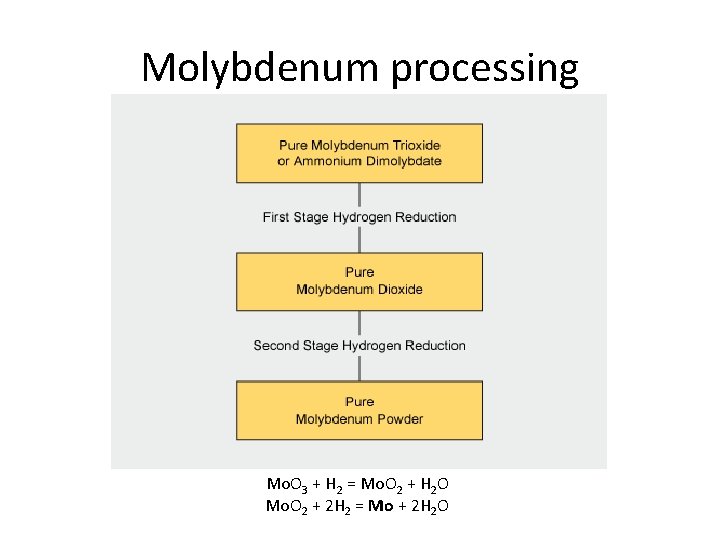
Molybdenum processing Mo. O 3 + H 2 = Mo. O 2 + H 2 O Mo. O 2 + 2 H 2 = Mo + 2 H 2 O
![Own experience working with molybdenum Experiment ARMONIA (LNGS) [1] The aim of the ARMONIA](http://slidetodoc.com/presentation_image_h2/b1984abe0b97ccd2f4aa56b4b342561a/image-33.jpg "Own experience working with molybdenum Experiment ARMONIA (LNGS) [1] The aim of the ARMONIA")
Own experience working with molybdenum Experiment ARMONIA (LNGS) [1] The aim of the ARMONIA experiment was a remeasurement of ≈1 kg of Mo enriched in 100 Mo to 99. 5% that was used before in [2] Initial material – metallic 100 Mo powder with mass of 1009 g Method of purification: 1. dissolving of metal into acid solution for recrystallization from aqueous solution in form of molybdic acid H 2100 Mo. O 4 2. Recovering of 100 -molybdenum oxide 100 Mo. O 3 [1] P. Belli et al. , Nuclear Physics A 846 (2010) 143– 156 [2] D. Blum, et al. , Phys. Lett. B 275 (1992) 506 33
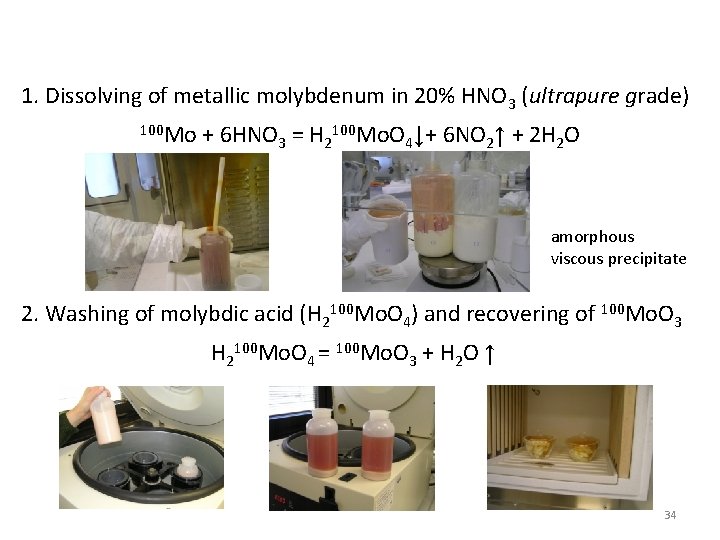
1. Dissolving of metallic molybdenum in 20% HNO 3 (ultrapure grade) 100 Mo + 6 HNO 3 = H 2100 Mo. O 4↓+ 6 NO 2↑ + 2 H 2 O amorphous viscous precipitate 2. Washing of molybdic acid (H 2100 Mo. O 4) and recovering of 100 Mo. O 3 H 2100 Mo. O 4 = 100 Mo. O 3 + H 2 O ↑ 34
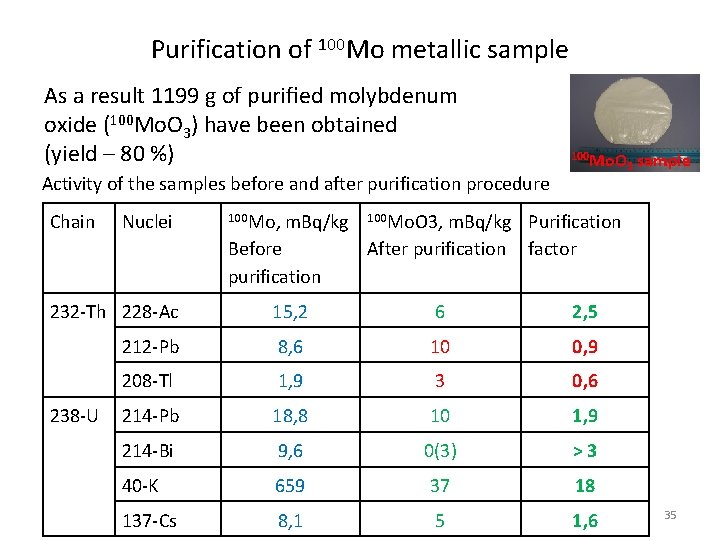
Purification of 100 Mo metallic sample As a result 1199 g of purified molybdenum oxide (100 Mo. O 3) have been obtained (yield – 80 %) 100 Mo. O Activity of the samples before and after purification procedure Chain Nuclei 100 Мо, m. Bq/kg Before purification sample 100 Мо. О 3, m. Bq/kg Purification After purification factor 232 -Th 228 -Ac 15, 2 6 2, 5 212 -Pb 8, 6 10 0, 9 208 -Tl 1, 9 3 0, 6 214 -Pb 18, 8 10 1, 9 214 -Bi 9, 6 0(3) >3 40 -K 659 37 18 137 -Cs 8, 1 5 1, 6 238 -U 3 35
Ways to improve the purification efficiency • Use recrystallization technique with applying of coprecipitation as additional effective method for purification • Use distillation of molybdenum oxide 100 Mo. O 3 • Investigate a chromatography on ion-exchange resins with aim of its following application 36

Thank you for attention 37
- Slides: 37