
MOLTEN SALT REACTORS A report on the ALISIA
- Slides: 25
MOLTEN SALT REACTORS A report on the ALISIA Information Day Geoff Parks
ALISIA (2007 -8) Assessment of LIquid Salts for Innovative Applications
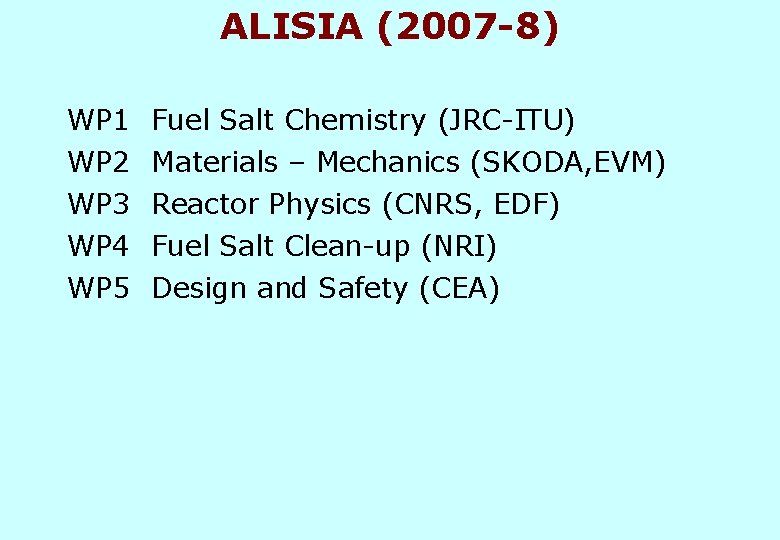
ALISIA (2007 -8) WP 1 WP 2 WP 3 WP 4 WP 5 Fuel Salt Chemistry (JRC-ITU) Materials – Mechanics (SKODA, EVM) Reactor Physics (CNRS, EDF) Fuel Salt Clean-up (NRI) Design and Safety (CEA)
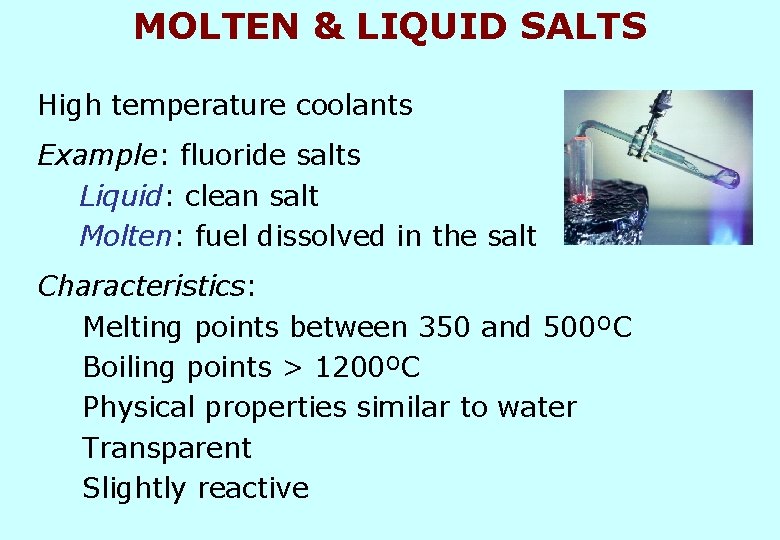
MOLTEN & LIQUID SALTS High temperature coolants Example: fluoride salts Liquid: clean salt Molten: fuel dissolved in the salt Characteristics: Melting points between 350 and 500ºC Boiling points > 1200ºC Physical properties similar to water Transparent Slightly reactive
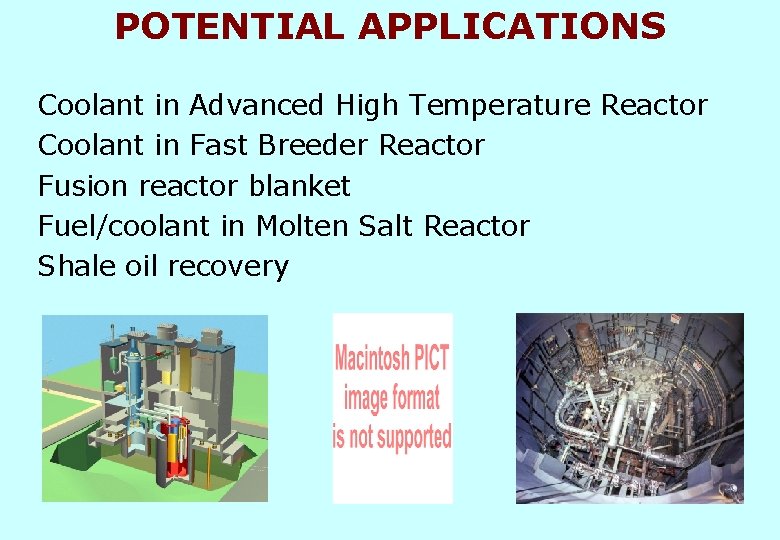
POTENTIAL APPLICATIONS Coolant in Advanced High Temperature Reactor Coolant in Fast Breeder Reactor Fusion reactor blanket Fuel/coolant in Molten Salt Reactor Shale oil recovery
LIQUID SALTS Example: Na. F-KF-Zr. F 4 Excellent coolant properties: Heat transport properties Heat transfer properties Very high boiling point Potentially meet the need for a high-temperature (>700ºC) low-pressure heat-transfer liquid
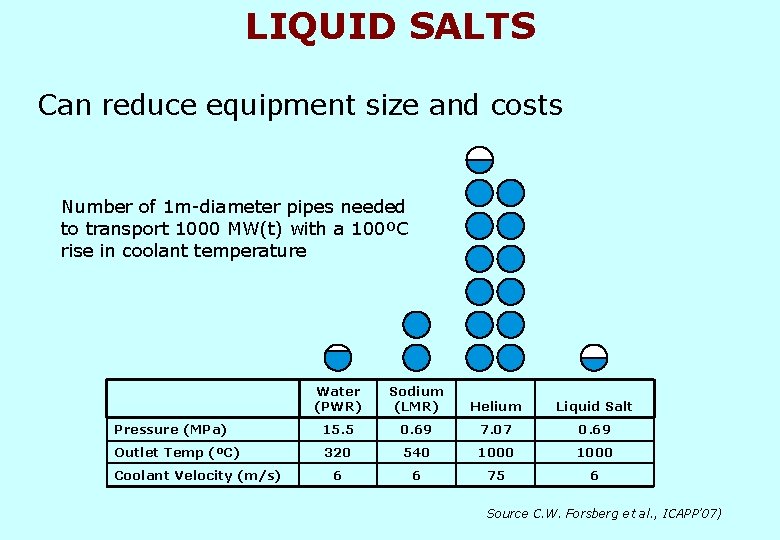
LIQUID SALTS Can reduce equipment size and costs Number of 1 m-diameter pipes needed to transport 1000 MW(t) with a 100ºC rise in coolant temperature Water (PWR) Sodium (LMR) Helium Liquid Salt Pressure (MPa) 15. 5 0. 69 7. 07 0. 69 Outlet Temp (ºC) 320 540 1000 6 6 75 6 Coolant Velocity (m/s) Source C. W. Forsberg et al. , ICAPP’ 07)
MOLTEN SALT REACTORS The advantages of a very good coolant Large thermal inertia Access to very high temperatures Compact reactor The advantages of a liquid fuel A single medium for fuel and coolant A favourable neutron balance Flexibility in fuel selection (U/Pu, Th/U) …
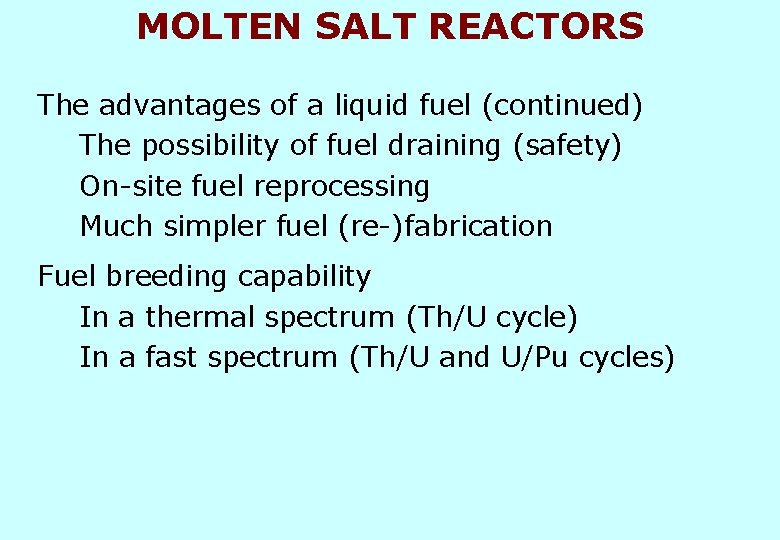
MOLTEN SALT REACTORS The advantages of a liquid fuel (continued) The possibility of fuel draining (safety) On-site fuel reprocessing Much simpler fuel (re-)fabrication Fuel breeding capability In a thermal spectrum (Th/U cycle) In a fast spectrum (Th/U and U/Pu cycles)
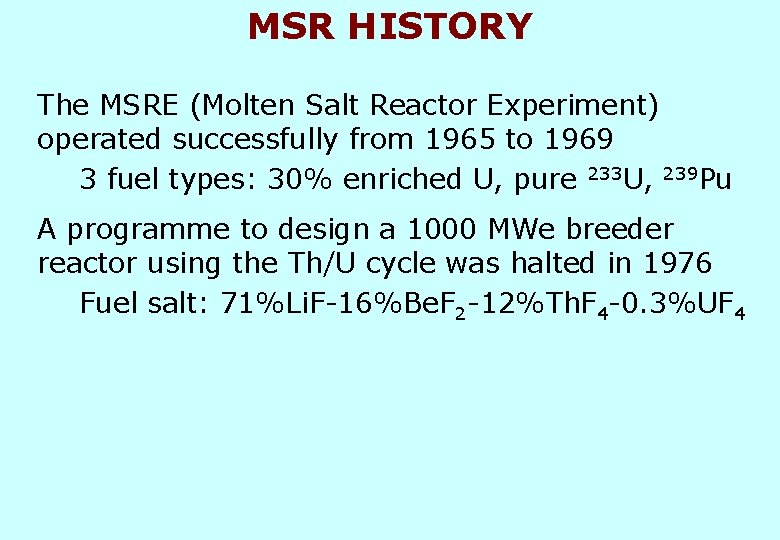
MSR HISTORY The MSRE (Molten Salt Reactor Experiment) operated successfully from 1965 to 1969 3 fuel types: 30% enriched U, pure 233 U, 239 Pu A programme to design a 1000 MWe breeder reactor using the Th/U cycle was halted in 1976 Fuel salt: 71%Li. F-16%Be. F 2 -12%Th. F 4 -0. 3%UF 4
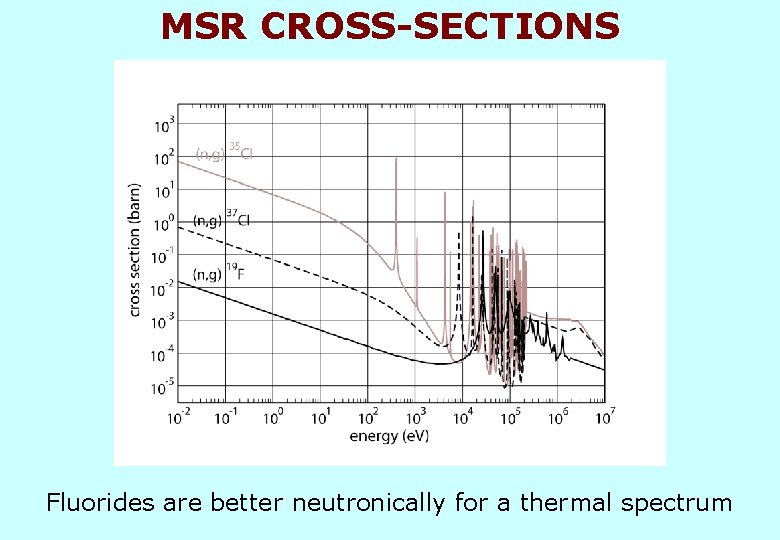
MSR CROSS-SECTIONS Fluorides are better neutronically for a thermal spectrum
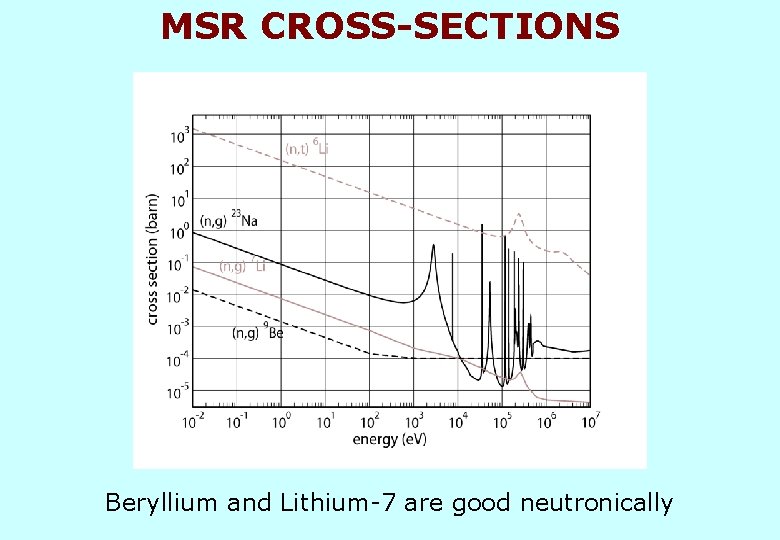
MSR CROSS-SECTIONS Beryllium and Lithium-7 are good neutronically
MSR FLUX SPECTRA
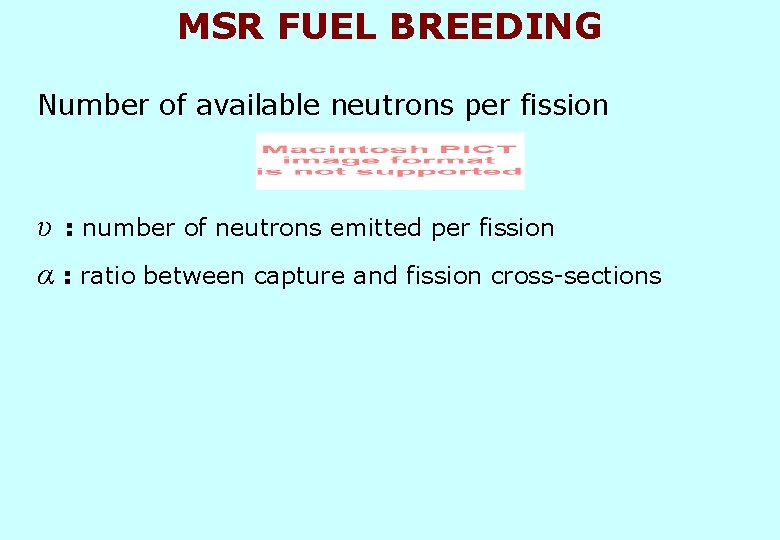
MSR FUEL BREEDING Number of available neutrons per fission υ : number of neutrons emitted per fission α : ratio between capture and fission cross-sections
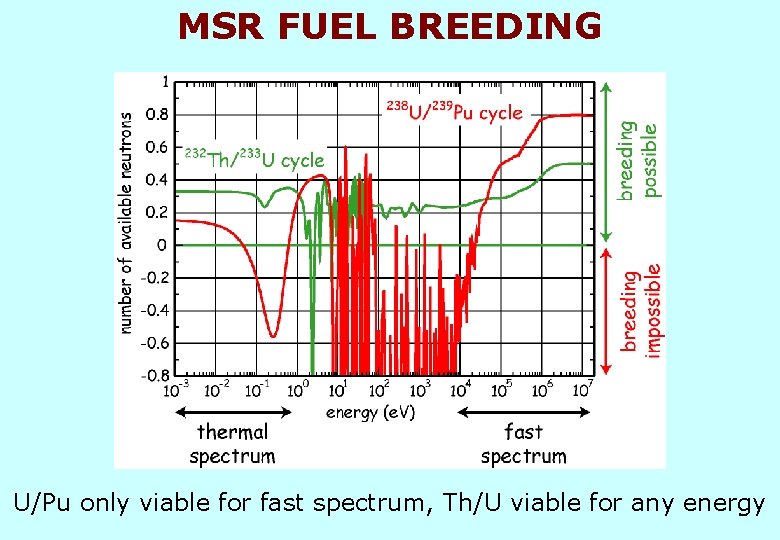
MSR FUEL BREEDING U/Pu only viable for fast spectrum, Th/U viable for any energy
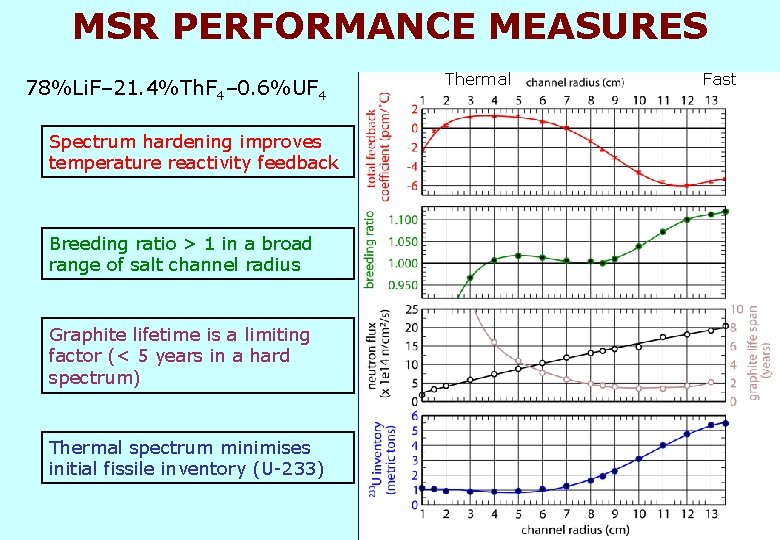
MSR PERFORMANCE MEASURES 78%Li. F– 21. 4%Th. F 4– 0. 6%UF 4 Spectrum hardening improves temperature reactivity feedback Breeding ratio > 1 in a broad range of salt channel radius Graphite lifetime is a limiting factor (< 5 years in a hard spectrum) Thermal spectrum minimises initial fissile inventory (U-233) Thermal Fast
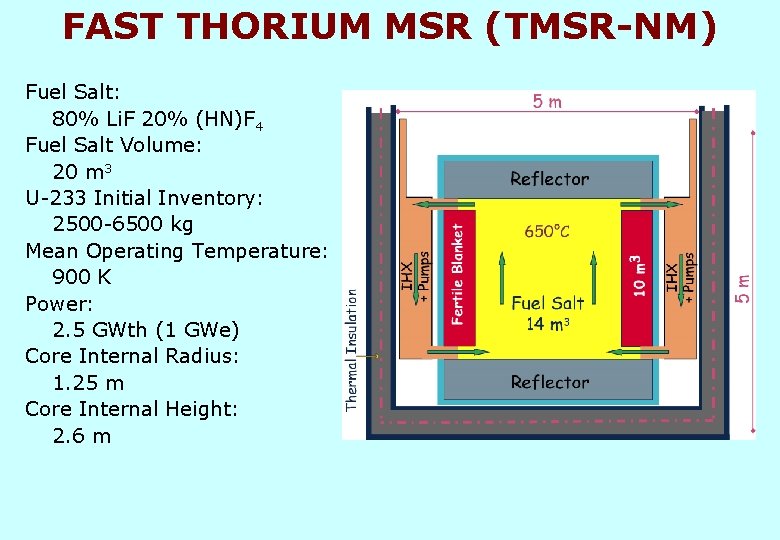
FAST THORIUM MSR (TMSR-NM) Fuel Salt: 80% Li. F 20% (HN)F 4 Fuel Salt Volume: 20 m 3 U-233 Initial Inventory: 2500 -6500 kg Mean Operating Temperature: 900 K Power: 2. 5 GWth (1 GWe) Core Internal Radius: 1. 25 m Core Internal Height: 2. 6 m
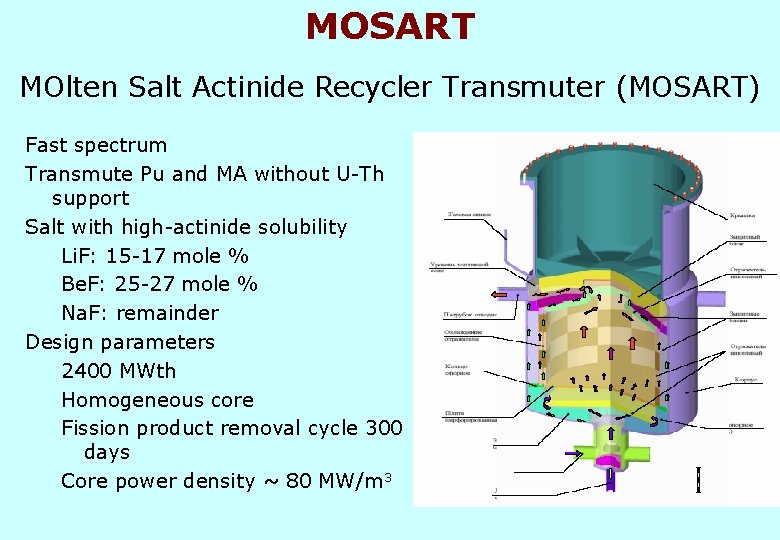
MOSART MOlten Salt Actinide Recycler Transmuter (MOSART) Fast spectrum Transmute Pu and MA without U-Th support Salt with high-actinide solubility Li. F: 15 -17 mole % Be. F: 25 -27 mole % Na. F: remainder Design parameters 2400 MWth Homogeneous core Fission product removal cycle 300 days Core power density ~ 80 MW/m 3
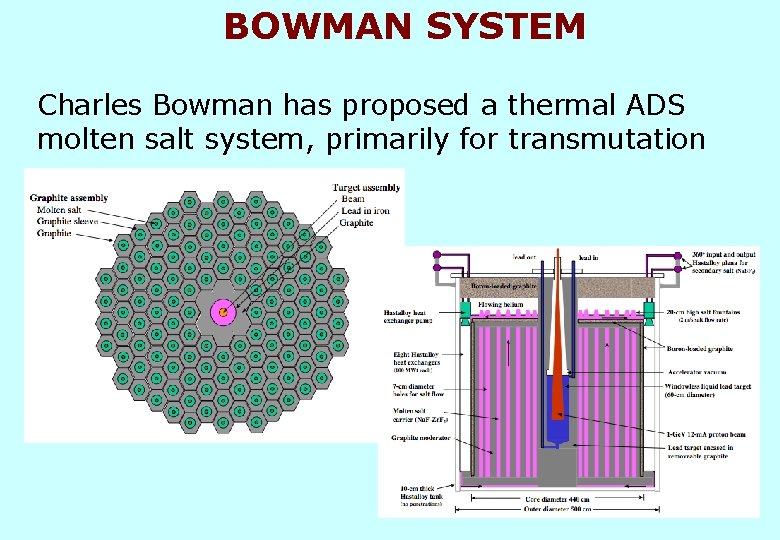
BOWMAN SYSTEM Charles Bowman has proposed a thermal ADS molten salt system, primarily for transmutation
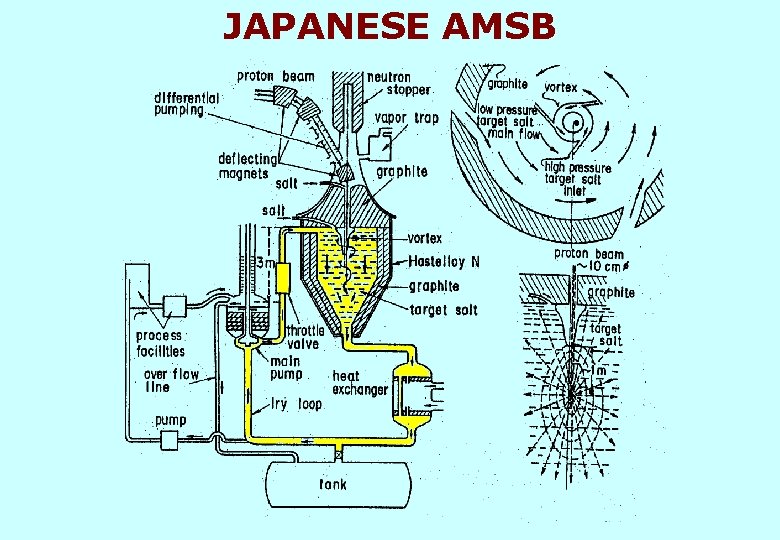
JAPANESE AMSB
JAPANESE AMSB Composed of three parts 1 Ge. V and 200 -300 m. A proton accelerator Single-fluid molten fluoride target/blanket system Heat transfer and electric power recovery system Multi-beam funneling available
MSR ISSUES Most studies have been theoretical and need experimental confirmation The behaviour of liquid salts as working fluids is complex and not yet well understood Experimental infrastructure (analytical and integral salt loops) is currently inadequate
MSR MATERIALS ISSUES MSR success depends strongly on the compatibility of the container materials with the molten salts used in primary and secondary circuits The high temperature, salt redox potential, radiation fluence and the neutron energy spectrum pose a serious challenge for any structural alloy A practicable system needs salt constituents that are not appreciably reduced by available structural metals and alloys whose components (Fe, Ni and Cr) can be in near equilibrium with the salt Products of oxidation of metals by fluoride melts are quite soluble in corroding media, so passivation is precluded, and the corrosion rate depends on other factors (oxidants, thermal gradients, salt flow rate, galvanic coupling)
MSR MATERIALS ISSUES MSRs use graphite as a moderator and reflector. Need material stability against radiation-induced distortion and low permeability to salt and gas ingress. Radiation damage can lead to formation of cracks sufficiently large for salt intrusion. Cracks and crevices in the graphite can allow Xenon-135 gas to remain in the core where it is a strong neutron absorber and will significantly reduce the breeding ratio of the reactor. The approach taken in the MSBR programme was to seal the graphite surface with pyrocarbon. No research has been done into lowering the permeability of graphite for MSR operation since the 1970 s
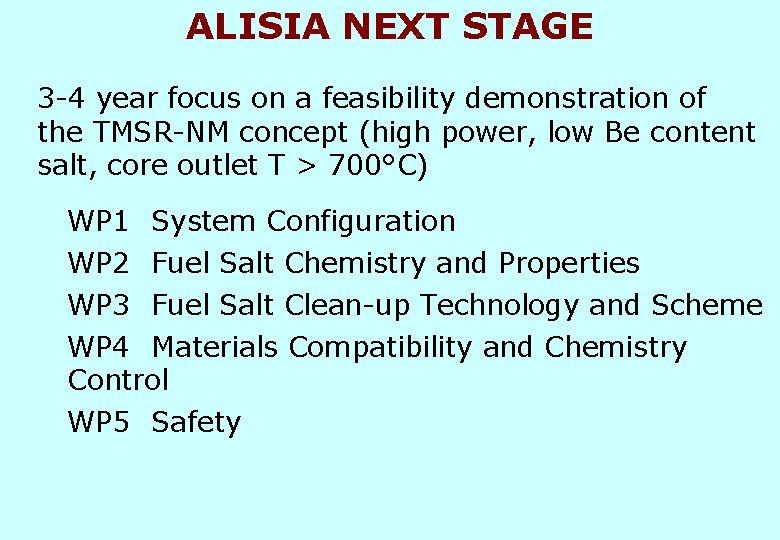
ALISIA NEXT STAGE 3 -4 year focus on a feasibility demonstration of the TMSR-NM concept (high power, low Be content salt, core outlet T > 700°C) WP 1 System Configuration WP 2 Fuel Salt Chemistry and Properties WP 3 Fuel Salt Clean-up Technology and Scheme WP 4 Materials Compatibility and Chemistry Control WP 5 Safety