
Moles 22 4 L Volume and Density OUTCOME

- Slides: 12
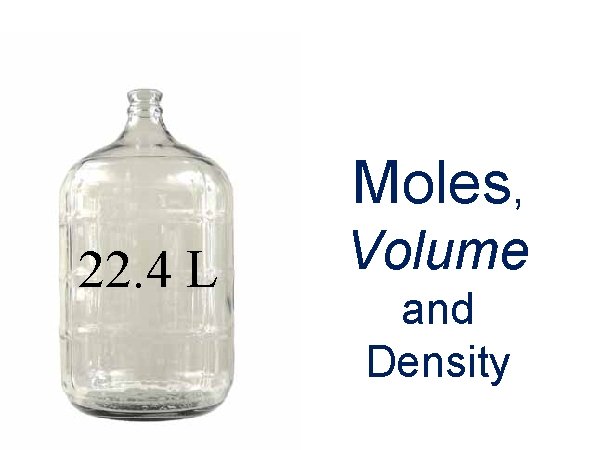
Moles, 22. 4 L Volume and Density
OUTCOME QUESTION(S): C 11 -3 -12 MOLAR CALCULATIONS Understand the importance of the concept of the mole and calculate the molar mass of various substances. Interpret a balanced equation in terms of moles, mass, and volumes of gases. Include: molar volume Solve problems requiring interconversions between moles, mass, volume, and number of particles. Include: density Vocabulary & Concepts STP
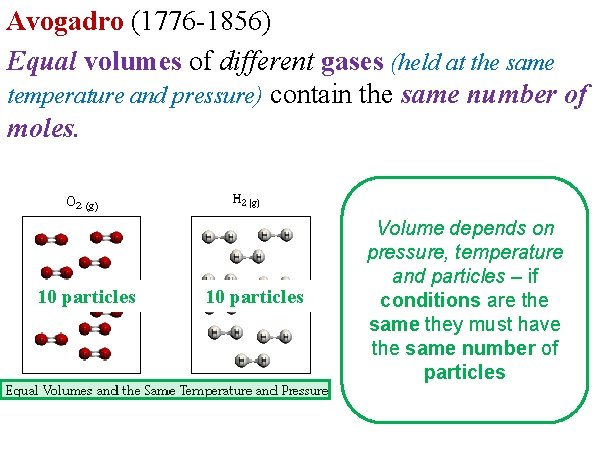
Avogadro (1776 -1856) Equal volumes of different gases (held at the same temperature and pressure) contain the same number of moles. 10 particles Volume depends on pressure, temperature and particles – if conditions are the same they must have the same number of particles
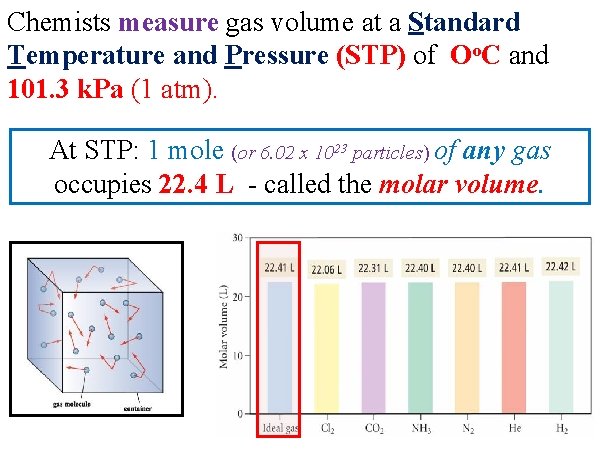
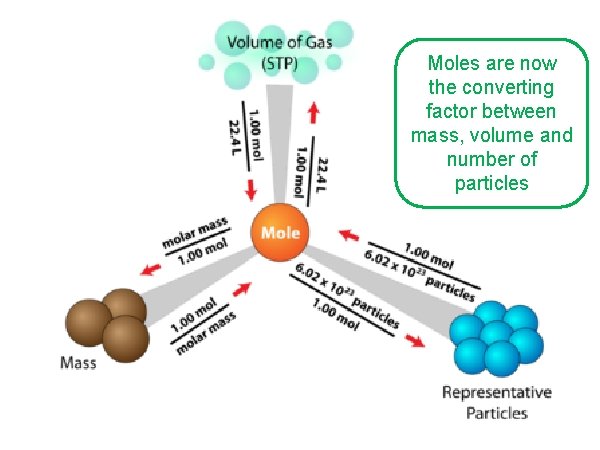
Chemists measure gas volume at a Standard Temperature and Pressure (STP) of Oo. C and 101. 3 k. Pa (1 atm). At STP: 1 mole (or 6. 02 x 1023 particles) of any gas occupies 22. 4 L - called the molar volume.
Moles are now the converting factor between mass, volume and number of particles
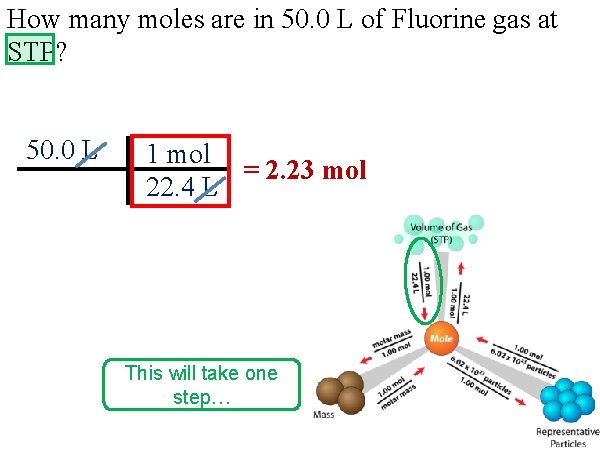
How many moles are in 50. 0 L of Fluorine gas at STP? 50. 0 L 1 mol = 2. 23 mol 22. 4 L This will take one step…
What is the STP volume of 10. 0 g of Methane gas? CH 4 = 16. 0 g/mol 10. 0 g 1 mol 16. 0 g 22. 4 L 1 mol This will take two steps… = 14. 0 L
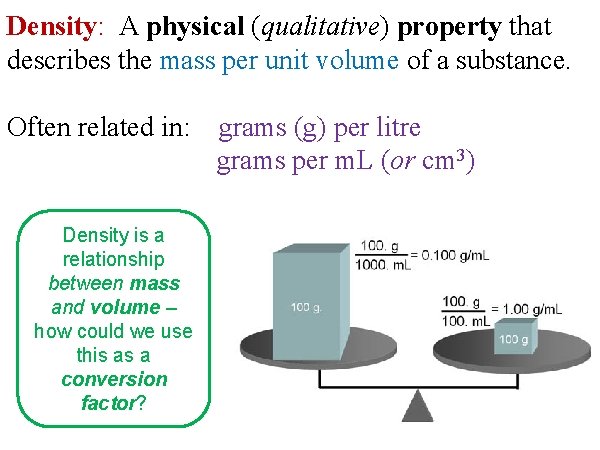
Density: A physical (qualitative) property that describes the mass per unit volume of a substance. Often related in: Density is a relationship between mass and volume – how could we use this as a conversion factor? grams (g) per litre grams per m. L (or cm 3)
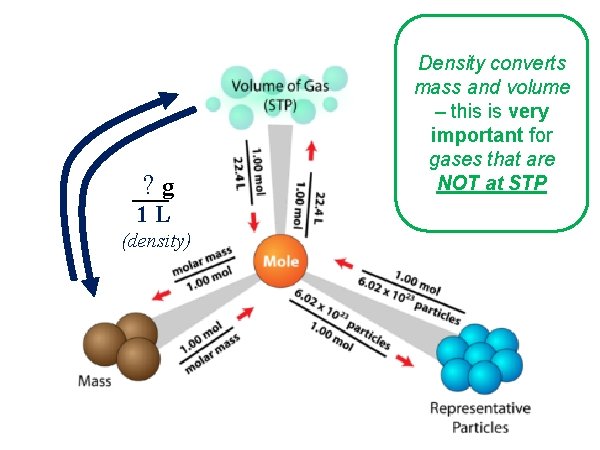
? g 1 L (density) Density converts mass and volume – this is very important for gases that are NOT at STP
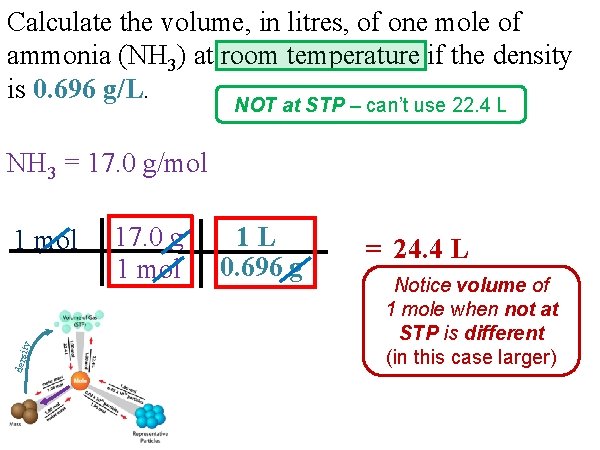
Calculate the volume, in litres, of one mole of ammonia (NH 3) at room temperature if the density is 0. 696 g/L. NOT at STP – can’t use 22. 4 L NH 3 = 17. 0 g/mol densi ty 1 mol 17. 0 g 1 mol 1 L 0. 696 g = 24. 4 L Notice volume of 1 mole when not at STP is different (in this case larger)
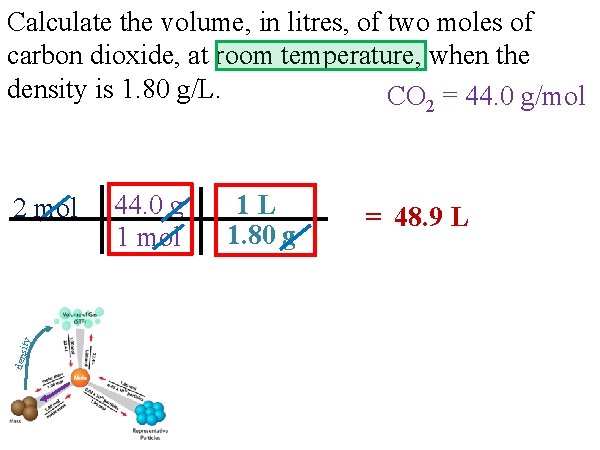
Calculate the volume, in litres, of two moles of carbon dioxide, at room temperature, when the density is 1. 80 g/L. CO 2 = 44. 0 g/mol densi ty 2 mol 44. 0 g 1 mol 1 L 1. 80 g = 48. 9 L
CAN YOU / HAVE YOU? C 11 -3 -12 MOLAR CALCULATIONS Understand the importance of the concept of the mole and calculate the molar mass of various substances. Interpret a balanced equation in terms of moles, mass, and volumes of gases. Include: molar volume Solve problems requiring interconversions between moles, mass, volume, and number of particles. Include: density Vocabulary & Concepts STP