
Molecular Structure Structure and bonding To understand molecular
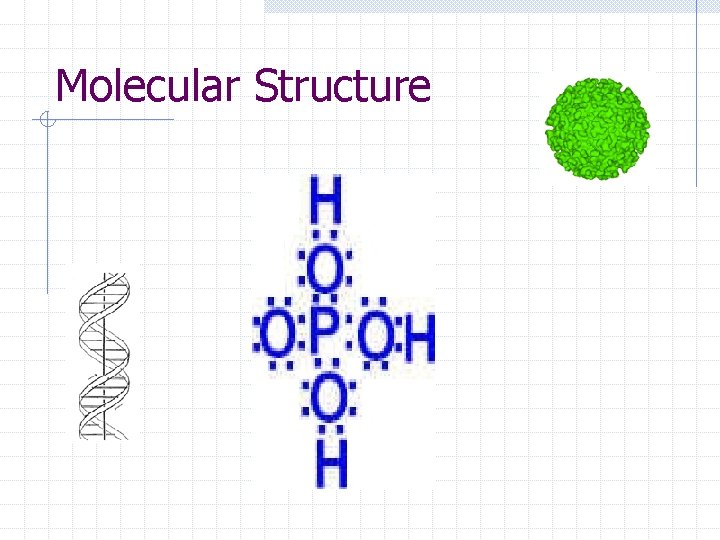
Molecular Structure
Structure and bonding To understand molecular structure, we will need an understanding of molecular bonding
Valence Electrons Valence electrons are the electrons that participate in bonding to other atoms n Core electrons do not Every element in the same group has the same number of valence electrons n This is why they have similar properties
Octet Rule Each noble gas atom has a filled outermost shell, which results in its stability All noble gases have eight valence electrons – hence the octet rule The octet rule provides a way of predicting the results of the most common reactions
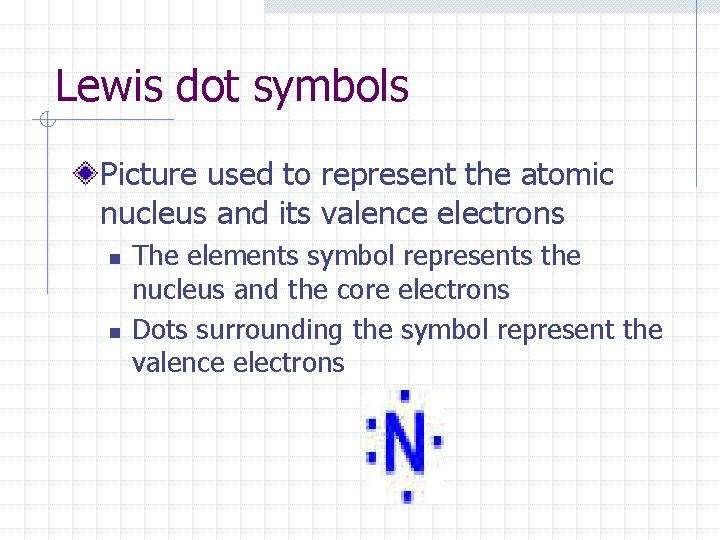
Lewis dot symbols Picture used to represent the atomic nucleus and its valence electrons n n The elements symbol represents the nucleus and the core electrons Dots surrounding the symbol represent the valence electrons
Chemical Bond Formation Covalent bond – The sharing of electrons between atoms n n n Electrons shared by two nuclei Electrons evenly distributed Usually occur between nonmetals Ionic bond – if the electrons involved are strongly displaced toward one atom and away from the other n Involve metals interacting with nonmetals
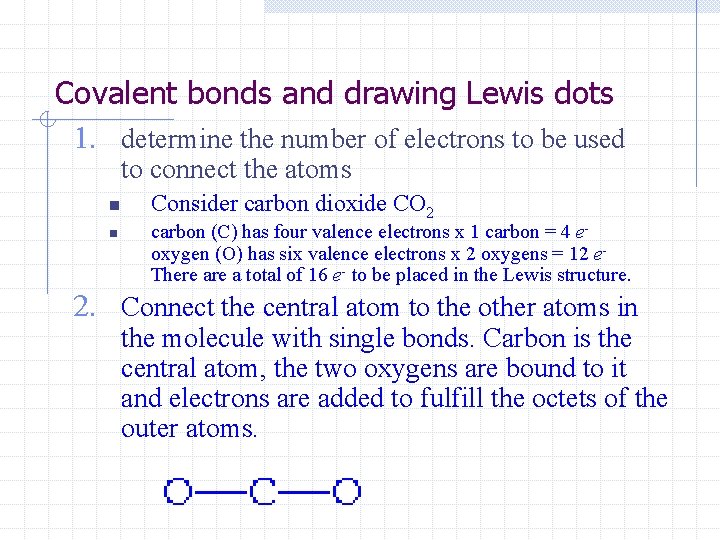
Covalent bonds and drawing Lewis dots 1. determine the number of electrons to be used to connect the atoms n n Consider carbon dioxide CO 2 carbon (C) has four valence electrons x 1 carbon = 4 eoxygen (O) has six valence electrons x 2 oxygens = 12 e. There a total of 16 e- to be placed in the Lewis structure. 2. Connect the central atom to the other atoms in the molecule with single bonds. Carbon is the central atom, the two oxygens are bound to it and electrons are added to fulfill the octets of the outer atoms.
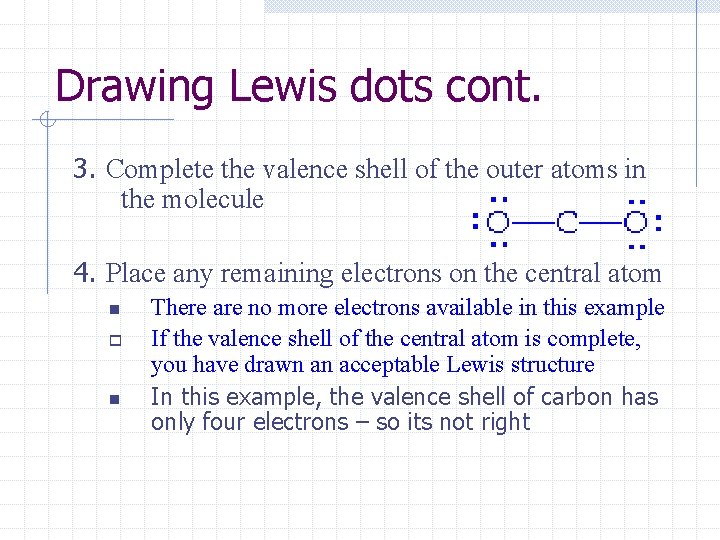
Drawing Lewis dots cont. 3. Complete the valence shell of the outer atoms in the molecule 4. Place any remaining electrons on the central atom n o n There are no more electrons available in this example If the valence shell of the central atom is complete, you have drawn an acceptable Lewis structure In this example, the valence shell of carbon has only four electrons – so its not right
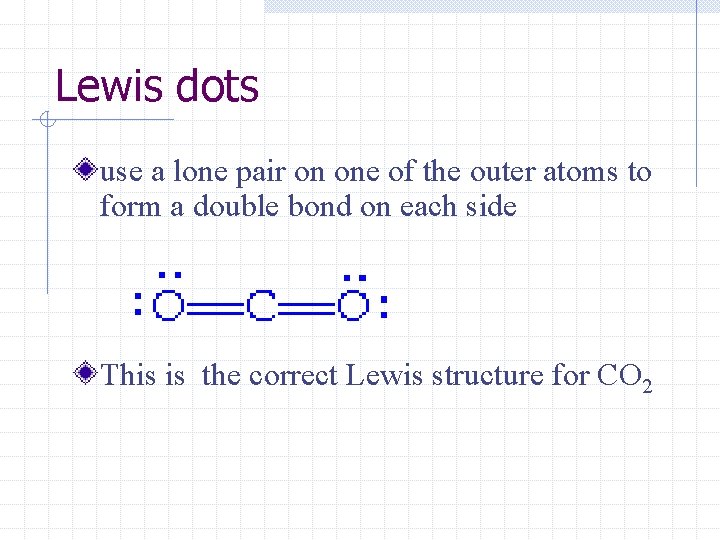
Lewis dots use a lone pair on one of the outer atoms to form a double bond on each side This is the correct Lewis structure for CO 2
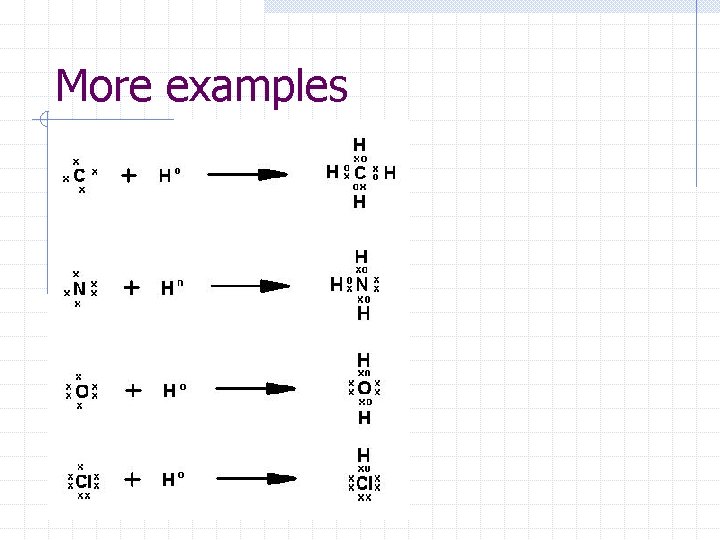
More examples f
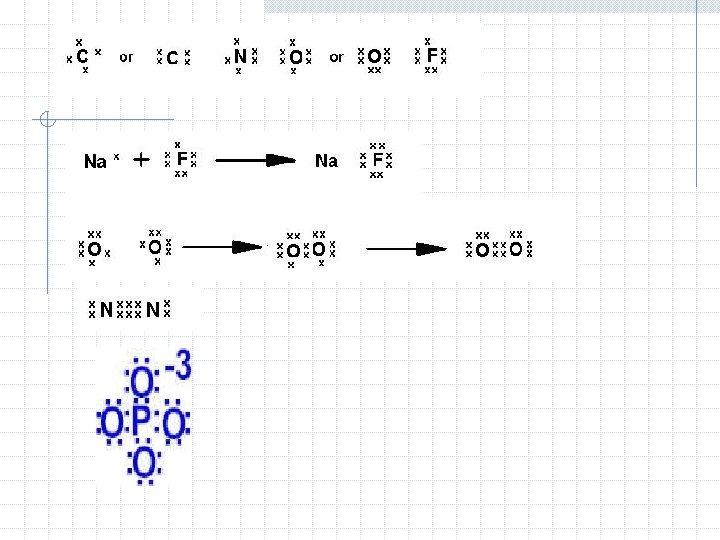
Practice Draw the Lewis structures for the following compounds (5 points) n n n CO Cl 2 CO H 2 O C 2 H 4 SCl 2 N 2 Homework: 1 -3 page 202 (5 points)
Resonance Structures For some molecules, you will find that there are two or more possible ways to draw the Lewis structures Linus Pauling proposed theory of resonance to deal with this problem Paulings theory combines the structures into a composite or resonance hybrid, a single structure formed by the combination of equivalent contributing structures
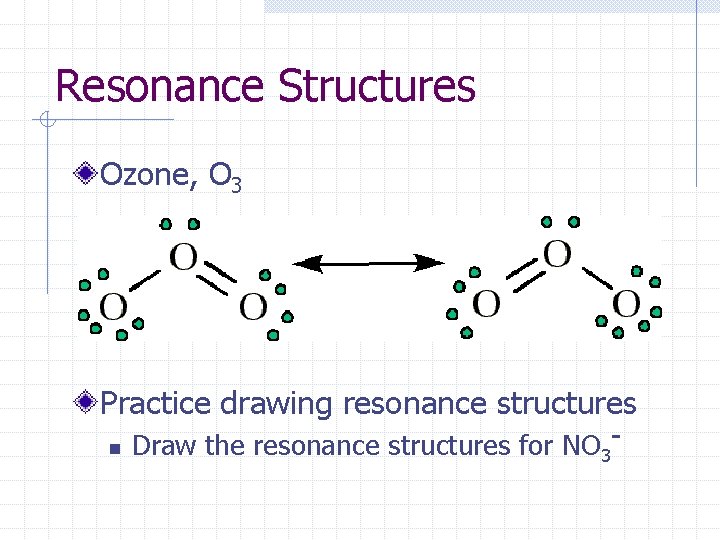
Resonance Structures Ozone, O 3 Practice drawing resonance structures n Draw the resonance structures for NO 3 -
Assignment 7 -9 page 204 10 points
Exceptions to the Octet Rule Some compounds have fewer than four pairs of electrons around the central atom n Compounds with hydrogen Some compounds have atoms with more than eight valence electrons n Elements of period 3 or higher w PF 5 w Compounds of noble gases Draw the Lewis structure for [Cl. F 2]-
Molecules with an odd number of electrons Place the odd electron on the central atom n Draw the Lewis dot structure for NO Any atom or molecule with an unpaired electron is called a Free Radical n n n Free radicals are very reactive Are central to formation of air pollutants Can combine with themselves to form dimers
Bond properties – Bond order The order of a bond is the number of bonding electron pairs shared by two atoms in a molecule Bond orders will usually be between 1 and 3 A fractional bond order is possible in molecules and ions having resonance structures Bond order = number of shared pairs divided by number of links
Bond Length Bond length is the distance between the nuclei of two bonded atoms Is largely determined by the size of the atoms Bonds become shorter as the bond order increases n A triple bond is shorter than a double bond is shorter than a single bond
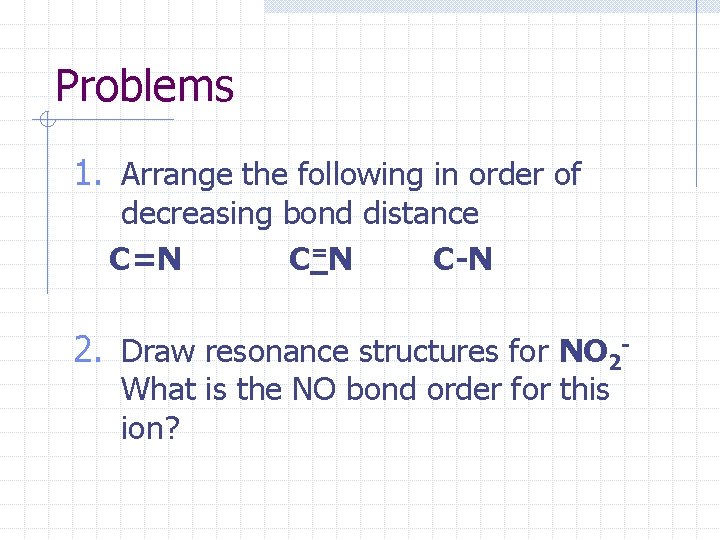
Problems 1. Arrange the following in order of decreasing bond distance C=N C-N 2. Draw resonance structures for NO 2 What is the NO bond order for this ion?
Bond Energy The bond dissociation energy, D, is the enthalpy (H=U + PV) change for breaking a bond in a molecule with the reactants and products in the noble gas phase under standard conditions The process of breaking bonds in a molecule is always endothermic The process of forming bonds is always exothermic
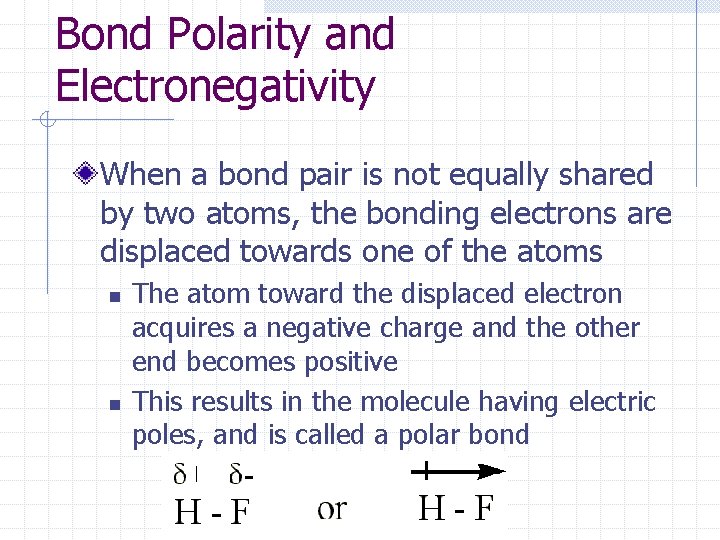
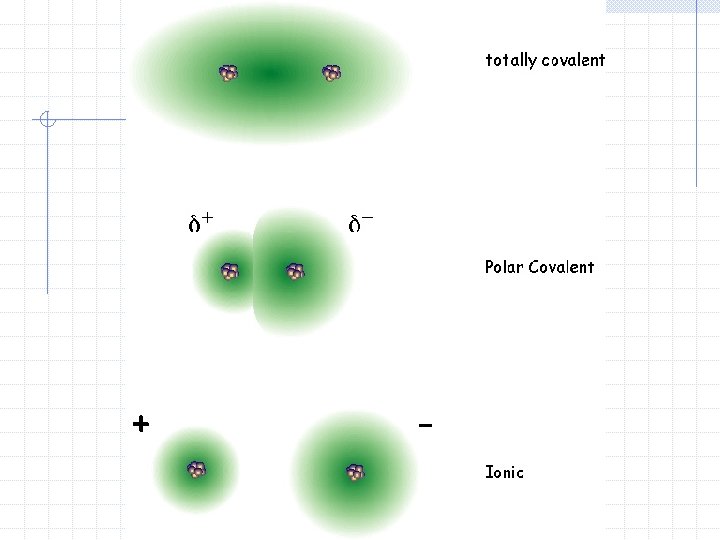
Bond Polarity and Electronegativity When a bond pair is not equally shared by two atoms, the bonding electrons are displaced towards one of the atoms n n The atom toward the displaced electron acquires a negative charge and the other end becomes positive This results in the molecule having electric poles, and is called a polar bond
Bond Polarity and Electronegativity If the displacement is complete, the bond is ionic If the displacement is less than complete, the bond is a polar covalent bond If no displacement occurs, the bond is nonpolar covalent
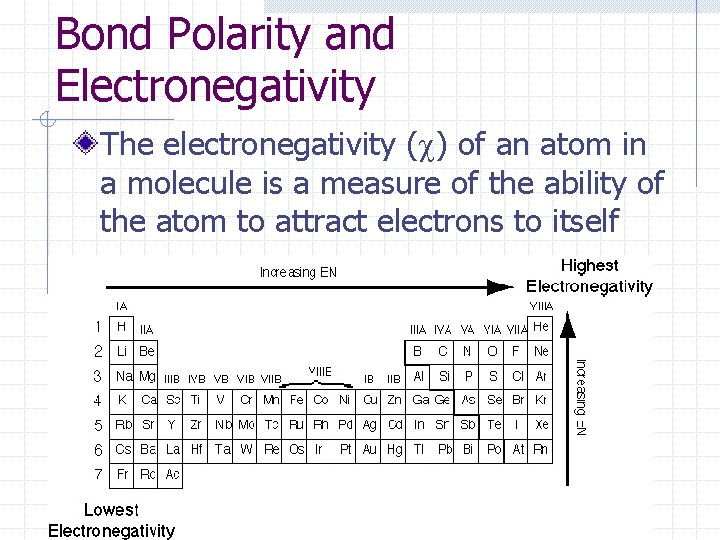
Bond Polarity and Electronegativity The electronegativity ( ) of an atom in a molecule is a measure of the ability of the atom to attract electrons to itself
Problems For each of the following, tell which bond pair is more polar and indicate the negative and positive poles 1. Li-F and Li-I 2. C-S and P-P 3. C=O and C=S
Oxidation Numbers Why do atoms have the oxidation numbers that they do?
Formal Charges on Atoms The formal charge of an atom is an estimate of atom charges in a molecule Atom formal charge = group number – number of lone pair electrons – ½ (number of bonding electrons) Atoms in molecules should have formal charges as small as possible (principle of electroneutrality) A molecule is most stable when any negative charge resides on the most electronegative atom
Formal Charges on Atoms Use your knowledge of formal charges to decide which resonance structures of the following molecules are most stable 1. CO 2 2. HOCN
Molecular Shape 3 -dimensional analysis Use the Valence Shell Electron-pair Repulsion (VSEPR) model We will look at these trends n n n Central atoms with only bond pairs Central atoms with bond pairs and lone pairs Multiple bonds
VSEPR Model Valence Shell Electron Pair Repulsion is a simple but effective model for predicting molecular geometry. The first assumption of VSEPR is: n A molecule adopts the geometry that minimizes the repulsive force among a given number of electron pairs.
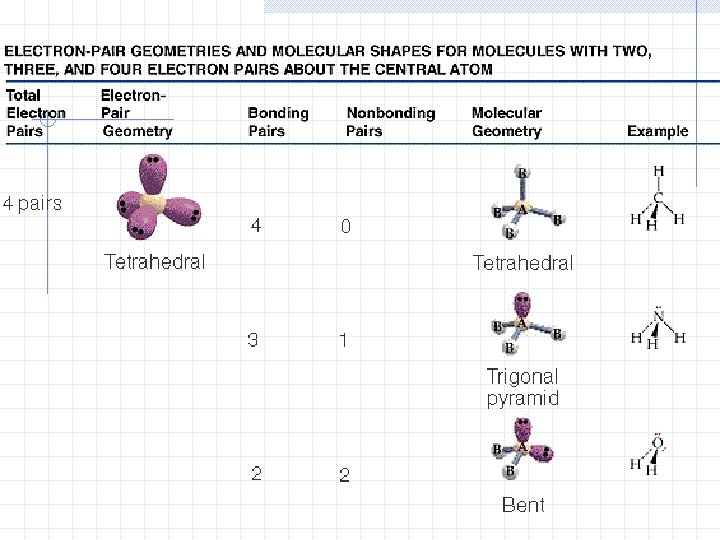
Applying VSEPR Draw the Lewis structure of the molecule Count the number of electron pairs around the central atom. Multiple bonds count as one electron pair The arrangement of electron pairs that minimizes repulsion is called the electron-pair geometry The arrangement of atoms is called the molecular geometry
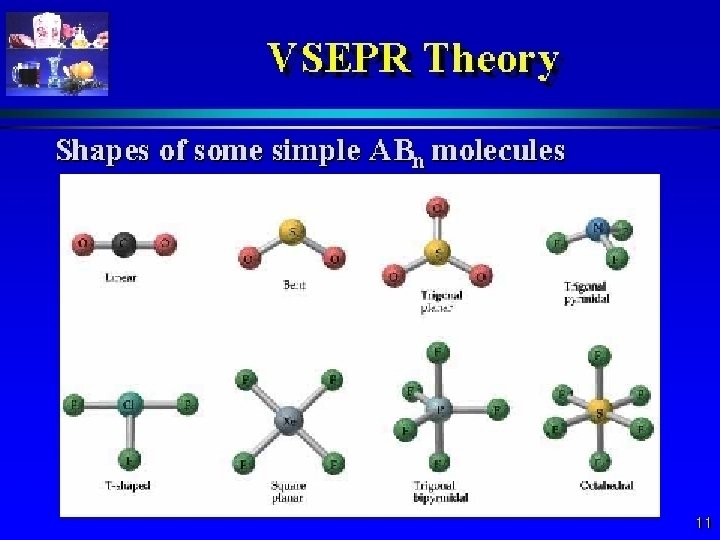
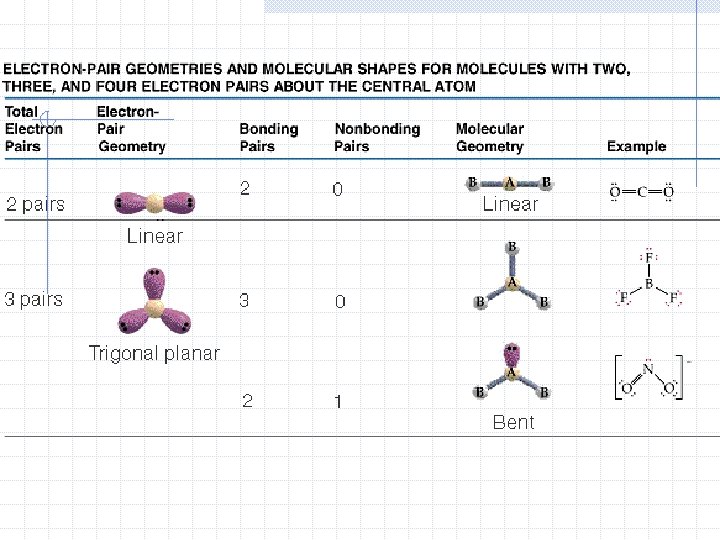
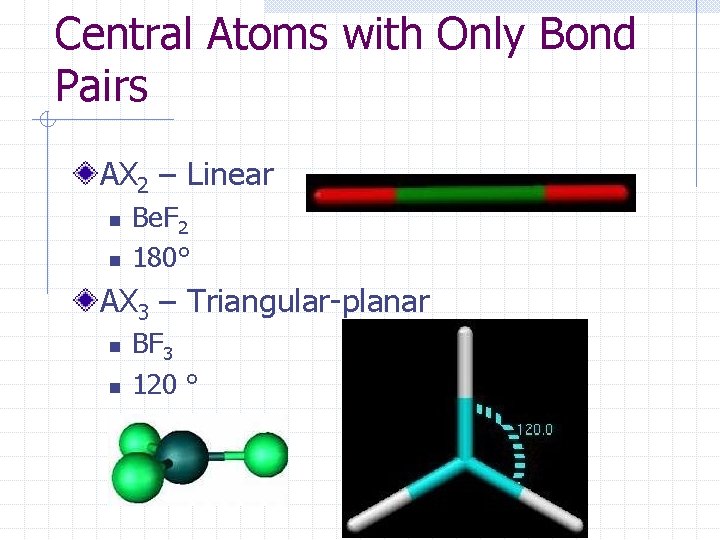
Central Atoms with Only Bond Pairs AX 2 – Linear n n Be. F 2 180° AX 3 – Triangular-planar n n BF 3 120 °
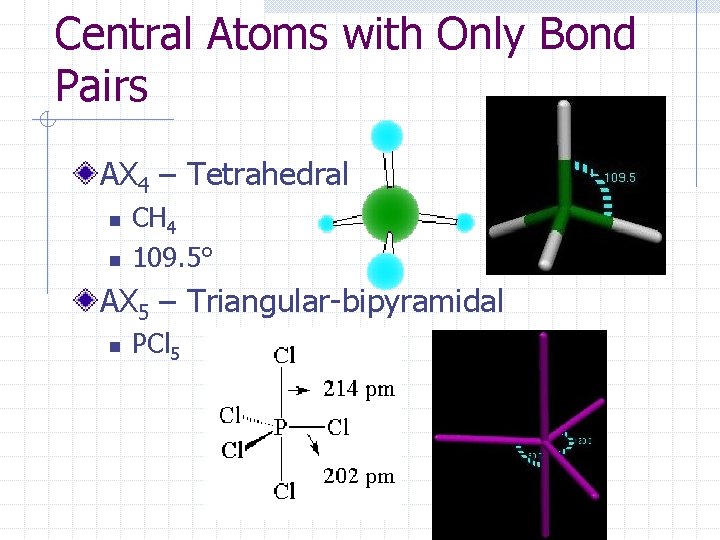
Central Atoms with Only Bond Pairs AX 4 – Tetrahedral n n CH 4 109. 5° AX 5 – Triangular-bipyramidal n PCl 5
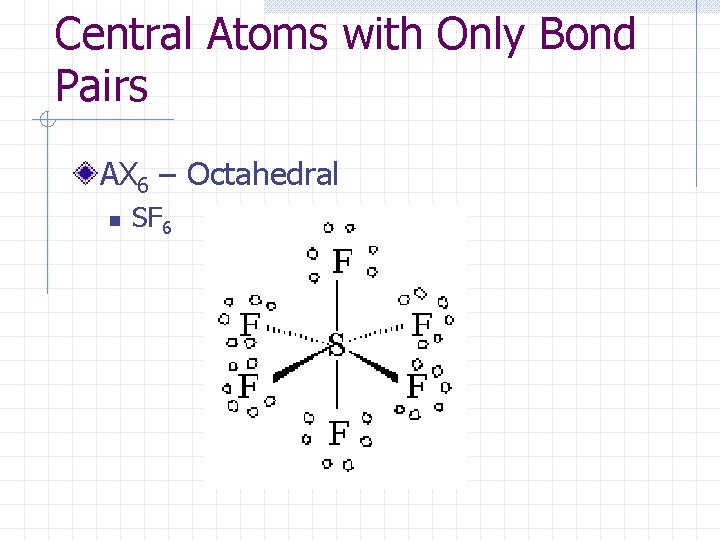
Central Atoms with Only Bond Pairs AX 6 – Octahedral n SF 6
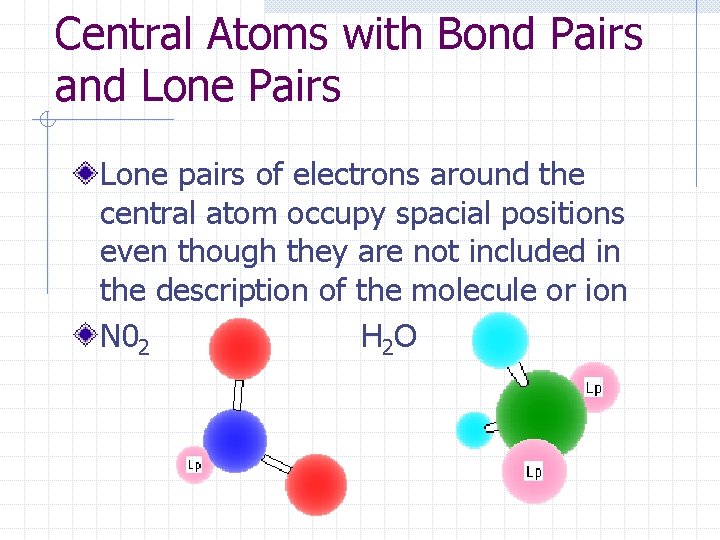
Central Atoms with Bond Pairs and Lone Pairs Lone pairs of electrons around the central atom occupy spacial positions even though they are not included in the description of the molecule or ion N 02 H 2 O
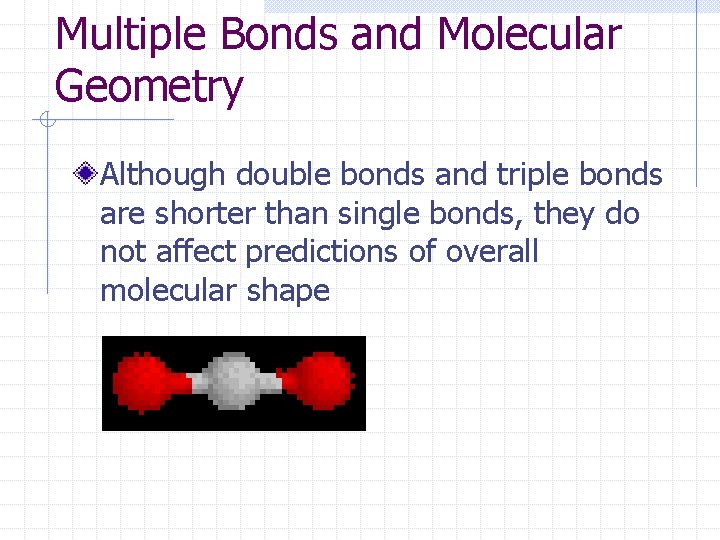
Multiple Bonds and Molecular Geometry Although double bonds and triple bonds are shorter than single bonds, they do not affect predictions of overall molecular shape
Exercise Use VSEPR rules to predict the shapes and geometries of the central atoms of the molecules on the handout
Molecular Polarity For each of the following molecules decide whether the molecule is polar and which side is positive and which is negative 1. 2. 3. BFCl 2 NH 2 Cl SCl 2

That’s It! STUDY FOR YOUR TEST!!!
- Slides: 44