
Molecular Structure of Biological Systems Intermolecular and Intramolecular
Molecular Structure of Biological Systems (Inter-molecular and Intra-molecular Forces)
Physical properties of biological systems on the molecular level Two kinds of physical behavior meet on the molecular level of biological structures: • On the one hand, there are the characteristic properties of microphysical processes, based on the individual behavior of single small particles like atoms, molecules, or supramolecular structures. These processes are mostly stochastic (non-deterministic so that the subsequent state of the system is determined probabilistically). • On the other hand, there are reactions which resemble macrophysical properties, the kind of behavior of “large” bodies. Our daily experiences with macrophysical systems teach us that their behavior is generally deterministic.
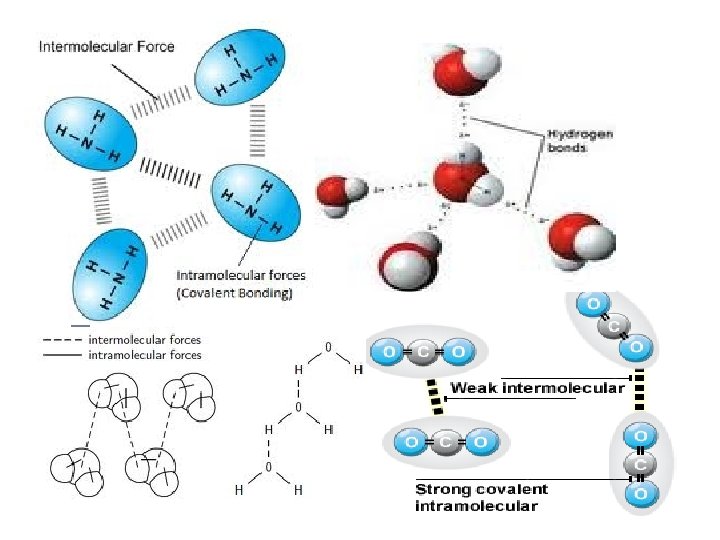
Inter and Intra-molecular Forces � Intermolecular � Forces between a molecule � Is what attracts molecules to each other � Intramolecular � Forces within the molecule � Is what keeps molecules together
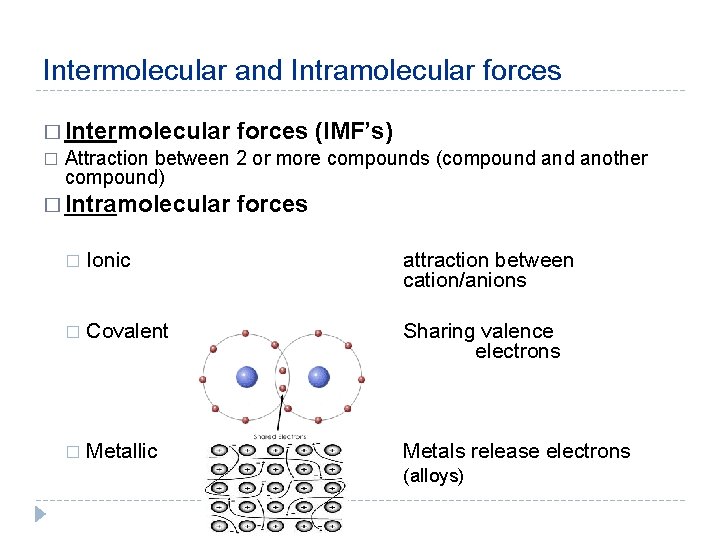
Intermolecular and Intramolecular forces � Intermolecular � forces (IMF’s) Attraction between 2 or more compounds (compound another compound) � Intramolecular forces � Ionic attraction between cation/anions � Covalent Sharing valence electrons � Metallic Metals release electrons (alloys)
Intermolecular Forces and physical properties � The strength of intermolecular forces determines the following physical properties of molecular compounds; � Physical state of a compound � Melting point � Boiling point � Surface tension � Hardness and texture � Solubility
3 Main IMF’s � 1. Hydrogen bonds (H-Bonds) � 2. Dipole-Dipole � 3. London Dispersion Forces (Van Der Woals)
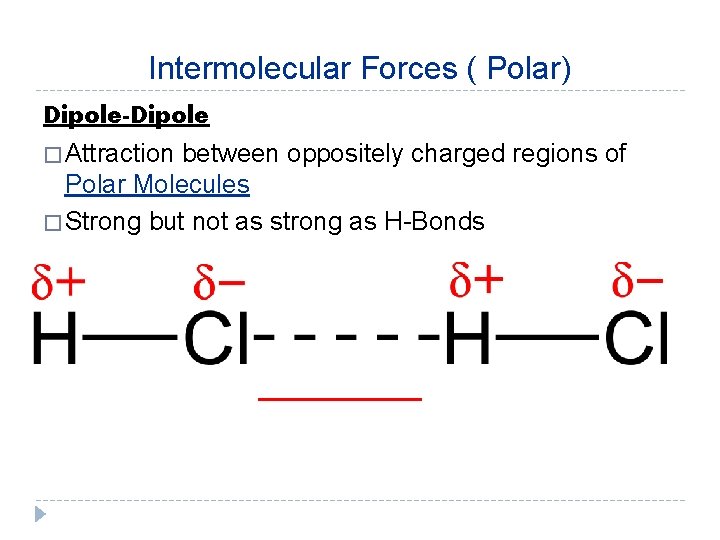
Intermolecular Forces ( Polar) Dipole-Dipole � Attraction between oppositely charged regions of Polar Molecules � Strong but not as strong as H-Bonds
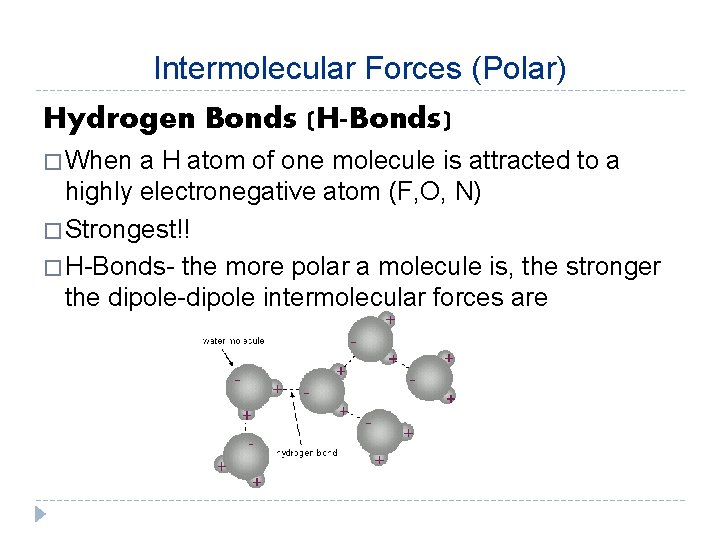
Intermolecular Forces (Polar) Hydrogen Bonds (H-Bonds) � When a H atom of one molecule is attracted to a highly electronegative atom (F, O, N) � Strongest!! � H-Bonds- the more polar a molecule is, the stronger the dipole-dipole intermolecular forces are
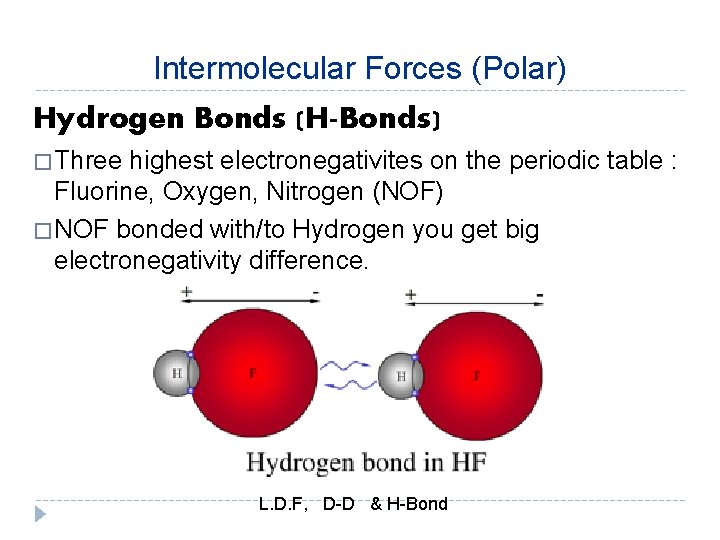
Intermolecular Forces (Polar) Hydrogen Bonds (H-Bonds) � Three highest electronegativites on the periodic table : Fluorine, Oxygen, Nitrogen (NOF) � NOF bonded with/to Hydrogen you get big electronegativity difference. L. D. F, D-D & H-Bond
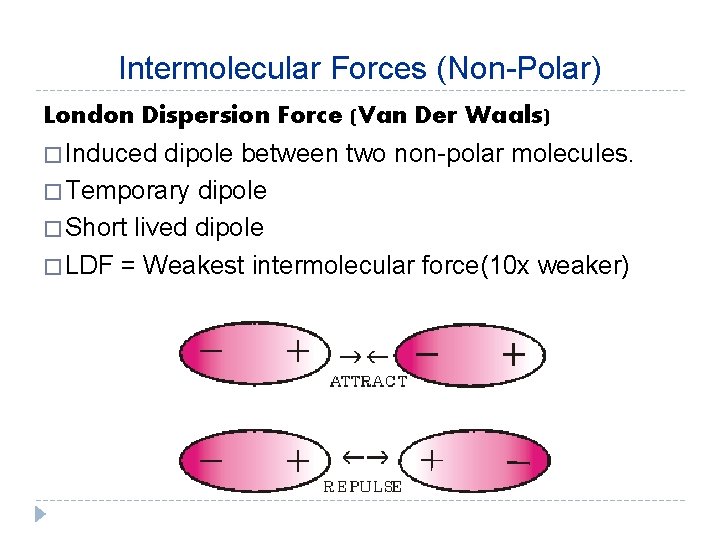
Intermolecular Forces (Non-Polar) London Dispersion Force (Van Der Waals) � Induced dipole between two non-polar molecules. � Temporary dipole � Short lived dipole � LDF = Weakest intermolecular force(10 x weaker)
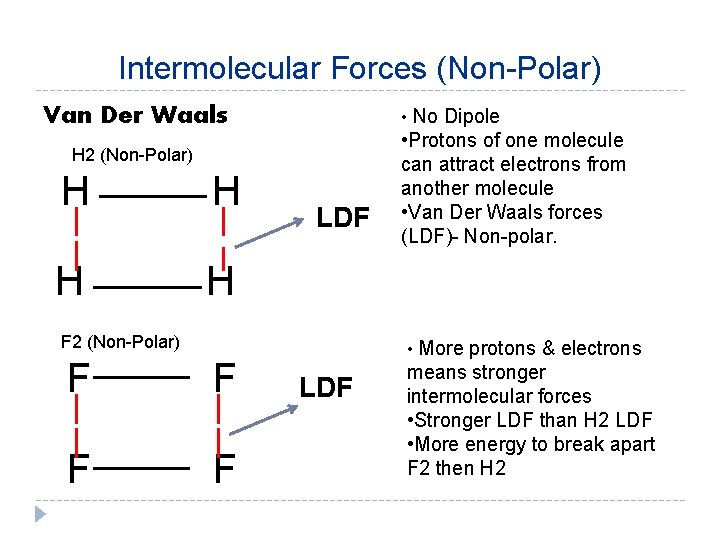
Intermolecular Forces (Non-Polar) Van Der Waals • No Dipole H 2 (Non-Polar) H H LDF F 2 (Non-Polar) F F • Protons of one molecule can attract electrons from another molecule • Van Der Waals forces (LDF)- Non-polar. • More protons & electrons LDF means stronger intermolecular forces • Stronger LDF than H 2 LDF • More energy to break apart F 2 then H 2
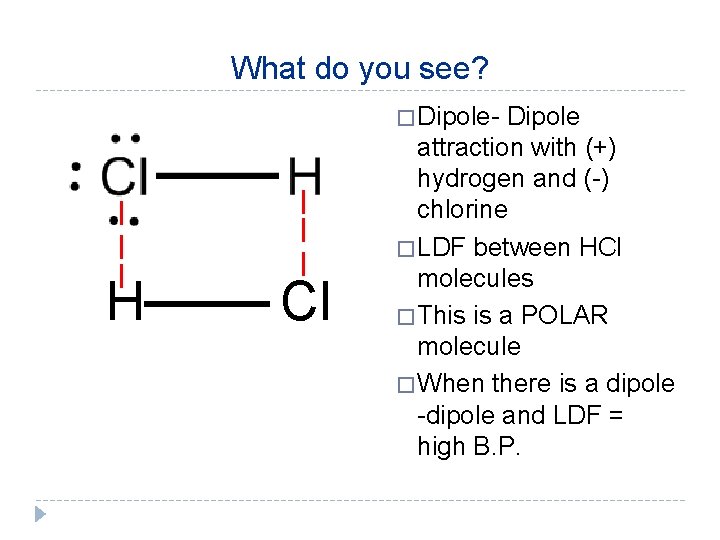
What do you see? � Dipole- H Cl Dipole attraction with (+) hydrogen and (-) chlorine � LDF between HCl molecules � This is a POLAR molecule � When there is a dipole -dipole and LDF = high B. P.
Difference between inter & intra molecular forces � Intermolecular forces are formed between molecules and intramolecular forces are formed within molecules � Intra molecular forces are much stronger compared to intermolecular forces � Covalent, Ionic and Metallic bonding are types of intramolecular forces � Dipole-Dipole, Dipole-Induced dispersion forces and hydrogen bonding are some of the examples of intermolecular forces.
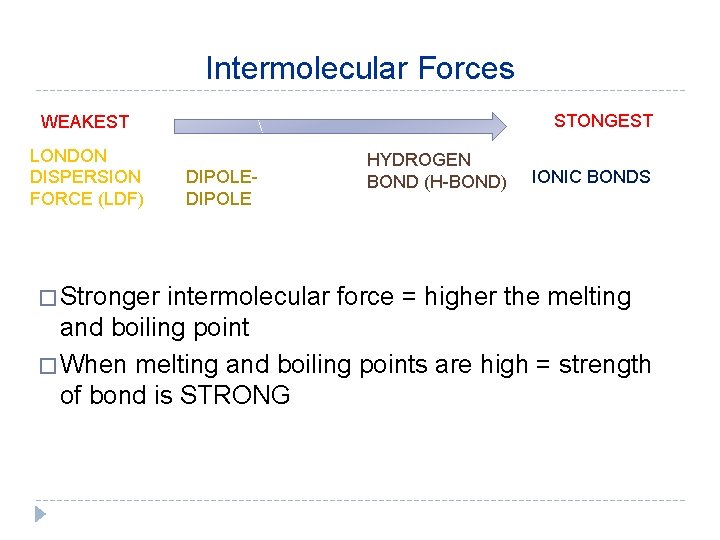
Intermolecular Forces STONGEST WEAKEST LONDON DISPERSION FORCE (LDF) � Stronger DIPOLE HYDROGEN BOND (H-BOND) IONIC BONDS intermolecular force = higher the melting and boiling point � When melting and boiling points are high = strength of bond is STRONG
- Slides: 15