
Molecular Spectroscopy Svetlana Berdyugina Kiepenheuer Institut fr Sonnenphysik
Molecular Spectroscopy Svetlana Berdyugina Kiepenheuer Institut für Sonnenphysik, Freiburg, Germany Hot Molecules in Exoplanets and Inner Disks
Outline 1. Observed spectra: band structure 2. Electronic energy: angular momentum, spin, quantum numbers, term notation 3. Vibrational energy: (an)harmonic oscillator 4. Rotational energy: models of rotators (dumbbell…) 5. Combining different contributions: Vibrating rotator Structure of electronic band systems 6. Multi-atomic molecules: Vibrations
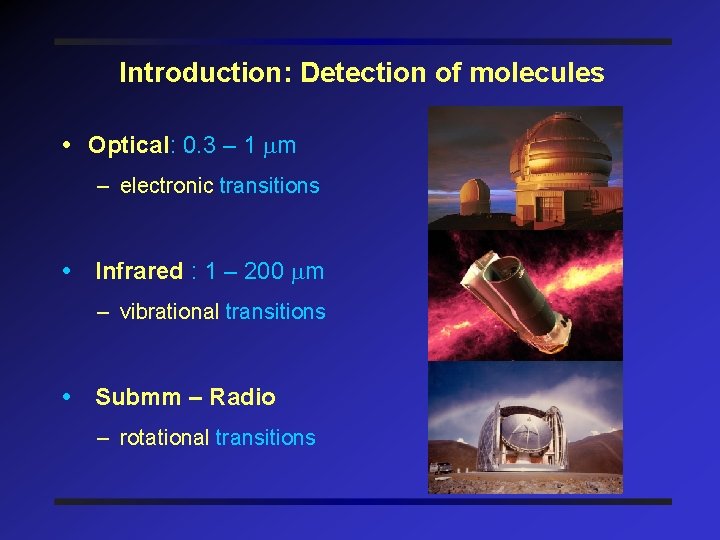
Introduction: Detection of molecules Optical: 0. 3 – 1 m – electronic transitions Infrared : 1 – 200 m – vibrational transitions Submm – Radio – rotational transitions
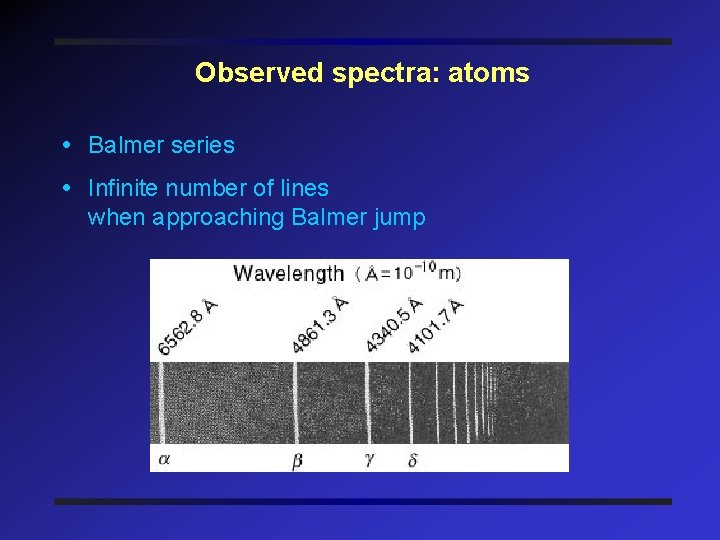
Observed spectra: atoms Balmer series Infinite number of lines when approaching Balmer jump
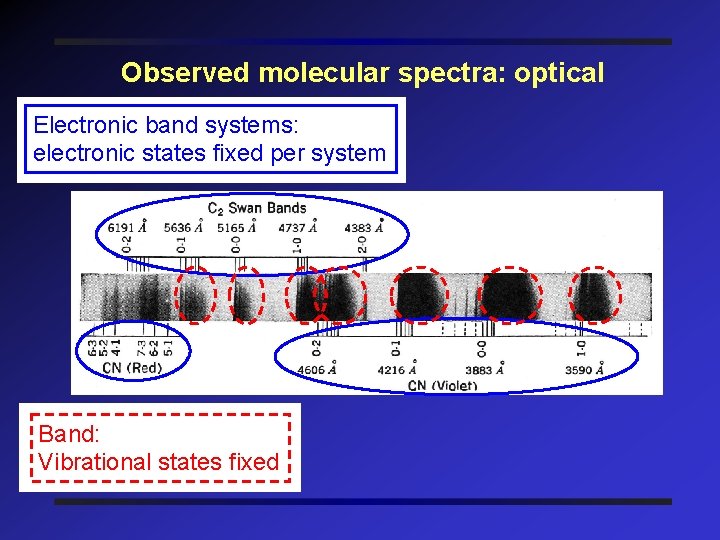
Observed molecular spectra: optical Electronic band systems: electronic states fixed per system Band: Vibrational states fixed
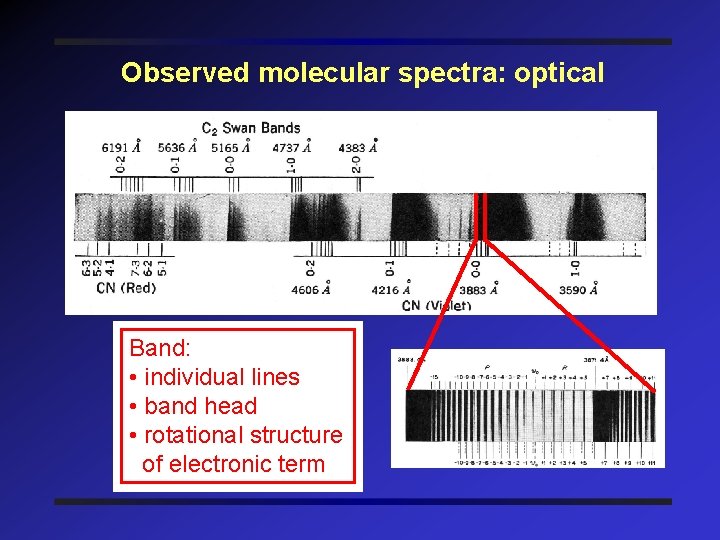
Observed molecular spectra: optical Band: • individual lines • band head • rotational structure of electronic term
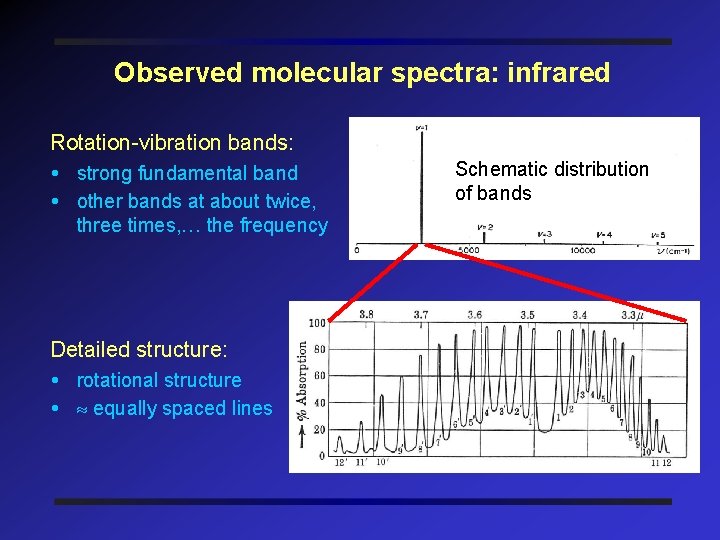
Observed molecular spectra: infrared Rotation-vibration bands: strong fundamental band other bands at about twice, three times, … the frequency Detailed structure: rotational structure equally spaced lines Schematic distribution of bands
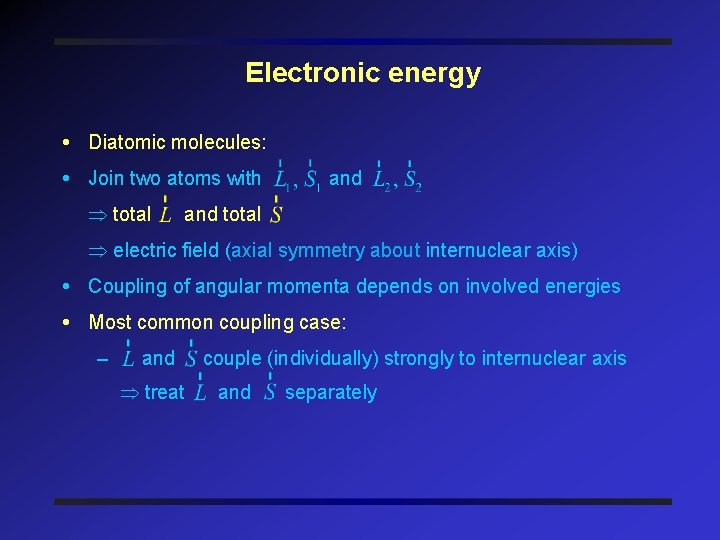
Electronic energy Diatomic molecules: Join two atoms with total and total electric field (axial symmetry about internuclear axis) Coupling of angular momenta depends on involved energies Most common coupling case: – and treat couple (individually) strongly to internuclear axis and separately
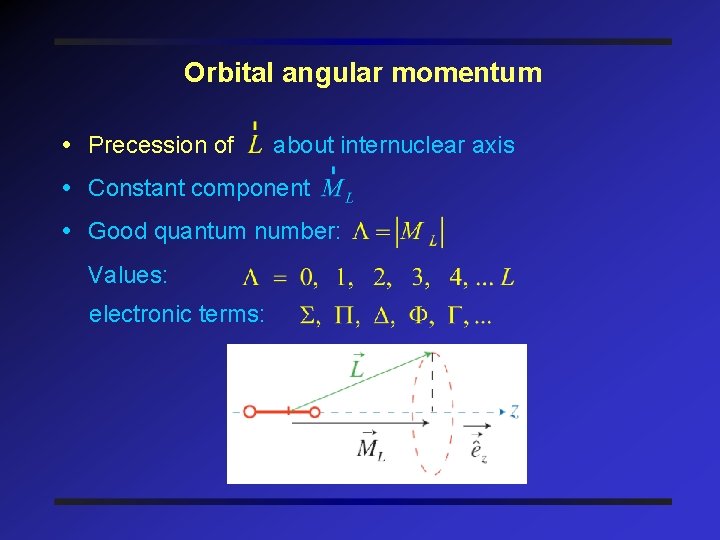
Orbital angular momentum Precession of about internuclear axis Constant component Good quantum number: Values: electronic terms:
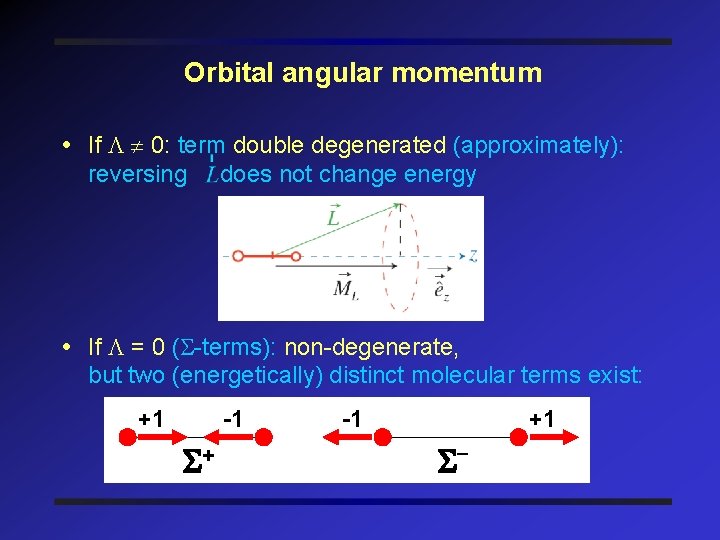
Orbital angular momentum If 0: term double degenerated (approximately): reversing does not change energy If = 0 ( -terms): non-degenerate, but two (energetically) distinct molecular terms exist: +1 -1 + -1 +1
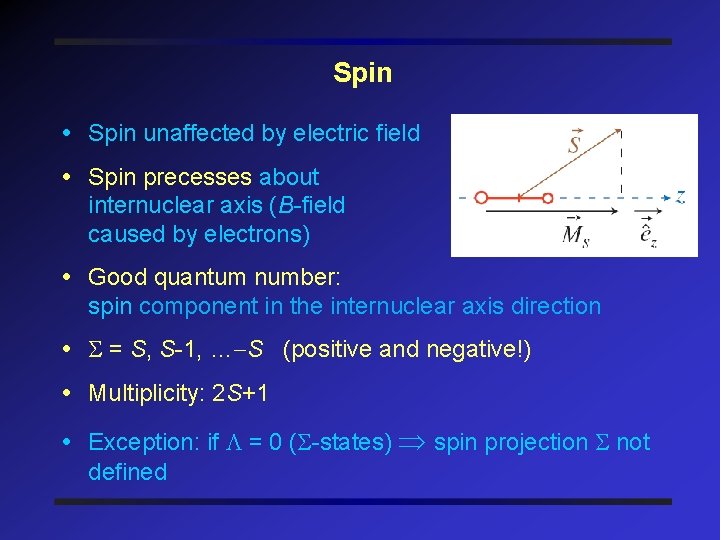
Spin unaffected by electric field Spin precesses about internuclear axis (B-field caused by electrons) Good quantum number: spin component in the internuclear axis direction = S, S-1, … S (positive and negative!) Multiplicity: 2 S+1 Exception: if = 0 ( -states) spin projection not defined
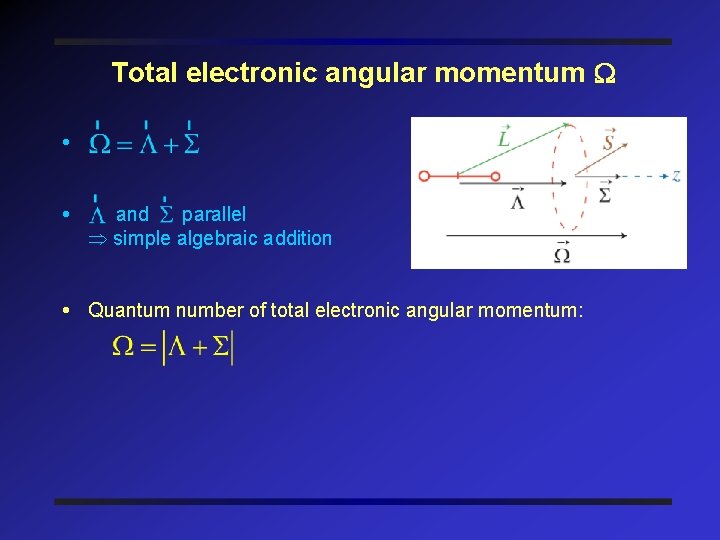
Total electronic angular momentum and parallel simple algebraic addition Quantum number of total electronic angular momentum:
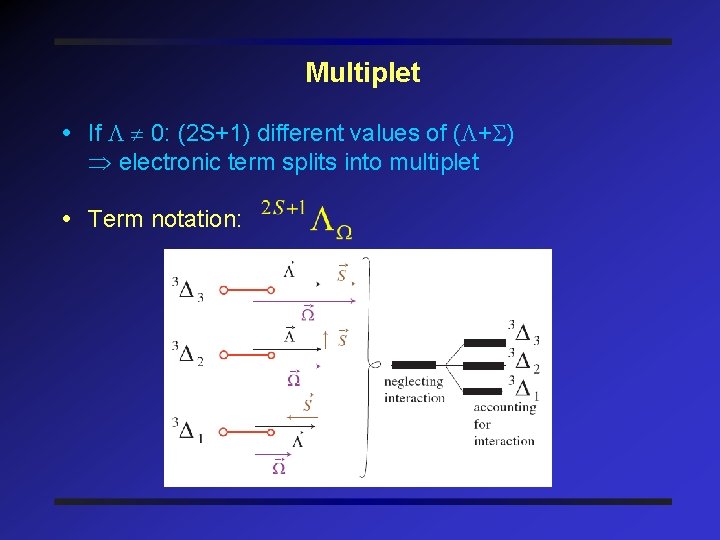
Multiplet If 0: (2 S+1) different values of ( + ) electronic term splits into multiplet Term notation:
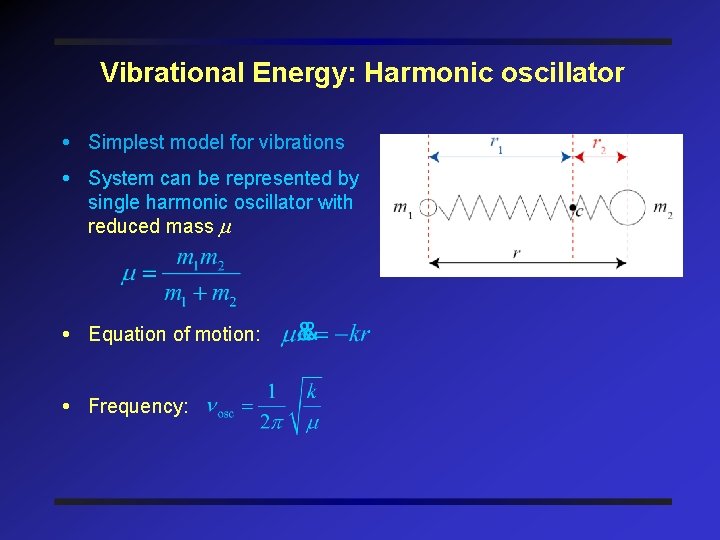
Vibrational Energy: Harmonic oscillator Simplest model for vibrations System can be represented by single harmonic oscillator with reduced mass Equation of motion: Frequency:
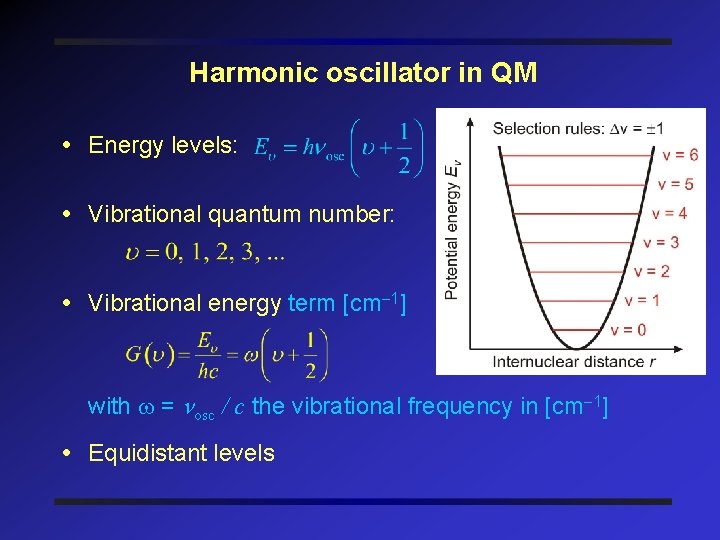
Harmonic oscillator in QM Energy levels: Vibrational quantum number: Vibrational energy term [cm 1] with = osc / c the vibrational frequency in [cm 1] Equidistant levels
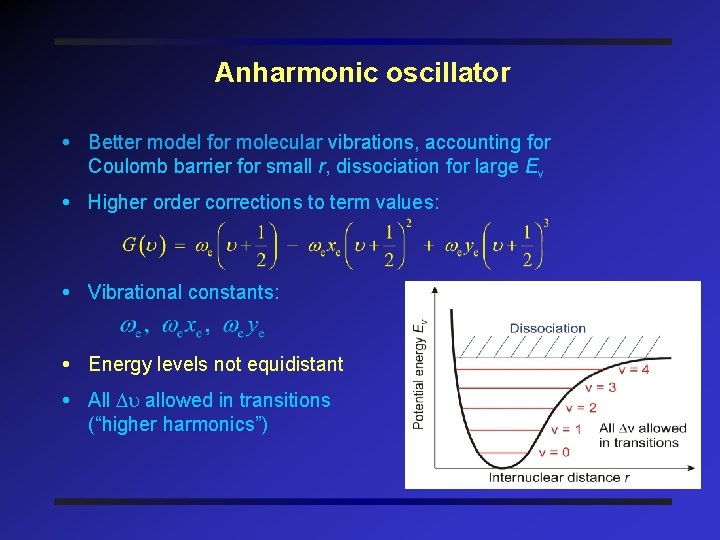
Anharmonic oscillator Better model for molecular vibrations, accounting for Coulomb barrier for small r, dissociation for large Ev Higher order corrections to term values: Vibrational constants: Energy levels not equidistant All allowed in transitions (“higher harmonics”)
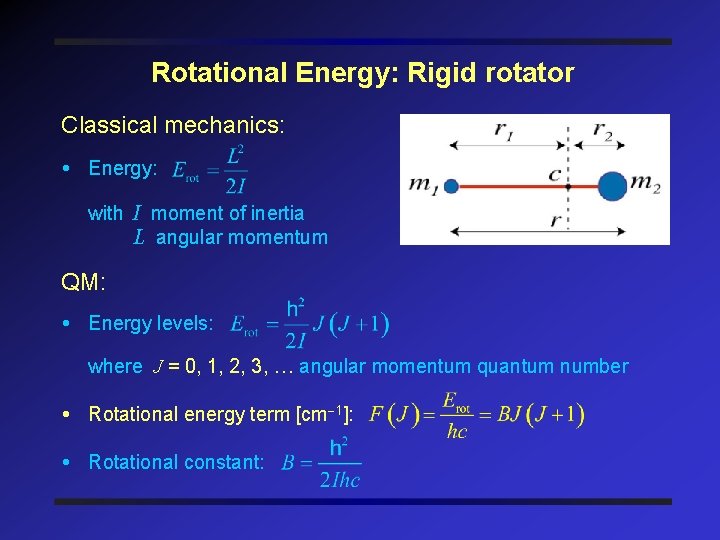
Rotational Energy: Rigid rotator Classical mechanics: Energy: with I moment of inertia L angular momentum QM: Energy levels: where J = 0, 1, 2, 3, … angular momentum quantum number Rotational energy term [cm 1]: Rotational constant:
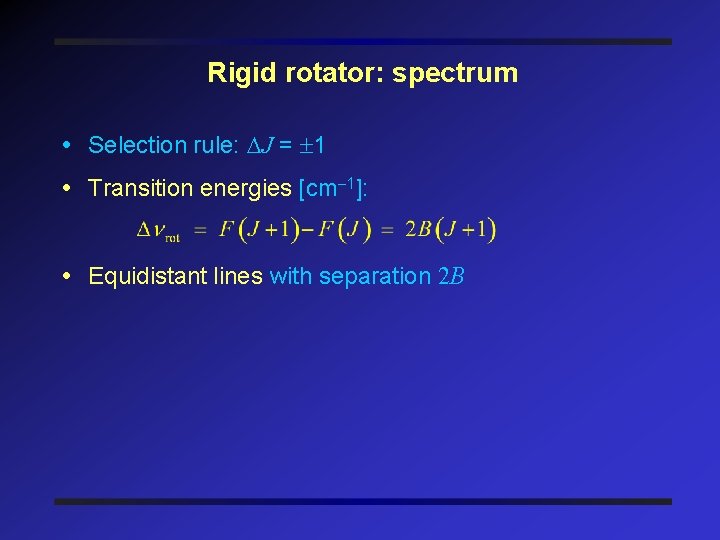
Rigid rotator: spectrum Selection rule: J = 1 Transition energies [cm 1]: Equidistant lines with separation 2 B
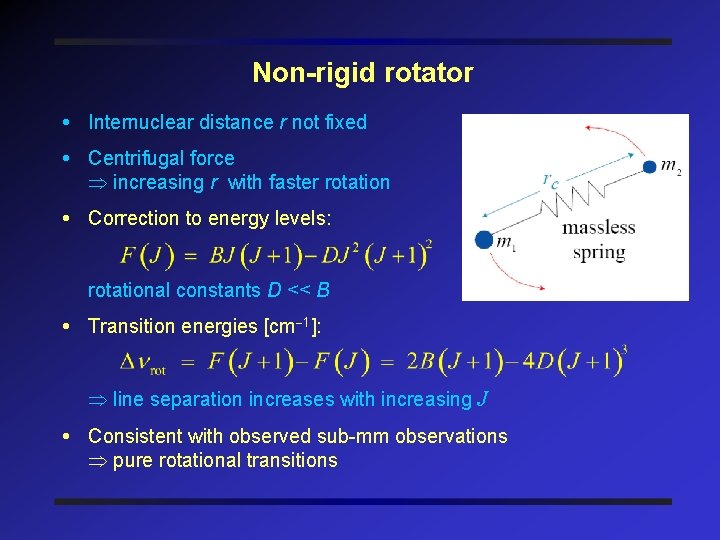
Non-rigid rotator Internuclear distance r not fixed Centrifugal force increasing r with faster rotation Correction to energy levels: rotational constants D << B Transition energies [cm 1]: line separation increases with increasing J Consistent with observed sub-mm observations pure rotational transitions
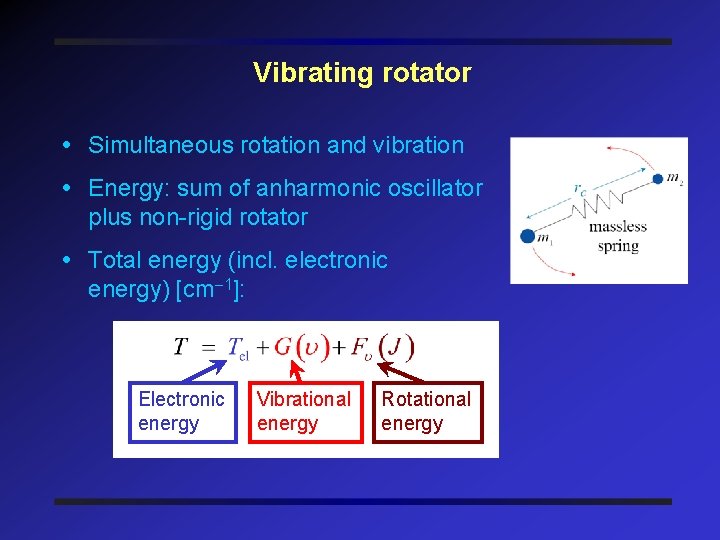
Vibrating rotator Simultaneous rotation and vibration Energy: sum of anharmonic oscillator plus non-rigid rotator Total energy (incl. electronic energy) [cm 1]: Electronic energy Vibrational energy Rotational energy
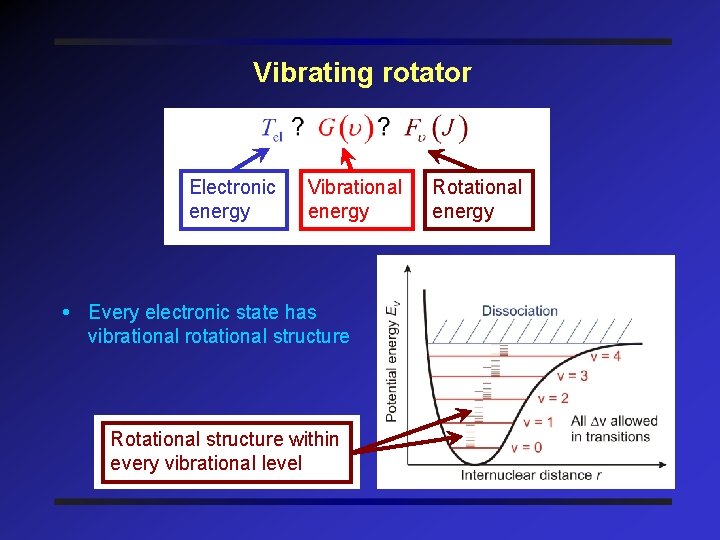
Vibrating rotator Electronic energy Vibrational energy Every electronic state has vibrational rotational structure Rotational structure within every vibrational level Rotational energy
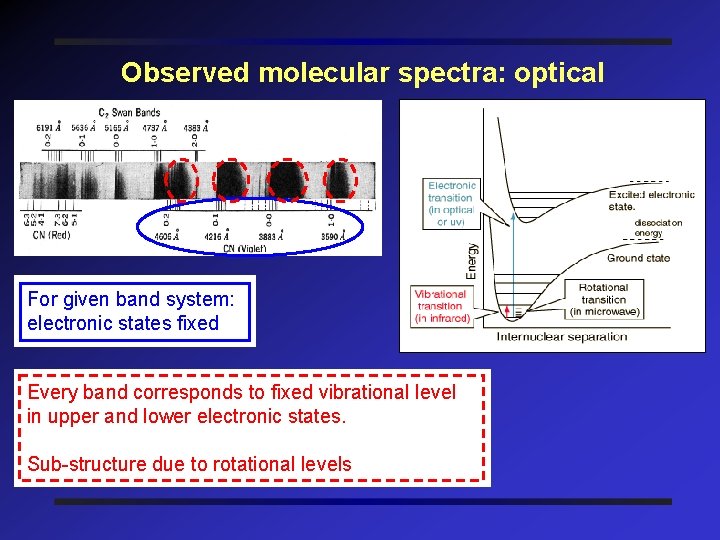
Observed molecular spectra: optical For given band system: electronic states fixed Every band corresponds to fixed vibrational level in upper and lower electronic states. Sub-structure due to rotational levels
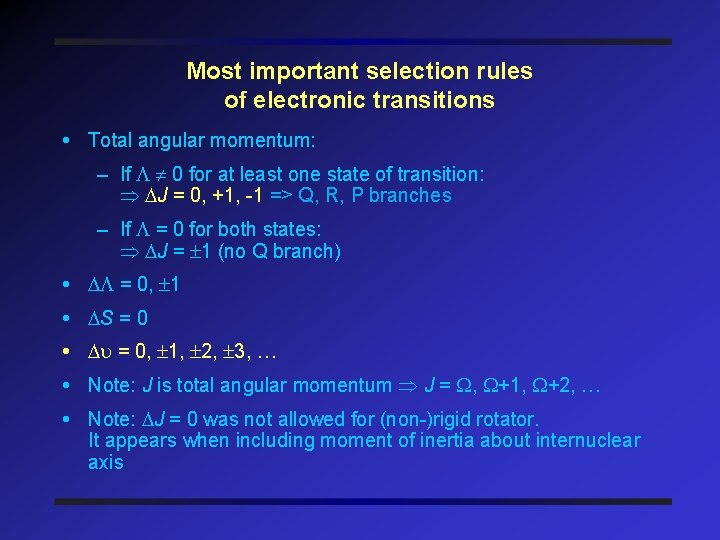
Most important selection rules of electronic transitions Total angular momentum: – If 0 for at least one state of transition: J = 0, +1, -1 => Q, R, P branches – If = 0 for both states: J = 1 (no Q branch) = 0, 1 S = 0, 1, 2, 3, … Note: J is total angular momentum J = , +1, +2, … Note: J = 0 was not allowed for (non-)rigid rotator. It appears when including moment of inertia about internuclear axis
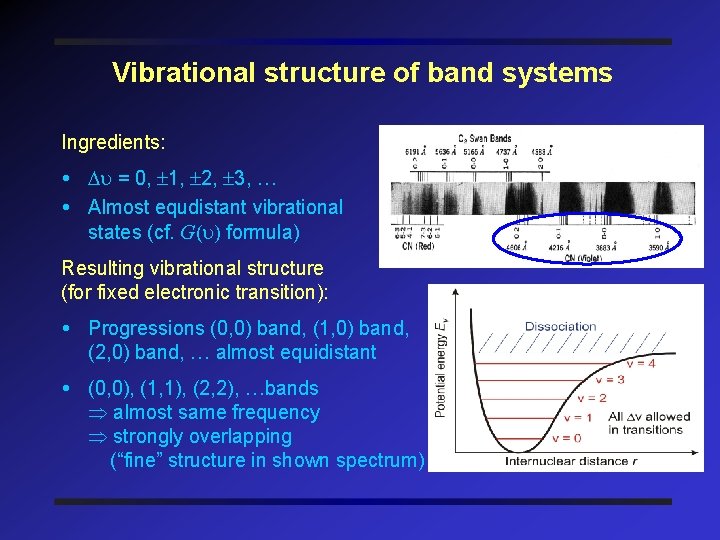
Vibrational structure of band systems Ingredients: = 0, 1, 2, 3, … Almost equdistant vibrational states (cf. G( ) formula) Resulting vibrational structure (for fixed electronic transition): Progressions (0, 0) band, (1, 0) band, (2, 0) band, … almost equidistant (0, 0), (1, 1), (2, 2), …bands almost same frequency strongly overlapping (“fine” structure in shown spectrum)
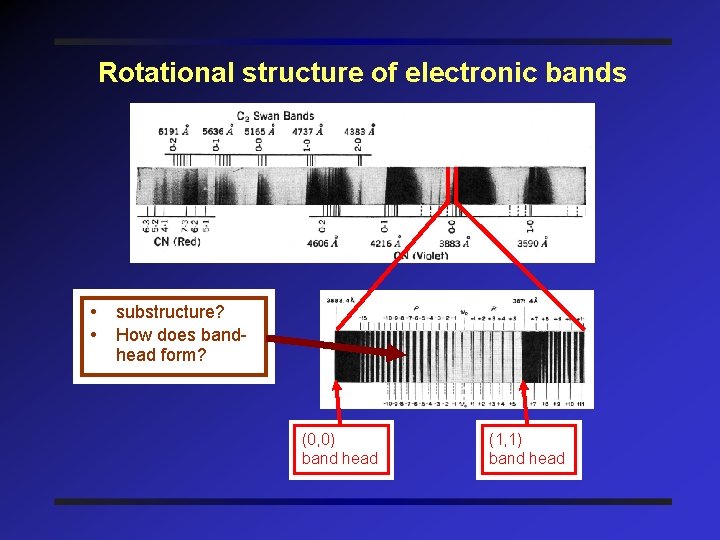
Rotational structure of electronic bands substructure? How does bandhead form? (0, 0) band head (1, 1) band head
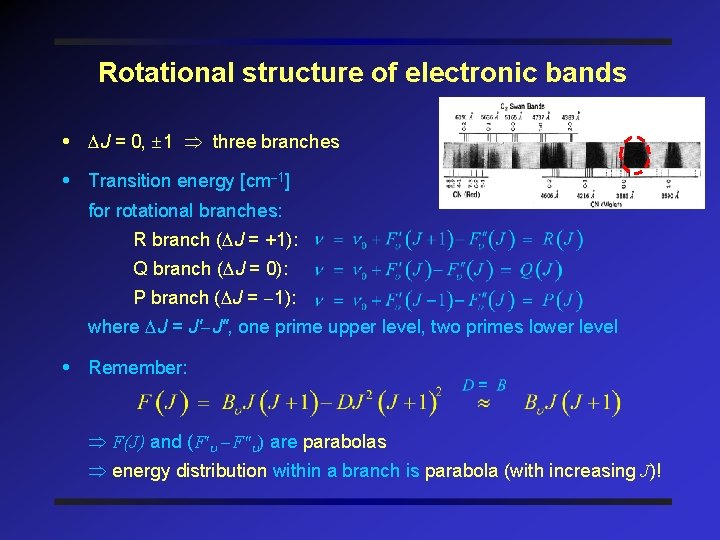
Rotational structure of electronic bands J = 0, 1 three branches Transition energy [cm 1] for rotational branches: R branch ( J = +1): Q branch ( J = 0): P branch ( J = 1): where J = J' J", one prime upper level, two primes lower level Remember: F(J) and (F' F" ) are parabolas energy distribution within a branch is parabola (with increasing J)!
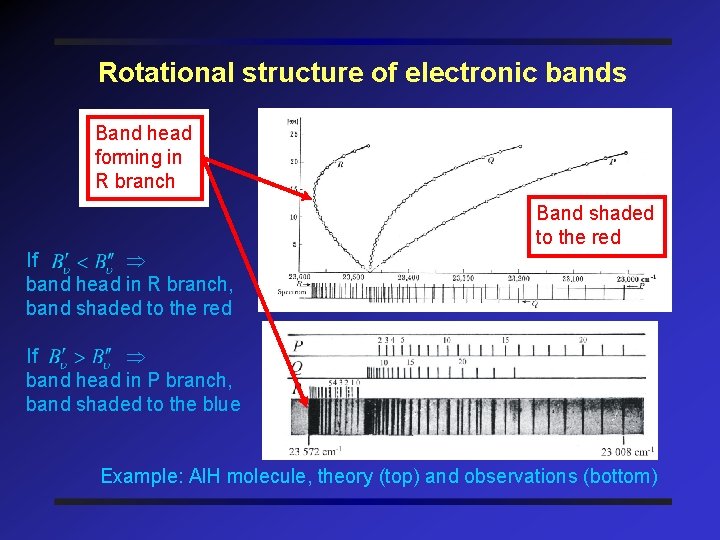
Rotational structure of electronic bands Band head forming in R branch If band head in R branch, band shaded to the red Band shaded to the red If band head in P branch, band shaded to the blue Example: Al. H molecule, theory (top) and observations (bottom)
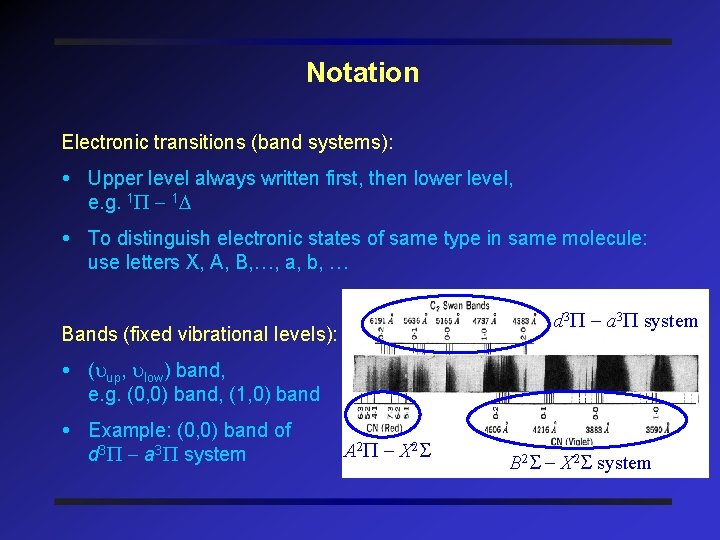
Notation Electronic transitions (band systems): Upper level always written first, then lower level, e. g. 1 1 To distinguish electronic states of same type in same molecule: use letters X, A, B, …, a, b, … d 3 a 3 system Bands (fixed vibrational levels): ( up, low) band, e. g. (0, 0) band, (1, 0) band Example: (0, 0) band of d 3 a 3 system A 2 X 2 B 2 X 2 system
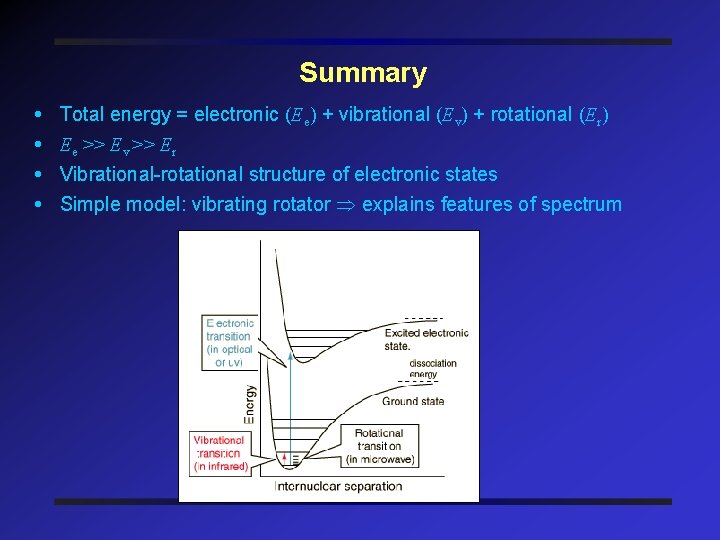
Summary Total energy = electronic (Ee) + vibrational (Ev) + rotational (Er) Ee >> Ev >> Er Vibrational-rotational structure of electronic states Simple model: vibrating rotator explains features of spectrum
Multi-atomic molecules: Vibrations Stretching: a change in the length of a bond Bending: a change in the angle between two bonds Rocking: a change in angle between a group of atoms Wagging: a change in angle between the plane of a group of atoms Twisting: a change in the angle between the planes of two groups of atoms Out-of-plane: a change in the angle between any one of the bond and the plane defined by the remaining atoms
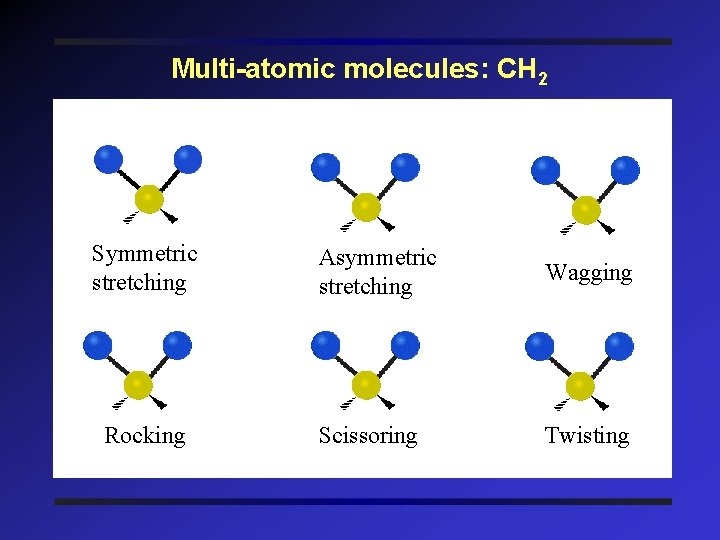
Multi-atomic molecules: CH 2 Symmetric stretching Rocking Asymmetric stretching Wagging Scissoring Twisting
- Slides: 31