
Molecular Simulations of the Dynamics of Grain Boundaries
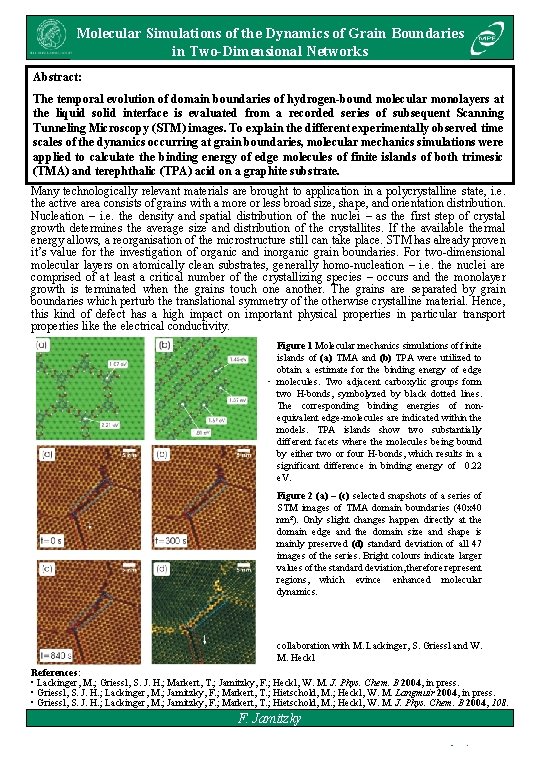
Molecular Simulations of the Dynamics of Grain Boundaries in Two-Dimensional Networks Abstract: The temporal evolution of domain boundaries of hydrogen-bound molecular monolayers at the liquid solid interface is evaluated from a recorded series of subsequent Scanning Tunneling Microscopy (STM) images. To explain the different experimentally observed time scales of the dynamics occurring at grain boundaries, molecular mechanics simulations were applied to calculate the binding energy of edge molecules of finite islands of both trimesic (TMA) and terephthalic (TPA) acid on a graphite substrate. Many technologically relevant materials are brought to application in a polycrystalline state, i. e. the active area consists of grains with a more or less broad size, shape, and orientation distribution. Nucleation – i. e. the density and spatial distribution of the nuclei – as the first step of crystal growth determines the average size and distribution of the crystallites. If the available thermal energy allows, a reorganisation of the microstructure still can take place. STM has already proven it’s value for the investigation of organic and inorganic grain boundaries. For two-dimensional molecular layers on atomically clean substrates, generally homo-nucleation – i. e. the nuclei are comprised of at least a critical number of the crystallizing species – occurs and the monolayer growth is terminated when the grains touch one another. The grains are separated by grain boundaries which perturb the translational symmetry of the otherwise crystalline material. Hence, this kind of defect has a high impact on important physical properties in particular transport properties like the electrical conductivity. Figure 1 Molecular mechanics simulations of finite islands of (a) TMA and (b) TPA were utilized to obtain a estimate for the binding energy of edge molecules. Two adjacent carboxylic groups form two H-bonds, symbolyzed by black dotted lines. The corresponding binding energies of nonequivalent edge-molecules are indicated within the models. TPA islands show two substantially different facets where the molecules being bound by either two or four H-bonds, which results in a significant difference in binding energy of 0. 22 e. V. Figure 2 (a) – (c) selected snapshots of a series of STM images of TMA domain boundaries (40 x 40 nm²). Only slight changes happen directly at the domain edge and the domain size and shape is mainly preserved (d) standard deviation of all 47 images of the series. Bright colours indicate larger values of the standard deviation, therefore represent regions, which evince enhanced molecular dynamics. collaboration with M. Lackinger, S. Griessl and W. M. Heckl References: • Lackinger, M. ; Griessl, S. J. H. ; Markert, T. ; Jamitzky, F. ; Heckl, W. M. J. Phys. Chem. B 2004, in press. • Griessl, S. J. H. ; Lackinger, M. ; Jamitzky, F. ; Markert, T. ; Hietschold, M. ; Heckl, W. M. Langmuir 2004, in press. • Griessl, S. J. H. ; Lackinger, M. ; Jamitzky, F. ; Markert, T. ; Hietschold, M. ; Heckl, W. M. J. Phys. Chem. B 2004, 108. F. Jamitzky
- Slides: 1