
MOLECULAR SHAPES Coursebook Notes p 81 HW 10
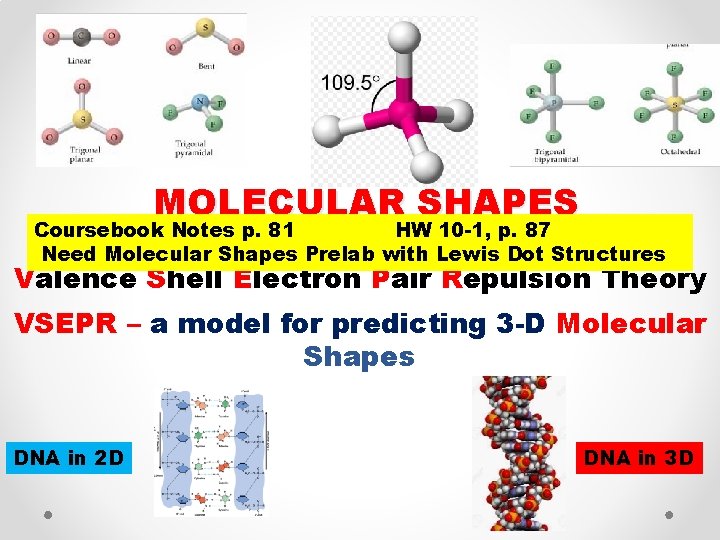
MOLECULAR SHAPES Coursebook Notes p. 81 HW 10 -1, p. 87 Need Molecular Shapes Prelab with Lewis Dot Structures Valence Shell Electron Pair Repulsion Theory VSEPR – a model for predicting 3 -D Molecular Shapes DNA in 2 D DNA in 3 D
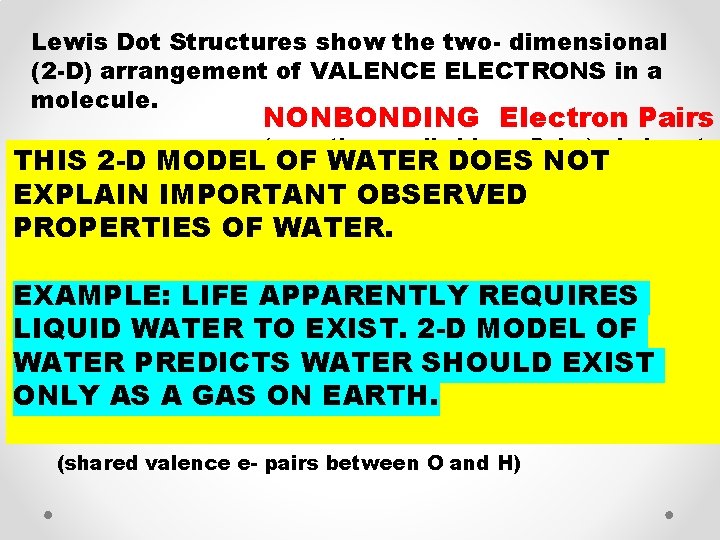
Lewis Dot Structures show the two- dimensional (2 -D) arrangement of VALENCE ELECTRONS in a molecule. NONBONDING Electron Pairs (sometimes called Lone Pairs) – belong to MODELjust OFone WATER NOT atom, in DOES this picture Oxygen. ) THIS 2 -D EXPLAIN IMPORTANT OBSERVED PROPERTIES OF WATER. EXAMPLE: LIFE APPARENTLY REQUIRES LIQUID WATER TO EXIST. 2 -D MODEL OF WATER PREDICTS WATER SHOULD EXIST ONLY AS A GAS ON EARTH. BONDING ELECTRON PAIRS (shared valence e- pairs between O and H)

NEWS FLASH – THE WORLD IS NOT FLAT (2 -D) – ITS ROUND (3 D)

TRUE PROPERTIES OF MOLECULES CAN ONLY BE FULLY UNDERSTAND BY MODELING REALITY IN THREE-DIMENSIONS! 3 -D HELPS US BETTER UNDERSTAND PHYSICAL REALITY Link to ship smacked by 100 foot water wave
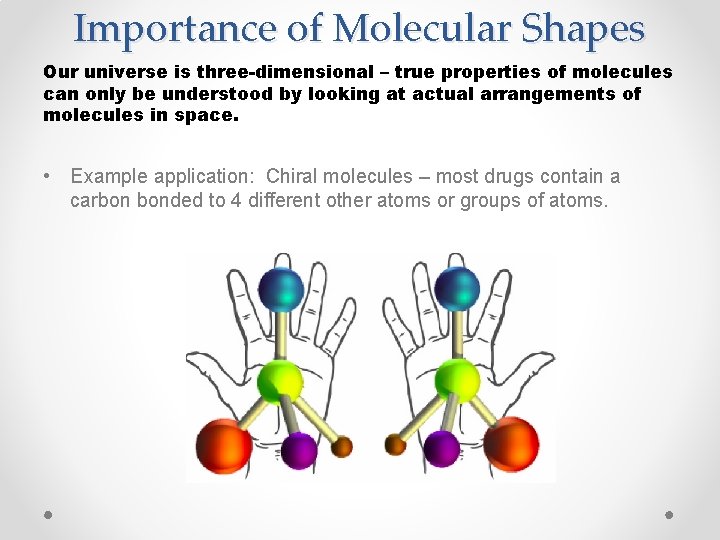
Importance of Molecular Shapes Our universe is three-dimensional – true properties of molecules can only be understood by looking at actual arrangements of molecules in space. • Example application: Chiral molecules – most drugs contain a carbon bonded to 4 different other atoms or groups of atoms.

Thalidomide – 1 form of drug treats morning sickness, the other causes birth defects • Effect of thalidomide mutations DIFFERENCES IN BINDING OF CHIRAL FORMS
HW 10 -1, p. 87 • 73) Why is the geometric structure of a molecule important, especially for biological molecules?
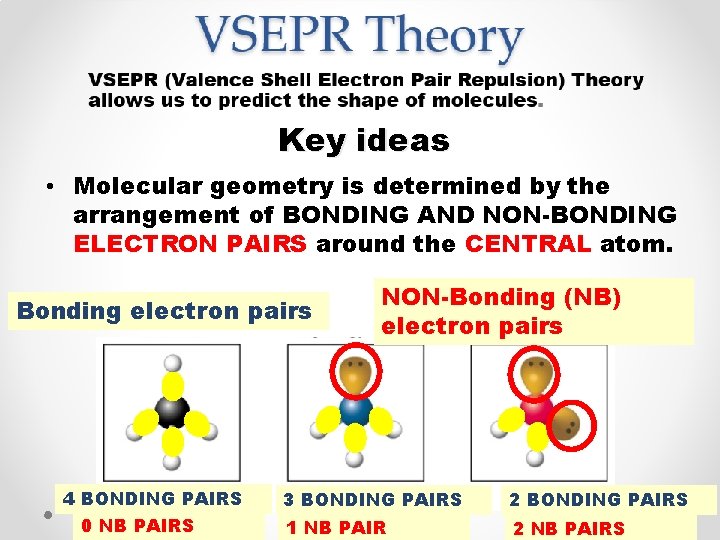
Key ideas • Molecular geometry is determined by the arrangement of BONDING AND NON-BONDING ELECTRON PAIRS around the CENTRAL atom. Bonding electron pairs 4 BONDING PAIRS 0 NB PAIRS NON-Bonding (NB) electron pairs 3 BONDING PAIRS 2 BONDING PAIRS 1 NB PAIR 2 NB PAIRS

COUNTING BONDING AND NONBONDING ELECTRON PAIRS AROUND THE CENTRAL ATOM Important Notes on Nonbonding Pairs (sometimes called LONE PAIRS: - Only Lone pairs (recall Pair = 2 e-) around CENTRAL Atom impact geometry. - Nonbonding Pairs on Central Atom are typically enclosed in a bubble. Important Notes on Double and Triple Bonds: - Double and Triple Bonds count as a single bonding region for the purposes of determining geometry.

How many Bonding Pairs (BP) and Nonbonding Pairs (NP) are present around the CENTRAL ATOM in each of the following molecules? TAKE OUT MOLECULAR MODELS PRELAB; GRAB WHITE BOARD AND MARKER FOR EACH BP: TEAM BP: 2 2 BP: 5 NP: 0 NP: 1 NP: 0

MOLECULAR MODELS LAB 2 0
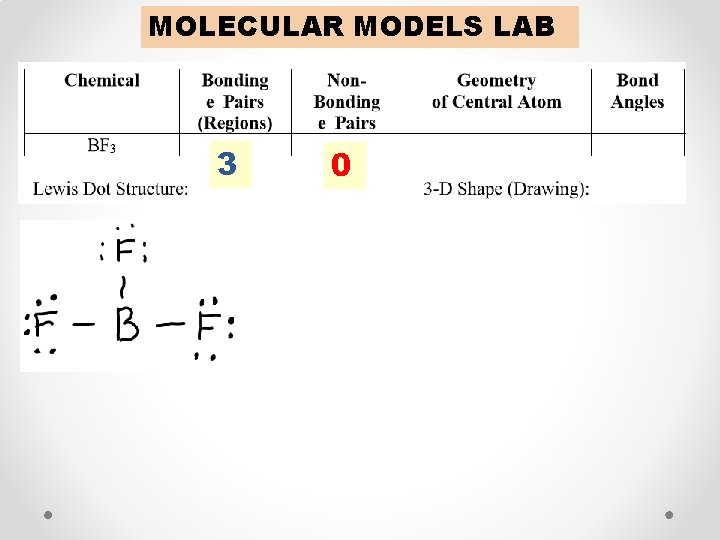
MOLECULAR MODELS LAB 3 0

MOLECULAR MODELS LAB 4 0

MOLECULAR MODELS LAB 5 0
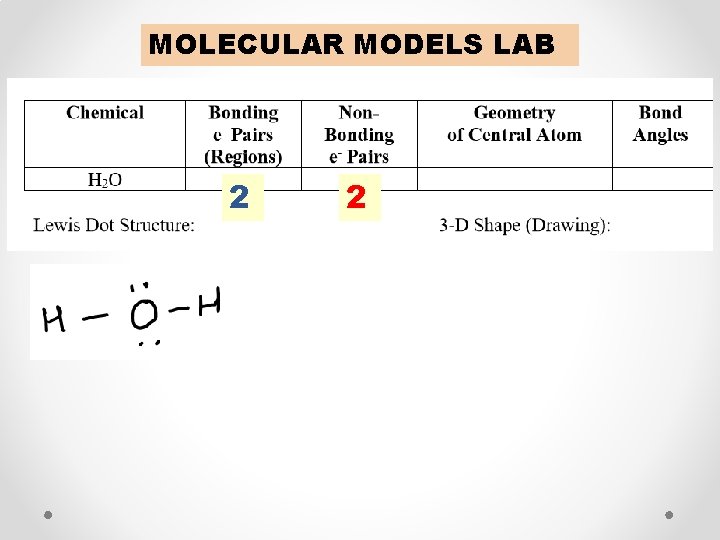
MOLECULAR MODELS LAB 2 2
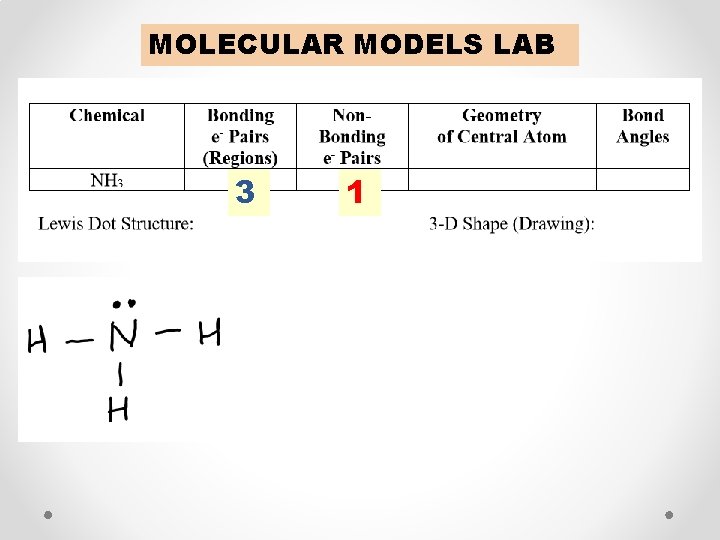
MOLECULAR MODELS LAB 3 1
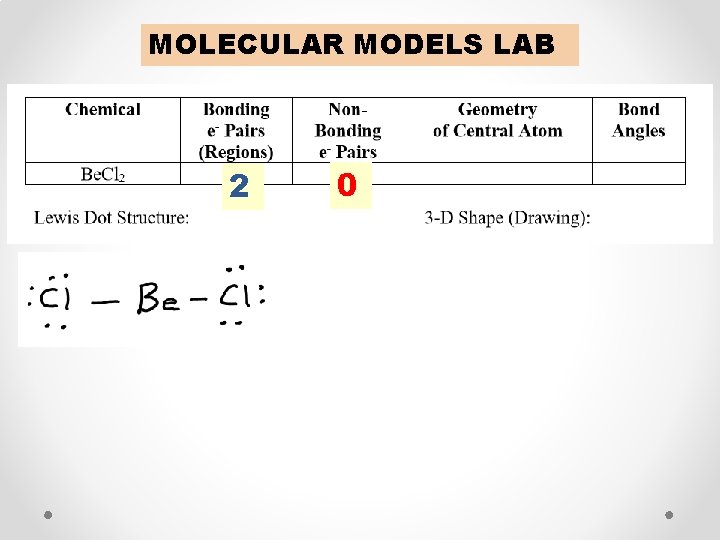
MOLECULAR MODELS LAB 2 0
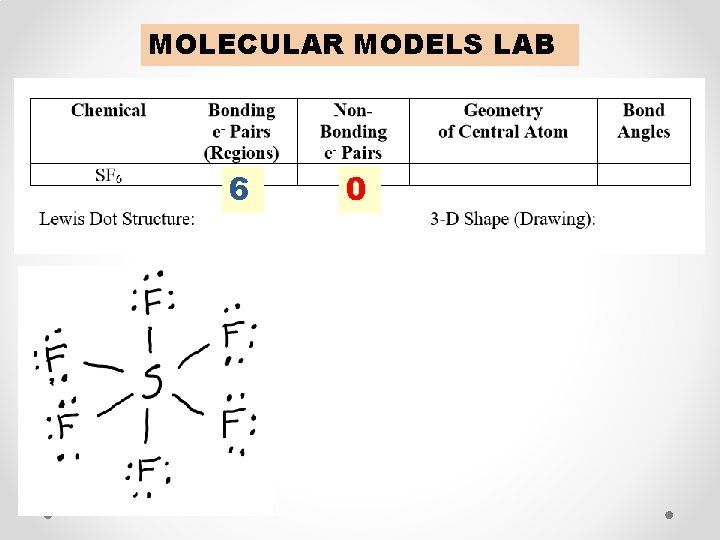
MOLECULAR MODELS LAB 6 0

MOLECULAR MODELS LAB 2 1
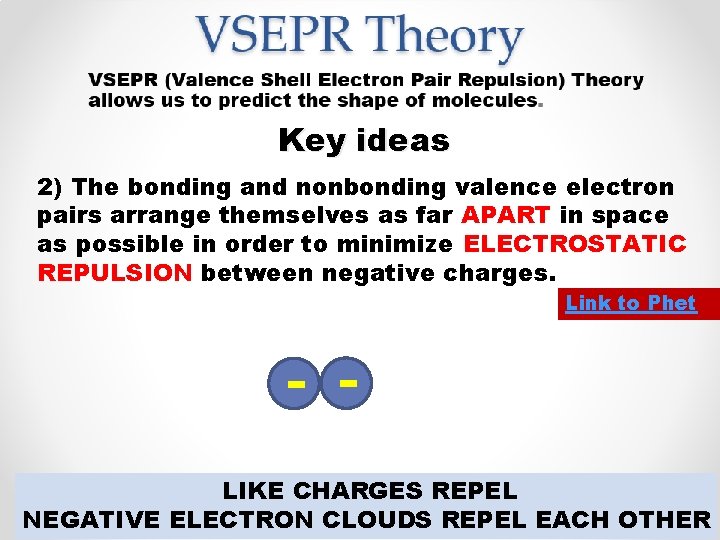
Key ideas 2) The bonding and nonbonding valence electron pairs arrange themselves as far APART in space as possible in order to minimize ELECTROSTATIC REPULSION between negative charges. Link to Phet LIKE CHARGES REPEL NEGATIVE ELECTRON CLOUDS REPEL EACH OTHER
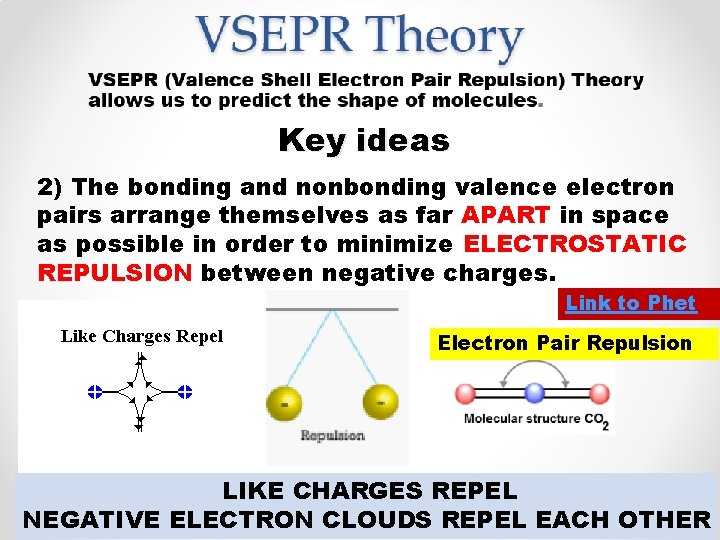
Key ideas 2) The bonding and nonbonding valence electron pairs arrange themselves as far APART in space as possible in order to minimize ELECTROSTATIC REPULSION between negative charges. Link to Phet Electron Pair Repulsion LIKE CHARGES REPEL NEGATIVE ELECTRON CLOUDS REPEL EACH OTHER
HW 10 -1, p. 87 • 74) What general principles determine the molecular structure (shape of a molecule)? Geometry of molecule is determined by arrangement of bonding and nonbonding electron pairs around the central atom. • 75) How is the structure around a given atom related to repulsion between valence electron pairs on the atom? Bonding and Nonbonding electrons pairs around the central atom are arranged as FAR APART IN SPACE as possible to MINIMIZE REPULSION. • 76) Why are all diatomic molecules linear regardless of the number of valence pairs on each atom? Only way electrons can be shared between two atoms is a straight line.
Using Concept of Minimizing Repulsion to predict geometry and bond angles for molecules with 2, 3 and 4 bonds Each team grab a bag containing 5 Styrofoam balls and 4 toothpicks Link to tutorial
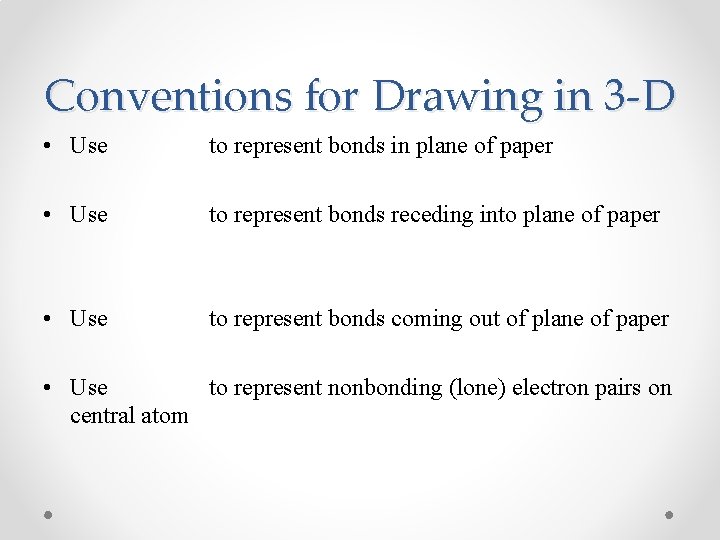
Conventions for Drawing in 3 -D • Use to represent bonds in plane of paper • Use to represent bonds receding into plane of paper • Use to represent bonds coming out of plane of paper • Use to represent nonbonding (lone) electron pairs on central atom
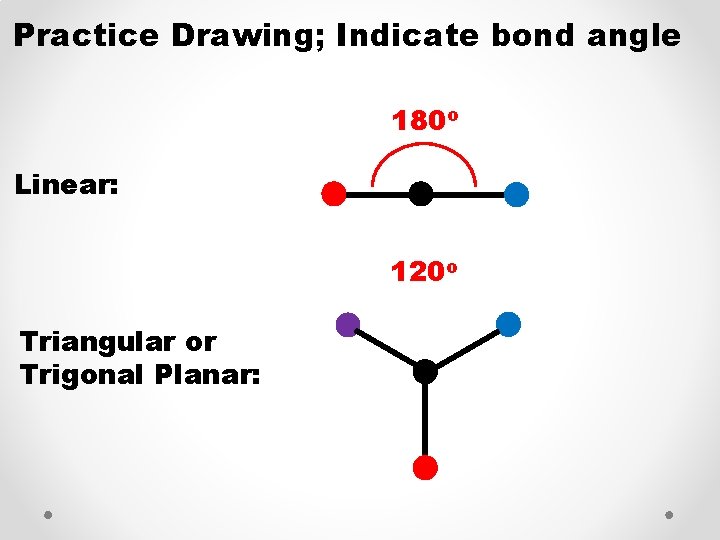
Practice Drawing; Indicate bond angle 180 o Linear: 120 o Triangular or Trigonal Planar:
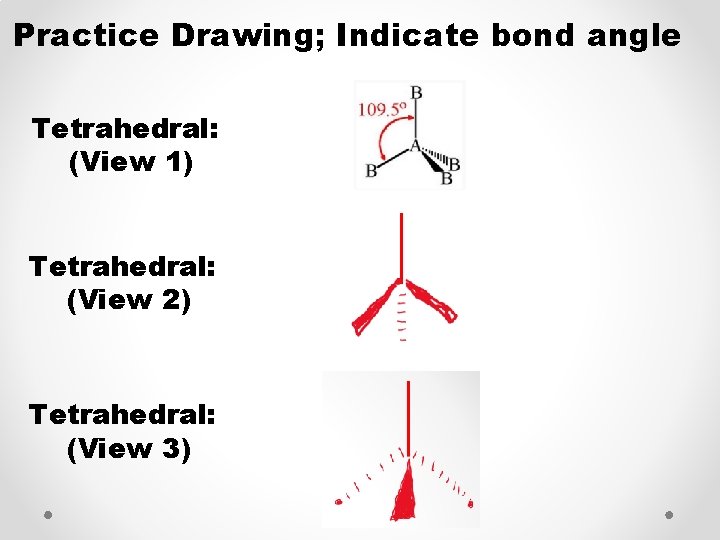
Practice Drawing; Indicate bond angle Tetrahedral: (View 1) Tetrahedral: (View 2) Tetrahedral: (View 3)
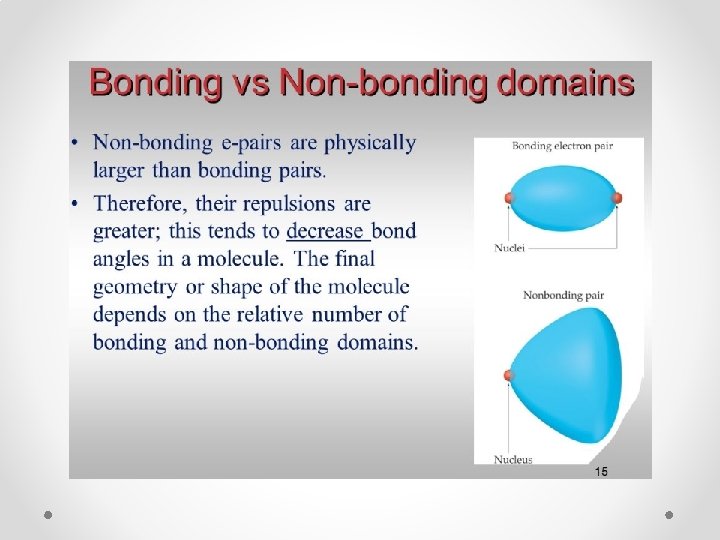
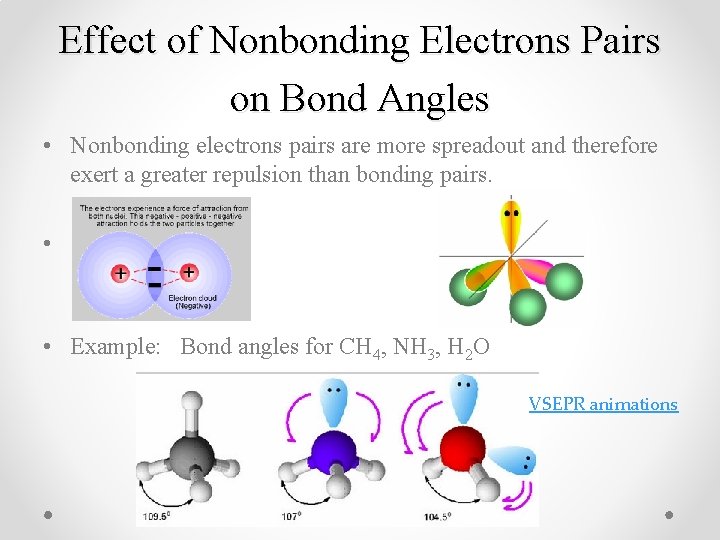
Effect of Nonbonding Electrons Pairs on Bond Angles • Nonbonding electrons pairs are more spreadout and therefore exert a greater repulsion than bonding pairs. • • Example: Bond angles for CH 4, NH 3, H 2 O VSEPR animations
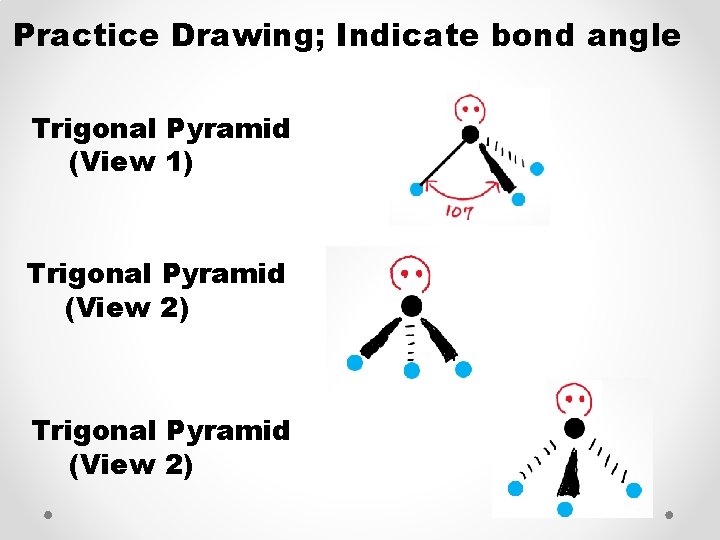
Practice Drawing; Indicate bond angle Trigonal Pyramid (View 1) Trigonal Pyramid (View 2)
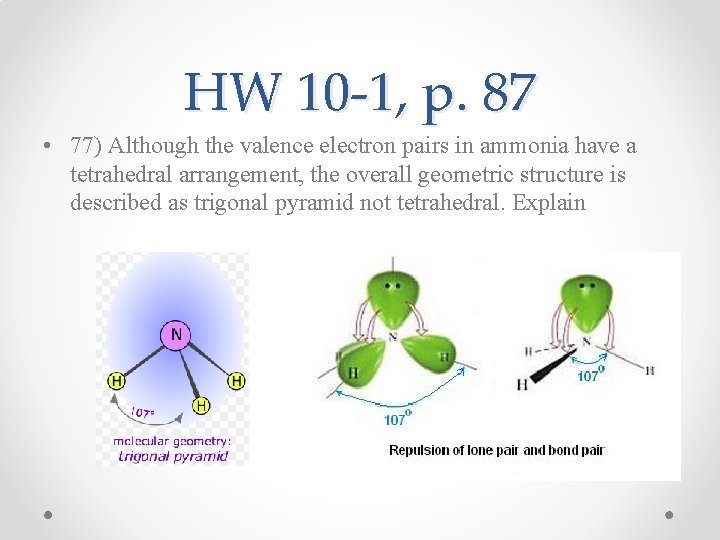
HW 10 -1, p. 87 • 77) Although the valence electron pairs in ammonia have a tetrahedral arrangement, the overall geometric structure is described as trigonal pyramid not tetrahedral. Explain
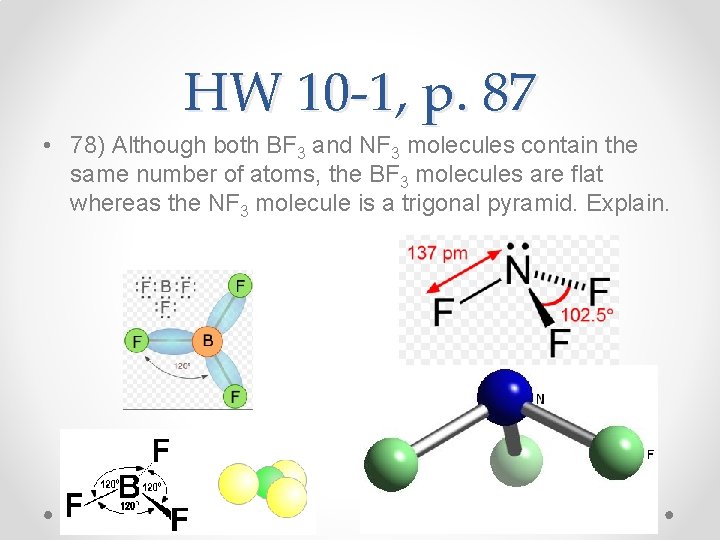
HW 10 -1, p. 87 • 78) Although both BF 3 and NF 3 molecules contain the same number of atoms, the BF 3 molecules are flat whereas the NF 3 molecule is a trigonal pyramid. Explain.
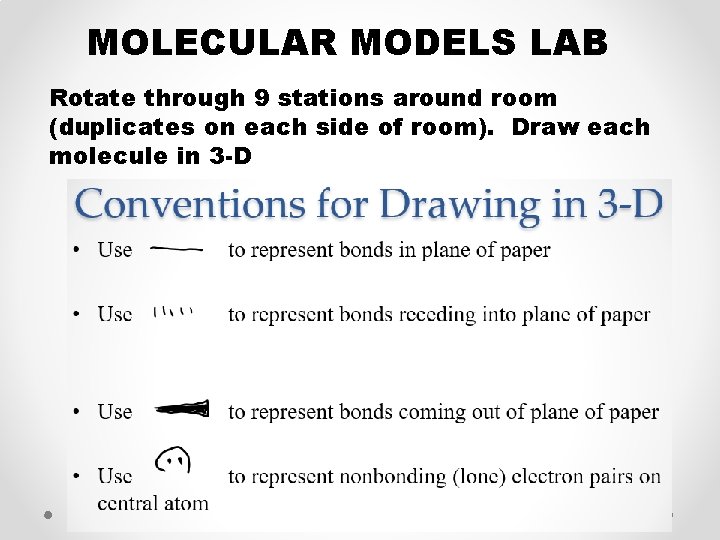
MOLECULAR MODELS LAB Rotate through 9 stations around room (duplicates on each side of room). Draw each molecule in 3 -D
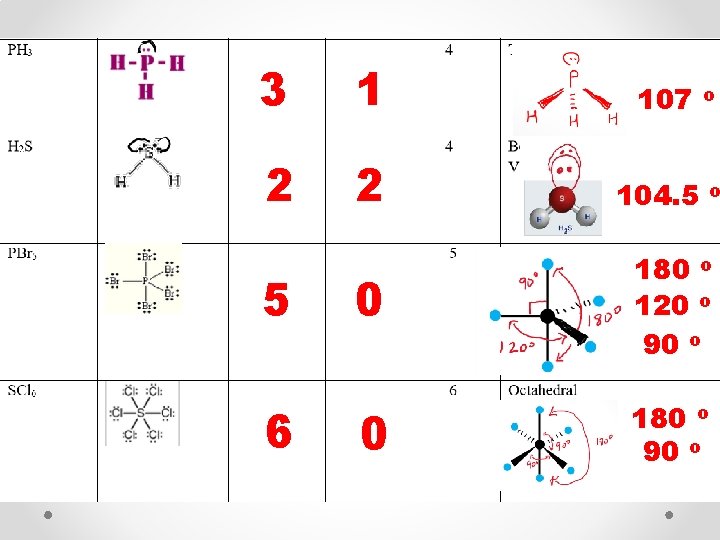
Link to VSEPR video use first 4: 00 min Link to VSEPR 2 Steps for Applying VSEPR: • Draw Lewis Dot structure (be sure to include all nonbonding (lone) pairs on central atom). • Count the number of bonding and nonbonding electron pairs on the central atom. • Double and triple bonds count as only ONE bonding pair (one bonding “region”). • Consult chart from your notes below that describes arrangement of electron pairs in space that minimizes electrostatic repulsions.
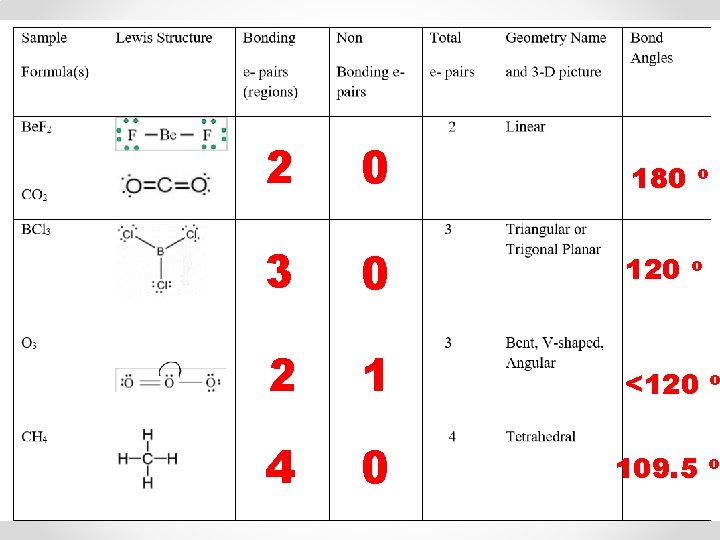
2 0 180 3 0 120 2 1 <120 o 4 0 109. 5 o o o
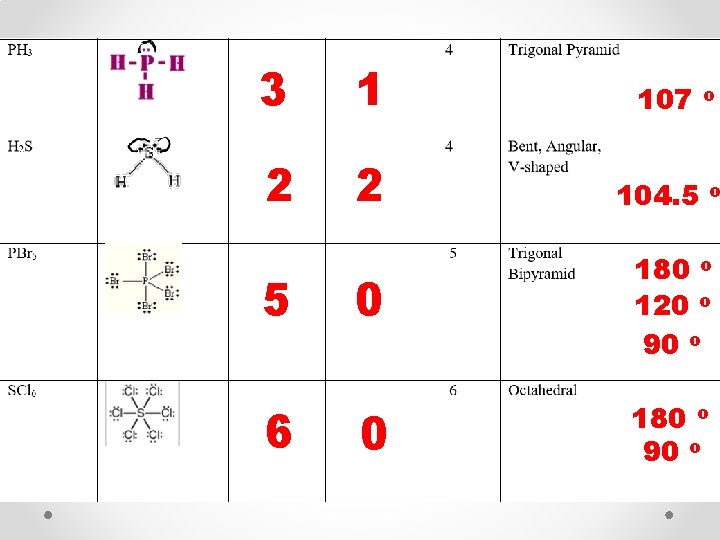
3 1 107 2 2 104. 5 5 6 o o 0 180 o 120 o 90 o 0 180 o 90 o
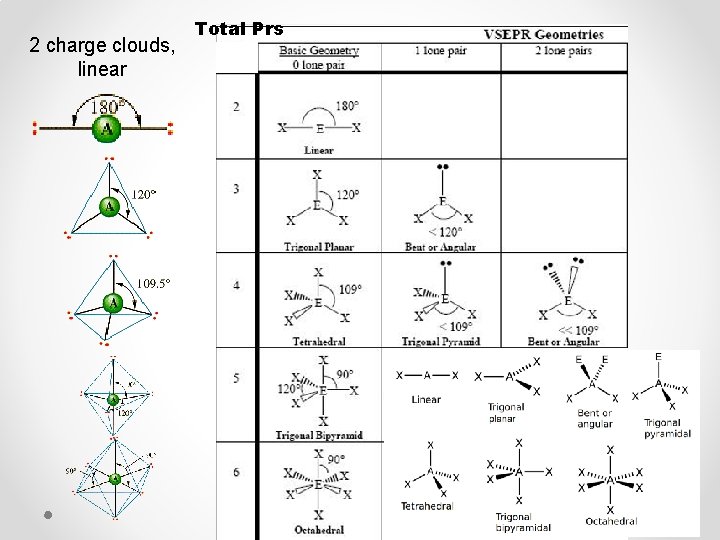
2 charge clouds, linear Total Prs
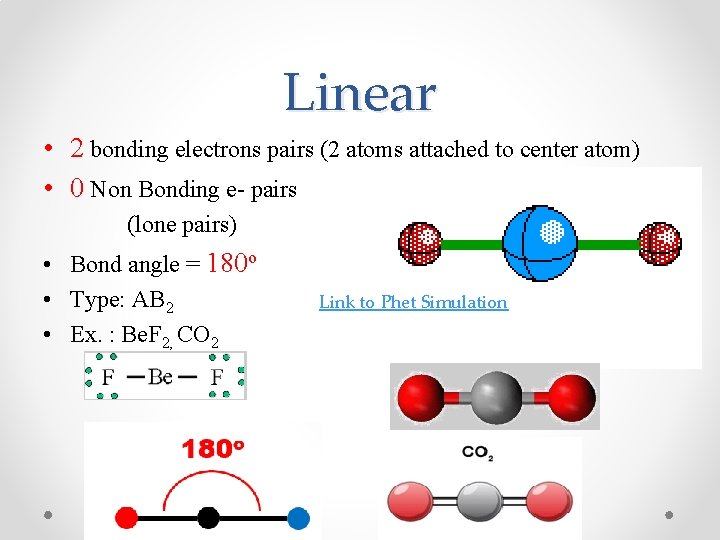
Linear • 2 bonding electrons pairs (2 atoms attached to center atom) • 0 Non Bonding e- pairs (lone pairs) • Bond angle = 180 o • Type: AB 2 • Ex. : Be. F 2, CO 2 Link to Phet Simulation
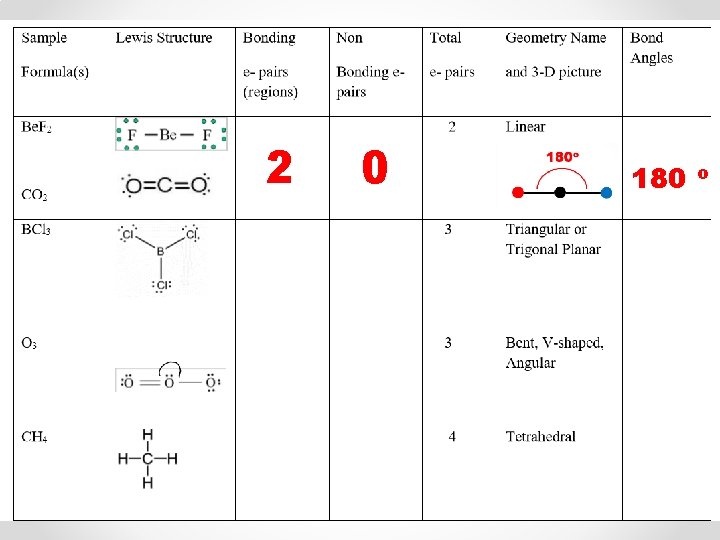
2 0 180 o
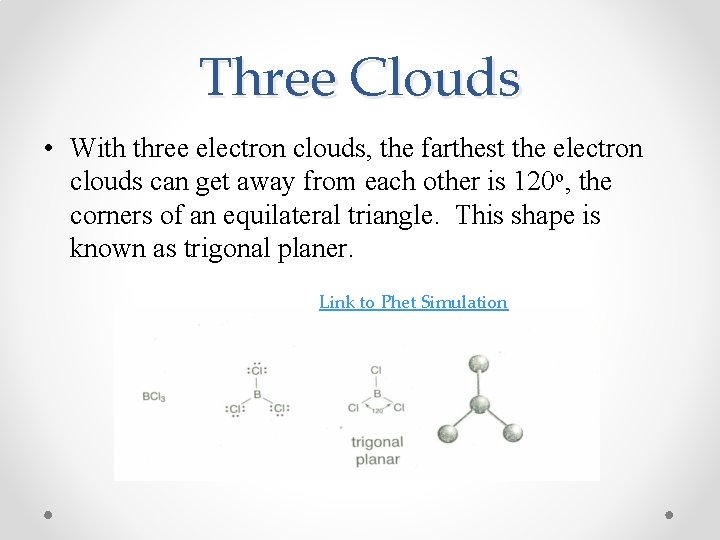
Three Clouds • With three electron clouds, the farthest the electron clouds can get away from each other is 120 o, the corners of an equilateral triangle. This shape is known as trigonal planer. Link to Phet Simulation
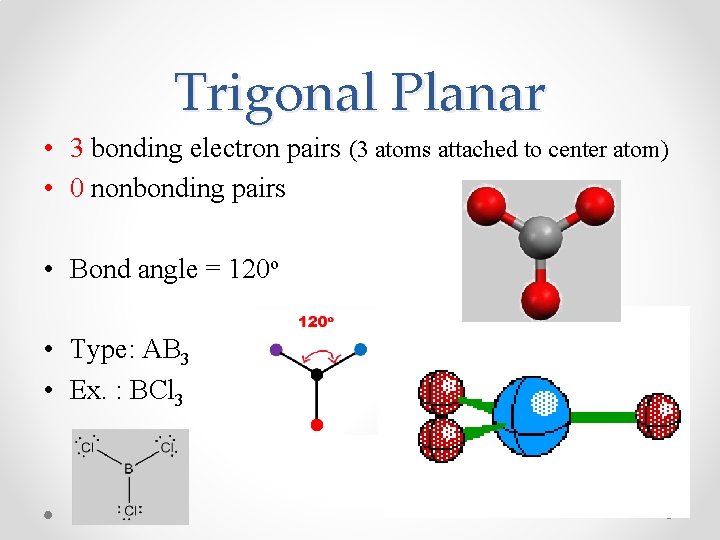
Trigonal Planar • 3 bonding electron pairs (3 atoms attached to center atom) • 0 nonbonding pairs • Bond angle = 120 o • Type: AB 3 • Ex. : BCl 3
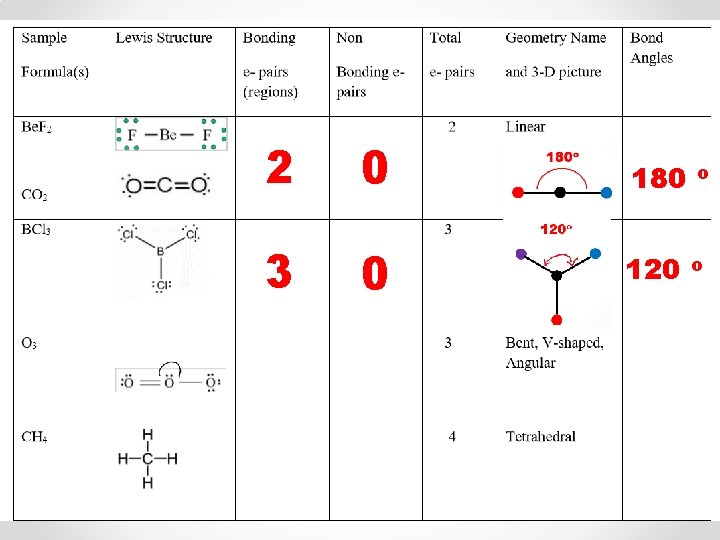
2 0 180 3 0 120 o o
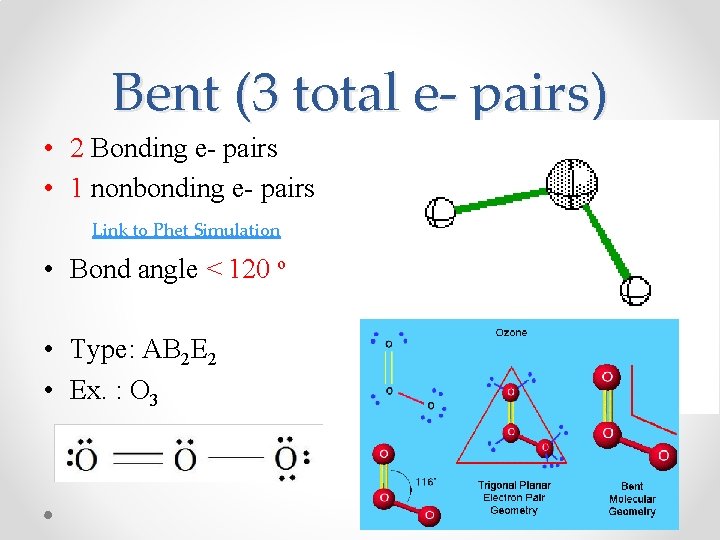
Bent (3 total e- pairs) • 2 Bonding e- pairs • 1 nonbonding e- pairs Link to Phet Simulation • Bond angle < 120 o • Type: AB 2 E 2 • Ex. : O 3
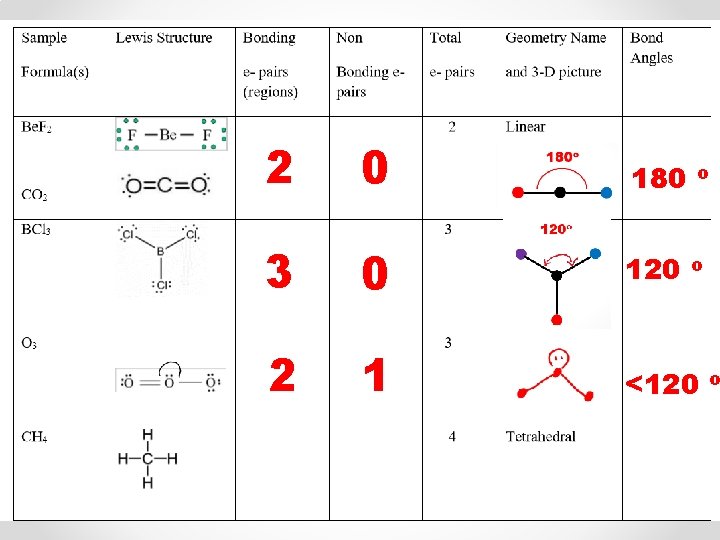
2 0 180 3 0 120 2 1 <120 o o o
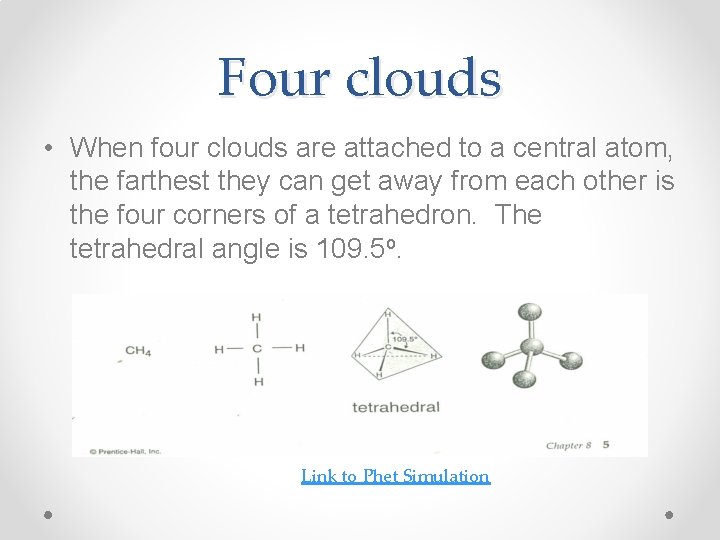
Four clouds • When four clouds are attached to a central atom, the farthest they can get away from each other is the four corners of a tetrahedron. The tetrahedral angle is 109. 5 o. Link to Phet Simulation
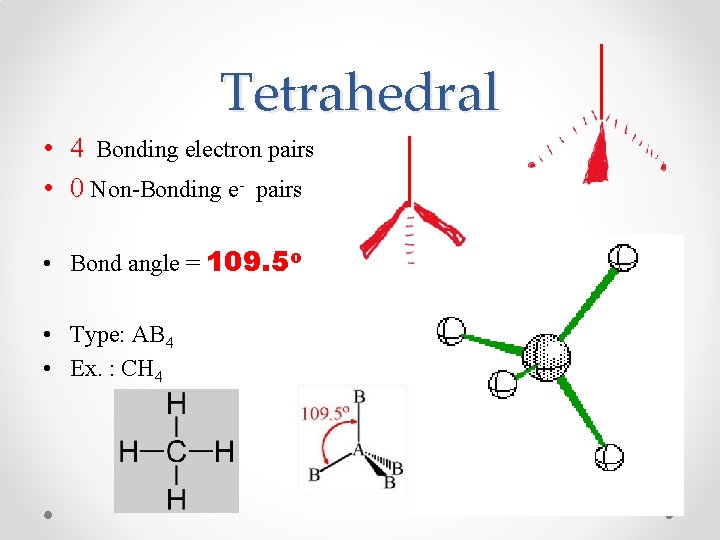
Tetrahedral • 4 Bonding electron pairs • 0 Non-Bonding e- pairs • Bond angle = 109. 5 o • Type: AB 4 • Ex. : CH 4
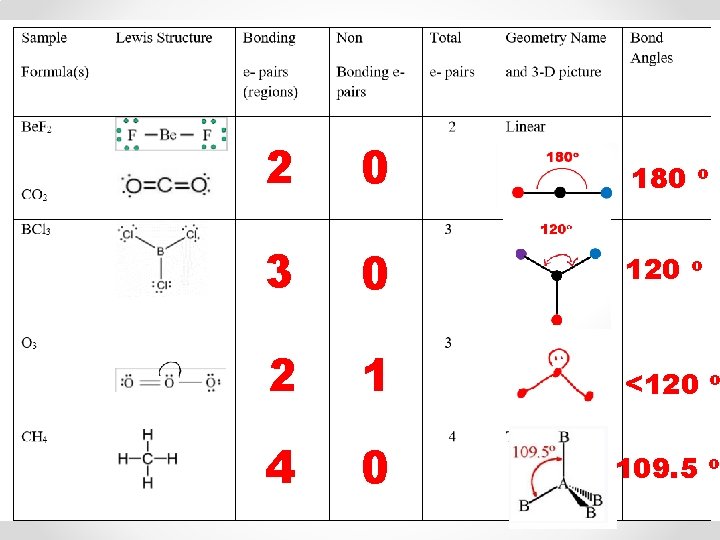
2 0 180 3 0 120 2 1 <120 o 4 0 109. 5 o o o
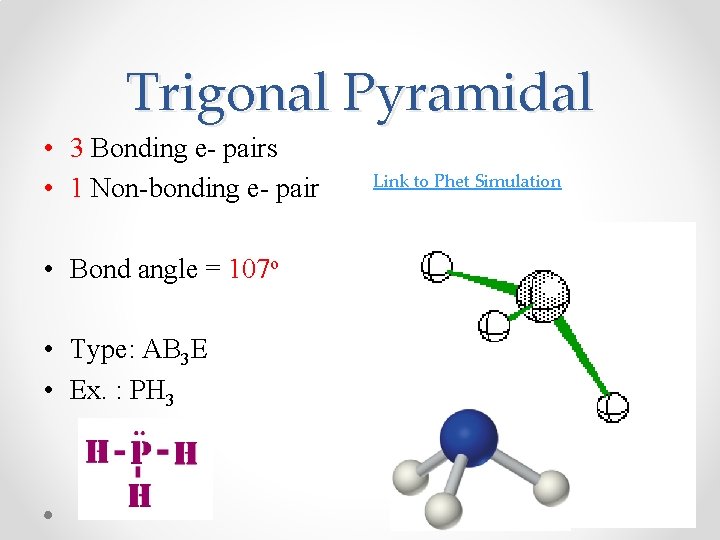
Trigonal Pyramidal • 3 Bonding e- pairs • 1 Non-bonding e- pair • Bond angle = 107 o • Type: AB 3 E • Ex. : PH 3 Link to Phet Simulation
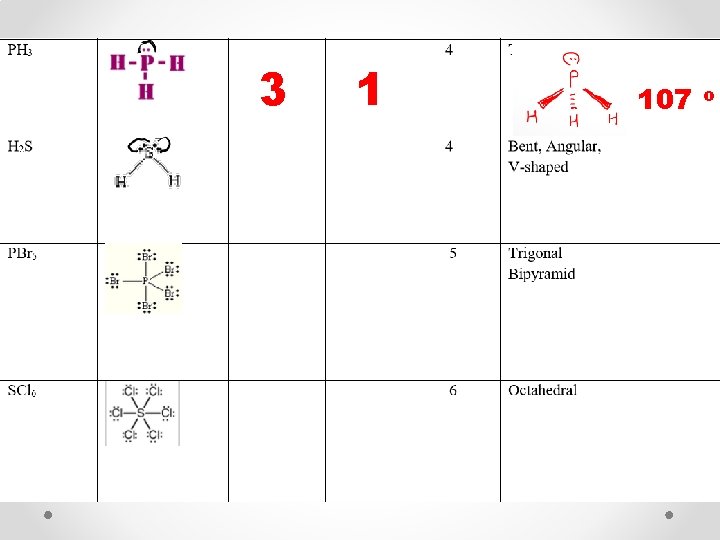
3 1 107 o
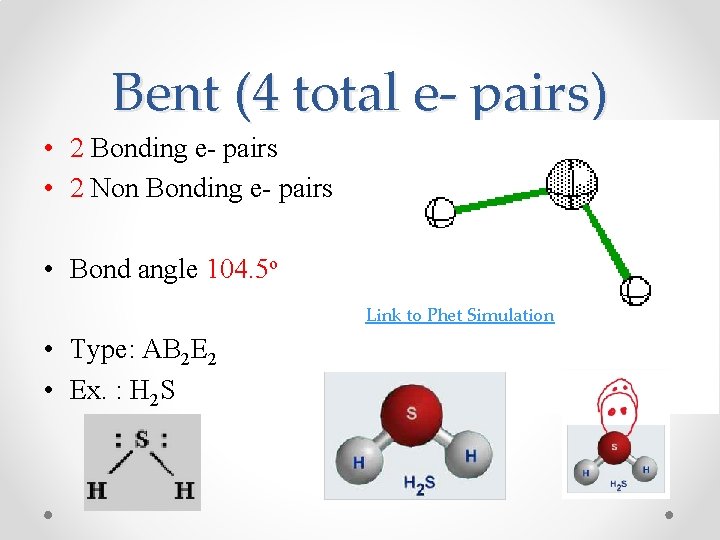
Bent (4 total e- pairs) • 2 Bonding e- pairs • 2 Non Bonding e- pairs • Bond angle 104. 5 o Link to Phet Simulation • Type: AB 2 E 2 • Ex. : H 2 S
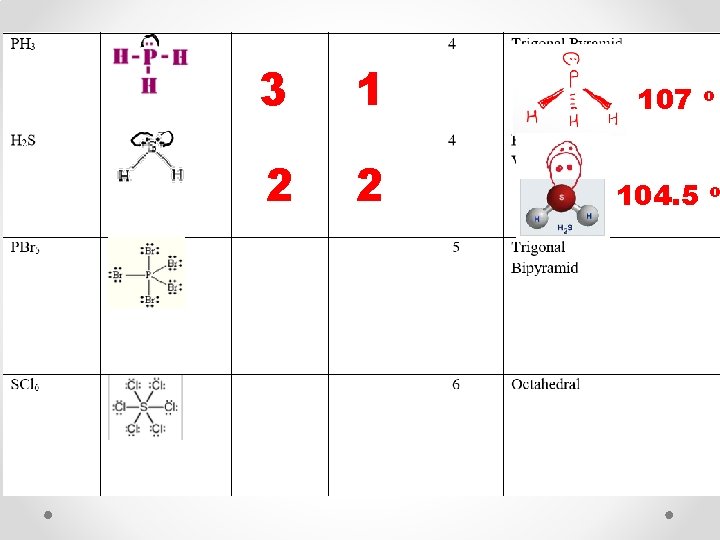
3 1 107 2 2 104. 5 o o
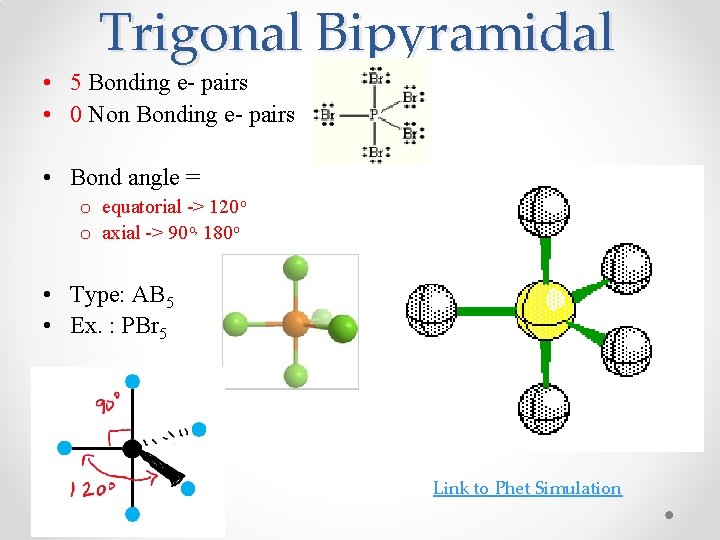
Trigonal Bipyramidal • 5 Bonding e- pairs • 0 Non Bonding e- pairs • Bond angle = o equatorial -> 120 o o axial -> 90 o, 180 o • Type: AB 5 • Ex. : PBr 5 Link to Phet Simulation
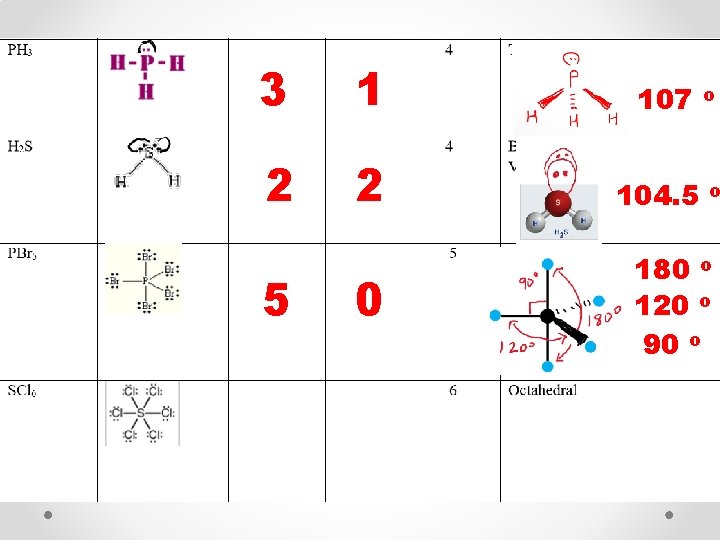
3 1 107 2 2 104. 5 5 0 o o 180 o 120 o 90 o
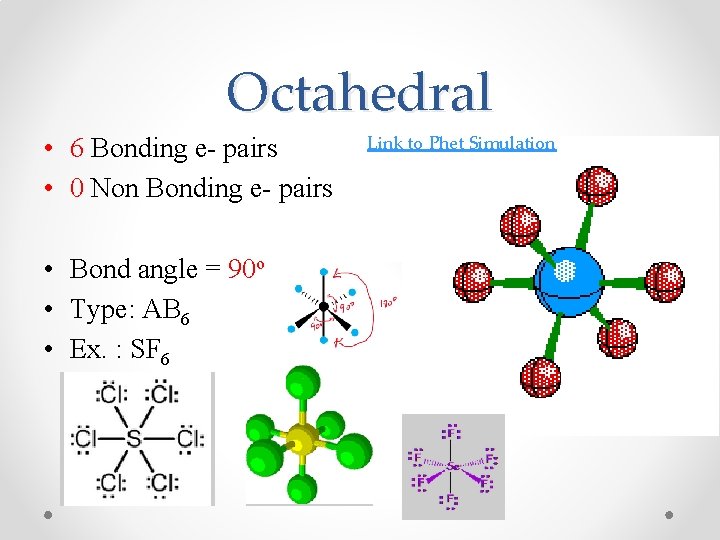
Octahedral • 6 Bonding e- pairs • 0 Non Bonding e- pairs • Bond angle = 90 o • Type: AB 6 • Ex. : SF 6 Link to Phet Simulation
3 1 107 2 2 104. 5 5 6 o o 0 180 o 120 o 90 o 0 180 o 90 o
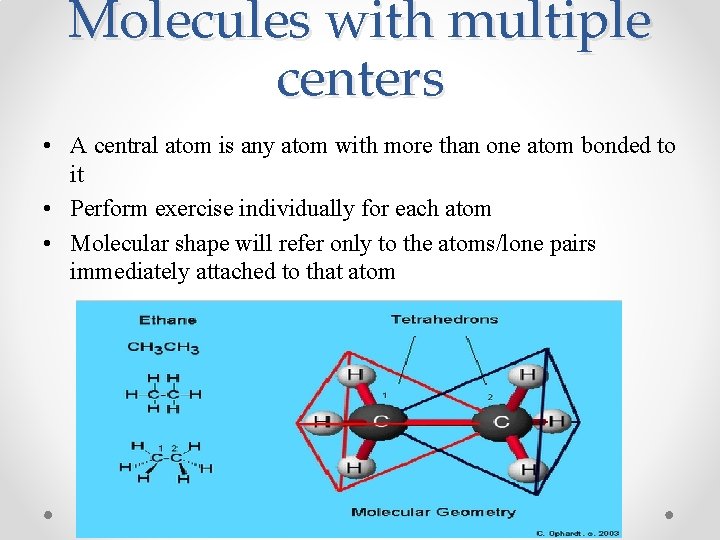
Molecules with multiple centers • A central atom is any atom with more than one atom bonded to it • Perform exercise individually for each atom • Molecular shape will refer only to the atoms/lone pairs immediately attached to that atom
- Slides: 55