
Molecular Shape Things to remember The shape of
Molecular Shape
Things to remember • The shape of a molecule is determined by where the nuclei are located. • But the nuclei go to certain locations because of the electron pairs.
Use the Lewis Structure • Lewis structure is 2 -D, but it can help you figure out the 3 -D shape. • Learn a few basic shapes and you’ll be ok.
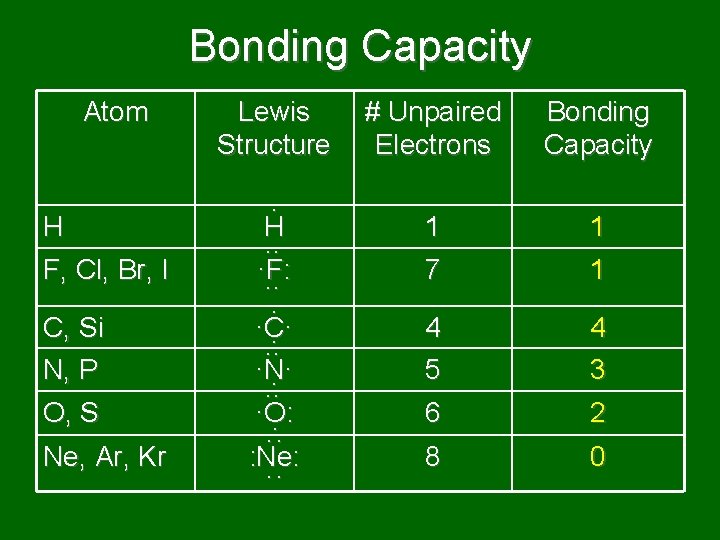
Bonding Capacity Atom H F, Cl, Br, I C, Si N, P O, S Ne, Ar, Kr Lewis Structure. H. . ·F: . . . ·C·. . . ·N·. . . ·O: ··· : Ne: ·· # Unpaired Electrons Bonding Capacity 1 1 7 1 4 5 4 3 6 2 8 0
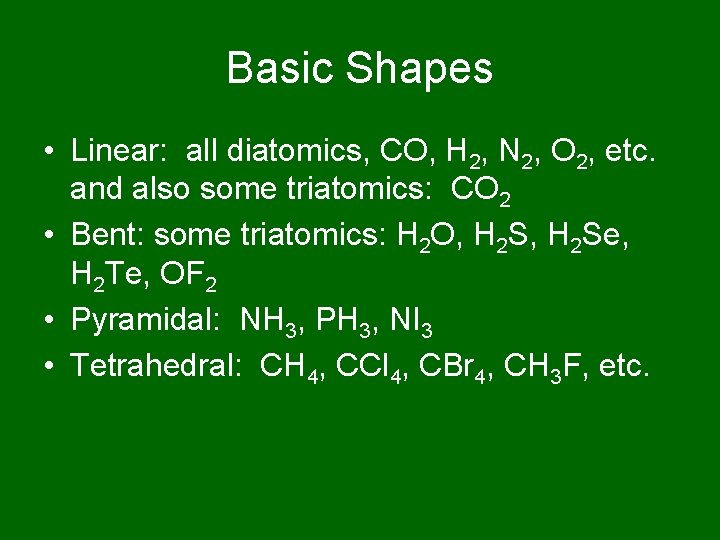
Basic Shapes • Linear: all diatomics, CO, H 2, N 2, O 2, etc. and also some triatomics: CO 2 • Bent: some triatomics: H 2 O, H 2 Se, H 2 Te, OF 2 • Pyramidal: NH 3, PH 3, NI 3 • Tetrahedral: CH 4, CCl 4, CBr 4, CH 3 F, etc.
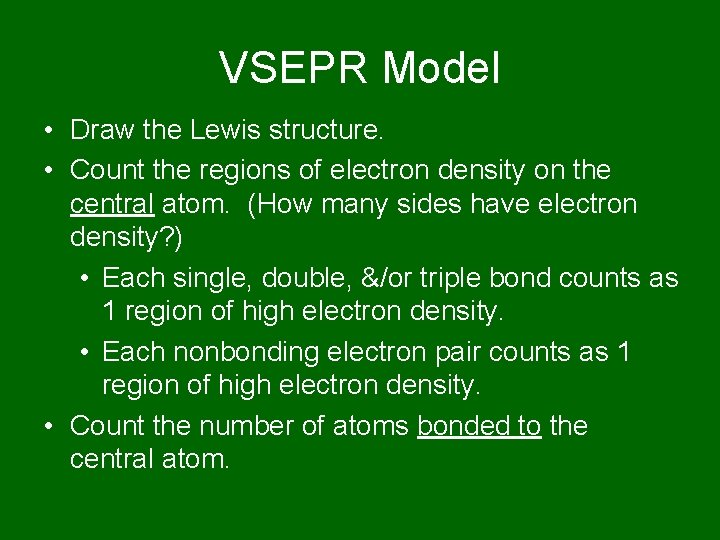
VSEPR Model • Draw the Lewis structure. • Count the regions of electron density on the central atom. (How many sides have electron density? ) • Each single, double, &/or triple bond counts as 1 region of high electron density. • Each nonbonding electron pair counts as 1 region of high electron density. • Count the number of atoms bonded to the central atom.
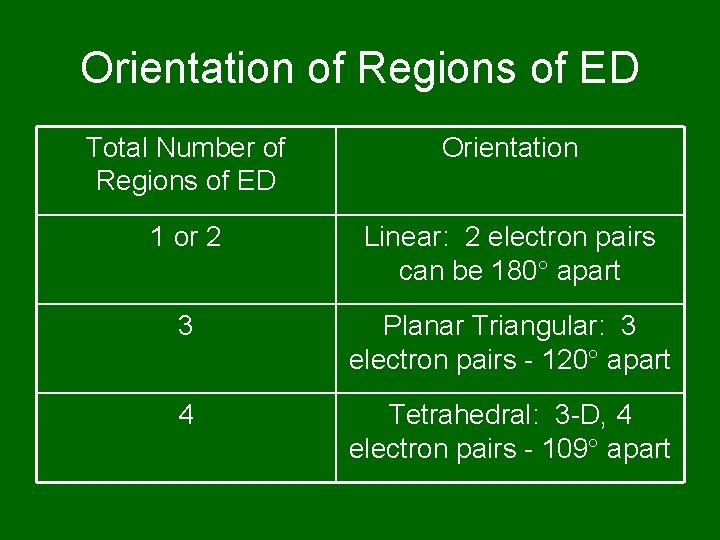
Orientation of Regions of ED Total Number of Regions of ED Orientation 1 or 2 Linear: 2 electron pairs can be 180 apart 3 Planar Triangular: 3 electron pairs - 120 apart 4 Tetrahedral: 3 -D, 4 electron pairs - 109 apart
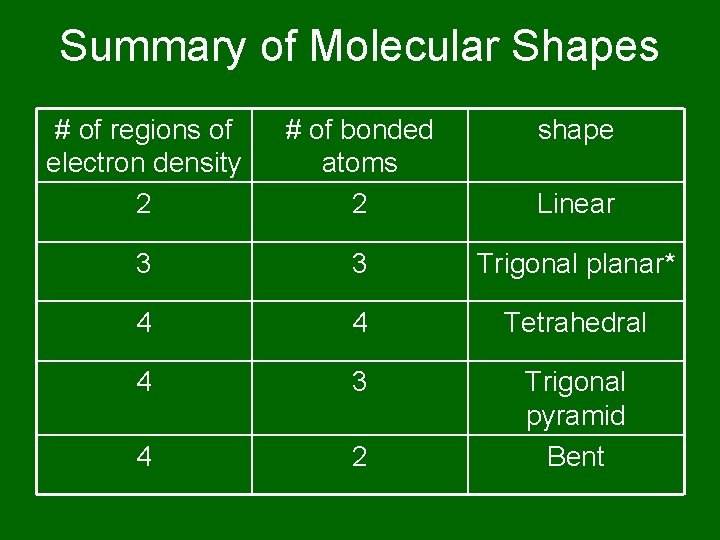
Summary of Molecular Shapes # of regions of electron density 2 # of bonded atoms 2 shape Linear 3 3 Trigonal planar* 4 4 Tetrahedral 4 3 4 2 Trigonal pyramid Bent
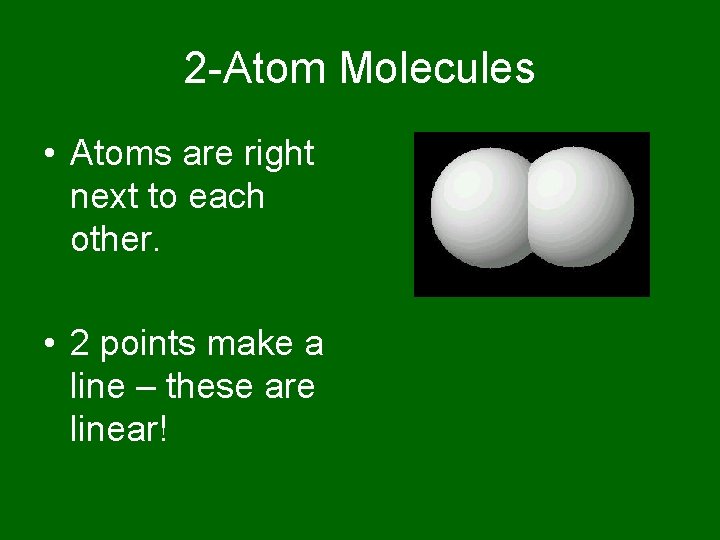
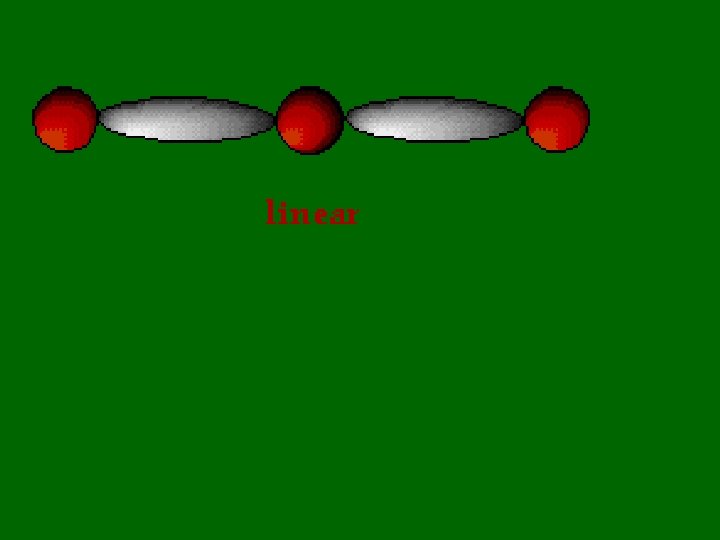
2 -Atom Molecules • Atoms are right next to each other. • 2 points make a line – these are linear!
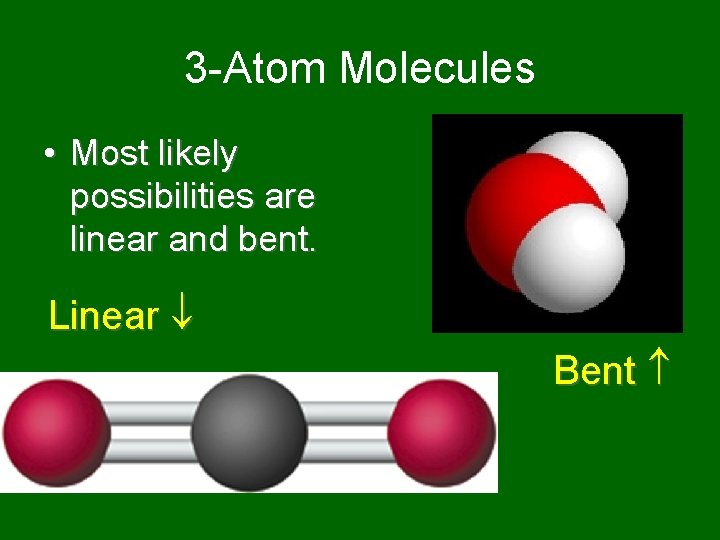
3 -Atom Molecules • Most likely possibilities are linear and bent. Linear Bent
3 -Atom Molecules • Triangular? Well, isn’t that another way of saying bent?
4 -Atom Molecules • Two possibilities: –Trigonal Planar – in 1 plane –Trigonal Pyramidal
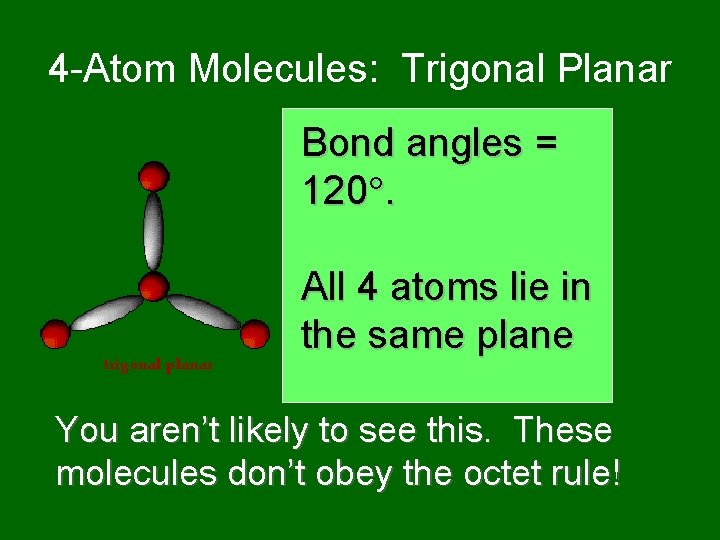
4 -Atom Molecules: Trigonal Planar Bond angles = 120. All 4 atoms lie in the same plane You aren’t likely to see this. These molecules don’t obey the octet rule!
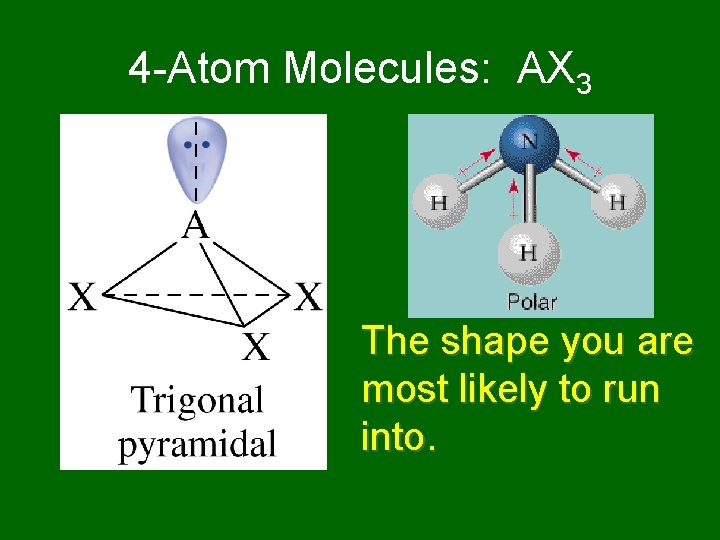
4 -Atom Molecules: AX 3 The shape you are most likely to run into.
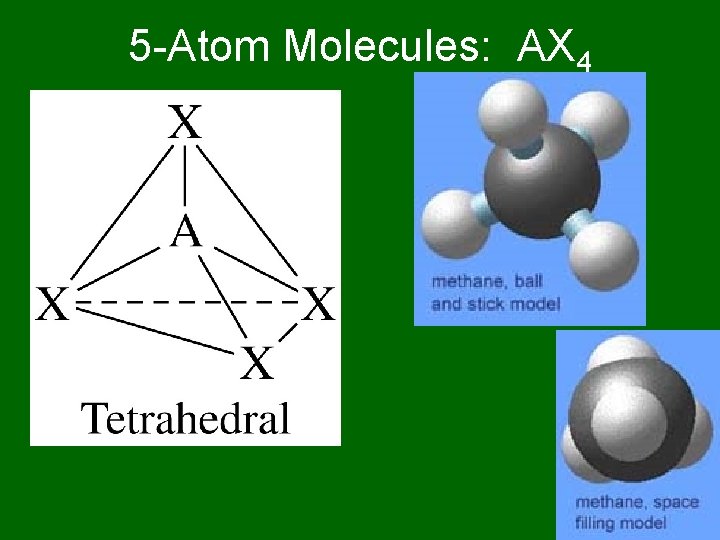
5 -Atom Molecules: AX 4
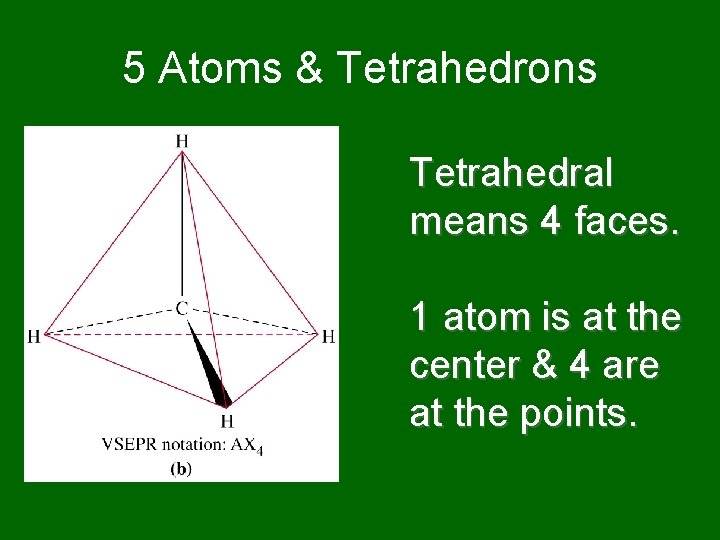
5 Atoms & Tetrahedrons Tetrahedral means 4 faces. 1 atom is at the center & 4 are at the points.
Molecular Shape • Determined by overlap of orbitals. • Shape is determined by two factors: – The total number of atoms and – The number of electron pairs in different locations on the central atom. – Classify electron pairs as bonding or nonbonding.
Molecular Shape & VSEPR • Electron pairs repel each other. They want to be as far apart from each other as they can. • Nonbonding pairs take up a little more room than bonding pairs.
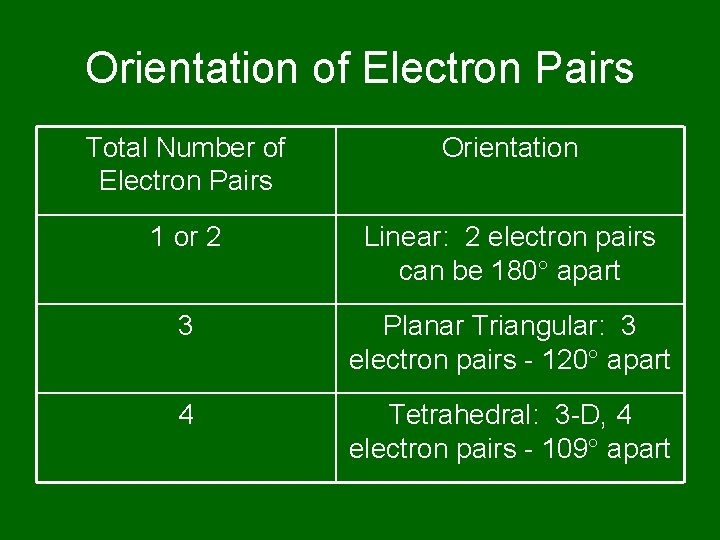
Orientation of Electron Pairs Total Number of Electron Pairs Orientation 1 or 2 Linear: 2 electron pairs can be 180 apart 3 Planar Triangular: 3 electron pairs - 120 apart 4 Tetrahedral: 3 -D, 4 electron pairs - 109 apart
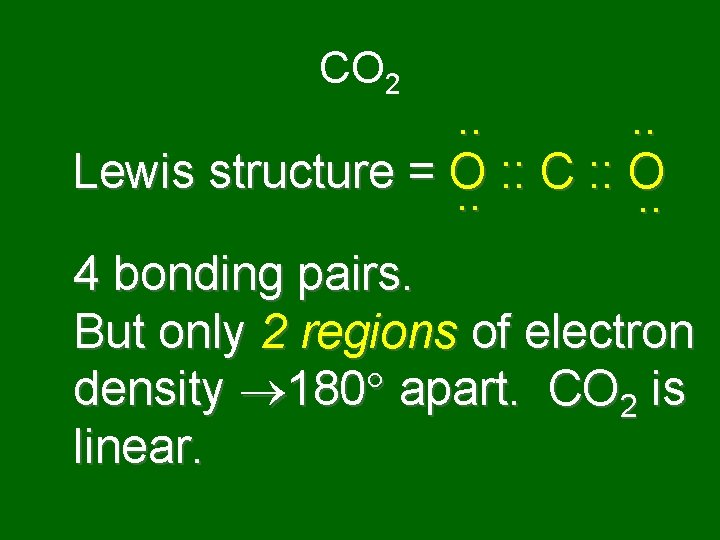
CO 2 . . Lewis structure = O : : C : : O. . 4 bonding pairs. But only 2 regions of electron density 180 apart. CO 2 is linear.
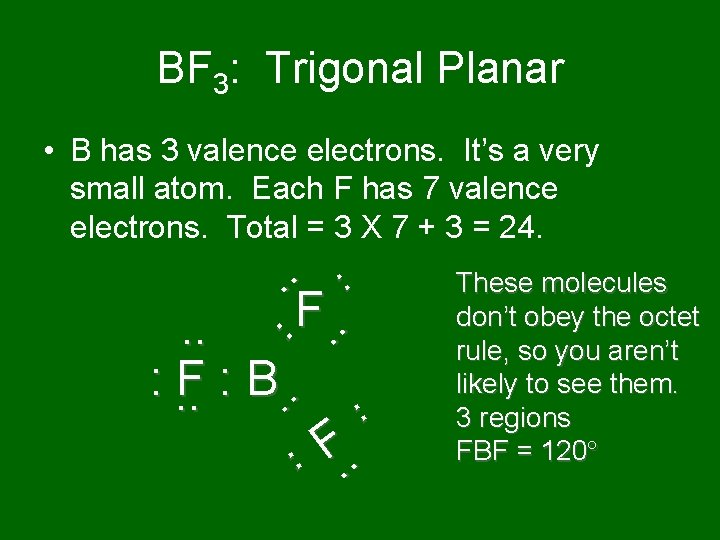
BF 3: Trigonal Planar • B has 3 valence electrons. It’s a very small atom. Each F has 7 valence electrons. Total = 3 X 7 + 3 = 24. . . F . . : . . F: B . . F. . These molecules don’t obey the octet rule, so you aren’t likely to see them. 3 regions FBF = 120
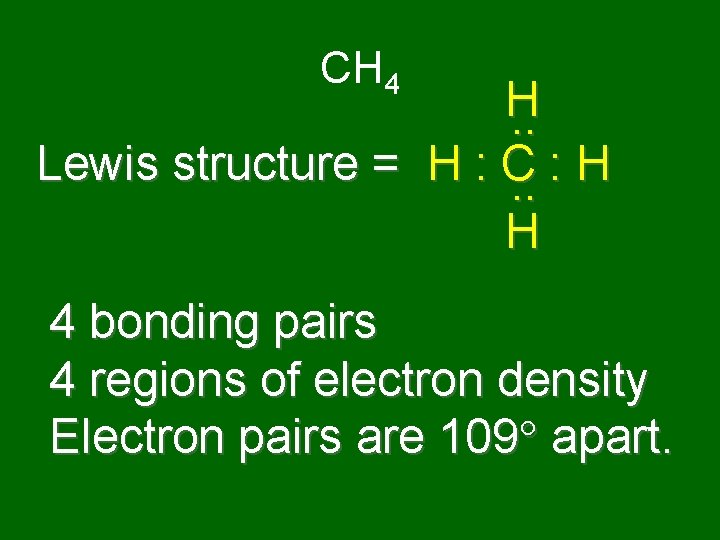
CH 4 H. . Lewis structure = H : C : H. . H 4 bonding pairs 4 regions of electron density Electron pairs are 109 apart.
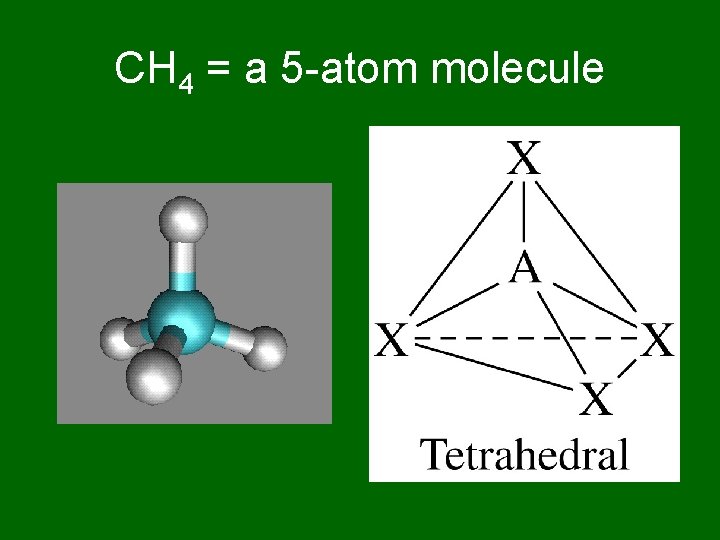
CH 4 = a 5 -atom molecule
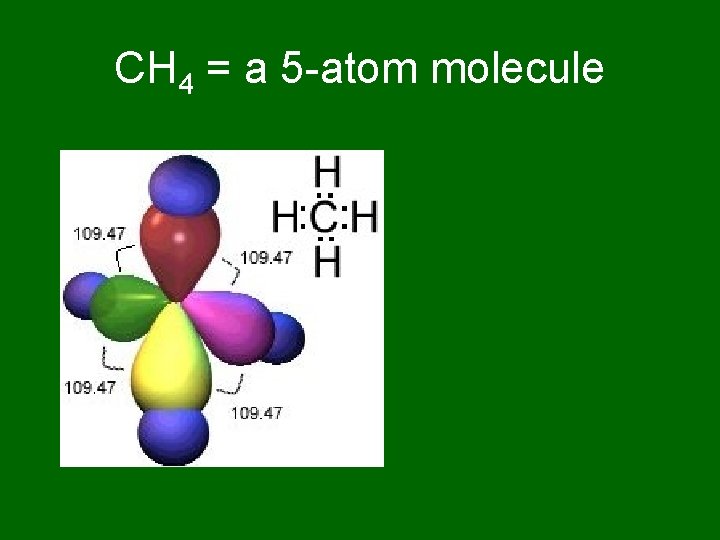
CH 4 = a 5 -atom molecule
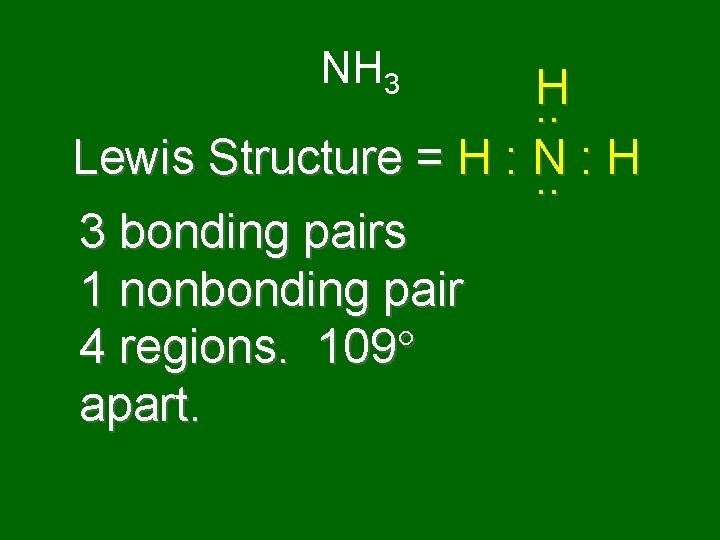
NH 3 H. . Lewis Structure = H : N : H. . 3 bonding pairs 1 nonbonding pair 4 regions. 109 apart.

4 -atom molecule. Shape = trigonal pyramid HNH = a bit less than 109
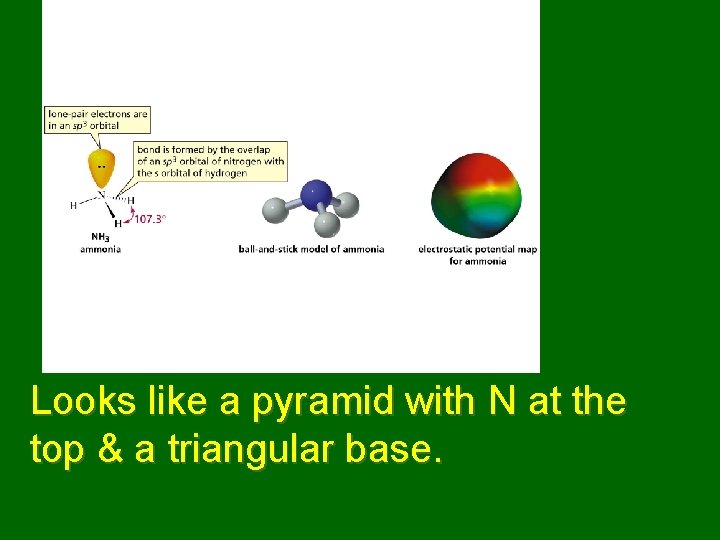
Looks like a pyramid with N at the top & a triangular base.
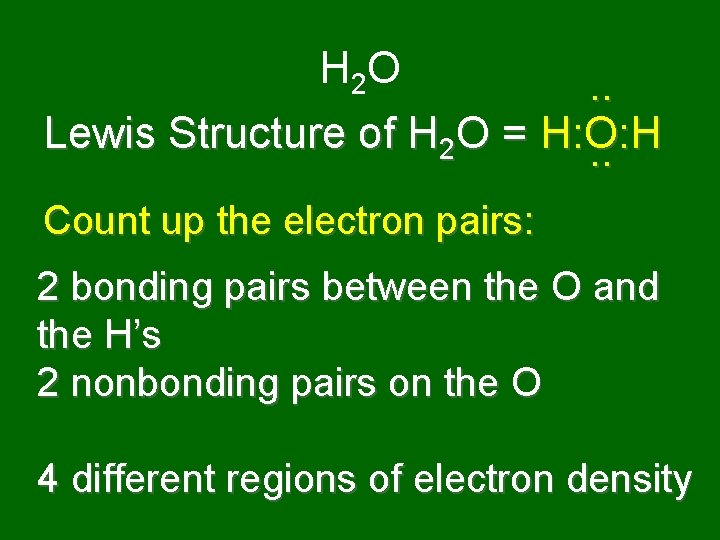
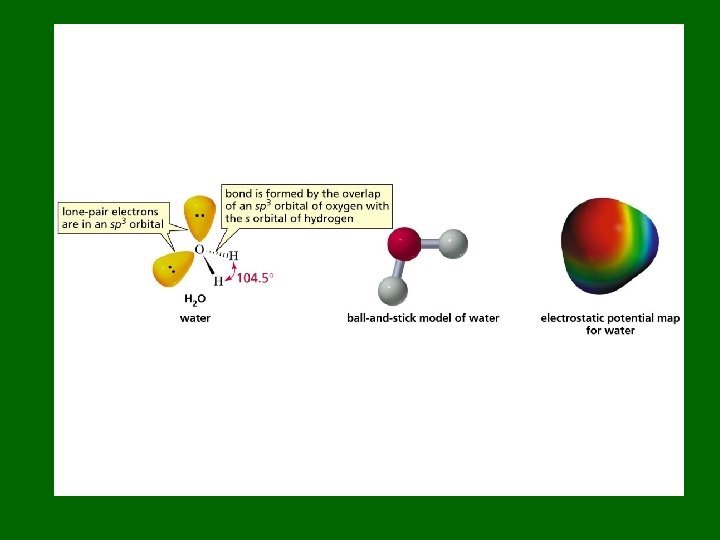
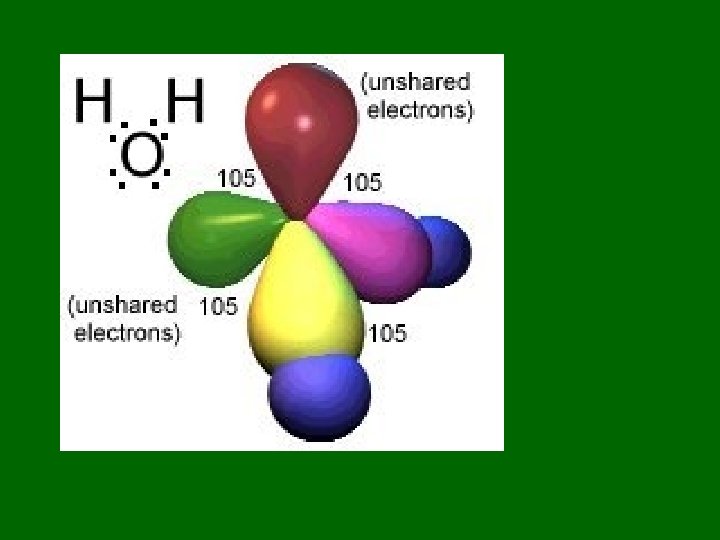
H 2 O. . Lewis Structure of H 2 O = H: O: H. . Count up the electron pairs: 2 bonding pairs between the O and the H’s 2 nonbonding pairs on the O 4 different regions of electron density
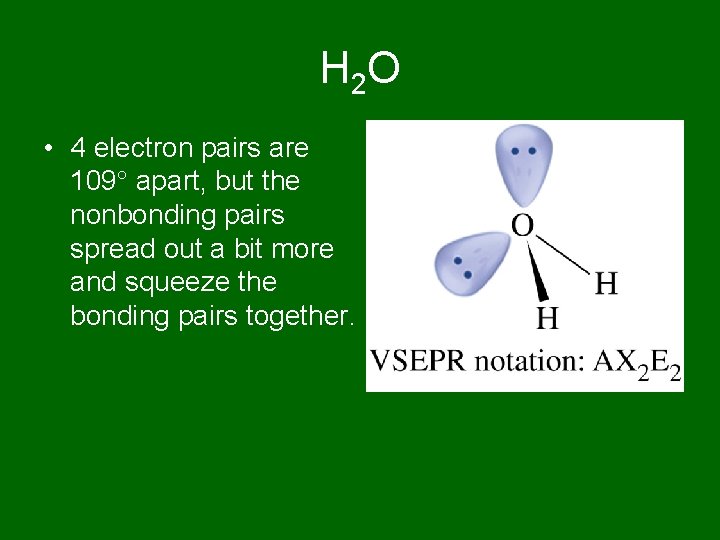
H 2 O • 4 electron pairs are 109 apart, but the nonbonding pairs spread out a bit more and squeeze the bonding pairs together.
Summary of Molecular Shapes • Start with Lewis Structure! • Look at number of regions of electron density on central atom. • Look at number of atoms bonded to central atom.
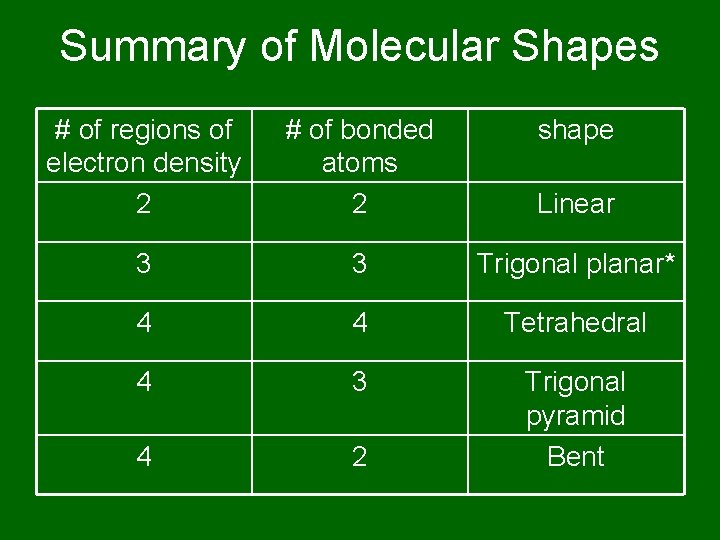
Summary of Molecular Shapes # of regions of electron density 2 # of bonded atoms 2 shape Linear 3 3 Trigonal planar* 4 4 Tetrahedral 4 3 4 2 Trigonal pyramid Bent
Molecular Polarity • Look at the type of bonds in the molecule. • Look at the shape of the molecule. • A polar molecular must contain polar bonds & it must be asymmetric (NOT symmetric).
Molecular Polarity • If molecule is symmetric, the electrical charge at any point on 1 side = electrical charge at matching point on opposite side. • the “pull” of one polar bond is offset by the “pull” of another polar bond. – It’s a tug-of-war that no one can win!
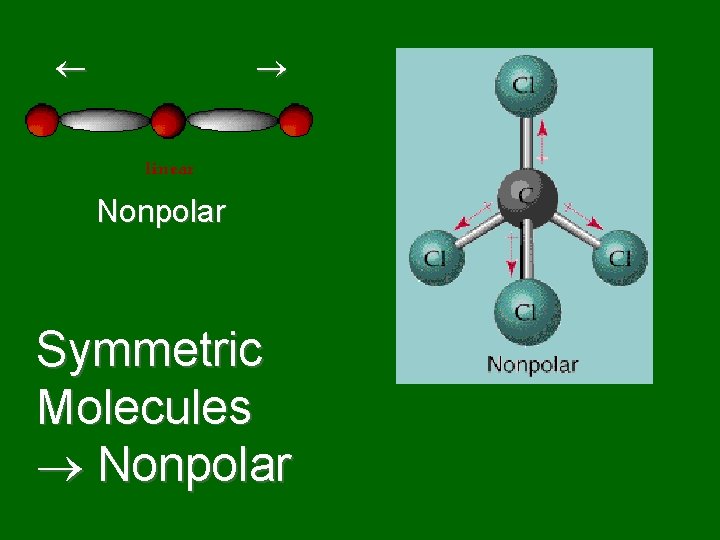
Nonpolar Symmetric Molecules Nonpolar

Asymmetric Molecules Polar
- Slides: 38