
Molecular Rotational Resonance Spectroscopy High Resolution FTMRR Spectroscopy
- Slides: 23
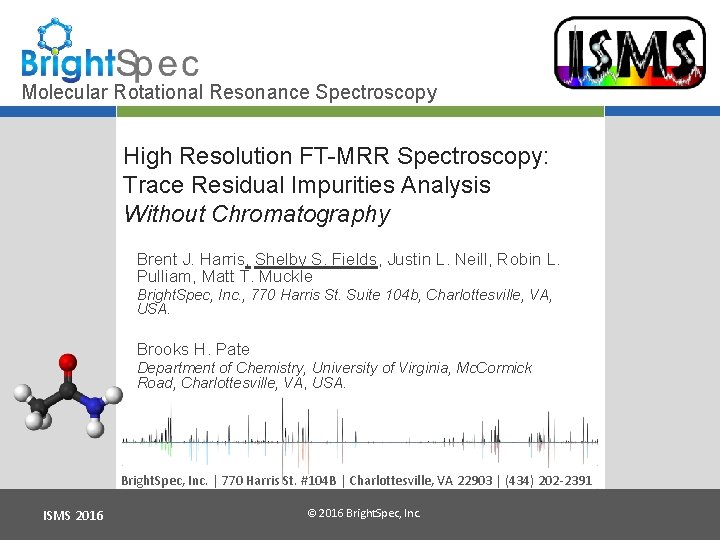
Molecular Rotational Resonance Spectroscopy High Resolution FT-MRR Spectroscopy: Trace Residual Impurities Analysis Without Chromatography Brent J. Harris, Shelby S. Fields, Justin L. Neill, Robin L. Pulliam, Matt T. Muckle Bright. Spec, Inc. , 770 Harris St. Suite 104 b, Charlottesville, VA, USA. Brooks H. Pate Department of Chemistry, University of Virginia, Mc. Cormick Road, Charlottesville, VA, USA. Bright. Spec, Inc. | 770 Harris St. #104 B | Charlottesville, VA 22903 | (434) 202 -2391 ISMS 2016 © 2016 Bright. Spec, Inc.
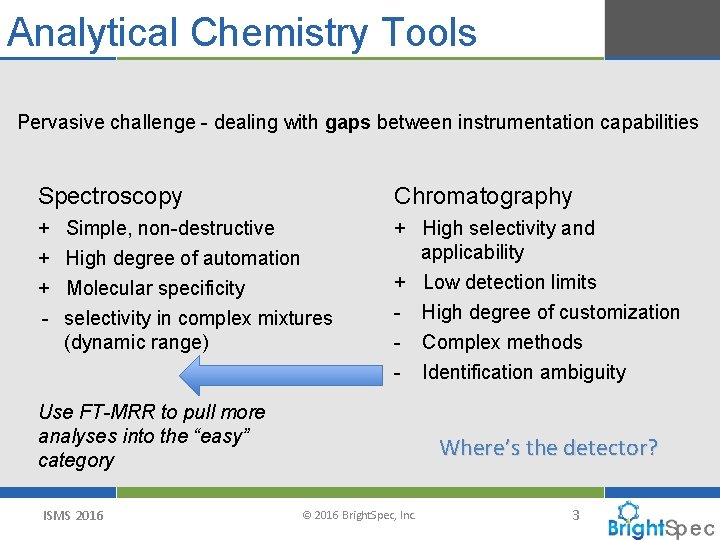
Analytical Chemistry Tools Pervasive challenge - dealing with gaps between instrumentation capabilities Spectroscopy Chromatography + Simple, non-destructive + High selectivity and applicability + Low detection limits - High degree of customization - Complex methods - Identification ambiguity + High degree of automation + Molecular specificity - selectivity in complex mixtures (dynamic range) Use FT-MRR to pull more analyses into the “easy” category ISMS 2016 Where’s the detector? © 2016 Bright. Spec, Inc. 3
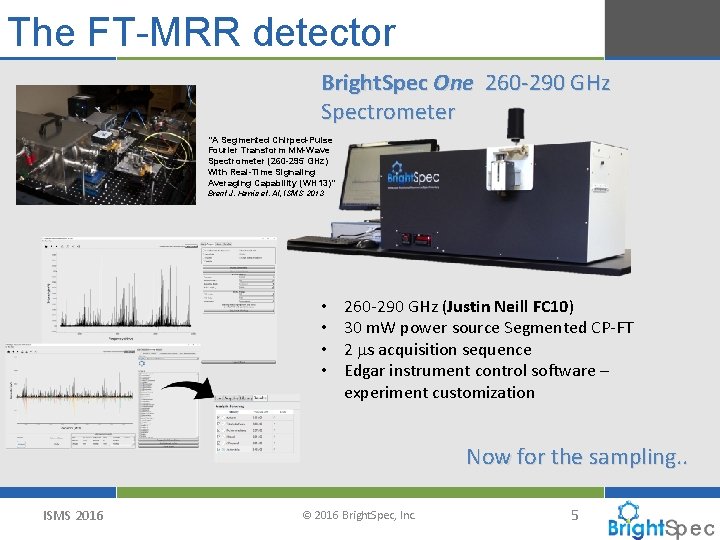
The FT-MRR detector Bright. Spec One 260 -290 GHz Spectrometer “A Segmented Chirped-Pulse Fourier Transform MM-Wave Spectrometer (260 -295 GHz) With Real-Time Signaling Averaging Capability (WH 13)” Brent J. Harris et. Al, ISMS 2013 • • 260 -290 GHz (Justin Neill FC 10) 30 m. W power source Segmented CP-FT 2 ms acquisition sequence Edgar instrument control software – experiment customization Now for the sampling. . ISMS 2016 © 2016 Bright. Spec, Inc. 5
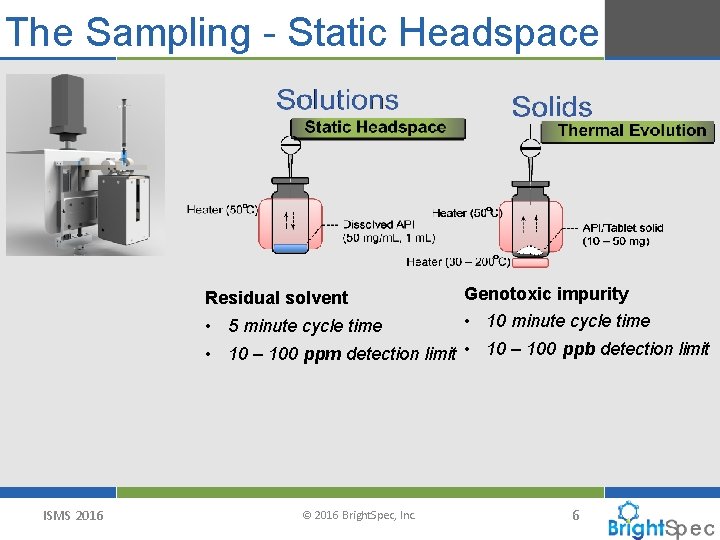
The Sampling - Static Headspace ° ° ° Residual solvent Genotoxic impurity • 10 minute cycle time • 5 minute cycle time • 10 – 100 ppm detection limit • 10 – 100 ppb detection limit ISMS 2016 © 2016 Bright. Spec, Inc. 6
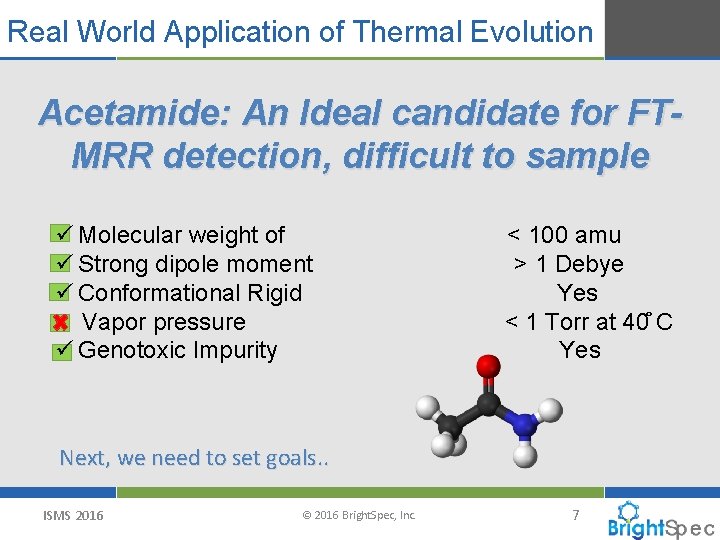
Real World Application of Thermal Evolution Acetamide: An Ideal candidate for FTMRR detection, difficult to sample ü Molecular weight of ü Strong dipole moment ü Conformational Rigid Vapor pressure ü Genotoxic Impurity < 100 amu > 1 Debye Yes < 1 Torr at 40° C Yes Next, we need to set goals. . ISMS 2016 © 2016 Bright. Spec, Inc. 7
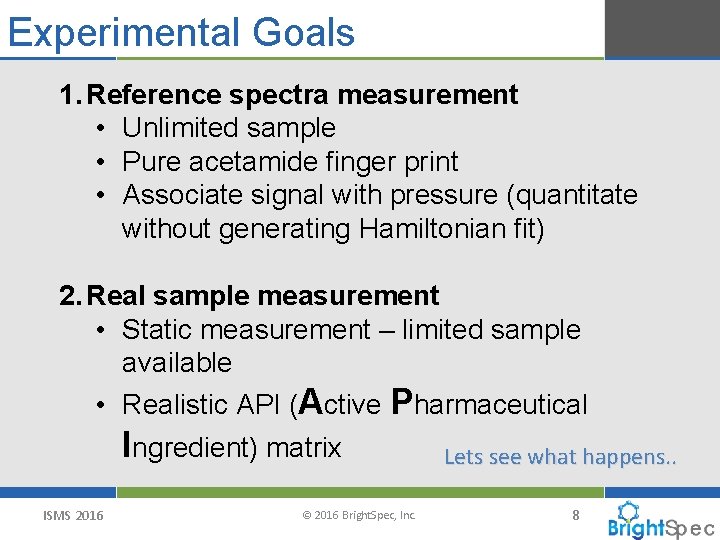
Experimental Goals 1. Reference spectra measurement • Unlimited sample • Pure acetamide finger print • Associate signal with pressure (quantitate without generating Hamiltonian fit) 2. Real sample measurement • Static measurement – limited sample available • Realistic API (Active Pharmaceutical Ingredient) matrix ISMS 2016 © 2016 Bright. Spec, Inc. Lets see what happens. . 8
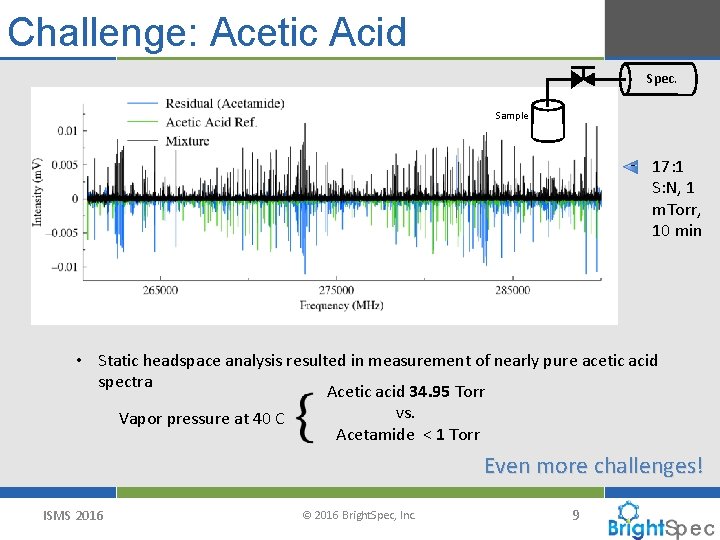
Challenge: Acetic Acid Spec. Sample • 17: 1 S: N, 1 m. Torr, 10 min • Static headspace analysis resulted in measurement of nearly pure acetic acid spectra Acetic acid 34. 95 Torr vs. Vapor pressure at 40 C Acetamide < 1 Torr Even more challenges! ISMS 2016 © 2016 Bright. Spec, Inc. 9
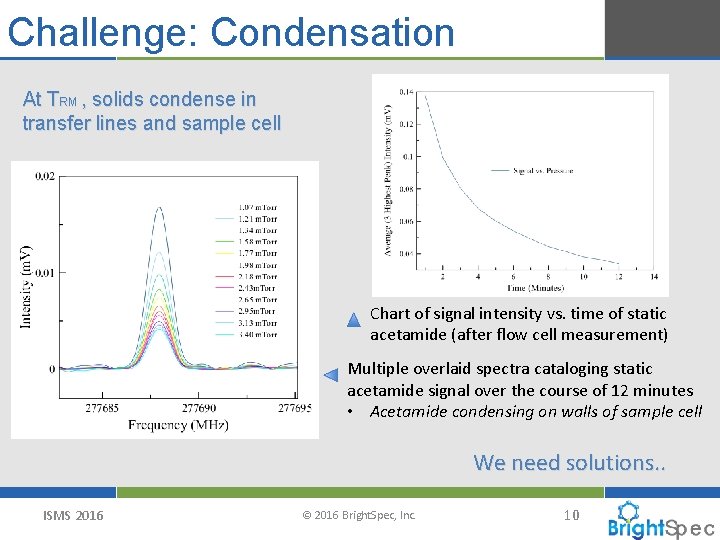
Challenge: Condensation At TRM , solids condense in transfer lines and sample cell Chart of signal intensity vs. time of static acetamide (after flow cell measurement) Multiple overlaid spectra cataloging static acetamide signal over the course of 12 minutes • Acetamide condensing on walls of sample cell We need solutions. . ISMS 2016 © 2016 Bright. Spec, Inc. 10
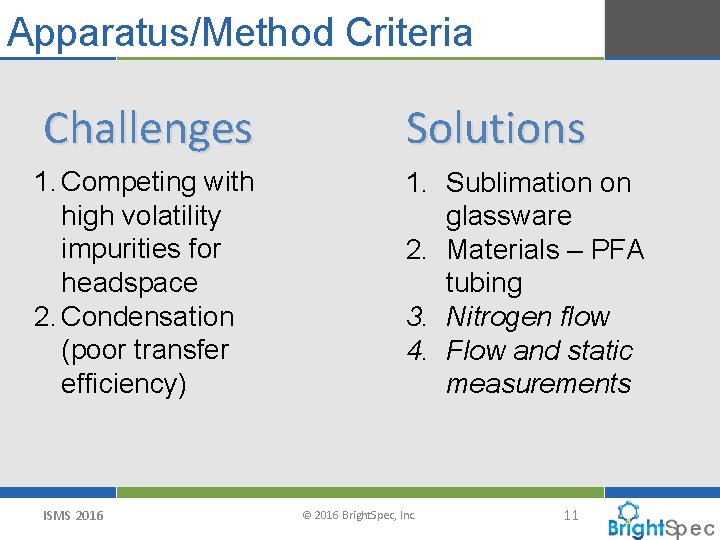
Apparatus/Method Criteria Challenges 1. Competing with high volatility impurities for headspace 2. Condensation (poor transfer efficiency) ISMS 2016 Solutions 1. Sublimation on glassware 2. Materials – PFA tubing 3. Nitrogen flow 4. Flow and static measurements © 2016 Bright. Spec, Inc. 11
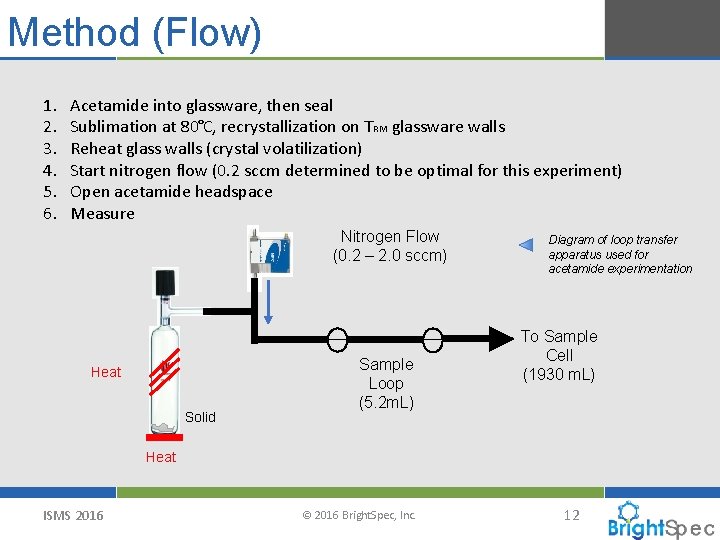
Method (Flow) 1. 2. 3. 4. 5. 6. Acetamide into glassware, then seal ° Sublimation at 80 C, recrystallization on T RM glassware walls Reheat glass walls (crystal volatilization) Start nitrogen flow (0. 2 sccm determined to be optimal for this experiment) Open acetamide headspace Measure Nitrogen Flow (0. 2 – 2. 0 sccm) Heat Solid Sample Loop (5. 2 m. L) Diagram of loop transfer apparatus used for acetamide experimentation To Sample Cell (1930 m. L) Heat ISMS 2016 © 2016 Bright. Spec, Inc. 12
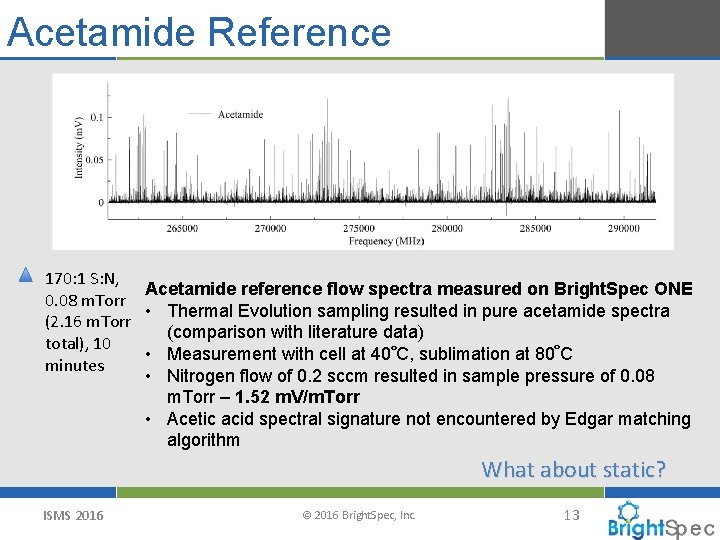
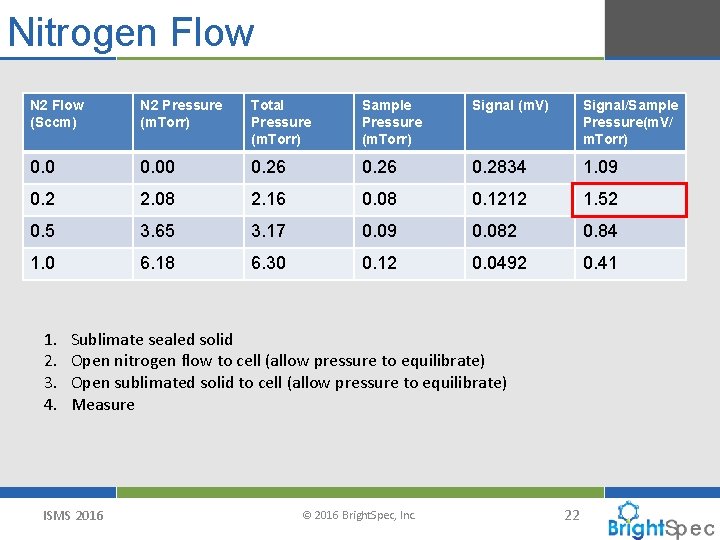
Acetamide Reference • 170: 1 S: N, Acetamide reference flow spectra measured on Bright. Spec ONE 0. 08 m. Torr • Thermal Evolution sampling resulted in pure acetamide spectra (2. 16 m. Torr (comparison with literature data) total), 10 • Measurement with cell at 40°C, sublimation at 80°C minutes • Nitrogen flow of 0. 2 sccm resulted in sample pressure of 0. 08 m. Torr – 1. 52 m. V/m. Torr • Acetic acid spectral signature not encountered by Edgar matching algorithm What about static? ISMS 2016 © 2016 Bright. Spec, Inc. 13
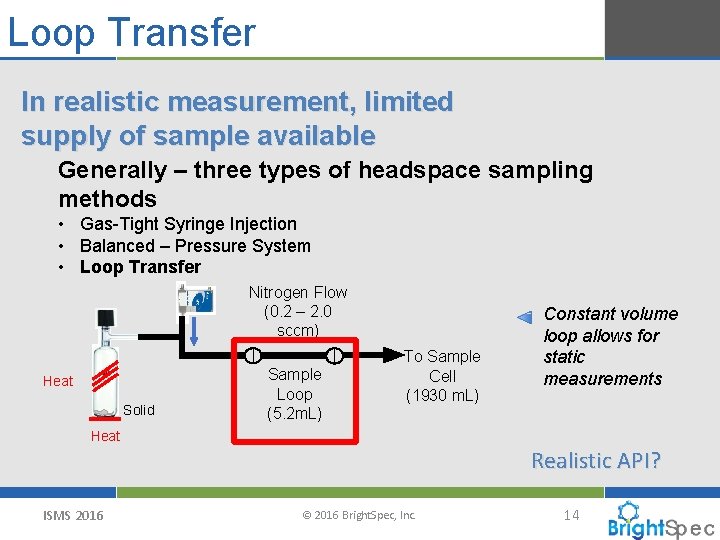
Loop Transfer In realistic measurement, limited supply of sample available Generally – three types of headspace sampling methods • Gas-Tight Syringe Injection • Balanced – Pressure System • Loop Transfer Nitrogen Flow (0. 2 – 2. 0 sccm) Heat Solid Sample Loop (5. 2 m. L) To Sample Cell (1930 m. L) Constant volume loop allows for static measurements Heat Realistic API? ISMS 2016 © 2016 Bright. Spec, Inc. 14
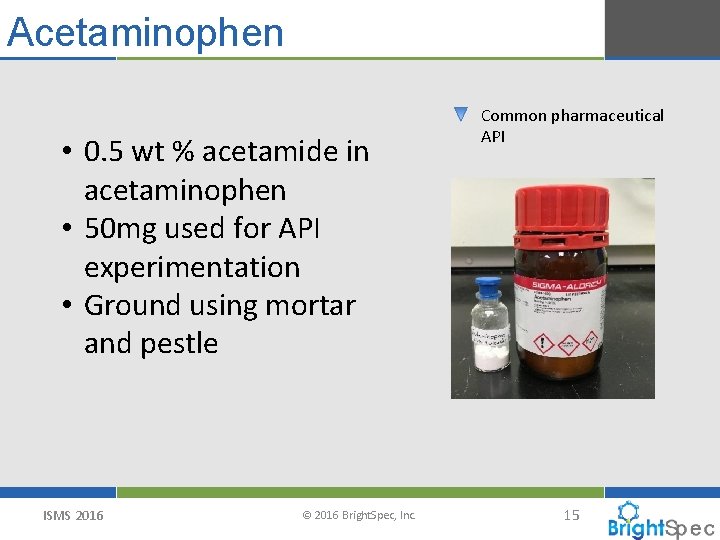
Acetaminophen • 0. 5 wt % acetamide in acetaminophen • 50 mg used for API experimentation • Ground using mortar and pestle ISMS 2016 © 2016 Bright. Spec, Inc. • Common pharmaceutical API 15
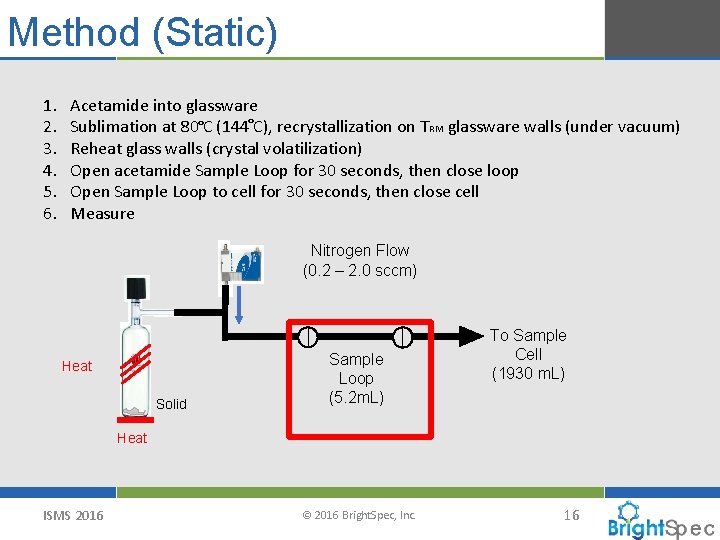
Method (Static) 1. 2. 3. 4. 5. 6. Acetamide into glassware ° Sublimation at 80 C (144 C), recrystallization on T RM glassware walls (under vacuum) ° Reheat glass walls (crystal volatilization) Open acetamide Sample Loop for 30 seconds, then close loop Open Sample Loop to cell for 30 seconds, then close cell Measure Nitrogen Flow (0. 2 – 2. 0 sccm) Heat Solid Sample Loop (5. 2 m. L) To Sample Cell (1930 m. L) Heat ISMS 2016 © 2016 Bright. Spec, Inc. 16
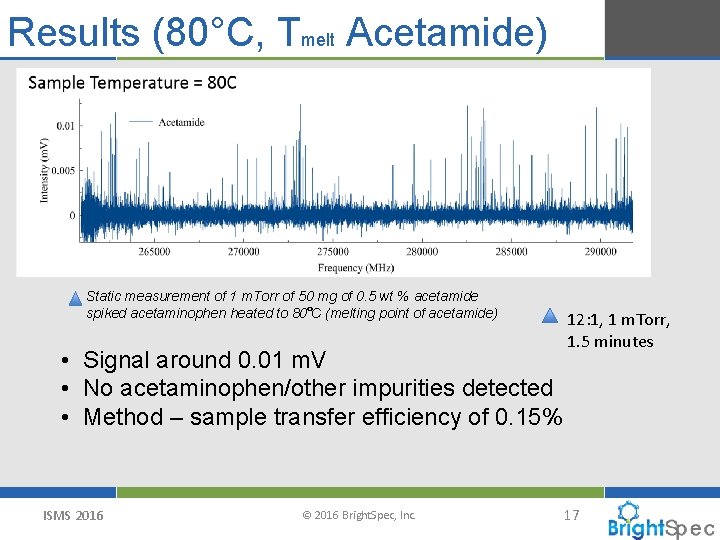
Results (80°C, Tmelt Acetamide) Static measurement of 1 m. Torr of 50 mg of 0. 5 wt % acetamide spiked acetaminophen heated to 80°C (melting point of acetamide) • 12: 1, 1 m. Torr, 1. 5 minutes • Signal around 0. 01 m. V • No acetaminophen/other impurities detected • Method – sample transfer efficiency of 0. 15% ISMS 2016 © 2016 Bright. Spec, Inc. 17
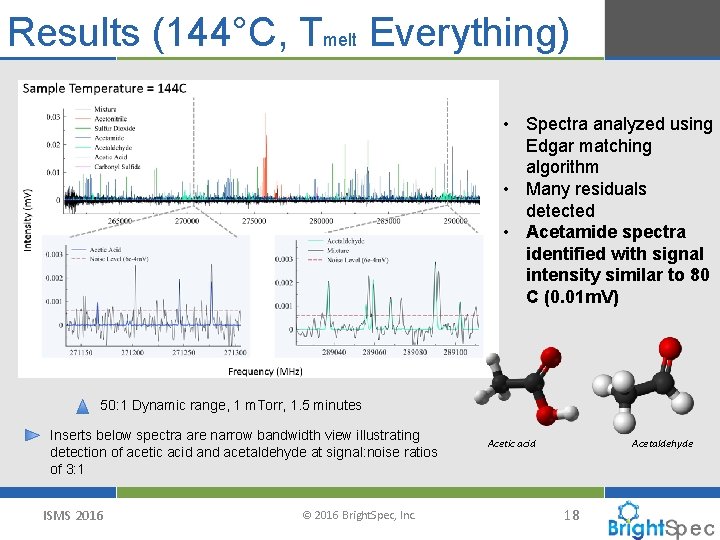
Results (144°C, Tmelt Everything) • Spectra analyzed using Edgar matching algorithm • Many residuals detected • Acetamide spectra identified with signal ° intensity similar to 80 C (0. 01 m. V) 50: 1 Dynamic range, 1 m. Torr, 1. 5 minutes Inserts below spectra are narrow bandwidth view illustrating detection of acetic acid and acetaldehyde at signal: noise ratios of 3: 1 ISMS 2016 © 2016 Bright. Spec, Inc. Acetic acid Acetaldehyde 18
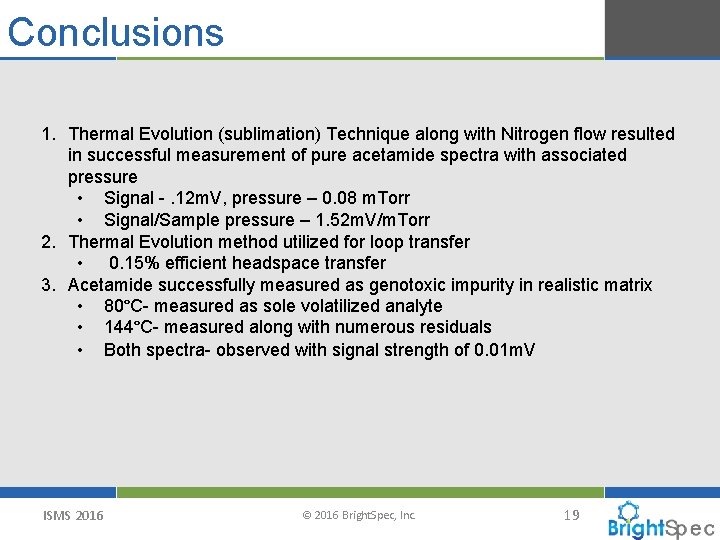
Conclusions 1. Thermal Evolution (sublimation) Technique along with Nitrogen flow resulted in successful measurement of pure acetamide spectra with associated pressure • Signal -. 12 m. V, pressure – 0. 08 m. Torr • Signal/Sample pressure – 1. 52 m. V/m. Torr 2. Thermal Evolution method utilized for loop transfer • 0. 15% efficient headspace transfer 3. Acetamide successfully measured as genotoxic impurity in realistic matrix • 80°C- measured as sole volatilized analyte • 144°C- measured along with numerous residuals • Both spectra- observed with signal strength of 0. 01 m. V ISMS 2016 © 2016 Bright. Spec, Inc. 19
Further Experimentation • Quantitation – Use of expansive spectral library and Edgar matching algorithm for compositional analysis of unknown mixtures • Reduced cycle time – cutting down established procedures for measurement while maintaining accuracy • More realistic experimental matrix – subject analytes imbedded in API matrix for more realistic measurement conditions ISMS 2016 © 2016 Bright. Spec, Inc. 20
Thank You FT-MRR for Analytical Chemistry … … and Scientific Discovery Bright. Spec Inc. Charlottesville, VA • Instrument Sales, Trials, Demos • Method Development • Analytical Services 770 Harris St. #104 b | Charlottesville, VA 22963 ISMS 2016 © 2016 Bright. Spec, Inc. 21
Nitrogen Flow N 2 Flow (Sccm) N 2 Pressure (m. Torr) Total Pressure (m. Torr) Sample Pressure (m. Torr) Signal (m. V) Signal/Sample Pressure(m. V/ m. Torr) 0. 00 0. 26 0. 2834 1. 09 0. 2 2. 08 2. 16 0. 08 0. 1212 1. 52 0. 5 3. 65 3. 17 0. 09 0. 082 0. 84 1. 0 6. 18 6. 30 0. 12 0. 0492 0. 41 1. 2. 3. 4. Sublimate sealed solid Open nitrogen flow to cell (allow pressure to equilibrate) Open sublimated solid to cell (allow pressure to equilibrate) Measure ISMS 2016 © 2016 Bright. Spec, Inc. 22
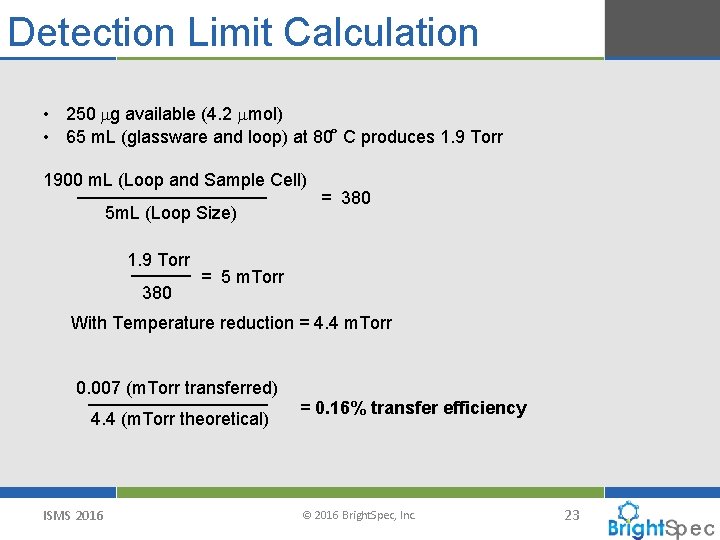
Detection Limit Calculation • 250 mg available (4. 2 mmol) • 65 m. L (glassware and loop) at 80° C produces 1. 9 Torr 1900 m. L (Loop and Sample Cell) __________ = 380 5 m. L (Loop Size) 1. 9 Torr ______ = 5 m. Torr 380 With Temperature reduction = 4. 4 m. Torr 0. 007 (m. Torr transferred) _________ 4. 4 (m. Torr theoretical) ISMS 2016 = 0. 16% transfer efficiency © 2016 Bright. Spec, Inc. 23
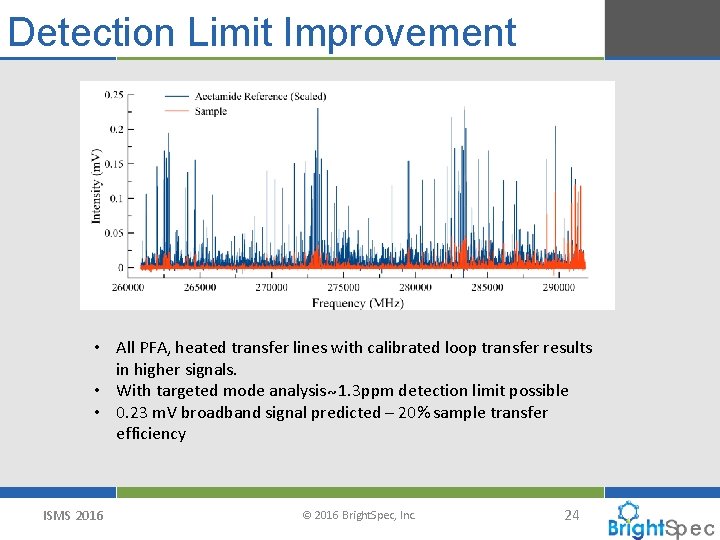
Detection Limit Improvement • All PFA, heated transfer lines with calibrated loop transfer results in higher signals. • With targeted mode analysis 1. 3 ppm detection limit possible ~ • 0. 23 m. V broadband signal predicted – 20% sample transfer efficiency ISMS 2016 © 2016 Bright. Spec, Inc. 24
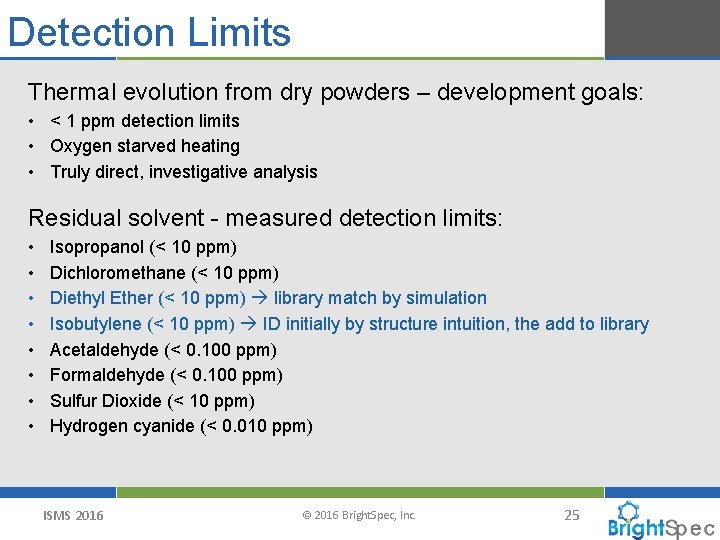
Detection Limits Thermal evolution from dry powders – development goals: • < 1 ppm detection limits • Oxygen starved heating • Truly direct, investigative analysis Residual solvent - measured detection limits: • • Isopropanol (< 10 ppm) Dichloromethane (< 10 ppm) Diethyl Ether (< 10 ppm) library match by simulation Isobutylene (< 10 ppm) ID initially by structure intuition, the add to library Acetaldehyde (< 0. 100 ppm) Formaldehyde (< 0. 100 ppm) Sulfur Dioxide (< 10 ppm) Hydrogen cyanide (< 0. 010 ppm) ISMS 2016 © 2016 Bright. Spec, Inc. 25