
Molecular Rotational Resonance Spectroscopy Frequency Band Performance Comparisons
Molecular Rotational Resonance Spectroscopy Frequency Band Performance Comparisons for Room-Temperature Chirped Pulse Millimeter Wave Spectroscopy Justin L. Neill, Brent J. Harris, Robin L. Pulliam, Matt T. Muckle Bright. Spec, Inc. , 770 Harris St. Suite 104 b, Charlottesville, VA, USA. Brooks H. Pate Department of Chemistry, University of Virginia, Mc. Cormick Road, Charlottesville, VA, USA. Bright. Spec, Inc. | 770 Harris St. #104 B | Charlottesville, VA 22903 | (434) 202 -2391 June 24, 2016 FC 10
Overview Goal of the study: To offer a quantitative performance comparison between room temperature chirped-pulse millimeter wave spectrometers operating in different frequency bands for rapid analytical characterization of complex mixtures. Criteria: • Correct identifications (needs: high resolution, good frequency coverage) Particular challenge is finding a weak component in a strong ‘forest’ • Range of molecular coverage (needs: bandwidth, matched to molecules of interest) • Sensitivity (needs: high power, well matched to strong transitions) • Ability to do advanced pulse sequences (need: high power to reach p/2, p pulse conditions) Acknowledgement: This material is based upon work supported by the U. S. Army under Contract No. W 31 P 4 Q-15 -C-0019. 6/24/2016 1
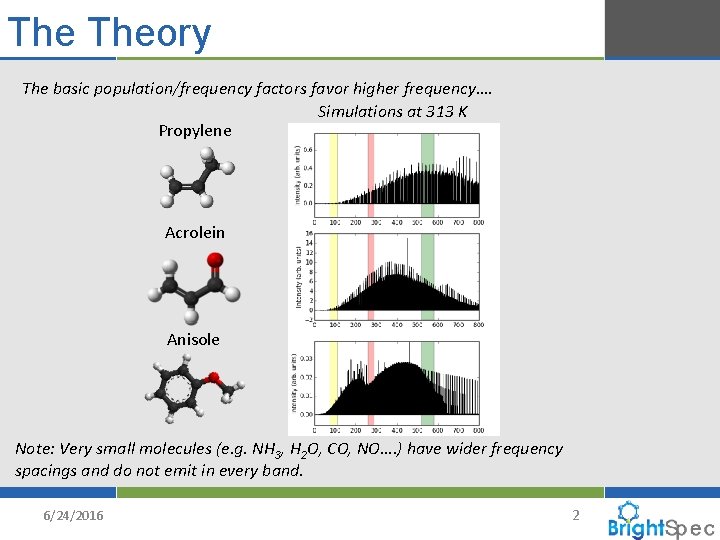
The Theory The basic population/frequency factors favor higher frequency…. Simulations at 313 K Propylene Acrolein Anisole Note: Very small molecules (e. g. NH 3, H 2 O, CO, NO…. ) have wider frequency spacings and do not emit in every band. 6/24/2016 2
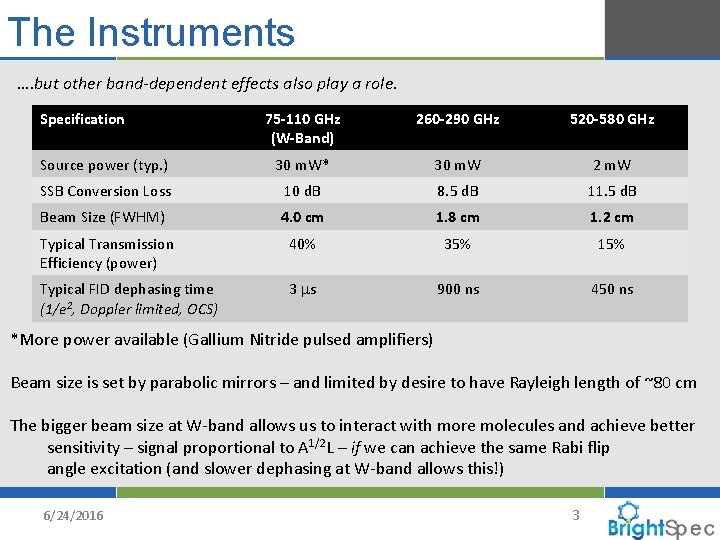
The Instruments …. but other band-dependent effects also play a role. Specification 75 -110 GHz (W-Band) 260 -290 GHz 520 -580 GHz Source power (typ. ) 30 m. W* 30 m. W 2 m. W SSB Conversion Loss 10 d. B 8. 5 d. B 11. 5 d. B Beam Size (FWHM) 4. 0 cm 1. 8 cm 1. 2 cm Typical Transmission Efficiency (power) 40% 35% 15% Typical FID dephasing time (1/e 2, Doppler limited, OCS) 3 ms 900 ns 450 ns *More power available (Gallium Nitride pulsed amplifiers) Beam size is set by parabolic mirrors – and limited by desire to have Rayleigh length of ~80 cm The bigger beam size at W-band allows us to interact with more molecules and achieve better sensitivity – signal proportional to A 1/2 L – if we can achieve the same Rabi flip angle excitation (and slower dephasing at W-band allows this!) 6/24/2016 3
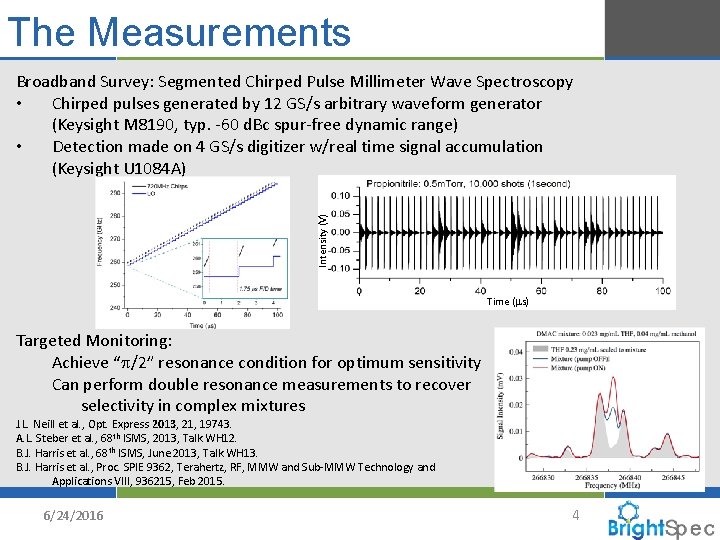
The Measurements Intensity (V) Broadband Survey: Segmented Chirped Pulse Millimeter Wave Spectroscopy • Chirped pulses generated by 12 GS/s arbitrary waveform generator (Keysight M 8190, typ. -60 d. Bc spur-free dynamic range) • Detection made on 4 GS/s digitizer w/real time signal accumulation (Keysight U 1084 A) Time (ms) Targeted Monitoring: Achieve “p/2” resonance condition for optimum sensitivity Can perform double resonance measurements to recover selectivity in complex mixtures J. L. Neill et al. , Opt. Express 2013, 21, 19743. A. L. Steber et al. , 68 th ISMS, 2013, Talk WH 12. B. J. Harris et al. , 68 th ISMS, June 2013, Talk WH 13. B. J. Harris et al. , Proc. SPIE 9362, Terahertz, RF, MMW and Sub-MMW Technology and Applications VIII, 936215, Feb 2015. 6/24/2016 4
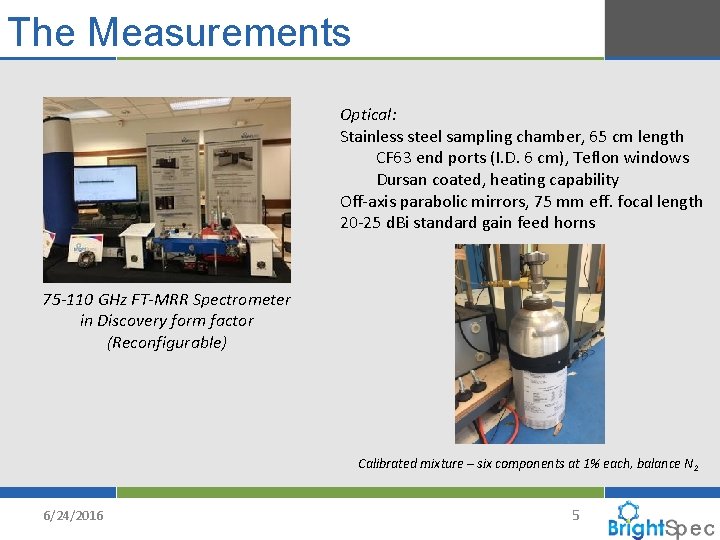
The Measurements Optical: Stainless steel sampling chamber, 65 cm length CF 63 end ports (I. D. 6 cm), Teflon windows Dursan coated, heating capability Off-axis parabolic mirrors, 75 mm eff. focal length 20 -25 d. Bi standard gain feed horns 75 -110 GHz FT-MRR Spectrometer in Discovery form factor (Reconfigurable) Calibrated mixture – six components at 1% each, balance N 2 6/24/2016 5
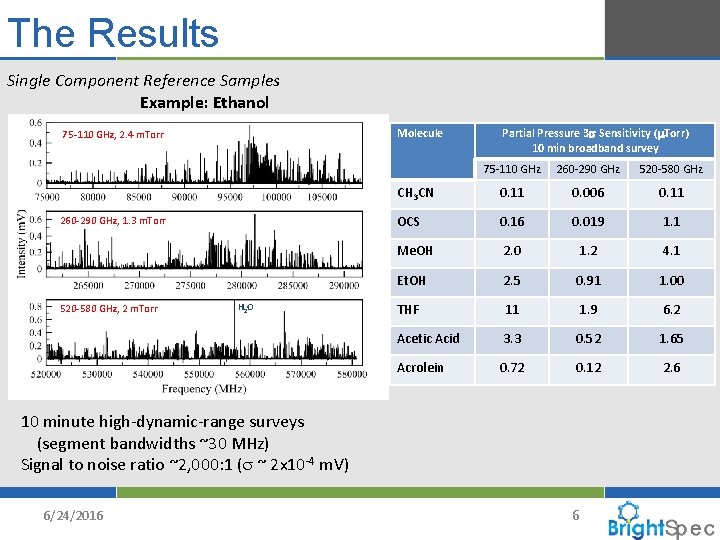
The Results Single Component Reference Samples Example: Ethanol Molecule 75 -110 GHz, 2. 4 m. Torr 260 -290 GHz, 1. 3 m. Torr 520 -580 GHz, 2 m. Torr H 2 O Partial Pressure 3 s Sensitivity (m. Torr) 10 min broadband survey 75 -110 GHz 260 -290 GHz 520 -580 GHz CH 3 CN 0. 11 0. 006 0. 11 OCS 0. 16 0. 019 1. 1 Me. OH 2. 0 1. 2 4. 1 Et. OH 2. 5 0. 91 1. 00 THF 11 1. 9 6. 2 Acetic Acid 3. 3 0. 52 1. 65 Acrolein 0. 72 0. 12 2. 6 10 minute high-dynamic-range surveys (segment bandwidths ~30 MHz) Signal to noise ratio ~2, 000: 1 (s ~ 2 x 10 -4 m. V) 6/24/2016 6
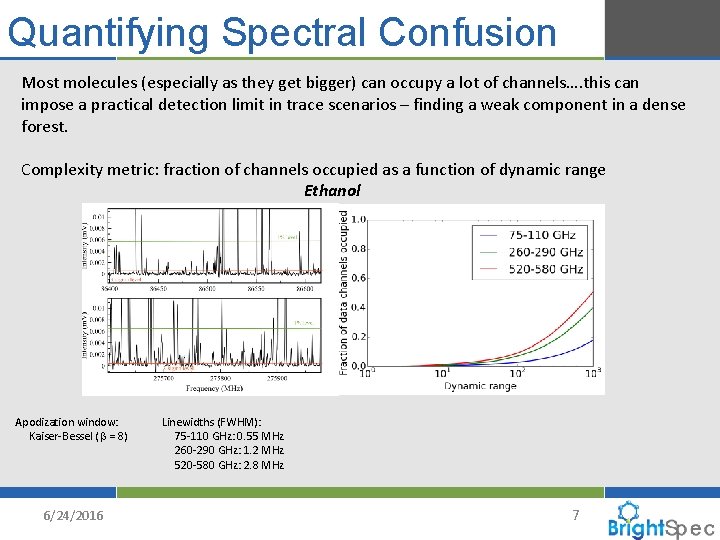
Quantifying Spectral Confusion Most molecules (especially as they get bigger) can occupy a lot of channels…. this can impose a practical detection limit in trace scenarios – finding a weak component in a dense forest. Complexity metric: fraction of channels occupied as a function of dynamic range Ethanol Apodization window: Kaiser-Bessel (b = 8) 6/24/2016 Linewidths (FWHM): 75 -110 GHz: 0. 55 MHz 260 -290 GHz: 1. 2 MHz 520 -580 GHz: 2. 8 MHz 7
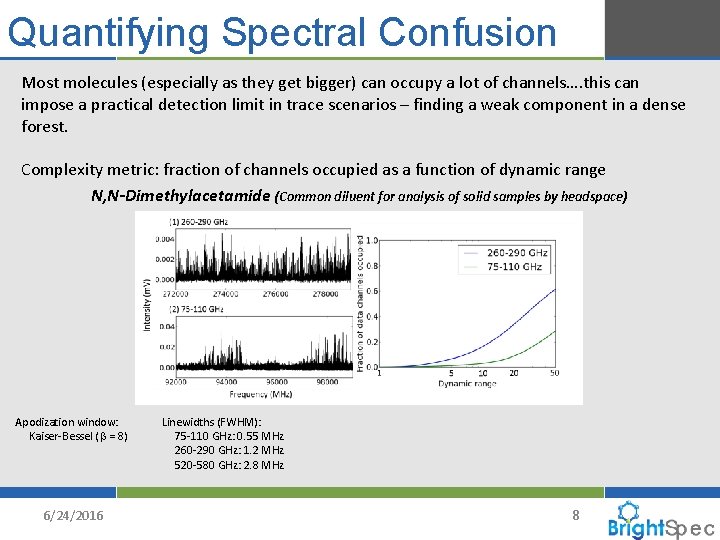
Quantifying Spectral Confusion Most molecules (especially as they get bigger) can occupy a lot of channels…. this can impose a practical detection limit in trace scenarios – finding a weak component in a dense forest. Complexity metric: fraction of channels occupied as a function of dynamic range N, N-Dimethylacetamide (Common diluent for analysis of solid samples by headspace) Apodization window: Kaiser-Bessel (b = 8) 6/24/2016 Linewidths (FWHM): 75 -110 GHz: 0. 55 MHz 260 -290 GHz: 1. 2 MHz 520 -580 GHz: 2. 8 MHz 8
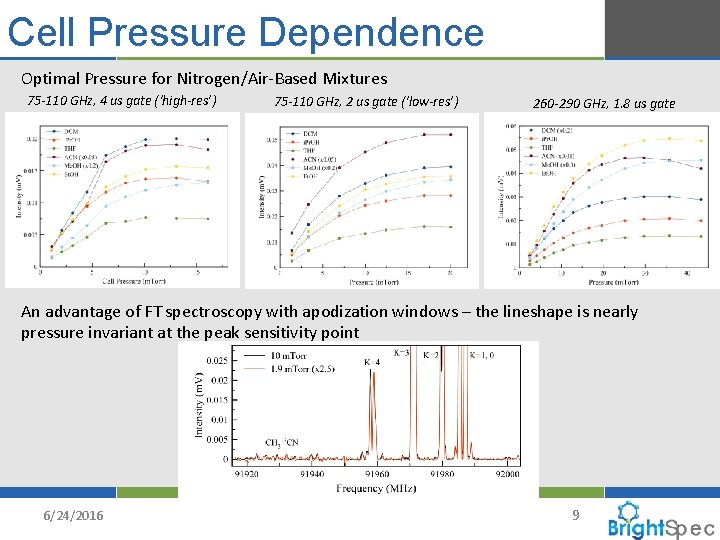
Cell Pressure Dependence Optimal Pressure for Nitrogen/Air-Based Mixtures 75 -110 GHz, 4 us gate (‘high-res’) 75 -110 GHz, 2 us gate (‘low-res’) 260 -290 GHz, 1. 8 us gate An advantage of FT spectroscopy with apodization windows – the lineshape is nearly pressure invariant at the peak sensitivity point 6/24/2016 9
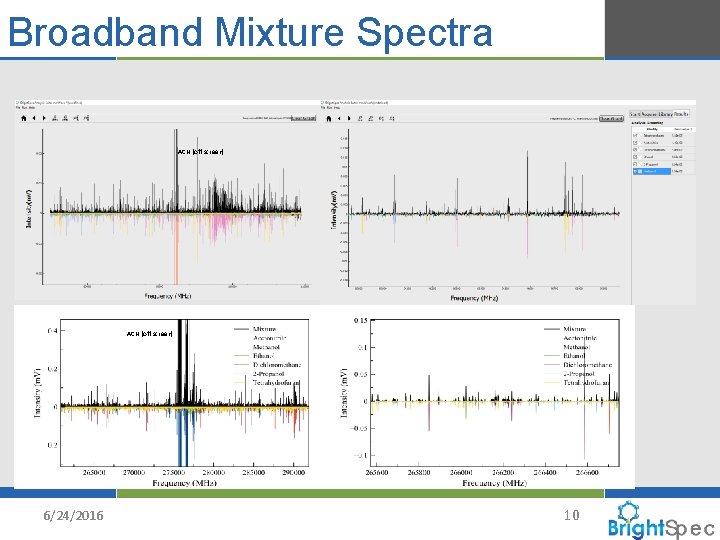
Broadband Mixture Spectra ACN (off screen) 6/24/2016 10
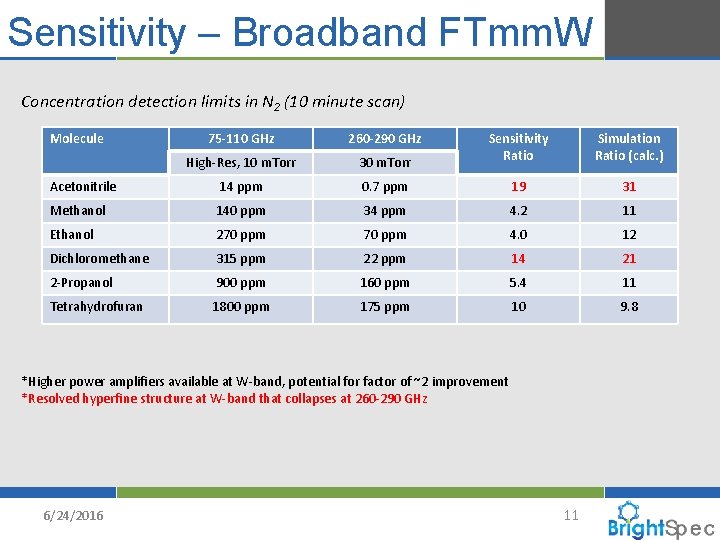
Sensitivity – Broadband FTmm. W Concentration detection limits in N 2 (10 minute scan) Molecule 75 -110 GHz 260 -290 GHz Sensitivity Ratio Simulation Ratio (calc. ) High-Res, 10 m. Torr 30 m. Torr Acetonitrile 14 ppm 0. 7 ppm 19 31 Methanol 140 ppm 34 ppm 4. 2 11 Ethanol 270 ppm 4. 0 12 Dichloromethane 315 ppm 22 ppm 14 21 2 -Propanol 900 ppm 160 ppm 5. 4 11 Tetrahydrofuran 1800 ppm 175 ppm 10 9. 8 *Higher power amplifiers available at W-band, potential for factor of ~2 improvement *Resolved hyperfine structure at W-band that collapses at 260 -290 GHz 6/24/2016 11
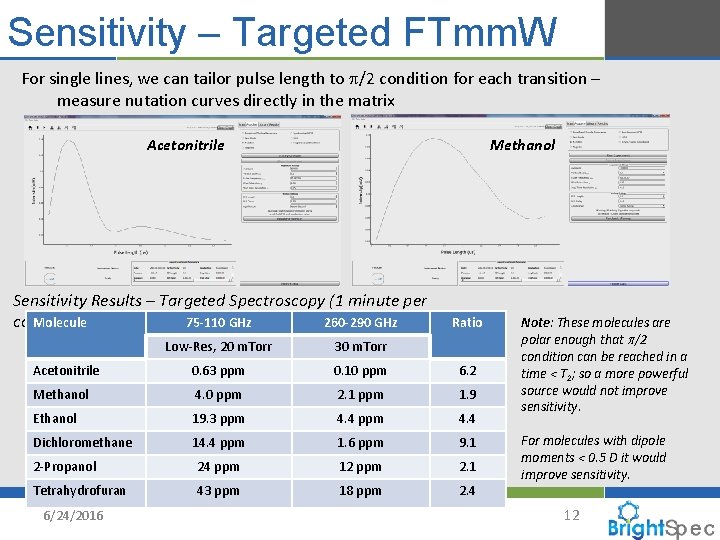
Sensitivity – Targeted FTmm. W For single lines, we can tailor pulse length to p/2 condition for each transition – measure nutation curves directly in the matrix Acetonitrile Methanol Sensitivity Results – Targeted Spectroscopy (1 minute per component) Molecule 75 -110 GHz 260 -290 GHz Ratio Low-Res, 20 m. Torr 30 m. Torr Acetonitrile 0. 63 ppm 0. 10 ppm 6. 2 Methanol 4. 0 ppm 2. 1 ppm 1. 9 Ethanol 19. 3 ppm 4. 4 Dichloromethane 14. 4 ppm 1. 6 ppm 9. 1 2 -Propanol 24 ppm 12 ppm 2. 1 Tetrahydrofuran 43 ppm 18 ppm 2. 4 6/24/2016 Note: These molecules are polar enough that p/2 condition can be reached in a time < T 2; so a more powerful source would not improve sensitivity. For molecules with dipole moments < 0. 5 D it would improve sensitivity. 12
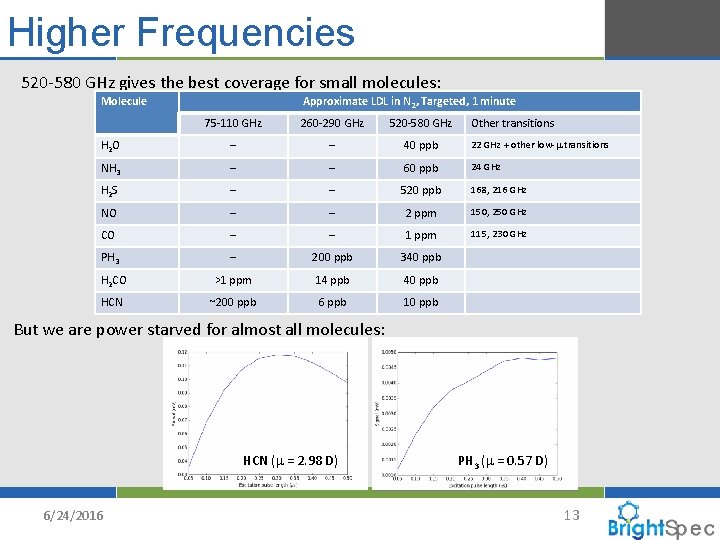
Higher Frequencies 520 -580 GHz gives the best coverage for small molecules: Molecule Approximate LDL in N 2, Targeted, 1 minute 75 -110 GHz 260 -290 GHz 520 -580 GHz Other transitions H 2 O -- -- 40 ppb 22 GHz + other low-m transitions NH 3 -- -- 60 ppb 24 GHz H 2 S -- -- 520 ppb 168, 216 GHz NO -- -- 2 ppm 150, 250 GHz CO -- -- 1 ppm 115, 230 GHz PH 3 -- 200 ppb 340 ppb H 2 CO >1 ppm 14 ppb 40 ppb HCN ~200 ppb 6 ppb 10 ppb But we are power starved for almost all molecules: HCN (m = 2. 98 D) 6/24/2016 PH 3 (m = 0. 57 D) 13
Conclusions Optimal sensitivity for most molecules suitable for room temperature FTmm. W spectroscopy is found between 200 -300 GHz, but… Room-temperature FT-millimeter wave spectroscopy at lower frequencies can give competitive sensitivity performance for many molecules, and: -Better complex mixture performance (greater dynamic range before confusion) -Lower cost Working at higher frequencies can give access to smaller molecules while maintaining reasonable sensitivity to larger molecules – however, less suited to complex mixtures (broader linewidths, higher line density, harder to achieve p/2 or p excitation for advanced measurements) The best band depends on the application! 6/24/2016 14
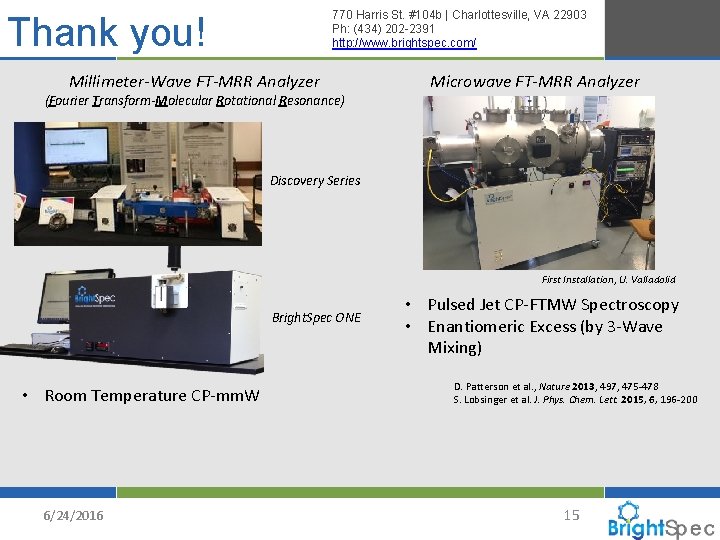
770 Harris St. #104 b | Charlottesville, VA 22903 Ph: (434) 202 -2391 http: //www. brightspec. com/ Thank you! Millimeter-Wave FT-MRR Analyzer (Fourier Transform-Molecular Rotational Resonance) Microwave FT-MRR Analyzer Discovery Series First Installation, U. Valladolid Bright. Spec ONE • Room Temperature CP-mm. W 6/24/2016 • Pulsed Jet CP-FTMW Spectroscopy • Enantiomeric Excess (by 3 -Wave Mixing) D. Patterson et al. , Nature 2013, 497, 475 -478 S. Lobsinger et al. J. Phys. Chem. Lett. 2015, 6, 196 -200 15
- Slides: 16