
Molecular Rotational Resonance Spectroscopy Fast Chiral Monitoring in
- Slides: 13
Molecular Rotational Resonance Spectroscopy Fast Chiral Monitoring in a Continuous Pharmaceutical Synthesis by MRR Spectroscopy Justin L. Neill, Matt T. Muckle (Bright. Spec) Brooks H. Pate (University of Virginia) Yuan Yang, B. Frank Gupton (Virginia Commonwealth University) International Symposium on Molecular Spectroscopy June 19, 2018 justin. neill@brightspec. com +1 (434) 202 -2391 http: //www. brightspec. com © 2018 Bright. Spec, Inc.
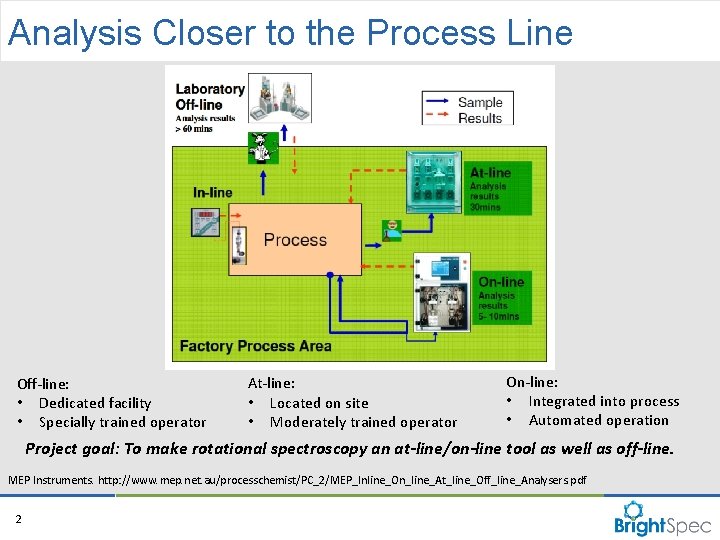
Analysis Closer to the Process Line Off-line: • Dedicated facility • Specially trained operator At-line: • Located on site • Moderately trained operator On-line: • Integrated into process • Automated operation Project goal: To make rotational spectroscopy an at-line/on-line tool as well as off-line. MEP Instruments. http: //www. mep. net. au/processchemist/PC_2/MEP_Inline_On_line_At_line_Off_line_Analysers. pdf 2 CP
Technical Requirements and Challenges MRR (Rotational Spectroscopy) has several important advantages over other process techniques: • Excellent selectivity to stereoisomers and regioisomers • No spectral overlap in a mixture (ability to resolve starting materials, products, and byproducts) • Simple method development, with very few consumables Key technical challenges to address: • • • 3 Automated sampling and volatilization interface Reduce instrument cycle time Automated operation, ease of use, interpretation, and maintenance Instrument robustness over time Reduce instrument size CP
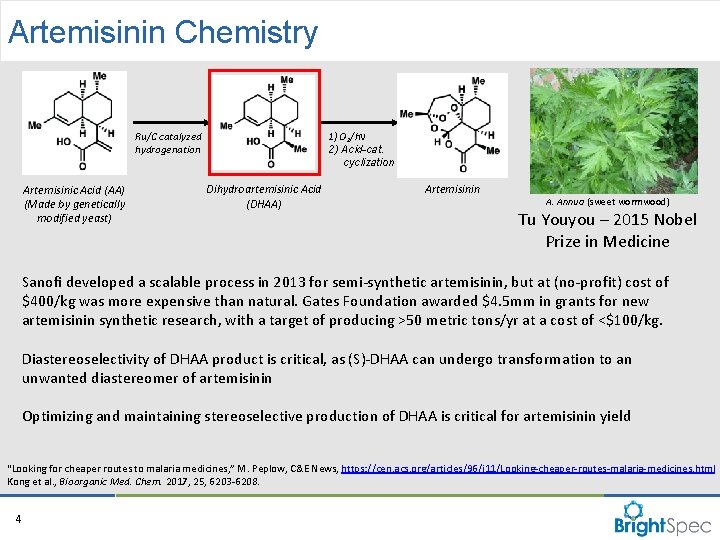
Artemisinin Chemistry 1) O 2/hn 2) Acid-cat. cyclization Ru/C catalyzed hydrogenation Artemisinic Acid (AA) (Made by genetically modified yeast) Dihydroartemisinic Acid (DHAA) Artemisinin A. Annua (sweet wormwood) Tu Youyou – 2015 Nobel Prize in Medicine Sanofi developed a scalable process in 2013 for semi-synthetic artemisinin, but at (no-profit) cost of $400/kg was more expensive than natural. Gates Foundation awarded $4. 5 mm in grants for new artemisinin synthetic research, with a target of producing >50 metric tons/yr at a cost of <$100/kg. Diastereoselectivity of DHAA product is critical, as (S)-DHAA can undergo transformation to an unwanted diastereomer of artemisinin Optimizing and maintaining stereoselective production of DHAA is critical for artemisinin yield “Looking for cheaper routes to malaria medicines, ” M. Peplow, C&E News, https: //cen. acs. org/articles/96/i 11/Looking-cheaper-routes-malaria-medicines. html Kong et al. , Bioorganic Med. Chem. 2017, 25, 6203 -6208. 4 CP
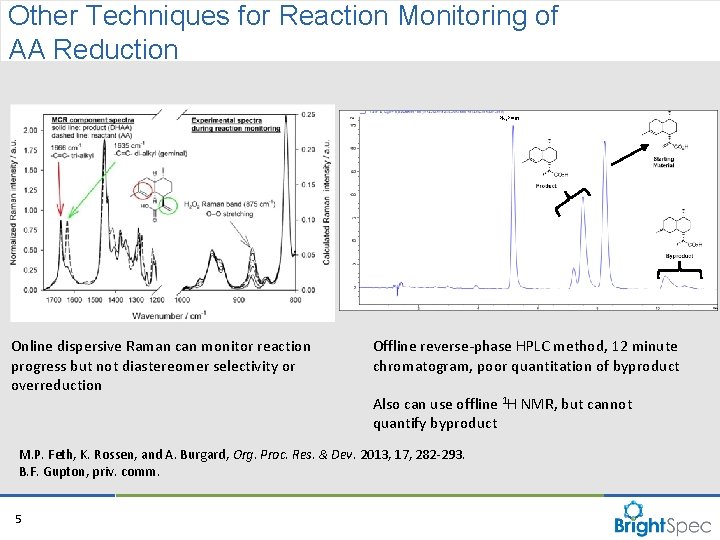
Other Techniques for Reaction Monitoring of AA Reduction Ph 3 P=O? Online dispersive Raman can monitor reaction progress but not diastereomer selectivity or overreduction Offline reverse-phase HPLC method, 12 minute chromatogram, poor quantitation of byproduct Also can use offline 1 H NMR, but cannot quantify byproduct M. P. Feth, K. Rossen, and A. Burgard, Org. Proc. Res. & Dev. 2013, 17, 282 -293. B. F. Gupton, priv. comm. 5 CP
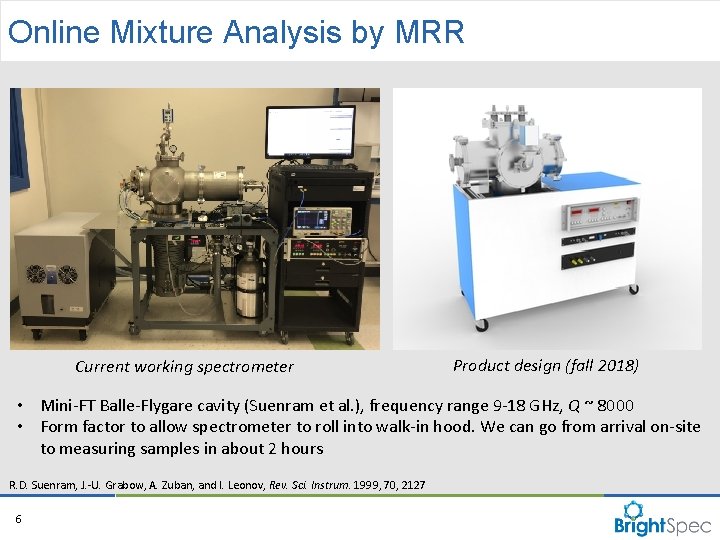
Online Mixture Analysis by MRR Product design (fall 2018) Current working spectrometer • Mini-FT Balle-Flygare cavity (Suenram et al. ), frequency range 9 -18 GHz, Q ~ 8000 • Form factor to allow spectrometer to roll into walk-in hood. We can go from arrival on-site to measuring samples in about 2 hours R. D. Suenram, J. -U. Grabow, A. Zuban, and I. Leonov, Rev. Sci. Instrum. 1999, 70, 2127 6 CP
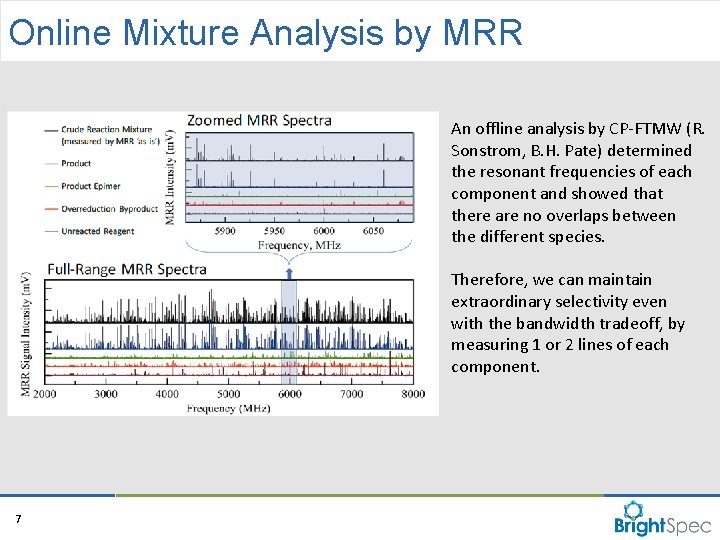
Online Mixture Analysis by MRR An offline analysis by CP-FTMW (R. Sonstrom, B. H. Pate) determined the resonant frequencies of each component and showed that there are no overlaps between the different species. Therefore, we can maintain extraordinary selectivity even with the bandwidth tradeoff, by measuring 1 or 2 lines of each component. 7 CP
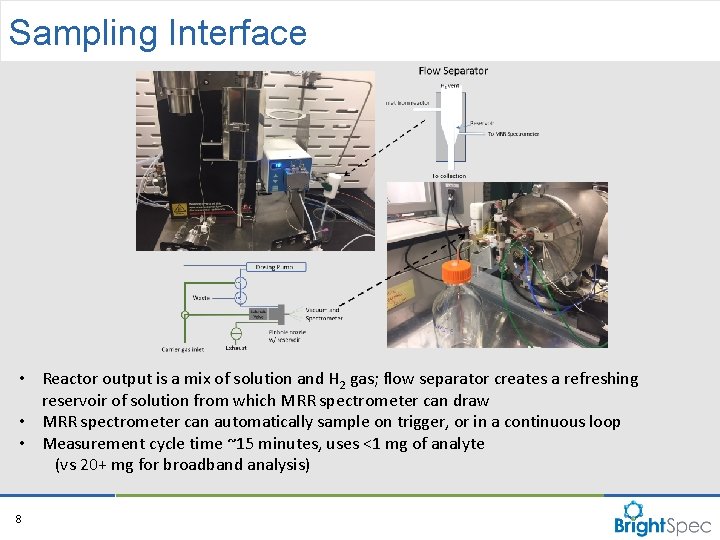
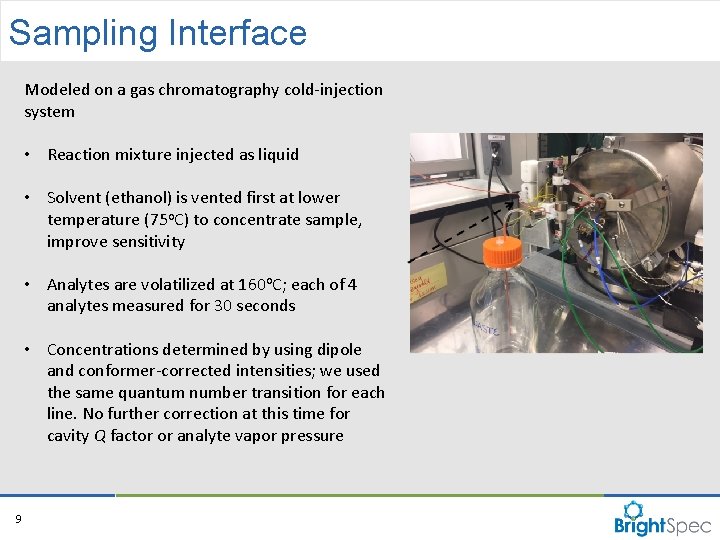
Sampling Interface • Reactor output is a mix of solution and H 2 gas; flow separator creates a refreshing reservoir of solution from which MRR spectrometer can draw • MRR spectrometer can automatically sample on trigger, or in a continuous loop • Measurement cycle time ~15 minutes, uses <1 mg of analyte (vs 20+ mg for broadband analysis) 8 CP
Sampling Interface Modeled on a gas chromatography cold-injection system • Reaction mixture injected as liquid • Solvent (ethanol) is vented first at lower temperature (75 o. C) to concentrate sample, improve sensitivity • Analytes are volatilized at 160 o. C; each of 4 analytes measured for 30 seconds • Concentrations determined by using dipole and conformer-corrected intensities; we used the same quantum number transition for each line. No further correction at this time for cavity Q factor or analyte vapor pressure 9 CP
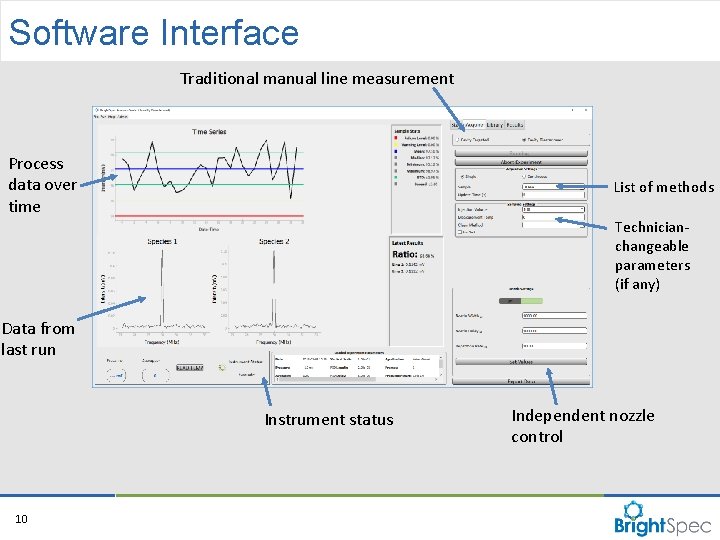
Software Interface Traditional manual line measurement Process data over time List of methods Technicianchangeable parameters (if any) Data from last run Instrument status 10 CP Independent nozzle control
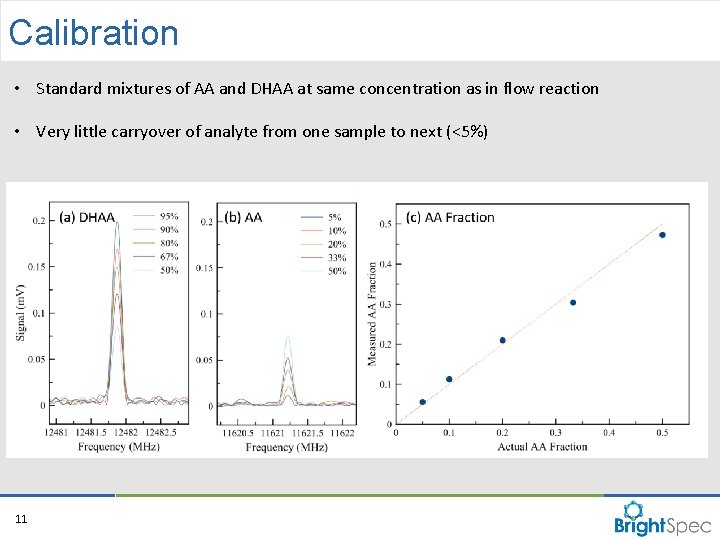
Calibration • Standard mixtures of AA and DHAA at same concentration as in flow reaction • Very little carryover of analyte from one sample to next (<5%) 11 CP
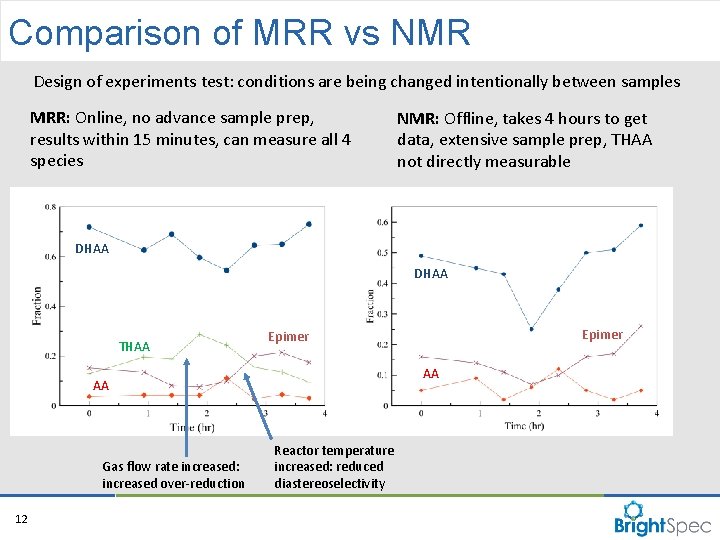
Comparison of MRR vs NMR Design of experiments test: conditions are being changed intentionally between samples MRR: Online, no advance sample prep, results within 15 minutes, can measure all 4 species NMR: Offline, takes 4 hours to get data, extensive sample prep, THAA not directly measurable DHAA THAA Epimer AA AA Gas flow rate increased: increased over-reduction 12 Reactor temperature increased: reduced diastereoselectivity CP
Conclusions MRR can measure reaction yield and byproducts, including stereoisomers, online and return quantitative data within minutes, as opposed to hours with traditional offline methods. Future work: • Development to reduce measurement cycle time – faster volatilization, venting, and heating control • Extend spectral database of known impurities • Method development for additional pharmaceutical API syntheses • Product design for extended on-site trials at VCU, Virginia Tech, and within pharma (Winter 2018 -19) Thank you for your attention! Funding support: Contract W 31 P 4 Q-16 -C-0068 SBIR #1556035 13 CP