
Molecular Photochemistry how to study mechanisms of photochemical
![Some examples of fluorescence quantum yields and other emission parameters [Turro] Compound F Benzene](https://slidetodoc.com/presentation_image_h/f9ce8aa4ba844a0a4e868a94e9f9debf/image-40.jpg "Some examples of fluorescence quantum yields and other emission parameters [Turro] Compound F Benzene")
![Quantum yields for phosphorescence and other triplet emission parameters [Turro] Compound Benzene Naphthalene 1](https://slidetodoc.com/presentation_image_h/f9ce8aa4ba844a0a4e868a94e9f9debf/image-42.jpg "Quantum yields for phosphorescence and other triplet emission parameters [Turro] Compound Benzene Naphthalene 1")
- Slides: 54
"Molecular Photochemistry - how to study mechanisms of photochemical reactions ? " Bronislaw Marciniak Faculty of Chemistry, Adam Mickiewicz University, Poznan, Poland 2012/2013 - lecture 1
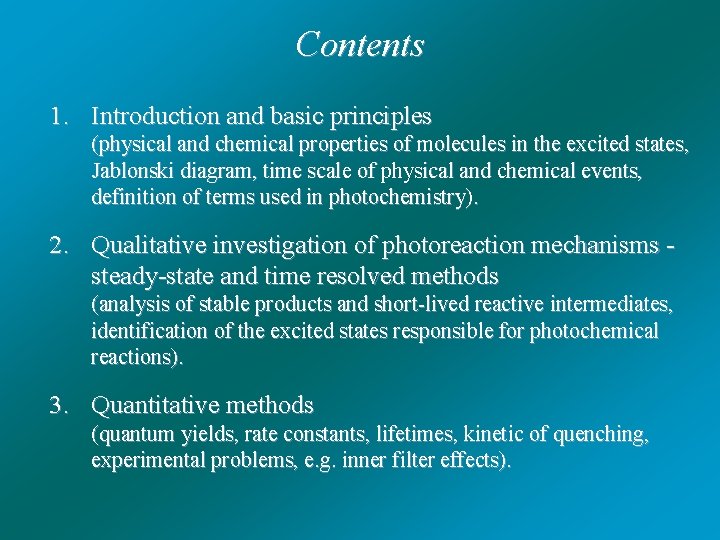
Contents 1. Introduction and basic principles (physical and chemical properties of molecules in the excited states, Jablonski diagram, time scale of physical and chemical events, definition of terms used in photochemistry). 2. Qualitative investigation of photoreaction mechanisms - steady-state and time resolved methods (analysis of stable products and short-lived reactive intermediates, identification of the excited states responsible for photochemical reactions). 3. Quantitative methods (quantum yields, rate constants, lifetimes, kinetic of quenching, experimental problems, e. g. inner filter effects).
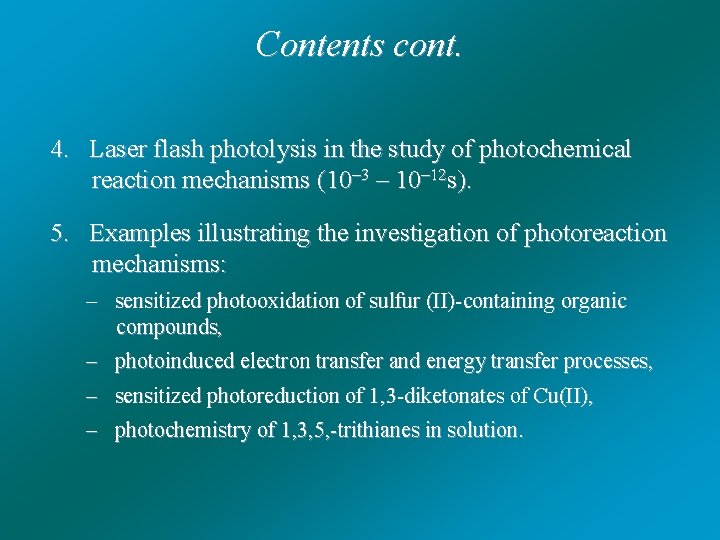
Contents cont. 4. Laser flash photolysis in the study of photochemical reaction mechanisms (10– 3 – 10– 12 s). 5. Examples illustrating the investigation of photoreaction mechanisms: sensitized photooxidation of sulfur (II)-containing organic compounds, photoinduced electron transfer and energy transfer processes, sensitized photoreduction of 1, 3 -diketonates of Cu(II), photochemistry of 1, 3, 5, -trithianes in solution.
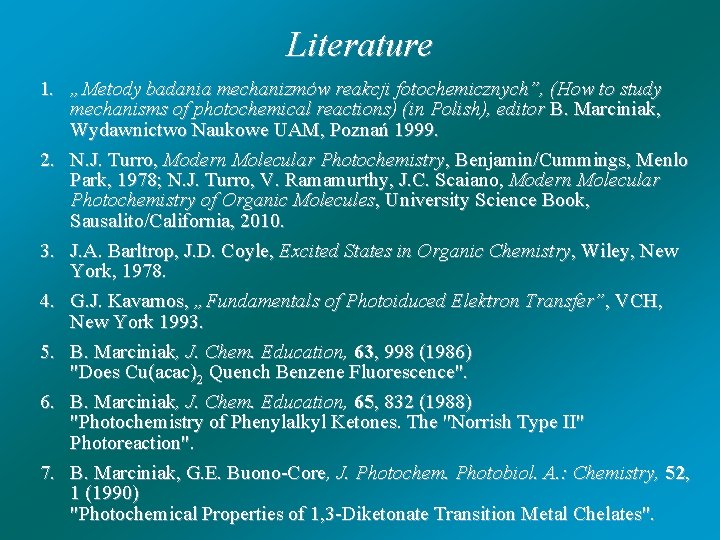
Literature 1. „Metody badania mechanizmów reakcji fotochemicznych”, (How to study mechanisms of photochemical reactions) (in Polish), editor B. Marciniak, Wydawnictwo Naukowe UAM, Poznań 1999. 2. N. J. Turro, Modern Molecular Photochemistry, Benjamin/Cummings, Menlo Park, 1978; N. J. Turro, V. Ramamurthy, J. C. Scaiano, Modern Molecular Photochemistry of Organic Molecules, University Science Book, Sausalito/California, 2010. 3. J. A. Barltrop, J. D. Coyle, Excited States in Organic Chemistry, Wiley, New York, 1978. 4. G. J. Kavarnos, „Fundamentals of Photoiduced Elektron Transfer”, VCH, New York 1993. 5. B. Marciniak, J. Chem. Education, 63, 998 (1986) "Does Cu(acac)2 Quench Benzene Fluorescence". 6. B. Marciniak, J. Chem. Education, 65, 832 (1988) "Photochemistry of Phenylalkyl Ketones. The "Norrish Type II" Photoreaction". 7. B. Marciniak, G. E. Buono-Core, J. Photochem. Photobiol. A. : Chemistry, 52, 1 (1990) "Photochemical Properties of 1, 3 -Diketonate Transition Metal Chelates".
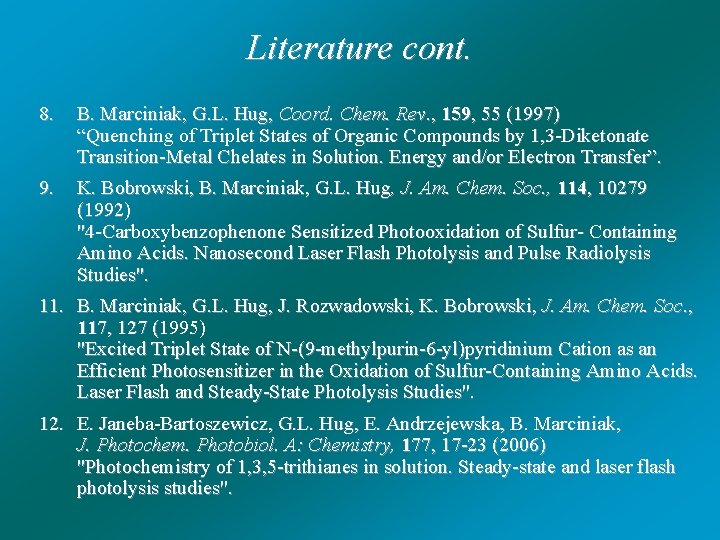
Literature cont. 8. B. Marciniak, G. L. Hug, Coord. Chem. Rev. , 159, 55 (1997) “Quenching of Triplet States of Organic Compounds by 1, 3 -Diketonate Transition-Metal Chelates in Solution. Energy and/or Electron Transfer”. 9. K. Bobrowski, B. Marciniak, G. L. Hug, J. Am. Chem. Soc. , 114, 10279 (1992) "4 -Carboxybenzophenone Sensitized Photooxidation of Sulfur- Containing Amino Acids. Nanosecond Laser Flash Photolysis and Pulse Radiolysis Studies". 11. B. Marciniak, G. L. Hug, J. Rozwadowski, K. Bobrowski, J. Am. Chem. Soc. , 117, 127 (1995) "Excited Triplet State of N-(9 -methylpurin-6 -yl)pyridinium Cation as an Efficient Photosensitizer in the Oxidation of Sulfur-Containing Amino Acids. Laser Flash and Steady-State Photolysis Studies". 12. E. Janeba-Bartoszewicz, G. L. Hug, E. Andrzejewska, B. Marciniak, J. Photochem. Photobiol. A: Chemistry, 177, 17 -23 (2006) "Photochemistry of 1, 3, 5 -trithianes in solution. Steady-state and laser flash photolysis studies".
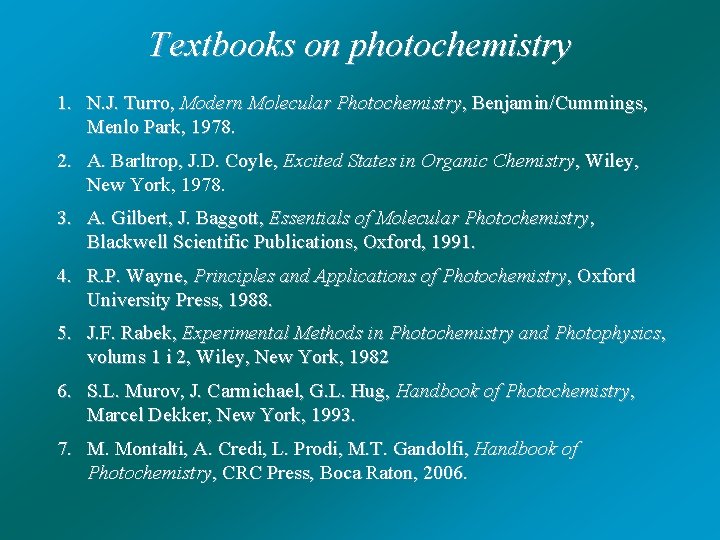
Textbooks on photochemistry 1. N. J. Turro, Modern Molecular Photochemistry, Benjamin/Cummings, Menlo Park, 1978. 2. A. Barltrop, J. D. Coyle, Excited States in Organic Chemistry, Wiley, New York, 1978. 3. A. Gilbert, J. Baggott, Essentials of Molecular Photochemistry, Blackwell Scientific Publications, Oxford, 1991. 4. R. P. Wayne, Principles and Applications of Photochemistry, Oxford University Press, 1988. 5. J. F. Rabek, Experimental Methods in Photochemistry and Photophysics, volums 1 i 2, Wiley, New York, 1982 6. S. L. Murov, J. Carmichael, G. L. Hug, Handbook of Photochemistry, Marcel Dekker, New York, 1993. 7. M. Montalti, A. Credi, L. Prodi, M. T. Gandolfi, Handbook of Photochemistry, CRC Press, Boca Raton, 2006.
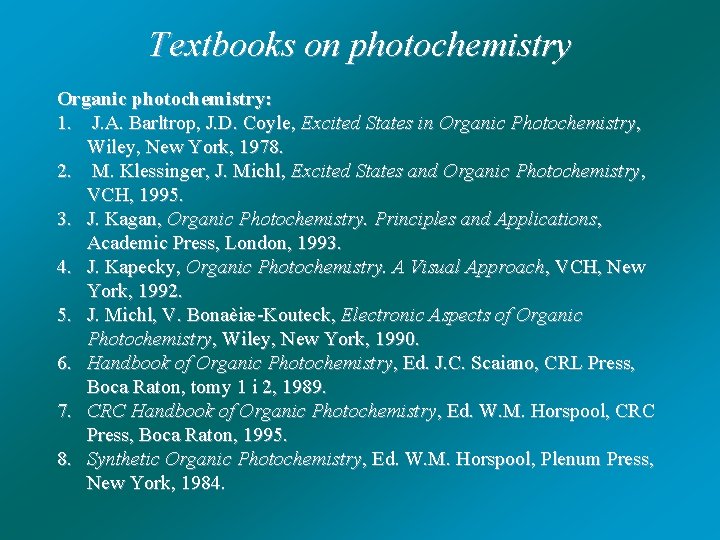
Textbooks on photochemistry Organic photochemistry: 1. J. A. Barltrop, J. D. Coyle, Excited States in Organic Photochemistry, Wiley, New York, 1978. 2. M. Klessinger, J. Michl, Excited States and Organic Photochemistry, VCH, 1995. 3. J. Kagan, Organic Photochemistry. Principles and Applications, Academic Press, London, 1993. 4. J. Kapecky, Organic Photochemistry. A Visual Approach, VCH, New York, 1992. 5. J. Michl, V. Bonaèiæ-Kouteck, Electronic Aspects of Organic Photochemistry, Wiley, New York, 1990. 6. Handbook of Organic Photochemistry, Ed. J. C. Scaiano, CRL Press, Boca Raton, tomy 1 i 2, 1989. 7. CRC Handbook of Organic Photochemistry, Ed. W. M. Horspool, CRC Press, Boca Raton, 1995. 8. Synthetic Organic Photochemistry, Ed. W. M. Horspool, Plenum Press, New York, 1984.
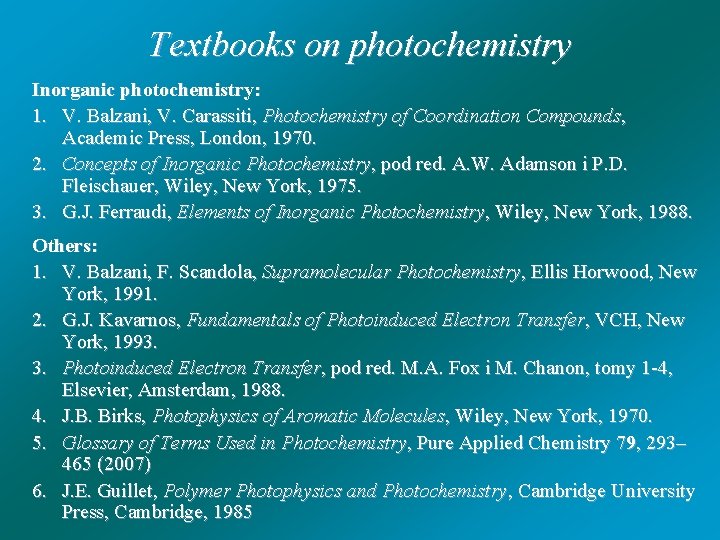
Textbooks on photochemistry Inorganic photochemistry: 1. V. Balzani, V. Carassiti, Photochemistry of Coordination Compounds, Academic Press, London, 1970. 2. Concepts of Inorganic Photochemistry, pod red. A. W. Adamson i P. D. Fleischauer, Wiley, New York, 1975. 3. G. J. Ferraudi, Elements of Inorganic Photochemistry, Wiley, New York, 1988. Others: 1. V. Balzani, F. Scandola, Supramolecular Photochemistry, Ellis Horwood, New York, 1991. 2. G. J. Kavarnos, Fundamentals of Photoinduced Electron Transfer, VCH, New York, 1993. 3. Photoinduced Electron Transfer, pod red. M. A. Fox i M. Chanon, tomy 1 -4, Elsevier, Amsterdam, 1988. 4. J. B. Birks, Photophysics of Aromatic Molecules, Wiley, New York, 1970. 5. Glossary of Terms Used in Photochemistry, Pure Applied Chemistry 79, 293– 465 (2007) 6. J. E. Guillet, Polymer Photophysics and Photochemistry, Cambridge University Press, Cambridge, 1985
1. Introduction and basic principles - physical and chemical properties of molecules in the excited states, - Jablonski diagram, - time scale of physical and chemical events, - definition of terms used in photochemistry
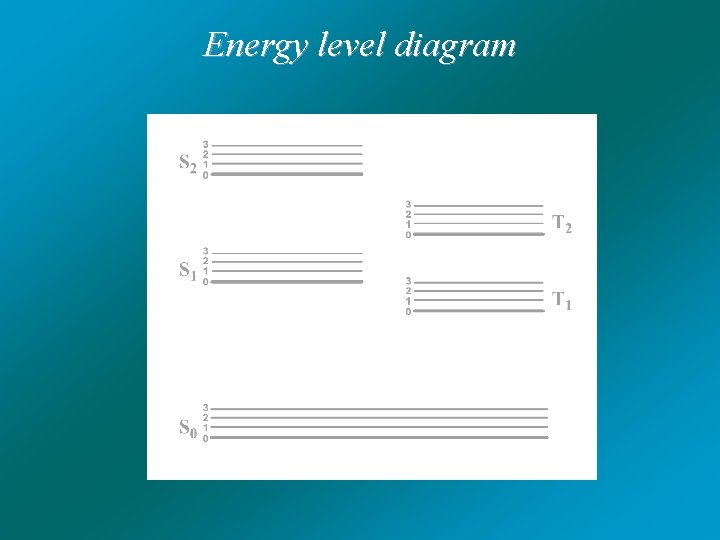
Energy level diagram
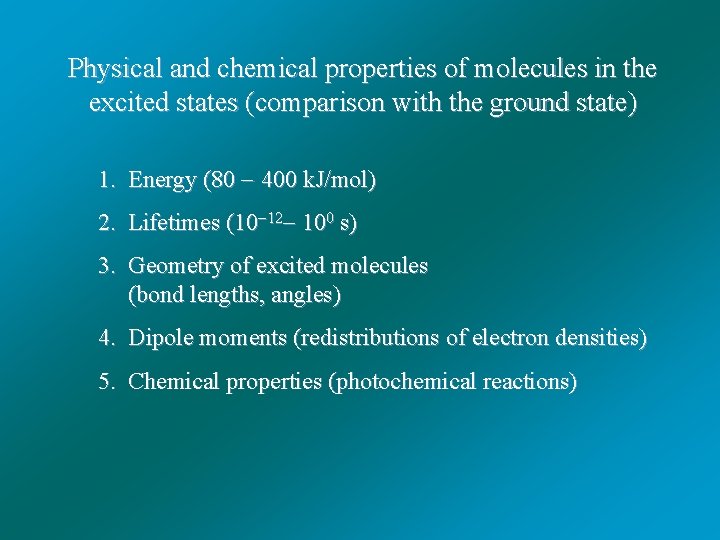
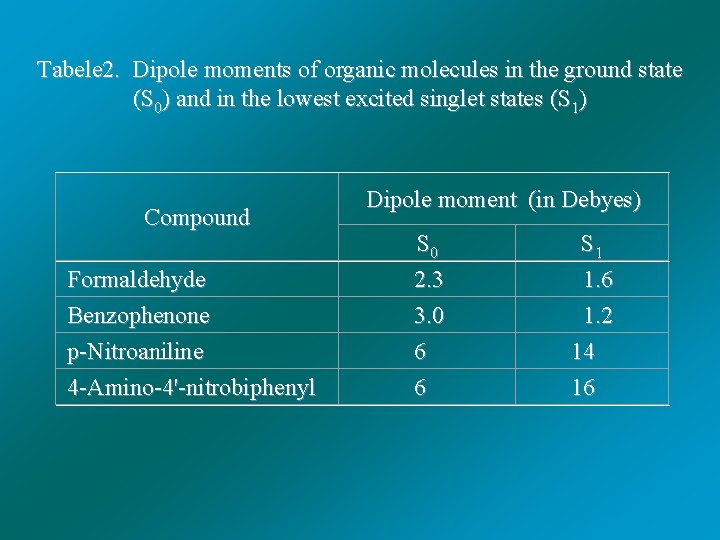
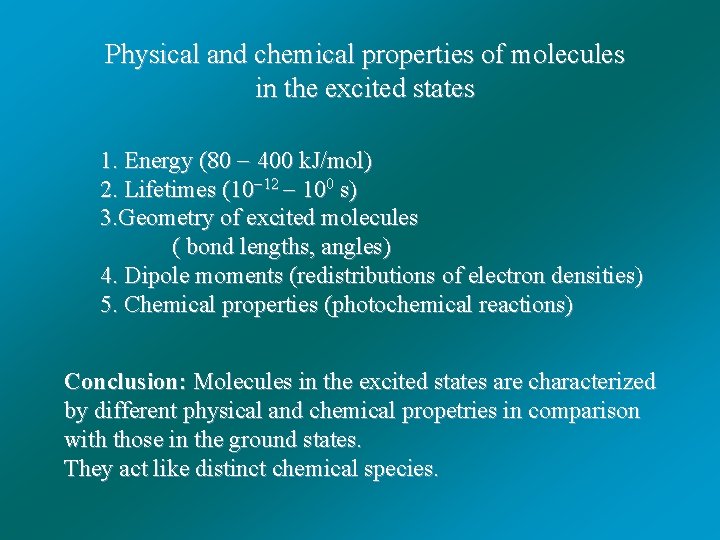
Physical and chemical properties of molecules in the excited states (comparison with the ground state) 1. Energy (80 400 k. J/mol) 2. Lifetimes (10 12 100 s) 3. Geometry of excited molecules (bond lengths, angles) 4. Dipole moments (redistributions of electron densities) 5. Chemical properties (photochemical reactions)
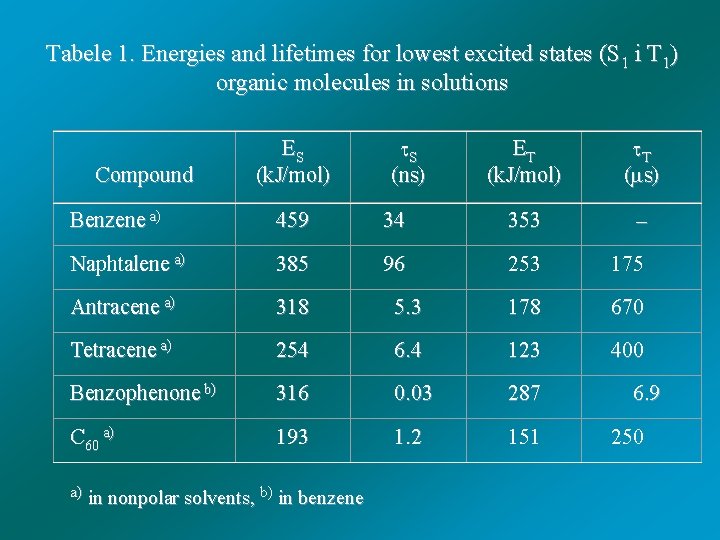
Tabele 1. Energies and lifetimes for lowest excited states (S 1 i T 1) organic molecules in solutions Compound ES (k. J/mol) S (ns) ET (k. J/mol) T ( s) Benzene a) 459 34 353 Naphtalene a) 385 96 253 175 Antracene a) 318 5. 3 178 670 Tetracene a) 254 6. 4 123 400 Benzophenone b) 316 C 60 a) 193 a) in nonpolar solvents, b) in benzene 0. 03 1. 2 287 151 6. 9 250
Tabele 2. Dipole moments of organic molecules in the ground state (S 0) and in the lowest excited singlet states (S 1) Compound Formaldehyde Benzophenone p-Nitroaniline 4 -Amino-4'-nitrobiphenyl Dipole moment (in Debyes) S 0 2. 3 3. 0 6 6 S 1 1. 6 1. 2 14 16
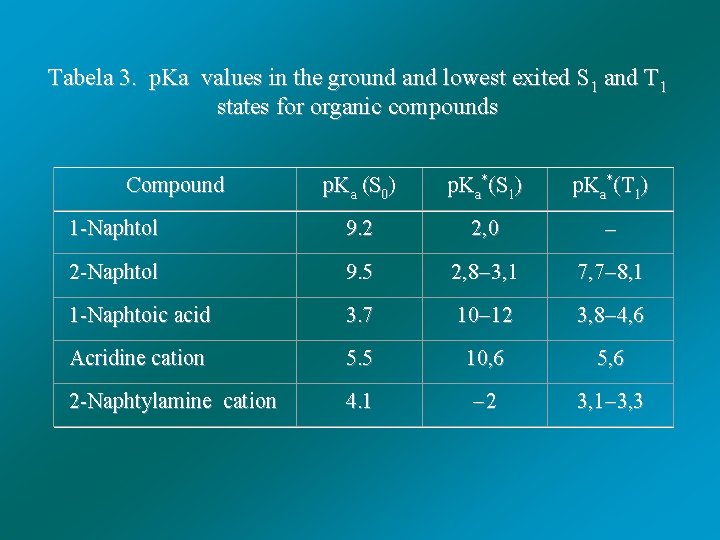
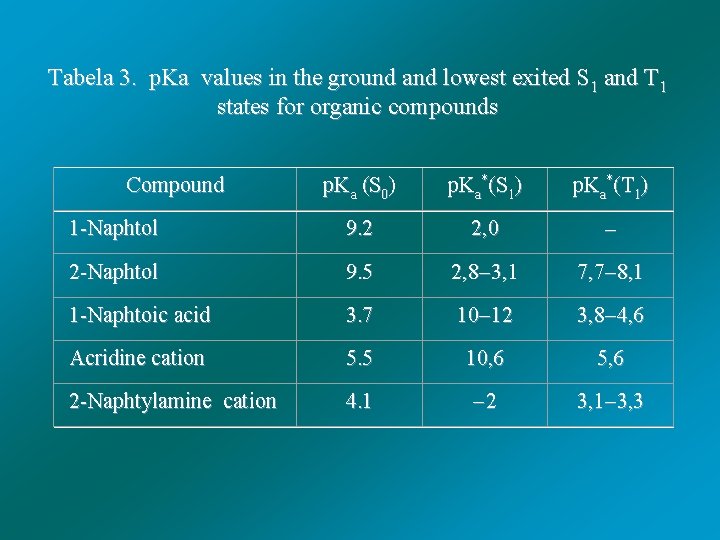
Tabela 3. p. Ka values in the ground and lowest exited S 1 and T 1 states for organic compounds Compound p. Ka (S 0) p. Ka*(S 1) p. Ka*(T 1) 1 -Naphtol 9. 2 2, 0 2 -Naphtol 9. 5 2, 8 3, 1 7, 7 8, 1 1 -Naphtoic acid 3. 7 10 12 3, 8 4, 6 Acridine cation 5. 5 10, 6 5, 6 2 -Naphtylamine cation 4. 1 2 3, 1 3, 3
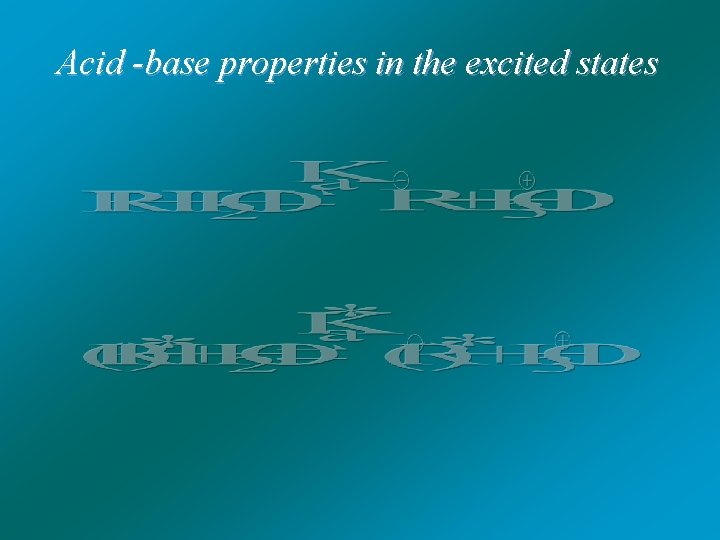
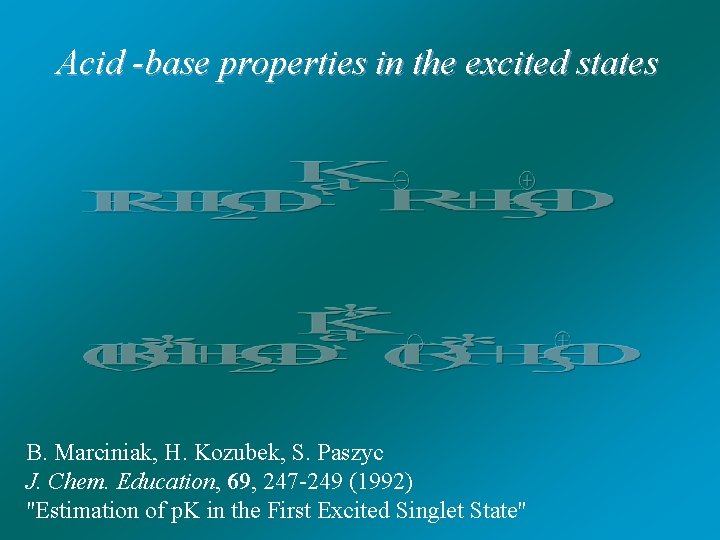
Acid -base properties in the excited states
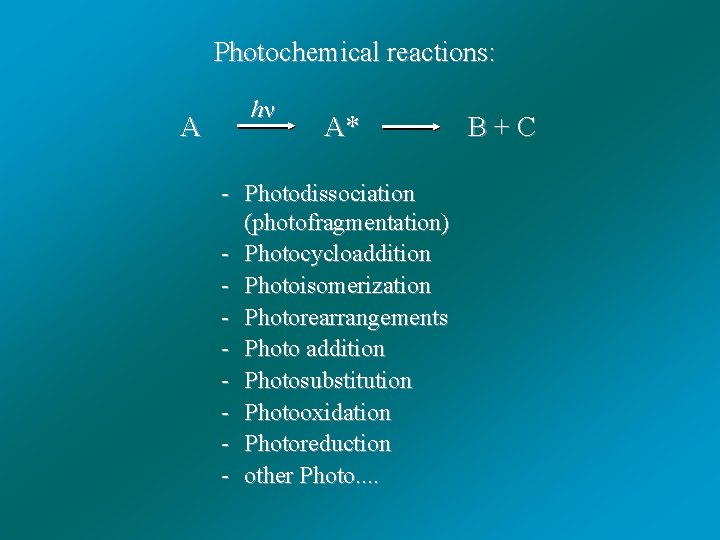
Photochemical reactions: A h A* - Photodissociation (photofragmentation) - Photocycloaddition - Photoisomerization - Photorearrangements - Photo addition - Photosubstitution - Photooxidation - Photoreduction - other Photo. . B + C
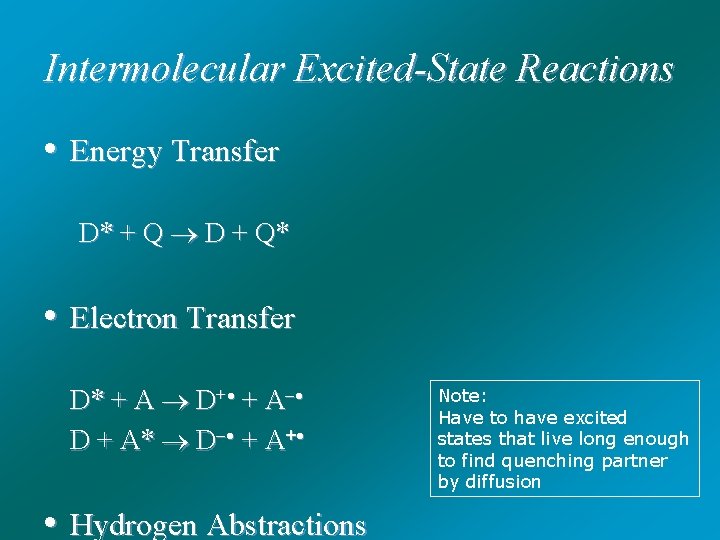
Intermolecular Excited-State Reactions • Energy Transfer D* + Q D + Q* • Electron Transfer D* + A D+ + A D + A* D + A+ • Hydrogen Abstractions Note: Have to have excited states that live long enough to find quenching partner by diffusion
Physical and chemical properties of molecules in the excited states 1. Energy (80 400 k. J/mol) 2. Lifetimes (10 12 100 s) 3. Geometry of excited molecules ( bond lengths, angles) 4. Dipole moments (redistributions of electron densities) 5. Chemical properties (photochemical reactions) Conclusion: Molecules in the excited states are characterized by different physical and chemical propetries in comparison with those in the ground states. They act like distinct chemical species.
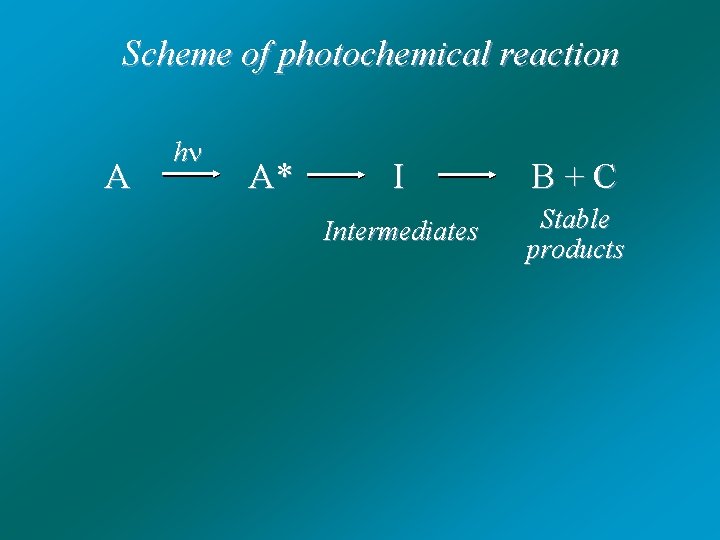
Scheme of photochemical reaction A h A* I B + C Intermediates Stable products
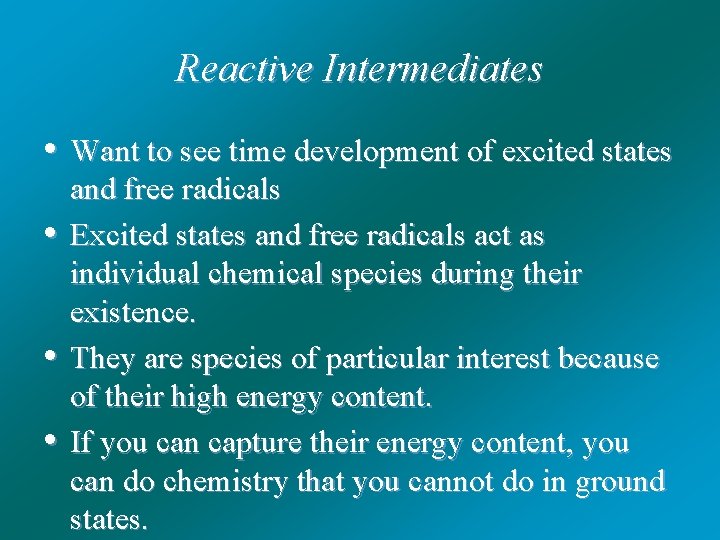
Reactive Intermediates • Want to see time development of excited states • • • and free radicals Excited states and free radicals act as individual chemical species during their existence. They are species of particular interest because of their high energy content. If you can capture their energy content, you can do chemistry that you cannot do in ground states.
How to Utilize the Energy Content? • If excited states channel their energy into specific bonds, then photochemistry can occur. • If scavengers or quenchers can find the excited state or free radical in time, then the electronic or chemical energy can be captured by the, ordinarily, stable scavenger or quencher.
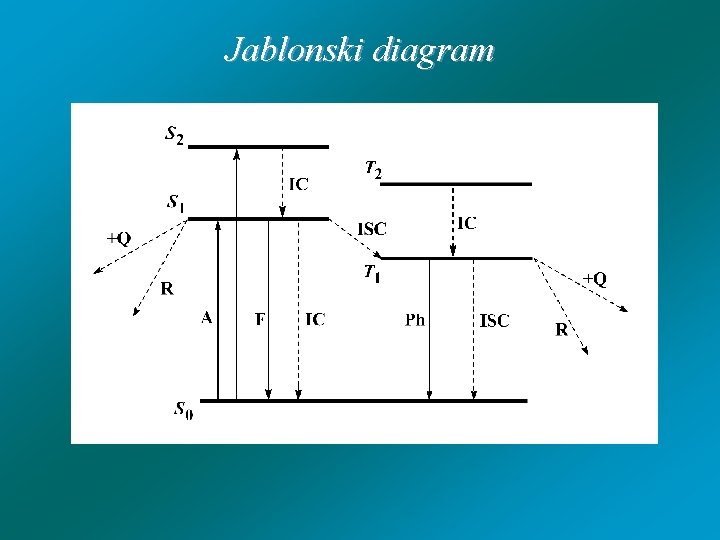
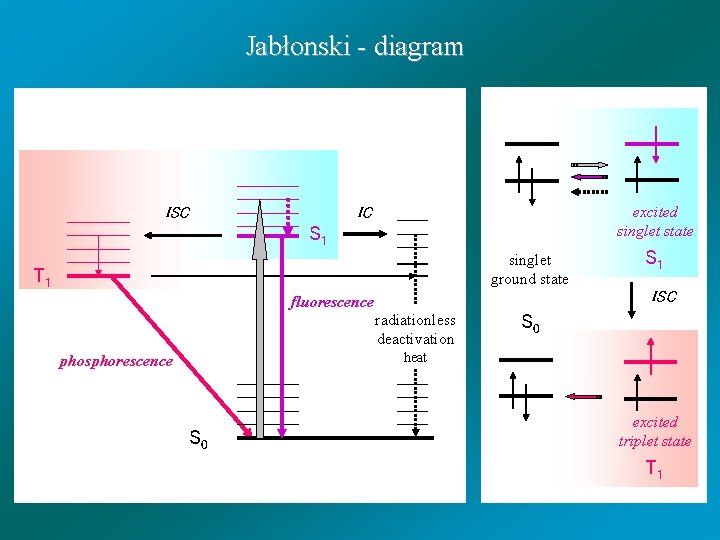
Jablonski diagram
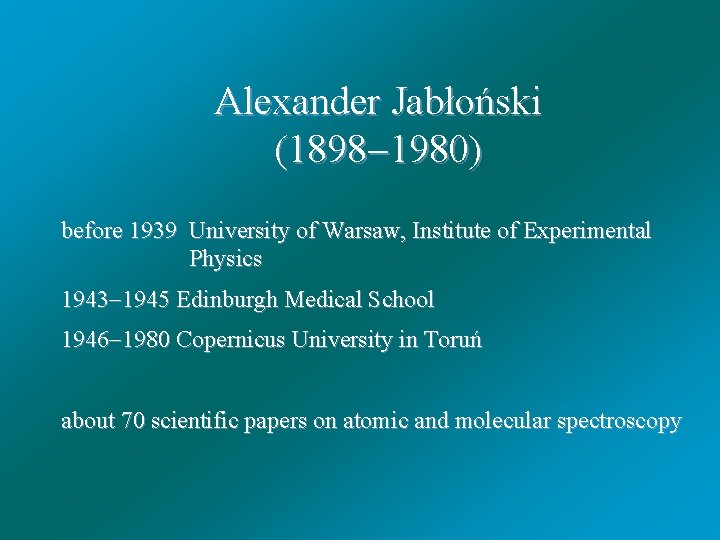
Alexander Jabłoński (1898 1980) before 1939 University of Warsaw, Institute of Experimental Physics 1943 1945 Edinburgh Medical School 1946 1980 Copernicus University in Toruń about 70 scientific papers on atomic and molecular spectroscopy
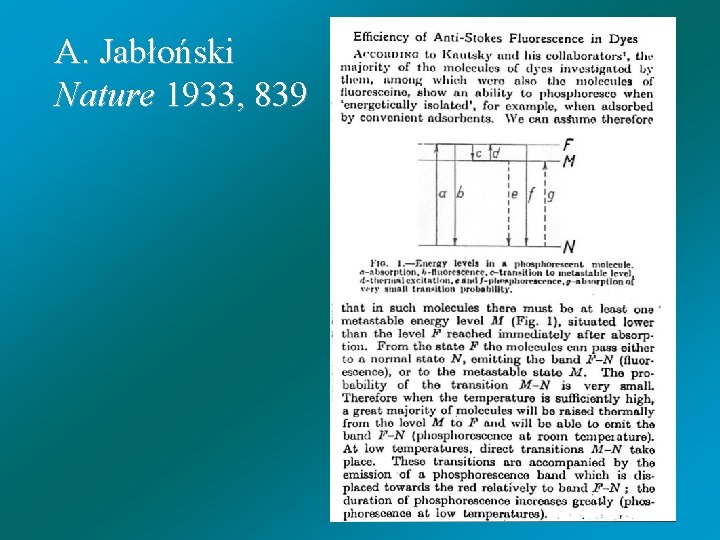
A. Jabłoński Nature 1933, 839
Jabłonski - diagram ISC excited singlet state IC S 1 singlet ground state T 1 fluorescence radiationless deactivation S 1 ISC S 0 heat phosphorescence S 0 excited triplet state T 1
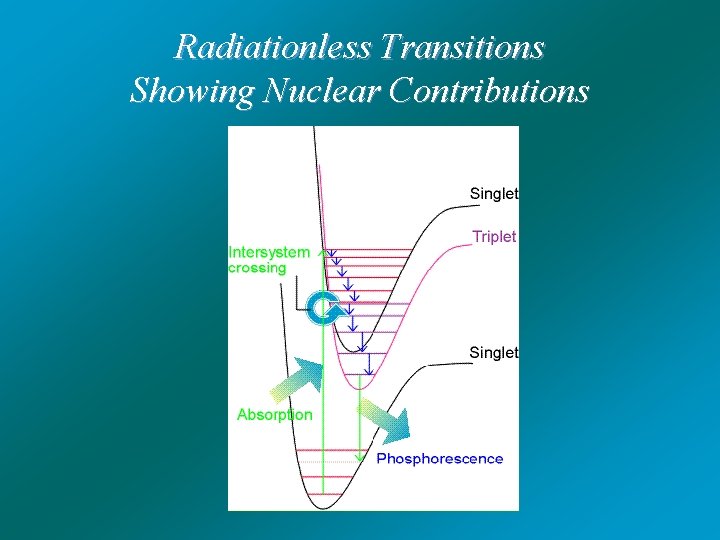
Radiationless Transitions Showing Nuclear Contributions
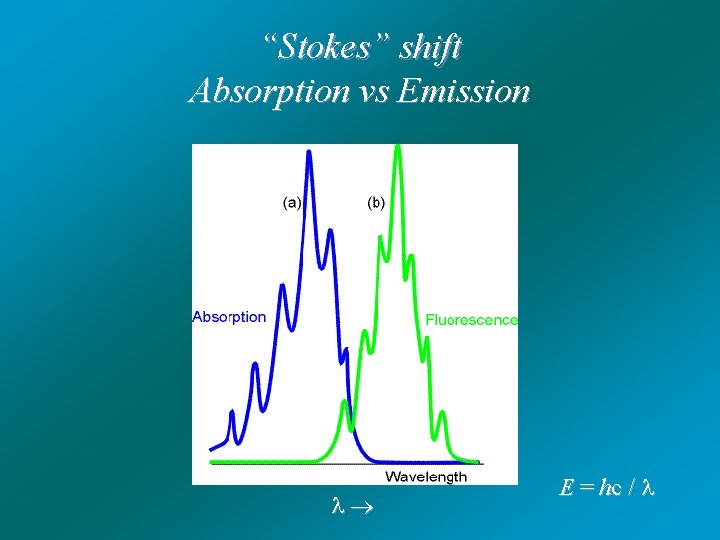
“Stokes” shift Absorption vs Emission E = hc /
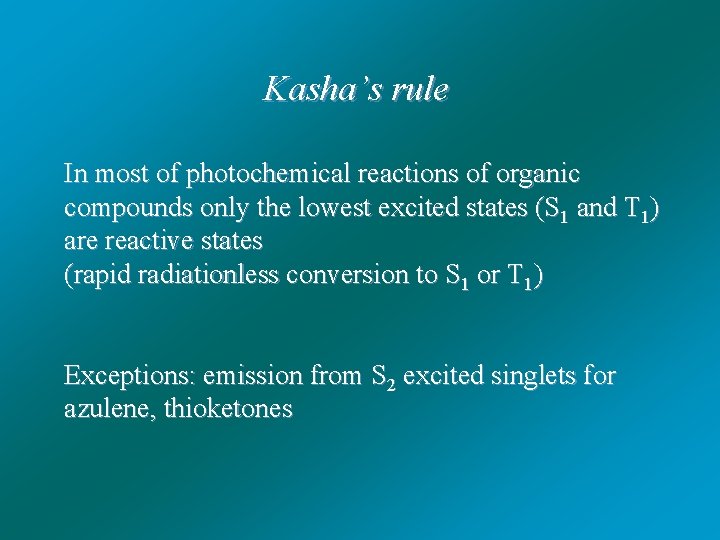
Kasha’s rule In most of photochemical reactions of organic compounds only the lowest excited states (S 1 and T 1) are reactive states (rapid radiationless conversion to S 1 or T 1) Exceptions: emission from S 2 excited singlets for azulene, thioketones
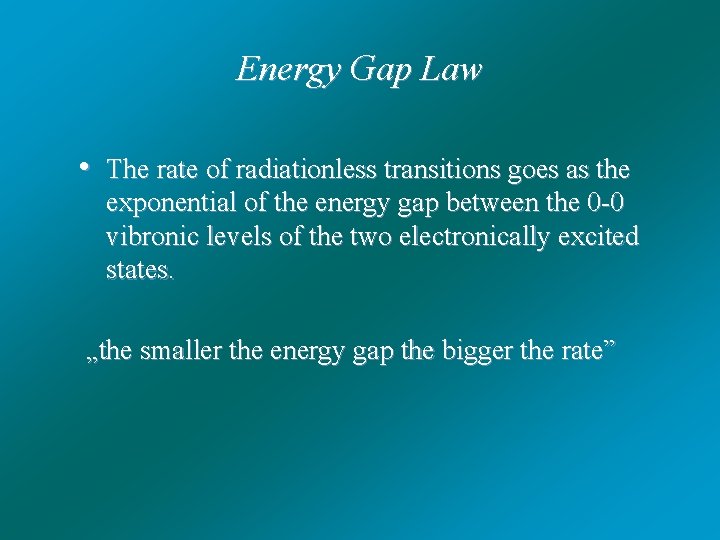
Energy Gap Law • The rate of radiationless transitions goes as the exponential of the energy gap between the 0 -0 vibronic levels of the two electronically excited states. „the smaller the energy gap the bigger the rate”
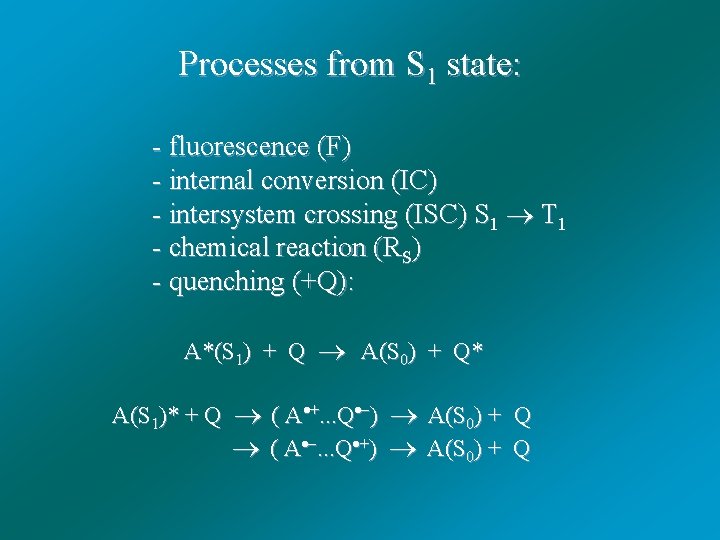
Processes from S 1 state: - fluorescence (F) - internal conversion (IC) - intersystem crossing (ISC) S 1 T 1 - chemical reaction (RS) - quenching (+Q): A*(S 1) + Q A(S 0) + Q* A(S 1)* + Q ( A +. . . Q ) A(S 0) + Q ( A . . . Q +) A(S 0) + Q
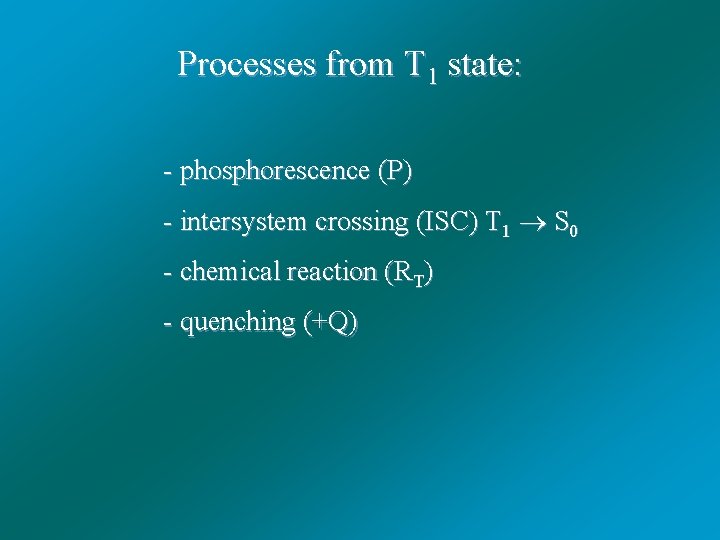
Processes from T 1 state: - phosphorescence (P) - intersystem crossing (ISC) T 1 S 0 - chemical reaction (RT) - quenching (+Q)
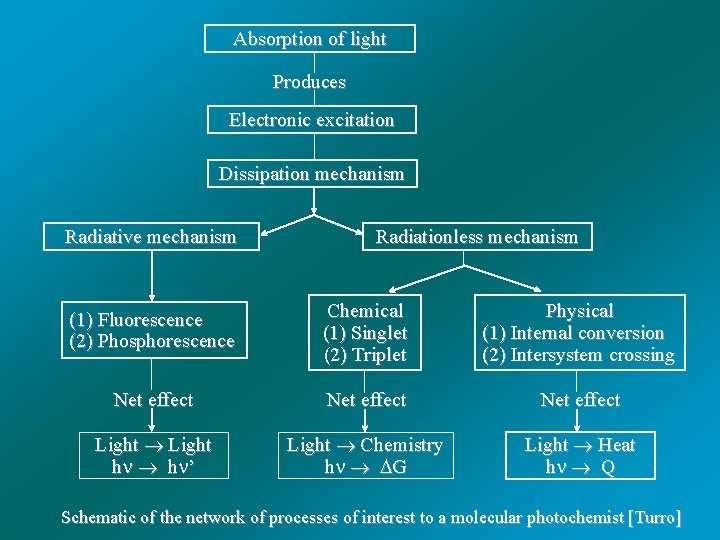
Absorption of light Produces Electronic excitation Dissipation mechanism Radiative mechanism Radiationless mechanism (1) Fluorescence (2) Phosphorescence Chemical (1) Singlet (2) Triplet Physical (1) Internal conversion (2) Intersystem crossing Net effect Light h h ’ Light Chemistry h G Light Heat h Q Schematic of the network of processes of interest to a molecular photochemist [Turro]
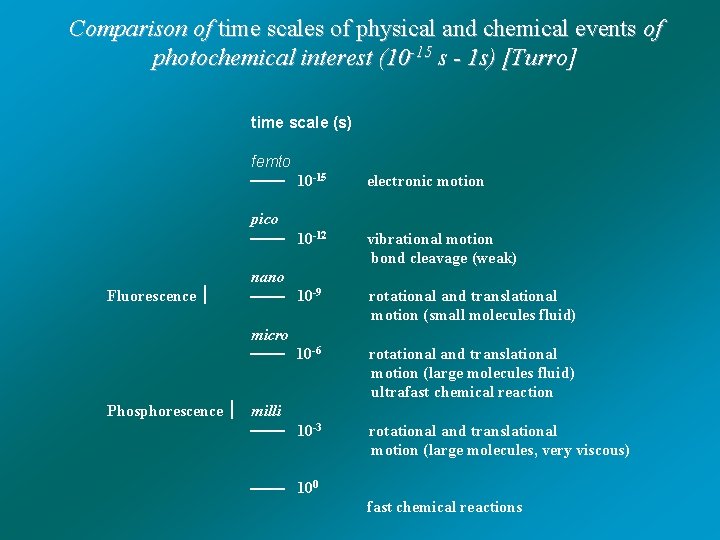
Comparison of time scales of physical and chemical events of photochemical interest (10 -15 s - 1 s) [Turro] time scale (s) femto 10 -15 electronic motion pico 10 -12 vibrational motion bond cleavage (weak) nano Fluorescence 10 -9 rotational and translational motion (small molecules fluid) micro 10 -6 rotational and translational motion (large molecules fluid) ultrafast chemical reaction Phosphorescence milli 10 -3 rotational and translational motion (large molecules, very viscous) 100 fast chemical reactions
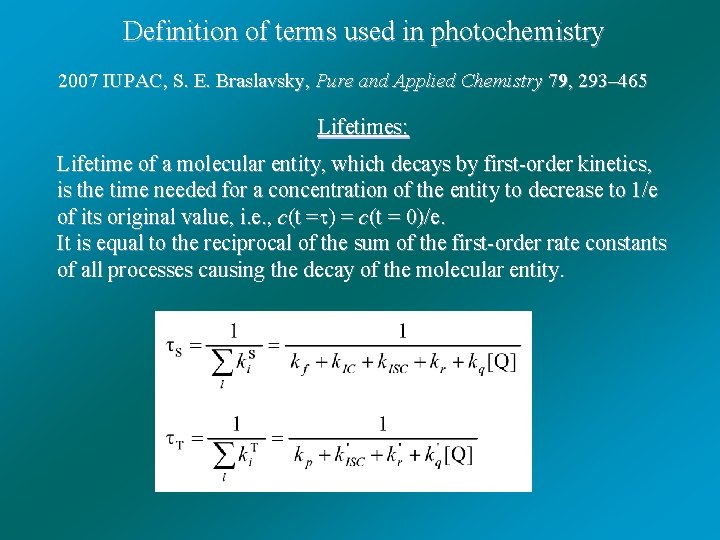
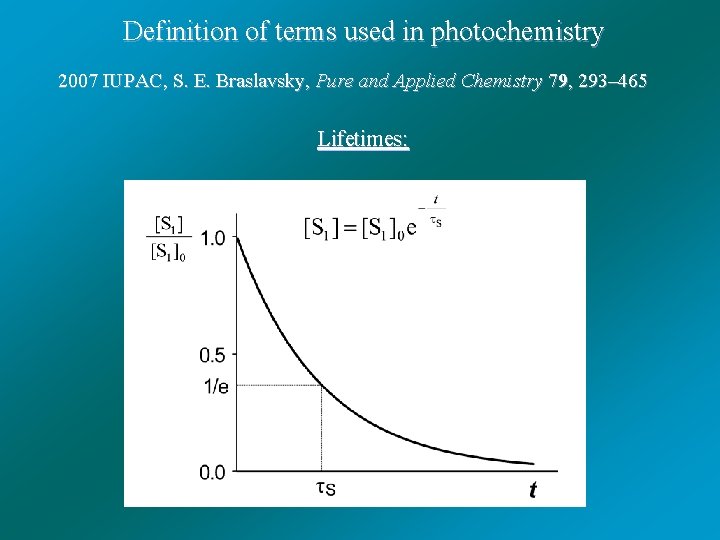
Definition of terms used in photochemistry 2007 IUPAC, S. E. Braslavsky, Pure and Applied Chemistry 79, 293– 465 Lifetimes: Lifetime of a molecular entity, which decays by first-order kinetics, is the time needed for a concentration of the entity to decrease to 1/e of its original value, i. e. , c(t = ) = c(t = 0)/e. It is equal to the reciprocal of the sum of the first-order rate constants of all processes causing the decay of the molecular entity.
Definition of terms used in photochemistry 2007 IUPAC, S. E. Braslavsky, Pure and Applied Chemistry 79, 293– 465 Lifetimes:
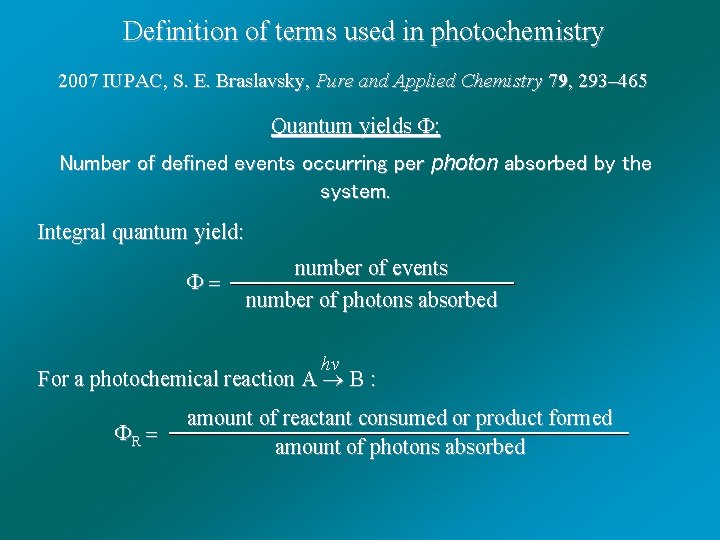
Definition of terms used in photochemistry 2007 IUPAC, S. E. Braslavsky, Pure and Applied Chemistry 79, 293– 465 Quantum yields : Number of defined events occurring per photon absorbed by the system. Integral quantum yield: = number of events number of photons absorbed hv For a photochemical reaction A B : R = amount of reactant consumed or product formed amount of photons absorbed
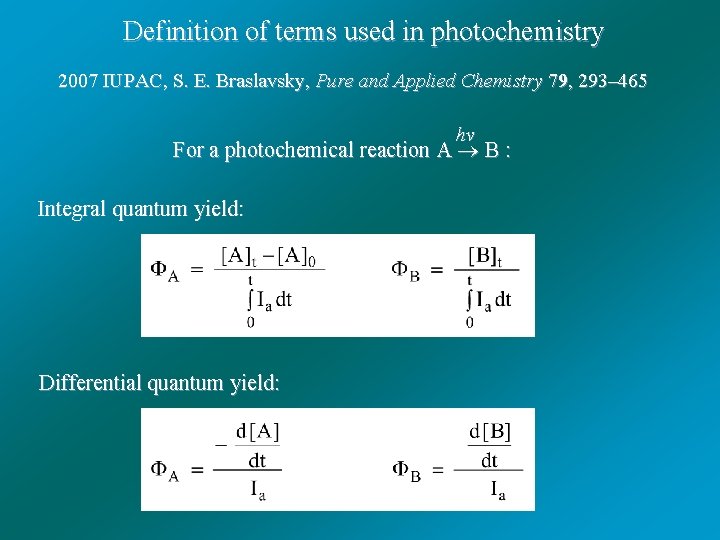
Definition of terms used in photochemistry 2007 IUPAC, S. E. Braslavsky, Pure and Applied Chemistry 79, 293– 465 hv For a photochemical reaction A B : Integral quantum yield: Differential quantum yield:
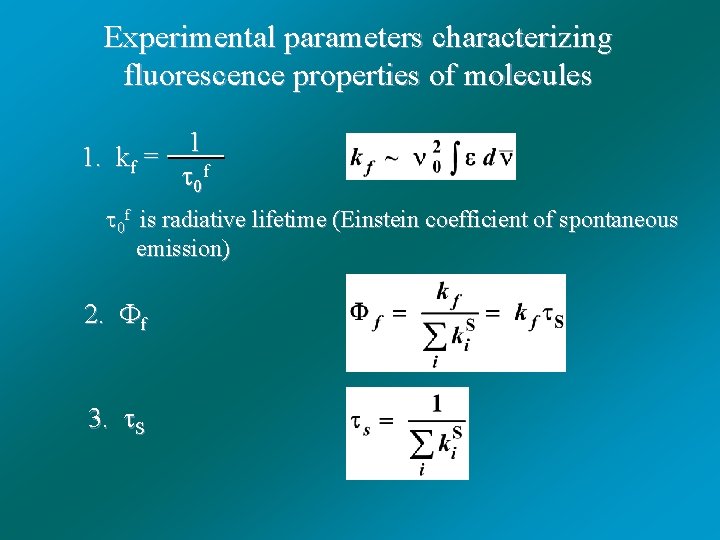
Experimental parameters characterizing fluorescence properties of molecules 1 1. kf = 0 f 0 f is radiative lifetime (Einstein coefficient of spontaneous emission) 2. f 3. S
Some examples of fluorescence quantum yields and other emission parameters [Turro] Compound F Benzene Naphthalene Anthracene 9, 10 -Diphenylanthracene Pyrene Triphenylene Perylene Stilbene 1 -Chloronaphthalene 1 -Bromonaphthalene 1 -Iodonaphthalene Benzophenone Acetone Perfluoroacetone (s-1) ~0. 2 ~0. 4 ~1. 0 ~0. 7 ~0. 1 ~1. 0 ~0. 05 ~0. 002 ~0. 000 ~0. 001 ~0. 1 max kf k. ISC Configuration (s-1) 250 270 8500 12600 510 355 39500 24000 ~300 ~20 ~20 of S 1 2 106 5 107 ~5 108 ~106 ~2 108 ~108 ~106 ~105 107 5 106 ~5 107 <105 ~107 <107 ~109 5 108 ~109 ~1010 ~1011 ~109 ~107 , , , n, n, n,
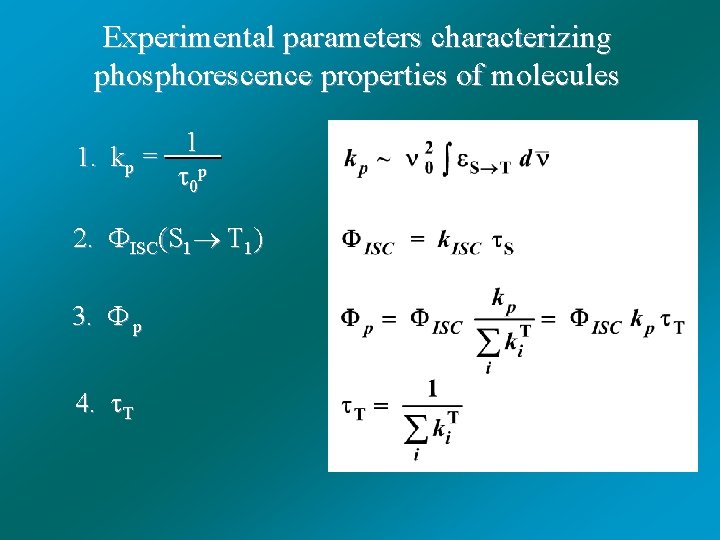
Experimental parameters characterizing phosphorescence properties of molecules 1 1. kp = p 0 2. ISC(S 1 T 1) 3. p 4. T
Quantum yields for phosphorescence and other triplet emission parameters [Turro] Compound Benzene Naphthalene 1 -Fluoronaphthalene 1 -Chloronaphthalene 1 -Bromonaphthalene 1 -Iodonaphthalene Triphenylene Benzophenone Biacetyl Acetone 4 -Phenylbenzophenone Acetophenone Cyclobutanone P 77 K ~0. 2 ~0. 05 ~0. 3 ~0. 4 ~0. 5 ~0. 9 ~0. 3 ~0. 03 , ~0. 7 0. 0 25°C (<10– 4) (<10– 4) — (<10– 4) (~0. 1) (~0. 01) ISC ~0. 7 — ~1. 0 ~0. 9 ~1. 0 —— (~0. 03) 0. 0 ~1. 0 0. 0 Configuration kp (s-1) of T 1 ~10– 1 , ~0. 3 , ~2 , ~300 , ~10– 1 , ~102 n, ~1. 0 ~102 — n, n,
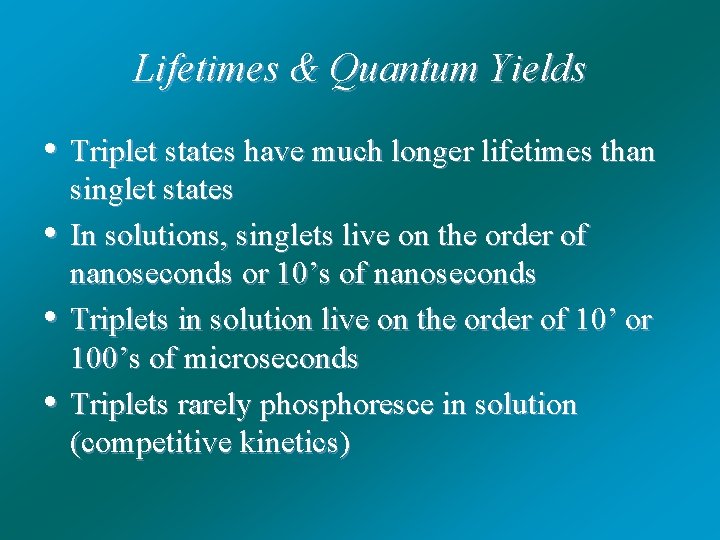
Lifetimes & Quantum Yields • Triplet states have much longer lifetimes than • • • singlet states In solutions, singlets live on the order of nanoseconds or 10’s of nanoseconds Triplets in solution live on the order of 10’ or 100’s of microseconds Triplets rarely phosphoresce in solution (competitive kinetics)
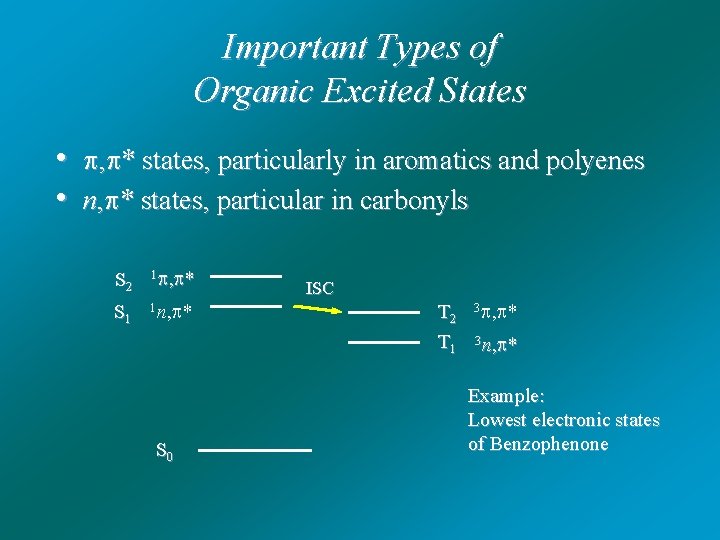
Important Types of Organic Excited States • , * states, particularly in aromatics and polyenes • n, * states, particular in carbonyls S 2 1 , * S 1 1 n, * S 0 ISC T 2 T 1 3 , * 3 n, * Example: Lowest electronic states of Benzophenone
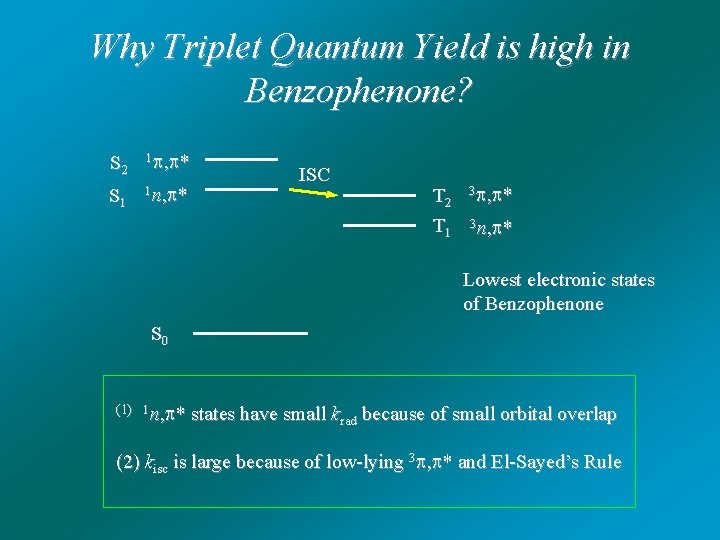
Why Triplet Quantum Yield is high in Benzophenone? S 2 1 , * S 1 1 n, * ISC T 2 T 1 3 , * 3 n, * Lowest electronic states of Benzophenone S 0 (1) 1 n, * states have small k because of small orbital overlap rad (2) kisc is large because of low-lying 3 , * and El-Sayed’s Rule
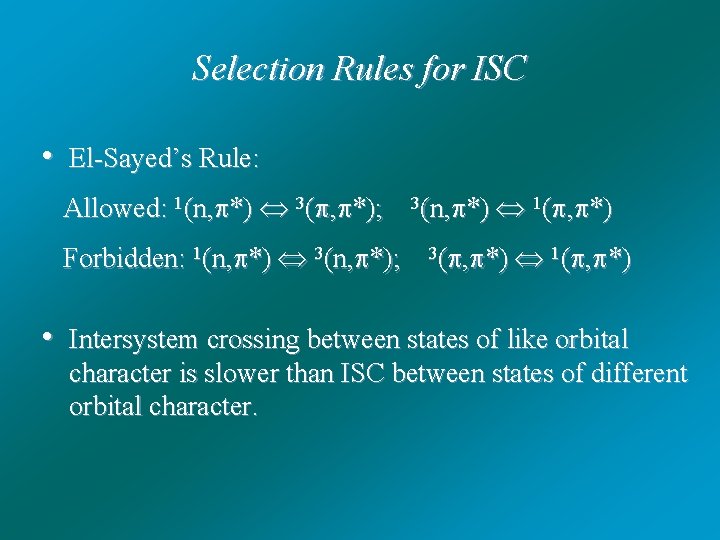
Selection Rules for ISC • El-Sayed’s Rule: Allowed: 1(n, *) 3( , *); 3(n, *) 1( , *) Forbidden: 1(n, *) 3(n, *); 3( , *) 1( , *) • Intersystem crossing between states of like orbital character is slower than ISC between states of different orbital character.
Characteristics of Radiationless Transitions • • • Kasha’s Rule El-Sayed’s Rule Wavelength Independence of Luminescence Energy Gap Law Competitive First-Order Kinetics
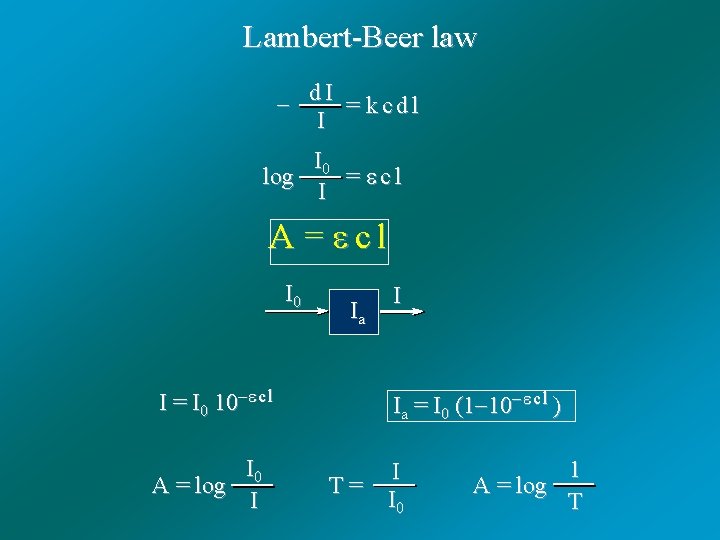
Lambert-Beer law d I = k c d l I I 0 log = c l I A = c l I 0 I = I 0 10 c l I 0 A = log I Ia = I 0 (1 10 c l ) I T = I 0 1 A = log T
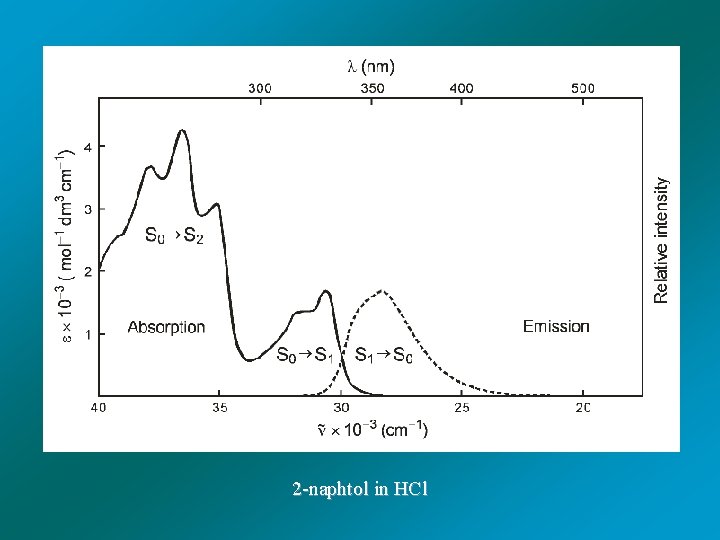
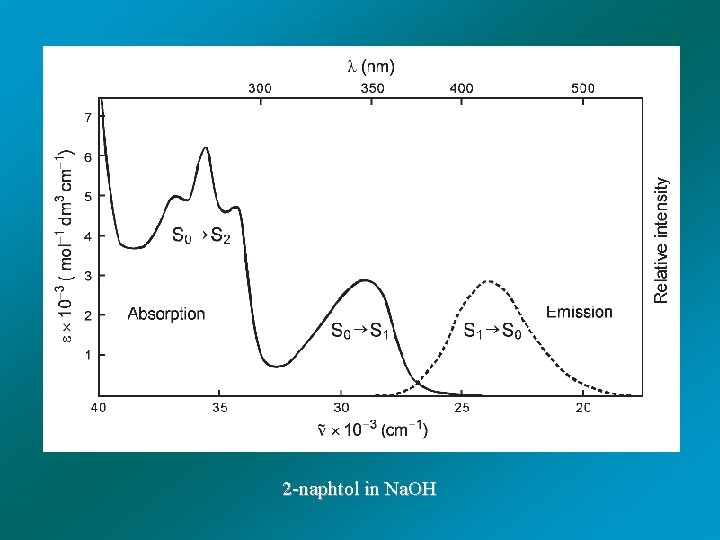
Acid -base properties in the excited states B. Marciniak, H. Kozubek, S. Paszyc J. Chem. Education, 69, 247 -249 (1992) "Estimation of p. K in the First Excited Singlet State"
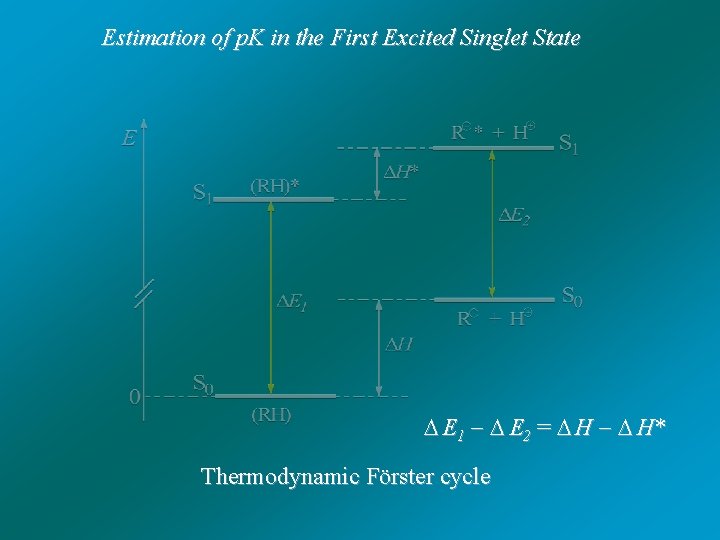
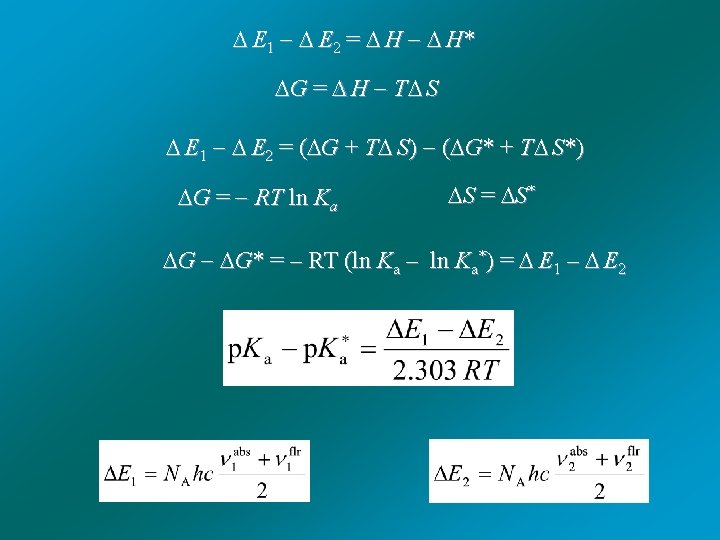
Estimation of p. K in the First Excited Singlet State E 1 E 2 = H H* Thermodynamic Förster cycle
E 1 E 2 = H H* G = H T S E 1 E 2 = ( G + T S) ( G* + T S*) G = RT ln Ka S = S* G G* = – RT (ln Ka – ln Ka*) = E 1 – E 2
2 -naphtol in HCl
2 -naphtol in Na. OH
Tabela 3. p. Ka values in the ground and lowest exited S 1 and T 1 states for organic compounds Compound p. Ka (S 0) p. Ka*(S 1) p. Ka*(T 1) 1 -Naphtol 9. 2 2, 0 2 -Naphtol 9. 5 2, 8 3, 1 7, 7 8, 1 1 -Naphtoic acid 3. 7 10 12 3, 8 4, 6 Acridine cation 5. 5 10, 6 5, 6 2 -Naphtylamine cation 4. 1 2 3, 1 3, 3