
Molecular Organization of Cell Membrane By Dr Abdel
Molecular Organization of Cell Membrane By Dr. Abdel Aziz M. Hussein Lecturer of Medical Physiology
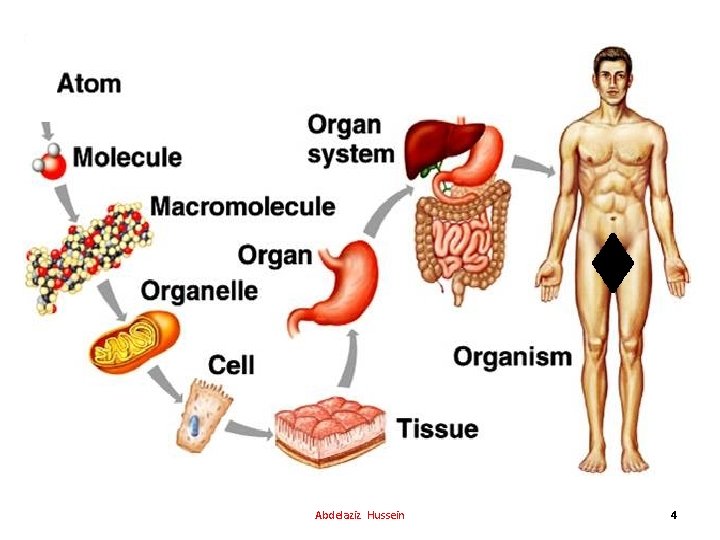
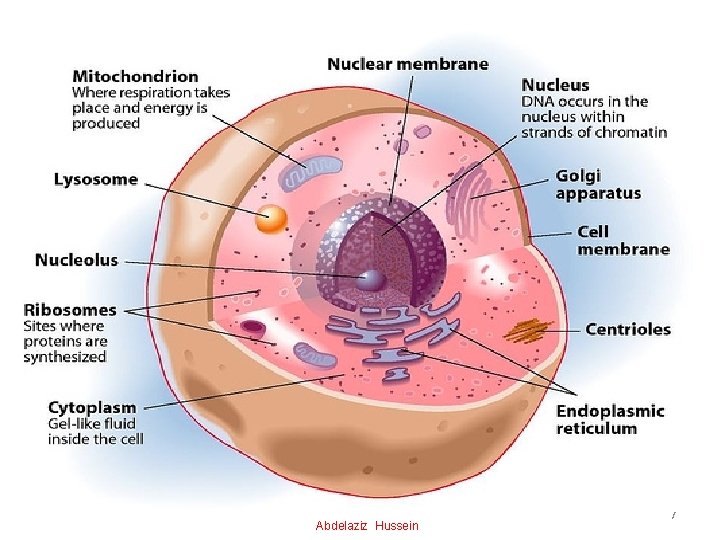
Organization of Human Body • The human body is made up of different systems e. g. digestive system, whose functions are coordinated and integrated together. • Each system consists of many organs that made up of many tissues of complementary functions. • Each tissue consists of millions of similar cells. • The cell is the basic unit of structure and function in the body • Each animal cell is surrounded by a cell membrane Abdelaziz Hussein 3
Abdelaziz Hussein 4
Cell (Plasma) Membrane Abdelaziz Hussein 5
Cell Membrane • It is a very thin elastic semi-permeable membrane (allowing some substances to pass through it and prevent others) that surrounds the cell • It is about 7. 5 nm (75 Ao = Angstrom = 10 -10 of meter) in thickness. Abdelaziz Hussein 6
Abdelaziz Hussein 7
Functions of Cell Membrane 1. 2. 3. 4. 5. 6. It separates the cytoplasm from ECF. It maintains cell's internal environment. It transports of macromolecules into and out of the cell. It controls distribution of ions e. g. Na, K extracellular ICF and ECF. It generates transmembrane potentials. It is contains receptors for hormones and transmitter substances which are important for signal transduction 8 Biophysics , Abdelaziz Hussein
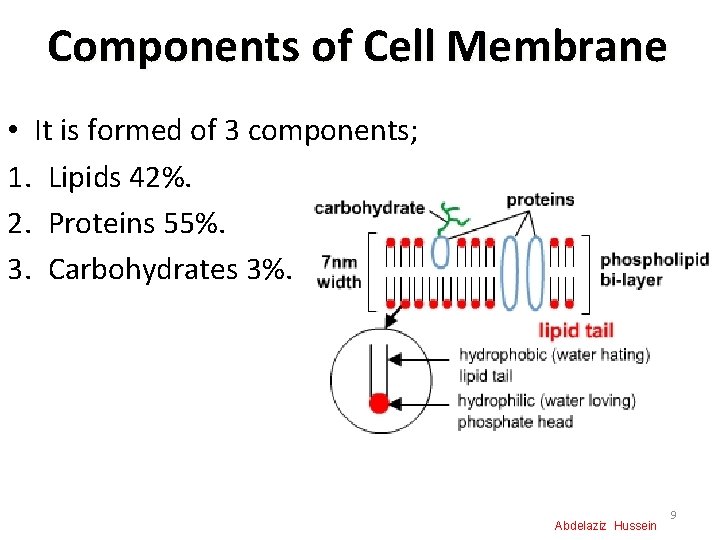
Components of Cell Membrane • It is formed of 3 components; 1. Lipids 42%. 2. Proteins 55%. 3. Carbohydrates 3%. Abdelaziz Hussein 9
Cell Membrane Lipids Abdelaziz Hussein 10
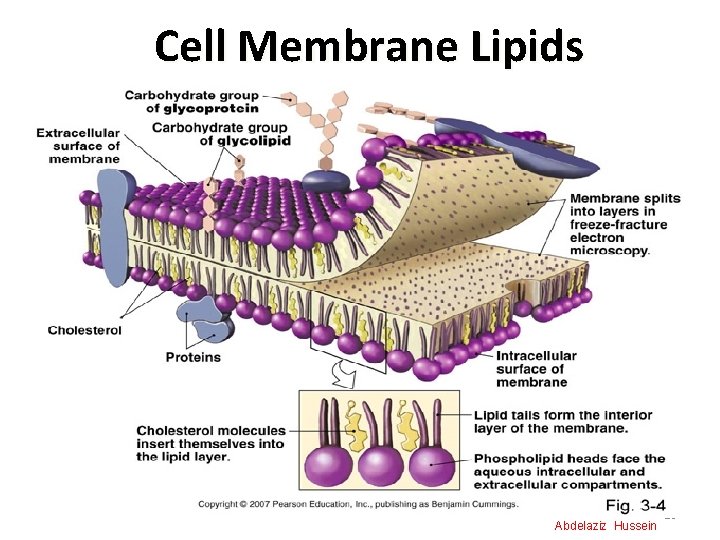
Cell Membrane Lipids • Form the basic structure of the membrane. • Include mainly phospholipids, cholesterol, and glycolipids. • Phospholipids are arranged into 2 layers (Lipid bilayer) • Phospholipids molecules resemble the clothes-pin shape • It consist of; • Head (PO 4 group) (face the ICF and ECF sides) relatively H 2 O soluble (polar, hydrophilic). • Tails (face each other in the interior of the bilayer) → relatively H 2 O insoluble (non-polar, hydrophobic). Abdelaziz Hussein 11
Cell Membrane Proteins Abdelaziz Hussein 12
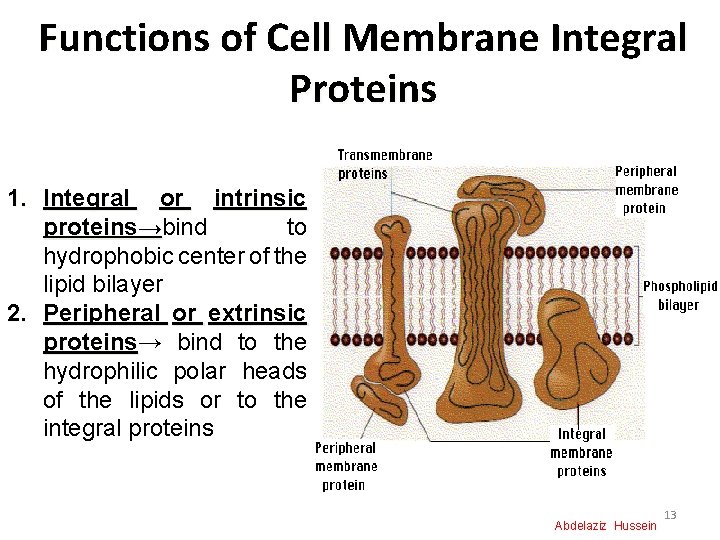
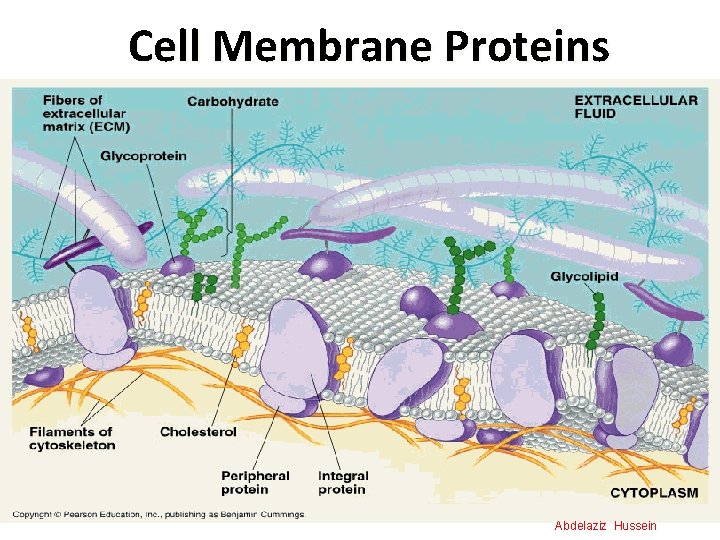
Functions of Cell Membrane Integral Proteins 1. Integral or intrinsic proteins→bind to proteins→ hydrophobic center of the lipid bilayer 2. Peripheral or extrinsic proteins→ bind to the proteins hydrophilic polar heads of the lipids or to the integral proteins Abdelaziz Hussein 13
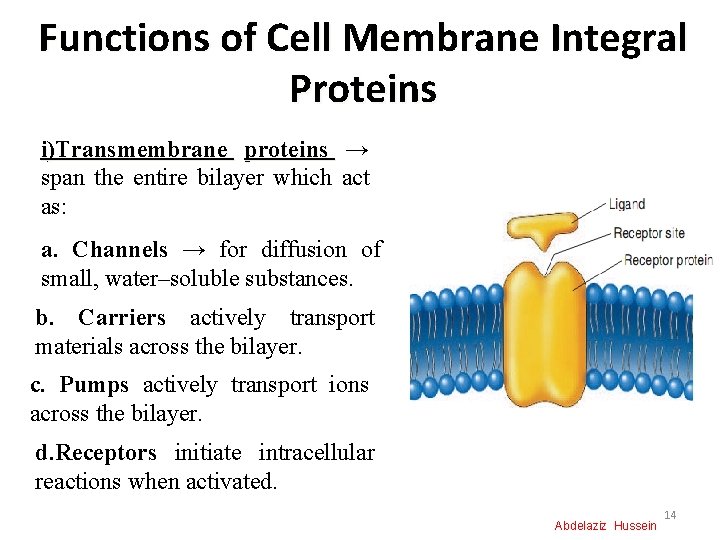
Functions of Cell Membrane Integral Proteins i)Transmembrane proteins → span the entire bilayer which act as: a. Channels → for diffusion of small, water–soluble substances. b. Carriers actively transport materials across the bilayer. c. Pumps actively transport ions across the bilayer. d. Receptors initiate intracellular reactions when activated. Abdelaziz Hussein 14
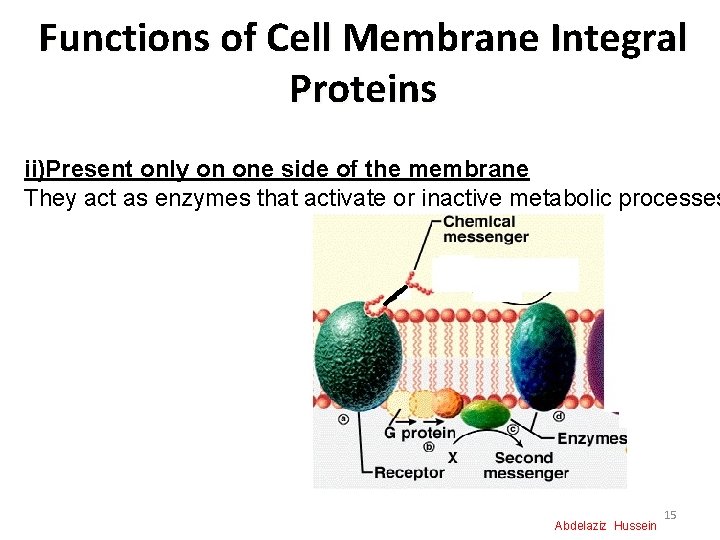
Functions of Cell Membrane Integral Proteins ii)Present only on one side of the membrane They act as enzymes that activate or inactive metabolic processes Abdelaziz Hussein 15
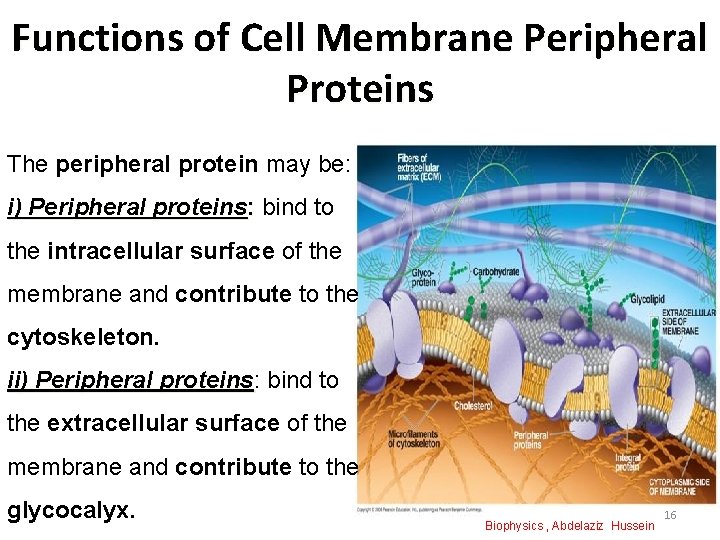
Functions of Cell Membrane Peripheral Proteins The peripheral protein may be: i) Peripheral proteins: bind to the intracellular surface of the membrane and contribute to the cytoskeleton. ii) Peripheral proteins: bind to the extracellular surface of the membrane and contribute to the glycocalyx. Biophysics , Abdelaziz Hussein 16
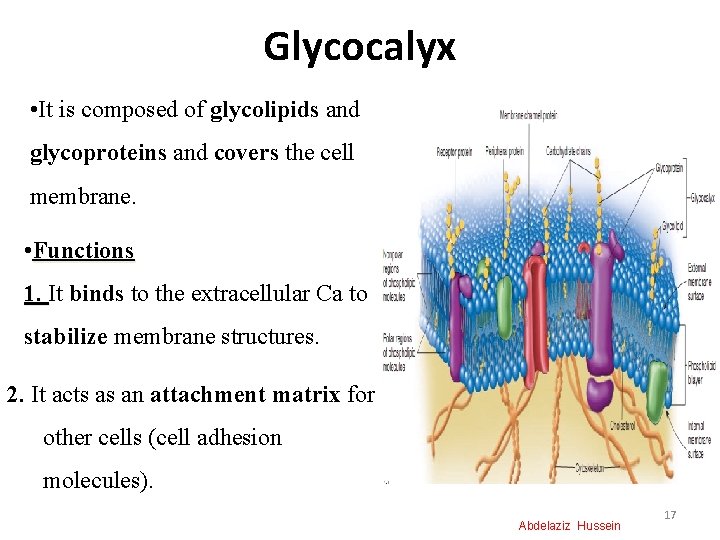
Glycocalyx • It is composed of glycolipids and glycoproteins and covers the cell membrane. • Functions 1. It binds to the extracellular Ca to stabilize membrane structures. 2. It acts as an attachment matrix for other cells (cell adhesion molecules). Abdelaziz Hussein 17
Transport through the Cell Membrane Abdelaziz Hussein 18
Transport through the Cell Membrane Abdelaziz Hussein 19
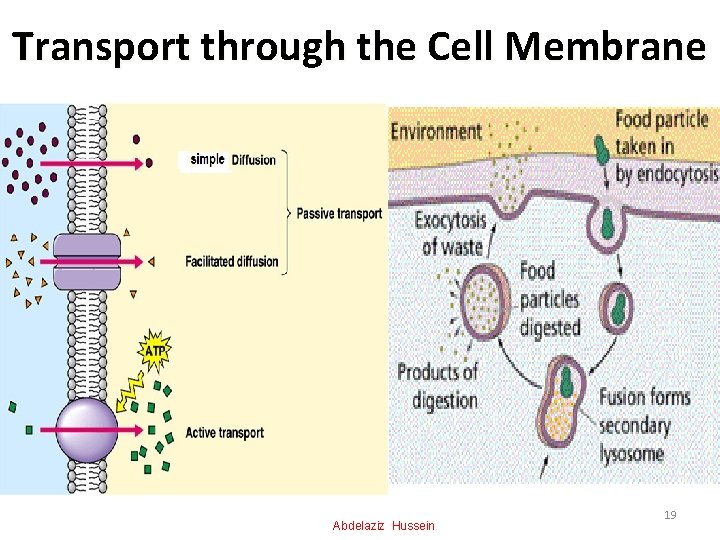
Transport through the Cell Membrane There are 3 mechanisms for transport of substances through cell membranes; a) Passive transport (Diffusion): It is movement of substances across the cell membrane down its electrochemical gradient. b) Active transport: It is movement of substances across the cell membrane against its electrochemical gradient. c) Vesicular transport: It is the process by which large sized substances are engulfed by the cell membrane to be either pushed inside the cell (endocytosis) or pushed outside the cell (exocytosis) Abdelaziz Hussein 20
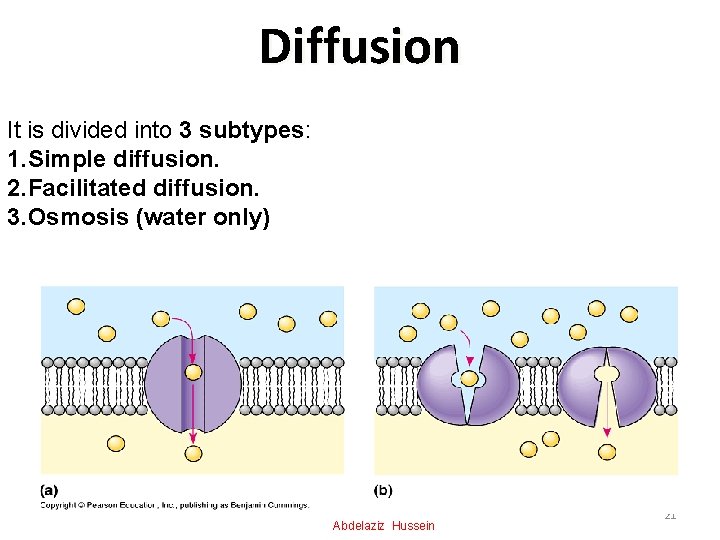
Diffusion It is divided into 3 subtypes: 1. Simple diffusion. 2. Facilitated diffusion. 3. Osmosis (water only) Abdelaziz Hussein 21
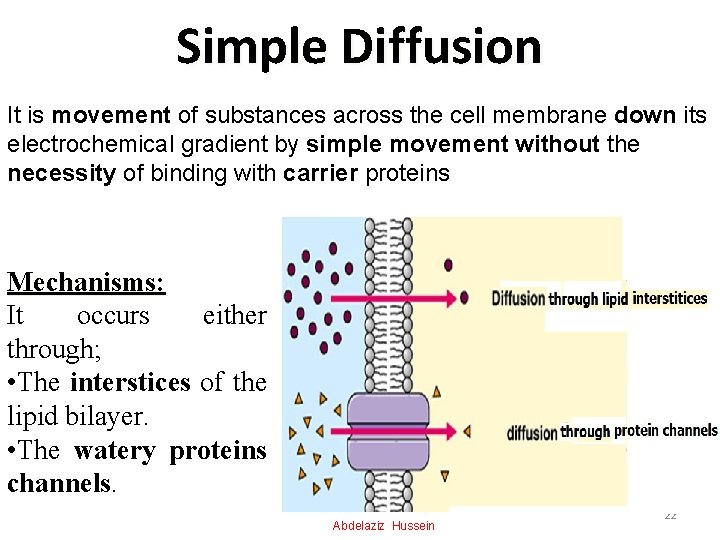
Simple Diffusion It is movement of substances across the cell membrane down its electrochemical gradient by simple movement without the necessity of binding with carrier proteins Mechanisms: It occurs either through; • The interstices of the lipid bilayer. • The watery proteins channels. Abdelaziz Hussein 22
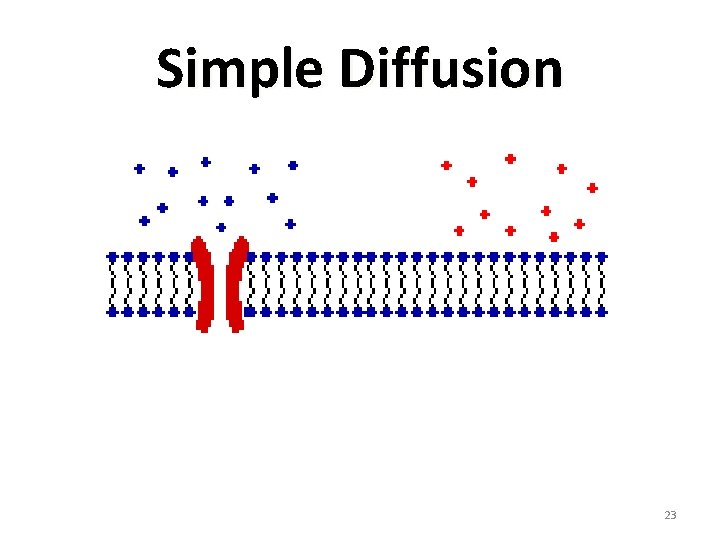
Simple Diffusion 23
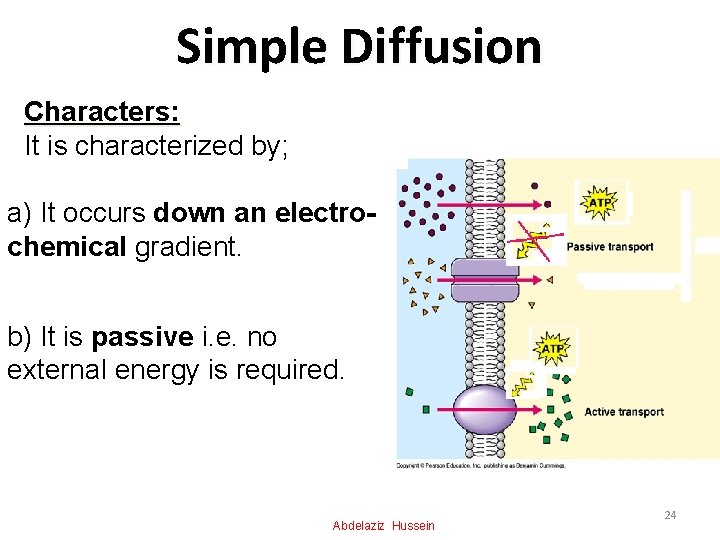
Simple Diffusion Characters: It is characterized by; a) It occurs down an electrochemical gradient. b) It is passive i. e. no external energy is required. Abdelaziz Hussein 24

Simple Diffusion Characters: It is characterized by; c) It is not rate-limiting i. e. linear with concentration gradients. d) The diffusion process is not saturable. Abdelaziz Hussein 25
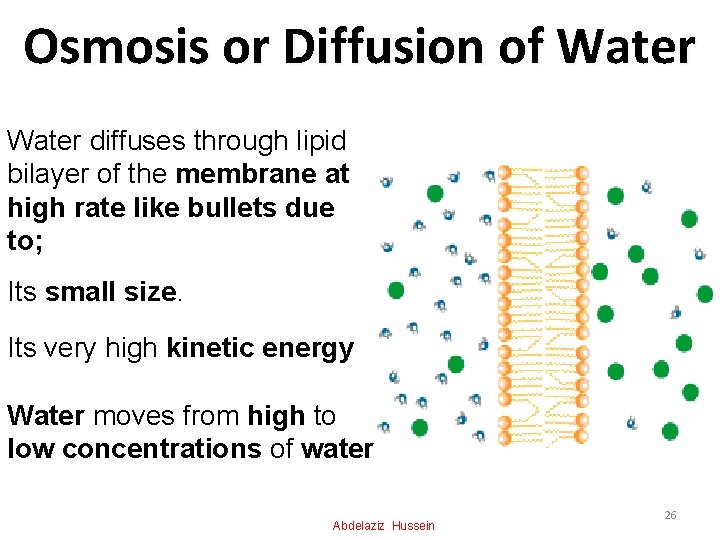
Osmosis or Diffusion of Water diffuses through lipid bilayer of the membrane at high rate like bullets due to; Its small size. Its very high kinetic energy Water moves from high to low concentrations of water Abdelaziz Hussein 26
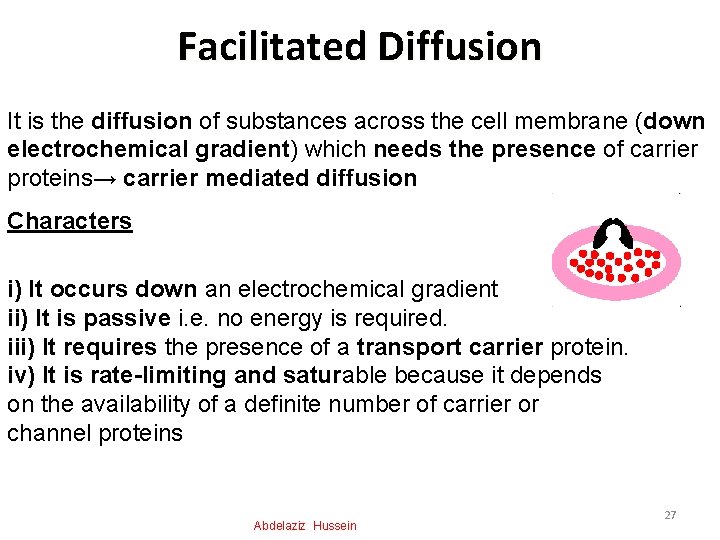
Facilitated Diffusion It is the diffusion of substances across the cell membrane (down electrochemical gradient) which needs the presence of carrier proteins→ carrier mediated diffusion Characters i) It occurs down an electrochemical gradient ii) It is passive i. e. no energy is required. iii) It requires the presence of a transport carrier protein. iv) It is rate-limiting and saturable because it depends on the availability of a definite number of carrier or channel proteins Abdelaziz Hussein 27
II) Active Transport Def. , It is the movement of substances across the cell membranes against an electrochemical gradient. Types: There are 2 subtypes of active transport: i) Primary active transport → obtain its energy directly from the hydrolysis of ATP e. g. Na-K Pump, Ca ATPase, H-K ATPase ii) Secondary active transport → use the energy stored in the Na concentration gradient e. g. Na-glucose co-transport and Na-Ca exchange Abdelaziz Hussein 28

II) Active Transport Characters 1. It occurs against the electrochemical gradient 2. It is active i. e. energy is required 3. It requires the presence of a transport carrier protein 4. It exhibits stereospecificity, saturation, and competition Abdelaziz Hussein 29
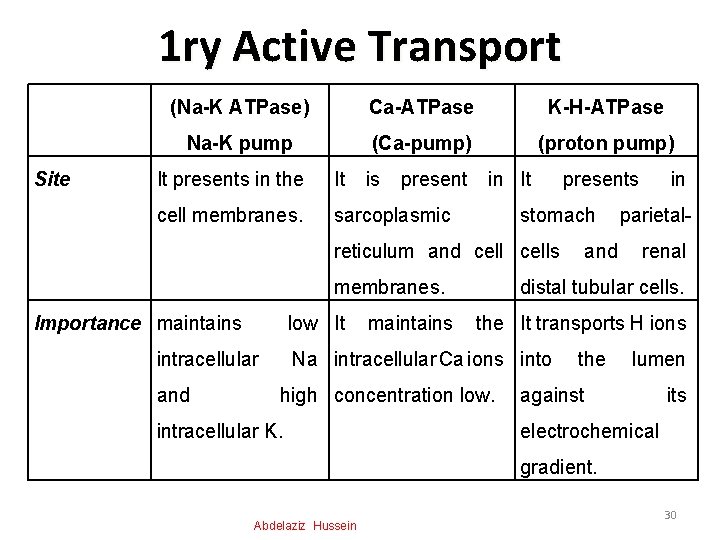
1 ry Active Transport Site (Na-K ATPase) Ca-ATPase K-H-ATPase Na-K pump (Ca-pump) (proton pump) It presents in the It is present cell membranes. sarcoplasmic in It stomach reticulum and cells membranes. Importance maintains low It intracellular and maintains and in parietalrenal distal tubular cells. the It transports H ions Na intracellular Ca ions into high concentration low. intracellular K. presents the lumen against its electrochemical gradient. Abdelaziz Hussein 30
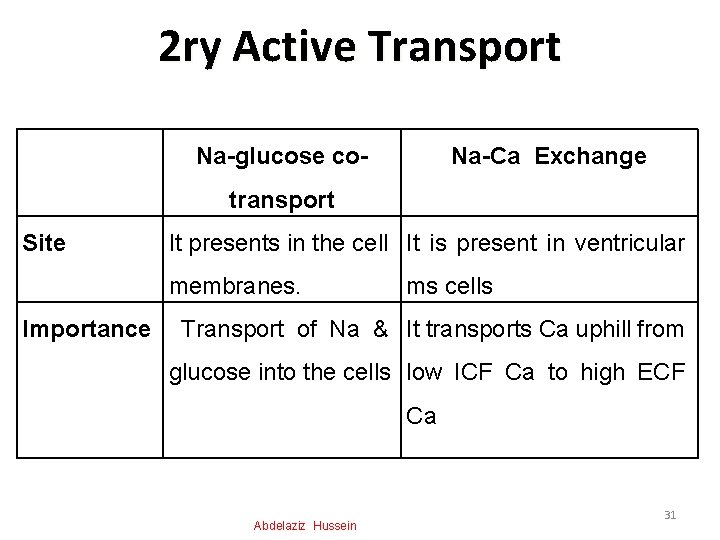
2 ry Active Transport Na-glucose co- Na-Ca Exchange transport Site It presents in the cell It is present in ventricular membranes. Importance ms cells Transport of Na & It transports Ca uphill from glucose into the cells low ICF Ca to high ECF Ca Abdelaziz Hussein 31
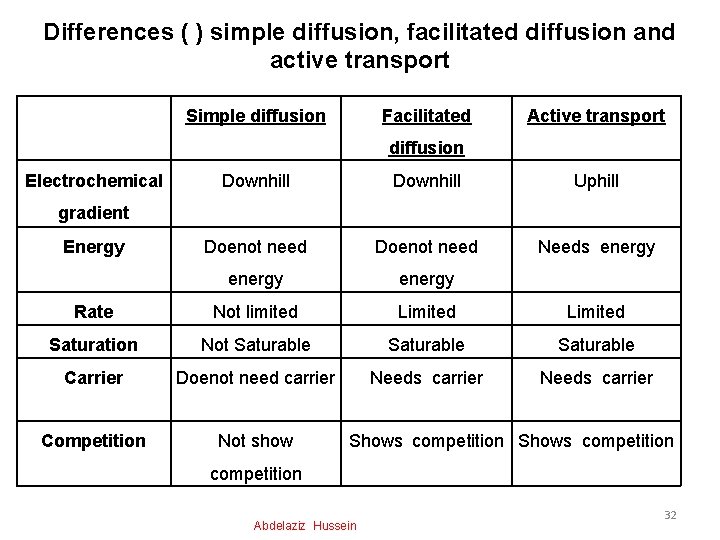
Differences ( ) simple diffusion, facilitated diffusion and active transport Simple diffusion Facilitated Active transport diffusion Electrochemical Downhill Uphill Doenot need Needs energy Rate Not limited Limited Saturation Not Saturable Carrier Doenot need carrier Needs carrier Competition Not show gradient Energy Shows competition Abdelaziz Hussein 32
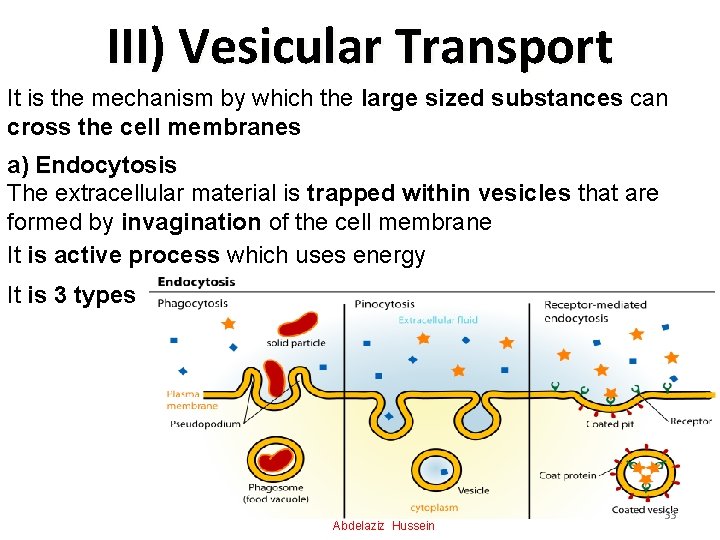
III) Vesicular Transport It is the mechanism by which the large sized substances can cross the cell membranes a) Endocytosis The extracellular material is trapped within vesicles that are formed by invagination of the cell membrane It is active process which uses energy It is 3 types Abdelaziz Hussein 33
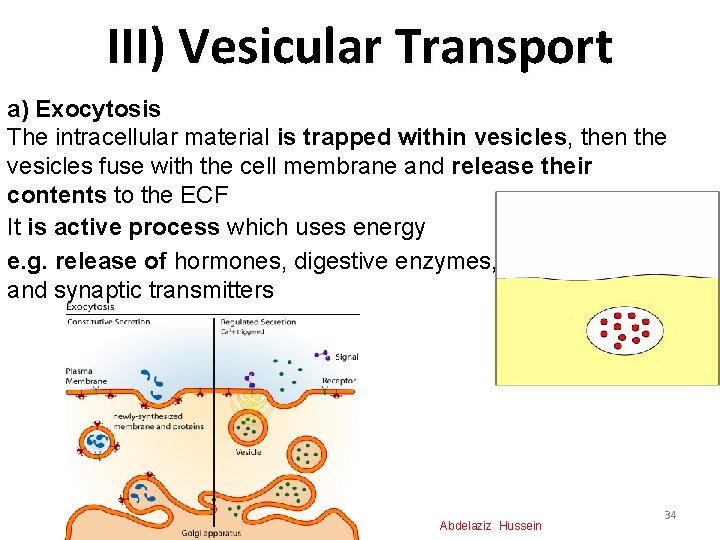
III) Vesicular Transport a) Exocytosis The intracellular material is trapped within vesicles, then the vesicles fuse with the cell membrane and release their contents to the ECF It is active process which uses energy e. g. release of hormones, digestive enzymes, and synaptic transmitters Abdelaziz Hussein 34

THANKS
- Slides: 35