
Molecular Orbital Theory presented by Michael Morse University
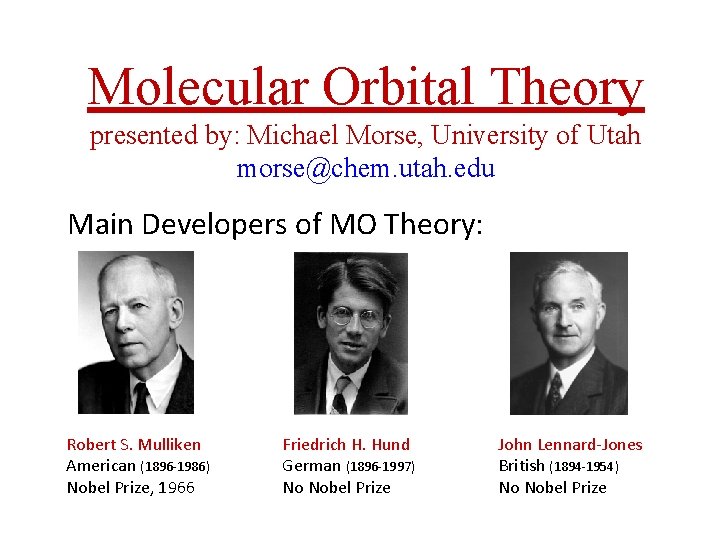
Molecular Orbital Theory presented by: Michael Morse, University of Utah morse@chem. utah. edu Main Developers of MO Theory: Robert S. Mulliken American (1896 -1986) Nobel Prize, 1966 Friedrich H. Hund German (1896 -1997) No Nobel Prize John Lennard-Jones British (1894 -1954) No Nobel Prize
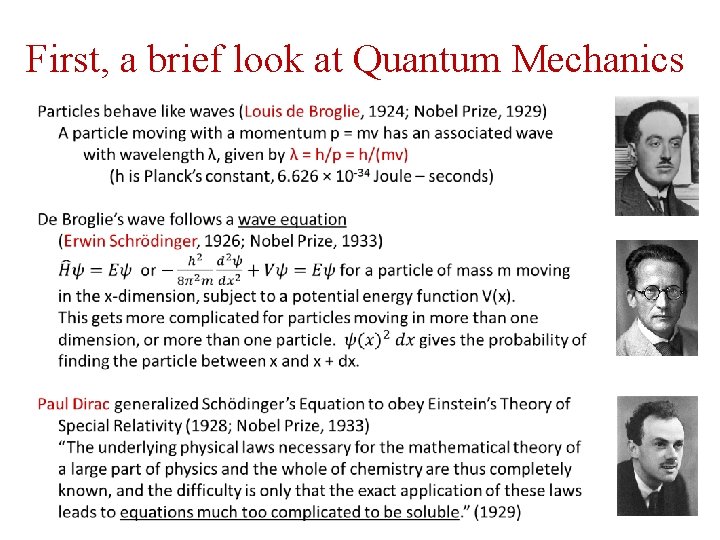
First, a brief look at Quantum Mechanics
If the equations are too complicated to be soluble, what can we do?
If the equations are too complicated to be soluble, what can we do? Make approximations!
![Valence Bond Theory [A very atom-based approximation scheme] Electron #1 is on nucleus A](http://slidetodoc.com/presentation_image/55d05a0fb86cc1cc8ea392ef10c99c47/image-5.jpg "Valence Bond Theory [A very atom-based approximation scheme] Electron #1 is on nucleus A")
Valence Bond Theory [A very atom-based approximation scheme] Electron #1 is on nucleus A while electron #2 is on nucleus B Electron #1 is on nucleus B while electron #2 is on nucleus A Linus Pauling Nobel Prize 1954 Charles Coulson no Nobel Prize
![A Different Approximation Scheme: Molecular Orbital Theory [A very molecule-based approximation scheme]](http://slidetodoc.com/presentation_image/55d05a0fb86cc1cc8ea392ef10c99c47/image-6.jpg "A Different Approximation Scheme: Molecular Orbital Theory [A very molecule-based approximation scheme]")
A Different Approximation Scheme: Molecular Orbital Theory [A very molecule-based approximation scheme]
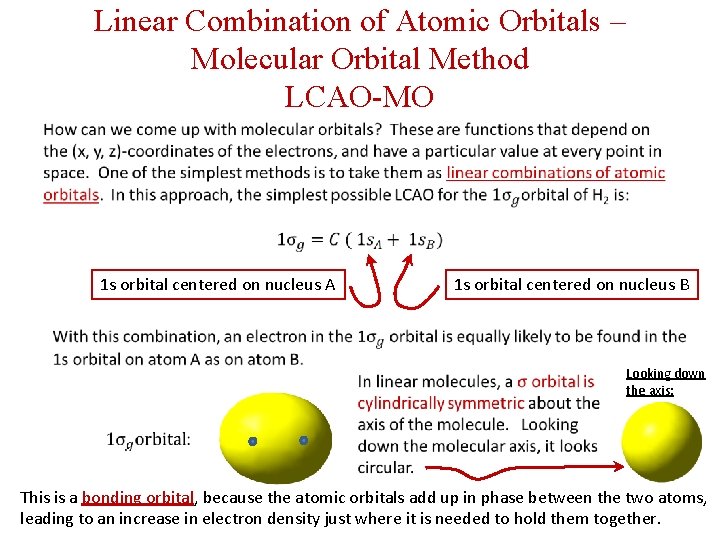
Linear Combination of Atomic Orbitals – Molecular Orbital Method LCAO-MO 1 s orbital centered on nucleus A 1 s orbital centered on nucleus B Looking down the axis: This is a bonding orbital, because the atomic orbitals add up in phase between the two atoms, leading to an increase in electron density just where it is needed to hold them together.
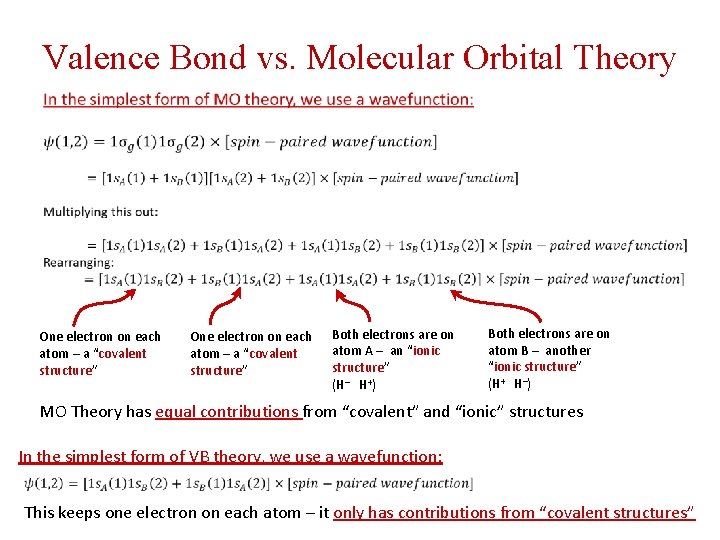
Valence Bond vs. Molecular Orbital Theory One electron on each atom – a “covalent structure” Both electrons are on atom A – an “ionic structure” (H‒ H+) Both electrons are on atom B – another “ionic structure” (H+ H‒) MO Theory has equal contributions from “covalent” and “ionic” structures In the simplest form of VB theory, we use a wavefunction: This keeps one electron on each atom – it only has contributions from “covalent structures”
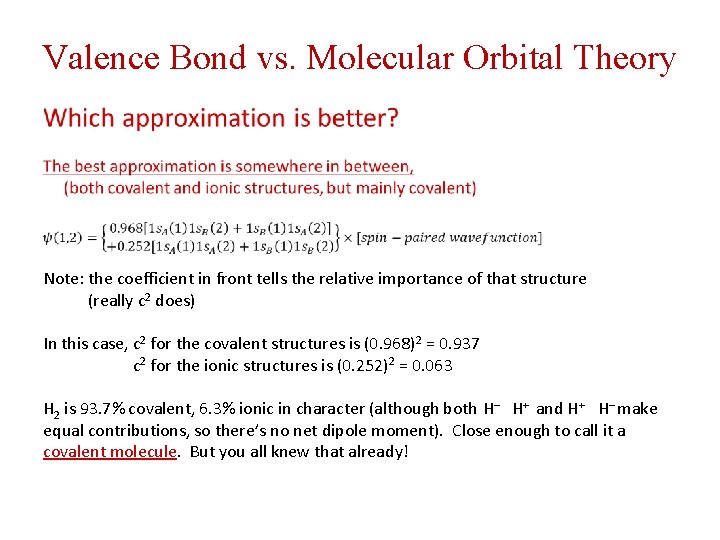
Valence Bond vs. Molecular Orbital Theory Note: the coefficient in front tells the relative importance of that structure (really c 2 does) In this case, c 2 for the covalent structures is (0. 968)2 = 0. 937 c 2 for the ionic structures is (0. 252)2 = 0. 063 H 2 is 93. 7% covalent, 6. 3% ionic in character (although both H‒ H+ and H+ H‒ make equal contributions, so there’s no net dipole moment). Close enough to call it a covalent molecule. But you all knew that already!
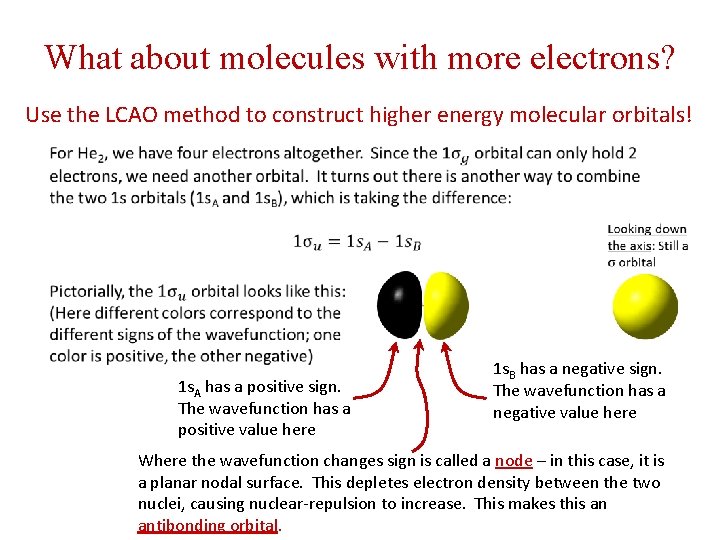
What about molecules with more electrons? Use the LCAO method to construct higher energy molecular orbitals! 1 s. A has a positive sign. The wavefunction has a positive value here 1 s. B has a negative sign. The wavefunction has a negative value here Where the wavefunction changes sign is called a node – in this case, it is a planar nodal surface. This depletes electron density between the two nuclei, causing nuclear-repulsion to increase. This makes this an antibonding orbital.
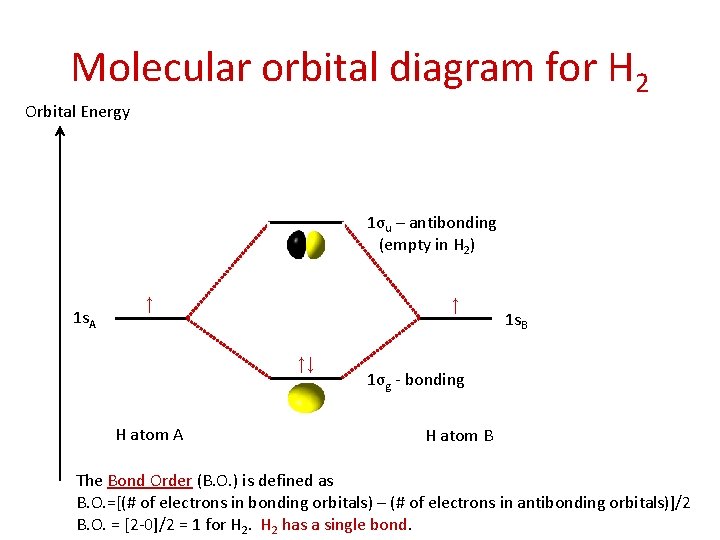
Molecular orbital diagram for H 2 Orbital Energy 1σu – antibonding (empty in H 2) 1 s. A ↑ ↑ ↑↓ H atom A 1 s. B 1σg - bonding H atom B The Bond Order (B. O. ) is defined as B. O. =[(# of electrons in bonding orbitals) – (# of electrons in antibonding orbitals)]/2 B. O. = [2 -0]/2 = 1 for H 2 has a single bond.
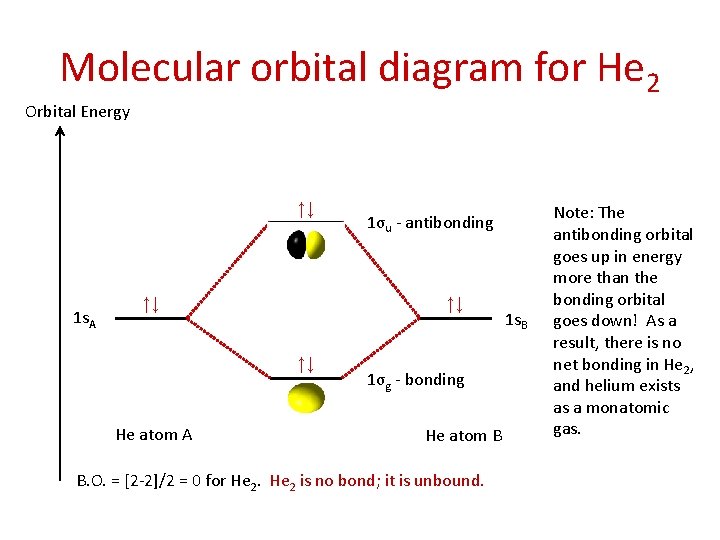
Molecular orbital diagram for He 2 Orbital Energy ↑↓ 1 s. A ↑↓ ↑↓ ↑↓ He atom A 1σu - antibonding 1σg - bonding He atom B B. O. = [2 -2]/2 = 0 for He 2 is no bond; it is unbound. 1 s. B Note: The antibonding orbital goes up in energy more than the bonding orbital goes down! As a result, there is no net bonding in He 2, and helium exists as a monatomic gas.
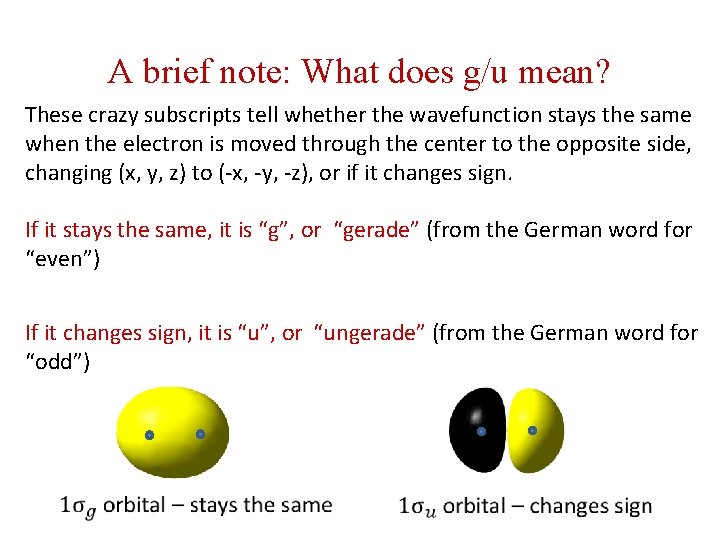
A brief note: What does g/u mean? These crazy subscripts tell whether the wavefunction stays the same when the electron is moved through the center to the opposite side, changing (x, y, z) to (-x, -y, -z), or if it changes sign. If it stays the same, it is “g”, or “gerade” (from the German word for “even”) If it changes sign, it is “u”, or “ungerade” (from the German word for “odd”)
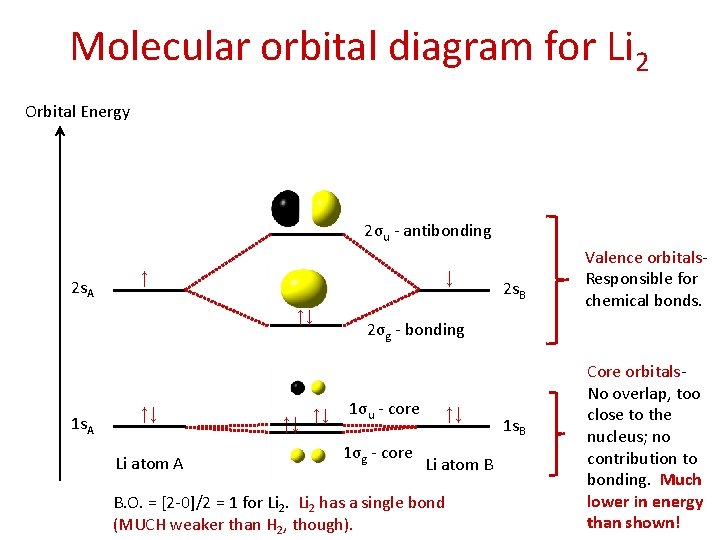
Molecular orbital diagram for Li 2 Orbital Energy 2σu - antibonding 2 s. A ↑ ↓ ↑↓ 1 s. A ↑↓ Li atom A ↑↓ ↑↓ 2 s. B Valence orbitals. Responsible for chemical bonds. 2σg - bonding 1σu - core 1σg - core ↑↓ Li atom B B. O. = [2 -0]/2 = 1 for Li 2 has a single bond (MUCH weaker than H 2, though). 1 s. B Core orbitals. No overlap, too close to the nucleus; no contribution to bonding. Much lower in energy than shown!
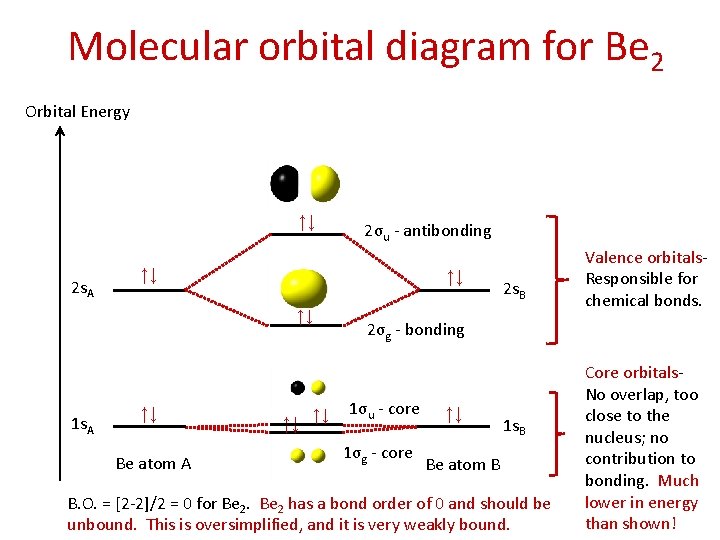
Molecular orbital diagram for Be 2 Orbital Energy ↑↓ 2 s. A ↑↓ ↑↓ ↑↓ 1 s. A 2σu - antibonding ↑↓ Be atom A ↑↓ ↑↓ 2 s. B Valence orbitals. Responsible for chemical bonds. 2σg - bonding 1σu - core 1σg - core ↑↓ 1 s. B Be atom B B. O. = [2 -2]/2 = 0 for Be 2 has a bond order of 0 and should be unbound. This is oversimplified, and it is very weakly bound. Core orbitals. No overlap, too close to the nucleus; no contribution to bonding. Much lower in energy than shown!
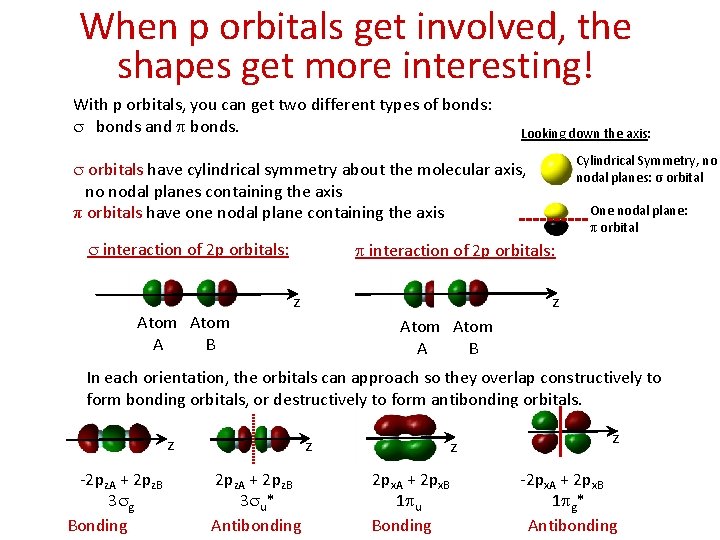
When p orbitals get involved, the shapes get more interesting! With p orbitals, you can get two different types of bonds: s bonds and p bonds. Looking down the axis: Cylindrical Symmetry, no nodal planes: σ orbital s orbitals have cylindrical symmetry about the molecular axis, no nodal planes containing the axis π orbitals have one nodal plane containing the axis s interaction of 2 p orbitals: Atom A B One nodal plane: π orbital p interaction of 2 p orbitals: z z Atom A B In each orientation, the orbitals can approach so they overlap constructively to form bonding orbitals, or destructively to form antibonding orbitals. z -2 pz. A + 2 pz. B 2 pz. A + 2 pz. B 3 sg 3 su* Bonding Antibonding z z z 2 px. A + 2 px. B -2 px. A + 2 px. B 1 pu 1 pg* Bonding Antibonding
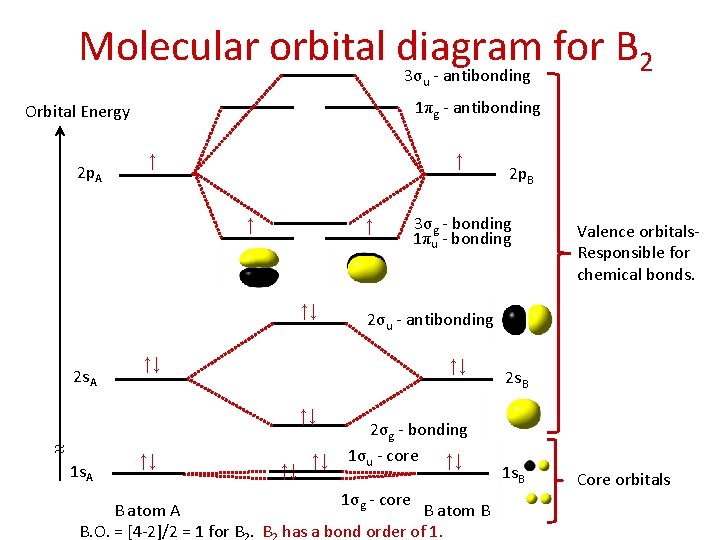
Molecular orbital diagram for B 2 3σ - antibonding u 1πg - antibonding Orbital Energy 2 p. A ↑ ↑ ↑↓ 2 s. A ↑↓ ≈ 1 s. A ↑↓ 3σg - bonding 1πu - bonding ↑↓ ↑↓ Valence orbitals. Responsible for chemical bonds. 2σu - antibonding ↑↓ ↑↓ 2 p. B 2σg - bonding 1σu - core ↑↓ 1σg - core B atom A B atom B B. O. = [4 -2]/2 = 1 for B. B has a bond order of 1. 2 s. B 1 s. B Core orbitals
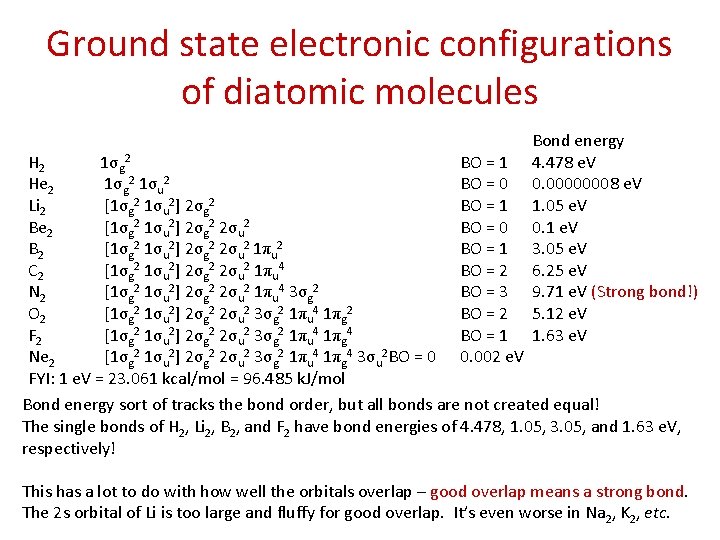
Ground state electronic configurations of diatomic molecules Bond energy 4. 478 e. V 0. 00000008 e. V 1. 05 e. V 0. 1 e. V 3. 05 e. V 6. 25 e. V 9. 71 e. V (Strong bond!) 5. 12 e. V 1. 63 e. V H 2 1σg 2 BO = 1 He 2 1σg 2 1σu 2 BO = 0 Li 2 [1σg 2 1σu 2] 2σg 2 BO = 1 Be 2 [1σg 2 1σu 2] 2σg 2 2σu 2 BO = 0 B 2 [1σg 2 1σu 2] 2σg 2 2σu 2 1πu 2 BO = 1 C 2 [1σg 2 1σu 2] 2σg 2 2σu 2 1πu 4 BO = 2 N 2 [1σg 2 1σu 2] 2σg 2 2σu 2 1πu 4 3σg 2 BO = 3 O 2 [1σg 2 1σu 2] 2σg 2 2σu 2 3σg 2 1πu 4 1πg 2 BO = 2 F 2 [1σg 2 1σu 2] 2σg 2 2σu 2 3σg 2 1πu 4 1πg 4 BO = 1 Ne 2 [1σg 2 1σu 2] 2σg 2 2σu 2 3σg 2 1πu 4 1πg 4 3σu 2 BO = 0 0. 002 e. V FYI: 1 e. V = 23. 061 kcal/mol = 96. 485 k. J/mol Bond energy sort of tracks the bond order, but all bonds are not created equal! The single bonds of H 2, Li 2, B 2, and F 2 have bond energies of 4. 478, 1. 05, 3. 05, and 1. 63 e. V, respectively! This has a lot to do with how well the orbitals overlap – good overlap means a strong bond. The 2 s orbital of Li is too large and fluffy for good overlap. It’s even worse in Na 2, K 2, etc.
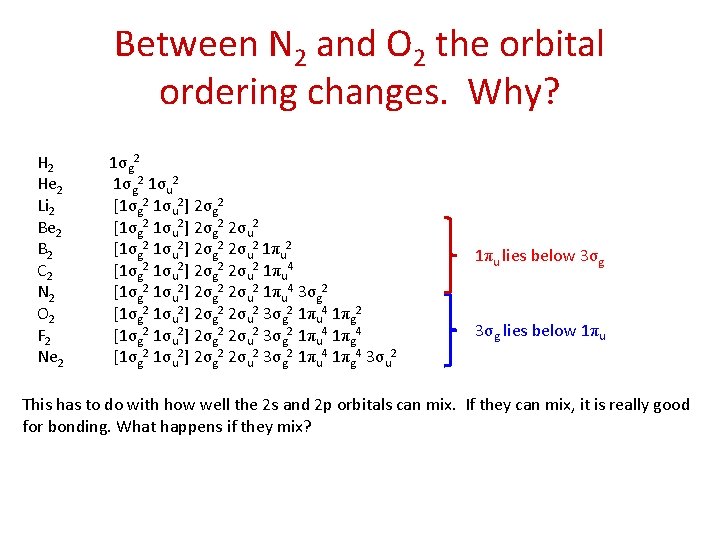
Between N 2 and O 2 the orbital ordering changes. Why? H 2 He 2 Li 2 Be 2 B 2 C 2 N 2 O 2 F 2 Ne 2 1σg 2 1σu 2 [1σg 2 1σu 2] 2σg 2 2σu 2 1πu 4 [1σg 2 1σu 2] 2σg 2 2σu 2 1πu 4 3σg 2 [1σg 2 1σu 2] 2σg 2 2σu 2 3σg 2 1πu 4 1πg 2 [1σg 2 1σu 2] 2σg 2 2σu 2 3σg 2 1πu 4 1πg 4 3σu 2 1πu lies below 3σg lies below 1πu This has to do with how well the 2 s and 2 p orbitals can mix. If they can mix, it is really good for bonding. What happens if they mix?
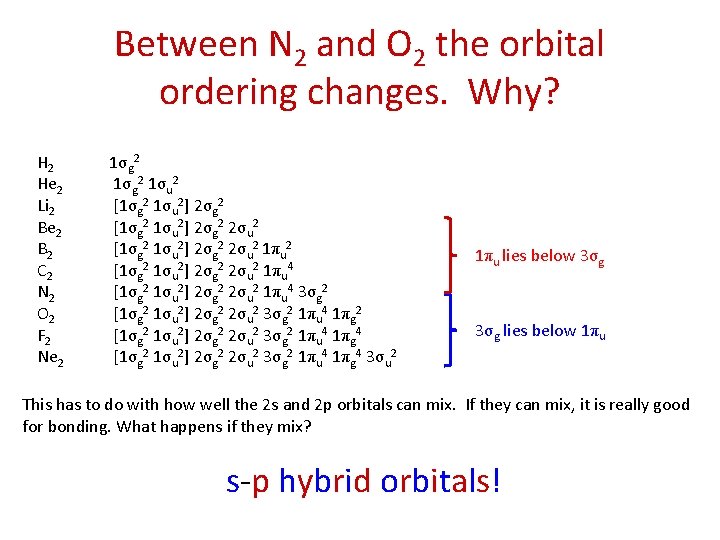
Between N 2 and O 2 the orbital ordering changes. Why? H 2 He 2 Li 2 Be 2 B 2 C 2 N 2 O 2 F 2 Ne 2 1σg 2 1σu 2 [1σg 2 1σu 2] 2σg 2 2σu 2 1πu 4 [1σg 2 1σu 2] 2σg 2 2σu 2 1πu 4 3σg 2 [1σg 2 1σu 2] 2σg 2 2σu 2 3σg 2 1πu 4 1πg 2 [1σg 2 1σu 2] 2σg 2 2σu 2 3σg 2 1πu 4 1πg 4 3σu 2 1πu lies below 3σg lies below 1πu This has to do with how well the 2 s and 2 p orbitals can mix. If they can mix, it is really good for bonding. What happens if they mix? s-p hybrid orbitals!
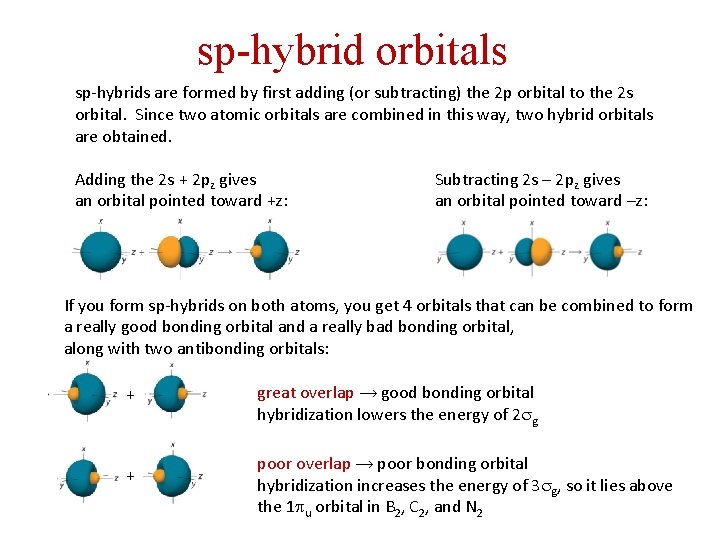
sp-hybrid orbitals sp-hybrids are formed by first adding (or subtracting) the 2 p orbital to the 2 s orbital. Since two atomic orbitals are combined in this way, two hybrid orbitals are obtained. Adding the 2 s + 2 pz gives an orbital pointed toward +z: Subtracting 2 s – 2 pz gives an orbital pointed toward –z: If you form sp-hybrids on both atoms, you get 4 orbitals that can be combined to form a really good bonding orbital and a really bad bonding orbital, along with two antibonding orbitals: + + great overlap → good bonding orbital hybridization lowers the energy of 2 sg poor overlap → poor bonding orbital hybridization increases the energy of 3 sg, so it lies above the 1 pu orbital in B 2, C 2, and N 2
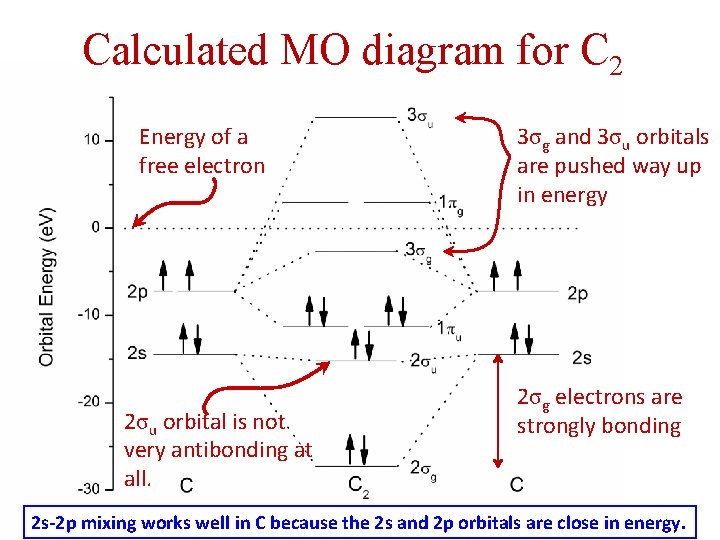
Calculated MO diagram for C 2 Energy of a free electron 2σu orbital is not very antibonding at all. 3σg and 3σu orbitals are pushed way up in energy 2σg electrons are strongly bonding 2 s-2 p mixing works well in C because the 2 s and 2 p orbitals are close in energy.
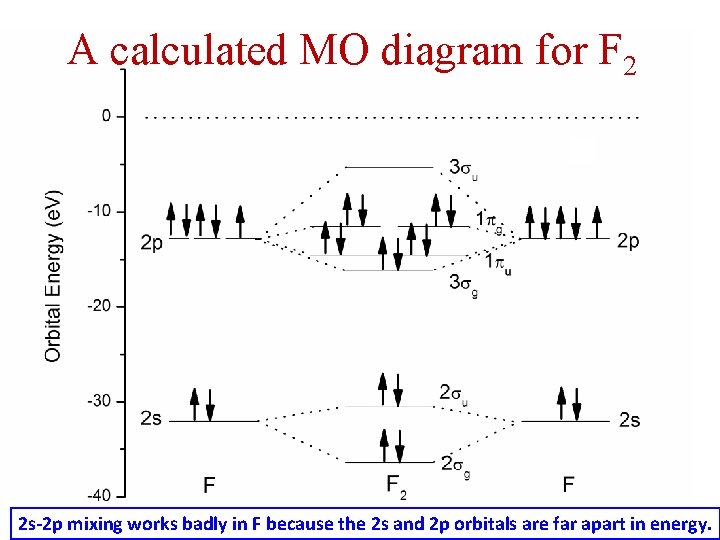
A calculated MO diagram for F 2 2 s-2 p mixing works badly in F because the 2 s and 2 p orbitals are far apart in energy.
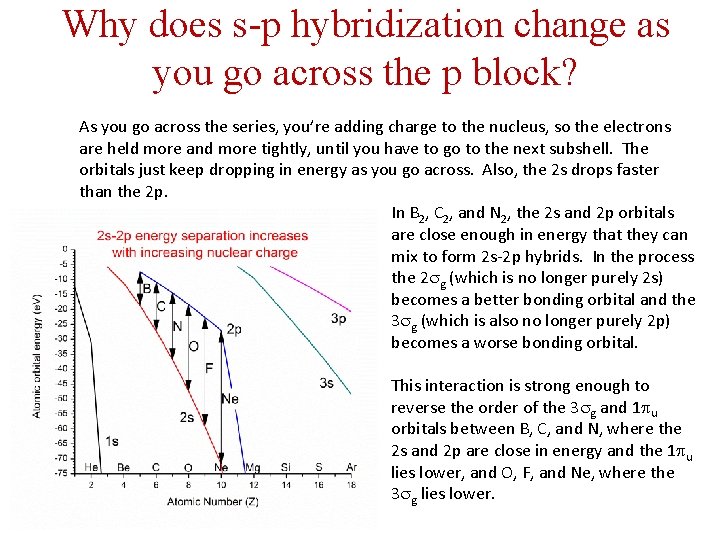
Why does s-p hybridization change as you go across the p block? As you go across the series, you’re adding charge to the nucleus, so the electrons are held more and more tightly, until you have to go to the next subshell. The orbitals just keep dropping in energy as you go across. Also, the 2 s drops faster than the 2 p. In B 2, C 2, and N 2, the 2 s and 2 p orbitals are close enough in energy that they can mix to form 2 s-2 p hybrids. In the process the 2 sg (which is no longer purely 2 s) becomes a better bonding orbital and the 3 sg (which is also no longer purely 2 p) becomes a worse bonding orbital. This interaction is strong enough to reverse the order of the 3 sg and 1 pu orbitals between B, C, and N, where the 2 s and 2 p are close in energy and the 1 pu lies lower, and O, F, and Ne, where the 3 sg lies lower.
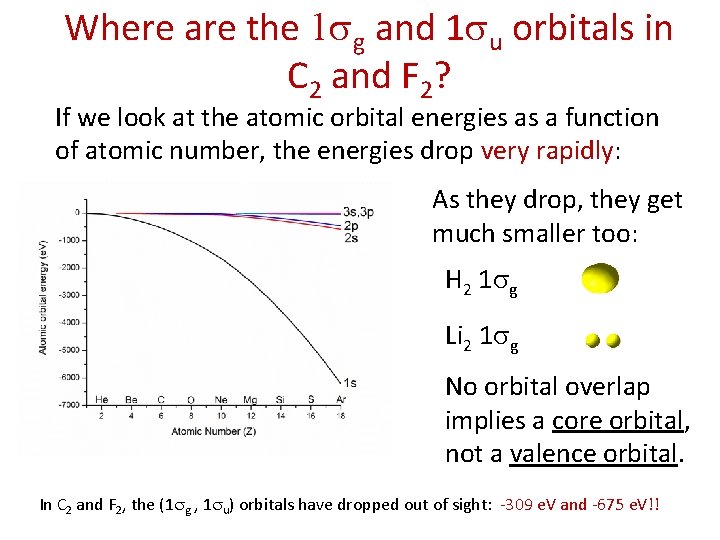
Where are the 1 sg and 1 su orbitals in C 2 and F 2? If we look at the atomic orbital energies as a function of atomic number, the energies drop very rapidly: As they drop, they get much smaller too: H 2 1 sg Li 2 1 sg No orbital overlap implies a core orbital, not a valence orbital. In C 2 and F 2, the (1 sg , 1 su) orbitals have dropped out of sight: -309 e. V and -675 e. V!!
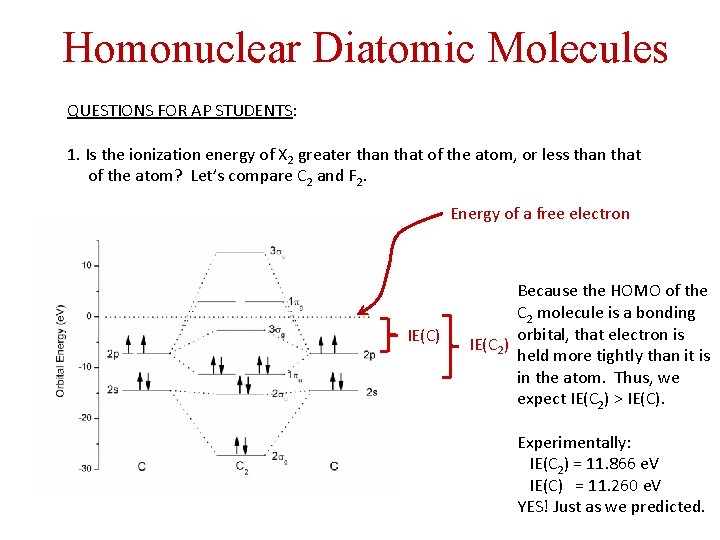
Homonuclear Diatomic Molecules QUESTIONS FOR AP STUDENTS: 1. Is the ionization energy of X 2 greater than that of the atom, or less than that of the atom? Let’s compare C 2 and F 2. Energy of a free electron IE(C) Because the HOMO of the C 2 molecule is a bonding orbital, that electron is IE(C 2) held more tightly than it is in the atom. Thus, we expect IE(C 2) > IE(C). Experimentally: IE(C 2) = 11. 866 e. V IE(C) = 11. 260 e. V YES! Just as we predicted.
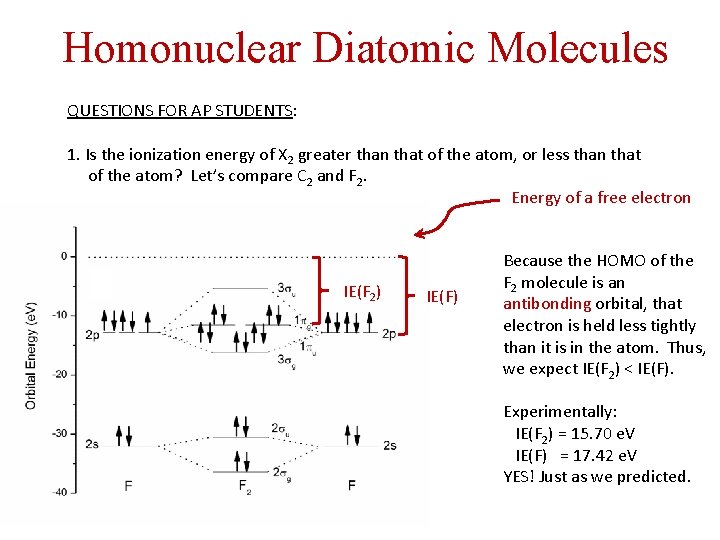
Homonuclear Diatomic Molecules QUESTIONS FOR AP STUDENTS: 1. Is the ionization energy of X 2 greater than that of the atom, or less than that of the atom? Let’s compare C 2 and F 2. Energy of a free electron IE(F 2) IE(F) Because the HOMO of the F 2 molecule is an antibonding orbital, that electron is held less tightly than it is in the atom. Thus, we expect IE(F 2) < IE(F). Experimentally: IE(F 2) = 15. 70 e. V IE(F) = 17. 42 e. V YES! Just as we predicted.
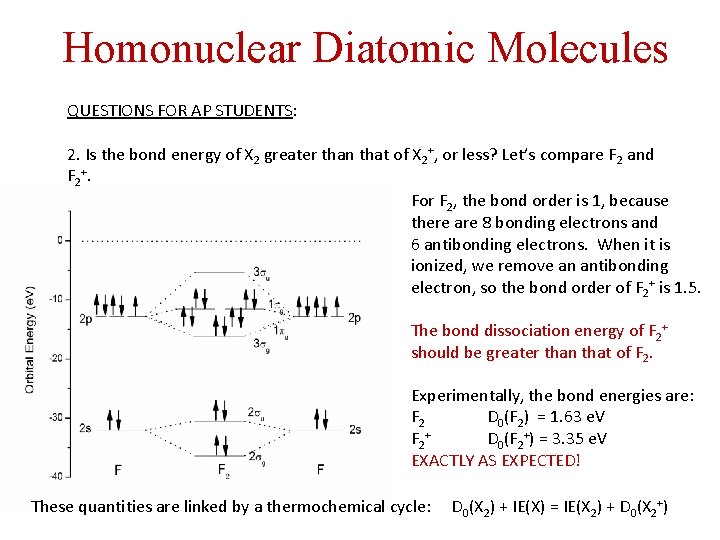
Homonuclear Diatomic Molecules QUESTIONS FOR AP STUDENTS: 2. Is the bond energy of X 2 greater than that of X 2+, or less? Let’s compare F 2 and F 2+. For F 2, the bond order is 1, because there are 8 bonding electrons and 6 antibonding electrons. When it is ionized, we remove an antibonding electron, so the bond order of F 2+ is 1. 5. The bond dissociation energy of F 2+ should be greater than that of F 2. Experimentally, the bond energies are: F 2 D 0(F 2) = 1. 63 e. V F 2+ D 0(F 2+) = 3. 35 e. V EXACTLY AS EXPECTED! These quantities are linked by a thermochemical cycle: D 0(X 2) + IE(X) = IE(X 2) + D 0(X 2+)
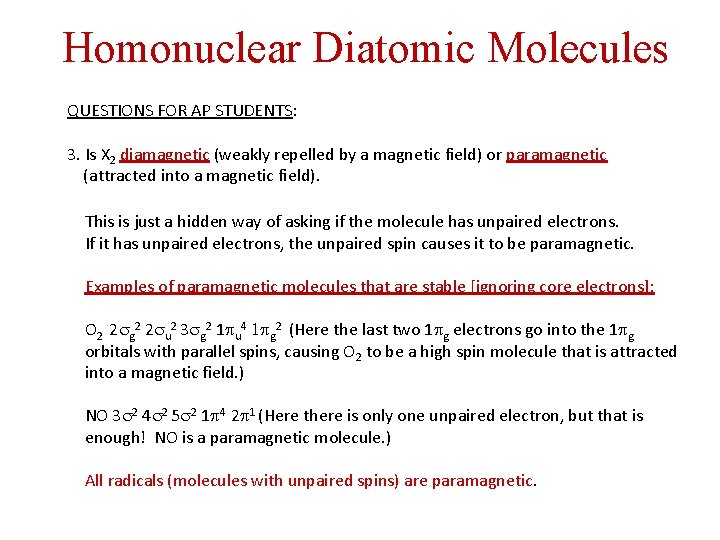
Homonuclear Diatomic Molecules QUESTIONS FOR AP STUDENTS: 3. Is X 2 diamagnetic (weakly repelled by a magnetic field) or paramagnetic (attracted into a magnetic field). This is just a hidden way of asking if the molecule has unpaired electrons. If it has unpaired electrons, the unpaired spin causes it to be paramagnetic. Examples of paramagnetic molecules that are stable [ignoring core electrons]: O 2 2 sg 2 2 su 2 3 sg 2 1 pu 4 1 pg 2 (Here the last two 1 pg electrons go into the 1 pg orbitals with parallel spins, causing O 2 to be a high spin molecule that is attracted into a magnetic field. ) NO 3 s 2 4 s 2 5 s 2 1 p 4 2 p 1 (Here there is only one unpaired electron, but that is enough! NO is a paramagnetic molecule. ) All radicals (molecules with unpaired spins) are paramagnetic.
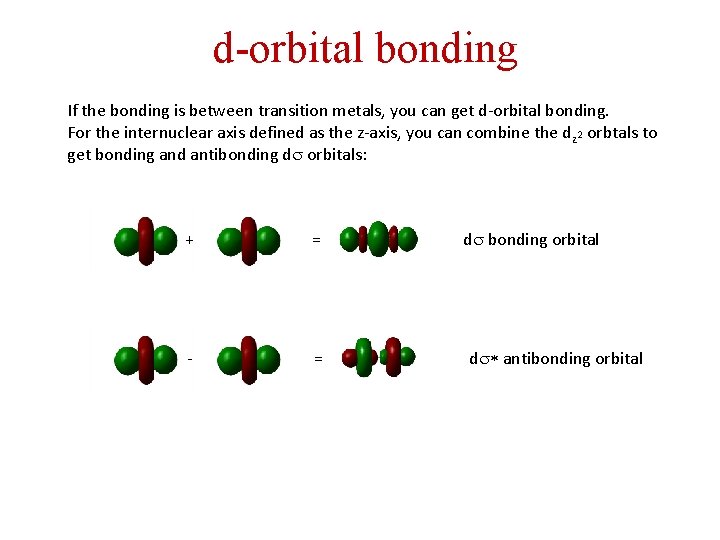
d-orbital bonding If the bonding is between transition metals, you can get d-orbital bonding. For the internuclear axis defined as the z-axis, you can combine the dz 2 orbtals to get bonding and antibonding ds orbitals: + = - = ds bonding orbital ds* antibonding orbital
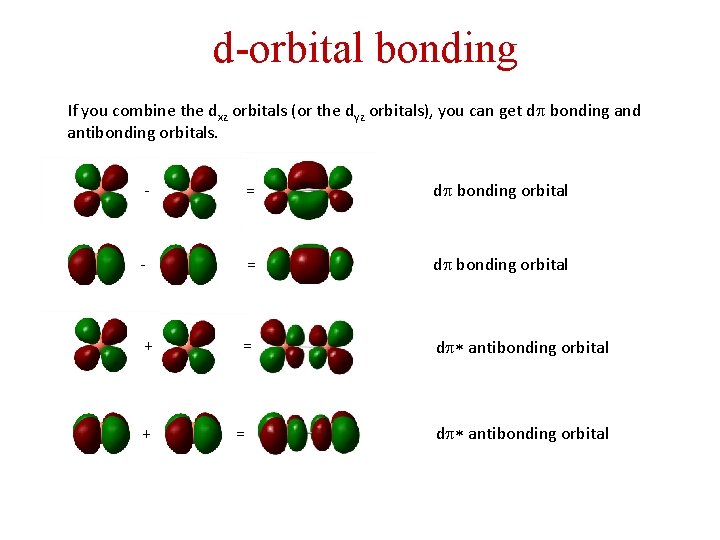
d-orbital bonding If you combine the dxz orbitals (or the dyz orbitals), you can get dp bonding and antibonding orbitals. - = dp bonding orbital + = dp* antibonding orbital + == dp* antibonding orbital
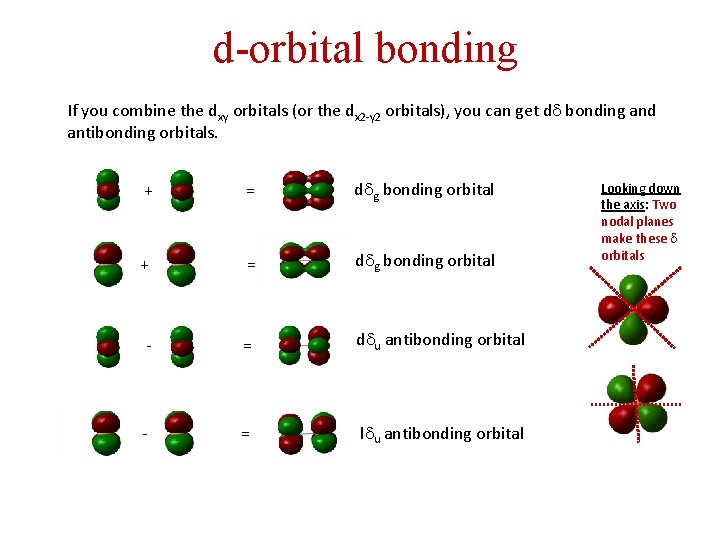
d-orbital bonding If you combine the dxy orbitals (or the dx 2 -y 2 orbitals), you can get dd bonding and antibonding orbitals. + = ddg bonding orbital -- = ddu antibonding orbital Looking down the axis: Two nodal planes make these d orbitals
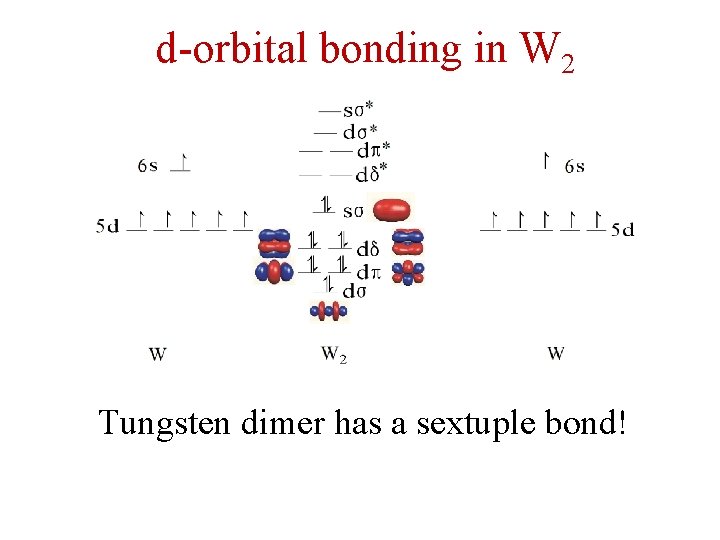
d-orbital bonding in W 2 Tungsten dimer has a sextuple bond!
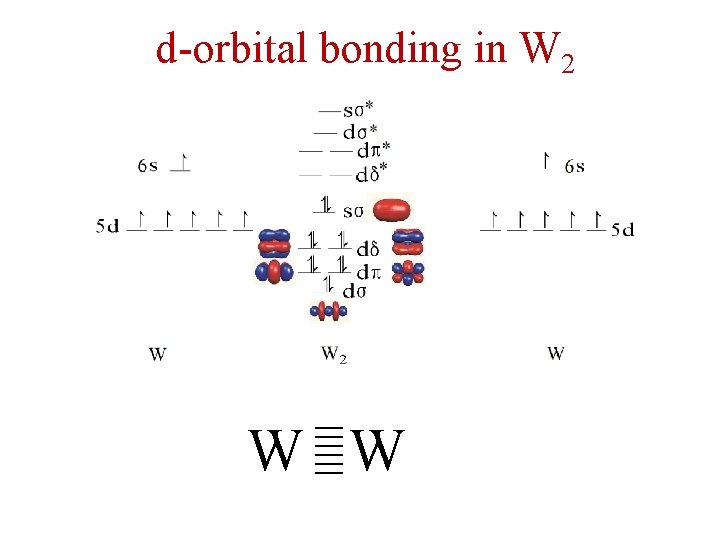
d-orbital bonding in W 2 ≡ W ≡W
Rules for combining atomic orbitals: 1. Orbitals must be relatively close in energy 2. Orbitals must overlap significantly 3. Orbitals must have the same symmetry That’s it.
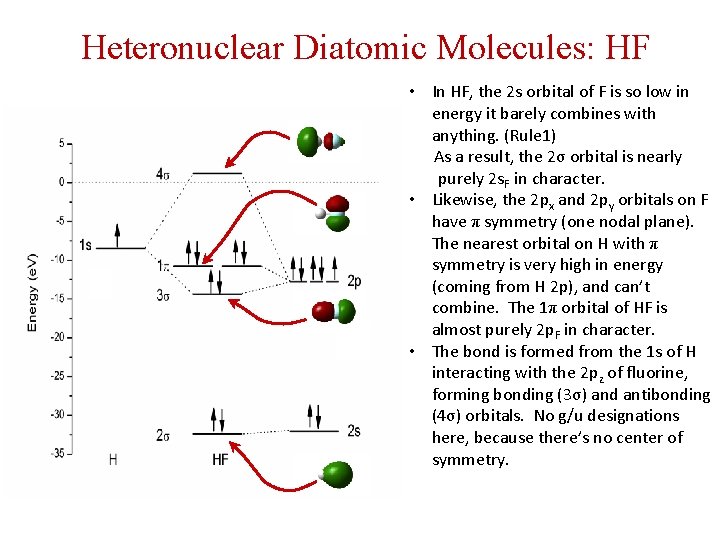
Heteronuclear Diatomic Molecules: HF • In HF, the 2 s orbital of F is so low in energy it barely combines with anything. (Rule 1) As a result, the 2σ orbital is nearly purely 2 s. F in character. • Likewise, the 2 px and 2 py orbitals on F have π symmetry (one nodal plane). The nearest orbital on H with π symmetry is very high in energy (coming from H 2 p), and can’t combine. The 1π orbital of HF is almost purely 2 p. F in character. • The bond is formed from the 1 s of H interacting with the 2 pz of fluorine, forming bonding (3σ) and antibonding (4σ) orbitals. No g/u designations here, because there’s no center of symmetry.
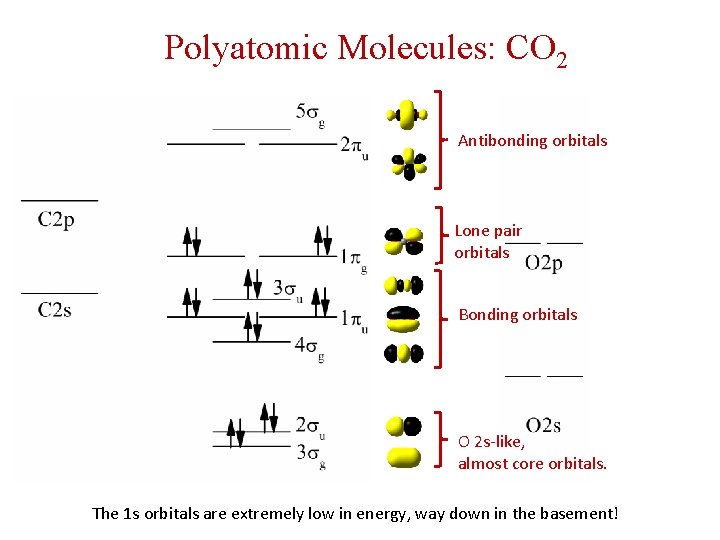
Polyatomic Molecules: CO 2 Antibonding orbitals Lone pair orbitals Bonding orbitals O 2 s-like, almost core orbitals. The 1 s orbitals are extremely low in energy, way down in the basement!
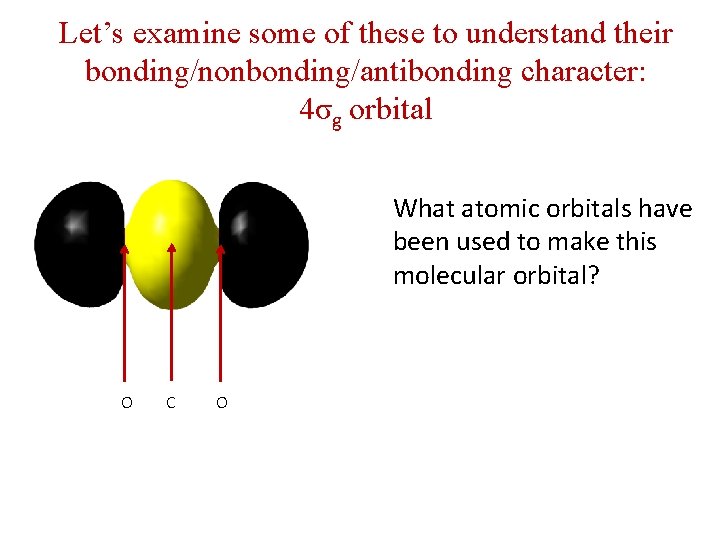
Let’s examine some of these to understand their bonding/nonbonding/antibonding character: 4σg orbital What atomic orbitals have been used to make this molecular orbital? O C O
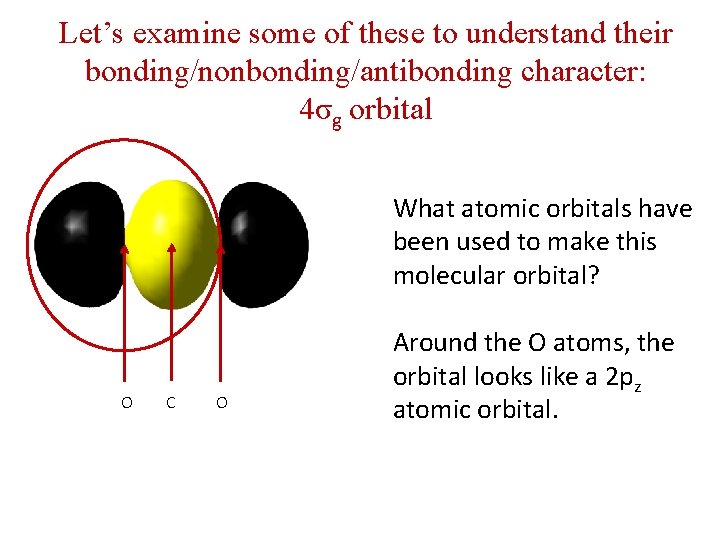
Let’s examine some of these to understand their bonding/nonbonding/antibonding character: 4σg orbital What atomic orbitals have been used to make this molecular orbital? O C O Around the O atoms, the orbital looks like a 2 pz atomic orbital.
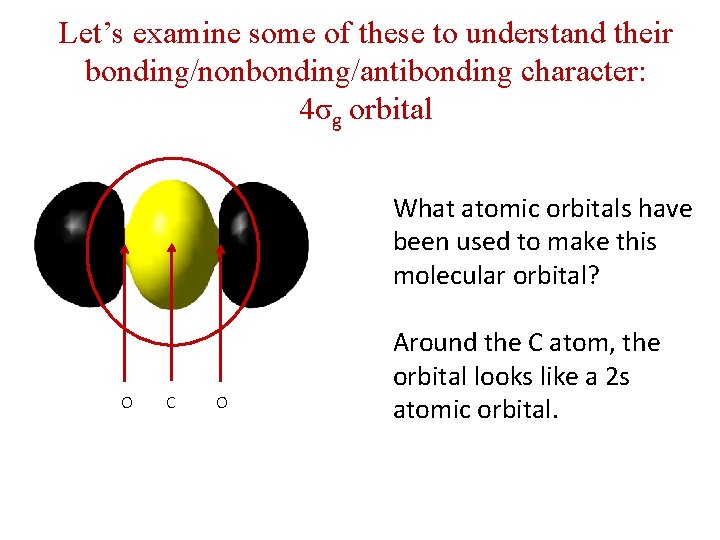
Let’s examine some of these to understand their bonding/nonbonding/antibonding character: 4σg orbital What atomic orbitals have been used to make this molecular orbital? O C O Around the C atom, the orbital looks like a 2 s atomic orbital.
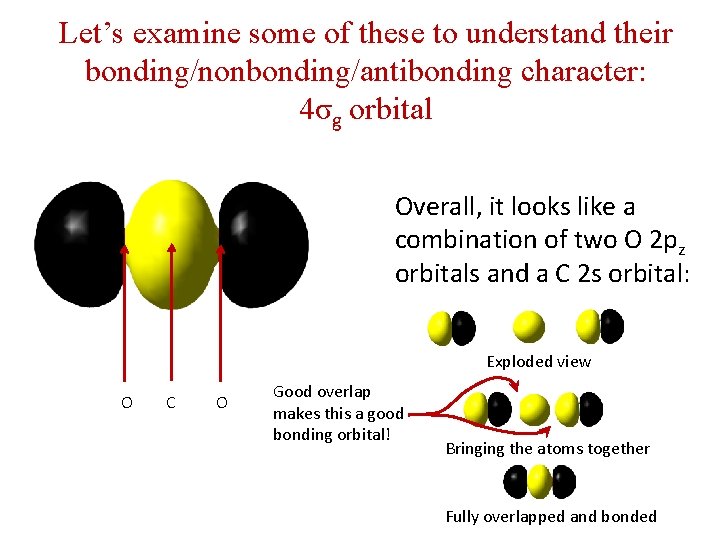
Let’s examine some of these to understand their bonding/nonbonding/antibonding character: 4σg orbital Overall, it looks like a combination of two O 2 pz orbitals and a C 2 s orbital: Exploded view O C O Good overlap makes this a good bonding orbital! Bringing the atoms together Fully overlapped and bonded
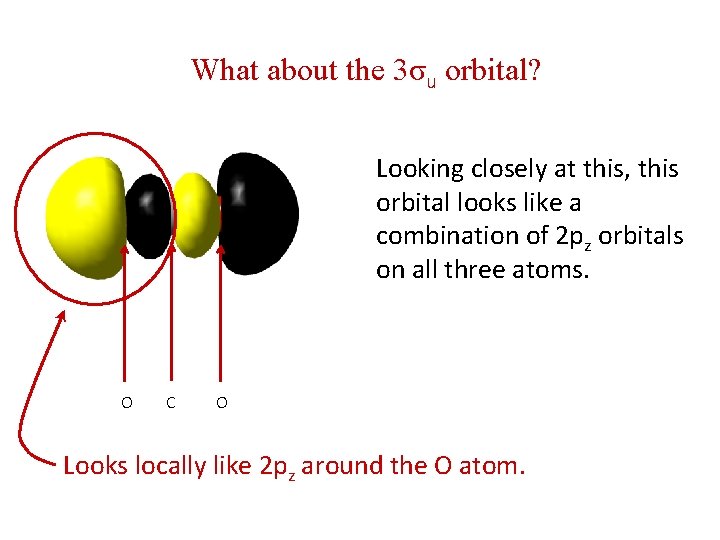
What about the 3σu orbital? Looking closely at this, this orbital looks like a combination of 2 pz orbitals on all three atoms. O C O Looks locally like 2 pz around the O atom.
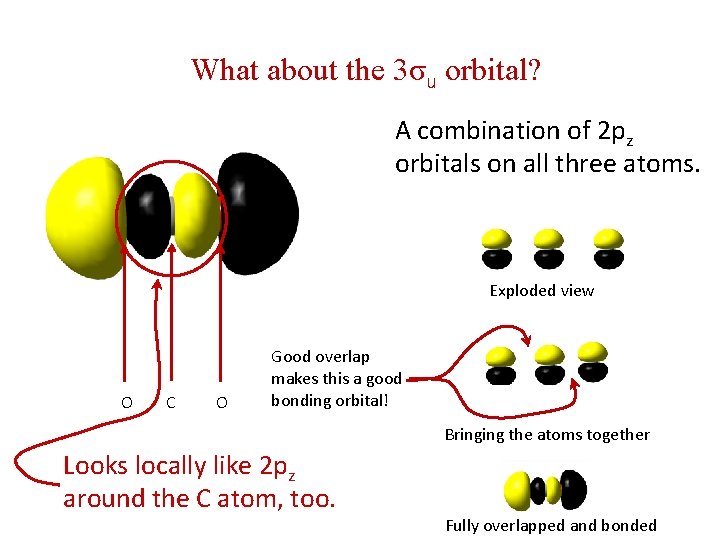
What about the 3σu orbital? A combination of 2 pz orbitals on all three atoms. Exploded view O C O Good overlap makes this a good bonding orbital! Bringing the atoms together Looks locally like 2 pz around the C atom, too. Fully overlapped and bonded
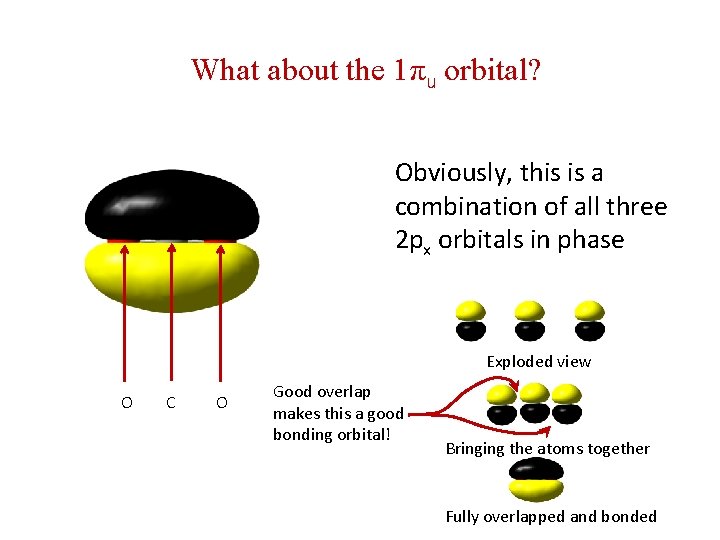
What about the 1πu orbital? Obviously, this is a combination of all three 2 px orbitals in phase Exploded view O C O Good overlap makes this a good bonding orbital! Bringing the atoms together Fully overlapped and bonded
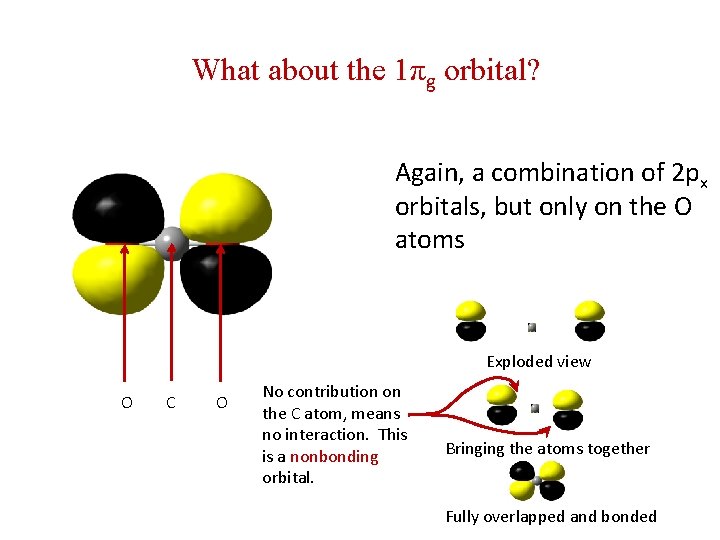
What about the 1πg orbital? Again, a combination of 2 px orbitals, but only on the O atoms Exploded view O C O No contribution on the C atom, means no interaction. This is a nonbonding orbital. Bringing the atoms together Fully overlapped and bonded
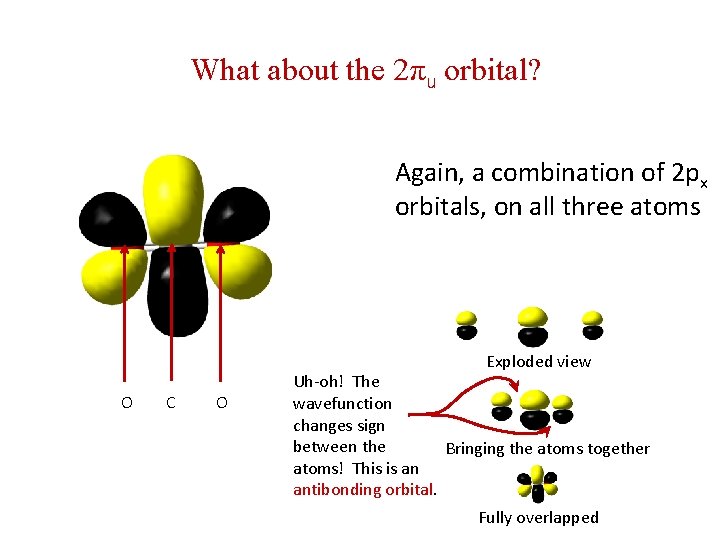
What about the 2πu orbital? Again, a combination of 2 px orbitals, on all three atoms Exploded view O C O Uh-oh! The wavefunction changes sign between the Bringing the atoms together atoms! This is an antibonding orbital. Fully overlapped
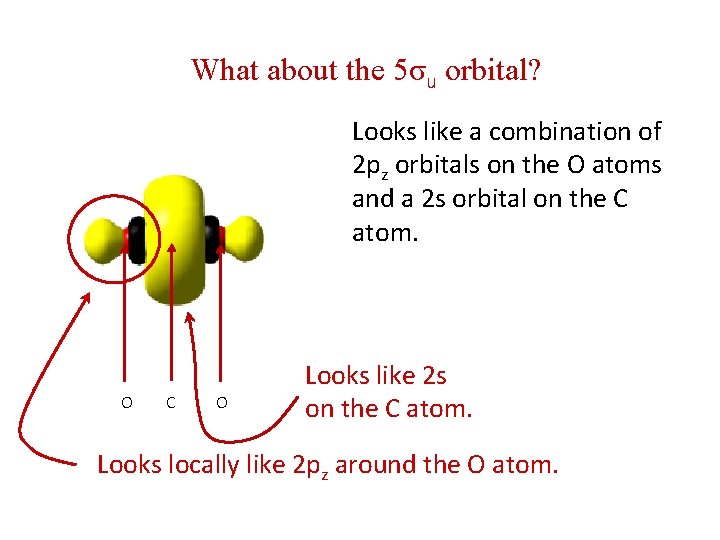
What about the 5σu orbital? Looks like a combination of 2 pz orbitals on the O atoms and a 2 s orbital on the C atom. O C O Looks like 2 s on the C atom. Looks locally like 2 pz around the O atom.
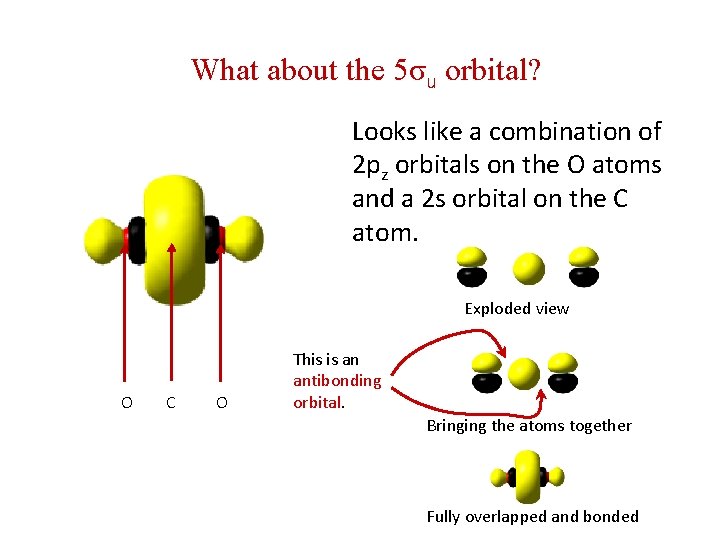
What about the 5σu orbital? Looks like a combination of 2 pz orbitals on the O atoms and a 2 s orbital on the C atom. Exploded view O C O This is an antibonding orbital. Bringing the atoms together Fully overlapped and bonded
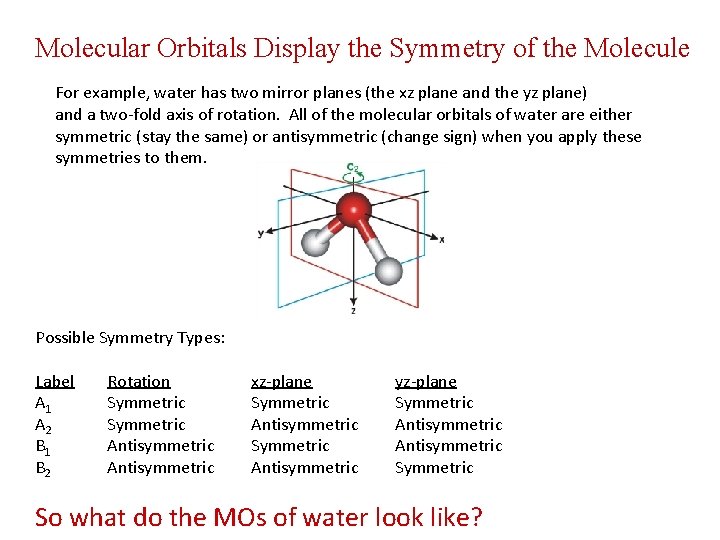
Molecular Orbitals Display the Symmetry of the Molecule For example, water has two mirror planes (the xz plane and the yz plane) and a two-fold axis of rotation. All of the molecular orbitals of water are either symmetric (stay the same) or antisymmetric (change sign) when you apply these symmetries to them. Possible Symmetry Types: Label A 1 A 2 B 1 B 2 Rotation Symmetric Antisymmetric xz-plane Symmetric Antisymmetric yz-plane Symmetric Antisymmetric So what do the MOs of water look like?
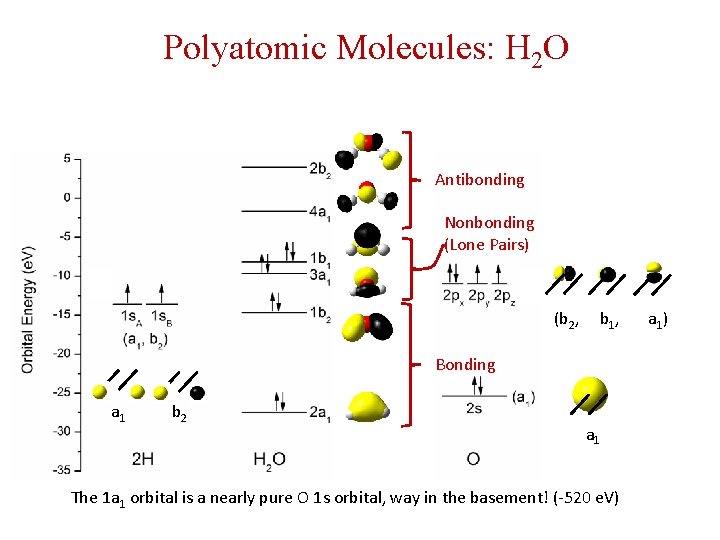
Polyatomic Molecules: H 2 O Antibonding Nonbonding (Lone Pairs) (b 2, b 1, a 1) Bonding a 1 b 2 a 1 The 1 a 1 orbital is a nearly pure O 1 s orbital, way in the basement! (-520 e. V)
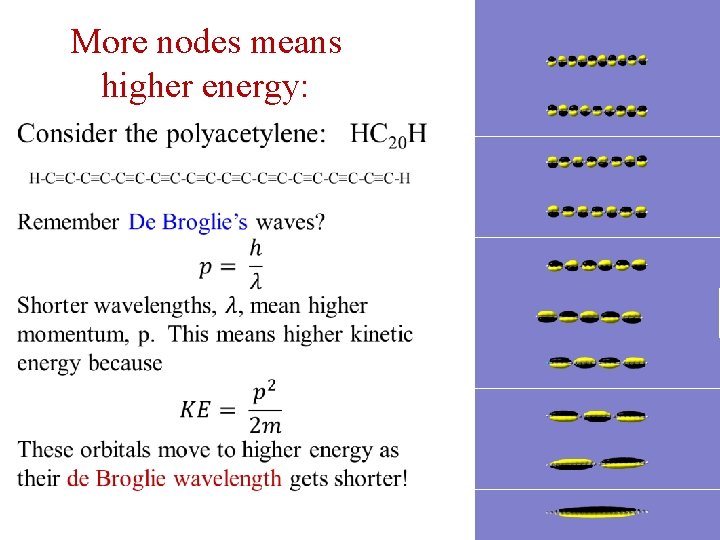
More nodes means higher energy:
Thanks to all of you for listening! All molecular orbital calculations were done using the computational chemistry software purchased from Gaussian, Inc.
- Slides: 52