
Molecular orbital theory Chapter 9 Paramagnetism An atom
Molecular orbital theory Chapter 9
Paramagnetism • An atom or molecule is paramagnetic if it contains ______. • An atom or molecule is diamagnetic if it contains only _____ ________. • Paramagnetic substances are attracted to magnets…. • (Whitten CD video)
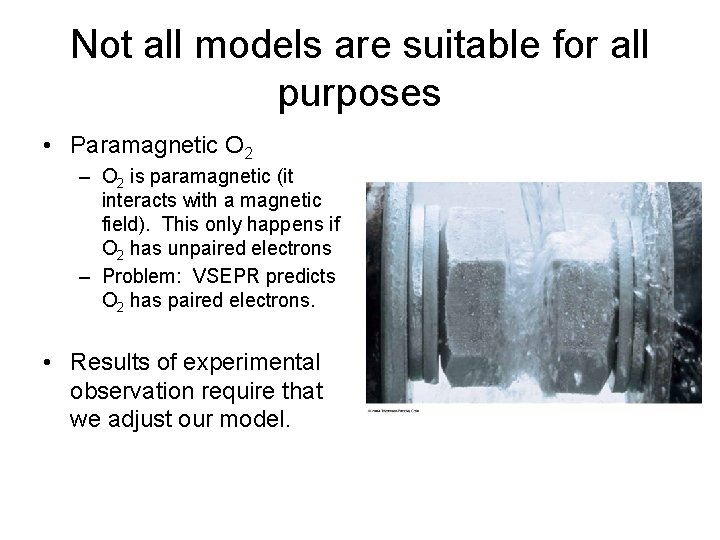
Not all models are suitable for all purposes • Paramagnetic O 2 – O 2 is paramagnetic (it interacts with a magnetic field). This only happens if O 2 has unpaired electrons – Problem: VSEPR predicts O 2 has paired electrons. • Results of experimental observation require that we adjust our model.
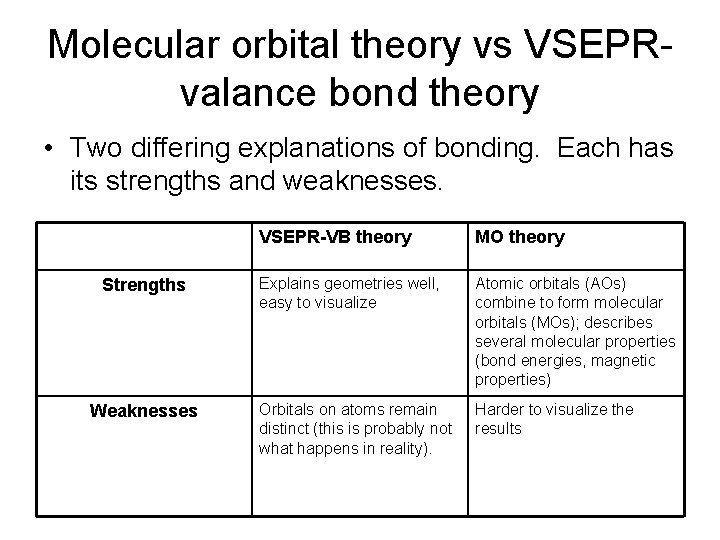
Molecular orbital theory vs VSEPRvalance bond theory • Two differing explanations of bonding. Each has its strengths and weaknesses. Strengths Weaknesses VSEPR-VB theory MO theory Explains geometries well, easy to visualize Atomic orbitals (AOs) combine to form molecular orbitals (MOs); describes several molecular properties (bond energies, magnetic properties) Orbitals on atoms remain distinct (this is probably not what happens in reality). Harder to visualize the results
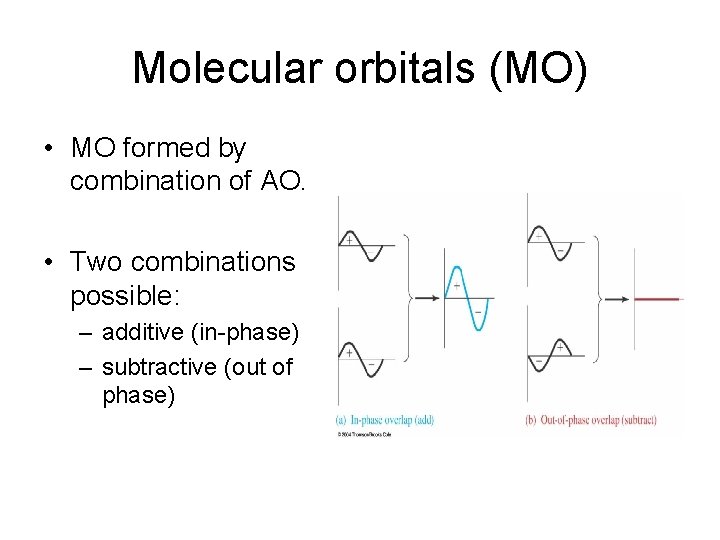
Molecular orbitals (MO) • MO formed by combination of AO. • Two combinations possible: – additive (in-phase) – subtractive (out of phase)
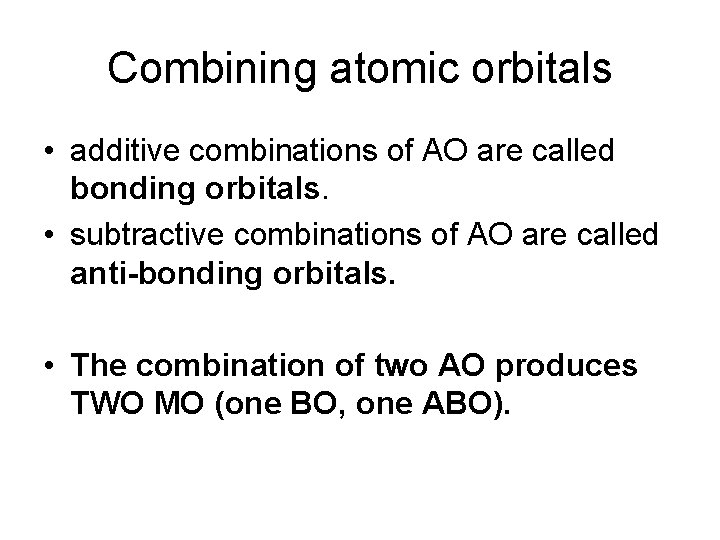
Combining atomic orbitals • additive combinations of AO are called bonding orbitals. • subtractive combinations of AO are called anti-bonding orbitals. • The combination of two AO produces TWO MO (one BO, one ABO).
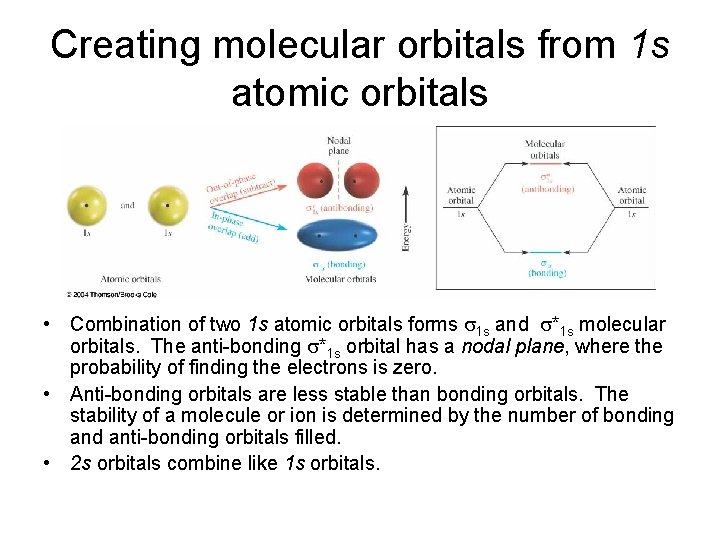
Creating molecular orbitals from 1 s atomic orbitals • Combination of two 1 s atomic orbitals forms 1 s and *1 s molecular orbitals. The anti-bonding *1 s orbital has a nodal plane, where the probability of finding the electrons is zero. • Anti-bonding orbitals are less stable than bonding orbitals. The stability of a molecule or ion is determined by the number of bonding and anti-bonding orbitals filled. • 2 s orbitals combine like 1 s orbitals.
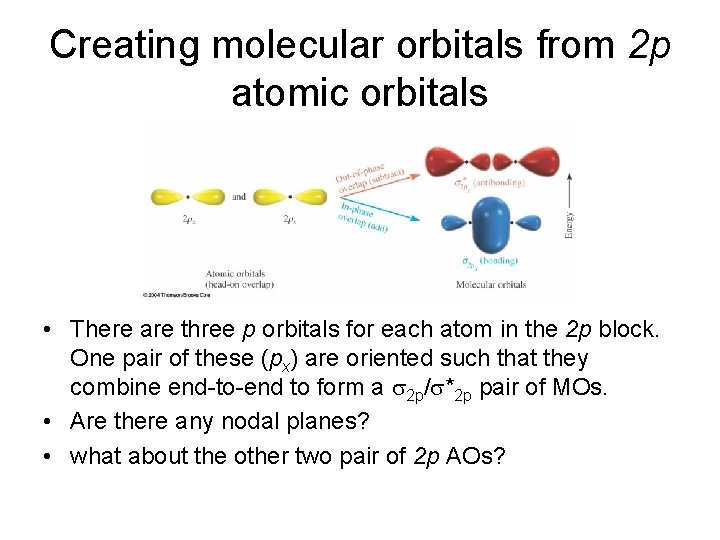
Creating molecular orbitals from 2 p atomic orbitals • There are three p orbitals for each atom in the 2 p block. One pair of these (px) are oriented such that they combine end-to-end to form a 2 p/ *2 p pair of MOs. • Are there any nodal planes? • what about the other two pair of 2 p AOs?
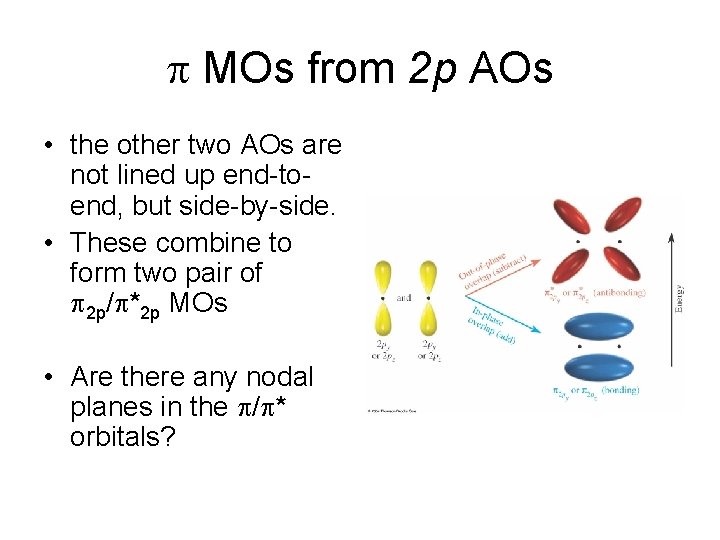
MOs from 2 p AOs • the other two AOs are not lined up end-toend, but side-by-side. • These combine to form two pair of 2 p/ *2 p MOs • Are there any nodal planes in the / * orbitals?
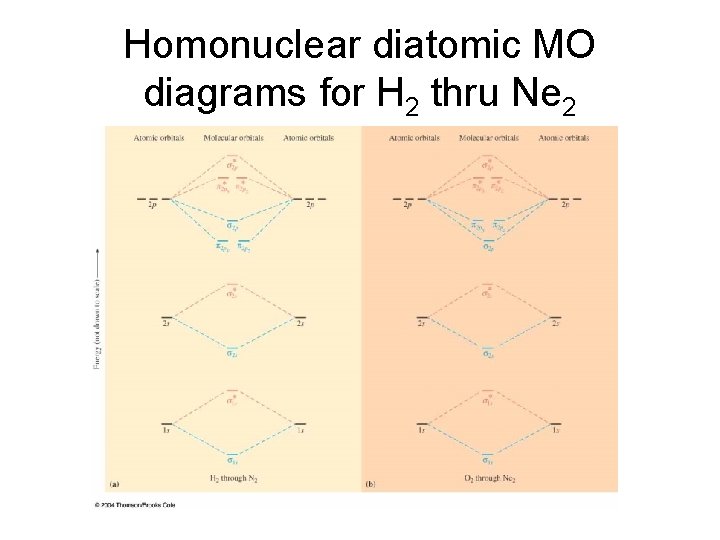
Homonuclear diatomic MO diagrams for H 2 thru Ne 2
Using MO diagrams 1. Select and draw the appropriate MO diagram 2. Count up ALL electrons in the molecule (not just valence electrons). 3. Add electrons to the MO diagram starting with the lowest energy level 1. Must follow Pauli Exclusion Principle 2. Must follow Hund’s Rule
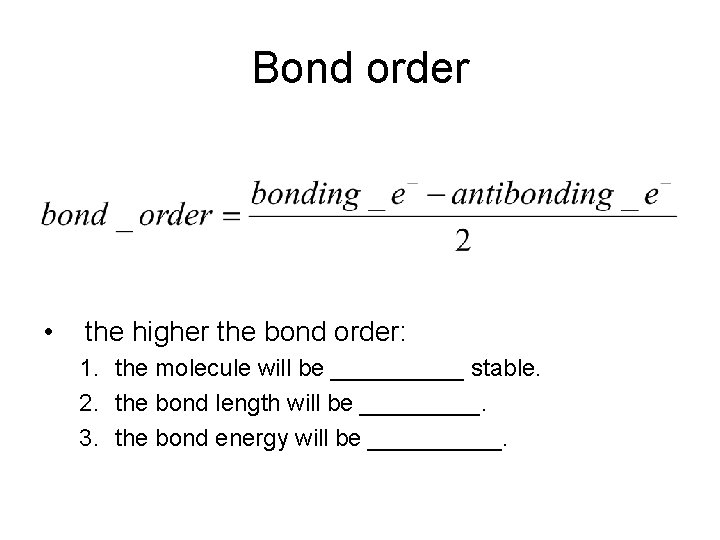
Bond order • the higher the bond order: 1. the molecule will be _____ stable. 2. the bond length will be _____. 3. the bond energy will be _____.
Homonuclear diatomic molecules • Let’s draw some MO diagrams for the homonuclear diatomic molecules. Determine the bond order for each. • H 2, He 2, Li 2, B 2, C 2, N 2, O 2, F 2 – What’s interesting about B 2 and O 2?
• Text, p. 357 provides further data on these molecules. • Be familiar with calculating bond order and comparing bond orders of different molecules.
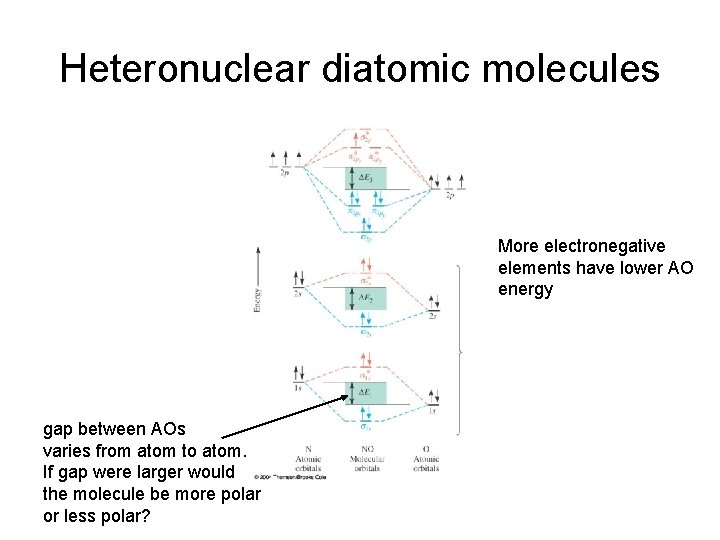
Heteronuclear diatomic molecules More electronegative elements have lower AO energy gap between AOs varies from atom to atom. If gap were larger would the molecule be more polar or less polar?
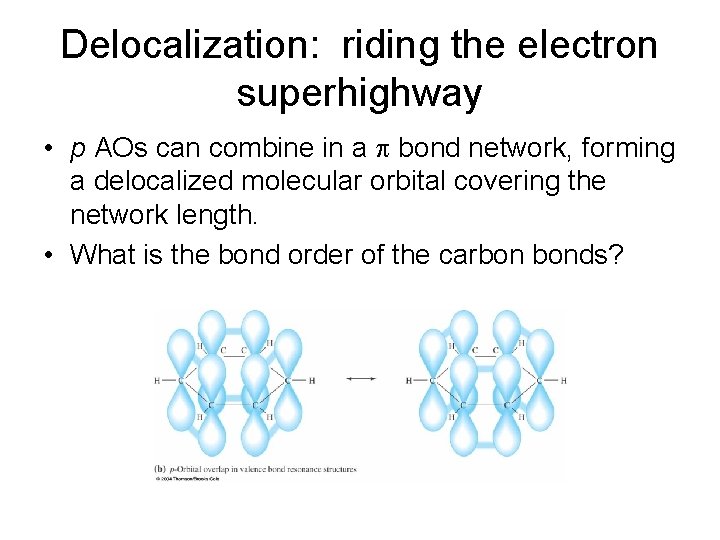
Delocalization: riding the electron superhighway • p AOs can combine in a bond network, forming a delocalized molecular orbital covering the network length. • What is the bond order of the carbon bonds?
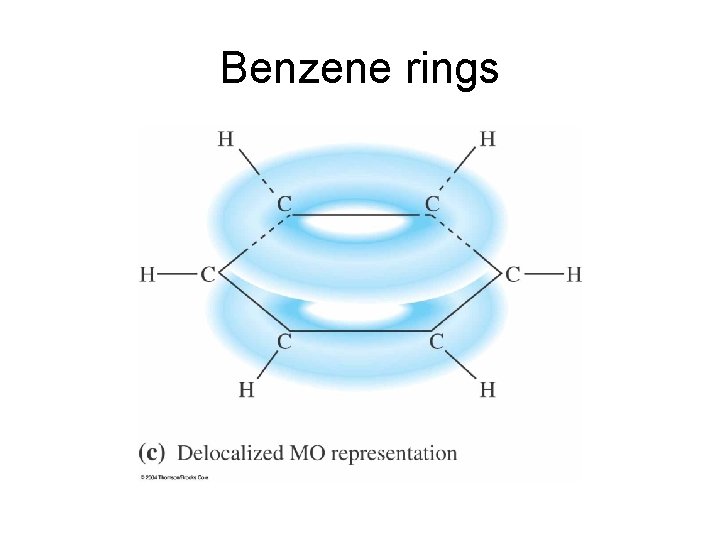
Benzene rings
- Slides: 17