
Molecular Mechanism of Insulin and Amylin Release in
- Slides: 7
Molecular Mechanism of Insulin and Amylin Release in the b-cell and Etiology of Type II Diabetes Mellitus Aleksandar Jeremic Department of Biological Sciences The George Washington University Phone: (202) 994 -7899 Email: jerema@gwu. edu http: //www. gwu. edu/%7 Eclade/faculty/jeremic/
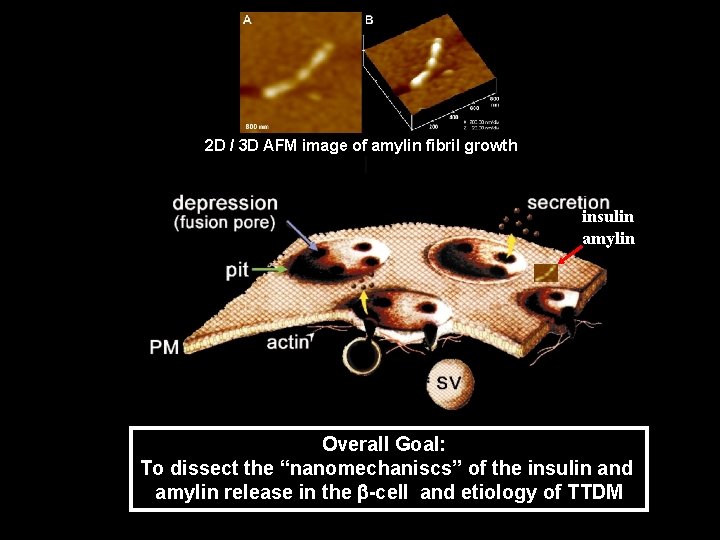
2 D / 3 D AFM image of amylin fibril growth insulin amylin Overall Goal: To dissect the “nanomechaniscs” of the insulin and amylin release in the b-cell and etiology of TTDM
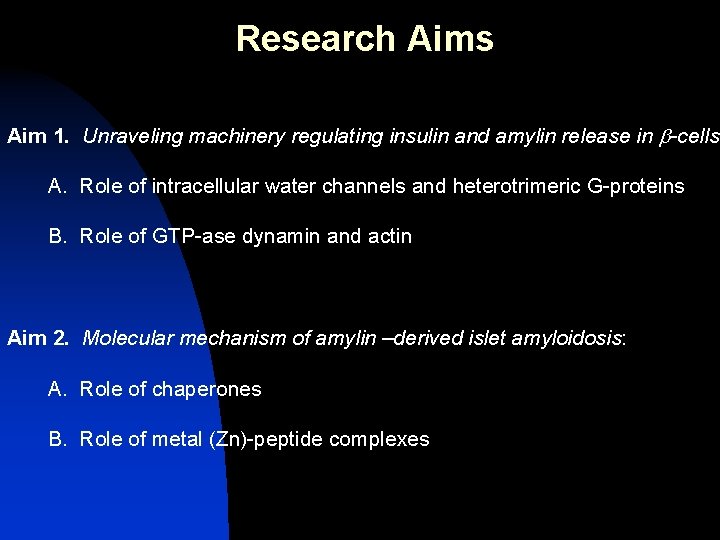
Research Aims Aim 1. Unraveling machinery regulating insulin and amylin release in b-cells: A. Role of intracellular water channels and heterotrimeric G-proteins B. Role of GTP-ase dynamin and actin Aim 2. Molecular mechanism of amylin –derived islet amyloidosis: A. Role of chaperones B. Role of metal (Zn)-peptide complexes
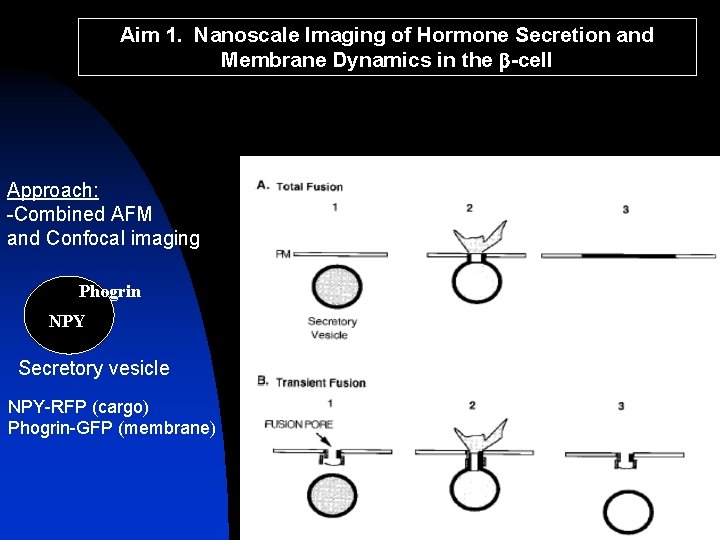
Aim 1. Nanoscale Imaging of Hormone Secretion and Membrane Dynamics in the b-cell Approach: -Combined AFM and Confocal imaging Phogrin NPY Secretory vesicle NPY-RFP (cargo) Phogrin-GFP (membrane)
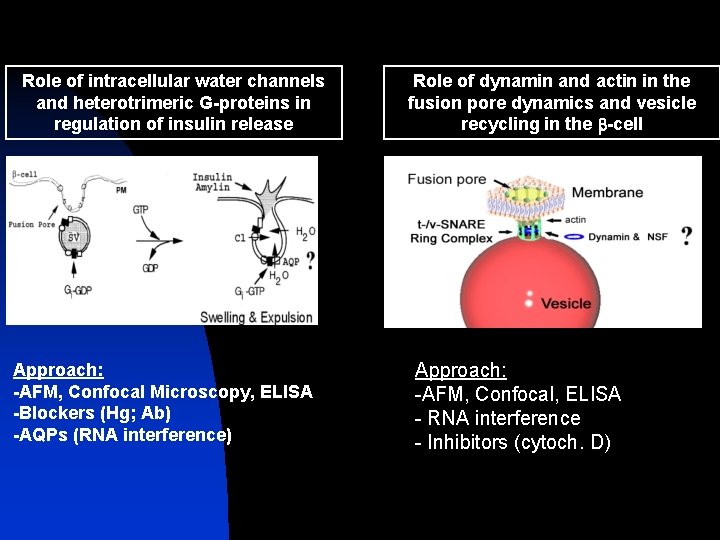
Role of intracellular water channels and heterotrimeric G-proteins in regulation of insulin release Approach: -AFM, Confocal Microscopy, ELISA -Blockers (Hg; Ab) -AQPs (RNA interference) Role of dynamin and actin in the fusion pore dynamics and vesicle recycling in the b-cell Approach: -AFM, Confocal, ELISA - RNA interference - Inhibitors (cytoch. D)
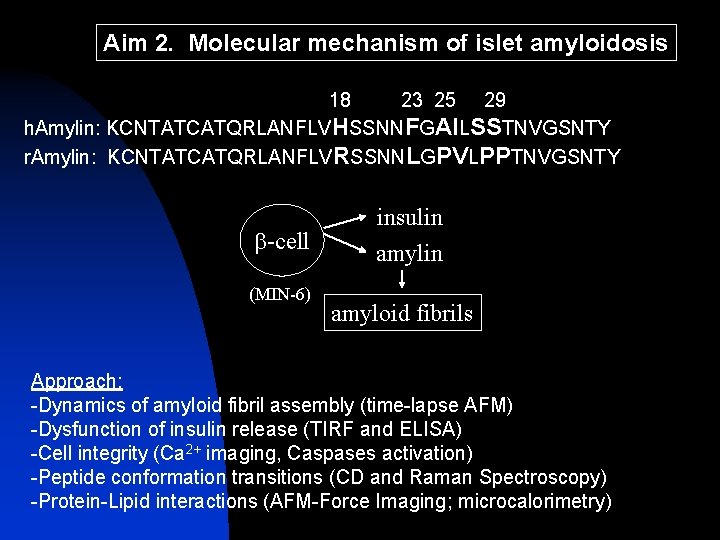
Aim 2. Molecular mechanism of islet amyloidosis 18 23 25 29 h. Amylin: KCNTATCATQRLANFLVHSSNNFGAILSSTNVGSNTY r. Amylin: KCNTATCATQRLANFLVRSSNNLGPVLPPTNVGSNTY b-cell (MIN-6) insulin amyloid fibrils Approach: -Dynamics of amyloid fibril assembly (time-lapse AFM) -Dysfunction of insulin release (TIRF and ELISA) -Cell integrity (Ca 2+ imaging, Caspases activation) -Peptide conformation transitions (CD and Raman Spectroscopy) -Protein-Lipid interactions (AFM-Force Imaging; microcalorimetry)
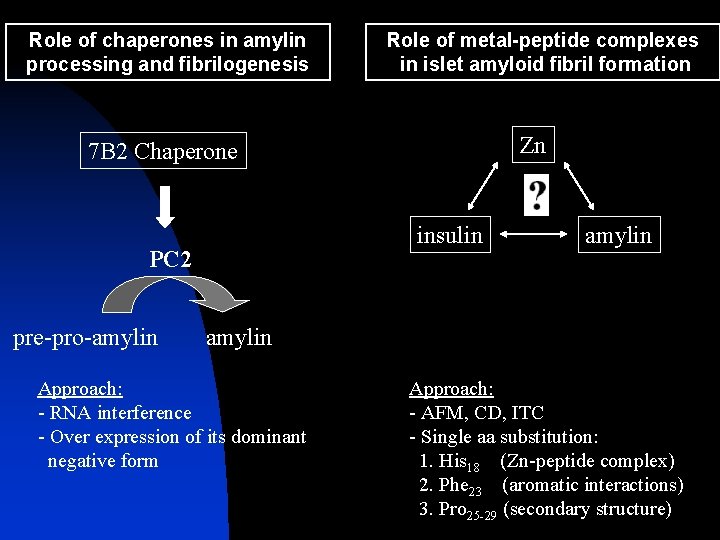
Role of chaperones in amylin processing and fibrilogenesis Role of metal-peptide complexes in islet amyloid fibril formation Zn 7 B 2 Chaperone insulin PC 2 pre-pro-amylin Approach: - RNA interference - Over expression of its dominant negative form Approach: - AFM, CD, ITC - Single aa substitution: 1. His 18 (Zn-peptide complex) 2. Phe 23 (aromatic interactions) 3. Pro 25 -29 (secondary structure)