
Molecular Imager Focal Plane Array Glen Langston NRAO
- Slides: 16
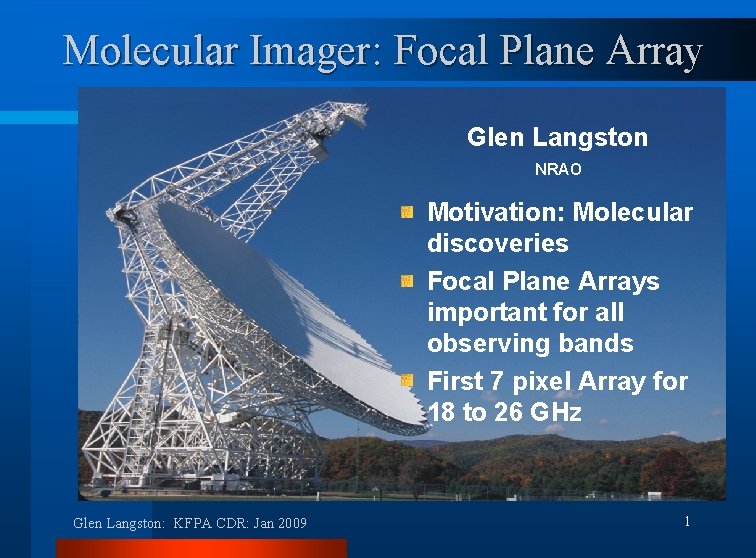
Molecular Imager: Focal Plane Array Glen Langston NRAO Motivation: Molecular discoveries Focal Plane Arrays important for all observing bands First 7 pixel Array for 18 to 26 GHz Glen Langston: KFPA CDR: Jan 2009 1
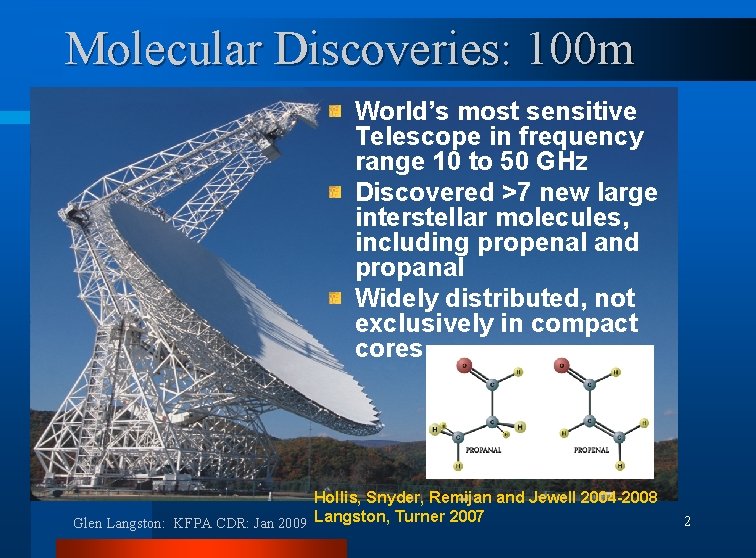
Molecular Discoveries: 100 m World’s most sensitive Telescope in frequency range 10 to 50 GHz Discovered >7 new large interstellar molecules, including propenal and propanal Widely distributed, not exclusively in compact cores Hollis, Snyder, Remijan and Jewell 2004 -2008 Glen Langston: KFPA CDR: Jan 2009 Langston, Turner 2007 2
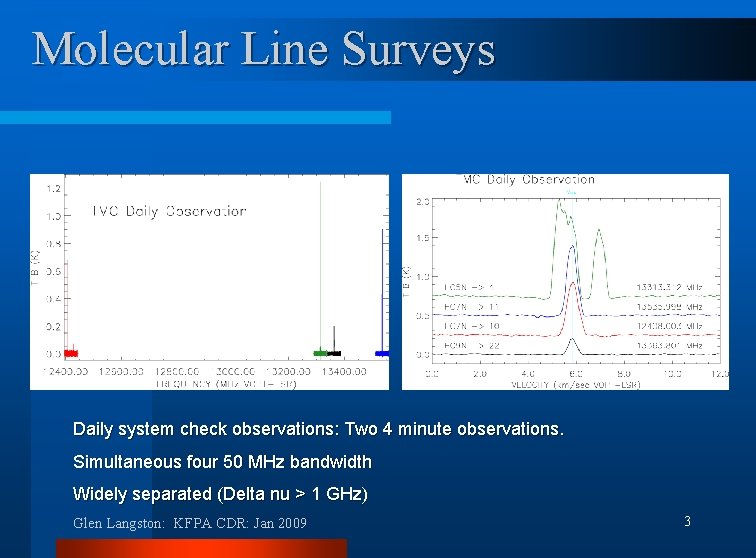
Molecular Line Surveys Daily system check observations: Two 4 minute observations. Simultaneous four 50 MHz bandwidth Widely separated (Delta nu > 1 GHz) Glen Langston: KFPA CDR: Jan 2009 3
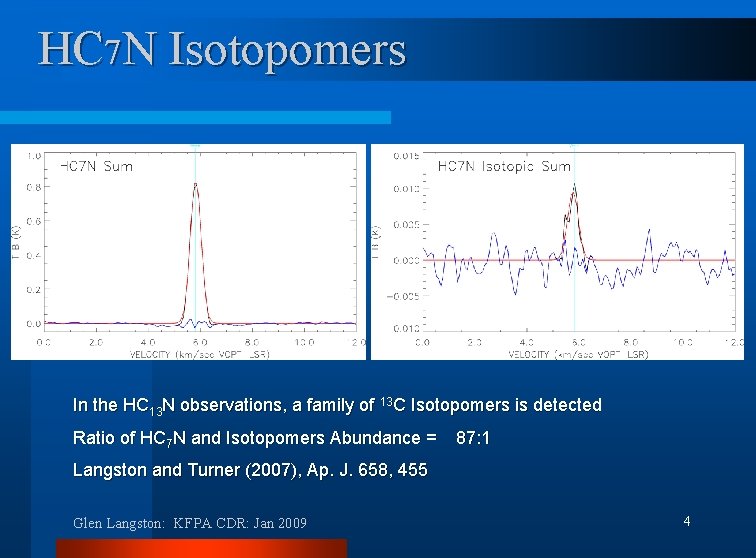
HC 7 N Isotopomers In the HC 13 N observations, a family of 13 C Isotopomers is detected Ratio of HC 7 N and Isotopomers Abundance = 87: 1 Langston and Turner (2007), Ap. J. 658, 455 Glen Langston: KFPA CDR: Jan 2009 4
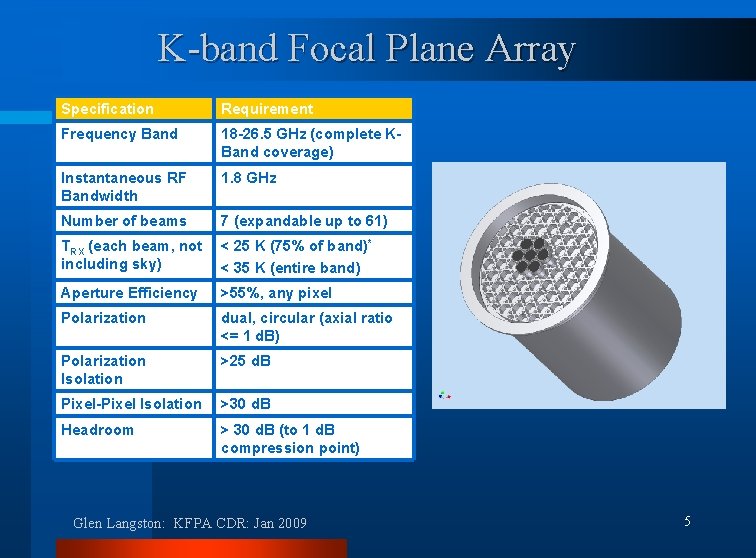
K-band Focal Plane Array Specification Requirement Frequency Band 18 -26. 5 GHz (complete KBand coverage) Instantaneous RF Bandwidth 1. 8 GHz Number of beams 7 (expandable up to 61) TRX (each beam, not including sky) < 25 K (75% of band)* < 35 K (entire band) Aperture Efficiency >55%, any pixel Polarization dual, circular (axial ratio <= 1 d. B) Polarization Isolation >25 d. B Pixel-Pixel Isolation >30 d. B Headroom > 30 d. B (to 1 d. B compression point) Glen Langston: KFPA CDR: Jan 2009 5
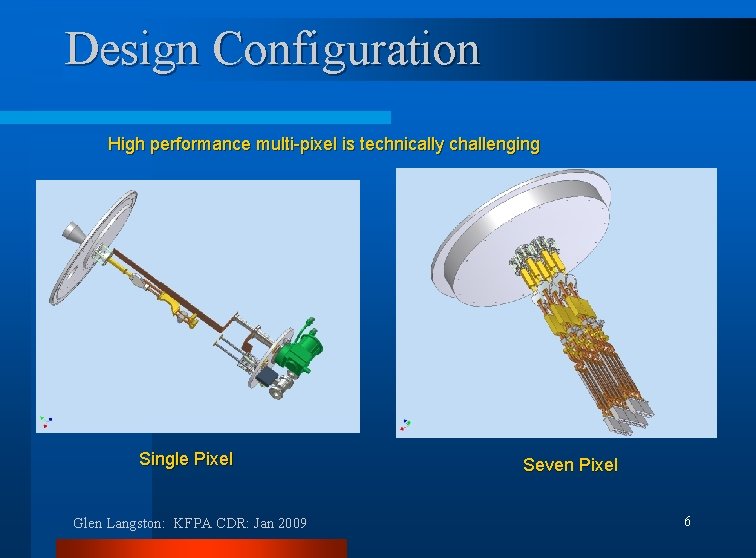
Design Configuration High performance multi-pixel is technically challenging Single Pixel Glen Langston: KFPA CDR: Jan 2009 Seven Pixel 6
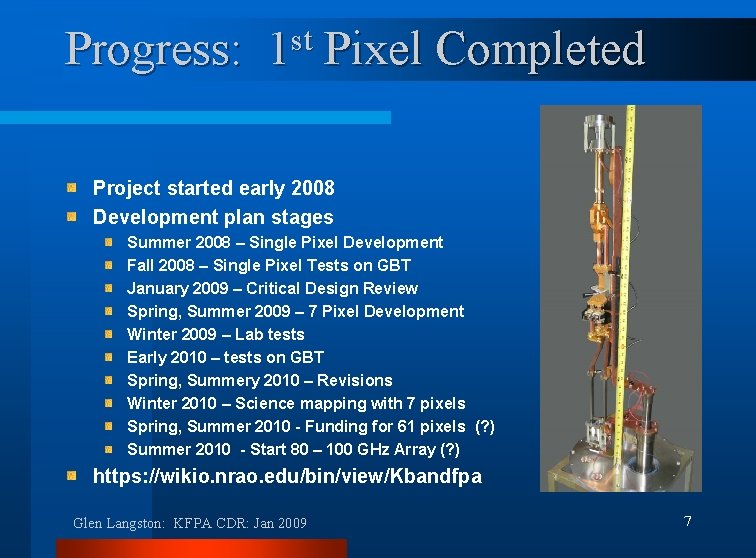
Progress: st 1 Pixel Completed Project started early 2008 Development plan stages Summer 2008 – Single Pixel Development Fall 2008 – Single Pixel Tests on GBT January 2009 – Critical Design Review Spring, Summer 2009 – 7 Pixel Development Winter 2009 – Lab tests Early 2010 – tests on GBT Spring, Summery 2010 – Revisions Winter 2010 – Science mapping with 7 pixels Spring, Summer 2010 - Funding for 61 pixels (? ) Summer 2010 - Start 80 – 100 GHz Array (? ) https: //wikio. nrao. edu/bin/view/Kbandfpa Glen Langston: KFPA CDR: Jan 2009 7
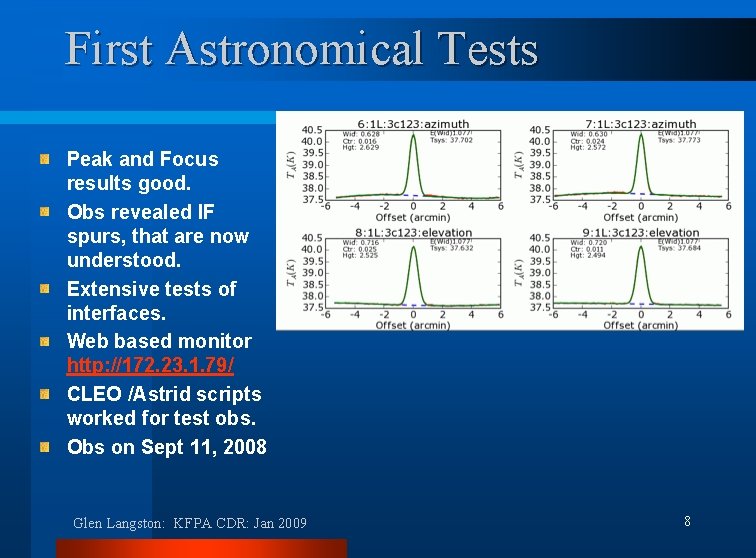
First Astronomical Tests Peak and Focus results good. Obs revealed IF spurs, that are now understood. Extensive tests of interfaces. Web based monitor http: //172. 23. 1. 79/ CLEO /Astrid scripts worked for test obs. Obs on Sept 11, 2008 Glen Langston: KFPA CDR: Jan 2009 8
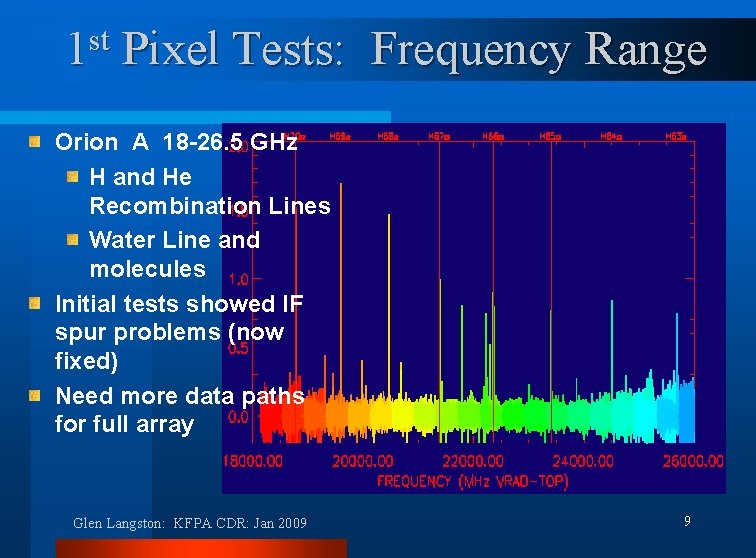
st 1 Pixel Tests: Frequency Range Orion A 18 -26. 5 GHz H and He Recombination Lines Water Line and molecules Initial tests showed IF spur problems (now fixed) Need more data paths for full array Glen Langston: KFPA CDR: Jan 2009 9
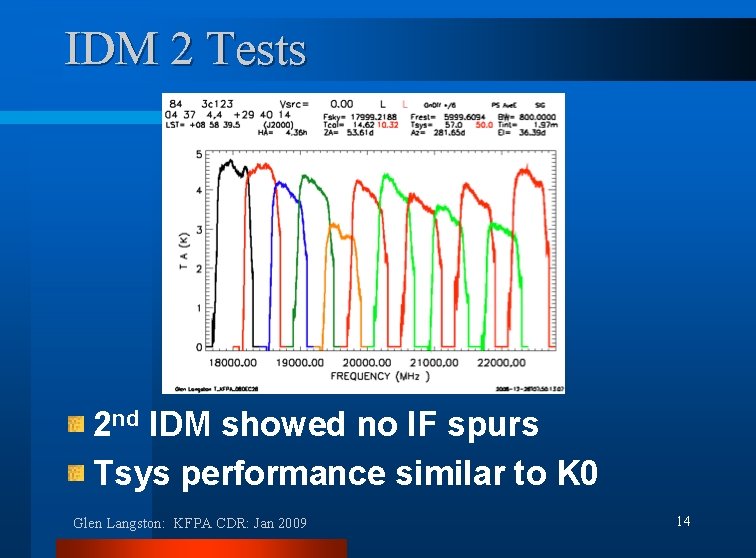
Gain and Tsys Tests Performed intensity measurements as a function of pixel offset from center location. Position Offset 3. 8’ at 19 GHz Gain Drop 5 +/- 2 % Position Offset 3. 8’ at 25 GHz Gain Drop 5 +/- 2 % Performed a sequence of obs with K 0 Feed system followed by K 1 sequence. Found higher system temperatures Cause: Low gain and IF spurs Obs Oct 2, 2008 Glen Langston: KFPA CDR: Jan 2009 10
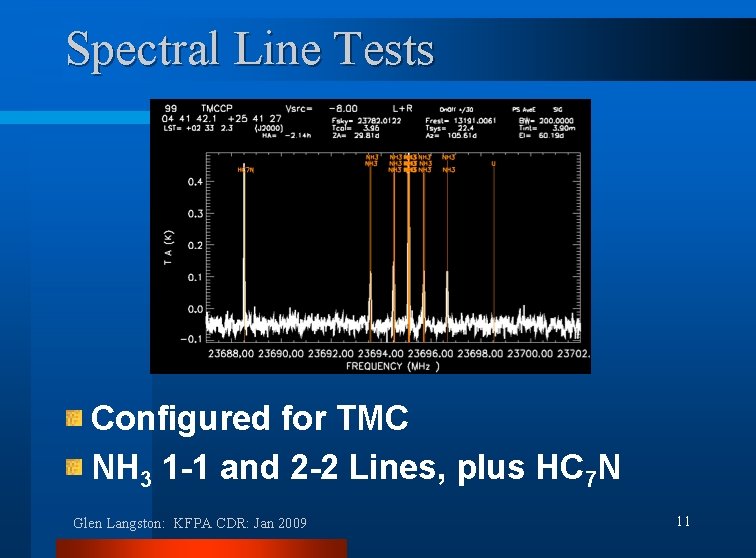
Spectral Line Tests Configured for TMC NH 3 1 -1 and 2 -2 Lines, plus HC 7 N Glen Langston: KFPA CDR: Jan 2009 11
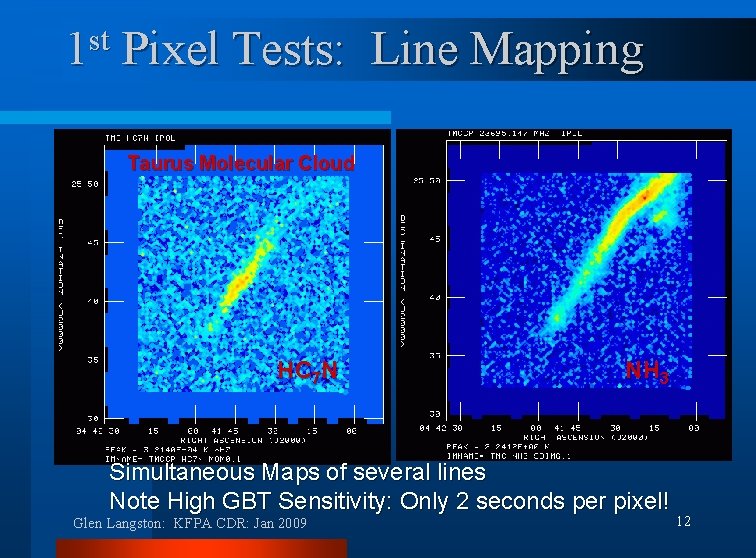
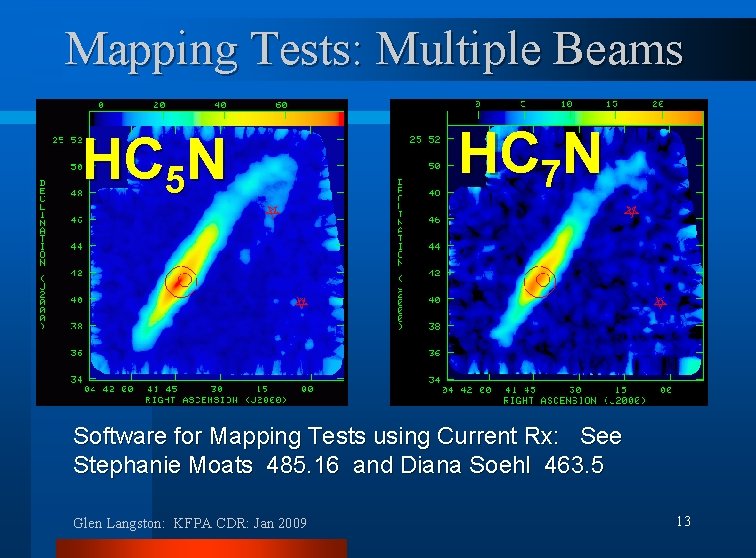
st 1 Pixel Tests: Line Mapping Taurus Molecular Cloud HC 7 N NH 3 Simultaneous Maps of several lines Note High GBT Sensitivity: Only 2 seconds per pixel! Glen Langston: KFPA CDR: Jan 2009 12
Mapping Tests: Multiple Beams HC 5 N HC 7 N Software for Mapping Tests using Current Rx: See Stephanie Moats 485. 16 and Diana Soehl 463. 5 Glen Langston: KFPA CDR: Jan 2009 13
IDM 2 Tests 2 nd IDM showed no IF spurs Tsys performance similar to K 0 Glen Langston: KFPA CDR: Jan 2009 14
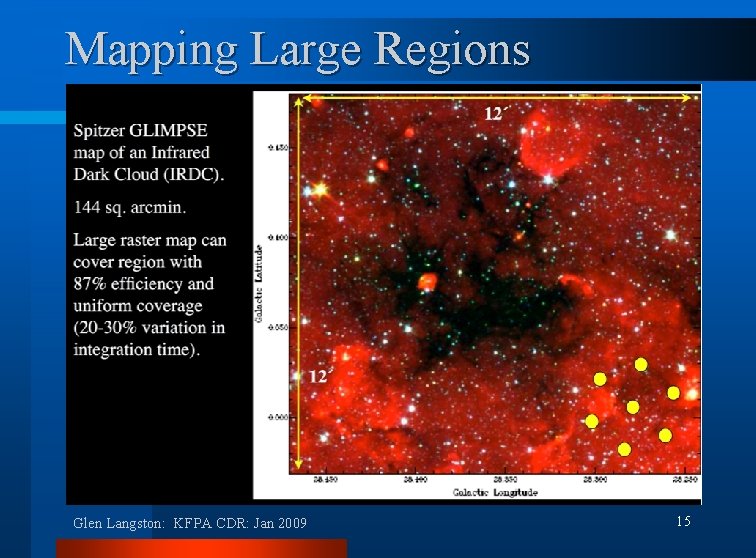
Mapping Large Regions Glen Langston: KFPA CDR: Jan 2009 15
Summary: New Tools available soon! Wide frequency (18 to 26 GHz) observations are critical for study of important large molecules and Chemistry. NRAO support of Astro-chemistry will be advanced by: Increasing spectrometer bandwidth Increasing number of beams in receivers GBT offers great capabilities for Astro-chemistry and Astro-biology, now and in the future! Glen Langston: KFPA CDR: Jan 2009 16