
Molecular geometry VSEPR The number of groups of
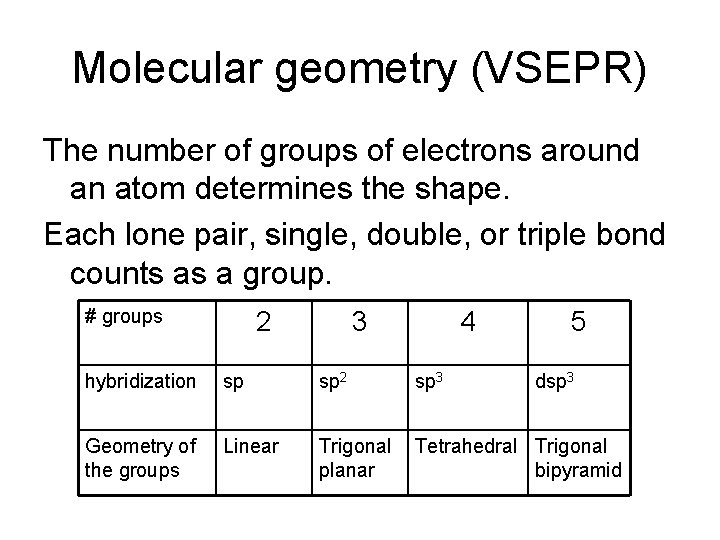
Molecular geometry (VSEPR) The number of groups of electrons around an atom determines the shape. Each lone pair, single, double, or triple bond counts as a group. # groups 2 3 4 5 hybridization sp sp 2 sp 3 dsp 3 Geometry of the groups Linear Trigonal planar Tetrahedral Trigonal bipyramid
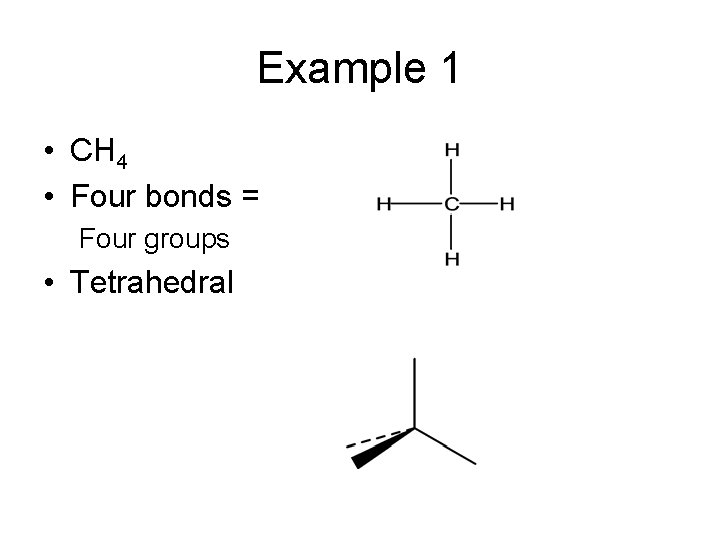
Example 1 • CH 4 • Four bonds = Four groups • Tetrahedral
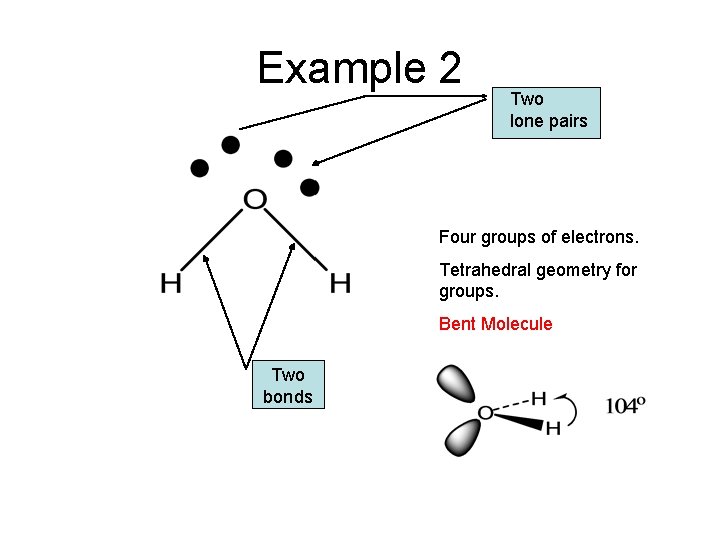
Example 2 Two lone pairs Four groups of electrons. Tetrahedral geometry for groups. Bent Molecule Two bonds
Nature of Chemical Bonds So far, we have the octet rule which tells us how many bonds we can make. But how do we understand the nature of the bonds? Three models for bonding: ionic, valence bond, molecular orbitals.
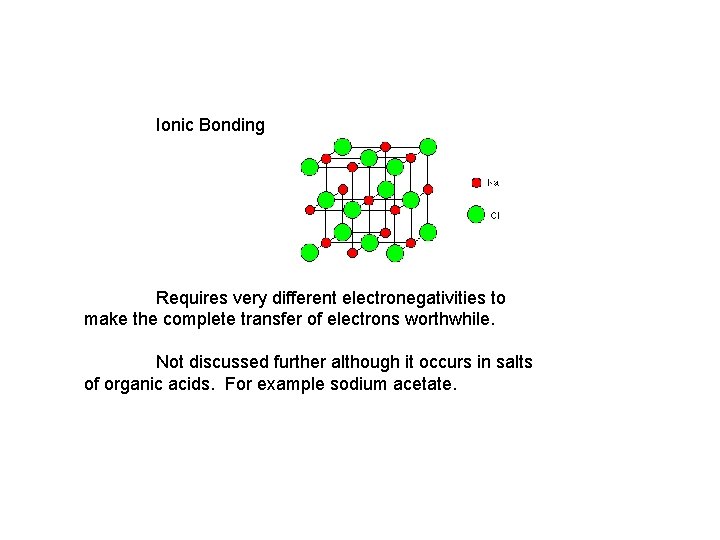
Ionic Bonding Requires very different electronegativities to make the complete transfer of electrons worthwhile. Not discussed further although it occurs in salts of organic acids. For example sodium acetate.
Quantum or Wave Mechanics • Albert Einstein: E = hn (energy is quantized) – light has particle properties. • Erwin Schrödinger: wave equation – wave function, : A solution to a set of equations that depicts the energy of an electron in an atom. – each wave function is associated with a unique set of quantum numbers. – each wave function represents a region of threedimensional space and is called an orbital – 2 is the probability of finding an electron at a given point in space.
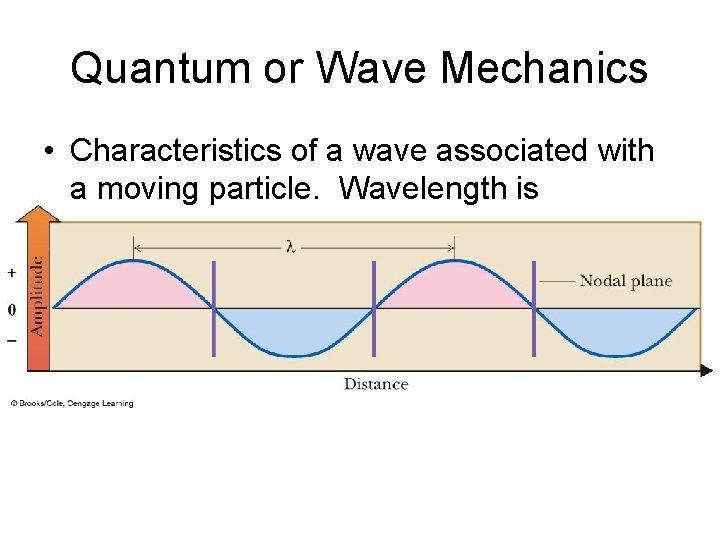
Quantum or Wave Mechanics • Characteristics of a wave associated with a moving particle. Wavelength is designated by the symbol l.
Quantum or Wave Mechanics • When we describe orbital interactions, we are referring to interactions of waves. Waves interact – constructively or – destructively. • When two waves overlap, if they are of the same sign they combine constructively, build-up. Opposite sign overlap combines destructively, meaning they cancel.
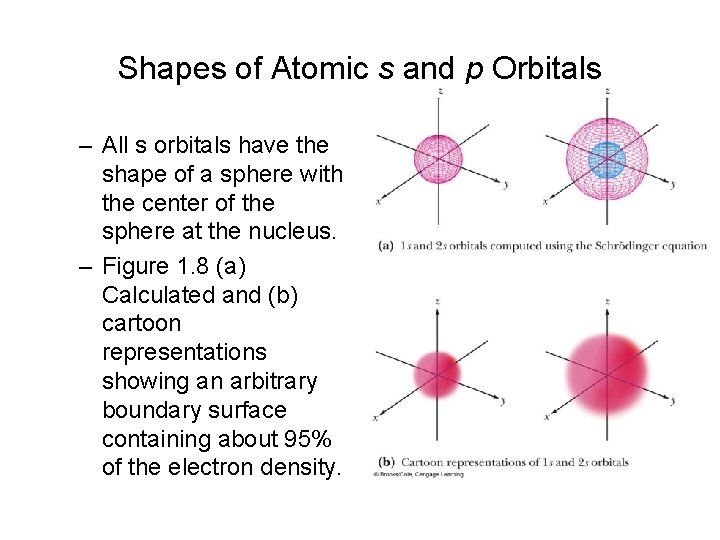
Shapes of Atomic s and p Orbitals – All s orbitals have the shape of a sphere with the center of the sphere at the nucleus. – Figure 1. 8 (a) Calculated and (b) cartoon representations showing an arbitrary boundary surface containing about 95% of the electron density.
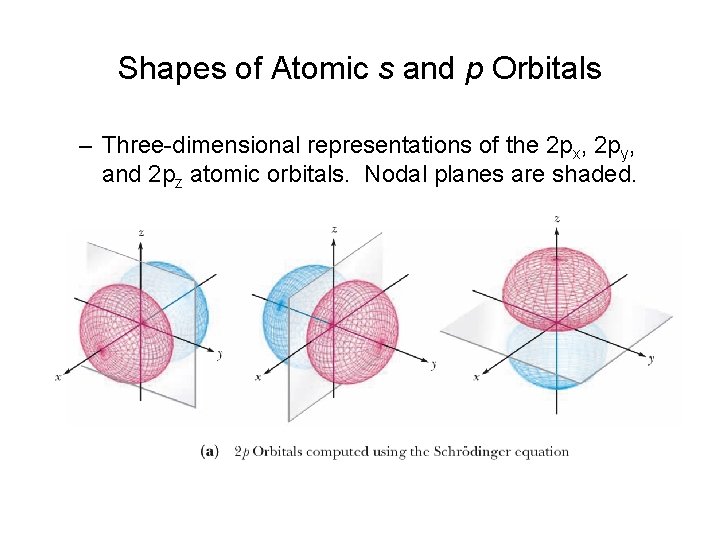
Shapes of Atomic s and p Orbitals – Three-dimensional representations of the 2 px, 2 py, and 2 pz atomic orbitals. Nodal planes are shaded.
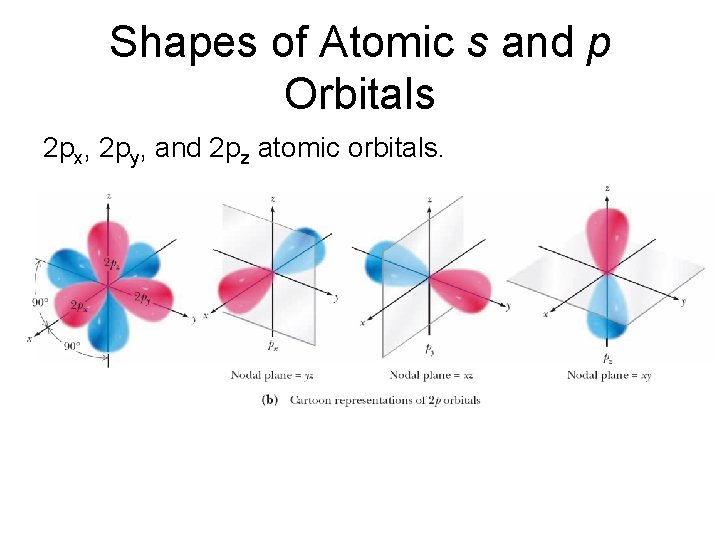
Shapes of Atomic s and p Orbitals 2 px, 2 py, and 2 pz atomic orbitals.
Molecular Orbital Theory • MO theory begins with the hypothesis that – electrons in atoms exist in atomic orbitals and – electrons in molecules exist in molecular orbitals.
Molecular Orbital Theory • Rules: – Combination of n atomic orbitals (mathematically adding and subtracting wave functions) gives n MOs (new wave functions). – MOs are arranged in order of increasing energy. – MO filling is governed by the same rules as for atomic orbitals: • Aufbau principle: fill beginning with lowest energy orbital • Pauli exclusion principle: no more than 2 e- in a MO • Hund’s rule: when two or more MOs of equivalent energy (degenerate) are available, add 1 e- to each before filling any one of them with 2 e-.
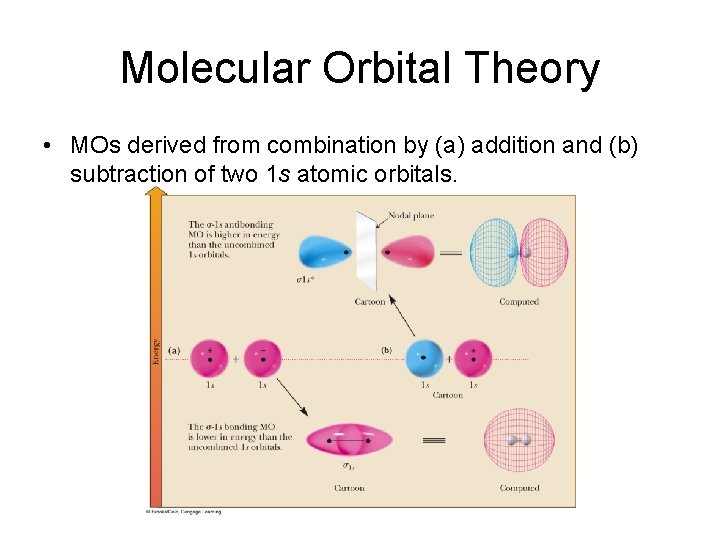
Molecular Orbital Theory • MOs derived from combination by (a) addition and (b) subtraction of two 1 s atomic orbitals.
Covalent Bonding • Bonding molecular orbital: A MO in which electrons have a lower energy than they would have in isolated atomic orbitals. • Sigma (s) bonding molecular orbital: A MO in which electron density is concentrated between two nuclei along the axis joining them and is cylindrically symmetrical.

Covalent Bonding • A MO energy diagram for H 2. (a) Ground state and (b) lowest excited state.
Covalent Bonding • Antibonding MO: A MO in which electrons have a higher energy than they would in isolated atomic orbitals.
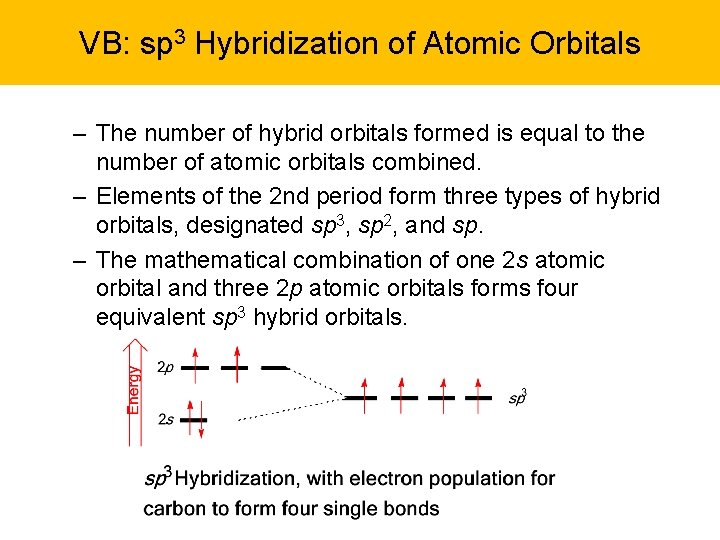
VB: sp 3 Hybridization of Atomic Orbitals – The number of hybrid orbitals formed is equal to the number of atomic orbitals combined. – Elements of the 2 nd period form three types of hybrid orbitals, designated sp 3, sp 2, and sp. – The mathematical combination of one 2 s atomic orbital and three 2 p atomic orbitals forms four equivalent sp 3 hybrid orbitals.
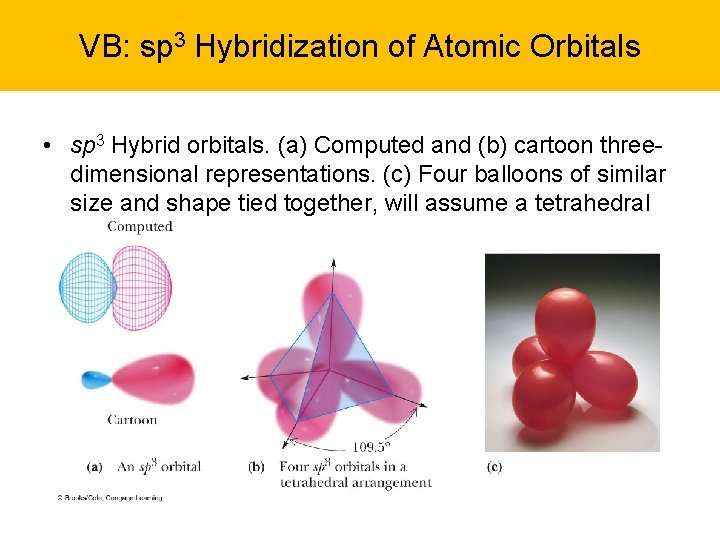
VB: sp 3 Hybridization of Atomic Orbitals • sp 3 Hybrid orbitals. (a) Computed and (b) cartoon threedimensional representations. (c) Four balloons of similar size and shape tied together, will assume a tetrahedral geometry.
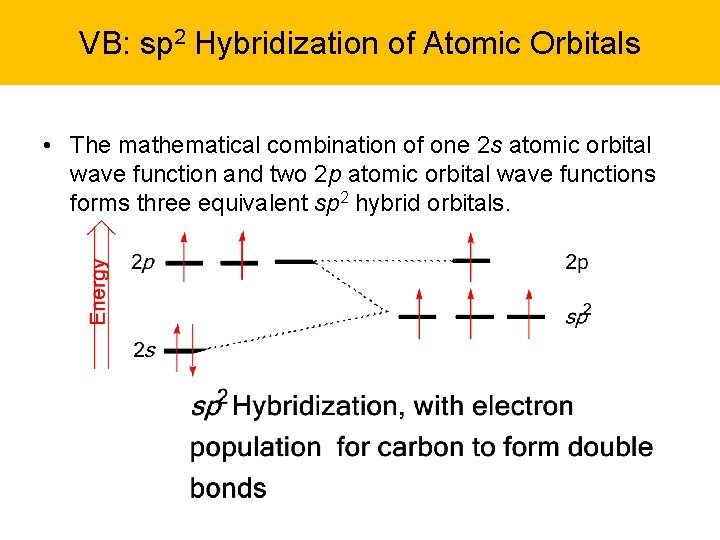
VB: sp 2 Hybridization of Atomic Orbitals • The mathematical combination of one 2 s atomic orbital wave function and two 2 p atomic orbital wave functions forms three equivalent sp 2 hybrid orbitals.
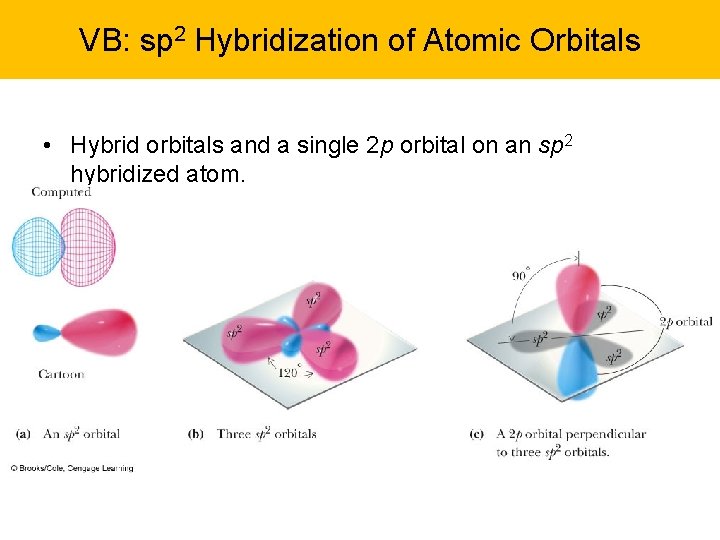
VB: sp 2 Hybridization of Atomic Orbitals • Hybrid orbitals and a single 2 p orbital on an sp 2 hybridized atom.
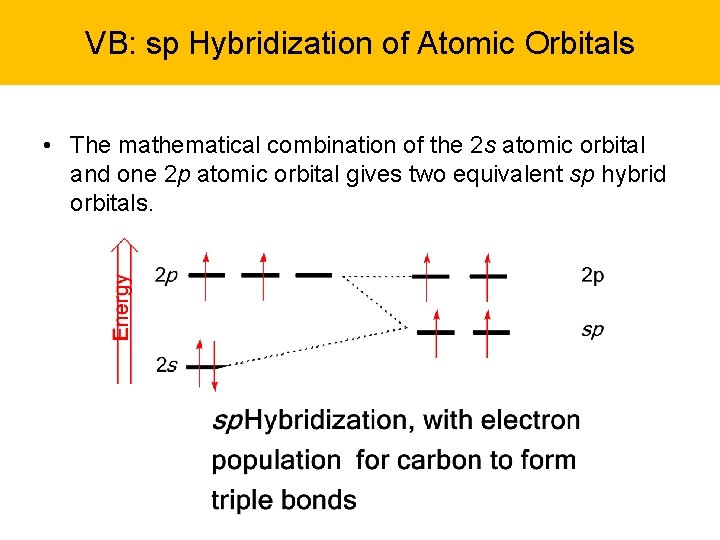
VB: sp Hybridization of Atomic Orbitals • The mathematical combination of the 2 s atomic orbital and one 2 p atomic orbital gives two equivalent sp hybrid orbitals.
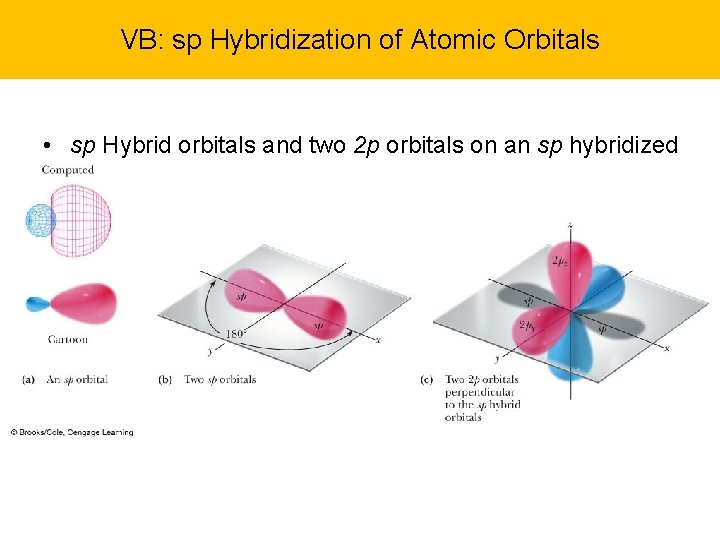
VB: sp Hybridization of Atomic Orbitals • sp Hybrid orbitals and two 2 p orbitals on an sp hybridized atom.
Combining VB & MO Theories • VB theory views bonding as arising from electron pairs localized between adjacent atoms. These pairs create bonds. • Further, organic chemists commonly use atomic orbitals involved in three hybridization states of atoms (sp 3, sp 2, and 2 p) to create orbitals to match the experimentally observed geometries. • How do we make orbitals that contain electrons that reside between adjacent atoms? For this, we turn back to MO theory.
Combining VB & MO Theories • To create orbitals that are localized between adjacent atoms, we add and subtract the atomic and hybrid orbitals on the adjacent atoms, which are aligned to overlap with each other. • Consider methane, CH 4. The sp 3 hybrid orbitals of carbon each point to a 1 s orbital of hydrogen and, therefore, we add and subtract these atomic orbitals to create molecular orbitals. • As with H 2, one resulting MO is lower in energy than the separated atomic orbitals, and is called a bonding s orbital. The other is higher in energy and is antibonding.
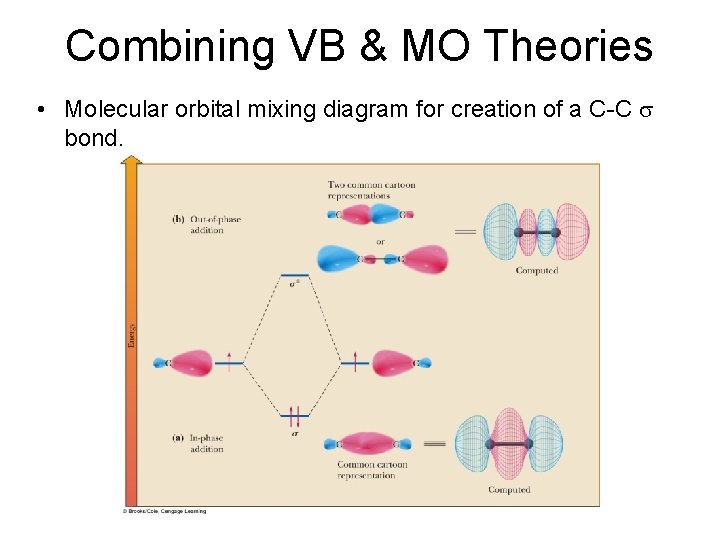
Combining VB & MO Theories • Molecular orbital mixing diagram for creation of a C-C s bond.
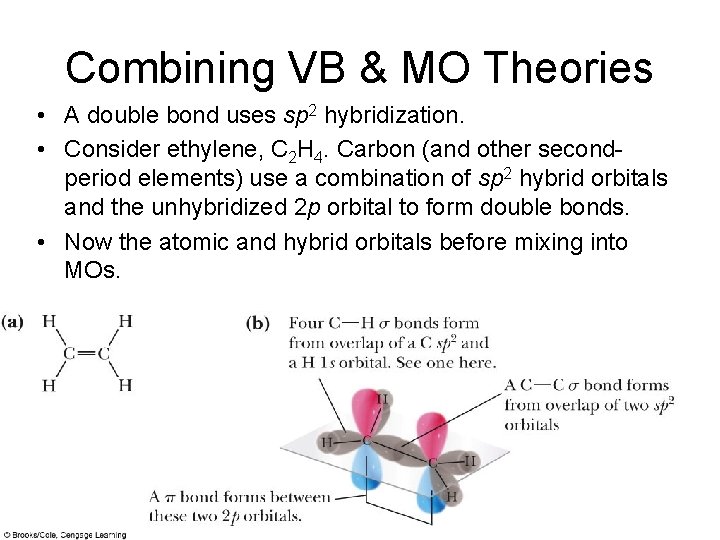
Combining VB & MO Theories • A double bond uses sp 2 hybridization. • Consider ethylene, C 2 H 4. Carbon (and other secondperiod elements) use a combination of sp 2 hybrid orbitals and the unhybridized 2 p orbital to form double bonds. • Now the atomic and hybrid orbitals before mixing into MOs.
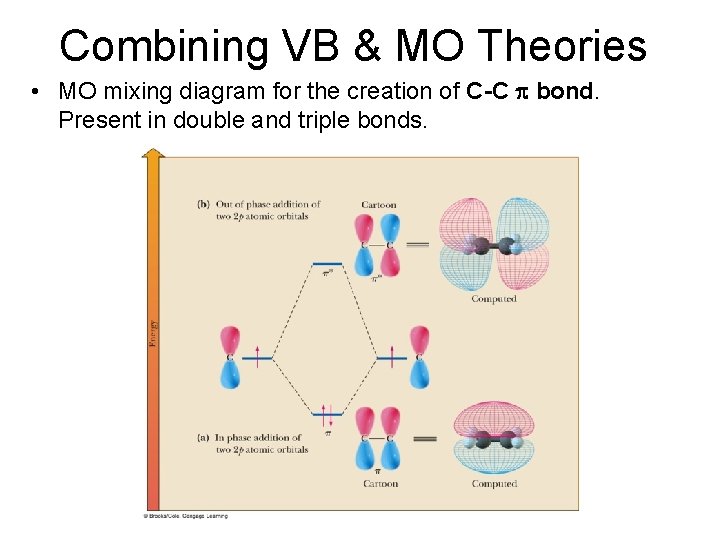
Combining VB & MO Theories • MO mixing diagram for the creation of C-C p bond. Present in double and triple bonds.
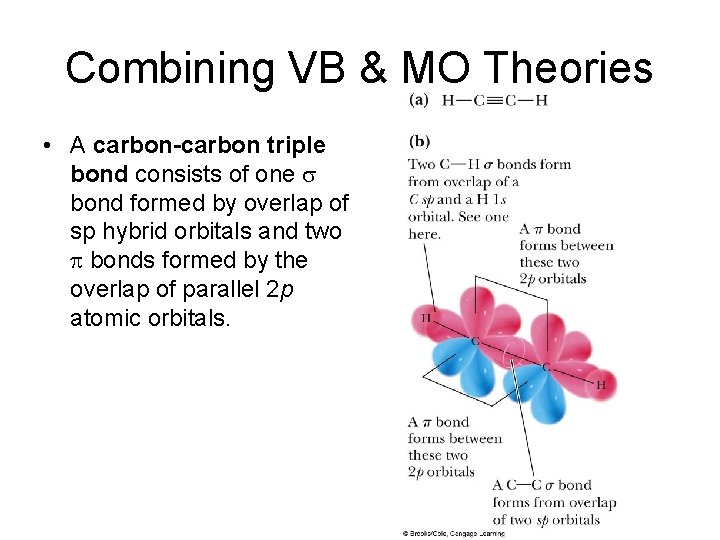
Combining VB & MO Theories • A carbon-carbon triple bond consists of one s bond formed by overlap of sp hybrid orbitals and two p bonds formed by the overlap of parallel 2 p atomic orbitals.
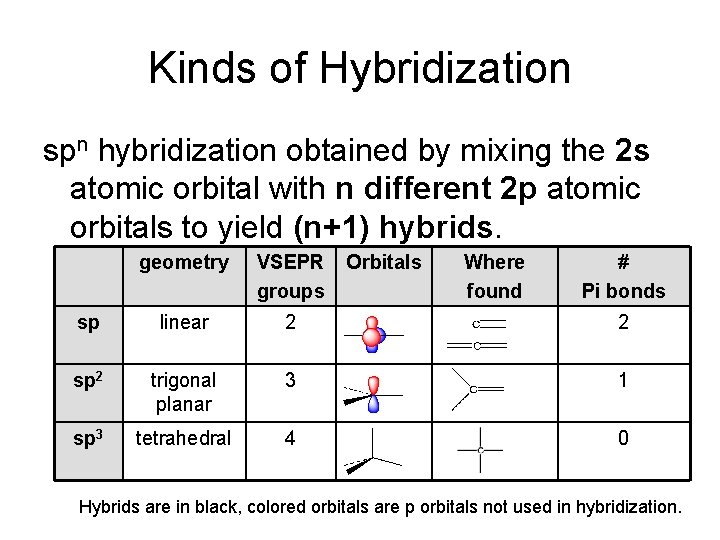
Kinds of Hybridization spn hybridization obtained by mixing the 2 s atomic orbital with n different 2 p atomic orbitals to yield (n+1) hybrids. geometry VSEPR groups Orbitals Where found # Pi bonds sp linear 2 2 sp 2 trigonal planar 3 1 sp 3 tetrahedral 4 0 Hybrids are in black, colored orbitals are p orbitals not used in hybridization.
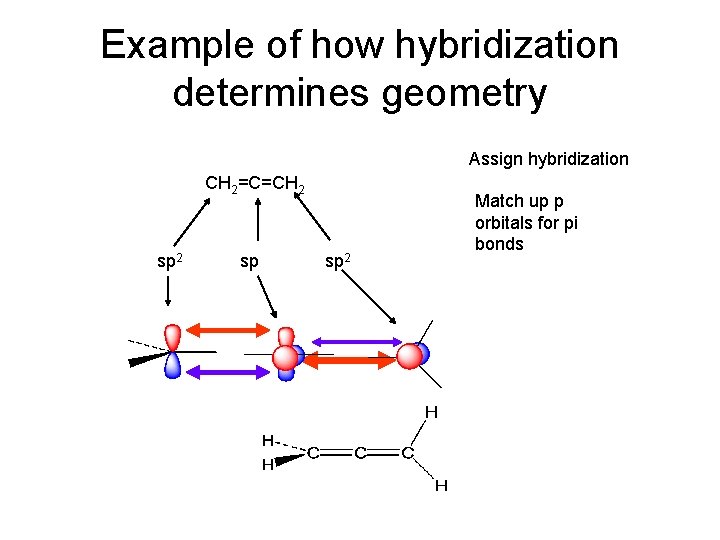
Example of how hybridization determines geometry Assign hybridization CH 2=C=CH 2 sp sp 2 Match up p orbitals for pi bonds
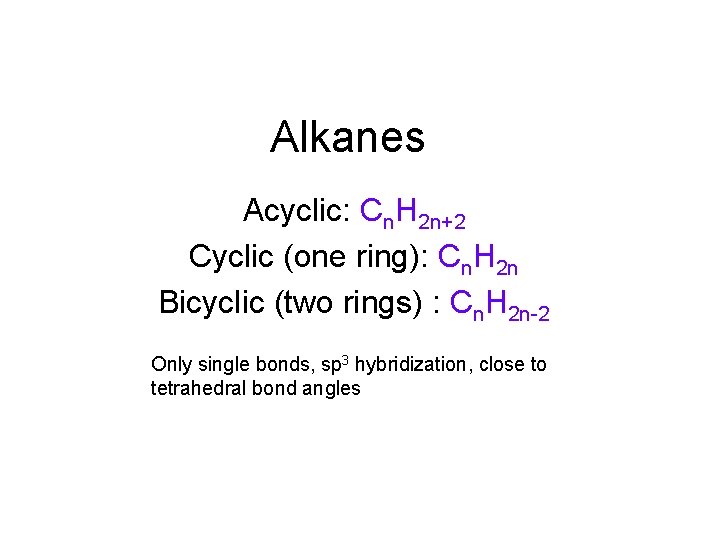
Alkanes Acyclic: Cn. H 2 n+2 Cyclic (one ring): Cn. H 2 n Bicyclic (two rings) : Cn. H 2 n-2 Only single bonds, sp 3 hybridization, close to tetrahedral bond angles
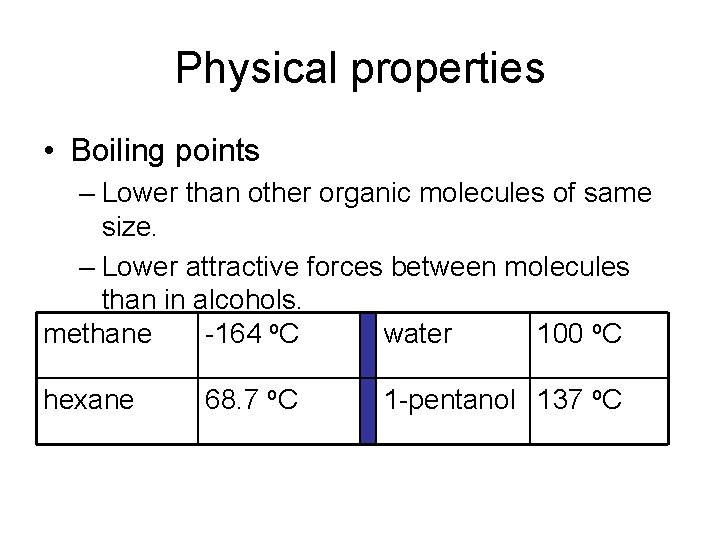
Physical properties • Boiling points – Lower than other organic molecules of same size. – Lower attractive forces between molecules than in alcohols. methane -164 o. C water 100 o. C hexane 68. 7 o. C 1 -pentanol 137 o. C
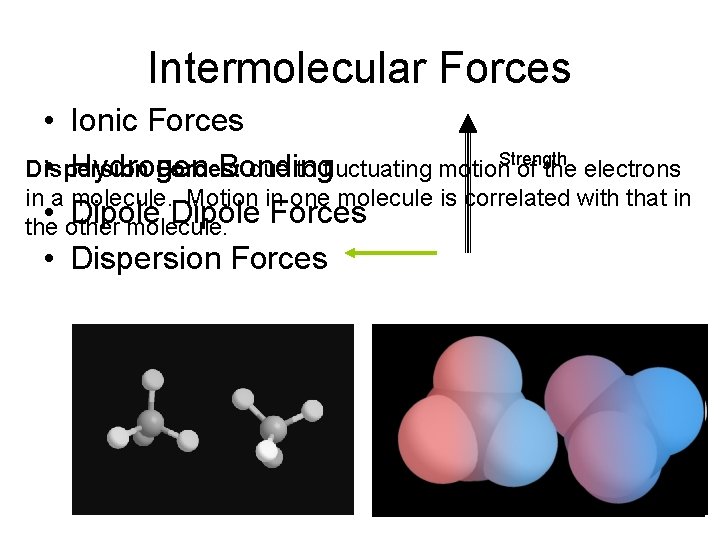
Intermolecular Forces • Ionic Forces • Hydrogen Bonding Dispersion Forces: due to fluctuating motion. Strength of the electrons in a molecule. Motion in one molecule is correlated with that in • other Dipole Forces the molecule. • Dispersion Forces
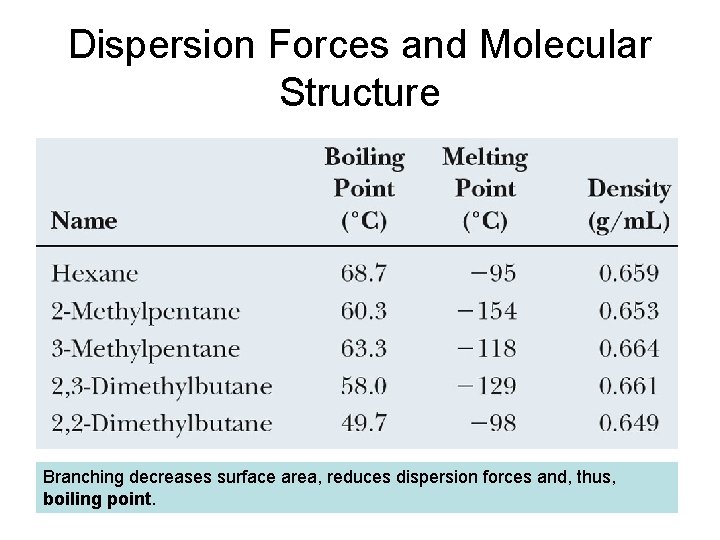
Dispersion Forces and Molecular Structure Branching decreases surface area, reduces dispersion forces and, thus, boiling point.
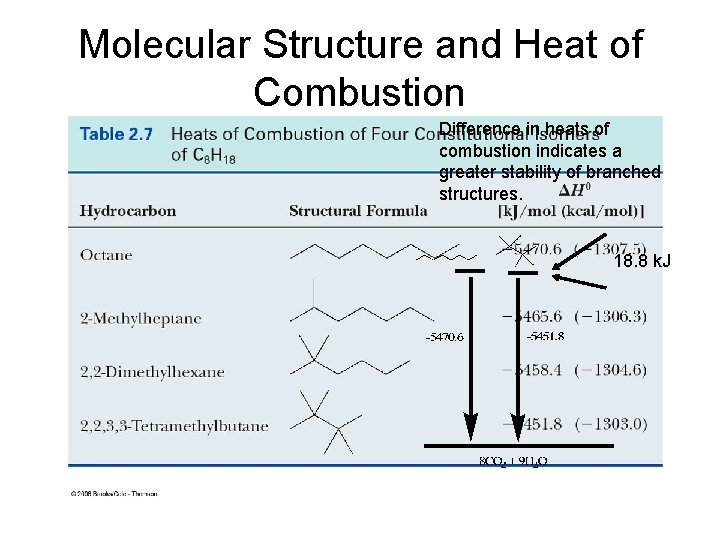
Molecular Structure and Heat of Combustion Difference in heats of combustion indicates a greater stability of branched structures. 18. 8 k. J
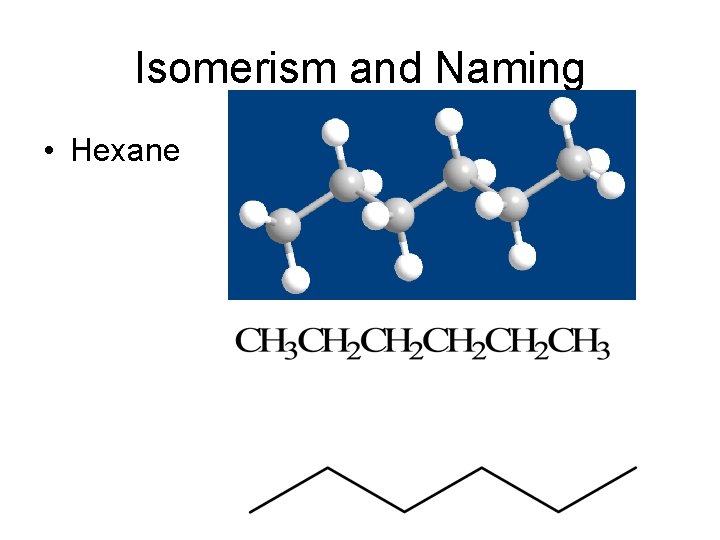
Isomerism and Naming • Hexane

2 -methylpentane
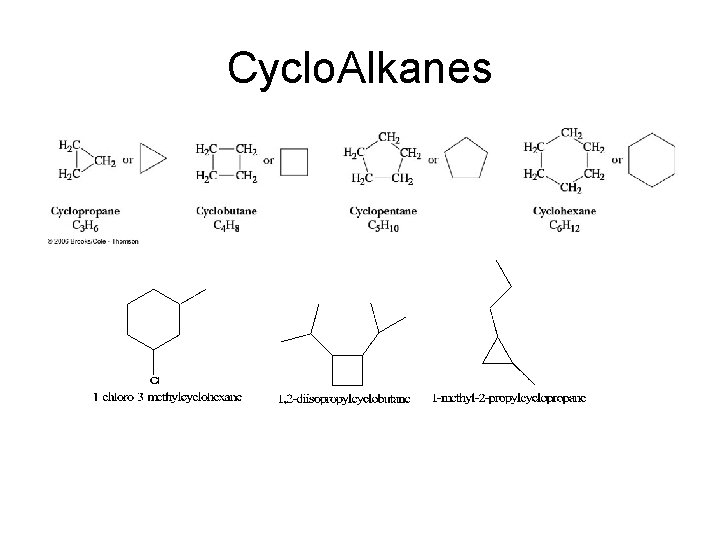
Cyclo. Alkanes
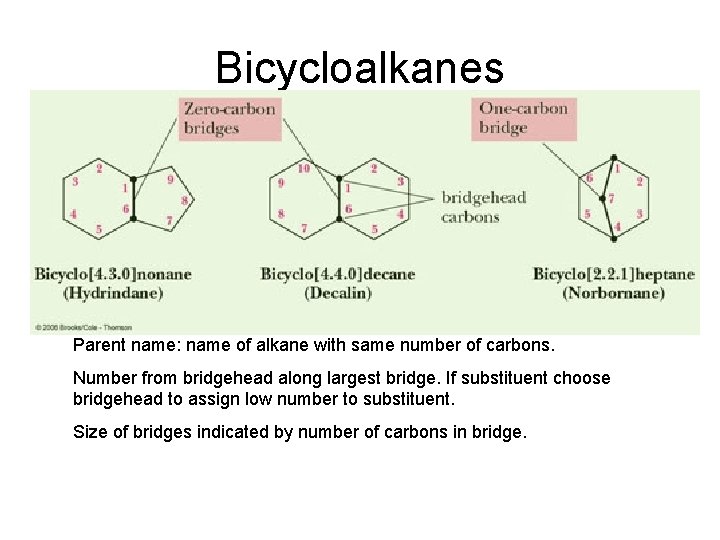
Bicycloalkanes Parent name: name of alkane with same number of carbons. Number from bridgehead along largest bridge. If substituent choose bridgehead to assign low number to substituent. Size of bridges indicated by number of carbons in bridge.
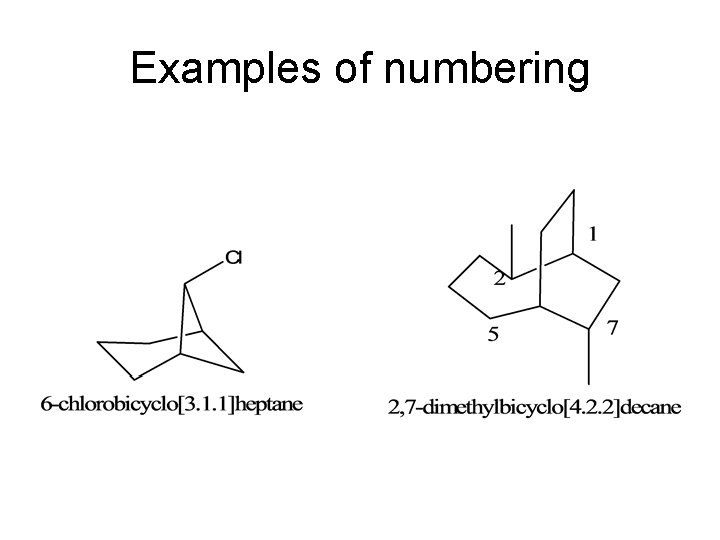
Examples of numbering
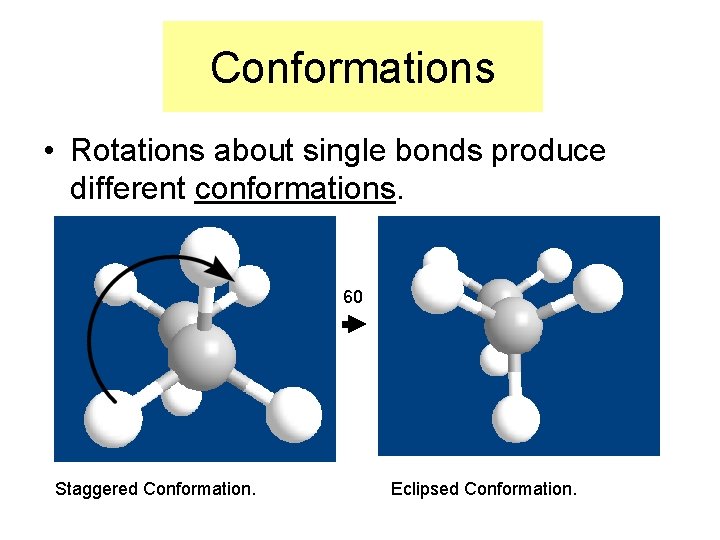
Conformations • Rotations about single bonds produce different conformations. 60 Staggered Conformation. Eclipsed Conformation.
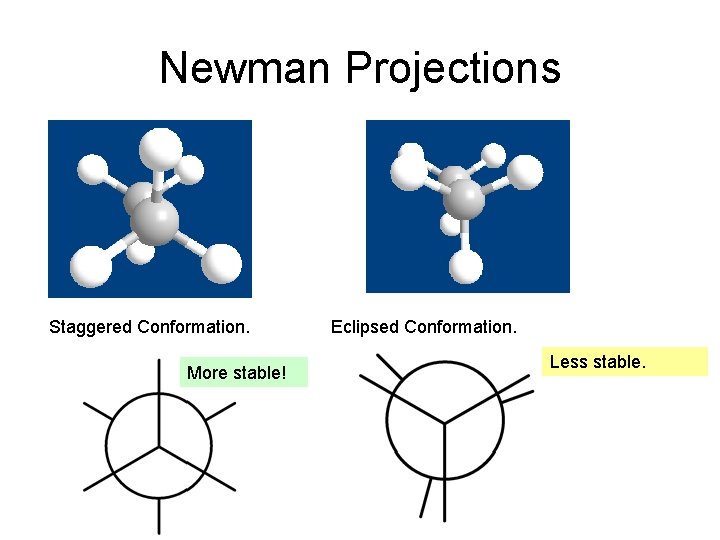
Newman Projections Staggered Conformation. More stable! Eclipsed Conformation. Less stable.
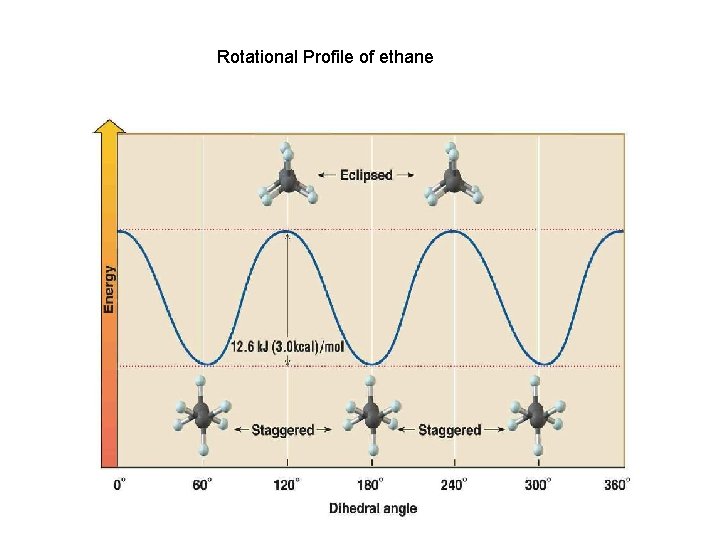
Rotational Profile of ethane
- Slides: 44