
Molecular Geometry and Chemical Bonding Theory Bond Theory
Molecular Geometry and Chemical Bonding Theory
Bond Theory • In this chapter we will discuss the geometries of molecules in terms of their electronic structure. – We will also explore two theories of chemical bonding: valence bond theory and molecular orbital theory. – Molecular geometry is the general shape of a molecule, as determined by the relative positions of the atomic nuclei. Copyright © Houghton Mifflin Company. All rights reserved. Presentation of Lecture Outlines, 10– 2
The Valence-Shell Electron Pair Repulsion Model • The valence-shell electron pair repulsion (VSEPR) model predicts the shapes of molecules and ions by assuming that the valence shell electron pairs are arranged as far from one another as possible. – To predict the relative positions of atoms around a given atom using the VSEPR model, you first note the arrangement of the electron pairs around that central atom. Copyright © Houghton Mifflin Company. All rights reserved. Presentation of Lecture Outlines, 10– 3
Predicting Molecular Geometry • The following rules and figures will help discern electron pair arrangements. 1. Draw the Lewis structure 2. Determine how many electrons pairs are around the central atom. Count a multiple bond as one pair. 3. Arrange the electrons pairs are shown in Figure 10. 3. Copyright © Houghton Mifflin Company. All rights reserved. Presentation of Lecture Outlines, 10– 4

Arrangement of Electron Pairs About an Atom 2 pairs Linear 3 pairs Trigonal planar 5 pairs Trigonal bipyramidal Copyright © Houghton Mifflin Company. All rights reserved. 4 pairs Tetrahedral 6 pairs Octahedral Presentation of Lecture Outlines, 10– 5
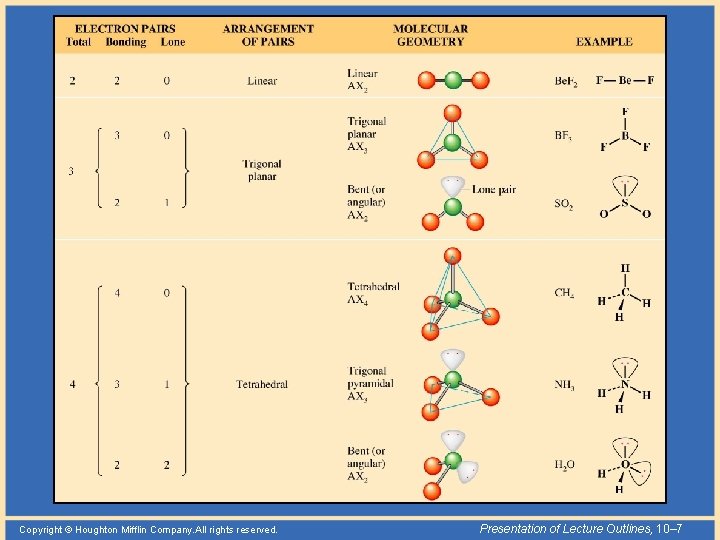
Predicting Molecular Geometry • The following rules and figures will help discern electron pair arrangements. 4. Obtain the molecular geometry from the directions of bonding pairs, as shown in Figures 10. 4 and 10. 8. (See Animations: Electron Pair Repulsion, 2 Pairs; Electron Pair Repulsion, 3 Pairs; and Electron Pair Repulsion, 4 Pairs) Copyright © Houghton Mifflin Company. All rights reserved. Presentation of Lecture Outlines, 10– 6
Copyright © Houghton Mifflin Company. All rights reserved. Presentation of Lecture Outlines, 10– 7
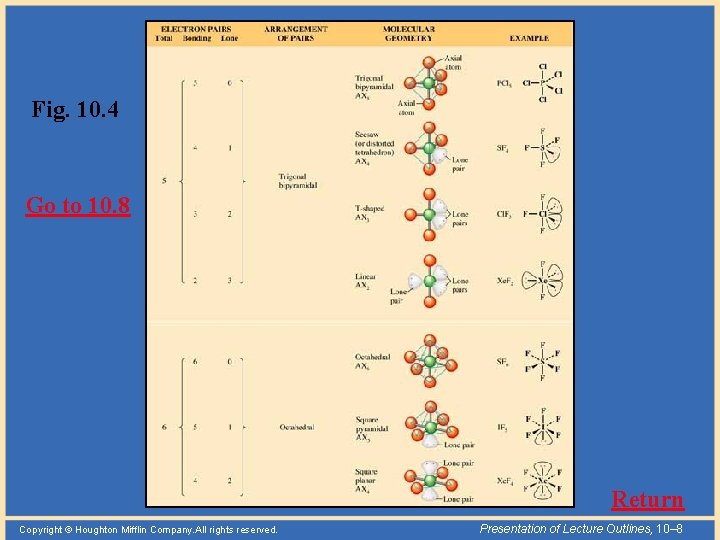
Fig. 10. 4 Go to 10. 8 Return Copyright © Houghton Mifflin Company. All rights reserved. Presentation of Lecture Outlines, 10– 8
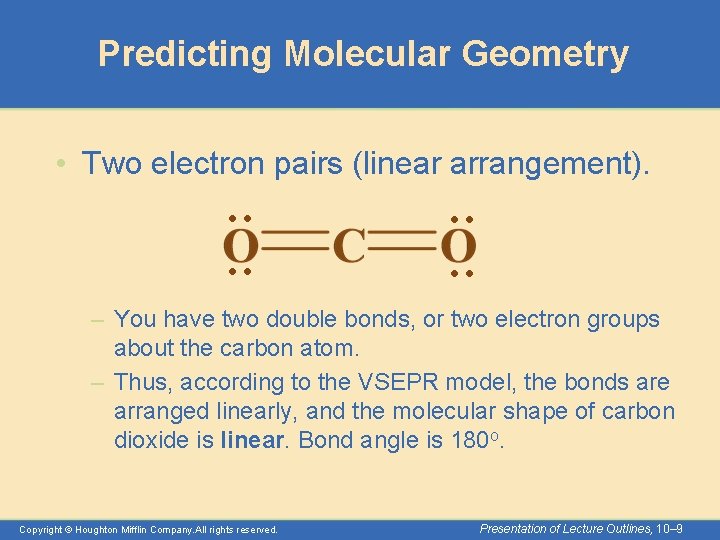
Predicting Molecular Geometry • Two electron pairs (linear arrangement). : : – You have two double bonds, or two electron groups about the carbon atom. – Thus, according to the VSEPR model, the bonds are arranged linearly, and the molecular shape of carbon dioxide is linear. Bond angle is 180 o. Copyright © Houghton Mifflin Company. All rights reserved. Presentation of Lecture Outlines, 10– 9
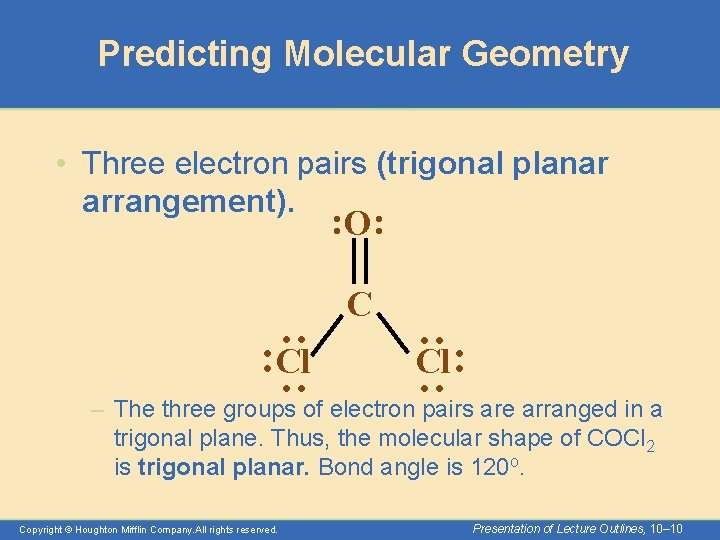
Predicting Molecular Geometry • Three electron pairs (trigonal planar arrangement). : O : C Cl: : Cl – The three groups of electron pairs are arranged in a trigonal plane. Thus, the molecular shape of COCl 2 is trigonal planar. Bond angle is 120 o. Copyright © Houghton Mifflin Company. All rights reserved. Presentation of Lecture Outlines, 10– 10
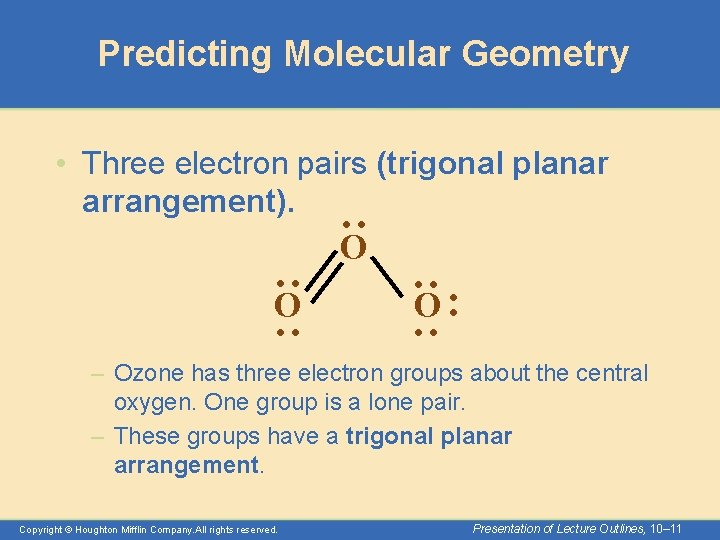
Predicting Molecular Geometry : • Three electron pairs (trigonal planar arrangement). O O: : : O – Ozone has three electron groups about the central oxygen. One group is a lone pair. – These groups have a trigonal planar arrangement. Copyright © Houghton Mifflin Company. All rights reserved. Presentation of Lecture Outlines, 10– 11
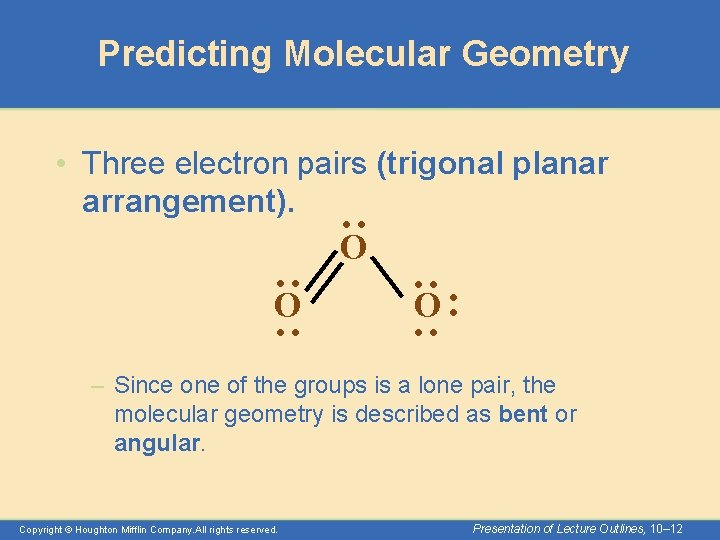
Predicting Molecular Geometry : • Three electron pairs (trigonal planar arrangement). O O: : : O – Since one of the groups is a lone pair, the molecular geometry is described as bent or angular. Copyright © Houghton Mifflin Company. All rights reserved. Presentation of Lecture Outlines, 10– 12
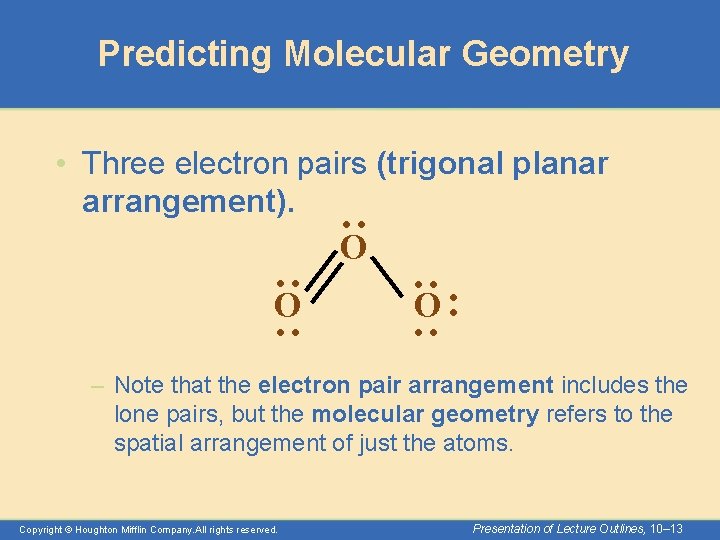
Predicting Molecular Geometry : • Three electron pairs (trigonal planar arrangement). O O: : : O – Note that the electron pair arrangement includes the lone pairs, but the molecular geometry refers to the spatial arrangement of just the atoms. Copyright © Houghton Mifflin Company. All rights reserved. Presentation of Lecture Outlines, 10– 13
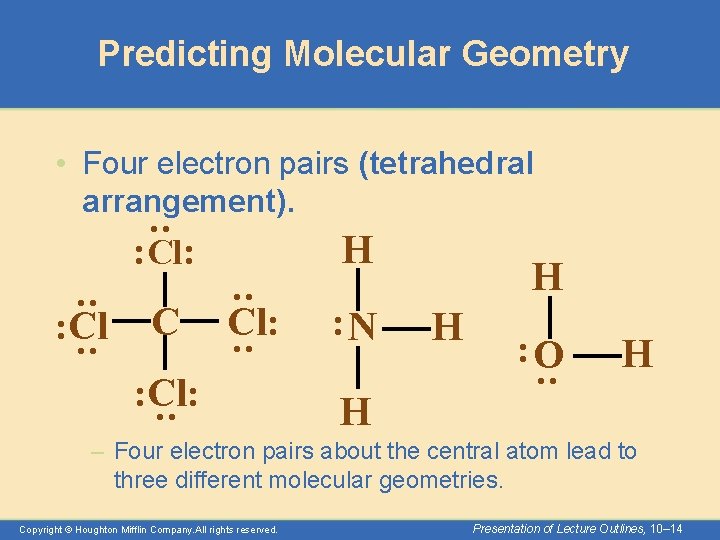
Predicting Molecular Geometry • Four electron pairs (tetrahedral arrangement). : H : Cl: C : : : Cl Cl: H : O : : : Cl: : N H H H – Four electron pairs about the central atom lead to three different molecular geometries. Copyright © Houghton Mifflin Company. All rights reserved. Presentation of Lecture Outlines, 10– 14
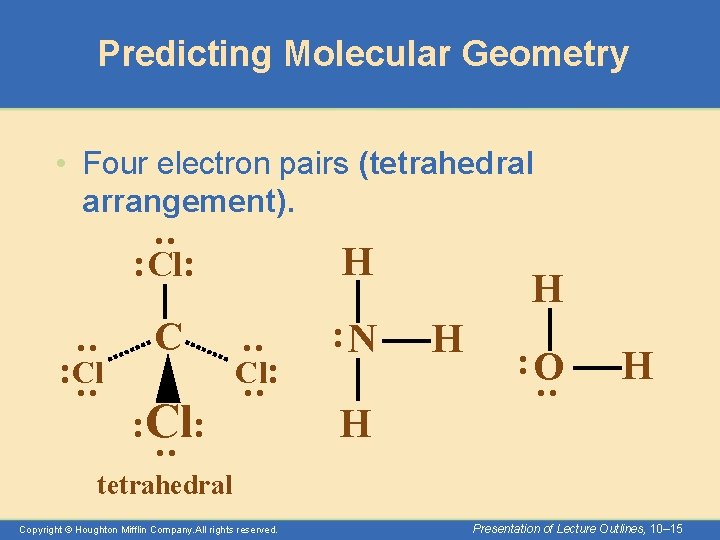
Predicting Molecular Geometry • Four electron pairs (tetrahedral arrangement). : H C : N H : O : Cl: H H H : : Cl: : Cl: tetrahedral Copyright © Houghton Mifflin Company. All rights reserved. Presentation of Lecture Outlines, 10– 15
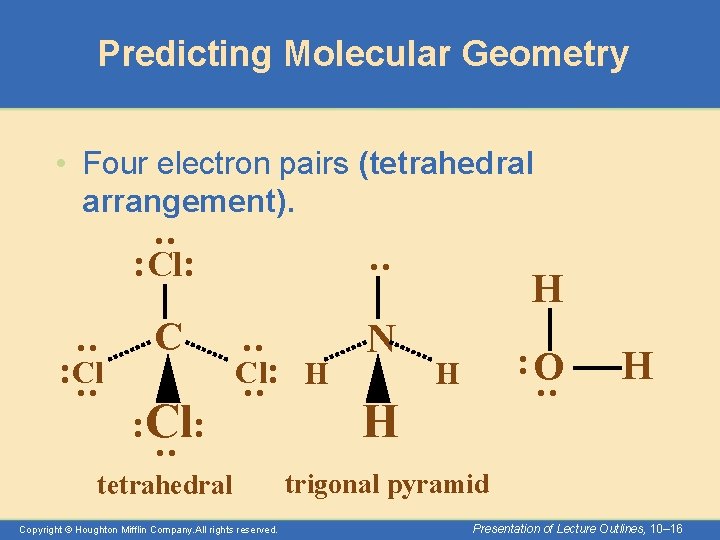
Predicting Molecular Geometry • Four electron pairs (tetrahedral arrangement). C N : O H : Cl: H H : : Cl: : Cl : Cl: tetrahedral Copyright © Houghton Mifflin Company. All rights reserved. trigonal pyramid Presentation of Lecture Outlines, 10– 16
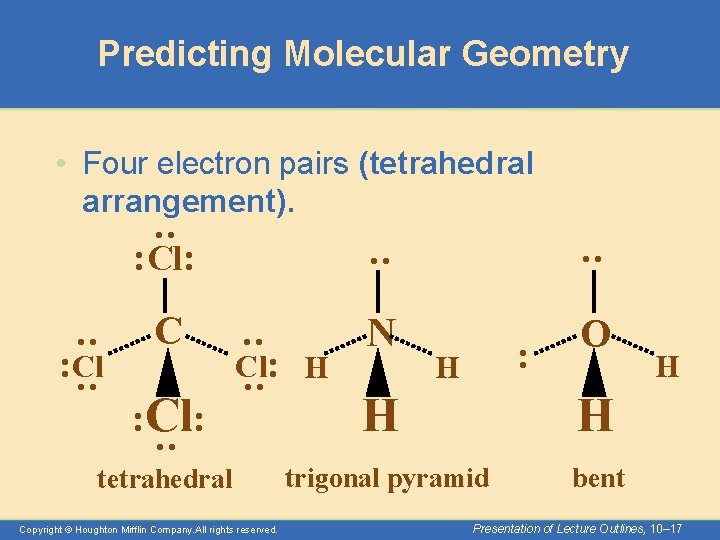
Predicting Molecular Geometry • Four electron pairs (tetrahedral arrangement). : C N O Cl: H : H H H trigonal pyramid bent H : : Cl: : Cl : Cl: tetrahedral Copyright © Houghton Mifflin Company. All rights reserved. Presentation of Lecture Outlines, 10– 17
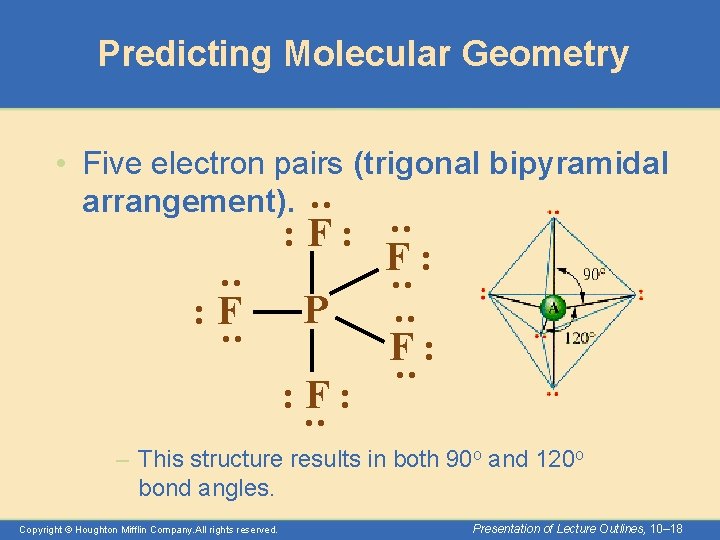
Predicting Molecular Geometry : F: : : P : : : : F: : : • Five electron pairs (trigonal bipyramidal arrangement). F: F: : – This structure results in both 90 o and 120 o bond angles. Copyright © Houghton Mifflin Company. All rights reserved. Presentation of Lecture Outlines, 10– 18
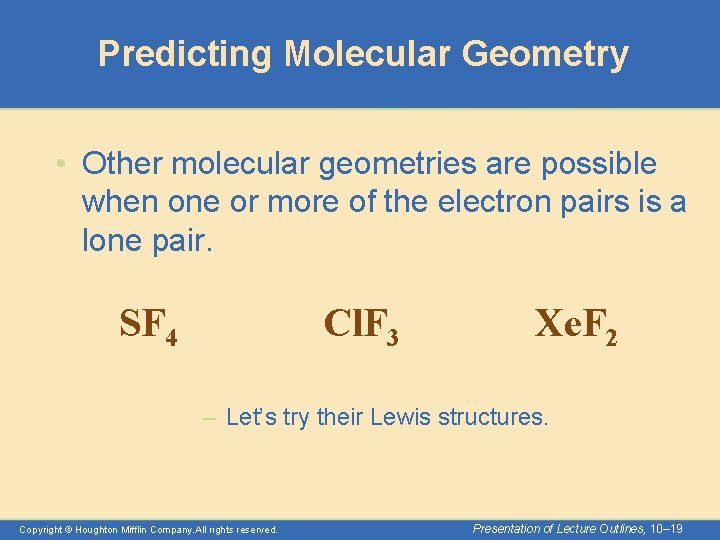
Predicting Molecular Geometry • Other molecular geometries are possible when one or more of the electron pairs is a lone pair. SF 4 Cl. F 3 Xe. F 2 – Let’s try their Lewis structures. Copyright © Houghton Mifflin Company. All rights reserved. Presentation of Lecture Outlines, 10– 19
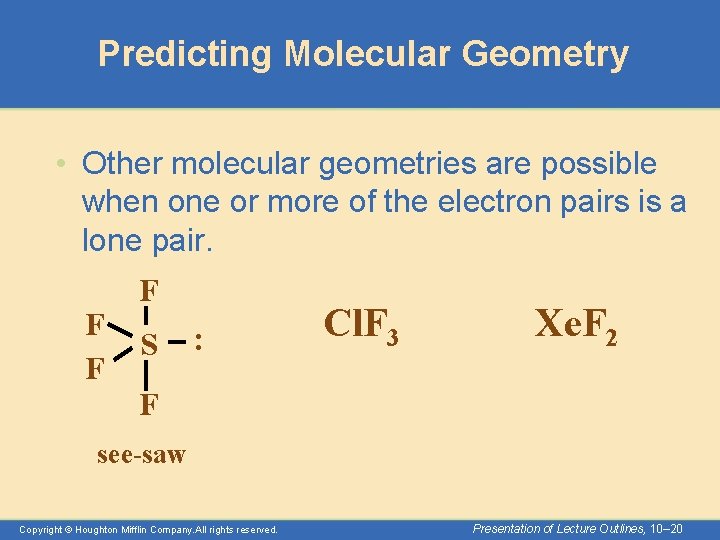
Predicting Molecular Geometry • Other molecular geometries are possible when one or more of the electron pairs is a lone pair. F F F S : Cl. F 3 Xe. F 2 F see-saw Copyright © Houghton Mifflin Company. All rights reserved. Presentation of Lecture Outlines, 10– 20
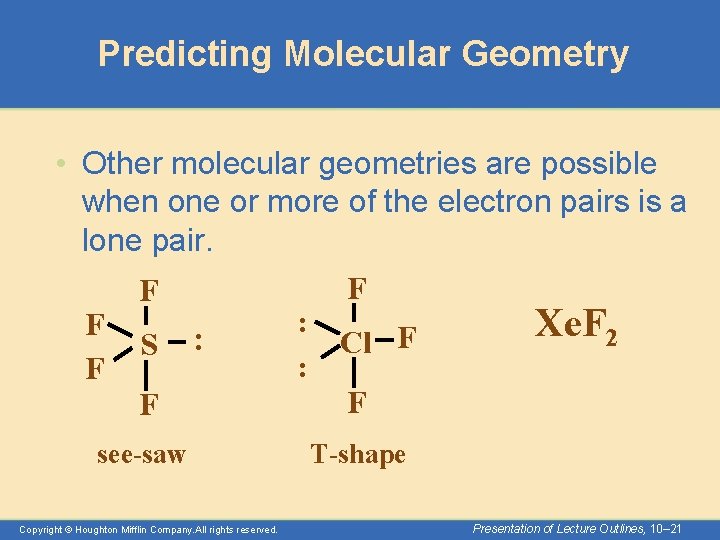
Predicting Molecular Geometry • Other molecular geometries are possible when one or more of the electron pairs is a lone pair. F F : F Xe. F 2 F : Cl S : F F F see-saw Copyright © Houghton Mifflin Company. All rights reserved. T-shape Presentation of Lecture Outlines, 10– 21
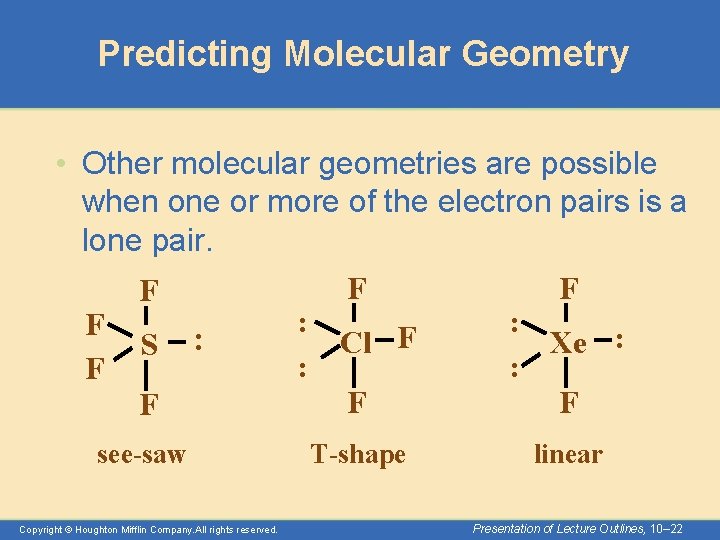
Predicting Molecular Geometry • Other molecular geometries are possible when one or more of the electron pairs is a lone pair. F F F : : F Xe : Cl F S : : : F F see-saw Copyright © Houghton Mifflin Company. All rights reserved. T-shape linear Presentation of Lecture Outlines, 10– 22
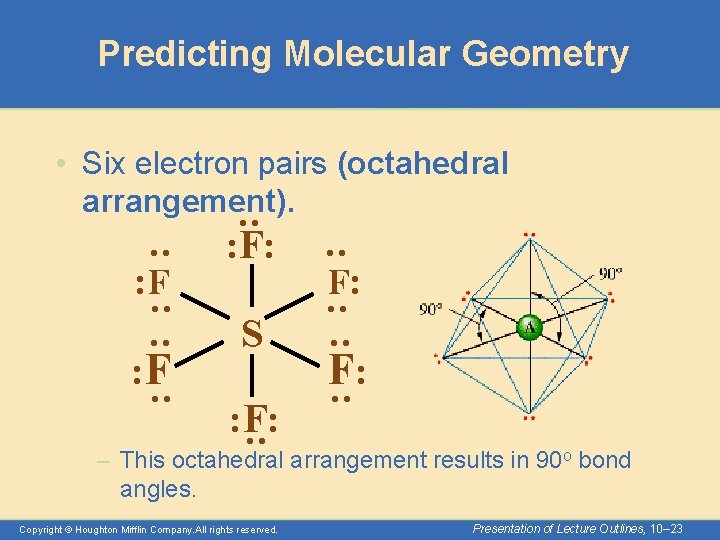
Predicting Molecular Geometry : : F: : : : S : : : : F: : : • Six electron pairs (octahedral arrangement). : F F: : – This octahedral arrangement results in 90 o bond angles. Copyright © Houghton Mifflin Company. All rights reserved. Presentation of Lecture Outlines, 10– 23
Predicting Molecular Geometry • Six electron pairs (octahedral arrangement). IF 5 Xe. F 4 – Six electron pairs also lead to other molecular geometries. Copyright © Houghton Mifflin Company. All rights reserved. Presentation of Lecture Outlines, 10– 24
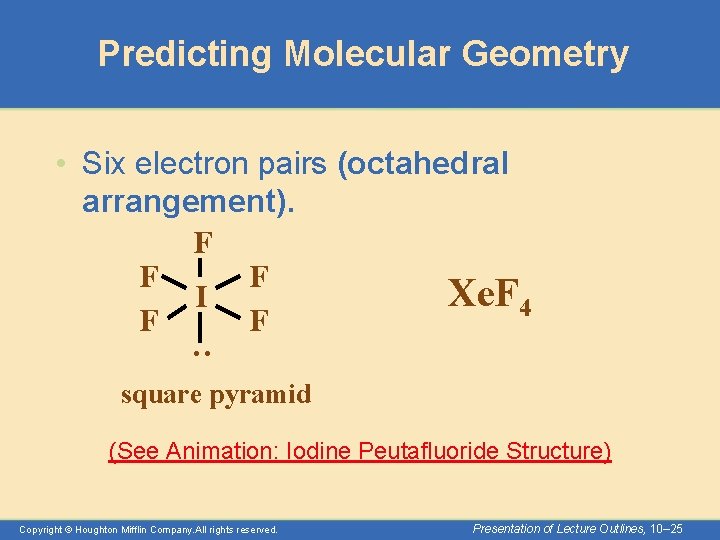
Predicting Molecular Geometry : • Six electron pairs (octahedral arrangement). F F F Xe. F 4 I F F square pyramid (See Animation: Iodine Peutafluoride Structure) Copyright © Houghton Mifflin Company. All rights reserved. Presentation of Lecture Outlines, 10– 25
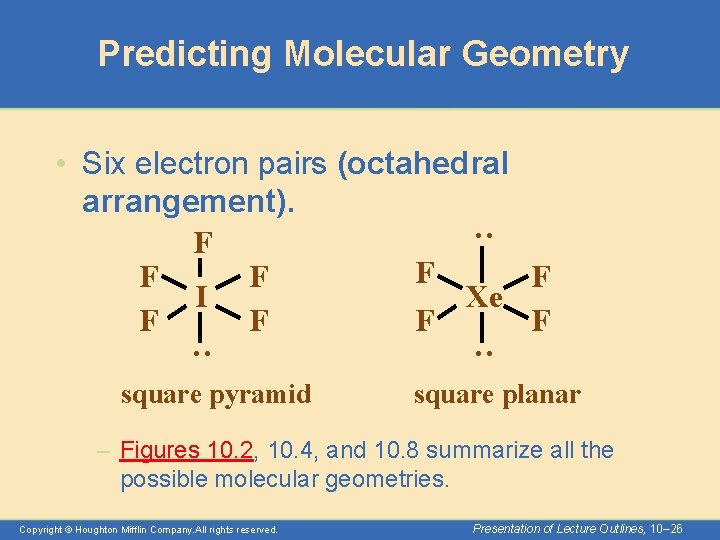
Predicting Molecular Geometry square pyramid : : : • Six electron pairs (octahedral arrangement). F F F I Xe F F square planar – Figures 10. 2, 10. 4, and 10. 8 summarize all the possible molecular geometries. Copyright © Houghton Mifflin Company. All rights reserved. Presentation of Lecture Outlines, 10– 26
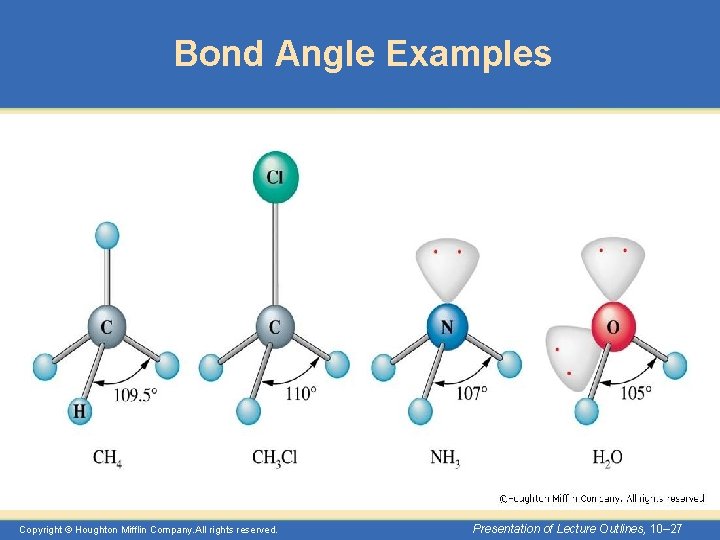
Bond Angle Examples Copyright © Houghton Mifflin Company. All rights reserved. Presentation of Lecture Outlines, 10– 27
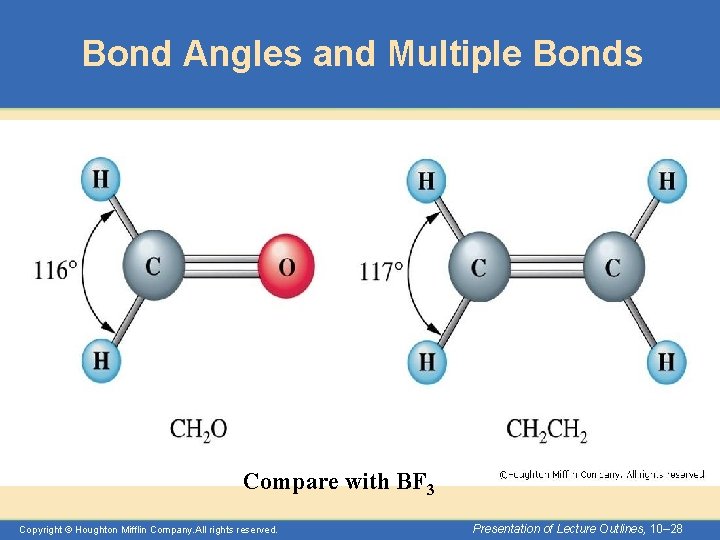
Bond Angles and Multiple Bonds Compare with BF 3 Copyright © Houghton Mifflin Company. All rights reserved. Presentation of Lecture Outlines, 10– 28

VSEPR Summary Click here for animation Copyright © Houghton Mifflin Company. All rights reserved. Presentation of Lecture Outlines, 10– 29
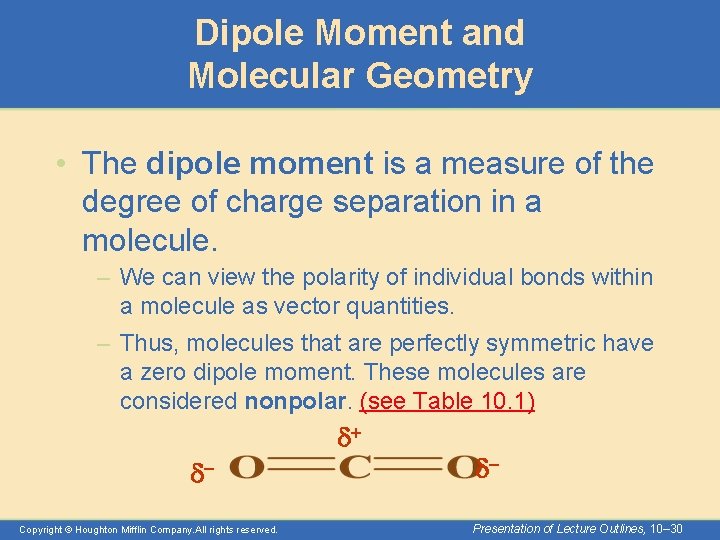
Dipole Moment and Molecular Geometry • The dipole moment is a measure of the degree of charge separation in a molecule. – We can view the polarity of individual bonds within a molecule as vector quantities. – Thus, molecules that are perfectly symmetric have a zero dipole moment. These molecules are considered nonpolar. (see Table 10. 1) d+ d. Copyright © Houghton Mifflin Company. All rights reserved. d. Presentation of Lecture Outlines, 10– 30
Polar Covalent Bonds • A polar covalent bond is one in which the bonding electrons spend more time near one of the two atoms involved. – When the atoms are alike, as in the H-H bond of H 2 , the bonding electrons are shared equally (a nonpolar covalent bond). – When the two atoms are of different elements, the bonding electrons need not be shared equally, resulting in a “polar” bond. 3 -31
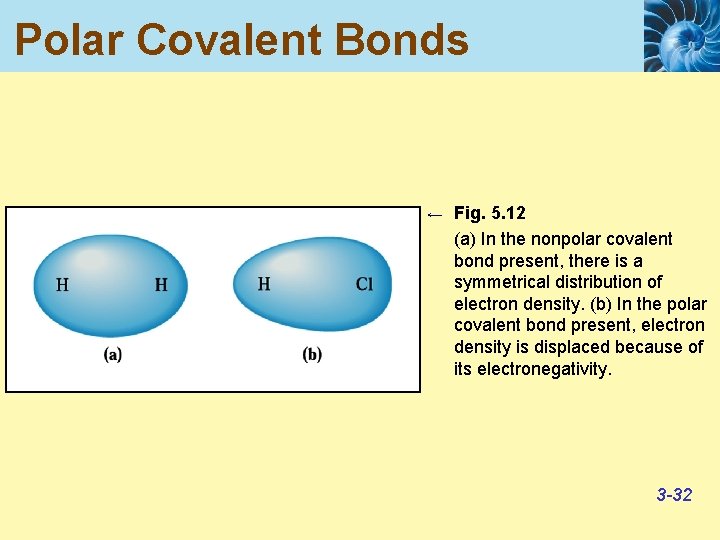
Polar Covalent Bonds ← Fig. 5. 12 (a) In the nonpolar covalent bond present, there is a symmetrical distribution of electron density. (b) In the polar covalent bond present, electron density is displaced because of its electronegativity. 3 -32
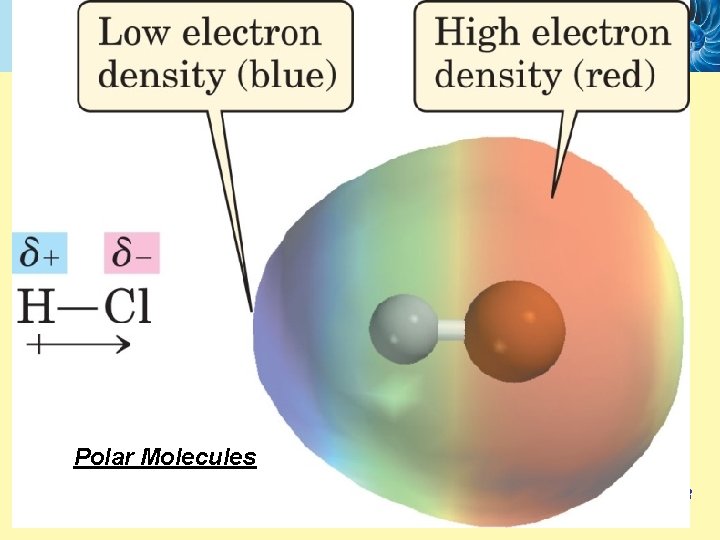
Polarity of Covalent Bonds In a polar covalent bond: • the more electronegative atom attracts the shared electrons more strongly and acquires a partial negative charge; indicated by d- or the head of a crossed arrow. • the less electronegative atom attracts the shared electrons less strongly and acquires a partial positive charge; indicated by d+ or the tail of a crossed arrow. Polar Molecules 3 -33
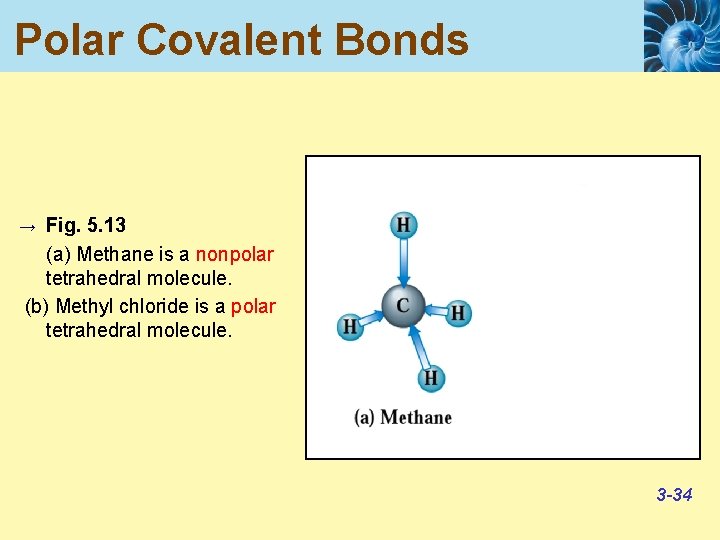
Polar Covalent Bonds → Fig. 5. 13 (a) Methane is a nonpolar tetrahedral molecule. (b) Methyl chloride is a polar tetrahedral molecule. 3 -34
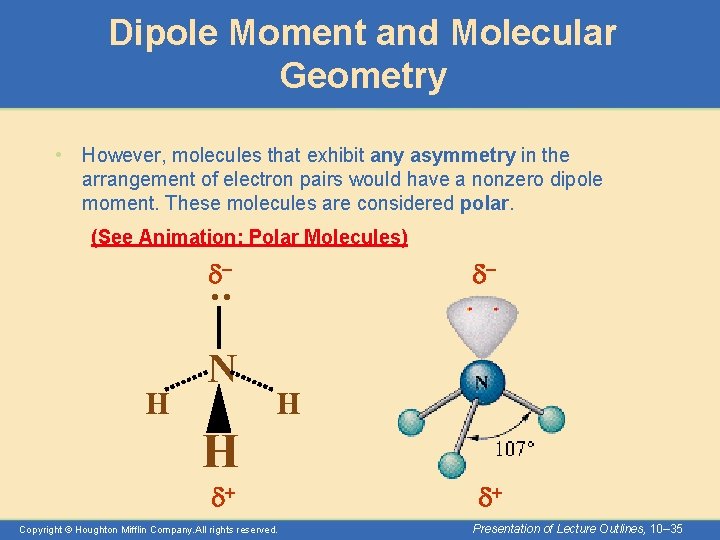
Dipole Moment and Molecular Geometry • However, molecules that exhibit any asymmetry in the arrangement of electron pairs would have a nonzero dipole moment. These molecules are considered polar. (See Animation: Polar Molecules) d- : d- H N H H d+ Copyright © Houghton Mifflin Company. All rights reserved. d+ Presentation of Lecture Outlines, 10– 35
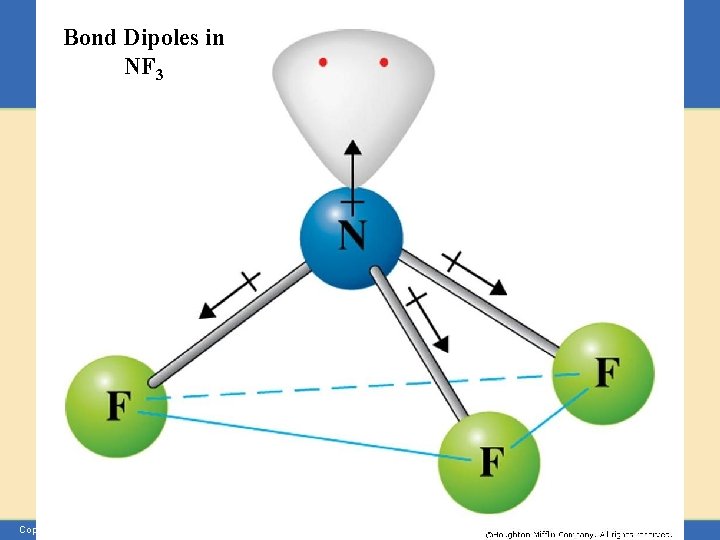
Bond Dipoles in NF 3 Copyright © Houghton Mifflin Company. All rights reserved. Presentation of Lecture Outlines, 10– 36
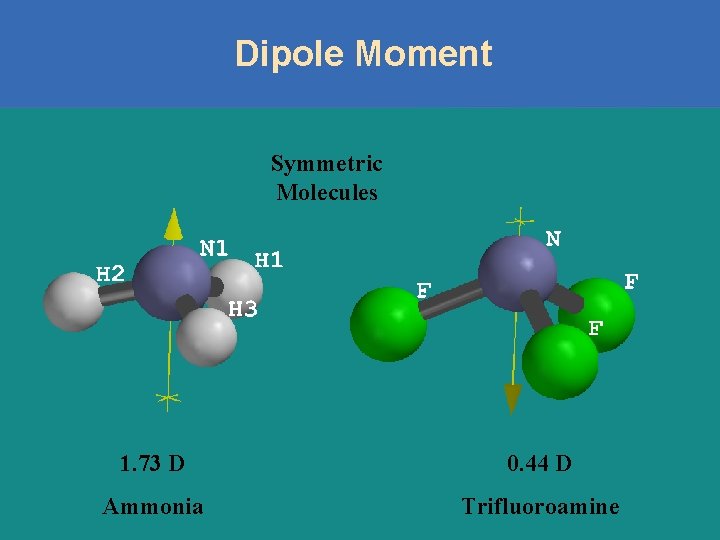
Dipole Moment Symmetric Molecules 1. 73 D 0. 44 D Ammonia Trifluoroamine Copyright © Houghton Mifflin Company. All rights reserved. Presentation of Lecture Outlines, 10– 37
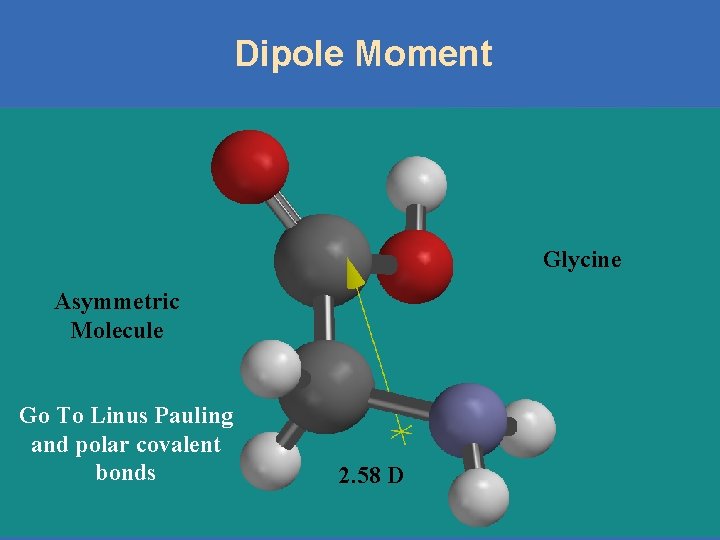
Dipole Moment Glycine Asymmetric Molecule Go To Linus Pauling and polar covalent bonds Copyright © Houghton Mifflin Company. All rights reserved. 2. 58 D Presentation of Lecture Outlines, 10– 38
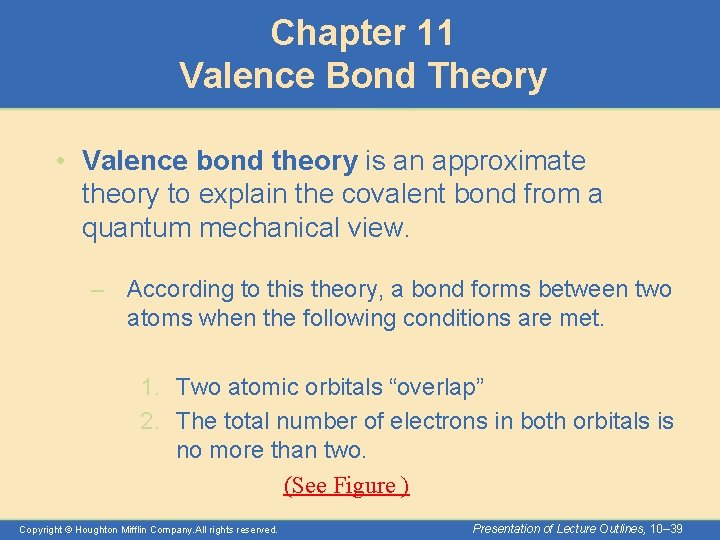
Chapter 11 Valence Bond Theory • Valence bond theory is an approximate theory to explain the covalent bond from a quantum mechanical view. – According to this theory, a bond forms between two atoms when the following conditions are met. 1. Two atomic orbitals “overlap” 2. The total number of electrons in both orbitals is no more than two. (See Figure ) Copyright © Houghton Mifflin Company. All rights reserved. Presentation of Lecture Outlines, 10– 39
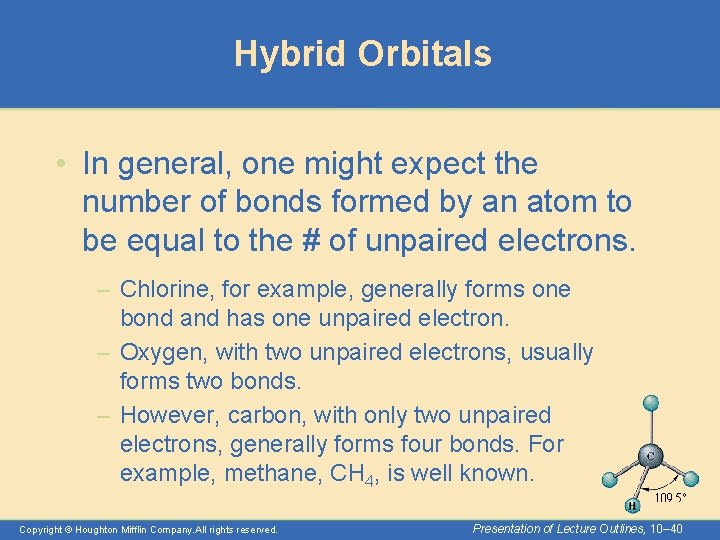
Hybrid Orbitals • In general, one might expect the number of bonds formed by an atom to be equal to the # of unpaired electrons. – Chlorine, for example, generally forms one bond and has one unpaired electron. – Oxygen, with two unpaired electrons, usually forms two bonds. – However, carbon, with only two unpaired electrons, generally forms four bonds. For example, methane, CH 4, is well known. Copyright © Houghton Mifflin Company. All rights reserved. Presentation of Lecture Outlines, 10– 40
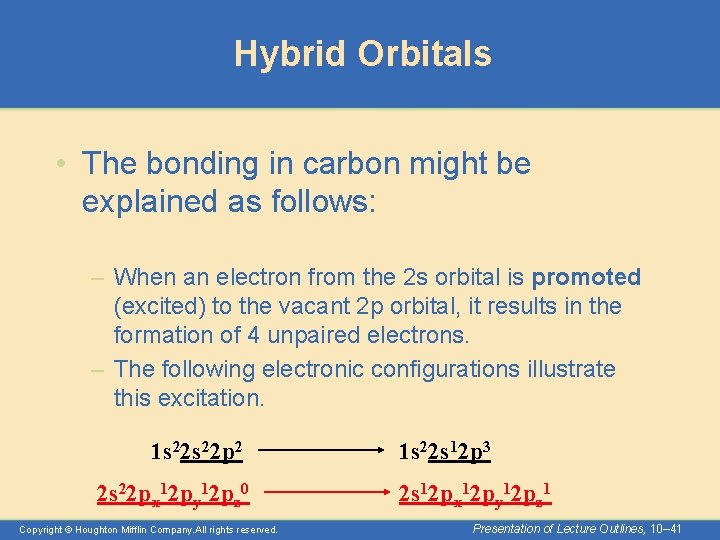
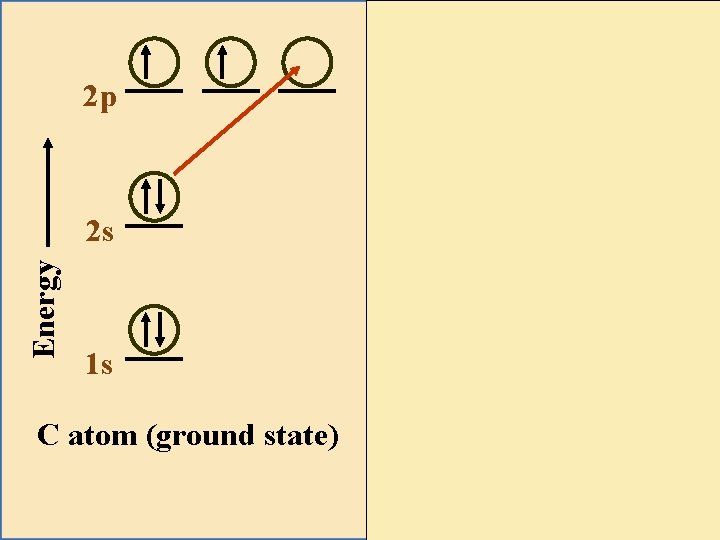
Hybrid Orbitals • The bonding in carbon might be explained as follows: – When an electron from the 2 s orbital is promoted (excited) to the vacant 2 p orbital, it results in the formation of 4 unpaired electrons. – The following electronic configurations illustrate this excitation. 1 s 22 p 2 2 s 22 px 12 py 12 pz 0 Copyright © Houghton Mifflin Company. All rights reserved. 1 s 22 s 12 p 3 2 s 12 px 12 py 12 pz 1 Presentation of Lecture Outlines, 10– 41
Energy 2 p 2 p 2 s 2 s 1 s 1 s C atom (ground state) C atom (promoted)
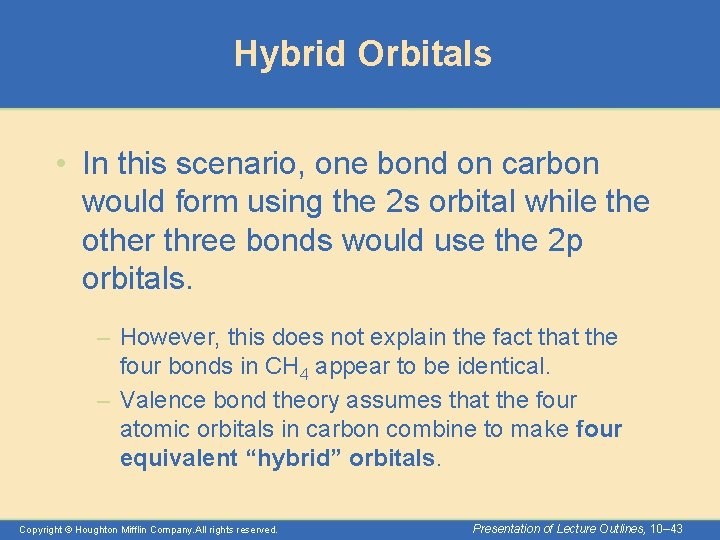
Hybrid Orbitals • In this scenario, one bond on carbon would form using the 2 s orbital while the other three bonds would use the 2 p orbitals. – However, this does not explain the fact that the four bonds in CH 4 appear to be identical. – Valence bond theory assumes that the four atomic orbitals in carbon combine to make four equivalent “hybrid” orbitals. Copyright © Houghton Mifflin Company. All rights reserved. Presentation of Lecture Outlines, 10– 43
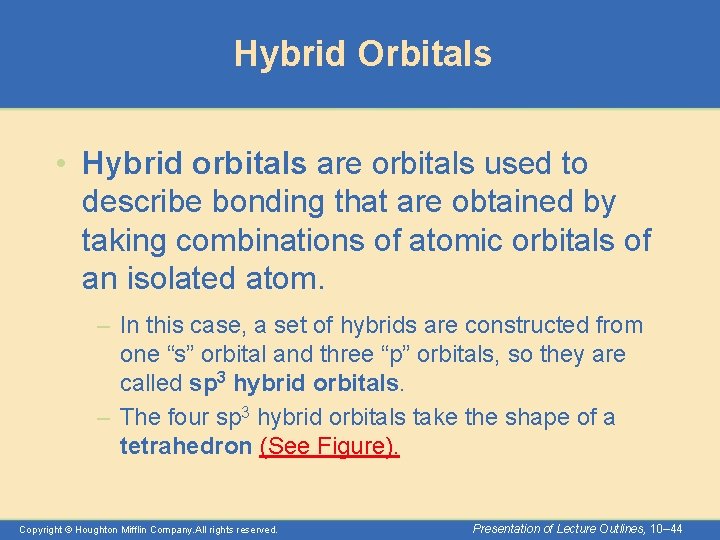
Hybrid Orbitals • Hybrid orbitals are orbitals used to describe bonding that are obtained by taking combinations of atomic orbitals of an isolated atom. – In this case, a set of hybrids are constructed from one “s” orbital and three “p” orbitals, so they are called sp 3 hybrid orbitals. – The four sp 3 hybrid orbitals take the shape of a tetrahedron (See Figure). Copyright © Houghton Mifflin Company. All rights reserved. Presentation of Lecture Outlines, 10– 44
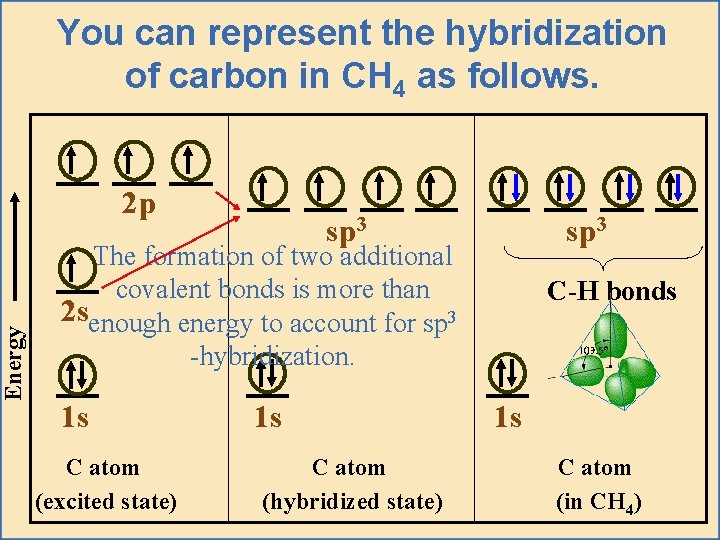
Energy You can represent the hybridization of carbon in CH 4 as follows. 2 p sp 3 The formation of two additional covalent bonds is more than 2 senough energy to account for sp 3 -hybridization. 1 s C atom (excited state) 1 s C atom (hybridized state) C-H bonds 1 s C atom (in CH 4)
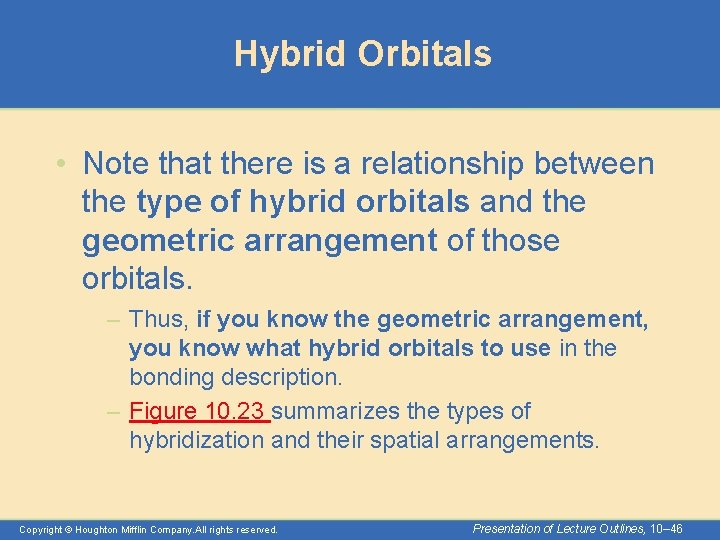
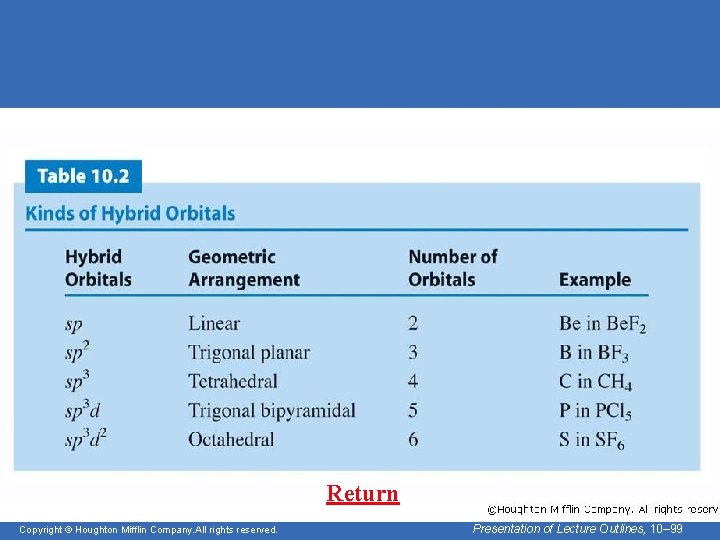
Hybrid Orbitals • Note that there is a relationship between the type of hybrid orbitals and the geometric arrangement of those orbitals. – Thus, if you know the geometric arrangement, you know what hybrid orbitals to use in the bonding description. – Figure 10. 23 summarizes the types of hybridization and their spatial arrangements. Copyright © Houghton Mifflin Company. All rights reserved. Presentation of Lecture Outlines, 10– 46
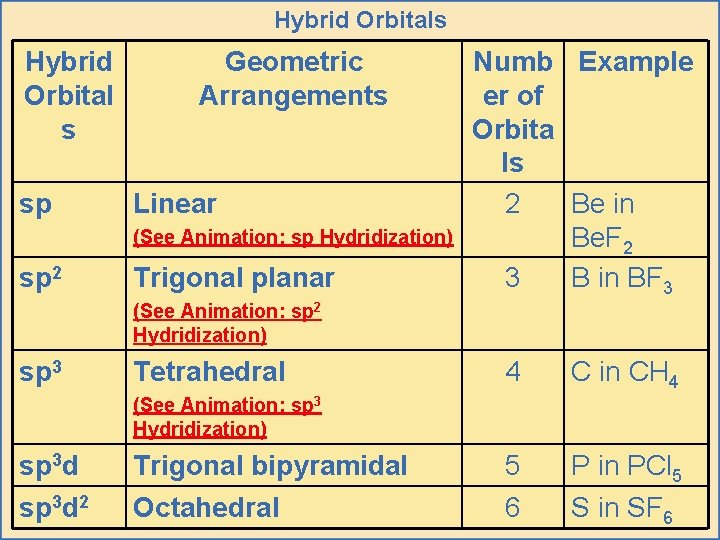
Hybrid Orbitals Hybrid Orbital s sp Geometric Arrangements Linear (See Animation: sp Hydridization) sp 2 Trigonal planar Numb Example er of Orbita ls 2 Be in Be. F 2 3 B in BF 3 (See Animation: sp 2 Hydridization) sp 3 Tetrahedral 4 C in CH 4 (See Animation: sp 3 Hydridization) sp 3 d Trigonal bipyramidal 5 P in PCl 5 sp 3 d 2 Octahedral 6 S in SF 6
Hybrid Orbitals • To obtain the bonding description of any atom in a molecule, you proceed as follows: 1. Write the Lewis electron-dot formula for the molecule. 2. From the Lewis formula, use the VSEPR theory to determine the arrangement of electron pairs around the atom. Copyright © Houghton Mifflin Company. All rights reserved. Presentation of Lecture Outlines, 10– 48
Hybrid Orbitals • To obtain the bonding description of any atom in a molecule, you proceed as follows: 3. From the geometric arrangement of the electron pairs, obtain the hybridization type (see Table 10. 2). 4. Assign valence electrons to the hybrid orbitals of this atom one at a time, pairing only when necessary. Copyright © Houghton Mifflin Company. All rights reserved. Presentation of Lecture Outlines, 10– 49
Hybrid Orbitals • To obtain the bonding description of any atom in a molecule, you proceed as follows: 5. Form bonds to this atom by overlapping singly occupied orbitals of other atoms with the singly occupied hybrid orbitals of this atom. Copyright © Houghton Mifflin Company. All rights reserved. Presentation of Lecture Outlines, 10– 50
A Problem to Consider • Describe the bonding in H 2 O according to valence bond theory. Assume that the molecular geometry is the same as given by the VSEPR model. – From the Lewis formula for a molecule, determine its geometry about the central atom using the VSEPR model. Copyright © Houghton Mifflin Company. All rights reserved. Presentation of Lecture Outlines, 10– 51
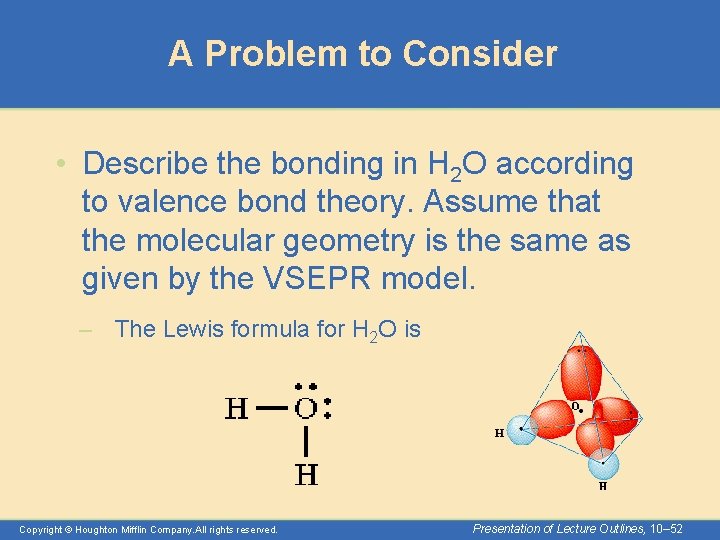
A Problem to Consider • Describe the bonding in H 2 O according to valence bond theory. Assume that the molecular geometry is the same as given by the VSEPR model. – The Lewis formula for H 2 O is Copyright © Houghton Mifflin Company. All rights reserved. Presentation of Lecture Outlines, 10– 52
A Problem to Consider • Describe the bonding in H 2 O according to valence bond theory. Assume that the molecular geometry is the same as given by the VSEPR model. – From this geometry, determine the hybrid orbitals on this atom, assigning its valence electrons to these orbitals one at a time. Copyright © Houghton Mifflin Company. All rights reserved. Presentation of Lecture Outlines, 10– 53
A Problem to Consider • Describe the bonding in H 2 O according to valence bond theory. Assume that the molecular geometry is the same as given by the VSEPR model. – Note that there are four pairs of electrons about the oxygen atom. – According to the VSEPR model, these are directed tetrahedrally, and from the previous table you see that you should use sp 3 hybrid orbitals. Copyright © Houghton Mifflin Company. All rights reserved. Presentation of Lecture Outlines, 10– 54
A Problem to Consider • Describe the bonding in H 2 O according to valence bond theory. Assume that the molecular geometry is the same as given by the VSEPR model. – Each O-H bond is formed by the overlap of a 1 s orbital of a hydrogen atom with one of the singly occupied sp 3 hybrid orbitals of the oxygen atom. Copyright © Houghton Mifflin Company. All rights reserved. Presentation of Lecture Outlines, 10– 55
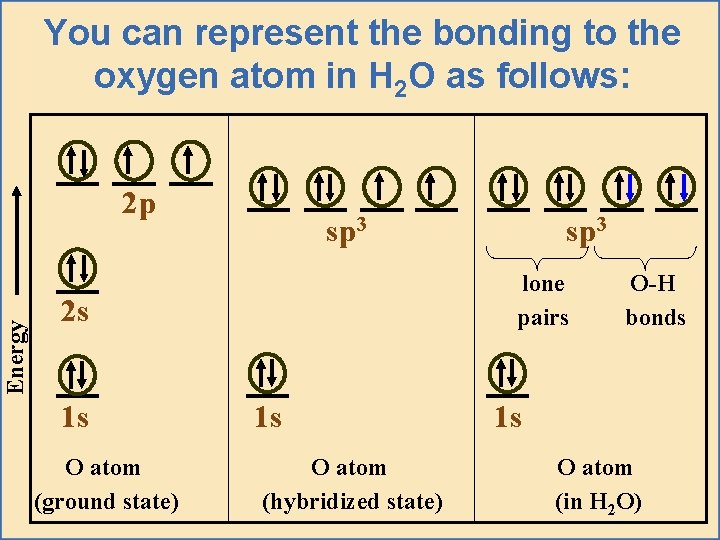
You can represent the bonding to the oxygen atom in H 2 O as follows: Energy 2 p sp 3 lone pairs 2 s 1 s O atom (ground state) sp 3 1 s O atom (hybridized state) O-H bonds 1 s O atom (in H 2 O)
A Problem to Consider • Describe the bonding in Xe. F 4 using hybrid orbitals. – From the Lewis formula for a molecule, determine its geometry about the central atom using the VSEPR model. Copyright © Houghton Mifflin Company. All rights reserved. Presentation of Lecture Outlines, 10– 57
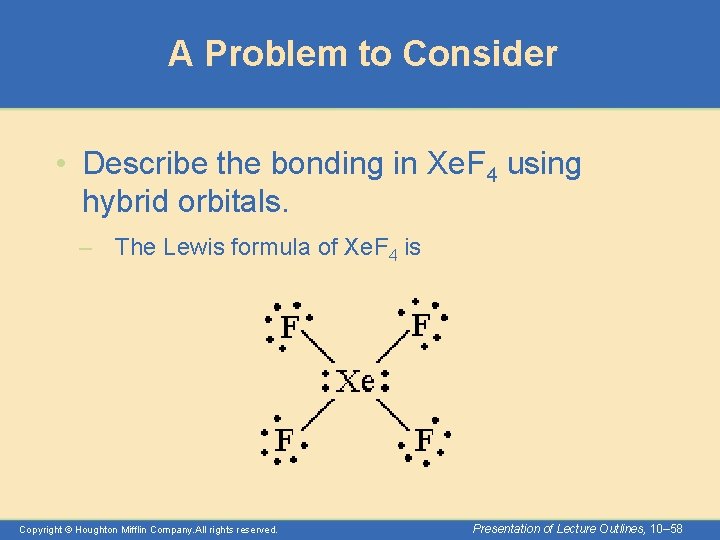
A Problem to Consider • Describe the bonding in Xe. F 4 using hybrid orbitals. – The Lewis formula of Xe. F 4 is Copyright © Houghton Mifflin Company. All rights reserved. Presentation of Lecture Outlines, 10– 58
A Problem to Consider • Describe the bonding in Xe. F 4 using hybrid orbitals. – From this geometry, determine the hybrid orbitals on this atom, assigning its valence electrons to these orbitals one at a time. Copyright © Houghton Mifflin Company. All rights reserved. Presentation of Lecture Outlines, 10– 59
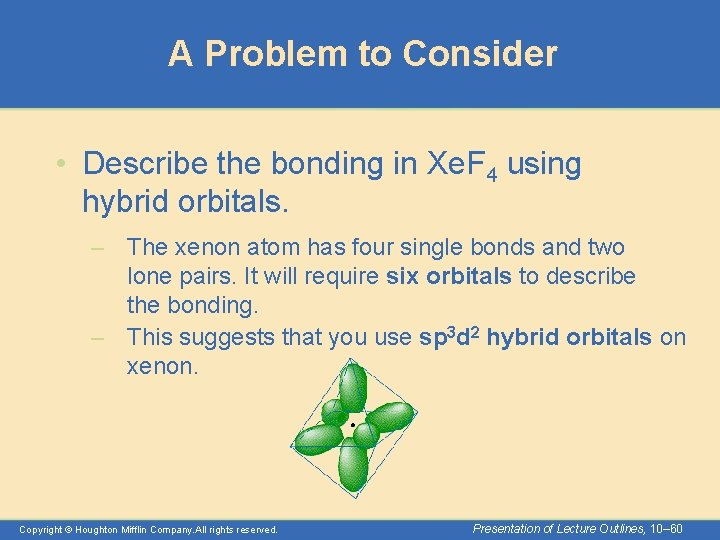
A Problem to Consider • Describe the bonding in Xe. F 4 using hybrid orbitals. – The xenon atom has four single bonds and two lone pairs. It will require six orbitals to describe the bonding. – This suggests that you use sp 3 d 2 hybrid orbitals on xenon. Copyright © Houghton Mifflin Company. All rights reserved. Presentation of Lecture Outlines, 10– 60
A Problem to Consider • Describe the bonding in Xe. F 4 using hybrid orbitals. – Each Xe-F bond is formed by the overlap of a xenon sp 3 d 2 hybrid orbital with a singly occupied fluorine 2 p orbital. – You can summarize this as follows: Copyright © Houghton Mifflin Company. All rights reserved. Presentation of Lecture Outlines, 10– 61
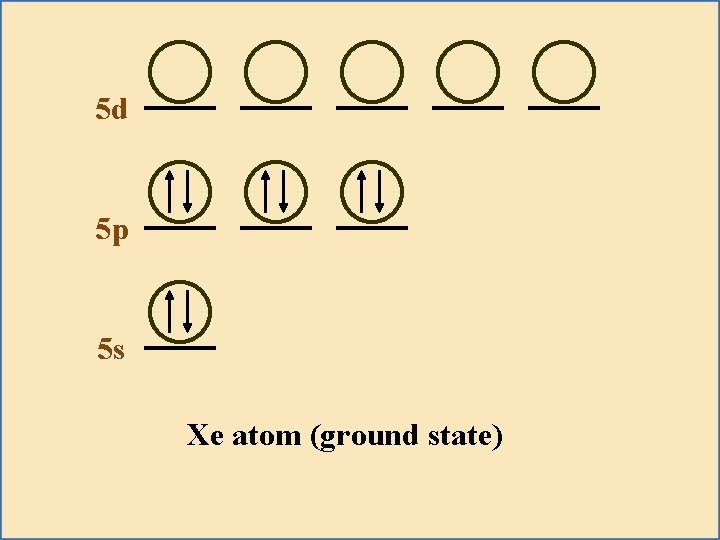
5 d 5 p 5 s Xe atom (ground state)
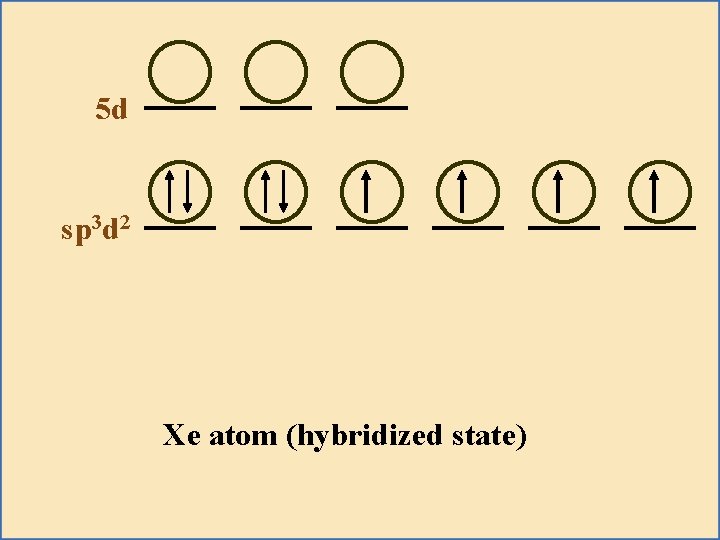
5 d sp 3 d 2 Xe atom (hybridized state)
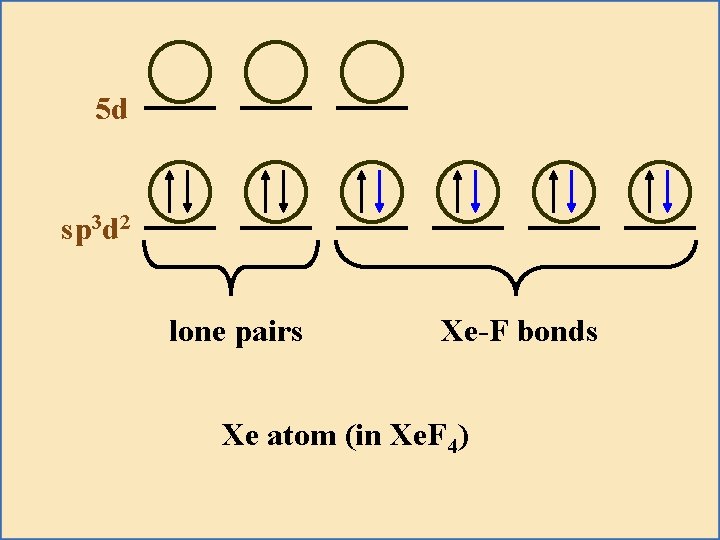
5 d sp 3 d 2 lone pairs Xe-F bonds Xe atom (in Xe. F 4)
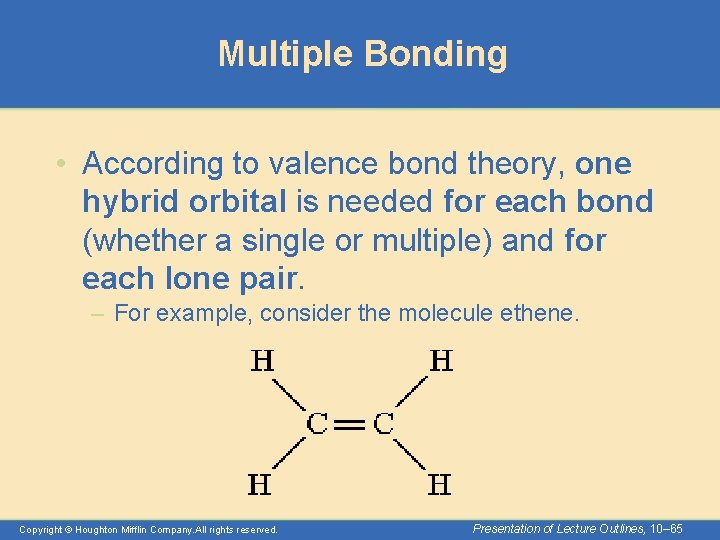
Multiple Bonding • According to valence bond theory, one hybrid orbital is needed for each bond (whether a single or multiple) and for each lone pair. – For example, consider the molecule ethene. Copyright © Houghton Mifflin Company. All rights reserved. Presentation of Lecture Outlines, 10– 65
Multiple Bonding • Each carbon atom is bonded to three other atoms and no lone pairs, which indicates the need for three hybrid orbitals. – This implies sp 2 hybridization. – The third 2 p orbital is left unhybridized and lies perpendicular to the plane of the trigonal sp 2 hybrids. – The following slide represents the sp 2 hybridization of the carbon atoms. Copyright © Houghton Mifflin Company. All rights reserved. Presentation of Lecture Outlines, 10– 66
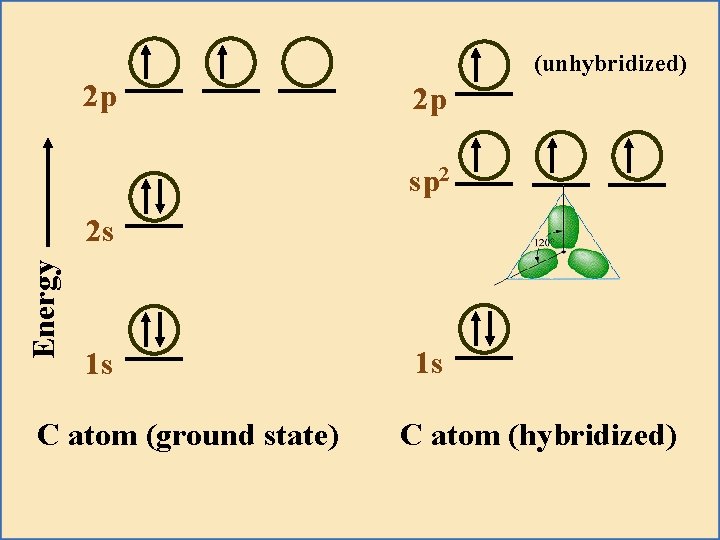
(unhybridized) 2 p 2 p sp 2 Energy 2 s 1 s C atom (ground state) 1 s C atom (hybridized)
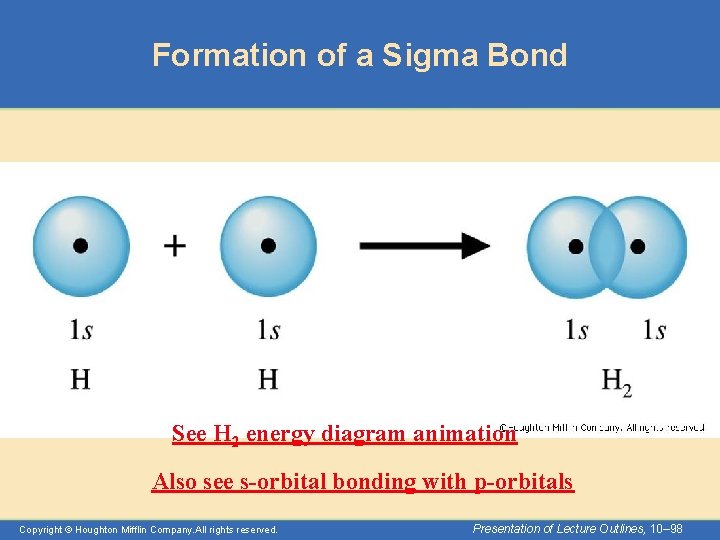
Multiple Bonding • To describe the multiple bonding in ethene, we must first distinguish between two kinds of bonds. – A s (sigma) bond is a “head-to-head” overlap of orbitals with a cylindrical shape about the bond axis. This occurs when two “s” orbitals overlap or “p” orbitals overlap along their axis. – A p (pi) bond is a “side-to-side” overlap of parallel “p” orbitals, creating an electron distribution above and below the bond axis. (See Animation: Carbon-Carbon Double Bond) Copyright © Houghton Mifflin Company. All rights reserved. Presentation of Lecture Outlines, 10– 68
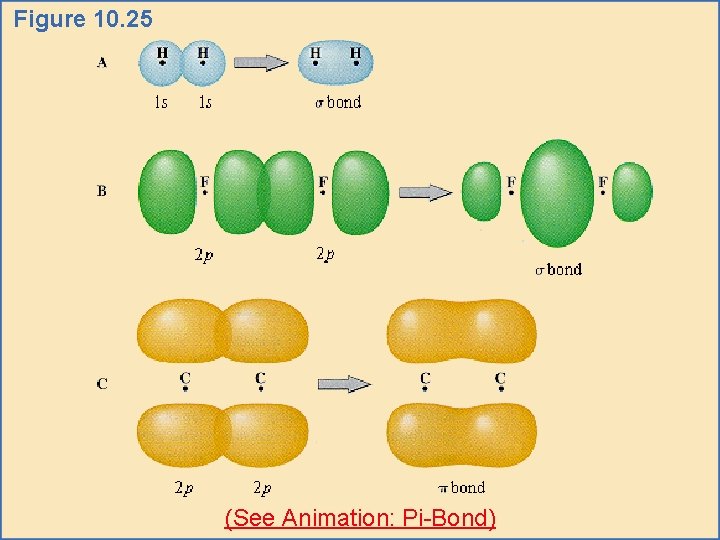
Figure 10. 25 (See Animation: Pi-Bond)
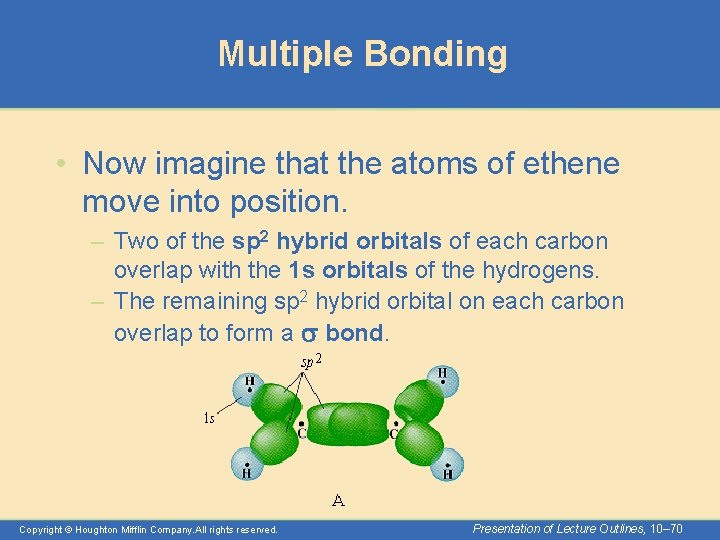
Multiple Bonding • Now imagine that the atoms of ethene move into position. – Two of the sp 2 hybrid orbitals of each carbon overlap with the 1 s orbitals of the hydrogens. – The remaining sp 2 hybrid orbital on each carbon overlap to form a s bond. Copyright © Houghton Mifflin Company. All rights reserved. Presentation of Lecture Outlines, 10– 70
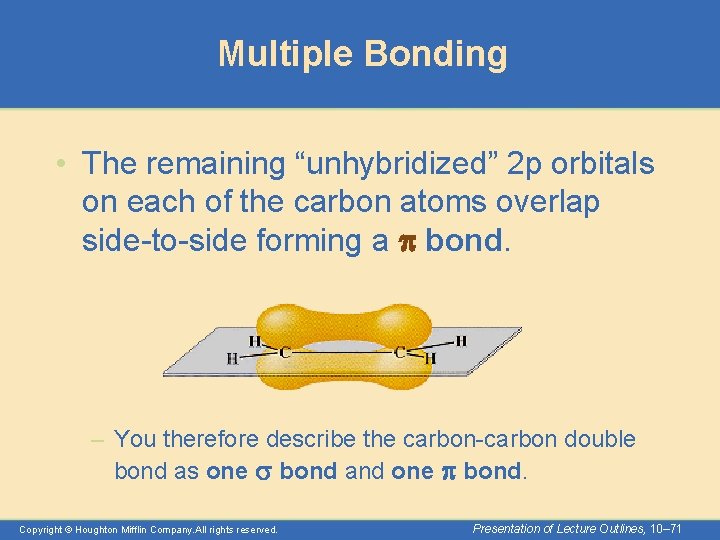
Multiple Bonding • The remaining “unhybridized” 2 p orbitals on each of the carbon atoms overlap side-to-side forming a p bond. – You therefore describe the carbon-carbon double bond as one s bond and one p bond. Copyright © Houghton Mifflin Company. All rights reserved. Presentation of Lecture Outlines, 10– 71
Molecular Orbital Theory • Molecular orbital theory is a theory of the electronic structure of molecules in terms of molecular orbitals, which may spread over several atoms or the entire molecule. – As atoms approach each other and their atomic orbitals overlap, molecular orbitals are formed. – In the quantum mechanical view, both a bonding and an antibonding molecular orbital are formed. Copyright © Houghton Mifflin Company. All rights reserved. Presentation of Lecture Outlines, 10– 72
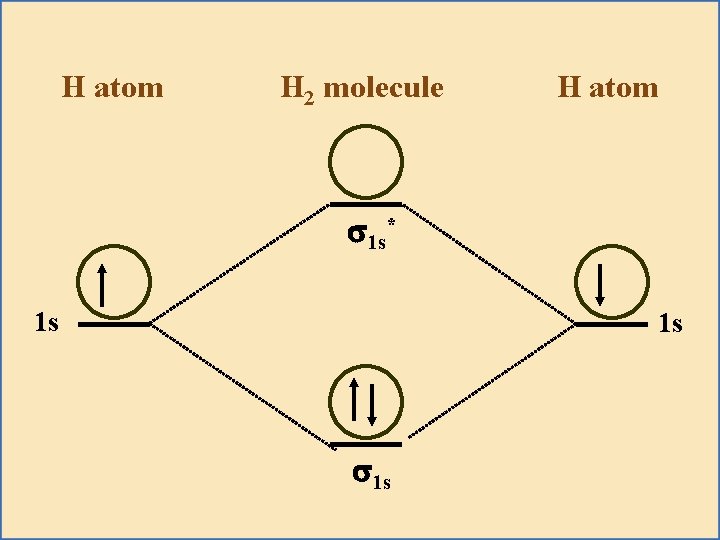
Molecular Orbital Theory • For example, when two hydrogen atoms bond, a s 1 s (bonding) molecular orbital is formed as well as a s 1 s * (antibonding) molecular orbital. (animation only runs from CD) – The following slide illustrates the relative energies of the molecular orbitals compared to the original atomic orbitals. – Because the energy of the two electrons is lower than the energy of the individual atoms, the molecule is stable. Copyright © Houghton Mifflin Company. All rights reserved. Presentation of Lecture Outlines, 10– 73
H atom H 2 molecule H atom s 1 s* 1 s 1 s
Bond Order • The term bond order refers to the number of bonds that exist between two atoms. – The bond order of a diatomic molecule is defined as one-half the difference between the number of electrons in bonding orbitals, nb, and the number of electrons in antibonding orbitals, na. Copyright © Houghton Mifflin Company. All rights reserved. Presentation of Lecture Outlines, 10– 75
Electronic Configurations of Diatomic Molecules • In heteronuclear diatomic molecules, such as CO or NO, we must have additional molecular orbitals. – The overlap of “p” orbitals results in two sets of s orbitals (two bonding and two antibonding) and one set of p orbitals (one bonding and one antibonding). (See Animation: Pi Bond and Antibond). – The next slide illustrates the relative energies of these molecular orbitals. Copyright © Houghton Mifflin Company. All rights reserved. Presentation of Lecture Outlines, 10– 76
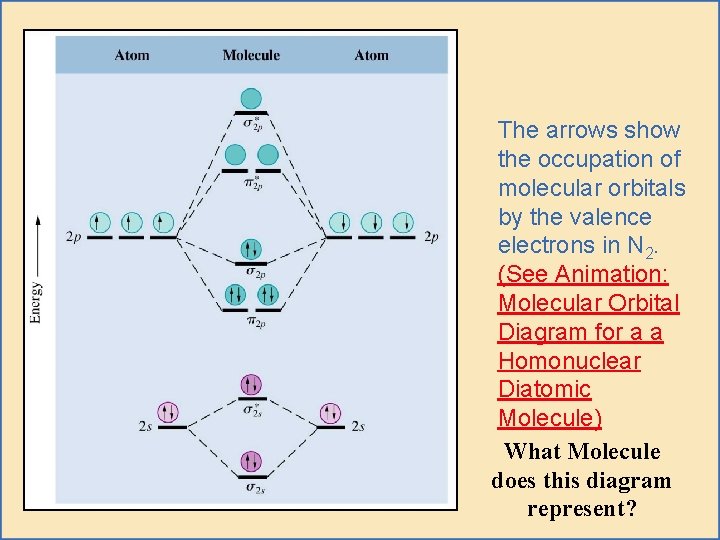
The arrows show the occupation of molecular orbitals by the valence electrons in N 2. (See Animation: Molecular Orbital Diagram for a a Homonuclear Diatomic Molecule) What Molecule does this diagram represent?
Practice Problems Chapter 10 27, 29, 37, 43, 55, 56 (draw energy level diagrams, and calculate bond order) 67, 68, 71, 77, 73, 88 I will do 79, as an example, class should draw MO diagrams for both products. Copyright © Houghton Mifflin Company. All rights reserved. Presentation of Lecture Outlines, 10– 78
Operational Skills • Predicting molecular geometries. • Relating dipole moment and molecular geometry. • Applying valence bond theory. • Describing molecular orbital configurations. Copyright © Houghton Mifflin Company. All rights reserved. Presentation of Lecture Outlines, 10– 79
Animation: Electron Pair Repulsion, 2 Pairs (Click here to open Quick. Time animation) Return to Slide 6 Copyright © Houghton Mifflin Company. All rights reserved. Presentation of Lecture Outlines, 10– 80
Animation: Electron Pair Repulsion, 3 Pairs (Click here to open Quick. Time animation) Return to Slide 6 Copyright © Houghton Mifflin Company. All rights reserved. Presentation of Lecture Outlines, 10– 81
Animation: Electron Pair Repulsion, 4 Pairs (Click here to open Quick. Time animation) Return to Slide 6 Copyright © Houghton Mifflin Company. All rights reserved. Presentation of Lecture Outlines, 10– 82
Animation: Iodine Peutafluoride Structure (Click here to open Quick. Time animation) Return to Slide 25 Copyright © Houghton Mifflin Company. All rights reserved. Presentation of Lecture Outlines, 10– 83
Animation: Polar Molecules (Click here to open Quick. Time animation) Return to Slide 28 Copyright © Houghton Mifflin Company. All rights reserved. Presentation of Lecture Outlines, 10– 84
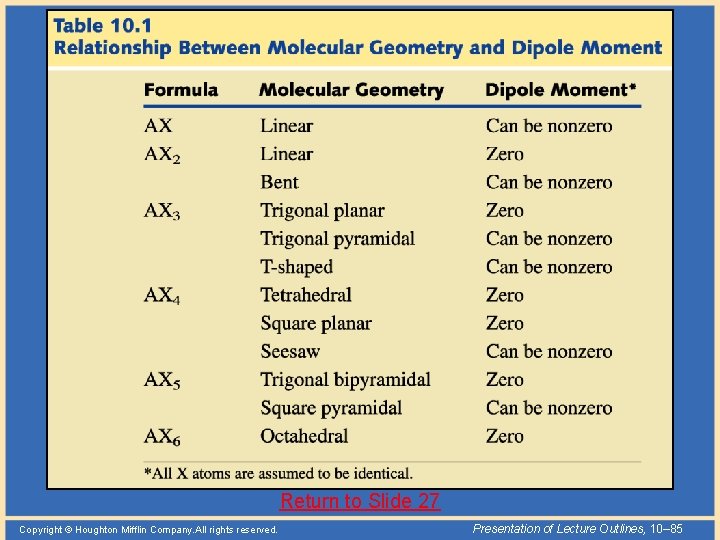
Return to Slide 27 Copyright © Houghton Mifflin Company. All rights reserved. Presentation of Lecture Outlines, 10– 85
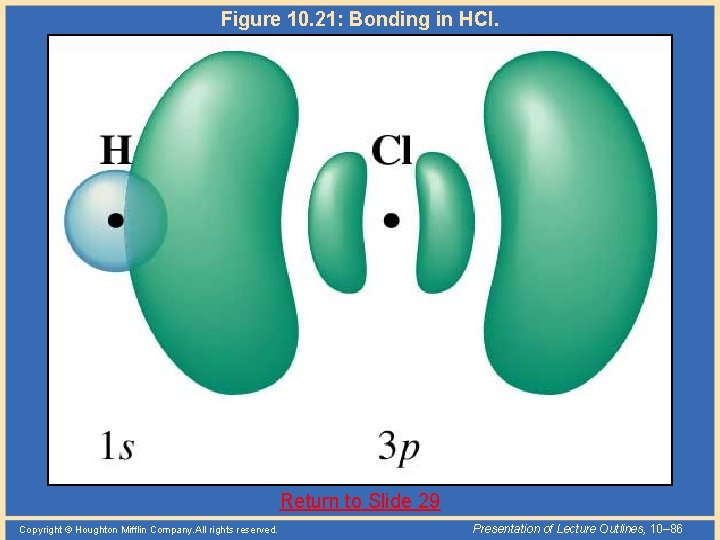
Figure 10. 21: Bonding in HCl. Return to Slide 29 Copyright © Houghton Mifflin Company. All rights reserved. Presentation of Lecture Outlines, 10– 86
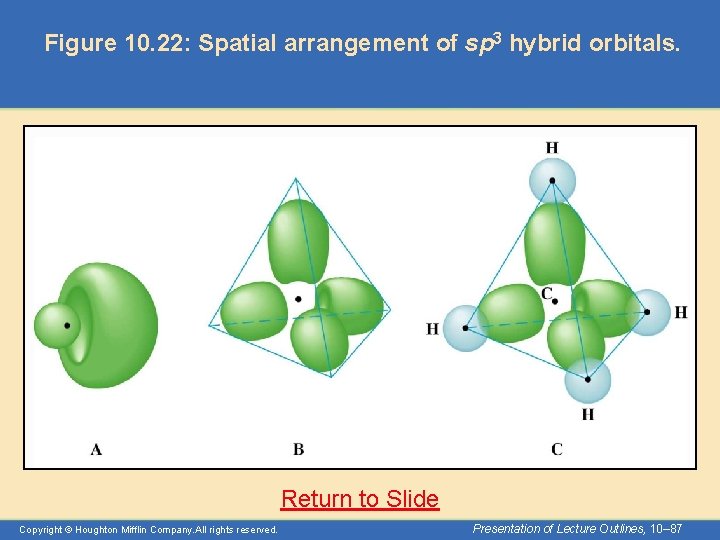
Figure 10. 22: Spatial arrangement of sp 3 hybrid orbitals. Return to Slide Copyright © Houghton Mifflin Company. All rights reserved. Presentation of Lecture Outlines, 10– 87
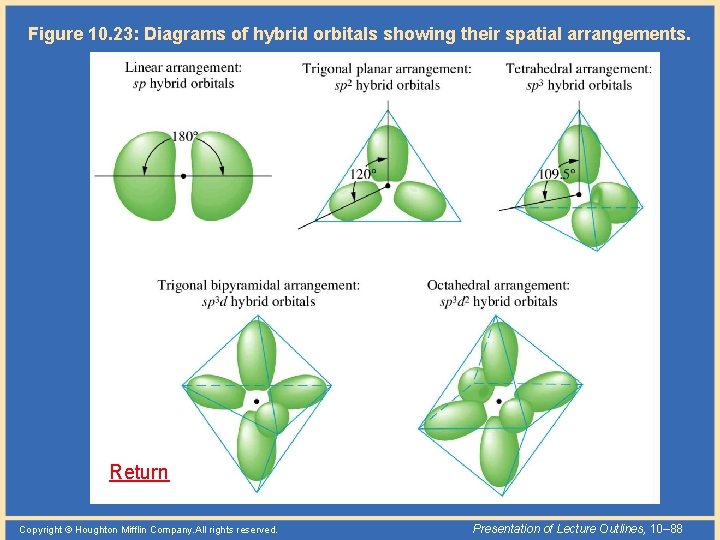
Figure 10. 23: Diagrams of hybrid orbitals showing their spatial arrangements. Return Copyright © Houghton Mifflin Company. All rights reserved. Presentation of Lecture Outlines, 10– 88
Animation: sp Hydridization (Click here to open Quick. Time animation) Return to Slide 37 Copyright © Houghton Mifflin Company. All rights reserved. Presentation of Lecture Outlines, 10– 89
Animation: sp 2 Hydridization (Click here to open Quick. Time animation) Return to Slide 37 Copyright © Houghton Mifflin Company. All rights reserved. Presentation of Lecture Outlines, 10– 90
Animation: sp 3 Hydridization (Click here to open Quick. Time animation) Return to Slide 37 Copyright © Houghton Mifflin Company. All rights reserved. Presentation of Lecture Outlines, 10– 91
Animation: Carbon-Carbon Double Bond (Click here to open Quick. Time animation) Return to Slide 58 Copyright © Houghton Mifflin Company. All rights reserved. Presentation of Lecture Outlines, 10– 92
Animation: Pi-Bond (Click here to open Quick. Time animation) Return to Slide 59 Copyright © Houghton Mifflin Company. All rights reserved. Presentation of Lecture Outlines, 10– 93
Animation: s. Orbitals/Bonding and Anti-Bonding (Click here to open Quick. Time animation) Return to Slide 63 Copyright © Houghton Mifflin Company. All rights reserved. Presentation of Lecture Outlines, 10– 94
Animation: Pi Bond and Antibond (Click here to open Quick. Time animation) Return to Slide 66 Copyright © Houghton Mifflin Company. All rights reserved. Presentation of Lecture Outlines, 10– 95
Animation: Molecular Orbital Diagram for a Homonuclear Diatomic Molecule (Click here to open Quick. Time animation) Return to Slide 67 Copyright © Houghton Mifflin Company. All rights reserved. Presentation of Lecture Outlines, 10– 96
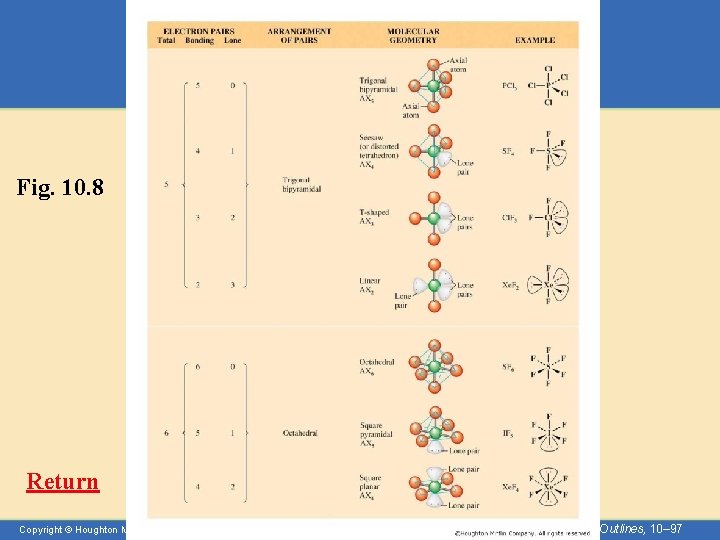
Fig. 10. 8 Return Copyright © Houghton Mifflin Company. All rights reserved. Presentation of Lecture Outlines, 10– 97
Formation of a Sigma Bond See H 2 energy diagram animation Also see s-orbital bonding with p-orbitals Copyright © Houghton Mifflin Company. All rights reserved. Presentation of Lecture Outlines, 10– 98
Return Copyright © Houghton Mifflin Company. All rights reserved. Presentation of Lecture Outlines, 10– 99
- Slides: 99