
MOLECULAR FORMULAS Chemistry 10 2014 2015 MOLECULAR FORMULAS

- Slides: 16
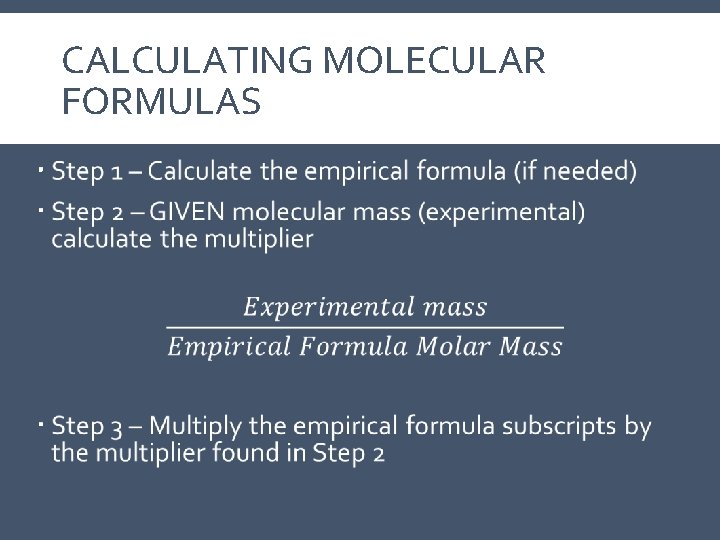
MOLECULAR FORMULAS Chemistry 10 2014 -2015
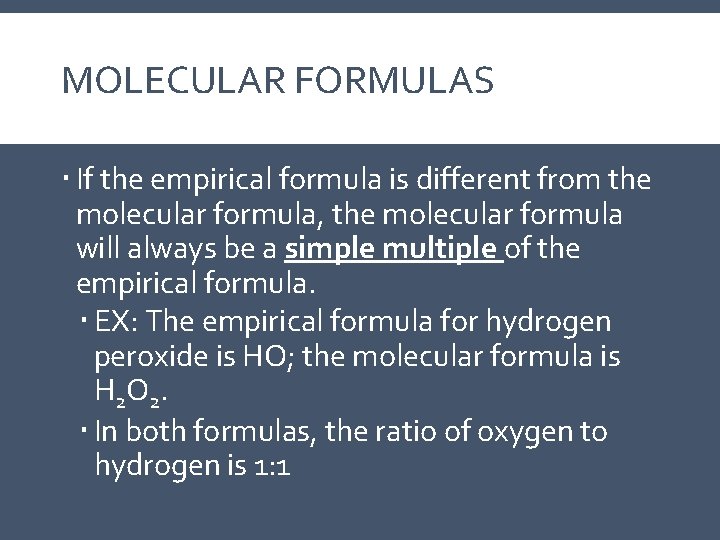
MOLECULAR FORMULAS If the empirical formula is different from the molecular formula, the molecular formula will always be a simple multiple of the empirical formula. EX: The empirical formula for hydrogen peroxide is HO; the molecular formula is H 2 O 2. In both formulas, the ratio of oxygen to hydrogen is 1: 1
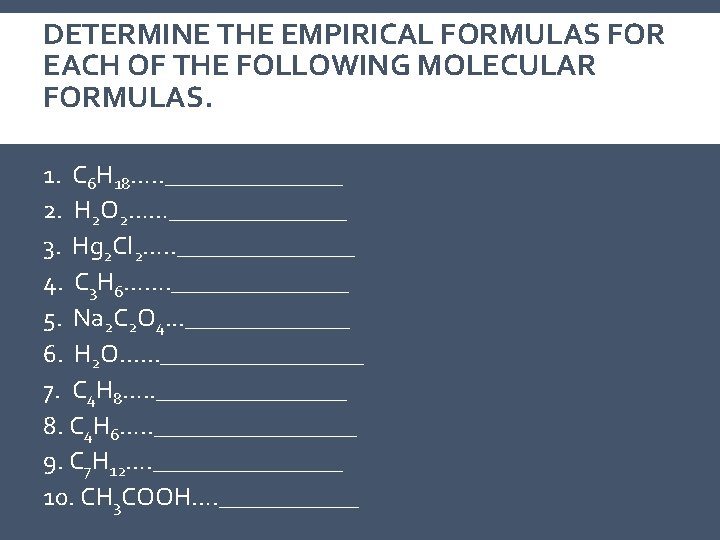
DETERMINE THE EMPIRICAL FORMULAS FOR EACH OF THE FOLLOWING MOLECULAR FORMULAS. 1. C 6 H 18…. . _______ 2. H 2 O 2……_______ 3. Hg 2 Cl 2…. . _______ 4. C 3 H 6……. _______ 5. Na 2 C 2 O 4. . . _______ 6. H 2 O. . . ________ 7. C 4 H 8…. . ________ 8. C 4 H 6…. . ________ 9. C 7 H 12…. ________ 10. CH 3 COOH…. ______
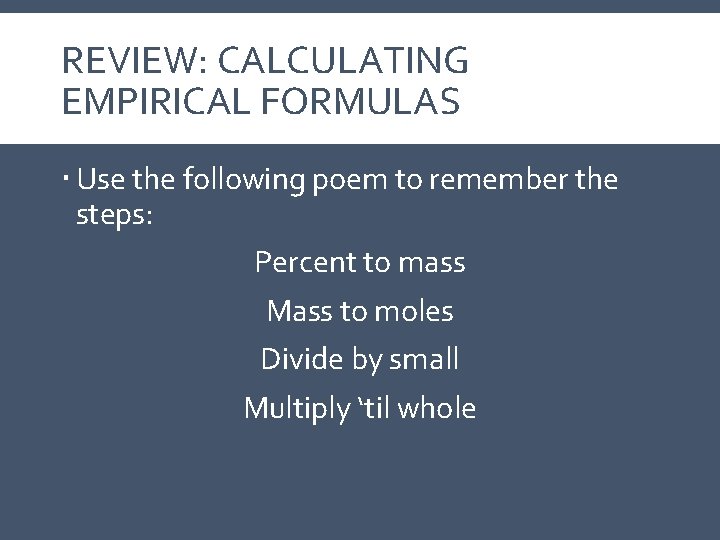
REVIEW: CALCULATING EMPIRICAL FORMULAS Use the following poem to remember the steps: Percent to mass Mass to moles Divide by small Multiply ‘til whole
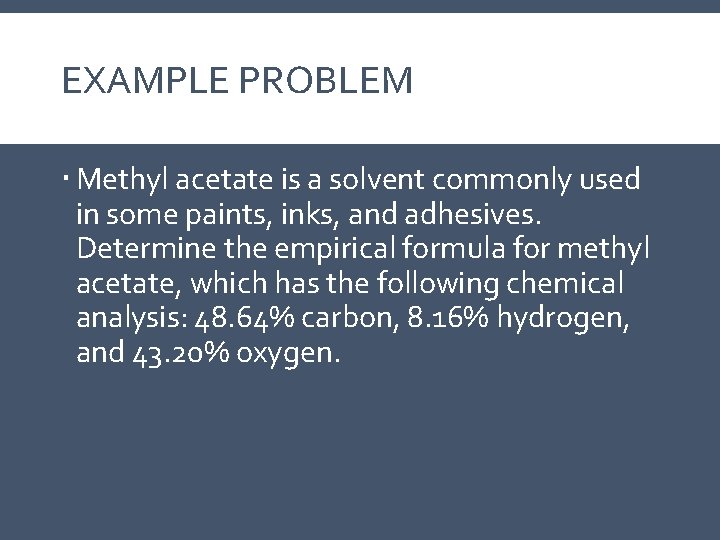
EXAMPLE PROBLEM Methyl acetate is a solvent commonly used in some paints, inks, and adhesives. Determine the empirical formula for methyl acetate, which has the following chemical analysis: 48. 64% carbon, 8. 16% hydrogen, and 43. 20% oxygen.
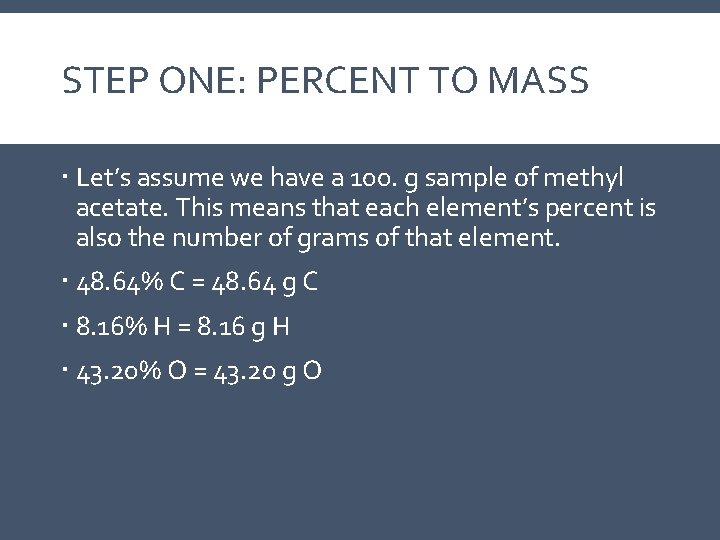
STEP ONE: PERCENT TO MASS Let’s assume we have a 100. g sample of methyl acetate. This means that each element’s percent is also the number of grams of that element. 48. 64% C = 48. 64 g C 8. 16% H = 8. 16 g H 43. 20% O = 43. 20 g O
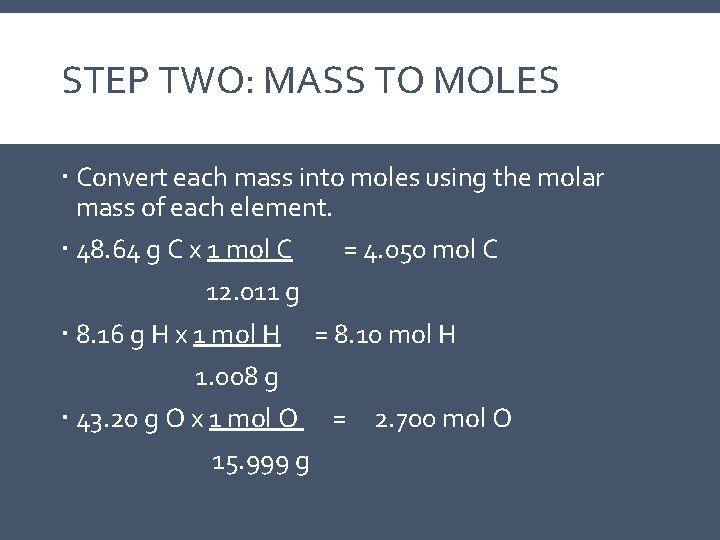
STEP TWO: MASS TO MOLES Convert each mass into moles using the molar mass of each element. 48. 64 g C x 1 mol C = 4. 050 mol C 12. 011 g 8. 16 g H x 1 mol H = 8. 10 mol H 1. 008 g 43. 20 g O x 1 mol O = 2. 700 mol O 15. 999 g
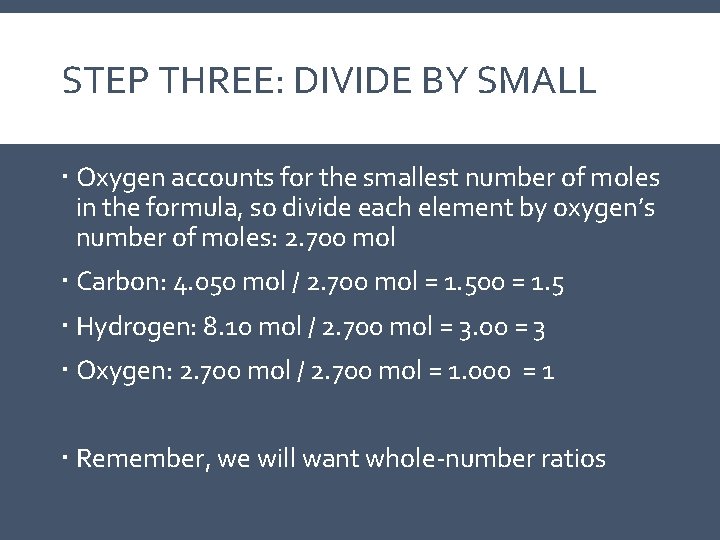
STEP THREE: DIVIDE BY SMALL Oxygen accounts for the smallest number of moles in the formula, so divide each element by oxygen’s number of moles: 2. 700 mol Carbon: 4. 050 mol / 2. 700 mol = 1. 500 = 1. 5 Hydrogen: 8. 10 mol / 2. 700 mol = 3. 00 = 3 Oxygen: 2. 700 mol / 2. 700 mol = 1. 000 = 1 Remember, we will want whole-number ratios
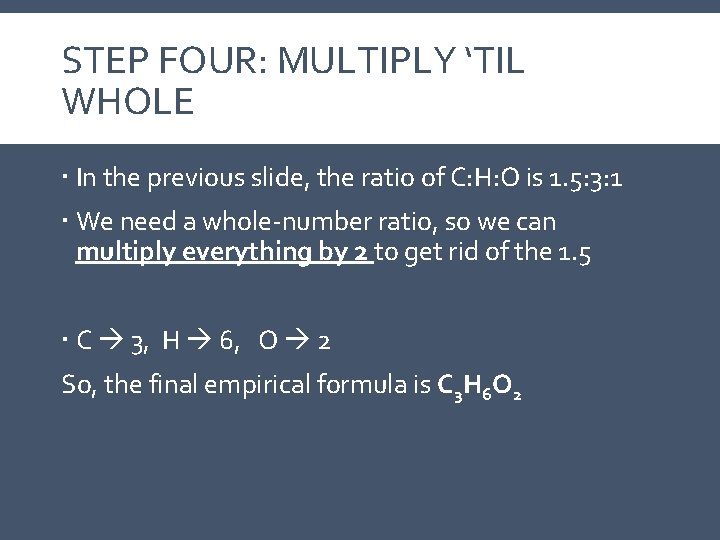
STEP FOUR: MULTIPLY ‘TIL WHOLE In the previous slide, the ratio of C: H: O is 1. 5: 3: 1 We need a whole-number ratio, so we can multiply everything by 2 to get rid of the 1. 5 C 3, H 6, O 2 So, the final empirical formula is C 3 H 6 O 2
CALCULATING MOLECULAR FORMULAS
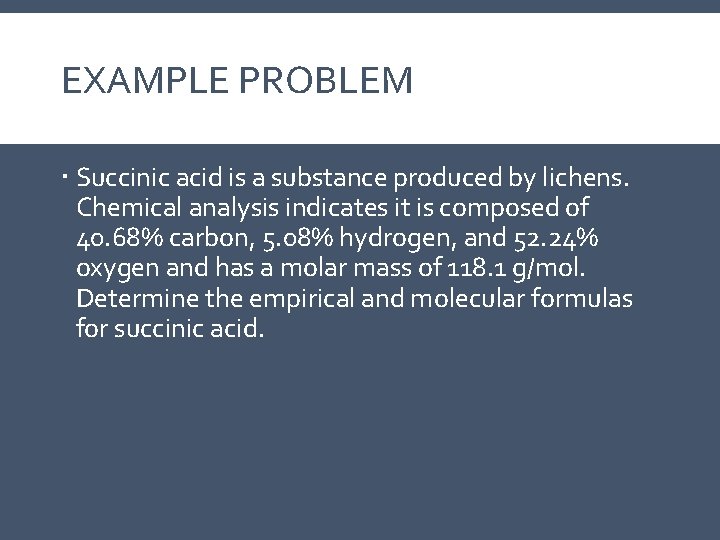
EXAMPLE PROBLEM Succinic acid is a substance produced by lichens. Chemical analysis indicates it is composed of 40. 68% carbon, 5. 08% hydrogen, and 52. 24% oxygen and has a molar mass of 118. 1 g/mol. Determine the empirical and molecular formulas for succinic acid.
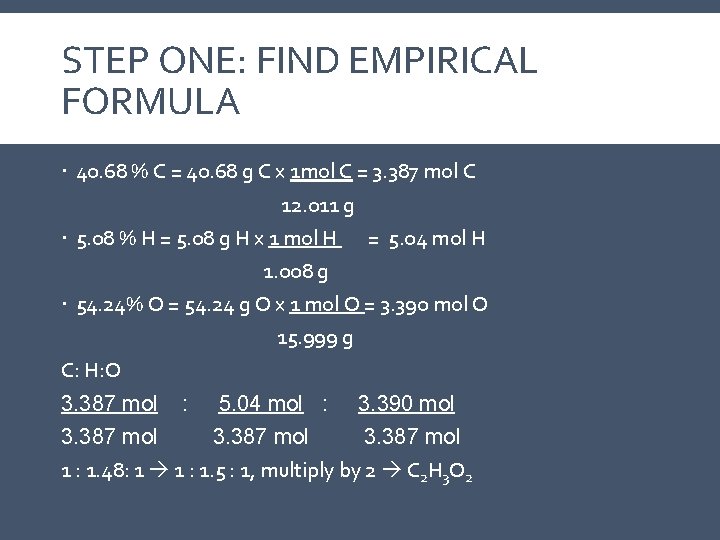
STEP ONE: FIND EMPIRICAL FORMULA 40. 68 % C = 40. 68 g C x 1 mol C = 3. 387 mol C 12. 011 g 5. 08 % H = 5. 08 g H x 1 mol H = 5. 04 mol H 1. 008 g 54. 24% O = 54. 24 g O x 1 mol O = 3. 390 mol O 15. 999 g C: H: O 3. 387 mol : 5. 04 mol : 3. 390 mol 3. 387 mol 1 : 1. 48: 1 1 : 1. 5 : 1, multiply by 2 C 2 H 3 O 2
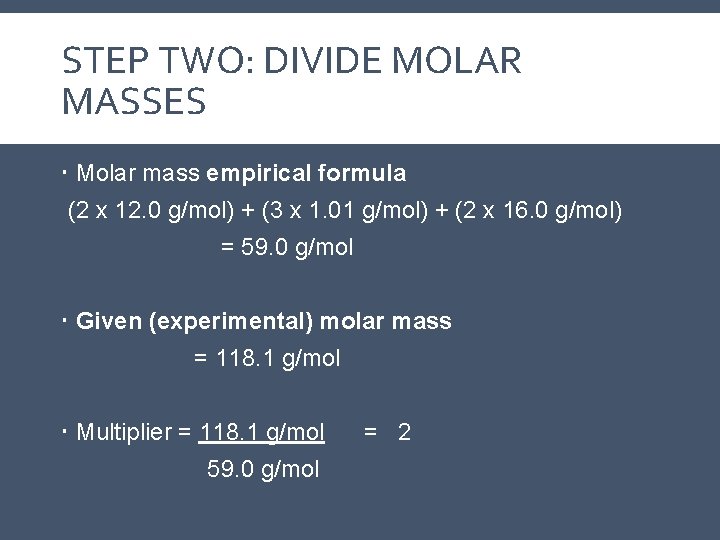
STEP TWO: DIVIDE MOLAR MASSES Molar mass empirical formula (2 x 12. 0 g/mol) + (3 x 1. 01 g/mol) + (2 x 16. 0 g/mol) = 59. 0 g/mol Given (experimental) molar mass = 118. 1 g/mol Multiplier = 118. 1 g/mol 59. 0 g/mol = 2
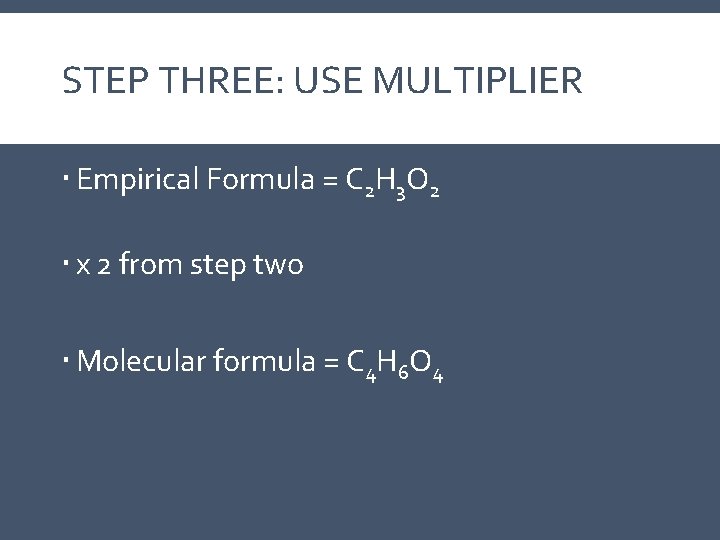
STEP THREE: USE MULTIPLIER Empirical Formula = C 2 H 3 O 2 x 2 from step two Molecular formula = C 4 H 6 O 4
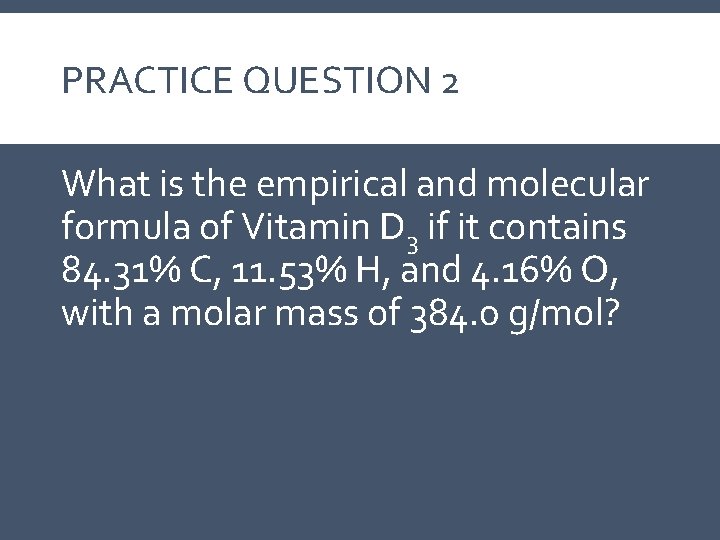
PRACTICE QUESTION 2 What is the empirical and molecular formula of Vitamin D 3 if it contains 84. 31% C, 11. 53% H, and 4. 16% O, with a molar mass of 384. 0 g/mol?
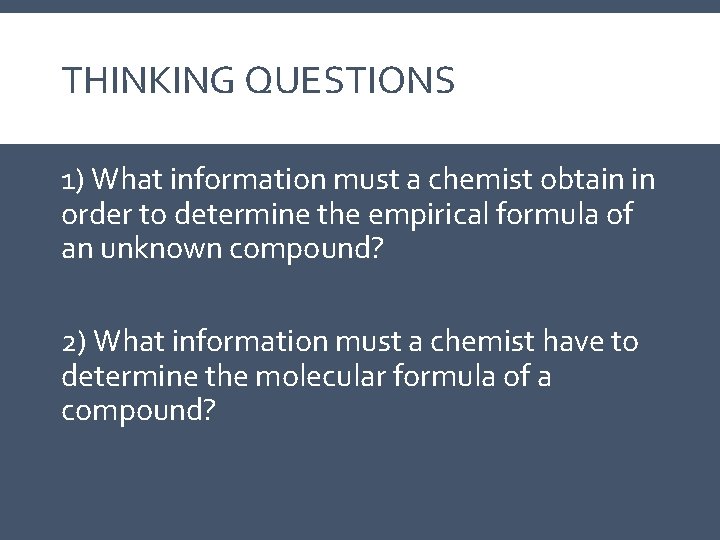
THINKING QUESTIONS 1) What information must a chemist obtain in order to determine the empirical formula of an unknown compound? 2) What information must a chemist have to determine the molecular formula of a compound?