
Molecular dynamics 2 Langevin dynamics NVT and NPT


- Slides: 26
Molecular dynamics (2) Langevin dynamics NVT and NPT ensembles
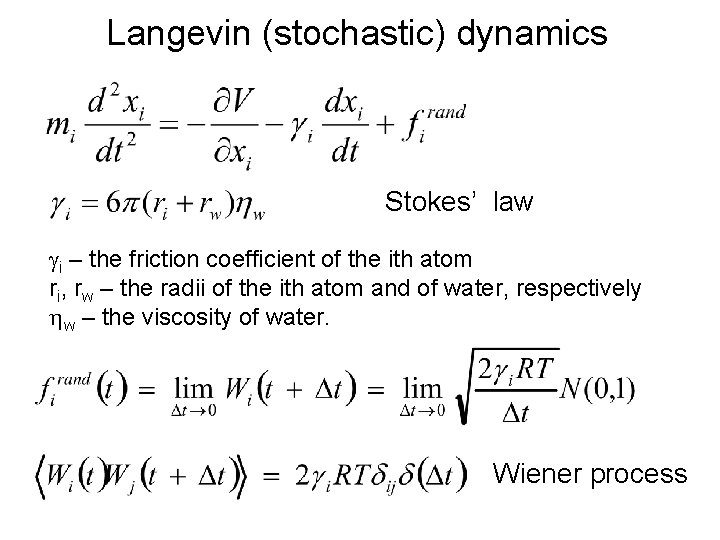
Langevin (stochastic) dynamics Stokes’ law gi – the friction coefficient of the ith atom ri, rw – the radii of the ith atom and of water, respectively hw – the viscosity of water. Wiener process
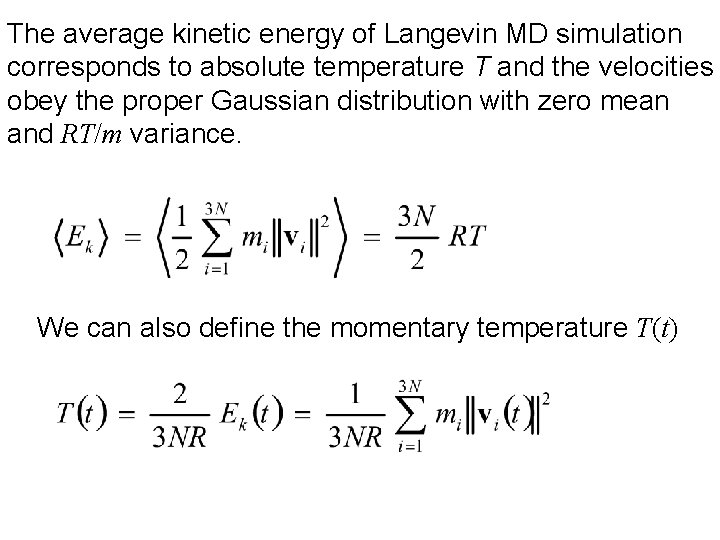
The average kinetic energy of Langevin MD simulation corresponds to absolute temperature T and the velocities obey the proper Gaussian distribution with zero mean and RT/m variance. We can also define the momentary temperature T(t)
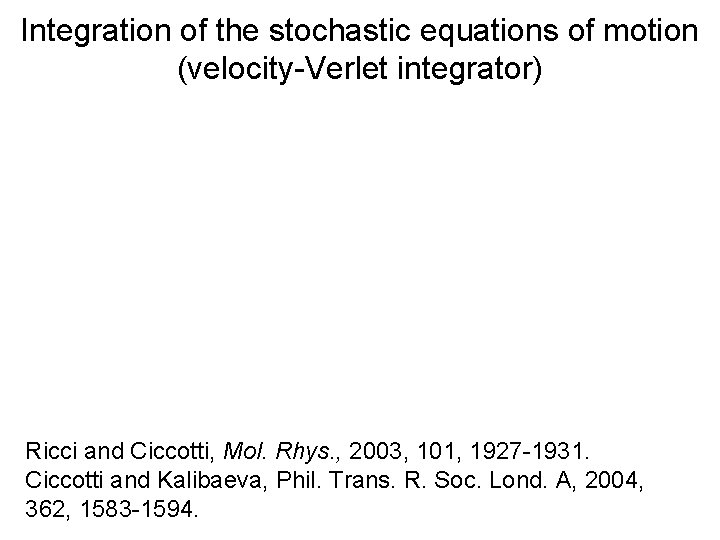
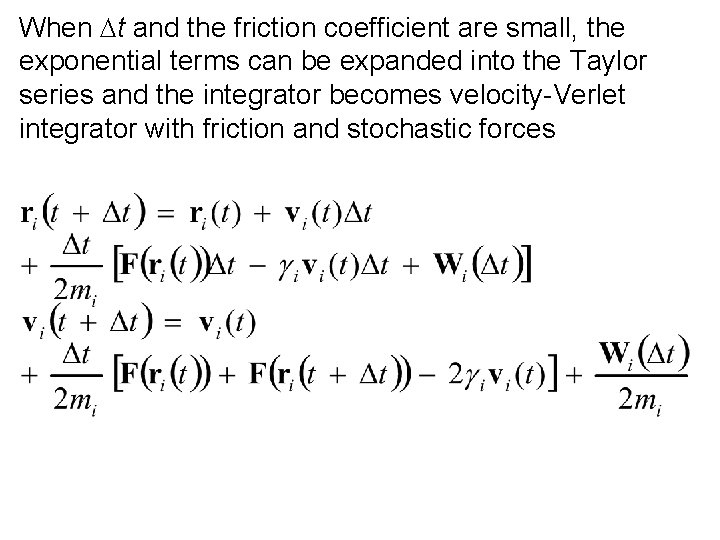
Integration of the stochastic equations of motion (velocity-Verlet integrator) Ricci and Ciccotti, Mol. Rhys. , 2003, 101, 1927 -1931. Ciccotti and Kalibaeva, Phil. Trans. R. Soc. Lond. A, 2004, 362, 1583 -1594.
When Dt and the friction coefficient are small, the exponential terms can be expanded into the Taylor series and the integrator becomes velocity-Verlet integrator with friction and stochastic forces
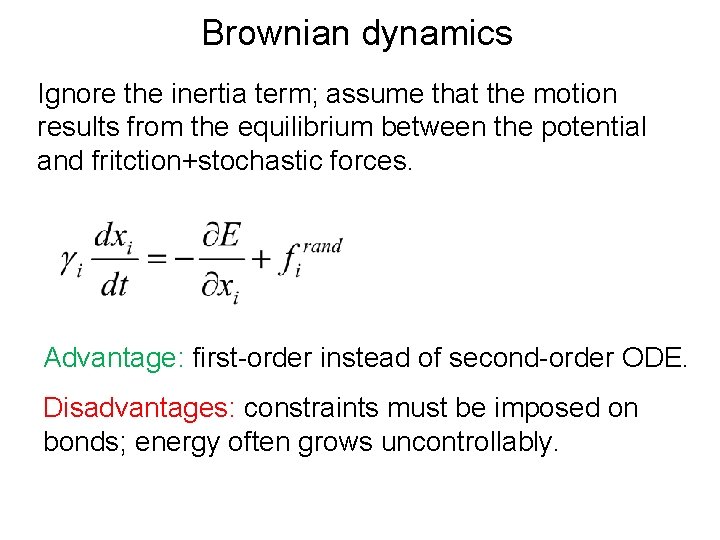
Brownian dynamics Ignore the inertia term; assume that the motion results from the equilibrium between the potential and fritction+stochastic forces. Advantage: first-order instead of second-order ODE. Disadvantages: constraints must be imposed on bonds; energy often grows uncontrollably.
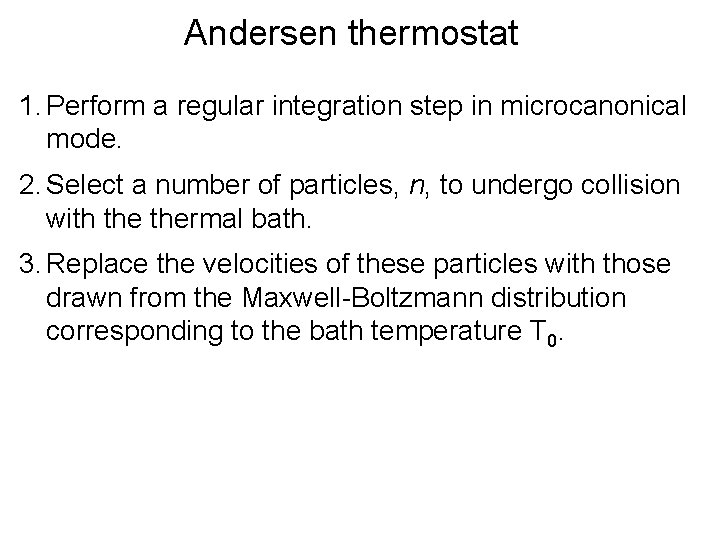
Andersen thermostat 1. Perform a regular integration step in microcanonical mode. 2. Select a number of particles, n, to undergo collision with thermal bath. 3. Replace the velocities of these particles with those drawn from the Maxwell-Boltzmann distribution corresponding to the bath temperature T 0.
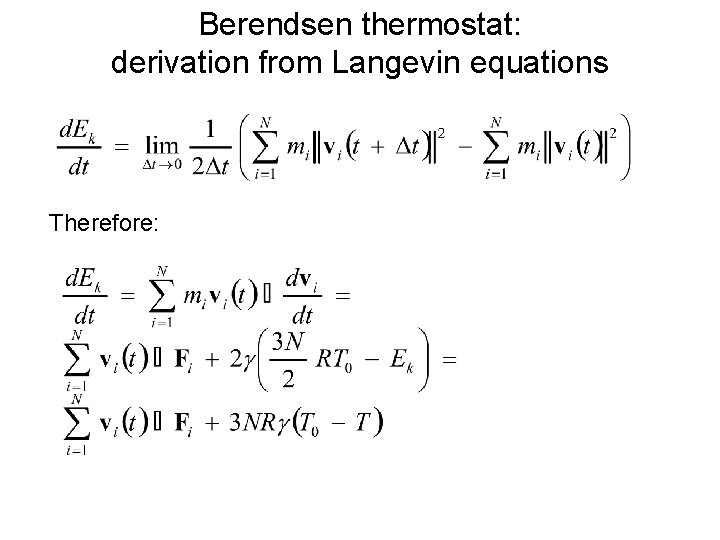
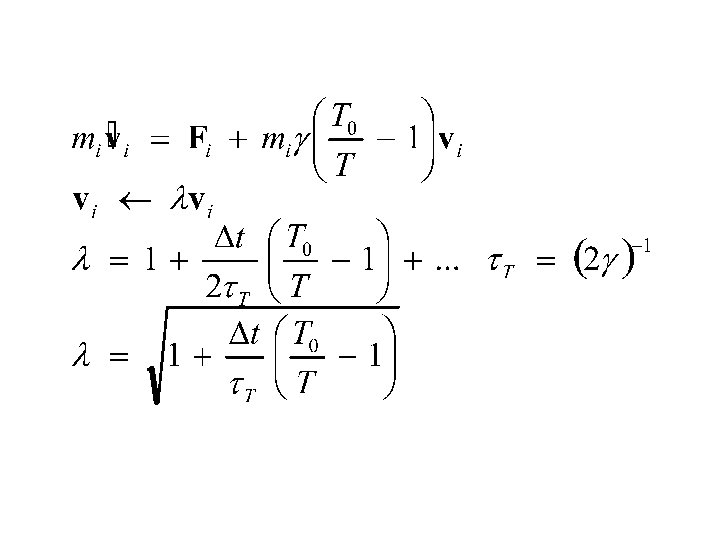
Berendsen thermostat: derivation from Langevin equations Therefore:
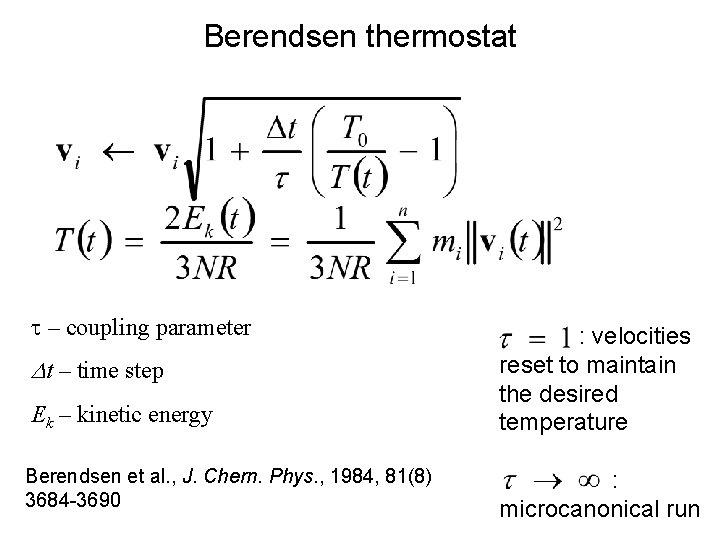
Berendsen thermostat t – coupling parameter Dt – time step Ek – kinetic energy Berendsen et al. , J. Chern. Phys. , 1984, 81(8) 3684 -3690 : velocities reset to maintain the desired temperature : microcanonical run
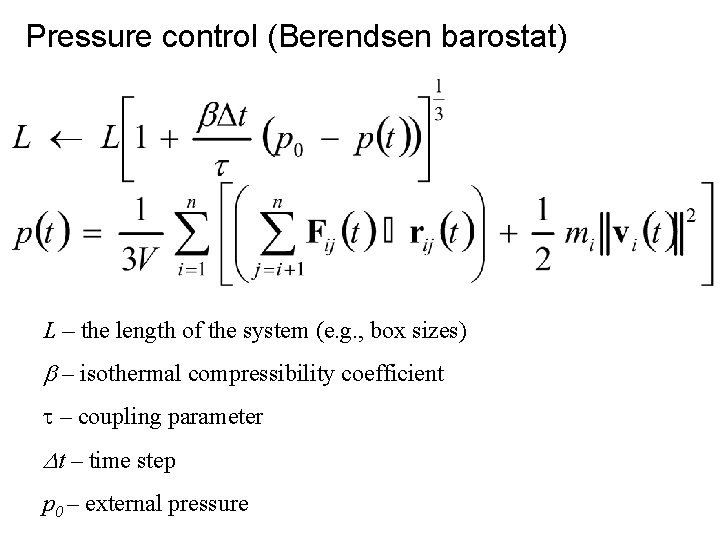
Pressure control (Berendsen barostat) L – the length of the system (e. g. , box sizes) b – isothermal compressibility coefficient t – coupling parameter Dt – time step p 0 – external pressure
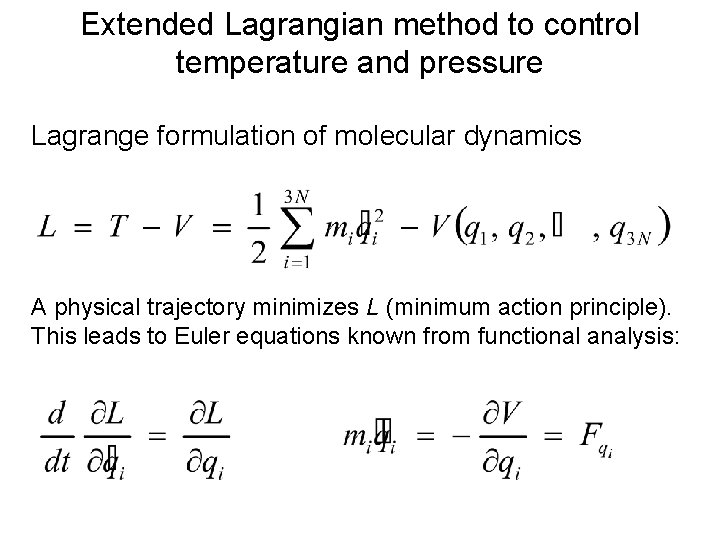
Extended Lagrangian method to control temperature and pressure Lagrange formulation of molecular dynamics A physical trajectory minimizes L (minimum action principle). This leads to Euler equations known from functional analysis:
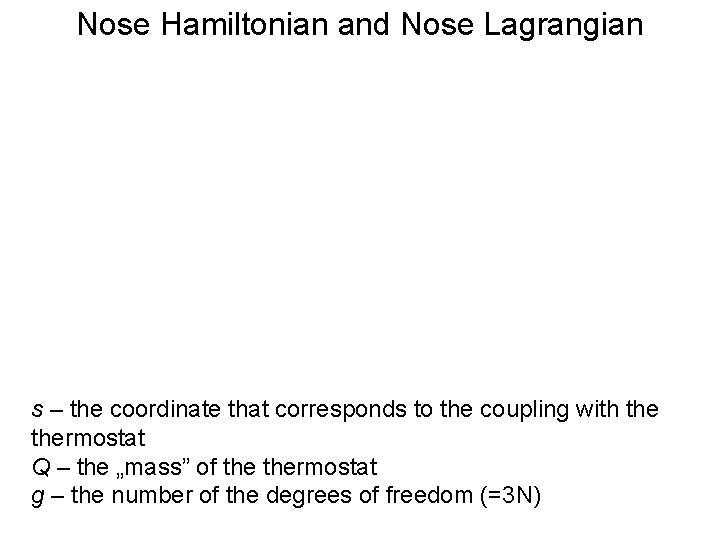
Nose Hamiltonian and Nose Lagrangian s – the coordinate that corresponds to the coupling with thermostat Q – the „mass” of thermostat g – the number of the degrees of freedom (=3 N)
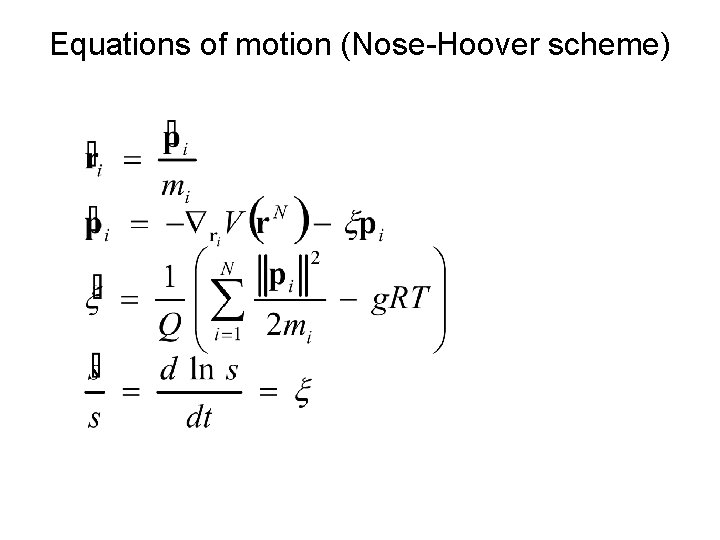
Equations of motion (Nose-Hoover scheme)
Velocity-Verlet algorithm
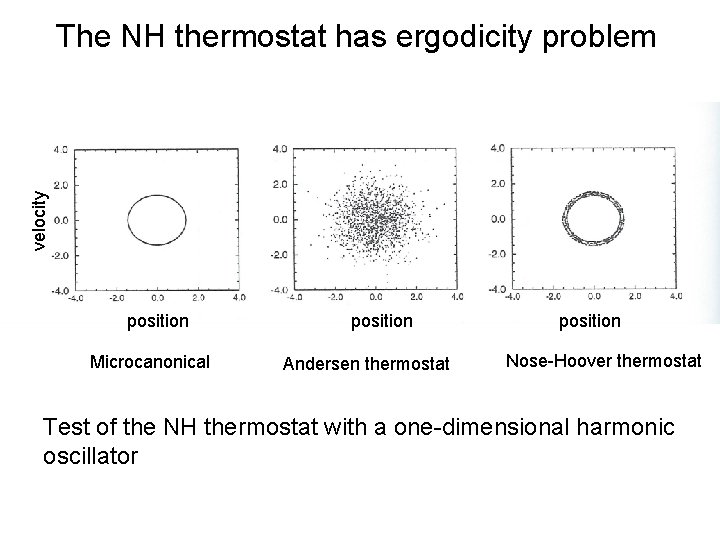
velocity The NH thermostat has ergodicity problem position Microcanonical position Andersen thermostat position Nose-Hoover thermostat Test of the NH thermostat with a one-dimensional harmonic oscillator
Nose-Hoover chains
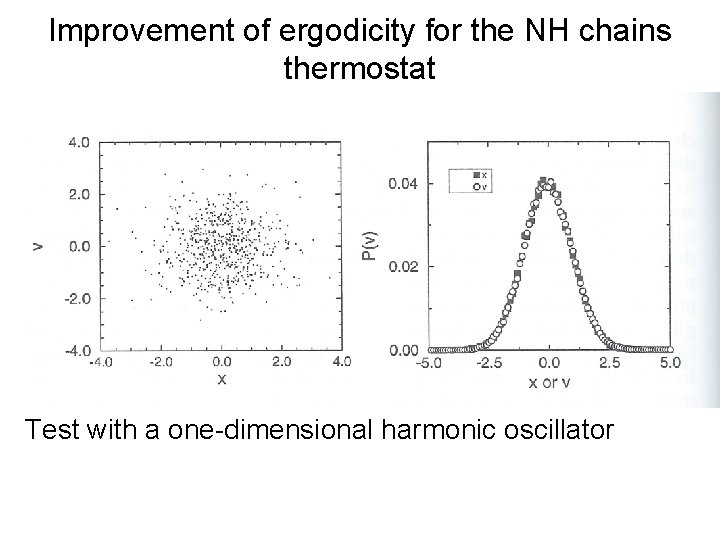
Improvement of ergodicity for the NH chains thermostat Test with a one-dimensional harmonic oscillator
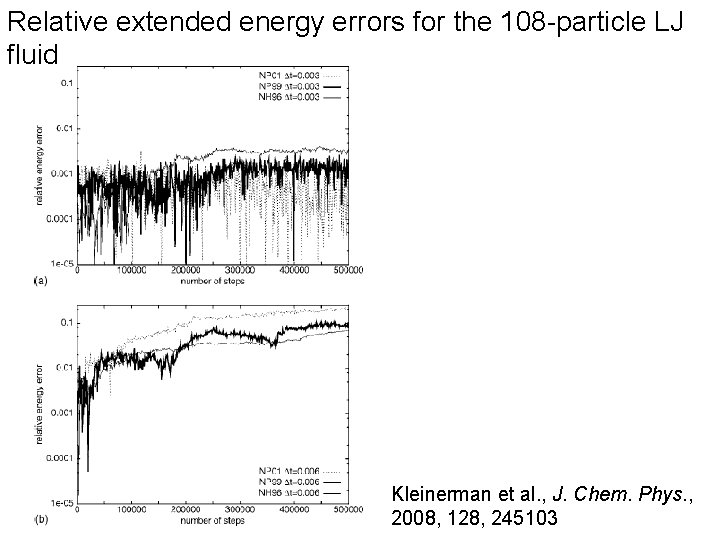
Relative extended energy errors for the 108 -particle LJ fluid Kleinerman et al. , J. Chem. Phys. , 2008, 128, 245103
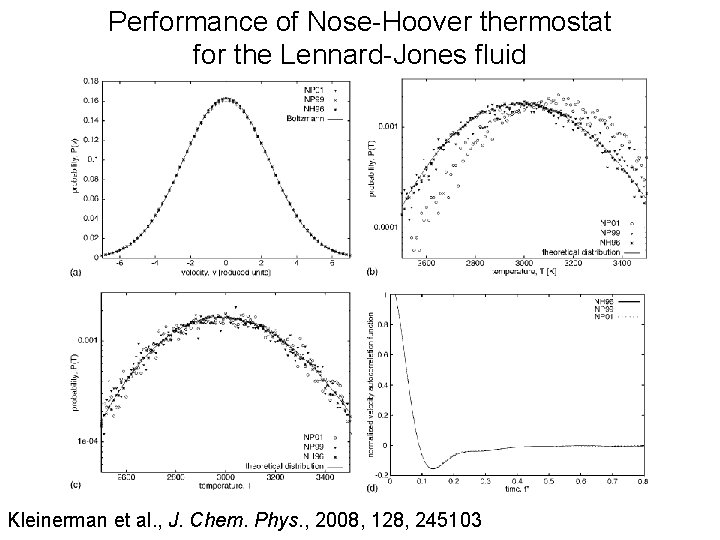
Performance of Nose-Hoover thermostat for the Lennard-Jones fluid Kleinerman et al. , J. Chem. Phys. , 2008, 128, 245103
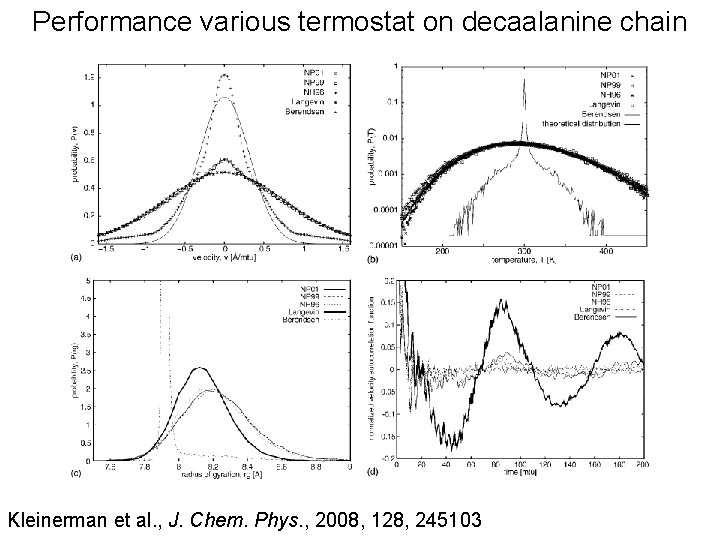
Performance various termostat on decaalanine chain Kleinerman et al. , J. Chem. Phys. , 2008, 128, 245103
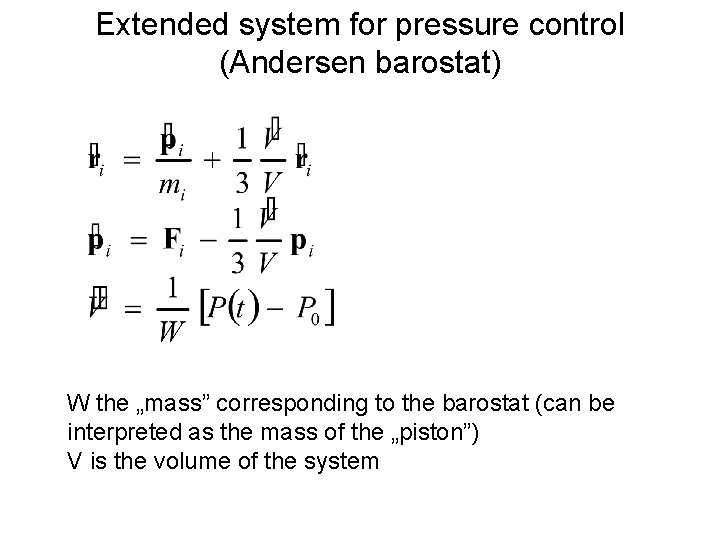
Extended system for pressure control (Andersen barostat) W the „mass” corresponding to the barostat (can be interpreted as the mass of the „piston”) V is the volume of the system
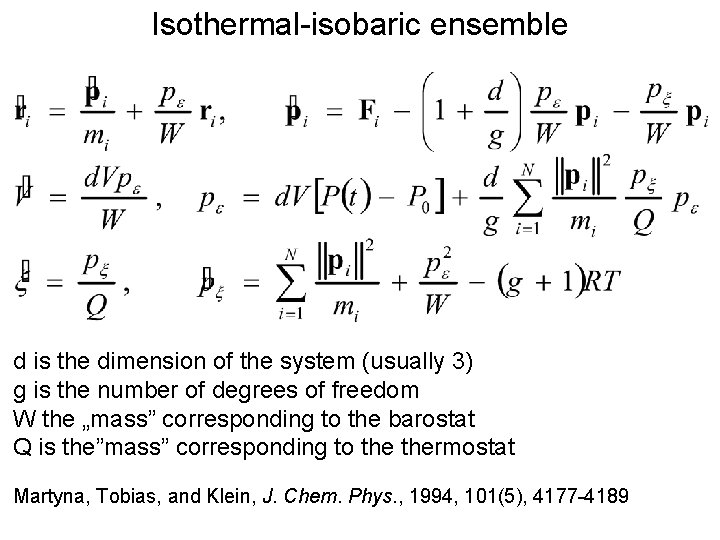
Isothermal-isobaric ensemble d is the dimension of the system (usually 3) g is the number of degrees of freedom W the „mass” corresponding to the barostat Q is the”mass” corresponding to thermostat Martyna, Tobias, and Klein, J. Chem. Phys. , 1994, 101(5), 4177 -4189
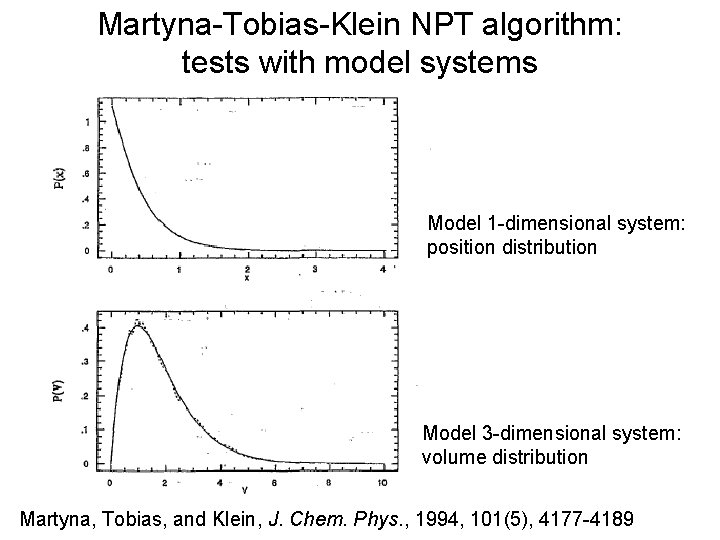
Martyna-Tobias-Klein NPT algorithm: tests with model systems Model 1 -dimensional system: position distribution Model 3 -dimensional system: volume distribution Martyna, Tobias, and Klein, J. Chem. Phys. , 1994, 101(5), 4177 -4189
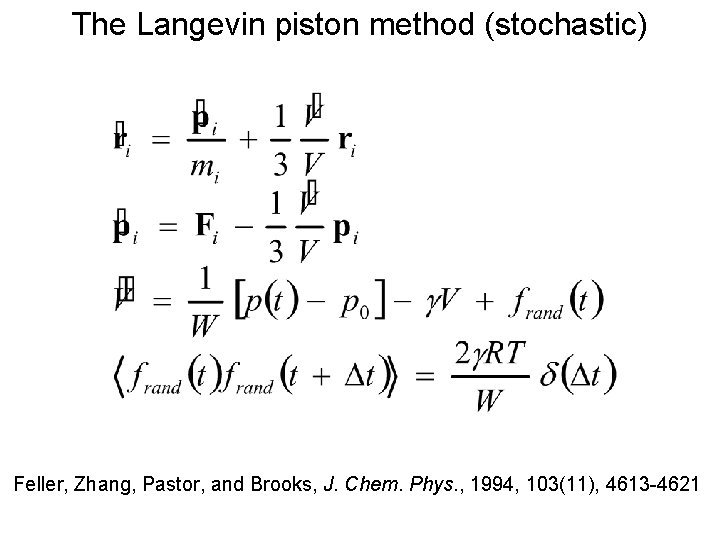
The Langevin piston method (stochastic) Feller, Zhang, Pastor, and Brooks, J. Chem. Phys. , 1994, 103(11), 4613 -4621
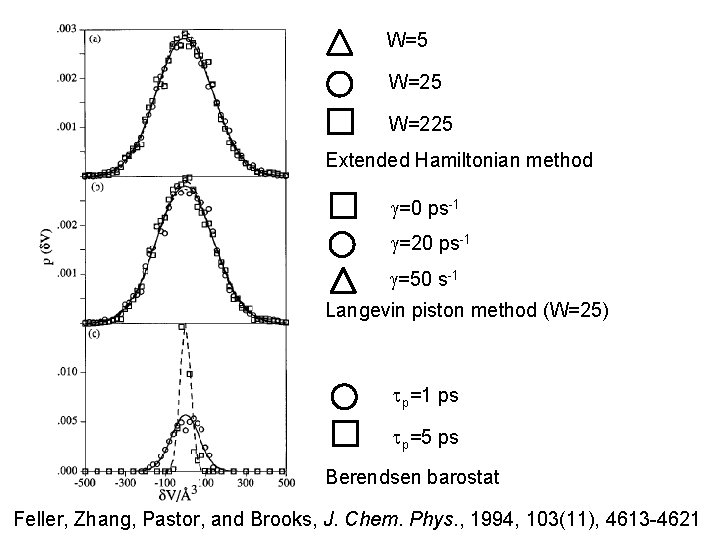
W=5 W=225 Extended Hamiltonian method g=0 ps-1 g=20 ps-1 g=50 s-1 Langevin piston method (W=25) tp=1 ps tp=5 ps Berendsen barostat Feller, Zhang, Pastor, and Brooks, J. Chem. Phys. , 1994, 103(11), 4613 -4621