
Molecular Differentiation in Prestellar Cores Mario Tafalla Observatorio
Molecular Differentiation in Pre-stellar Cores Mario Tafalla Observatorio Astronómico Nacional (Spain) Outline * Basic physical properties of cores * Evidence for chemical differentiation * How to use chemical composition to trace core evolution
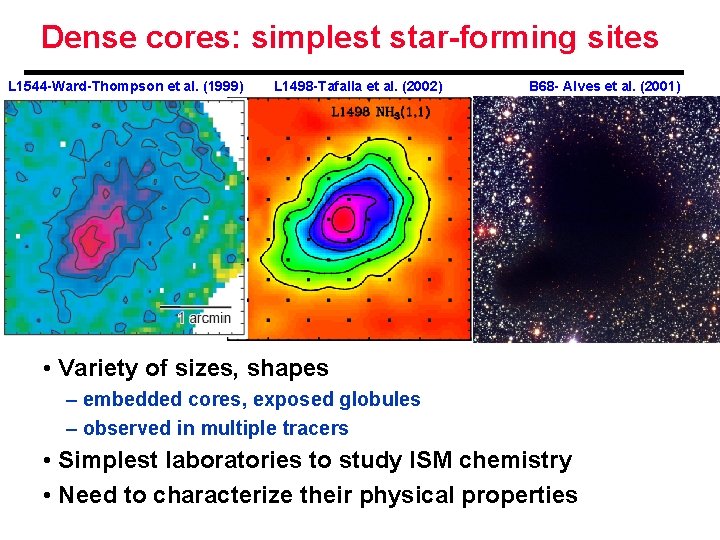
Dense cores: simplest star-forming sites L 1544 -Ward-Thompson et al. (1999) L 1498 -Tafalla et al. (2002) B 68 - Alves et al. (2001) • Variety of sizes, shapes – embedded cores, exposed globules – observed in multiple tracers • Simplest laboratories to study ISM chemistry • Need to characterize their physical properties
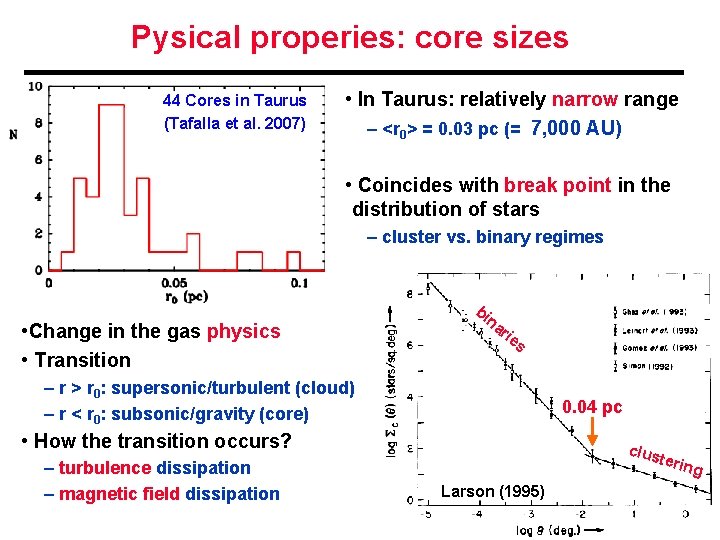
Pysical properies: core sizes 44 Cores in Taurus (Tafalla et al. 2007) • In Taurus: relatively narrow range – <r 0> = 0. 03 pc (= 7, 000 AU) • Coincides with break point in the distribution of stars – cluster vs. binary regimes • Change in the gas physics • Transition bi na rie s – r > r 0: supersonic/turbulent (cloud) – r < r 0: subsonic/gravity (core) 0. 04 pc • How the transition occurs? – turbulence dissipation – magnetic field dissipation clus Larson (1995) terin g
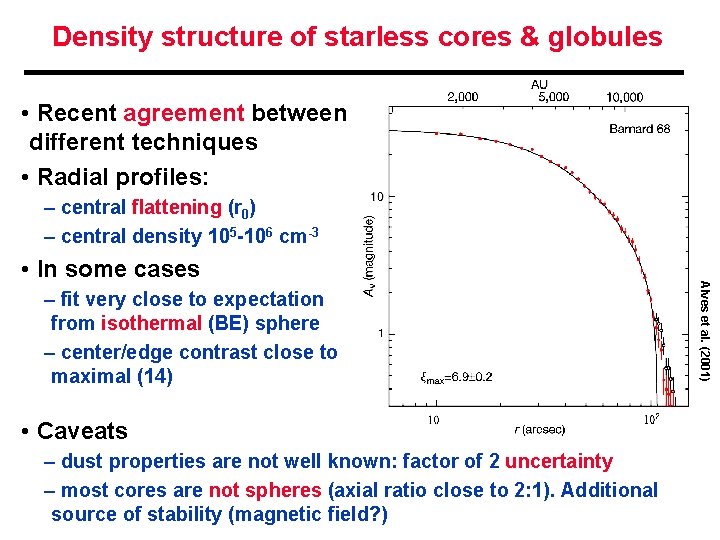
Density structure of starless cores & globules • Recent agreement between different techniques • Radial profiles: – central flattening (r 0) – central density 105 -106 cm-3 – fit very close to expectation from isothermal (BE) sphere – center/edge contrast close to maximal (14) • Caveats – dust properties are not well known: factor of 2 uncertainty – most cores are not spheres (axial ratio close to 2: 1). Additional source of stability (magnetic field? ) Alves et al. (2001) • In some cases
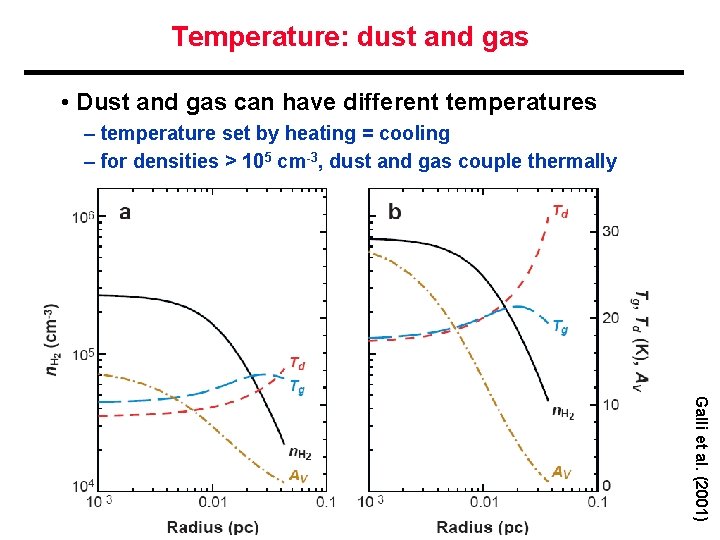
Temperature: dust and gas • Dust and gas can have different temperatures – temperature set by heating = cooling – for densities > 105 cm-3, dust and gas couple thermally Galli et al. (2001)
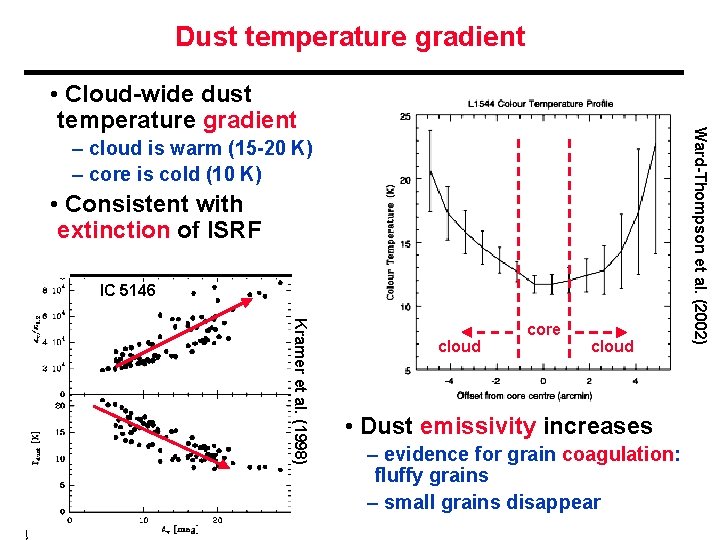
Dust temperature gradient – cloud is warm (15 -20 K) – core is cold (10 K) • Consistent with extinction of ISRF IC 5146 Kramer et al. (1998) cloud core cloud • Dust emissivity increases – evidence for grain coagulation: fluffy grains – small grains disappear Ward-Thompson et al. (2002) • Cloud-wide dust temperature gradient
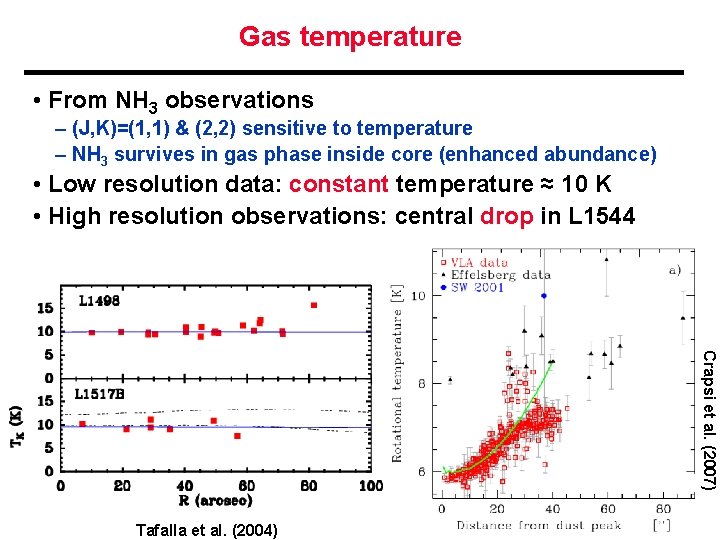
Gas temperature • From NH 3 observations – (J, K)=(1, 1) & (2, 2) sensitive to temperature – NH 3 survives in gas phase inside core (enhanced abundance) • Low resolution data: constant temperature ≈ 10 K • High resolution observations: central drop in L 1544 Crapsi et al. (2007) Tafalla et al. (2004)

Kinematics. Internal motions • Derived from linewidth Tafalla et al. (2007) Taurus – N 2 H+ & NH 3 • In contrast with clouds – internal subsonic motions • Thermal pressure support dominates turbulent pressure • Break-down of Larson’s law – velocity coherent cores (Goodman et al 1998) Tafalla et al. (2004) L 1498
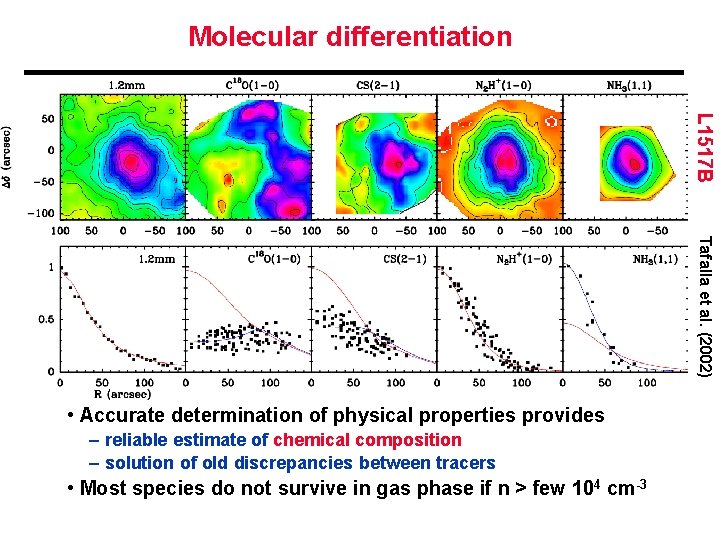
Molecular differentiation L 1517 B Tafalla et al. (2002) • Accurate determination of physical properties provides – reliable estimate of chemical composition – solution of old discrepancies between tracers • Most species do not survive in gas phase if n > few 104 cm-3

Molecular freeze out • At low temperatures: molecules stick on grains • Equilibrium situation – molecules on grains if Tgrain < Tfreezeout – molecules in gas phase if Tgrain > Tfreezeout • Time for equilibrium is ≈ 5 109 /n(H 2) yr – if n(H 2) = 105 cm-3, tfrz ≈ 5 104 yr (<< core lifetime) Leger (1983) Scott Sandford
Why do N 2 H+ and NH 3 stay in the gas phase? • Initial models (e. g. , Bergin & Langer 1997) – N 2 binding energy assumed lower than CO b. e. – CO, etc freezes at low densities, N 2 at high densities, N 2 H+ and NH 3 are formed from N 2 • Laboratory work (Öberg et al. 2005, Bisschop et al. 2006) – binding energies are almost equal – sticking probability S=1 • New understanding of differential freeze out – both CO and N 2 freeze out simultaneously – disappearance of CO from gas phase changes chemistry • CO is highly abundant (X≈10 -5) – major destroyer of N 2 H+ – freeze out of CO dominates chemistry (over N 2 freeze out) – N 2 H+ is enhanced (NH 3 is formed from N 2 H+)
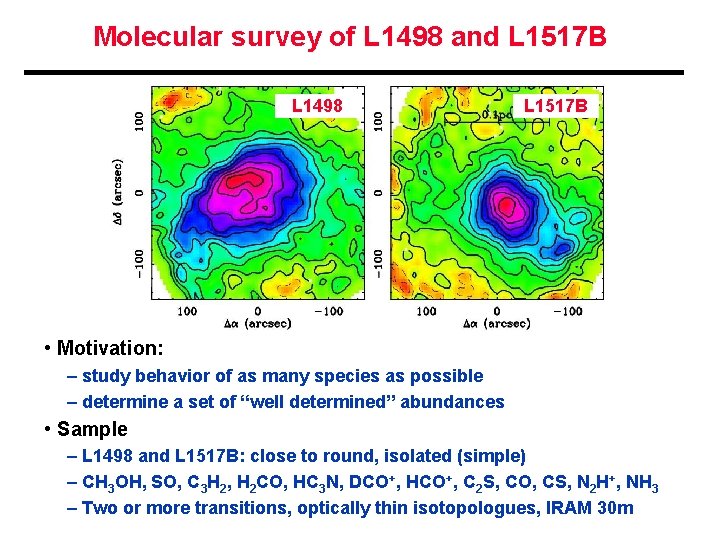
Molecular survey of L 1498 and L 1517 B L 1498 L 1517 B • Motivation: – study behavior of as many species as possible – determine a set of “well determined” abundances • Sample – L 1498 and L 1517 B: close to round, isolated (simple) – CH 3 OH, SO, C 3 H 2, H 2 CO, HC 3 N, DCO+, HCO+, C 2 S, CO, CS, N 2 H+, NH 3 – Two or more transitions, optically thin isotopologues, IRAM 30 m
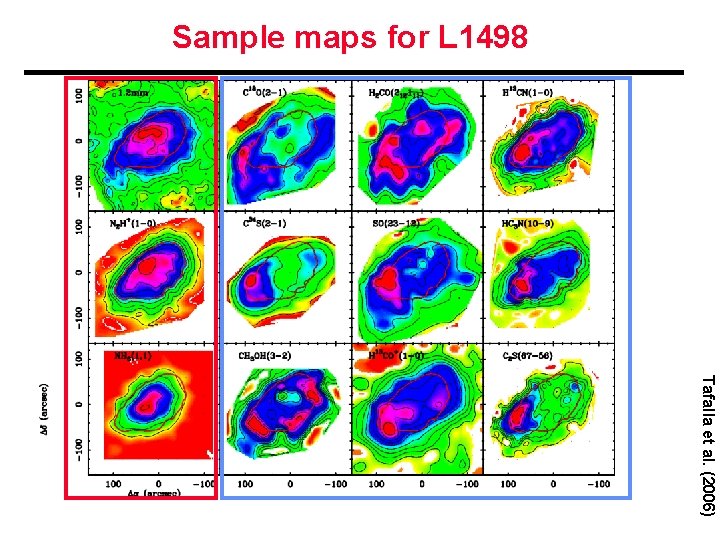
Sample maps for L 1498 Tafalla et al. (2006)
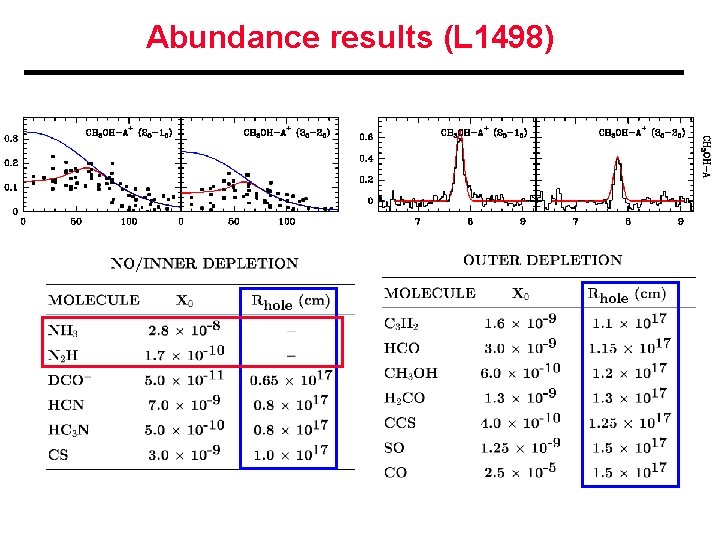
Abundance results (L 1498)
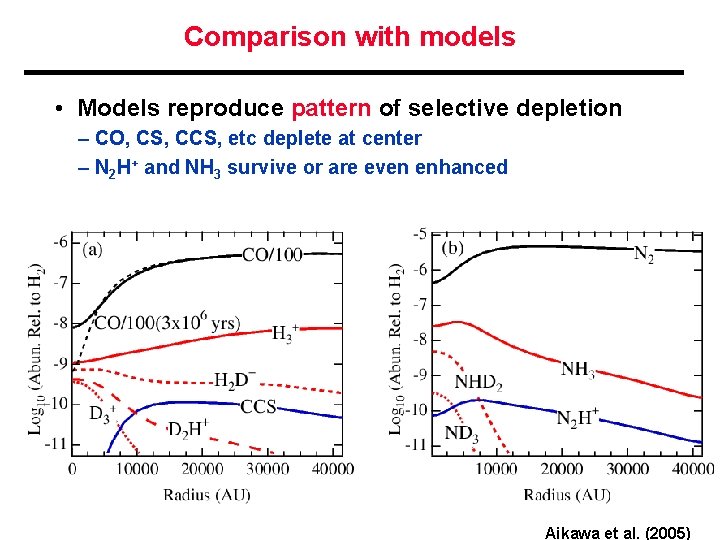
Comparison with models • Models reproduce pattern of selective depletion – CO, CS, CCS, etc deplete at center – N 2 H+ and NH 3 survive or are even enhanced Aikawa et al. (2005)
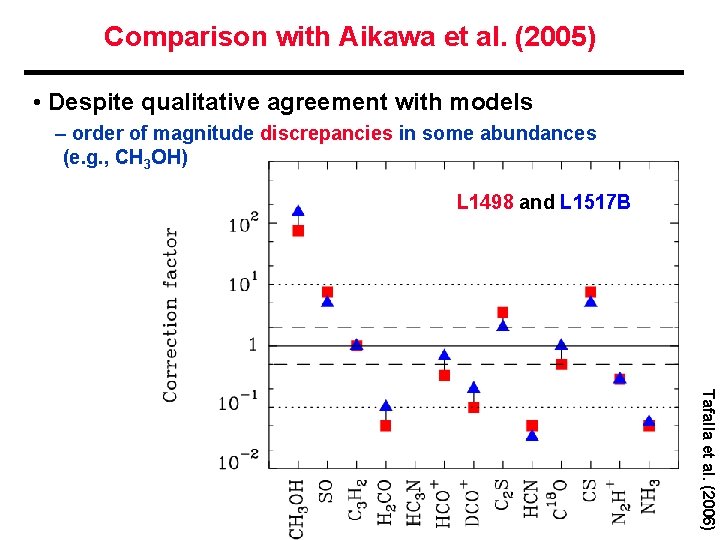
Comparison with Aikawa et al. (2005) • Despite qualitative agreement with models – order of magnitude discrepancies in some abundances (e. g. , CH 3 OH) L 1498 and L 1517 B Tafalla et al. (2006)
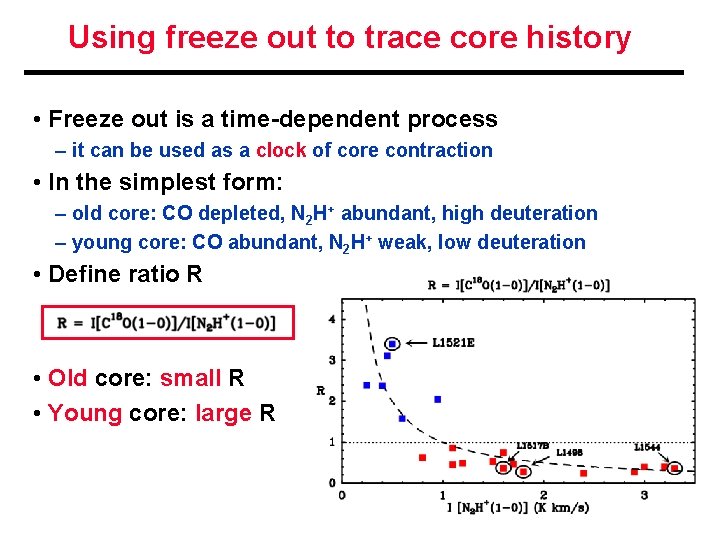
Using freeze out to trace core history • Freeze out is a time-dependent process – it can be used as a clock of core contraction • In the simplest form: – old core: CO depleted, N 2 H+ abundant, high deuteration – young core: CO abundant, N 2 H+ weak, low deuteration • Define ratio R (measured at core center) • Old core: small R • Young core: large R
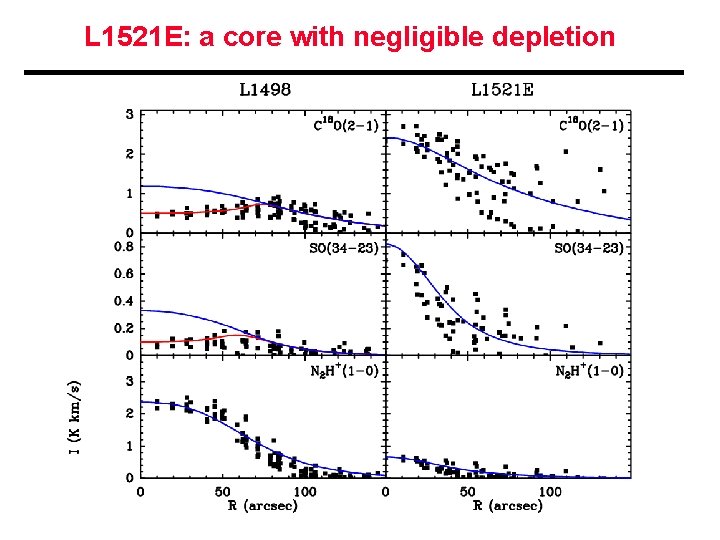
L 1521 E: a core with negligible depletion
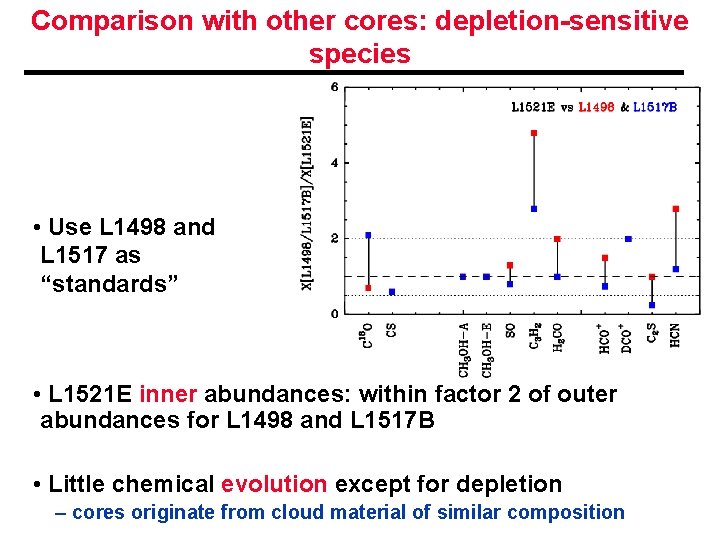
Comparison with other cores: depletion-sensitive species • Use L 1498 and L 1517 as “standards” • L 1521 E inner abundances: within factor 2 of outer abundances for L 1498 and L 1517 B • Little chemical evolution except for depletion – cores originate from cloud material of similar composition
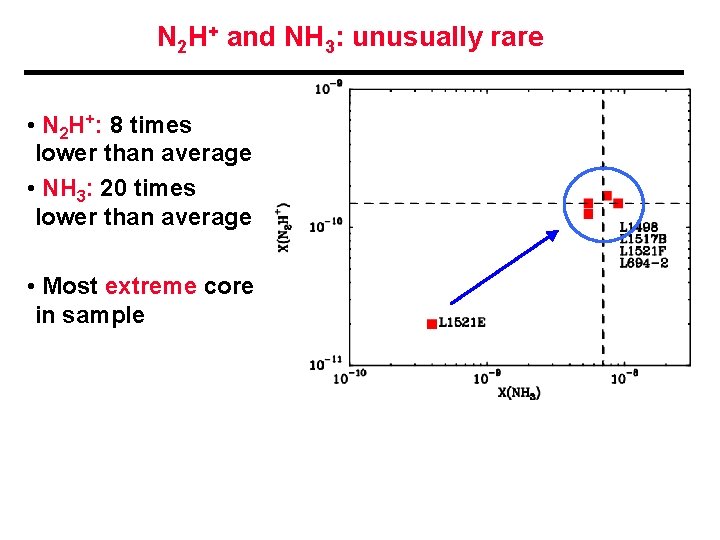
N 2 H+ and NH 3: unusually rare • N 2 H+: 8 times lower than average • NH 3: 20 times lower than average • Most extreme core in sample
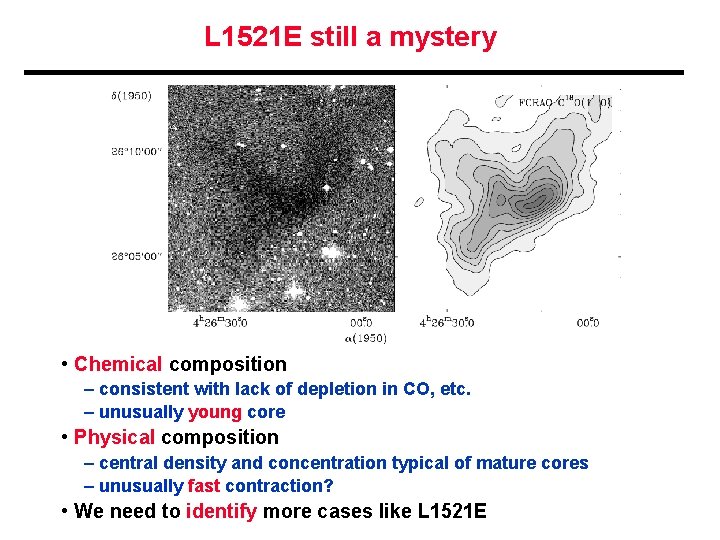
L 1521 E still a mystery • Chemical composition – consistent with lack of depletion in CO, etc. – unusually young core • Physical composition – central density and concentration typical of mature cores – unusually fast contraction? • We need to identify more cases like L 1521 E
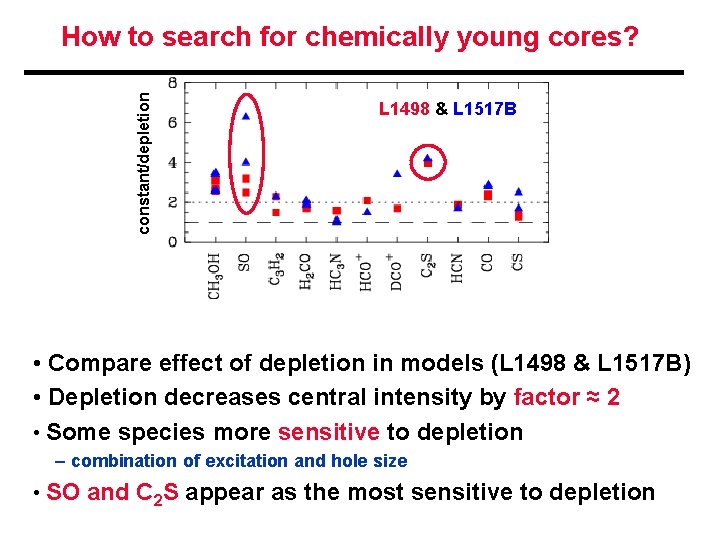
constant/depletion How to search for chemically young cores? L 1498 & L 1517 B • Compare effect of depletion in models (L 1498 & L 1517 B) • Depletion decreases central intensity by factor ≈ 2 • Some species more sensitive to depletion – combination of excitation and hole size • SO and C 2 S appear as the most sensitive to depletion
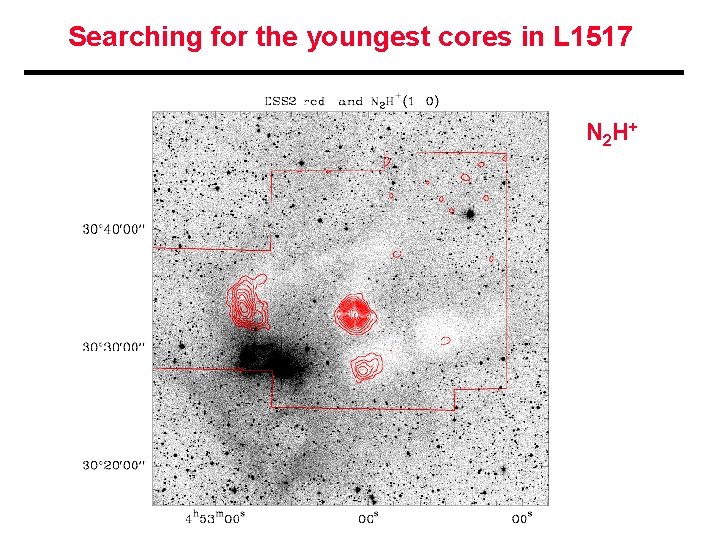
Searching for the youngest cores in L 1517 N 2 H +
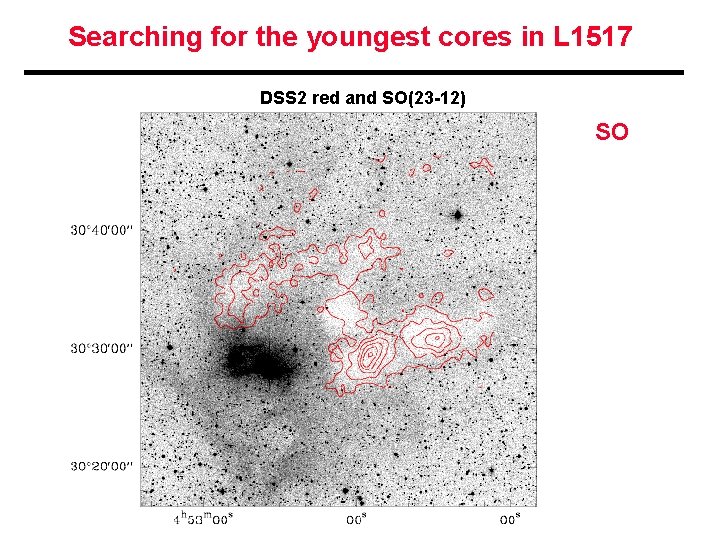
Searching for the youngest cores in L 1517 DSS 2 red and SO(23 -12) SO
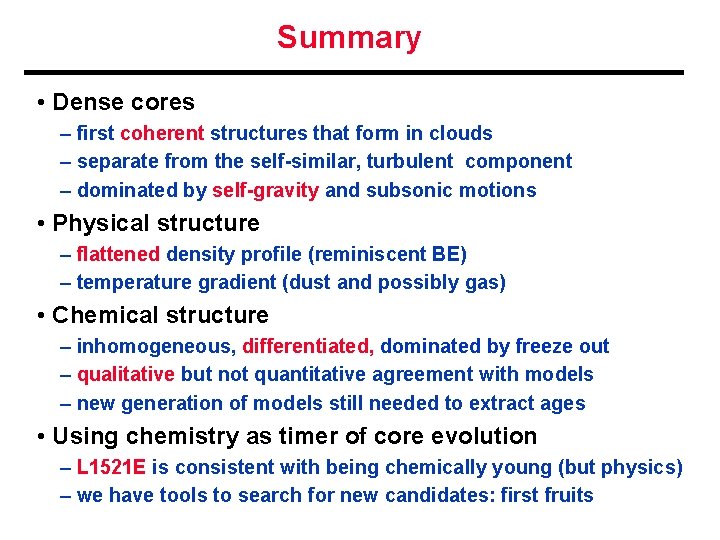
Summary • Dense cores – first coherent structures that form in clouds – separate from the self-similar, turbulent component – dominated by self-gravity and subsonic motions • Physical structure – flattened density profile (reminiscent BE) – temperature gradient (dust and possibly gas) • Chemical structure – inhomogeneous, differentiated, dominated by freeze out – qualitative but not quantitative agreement with models – new generation of models still needed to extract ages • Using chemistry as timer of core evolution – L 1521 E is consistent with being chemically young (but physics) – we have tools to search for new candidates: first fruits
- Slides: 25