
Molecular Biophysics Lecture 2 Protein Structure II 12824
Molecular Biophysics Lecture 2 Protein Structure II 12824 BCHS 6297 Lecturers held Tuesday and Thursday 10 AM – 12 Noon 402 B-HSC
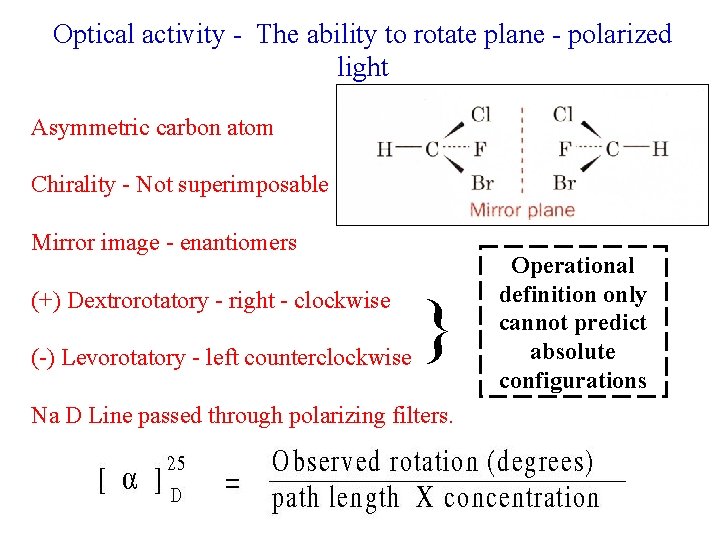
Optical activity - The ability to rotate plane - polarized light Asymmetric carbon atom Chirality - Not superimposable Mirror image - enantiomers (+) Dextrorotatory - right - clockwise (-) Levorotatory - left counterclockwise } Na D Line passed through polarizing filters. Operational definition only cannot predict absolute configurations
Stereoisomers One or many chiral centers N chiral centers 2 N possible stereoisomers and 2 N-1 are enantiomeric For N = 2 there are 4 possible sterioisomers of which 2 are enatiomers and 2 are diastereomers Diastereomers are not mirror images and have different chemical properties.
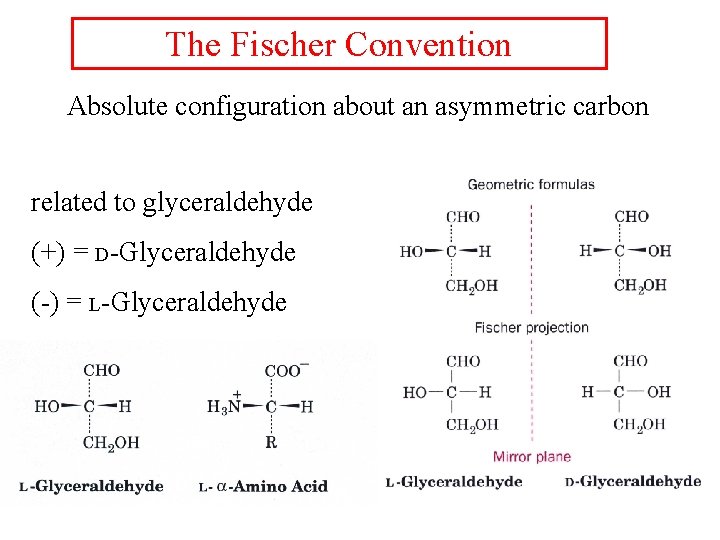
The Fischer Convention Absolute configuration about an asymmetric carbon related to glyceraldehyde (+) = D-Glyceraldehyde (-) = L-Glyceraldehyde
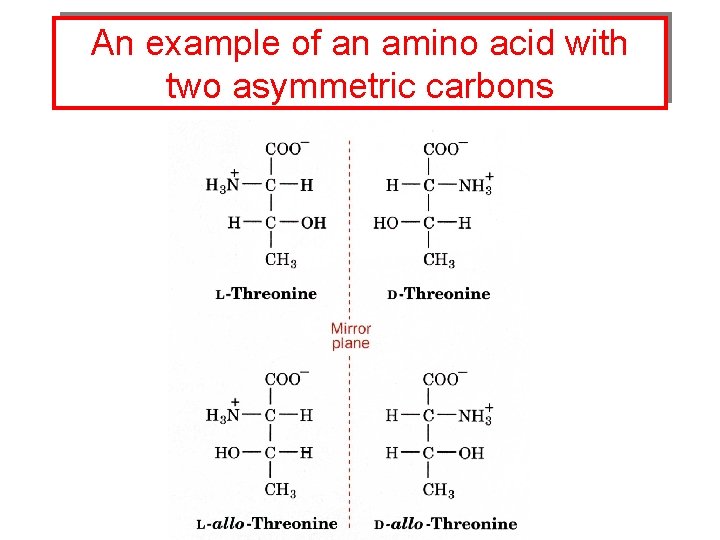
An example of an amino acid with two asymmetric carbons
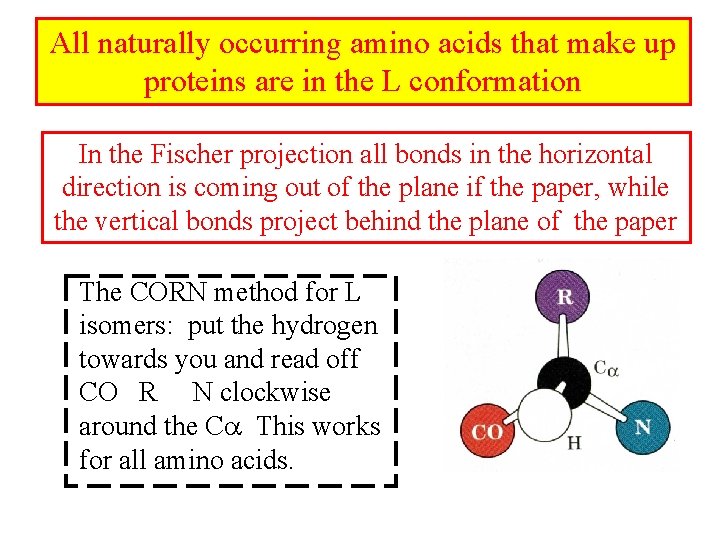
All naturally occurring amino acids that make up proteins are in the L conformation In the Fischer projection all bonds in the horizontal direction is coming out of the plane if the paper, while the vertical bonds project behind the plane of the paper The CORN method for L isomers: put the hydrogen towards you and read off CO R N clockwise around the Ca This works for all amino acids.
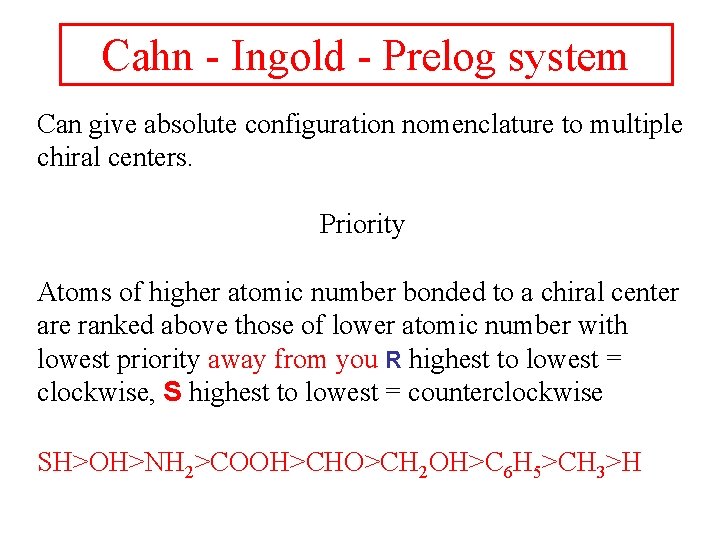
Cahn - Ingold - Prelog system Can give absolute configuration nomenclature to multiple chiral centers. Priority Atoms of higher atomic number bonded to a chiral center are ranked above those of lower atomic number with lowest priority away from you R highest to lowest = clockwise, S highest to lowest = counterclockwise SH>OH>NH 2>COOH>CHO>CH 2 OH>C 6 H 5>CH 3>H
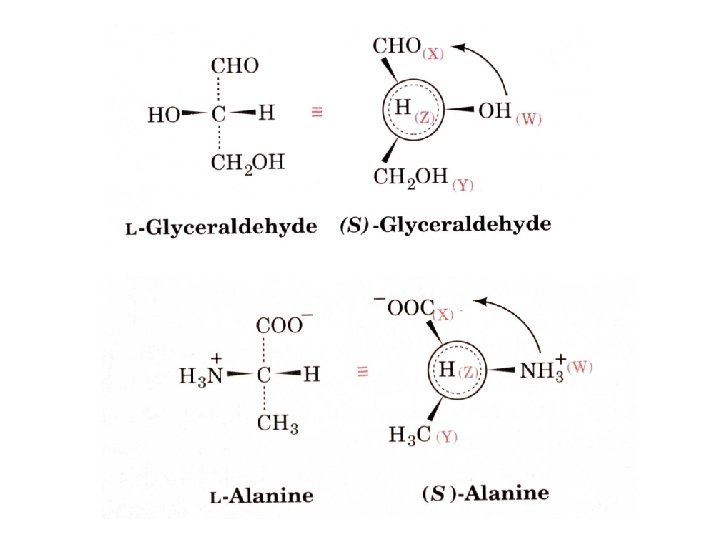
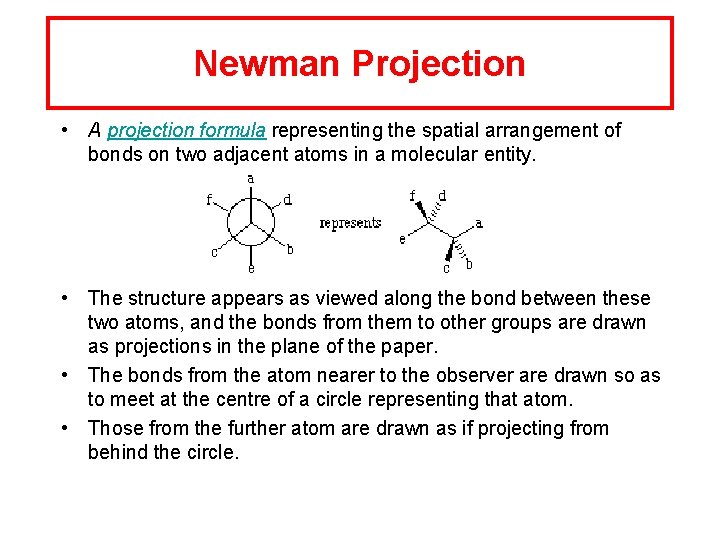
Newman Projection • A projection formula representing the spatial arrangement of bonds on two adjacent atoms in a molecular entity. • The structure appears as viewed along the bond between these two atoms, and the bonds from them to other groups are drawn as projections in the plane of the paper. • The bonds from the atom nearer to the observer are drawn so as to meet at the centre of a circle representing that atom. • Those from the further atom are drawn as if projecting from behind the circle.
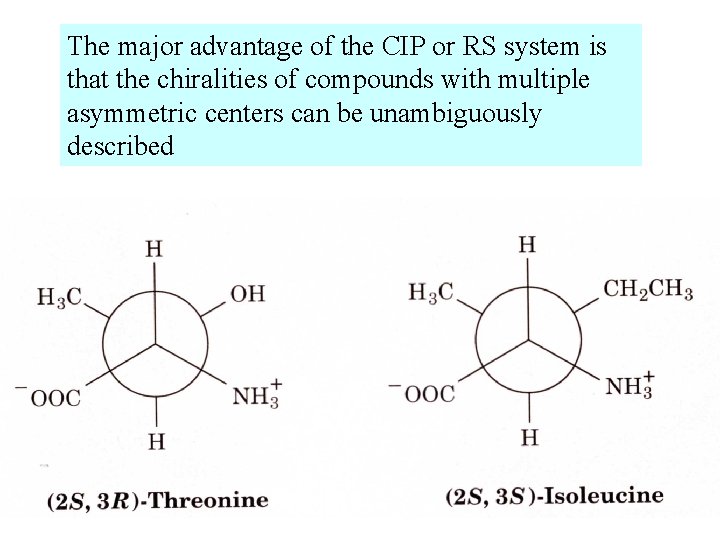
The major advantage of the CIP or RS system is that the chiralities of compounds with multiple asymmetric centers can be unambiguously described
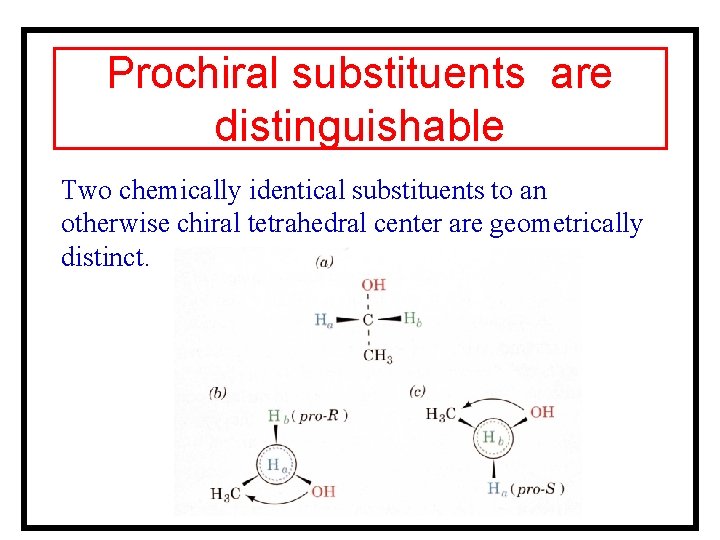
Prochiral substituents are distinguishable Two chemically identical substituents to an otherwise chiral tetrahedral center are geometrically distinct.
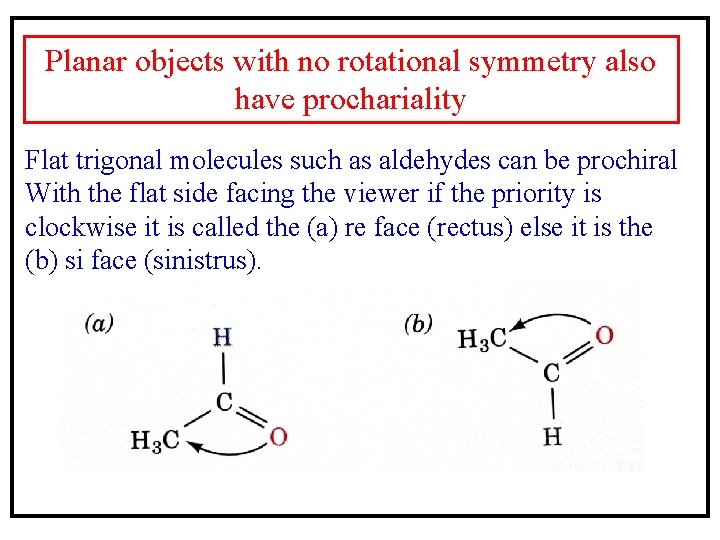
Planar objects with no rotational symmetry also have prochariality Flat trigonal molecules such as aldehydes can be prochiral With the flat side facing the viewer if the priority is clockwise it is called the (a) re face (rectus) else it is the (b) si face (sinistrus).
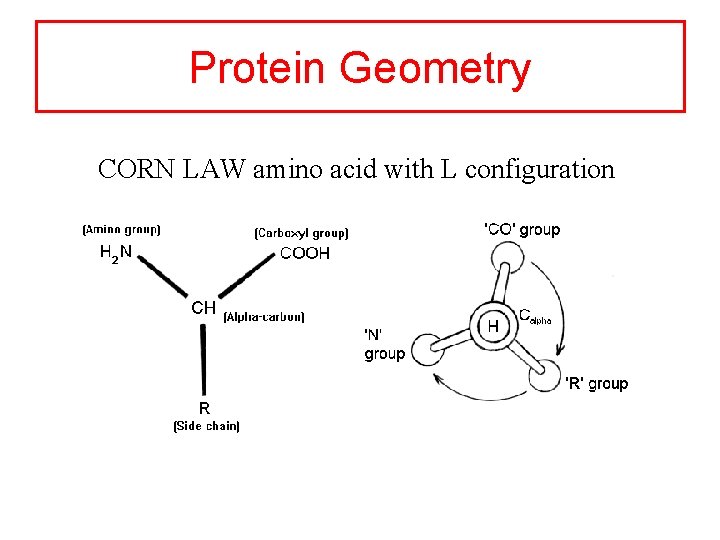
Protein Geometry CORN LAW amino acid with L configuration
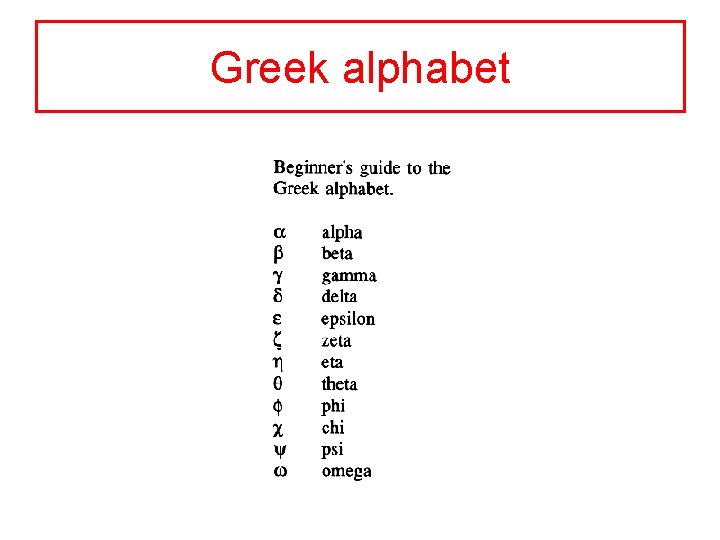
Greek alphabet
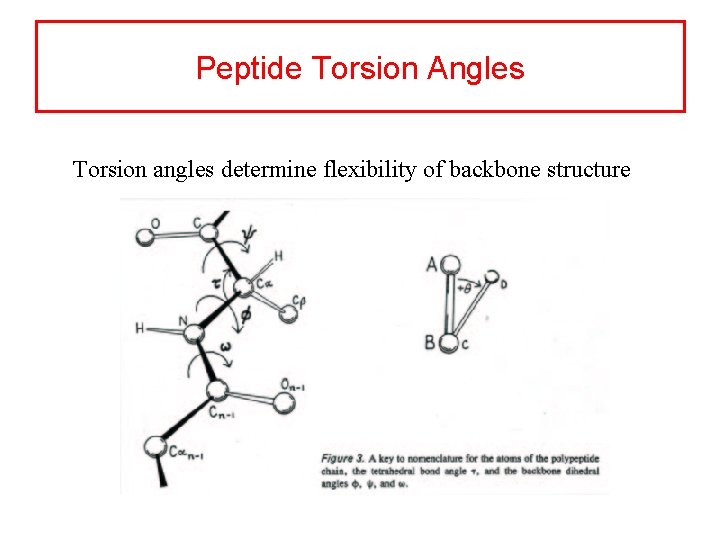
Peptide Torsion Angles Torsion angles determine flexibility of backbone structure

Side Chain Conformation
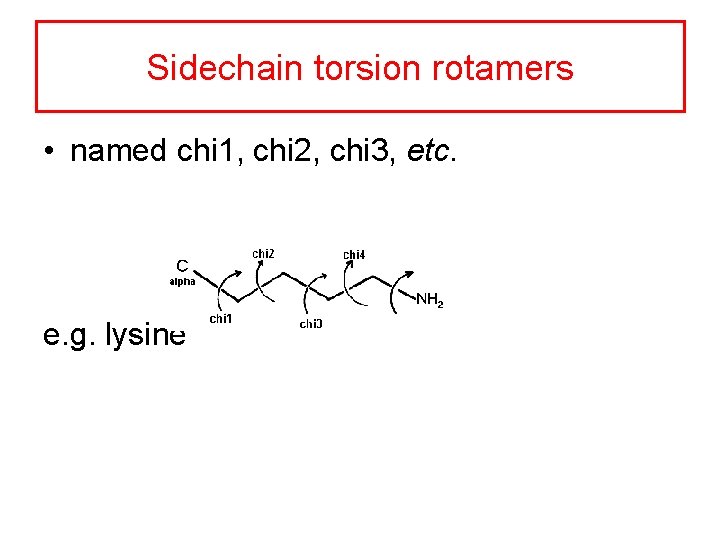
Sidechain torsion rotamers • named chi 1, chi 2, chi 3, etc. e. g. lysine
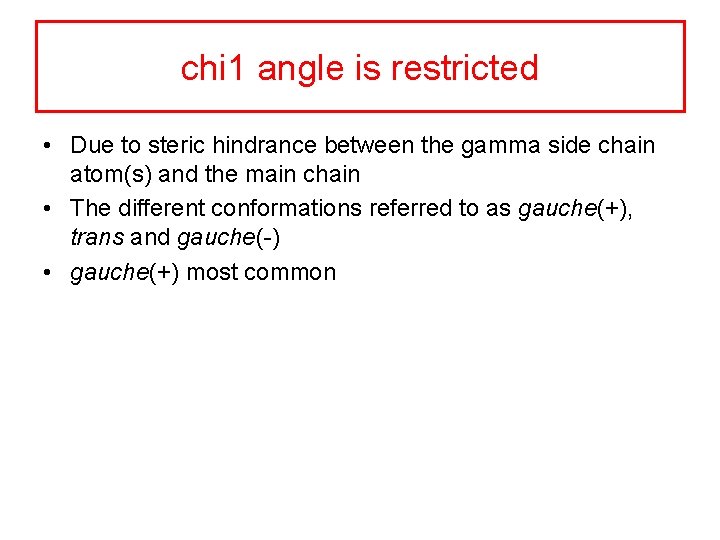
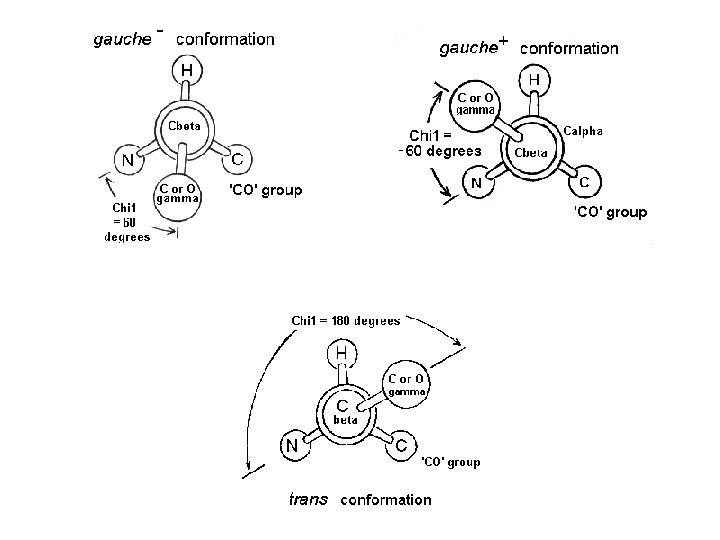
chi 1 angle is restricted • Due to steric hindrance between the gamma side chain atom(s) and the main chain • The different conformations referred to as gauche(+), trans and gauche(-) • gauche(+) most common
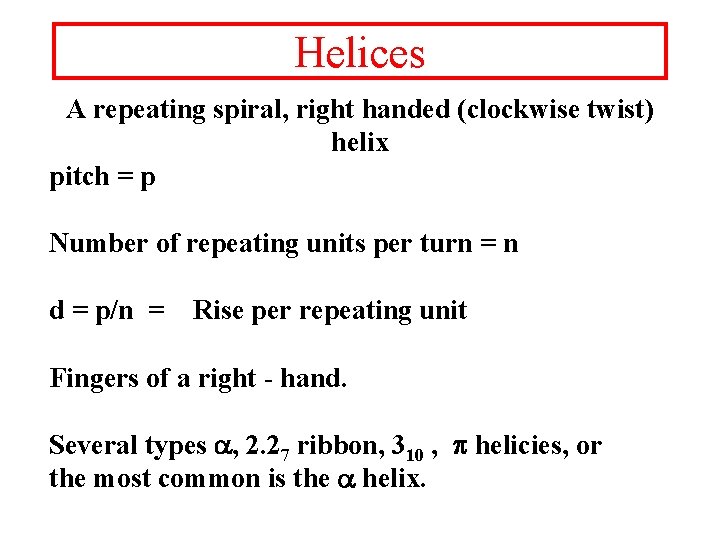
Helices A repeating spiral, right handed (clockwise twist) helix pitch = p Number of repeating units per turn = n d = p/n = Rise per repeating unit Fingers of a right - hand. Several types , 2. 27 ribbon, 310 , helicies, or the most common is the helix.
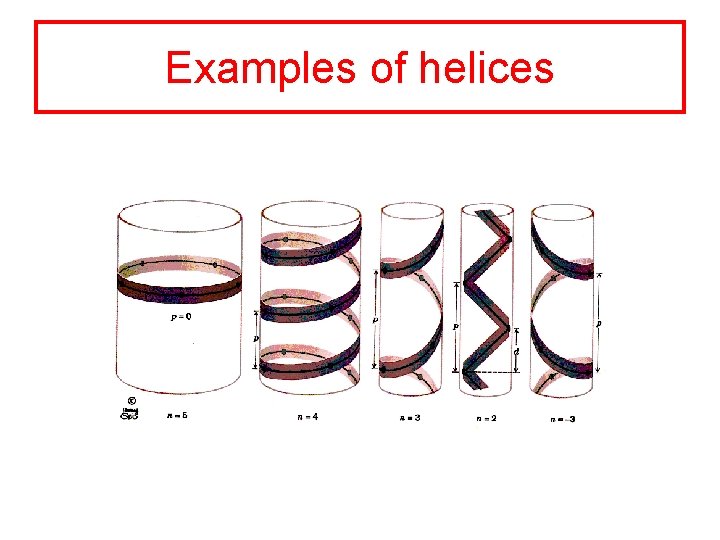
Examples of helices
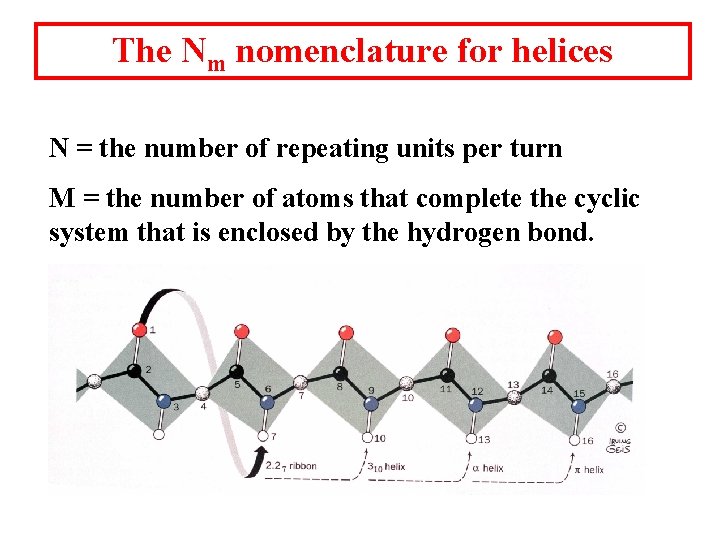
The Nm nomenclature for helices N = the number of repeating units per turn M = the number of atoms that complete the cyclic system that is enclosed by the hydrogen bond.
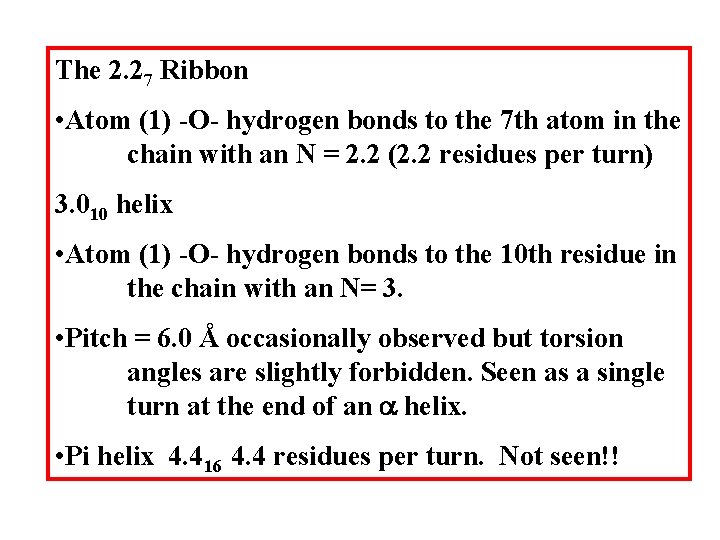
The 2. 27 Ribbon • Atom (1) -O- hydrogen bonds to the 7 th atom in the chain with an N = 2. 2 (2. 2 residues per turn) 3. 010 helix • Atom (1) -O- hydrogen bonds to the 10 th residue in the chain with an N= 3. • Pitch = 6. 0 Å occasionally observed but torsion angles are slightly forbidden. Seen as a single turn at the end of an helix. • Pi helix 4. 416 4. 4 residues per turn. Not seen!!
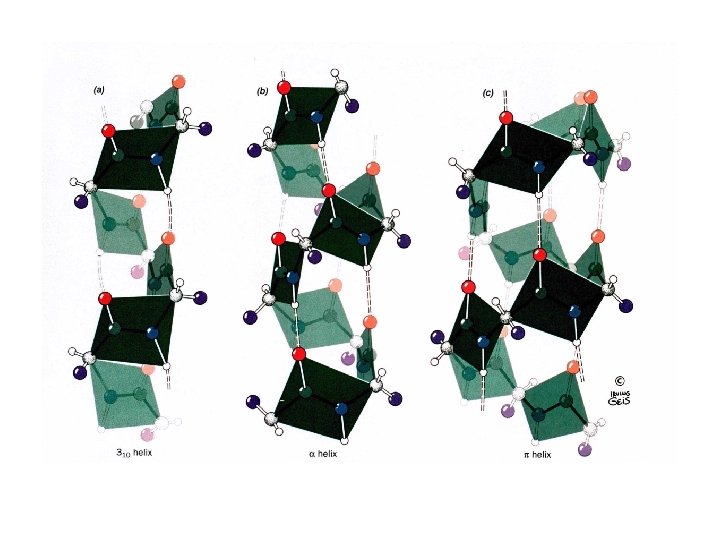
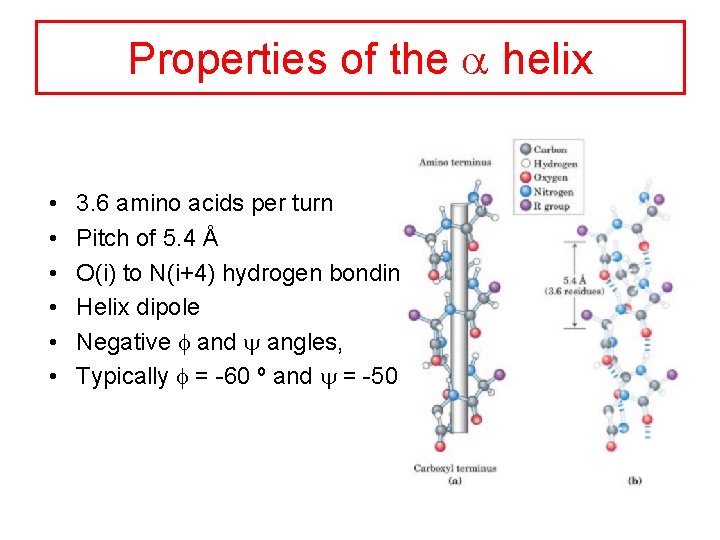
Properties of the a helix • • • 3. 6 amino acids per turn Pitch of 5. 4 Å O(i) to N(i+4) hydrogen bonding Helix dipole Negative f and y angles, Typically f = -60 º and y = -50 º
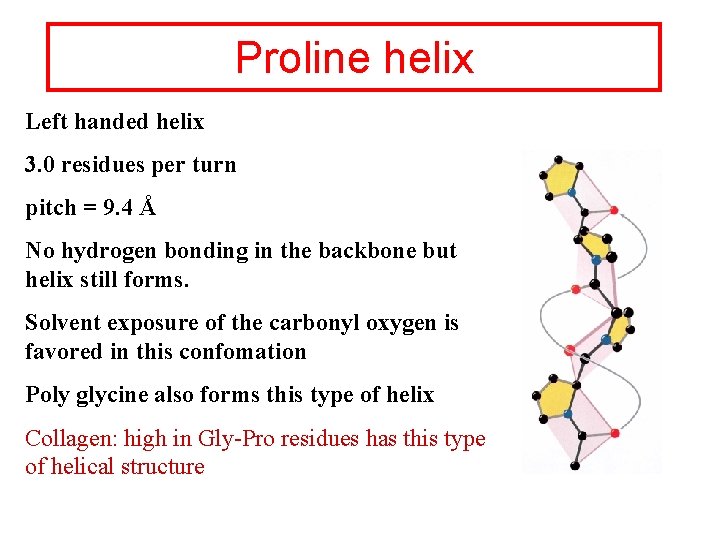
Proline helix Left handed helix 3. 0 residues per turn pitch = 9. 4 Å No hydrogen bonding in the backbone but helix still forms. Solvent exposure of the carbonyl oxygen is favored in this confomation Poly glycine also forms this type of helix Collagen: high in Gly-Pro residues has this type of helical structure
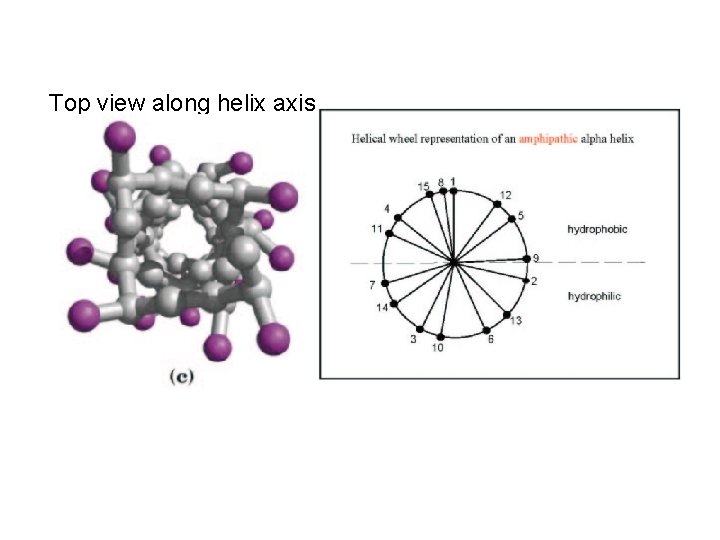
Top view along helix axis
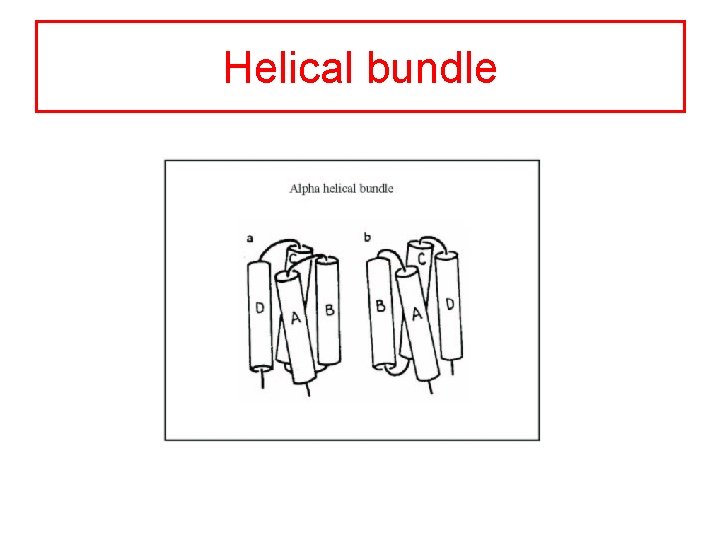
Helical bundle
Distortions of alpha-helices • The packing of buried helices against other secondary structure elements in the core of the protein. • Proline residues induce distortions of around 20 degrees in the direction of the helix axis. (causes two H-bonds in the helix to be broken) • Solvent. Exposed helices are often bent away from the solvent region. This is because the exposed C=O groups tend to point towards solvent to maximize their H-bonding capacity
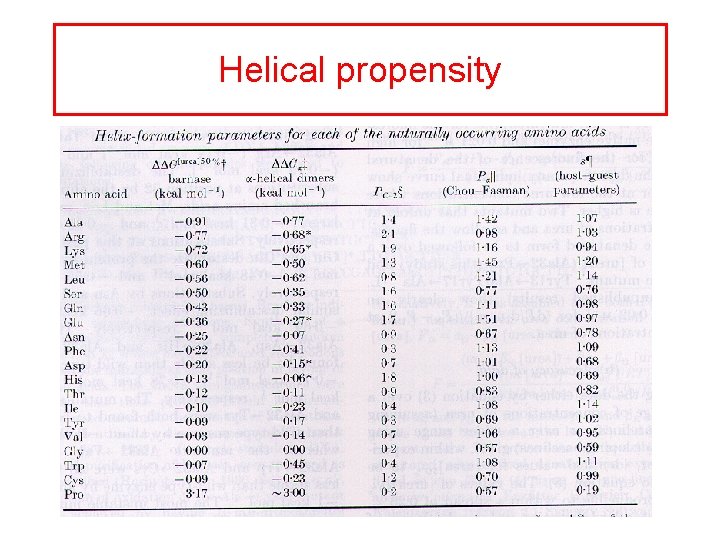
Helical propensity
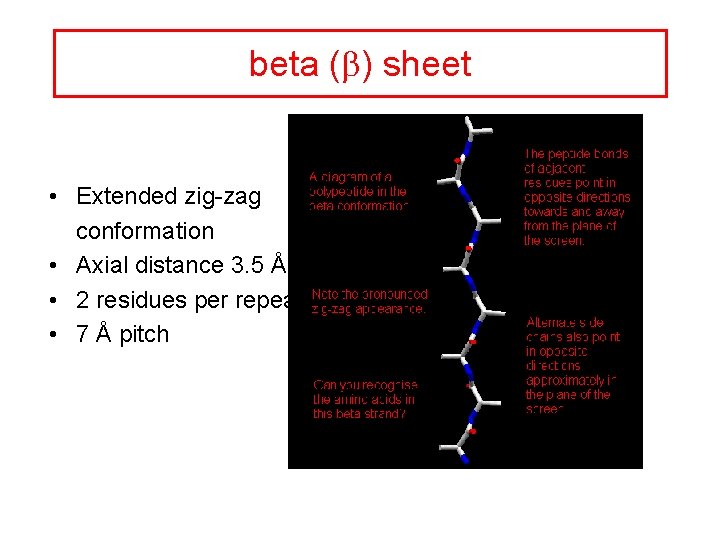
beta (b) sheet • Extended zig-zag conformation • Axial distance 3. 5 Å • 2 residues per repeat • 7 Å pitch
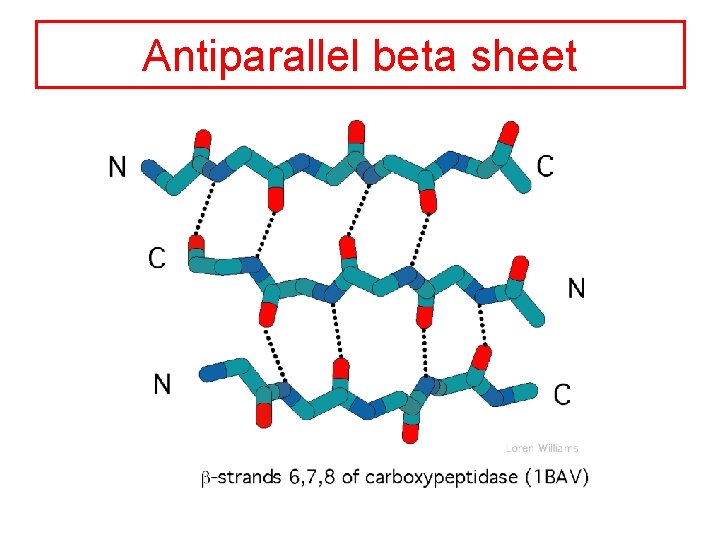
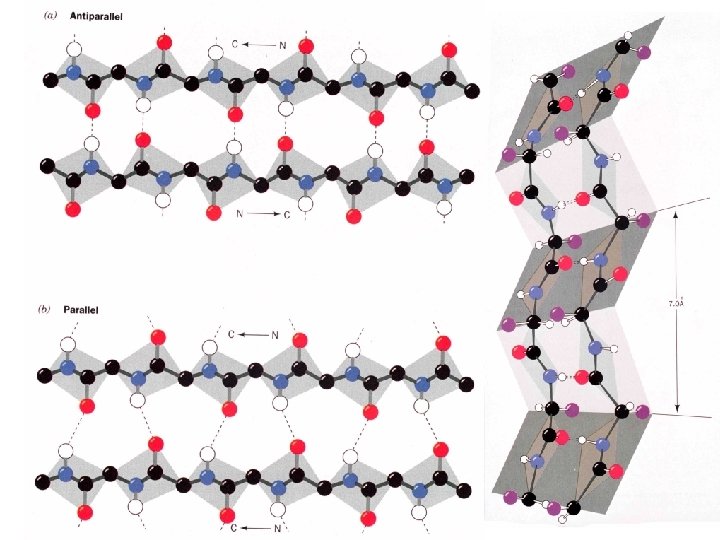
Antiparallel beta sheet
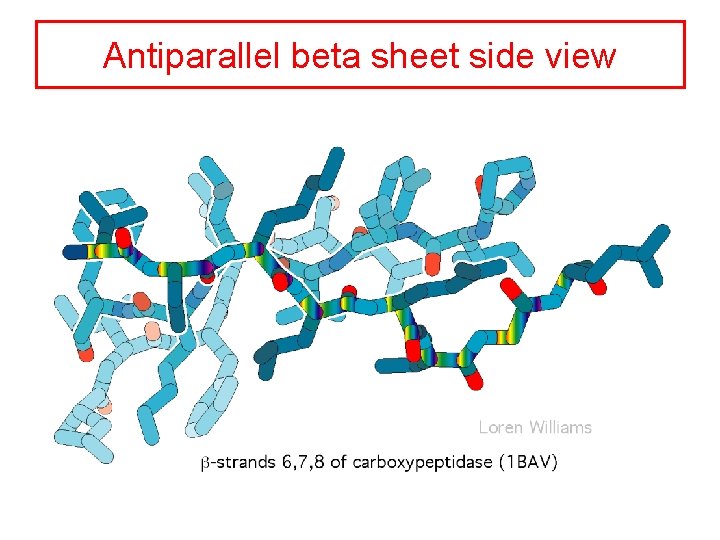
Antiparallel beta sheet side view
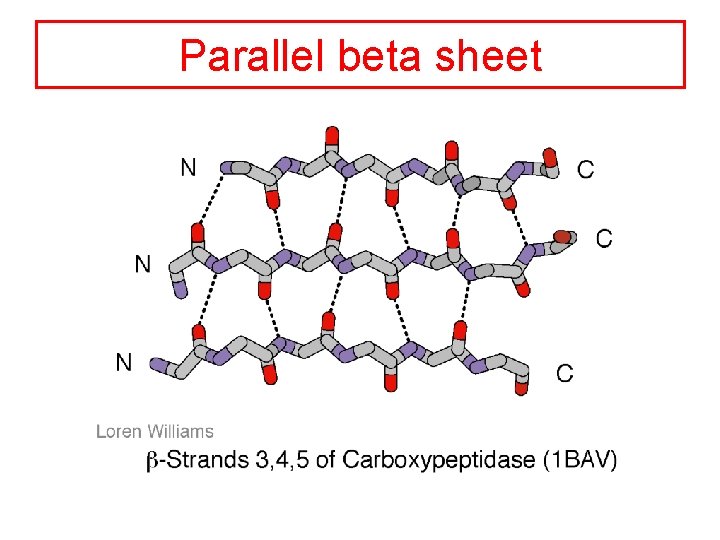
Parallel beta sheet
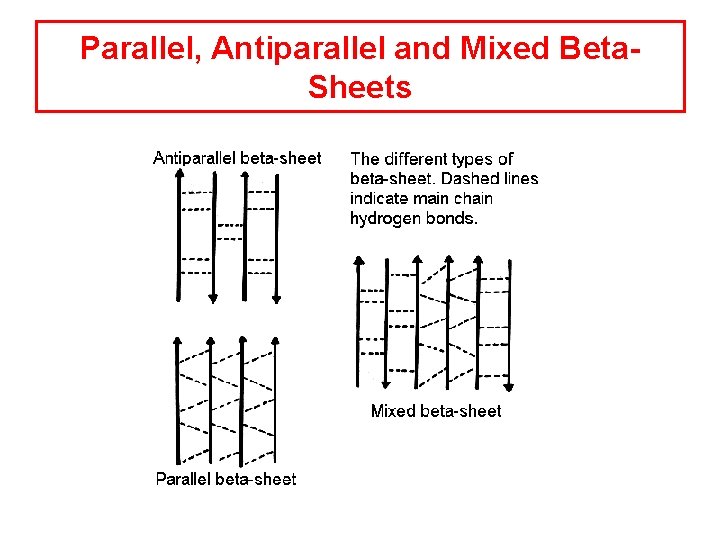
Parallel, Antiparallel and Mixed Beta. Sheets
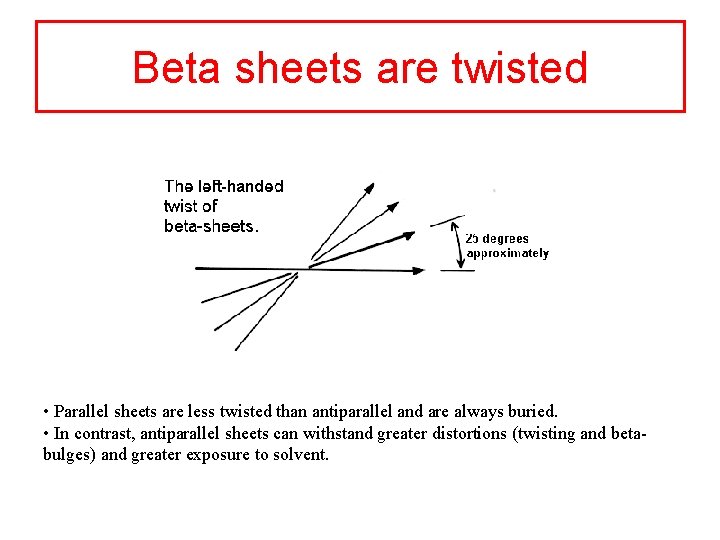
Beta sheets are twisted • Parallel sheets are less twisted than antiparallel and are always buried. • In contrast, antiparallel sheets can withstand greater distortions (twisting and betabulges) and greater exposure to solvent.
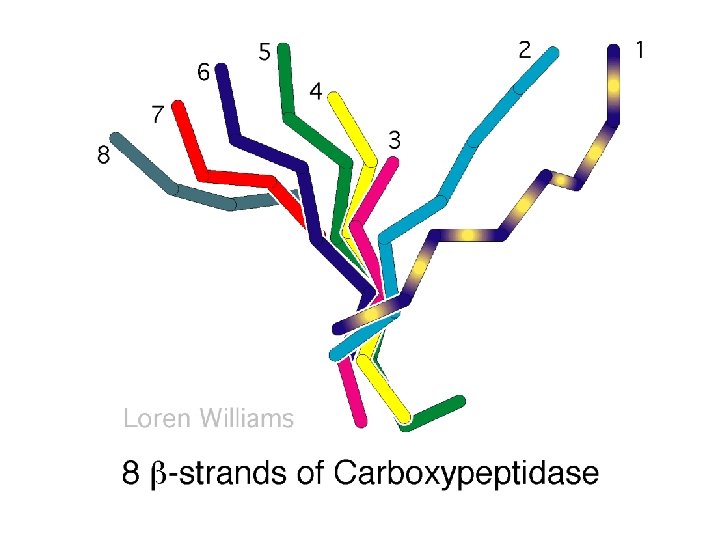
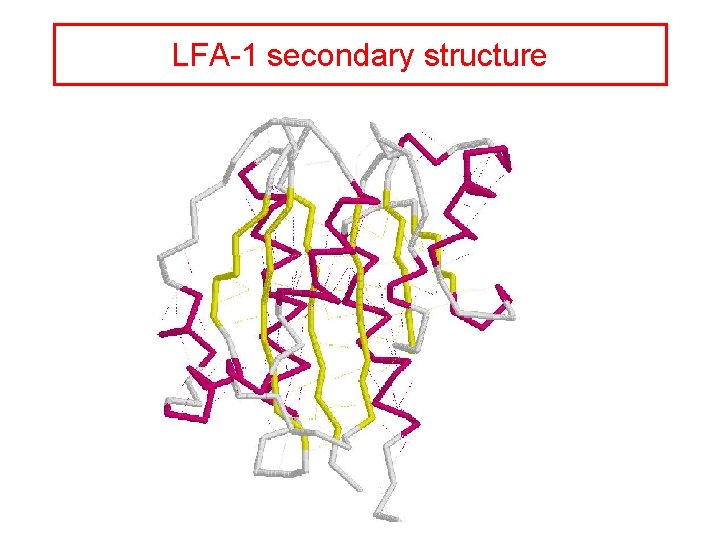
LFA-1 secondary structure
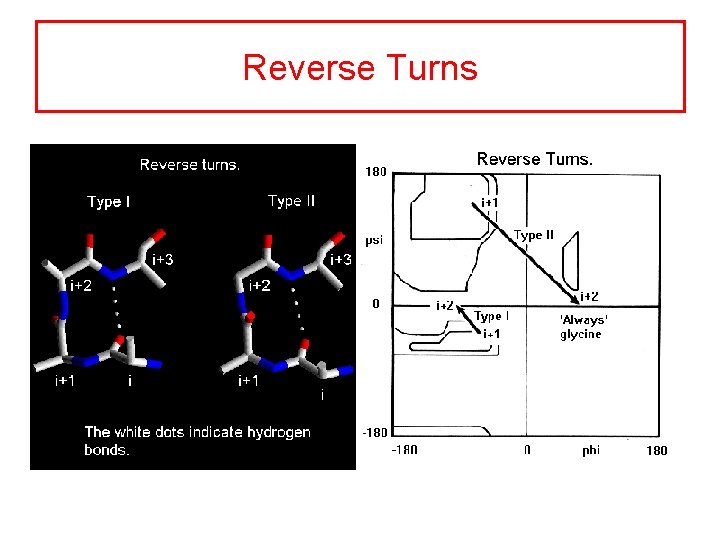
Reverse Turns
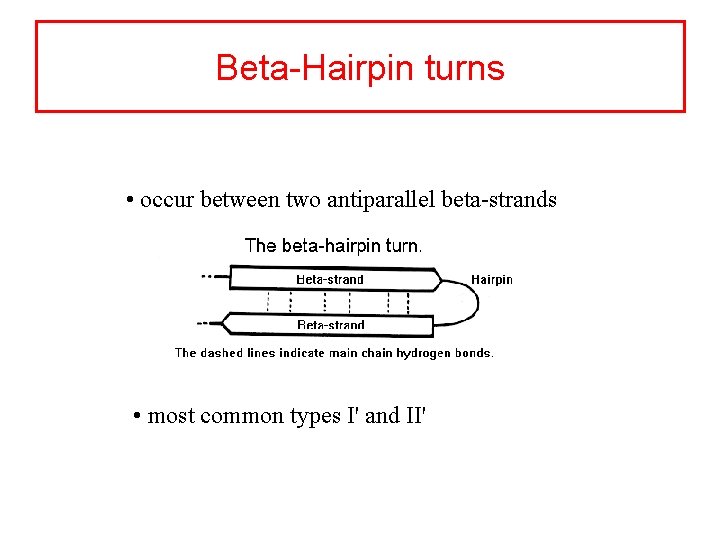
Beta-Hairpin turns • occur between two antiparallel beta-strands • most common types I' and II'
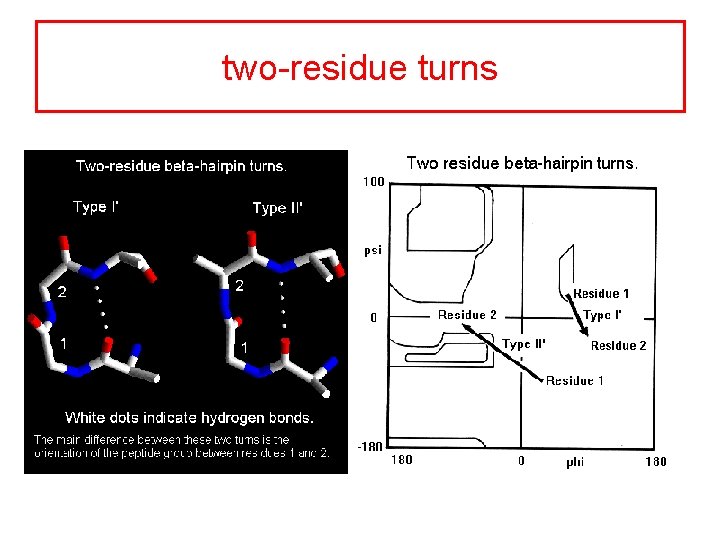
two-residue turns
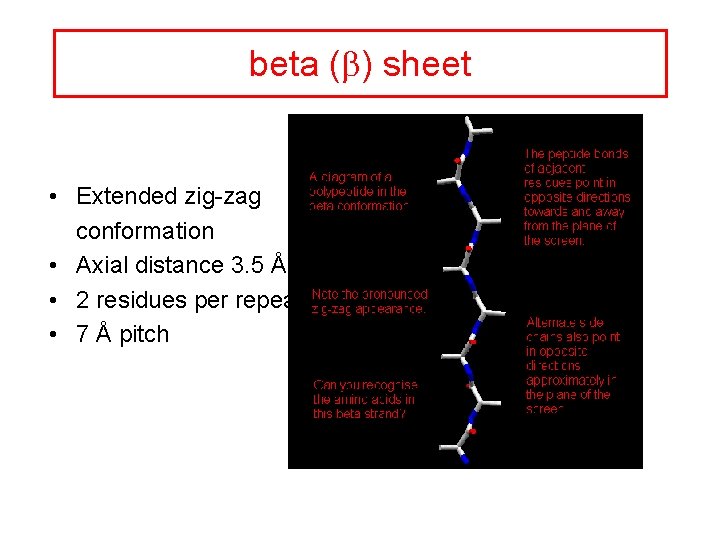
beta (b) sheet • Extended zig-zag conformation • Axial distance 3. 5 Å • 2 residues per repeat • 7 Å pitch
- Slides: 43