
Molecular Biology II Common Techniques Aspects to Cover
Molecular Biology II Common Techniques
Aspects to Cover DNA/RNA Quantitation Gel Electrophoresis Restriction Endonuclease Digestion DNA Ligation DNA/RNA Polymerases Reverse Transcription (RT) Plasmid Vectors Cloning Southern/ Northern Blotting Primers Polymerase Chain Reaction (PCR) Quantitative RT-q. PCR Quick application of RT-q. PCR in our laboratory

Restriction Endonuclease Digestion Cut DNA at specific 4 or 6 base pair sequences Sequences are usually palindromic C C C G G G Can create ‘sticky’ or ‘blunt’ ends G G G C C C Sma. I C C C G G G C C C
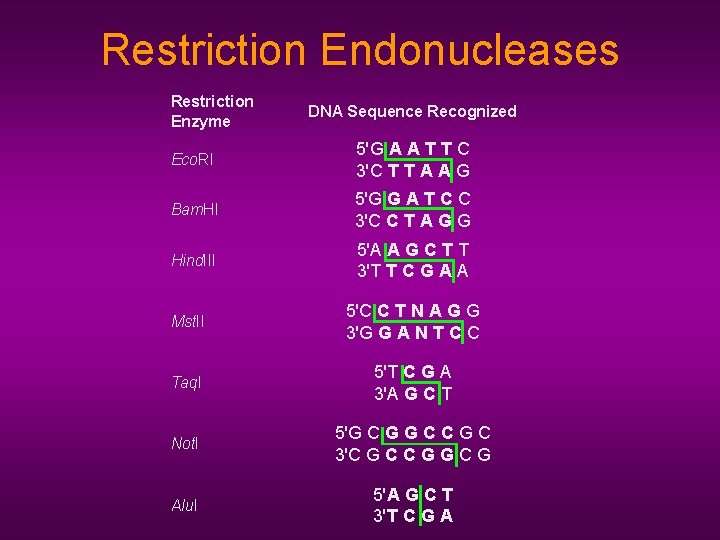
Restriction Endonucleases Restriction Enzyme DNA Sequence Recognized Eco. RI 5'G A A T T C 3'C T T A A G Bam. HI 5'G G A T C C 3'C C T A G G Hind. III 5'A A G C T T 3'T T C G A A Mst. II 5'C C T N A G G 3'G G A N T C C Taq. I 5'T C G A 3'A G C T Not. I 5'G C G G C C G C 3'C G C C G G C G Alu. I 5'A G C T 3'T C G A
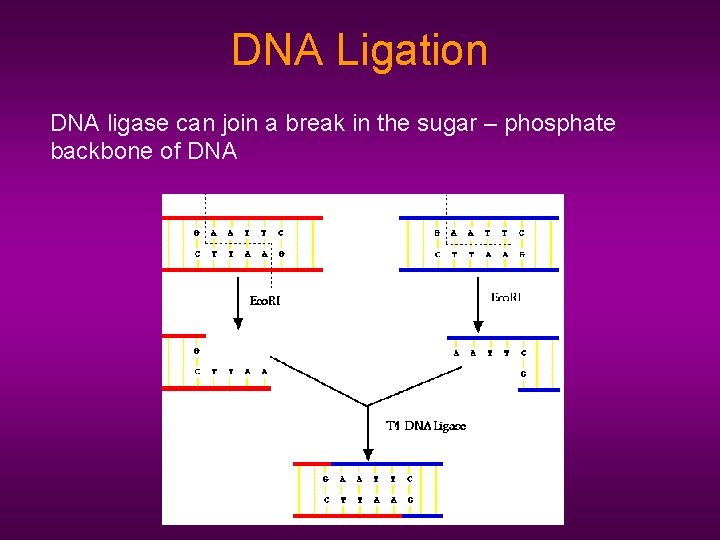
DNA Ligation DNA ligase can join a break in the sugar – phosphate backbone of DNA
Polymerases Synthesis of nucleic acids from template in the 5’ to 3’ direction DNA-dependent DNA polymerases (replicate DNA) DNA pol a, b, g, d, e – replication of DNA in eukaryotes (19) DNA pol I, III – replication of DNA in prokaryotes Klenow – subunit of E. coli DNA pol I labelling fragments for Southern/Northern blot Taq DNA pol – from Thermus aquaticus PCR DNA-dependent RNA polymerases (transcribes RNA) Reverse Transcriptase Uses RNA as template for DNA synthesis
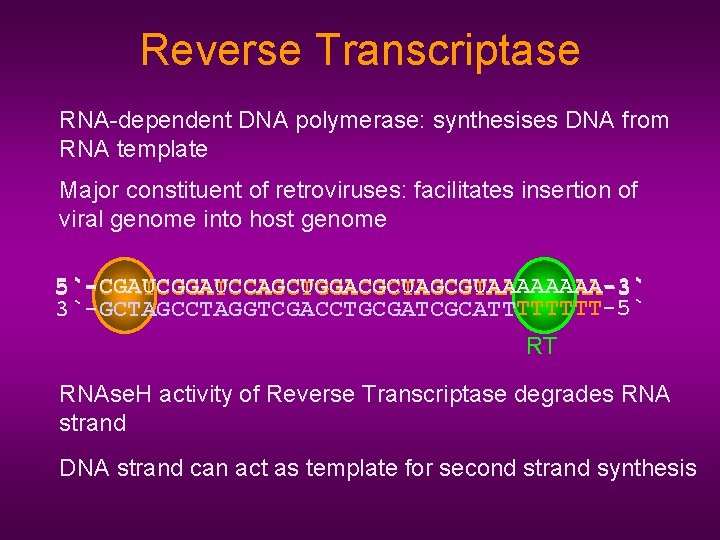
Reverse Transcriptase RNA-dependent DNA polymerase: synthesises DNA from RNA template Major constituent of retroviruses: facilitates insertion of viral genome into host genome 5`-CGAUCGGAUCCAGCUGGACGCUAGCGUAAAA-3` 5`-CGATCGGATCCAGCTGGACGCTAGCGTAAAA-3` 3`-GCTAGCCTAGGTCGACCTGCGATCGCATTTT-5` RT RNAse. H activity of Reverse Transcriptase degrades RNA strand DNA strand can act as template for second strand synthesis
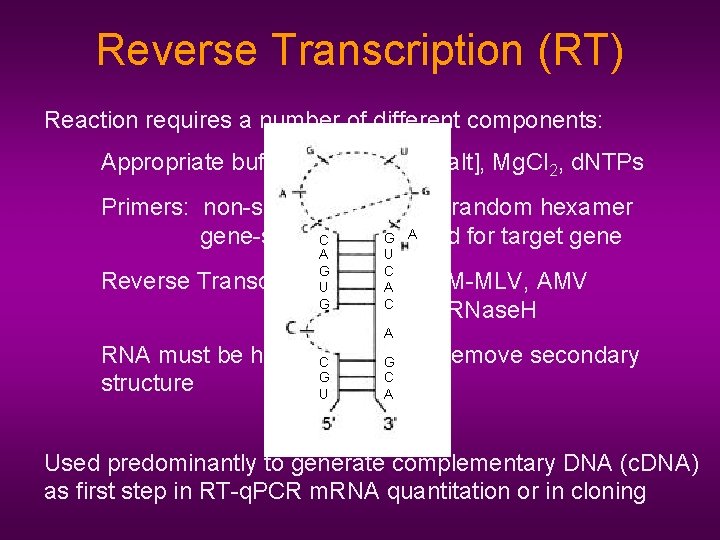
Reverse Transcription (RT) Reaction requires a number of different components: Appropriate buffer conditions - [salt], Mg. Cl 2, d. NTPs Primers: non-specific - oligo d. T, random hexamer G A gene-specific for target gene C - designed A G U C A C Reverse Transcriptase enzyme: M-MLV, AMV RNase. H A RNA must be heated. Cto 65 o. GC to remove secondary G C structure U A Used predominantly to generate complementary DNA (c. DNA) as first step in RT-q. PCR m. RNA quantitation or in cloning

Plasmid Vectors Small circular molecules of ds. DNA Frequently used for cloning due to their ability to carry foreign DNA into bacterial cells and create multiple copies Contain multiple cloning sites to assist in insertion of foreign DNA Contain regulatory elements for replication and antibiotic resistance genes for selection Used as vectors to express cloned genes in both bacterial and eukaryotic cells
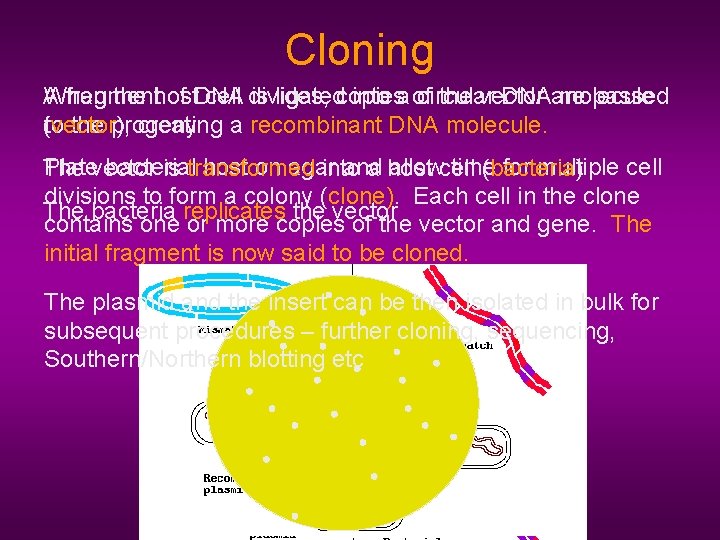
Cloning A When fragment the host of DNA cell divides, is ligatedcopies into a of circular the vector DNAare molecule passed (vector), to the progeny creating a recombinant DNA molecule. Platevector bacterial host on agar and allowcell time for multiple cell The is transformed into a host (bacteria) divisions to form a colony (clone). Each cell in the clone The bacteria replicates the vector contains one or more copies of the vector and gene. The initial fragment is now said to be cloned. The plasmid and the insert can be then isolated in bulk for subsequent procedures – further cloning, sequencing, Southern/Northern blotting etc
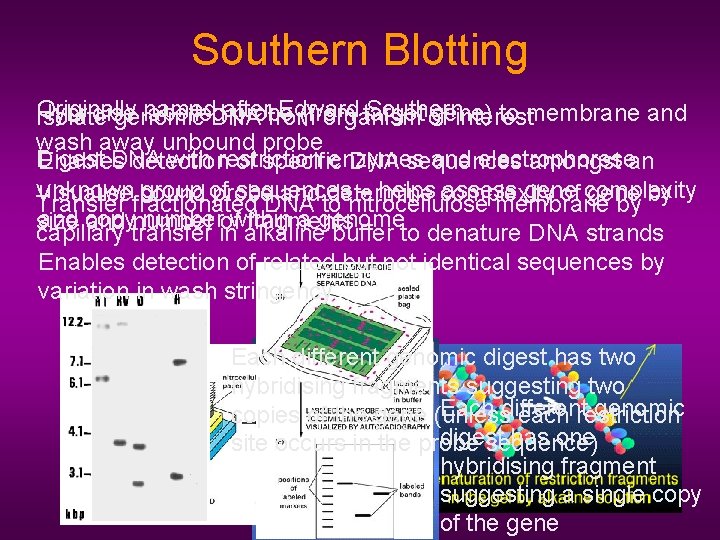
Southern Blotting Originally named. DNA after Edward Southern Hybridise labelled probe (from target gene) to membrane and Isolate genomic from organism of interest wash away unbound probe Digest DNA with restriction enzymes and electrophorese Enables detection of specific DNA sequences amongst an unknown bound group of sequences – helps complexity assess gene complexity Visualise probe and determine of gene Transfer fractionated DNA to nitrocellulose membrane by by and copy numberofwithin a genome size and number fragments capillary transfer in alkaline buffer to denature DNA strands Enables detection of related but not identical sequences by variation in wash stringency Each different genomic digest has two hybridising fragments suggesting two Each different genomic copies of the gene (unless each restriction digest has one site occurs in the probe sequence) hybridising fragment suggesting a single copy of the gene
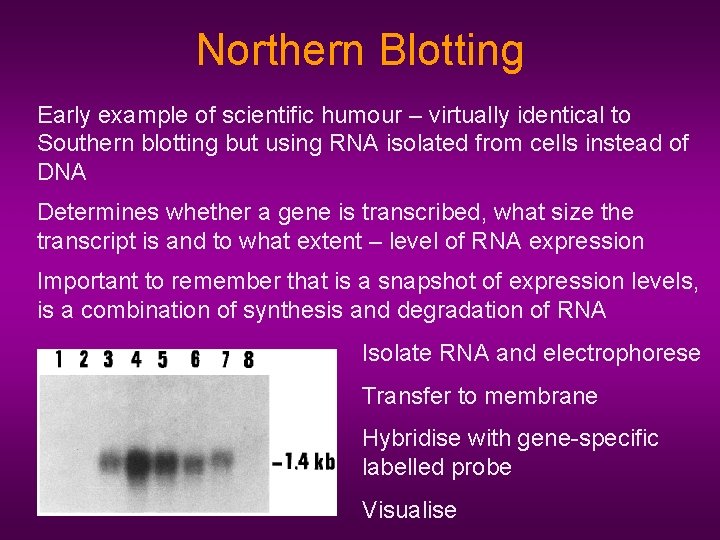
Northern Blotting Early example of scientific humour – virtually identical to Southern blotting but using RNA isolated from cells instead of DNA Determines whether a gene is transcribed, what size the transcript is and to what extent – level of RNA expression Important to remember that is a snapshot of expression levels, is a combination of synthesis and degradation of RNA Isolate RNA and electrophorese Transfer to membrane Hybridise with gene-specific labelled probe Visualise
Primers Used in reverse transcription, sequencing, PCR Short pieces of DNA (18 -25 bp) used to “prime” for DNA synthesis Provide 3` OH group for strand elongation Must be complementary to region in template Can either target a specific gene (PCR) or randomly prime (RT) If targeting a specific gene, must not be complementary to any other region in template
Polymerase Chain Reaction (PCR) Used to clone specific sequences of DNA for further manipulation Used to in conjunction with reverse transcription to quantitate levels of a specific gene m. RNA (RT-q. PCR)
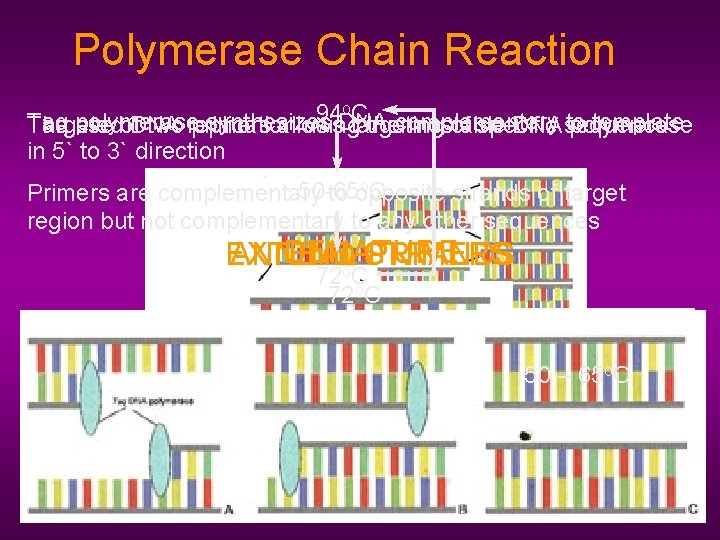
Polymerase Chain Reaction o. C 94 Taq polymerase synthesizes DNA complementary to template Targeted The use of. DNA two replication primers allows using targeting thermostable of specific DNA sequences polymerase in 5` to 3` direction o. C 50 -65 Primers are complementary to opposite strands of target region but not complementary to any other sequences DENATURE ANNEAL PRIMERS EXTEND STRANDS o 72 C 72 o. C Each cycle of PCR doubles the number of progeny DNA duplexes (which can then act as template as well) o 94 C 1 50 – 65 o. C 1 cycle = 2 copies of starting template 25 cycles = 225 copies of starting template
PCR Requirements Buffer – to maintain p. H d. NTPs – for incorporation into elongating DNA fragment Mg. Cl 2 – essential for primer binding 0. 5 – 4 m. M primers – forward and reverse pair gene specific 0. 2 m. M – 10 m. M Enzyme – Taq polymerase or equivalent
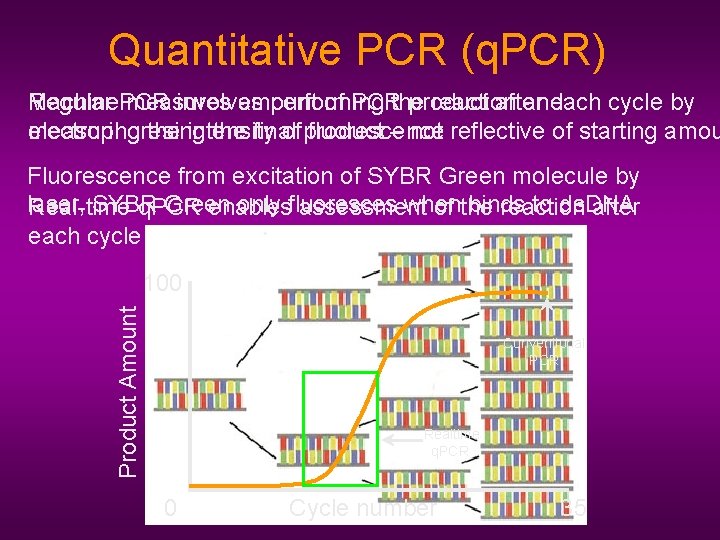
Quantitative PCR (q. PCR) Machine. PCR Regular measures involves amount performing of PCRthe product reaction after and each cycle by electrophoresing measuring the intensity the final of product fluorescence – not reflective of starting amou Fluorescence from excitation of SYBR Green molecule by laser, SYBR Green only fluoresces when binds to ds. DNA Real-time q. PCR enables assessment of the reaction after each cycle Product Amount 100 Conventional PCR Realtime q. PCR 0 Cycle number 35
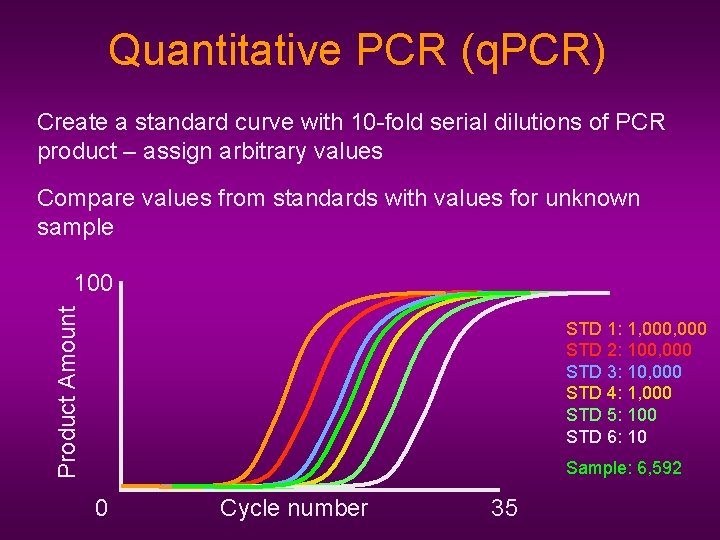
Quantitative PCR (q. PCR) Create a standard curve with 10 -fold serial dilutions of PCR product – assign arbitrary values Compare values from standards with values for unknown sample Product Amount 100 STD 1: 1, 000 STD 2: 100, 000 STD 3: 10, 000 STD 4: 1, 000 STD 5: 100 STD 6: 10 Sample: 6, 592 0 Cycle number 35
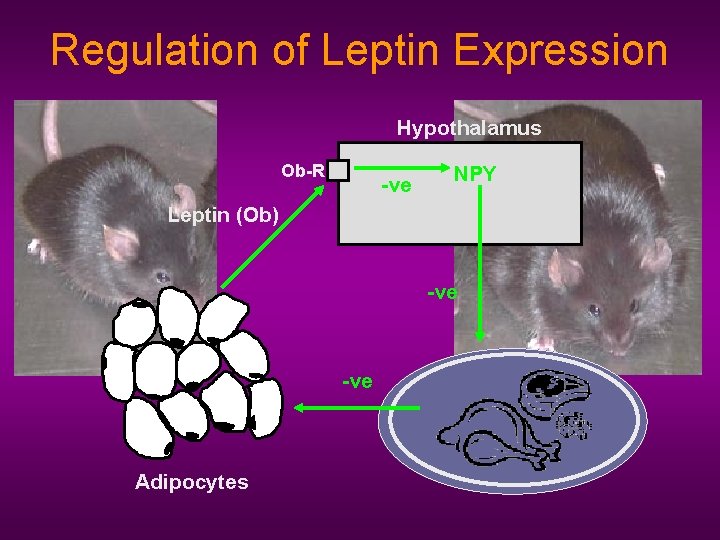
Regulation of Leptin Expression Hypothalamus Ob-R -ve NPY Leptin (Ob) -ve Adipocytes
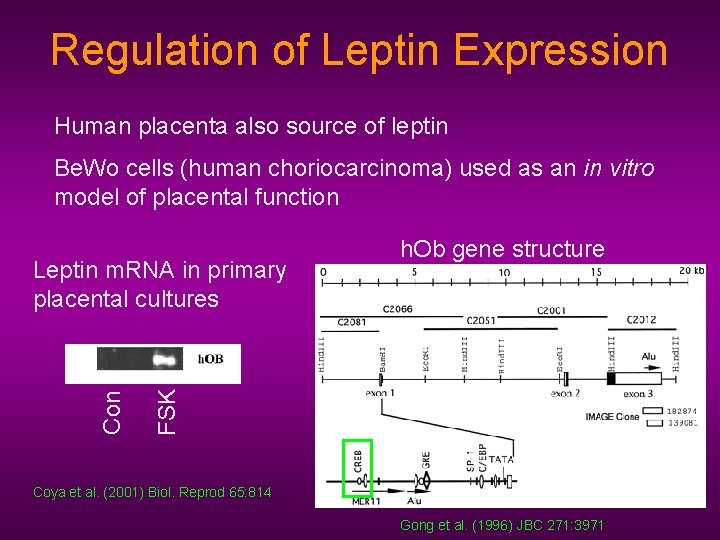
Regulation of Leptin Expression Human placenta also source of leptin Be. Wo cells (human choriocarcinoma) used as an in vitro model of placental function FSK Con Leptin m. RNA in primary placental cultures h. Ob gene structure Coya et al. (2001) Biol. Reprod 65: 814 Gong et al. (1996) JBC 271: 3971
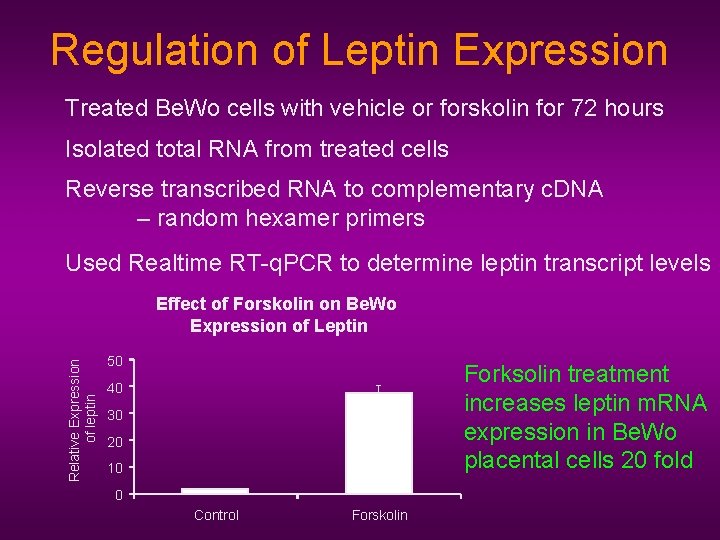
Regulation of Leptin Expression Treated Be. Wo cells with vehicle or forskolin for 72 hours Isolated total RNA from treated cells Reverse transcribed RNA to complementary c. DNA – random hexamer primers Used Realtime RT-q. PCR to determine leptin transcript levels Relative Expression of leptin Effect of Forskolin on Be. Wo Expression of Leptin 50 Forksolin treatment increases leptin m. RNA expression in Be. Wo placental cells 20 fold 40 30 20 10 0 Control Forskolin
- Slides: 21