
Molecular Biology DNA Expression CHAPTER 9 PART B
Molecular Biology DNA Expression CHAPTER 9 PART B
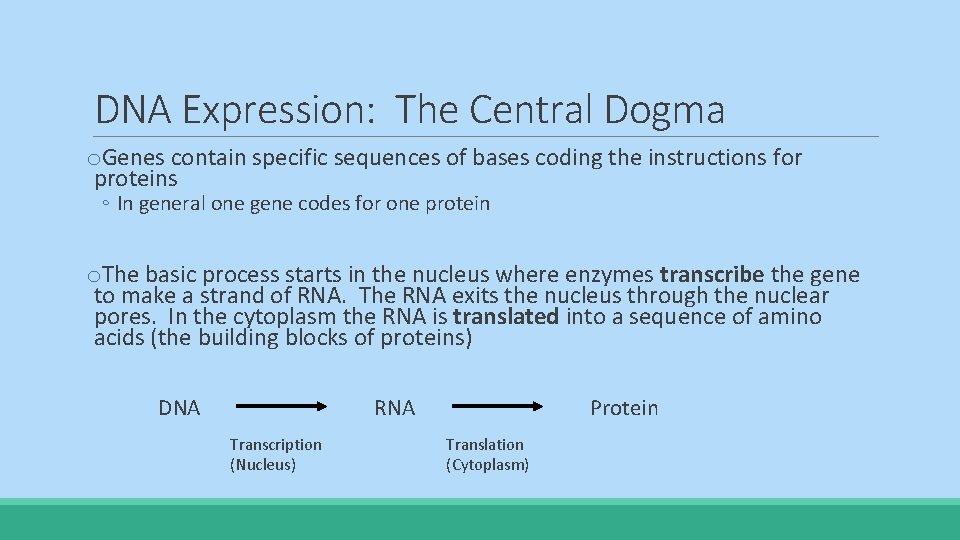
DNA Expression: The Central Dogma o. Genes contain specific sequences of bases coding the instructions for proteins ◦ In general one gene codes for one protein o. The basic process starts in the nucleus where enzymes transcribe the gene to make a strand of RNA. The RNA exits the nucleus through the nuclear pores. In the cytoplasm the RNA is translated into a sequence of amino acids (the building blocks of proteins) DNA RNA Transcription (Nucleus) Protein Translation (Cytoplasm)
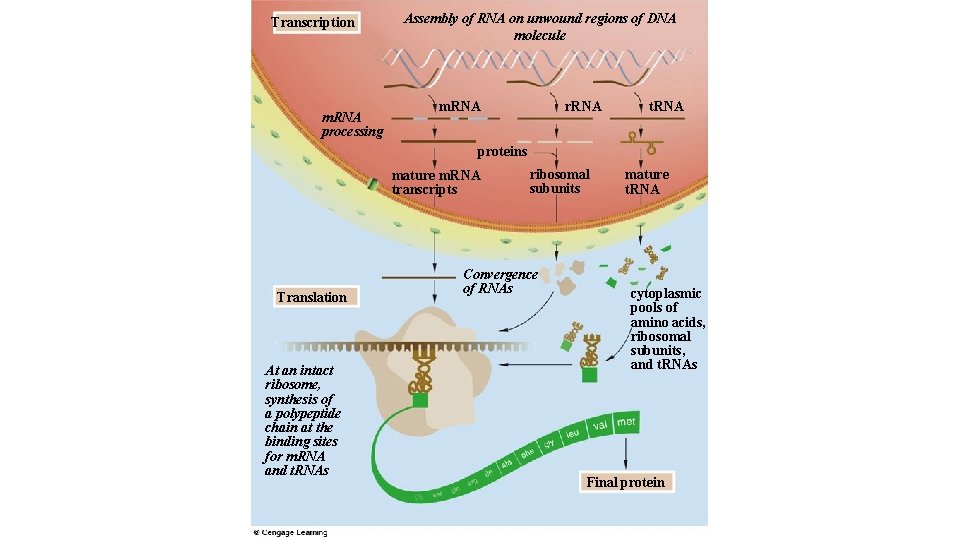
Transcription m. RNA processing Assembly of RNA on unwound regions of DNA molecule m. RNA r. RNA t. RNA proteins mature m. RNA transcripts Translation At an intact ribosome, synthesis of a polypeptide chain at the binding sites for m. RNA and t. RNAs ribosomal subunits Convergence of RNAs mature t. RNA cytoplasmic pools of amino acids, ribosomal subunits, and t. RNAs Final protein
Transcription: from DNA to m. RNA o. Transcription is the first step in gene expression o. Transcription occurs in the nucleus in eukaryotes o. The base sequence of a gene in DNA is copied to make a single strand of RNA
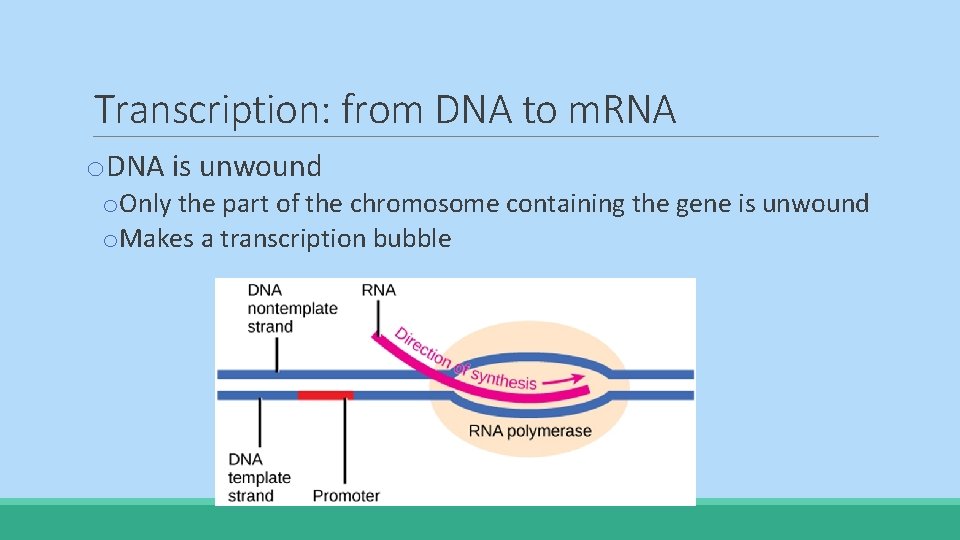
Transcription: from DNA to m. RNA o. DNA is unwound o. Only the part of the chromosome containing the gene is unwound o. Makes a transcription bubble
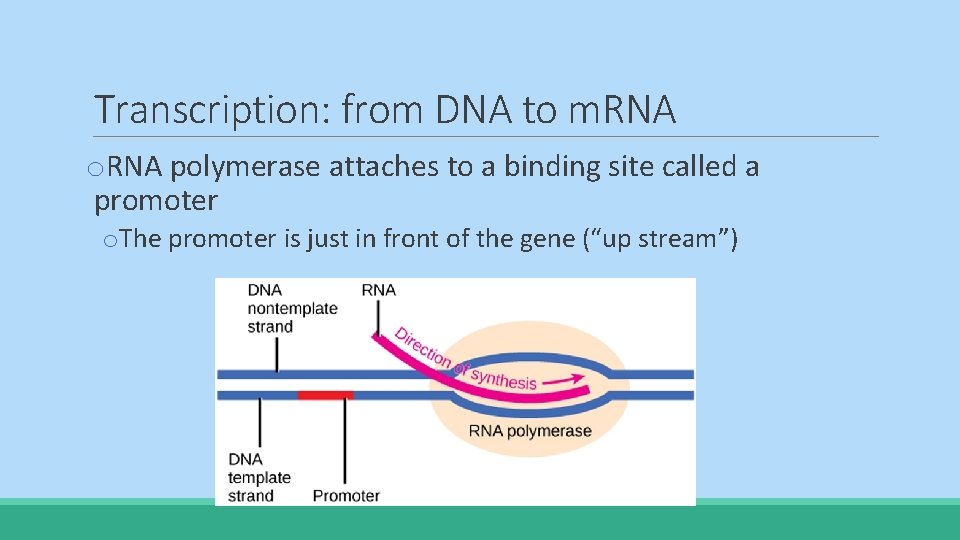
Transcription: from DNA to m. RNA o. RNA polymerase attaches to a binding site called a promoter o. The promoter is just in front of the gene (“up stream”)
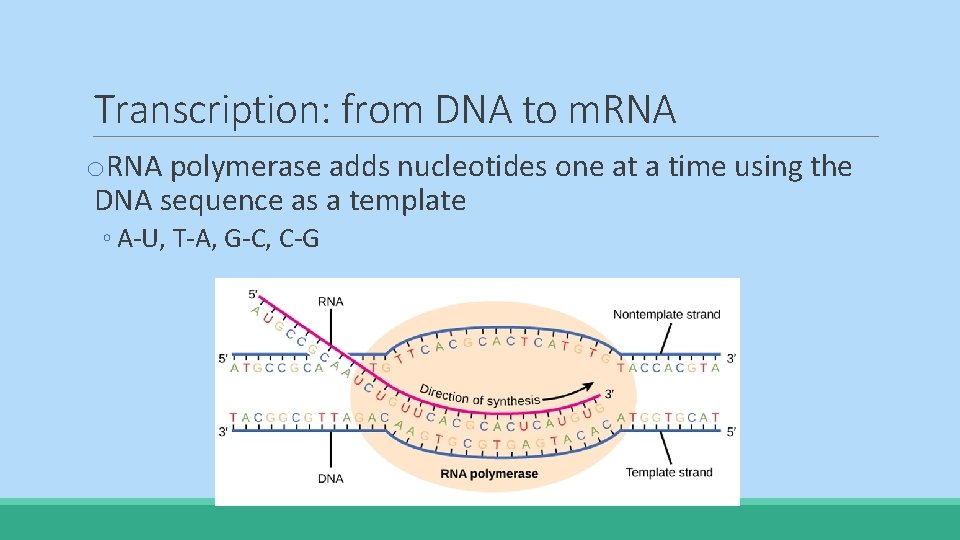
Transcription: from DNA to m. RNA o. RNA polymerase adds nucleotides one at a time using the DNA sequence as a template ◦ A-U, T-A, G-C, C-G
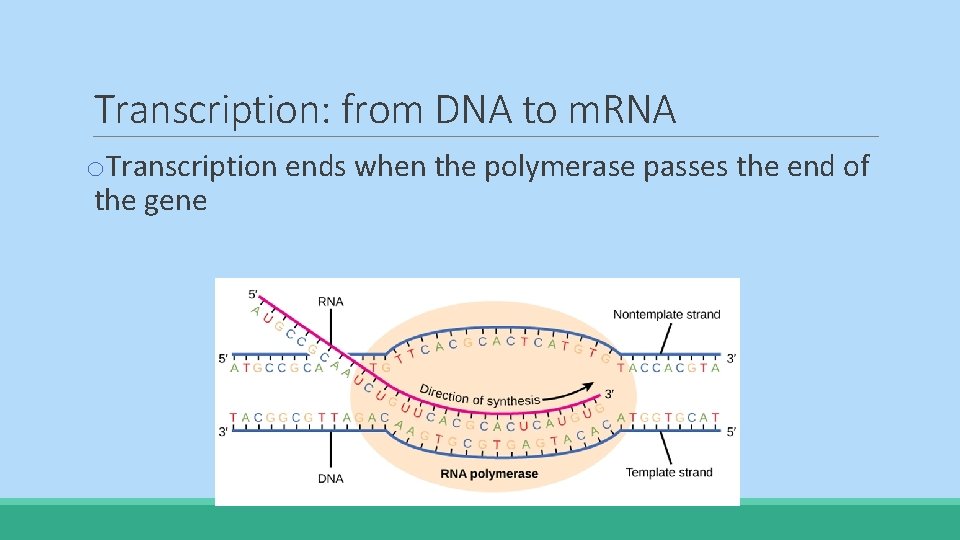
Transcription: from DNA to m. RNA o. Transcription ends when the polymerase passes the end of the gene
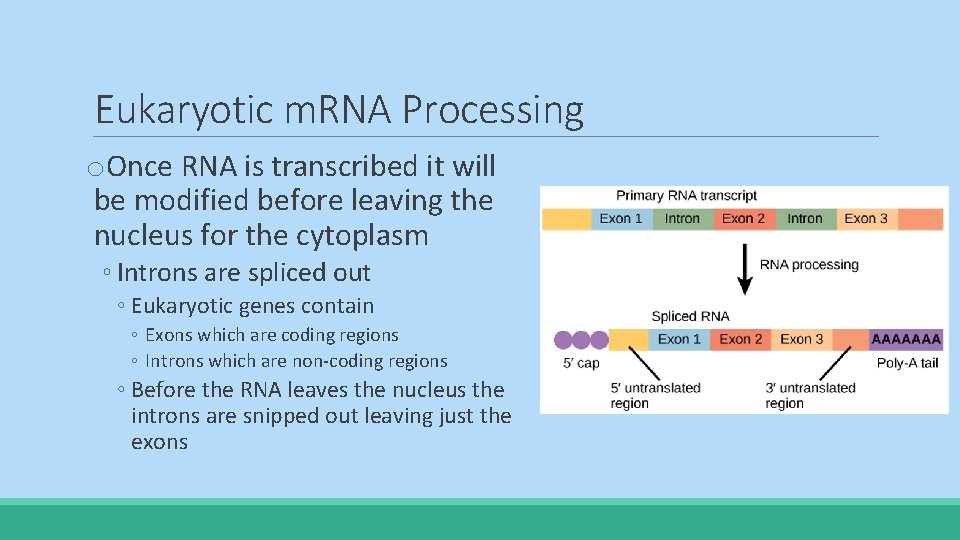
Eukaryotic m. RNA Processing o. Once RNA is transcribed it will be modified before leaving the nucleus for the cytoplasm ◦ Introns are spliced out ◦ Eukaryotic genes contain ◦ Exons which are coding regions ◦ Introns which are non-coding regions ◦ Before the RNA leaves the nucleus the introns are snipped out leaving just the exons
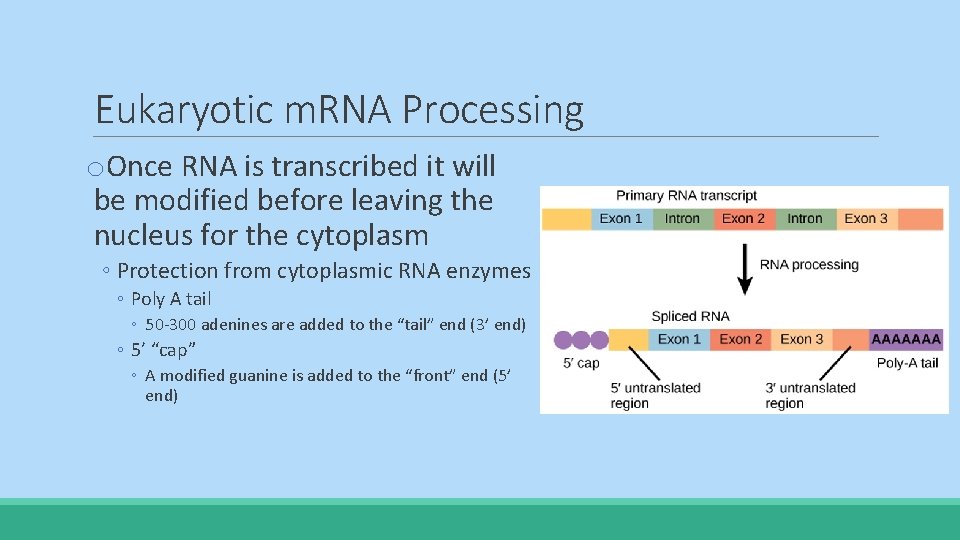
Eukaryotic m. RNA Processing o. Once RNA is transcribed it will be modified before leaving the nucleus for the cytoplasm ◦ Protection from cytoplasmic RNA enzymes ◦ Poly A tail ◦ 50 -300 adenines are added to the “tail” end (3’ end) ◦ 5’ “cap” ◦ A modified guanine is added to the “front” end (5’ end)
Translation o. Translation is the second step in gene expression o. Translation occurs in the cytoplasm o. The base sequence in the m. RNA is decoded into a sequence of amino acids in a protein
Translation o. The Genetic Code ◦ The sequence of nucleotides/bases in the m. RNA “spell” out the instructions for what protein the cell should make ◦ Different proteins determine the traits of cells and organisms ◦ Each set of three bases is one “word” or codon ◦ A codon indicates which amino acid to add to the protein ◦ Amino acids are protein monomers/subunits
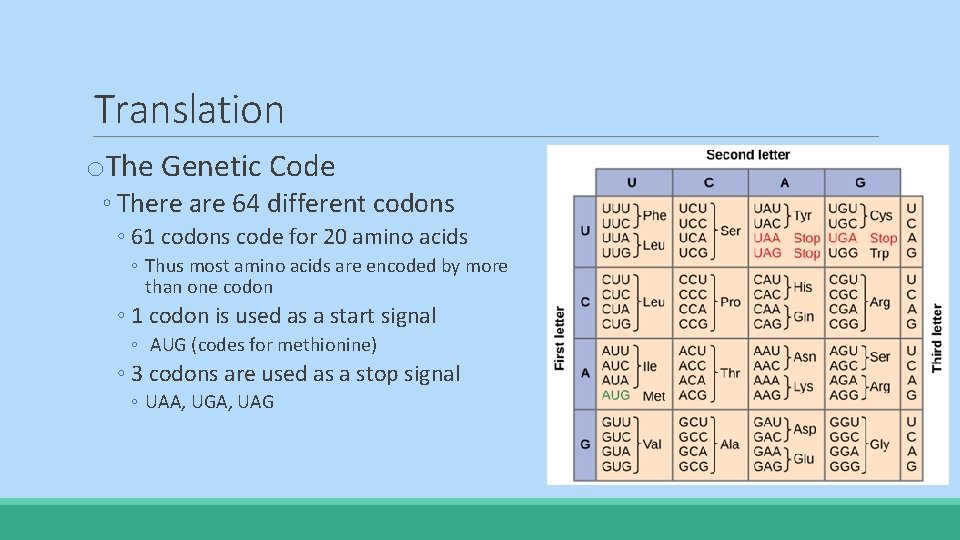
Translation o. The Genetic Code ◦ There are 64 different codons ◦ 61 codons code for 20 amino acids ◦ Thus most amino acids are encoded by more than one codon ◦ 1 codon is used as a start signal ◦ AUG (codes for methionine) ◦ 3 codons are used as a stop signal ◦ UAA, UGA, UAG
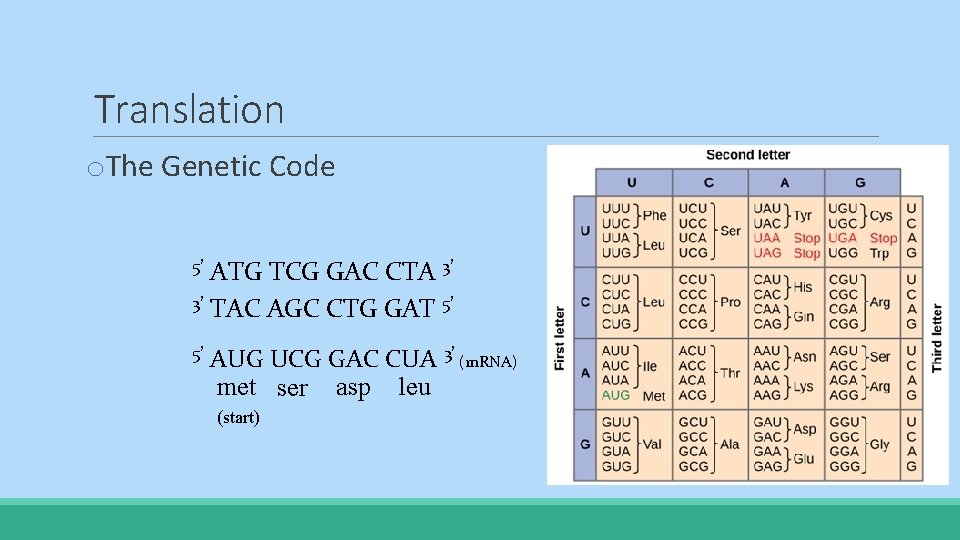
Translation o. The Genetic Code ATG TCG GAC CTA 3’ 3’ TAC AGC CTG GAT 5’ 5’ 5’ AUG UCG GAC CUA 3’ (m. RNA) met ser asp leu (start)
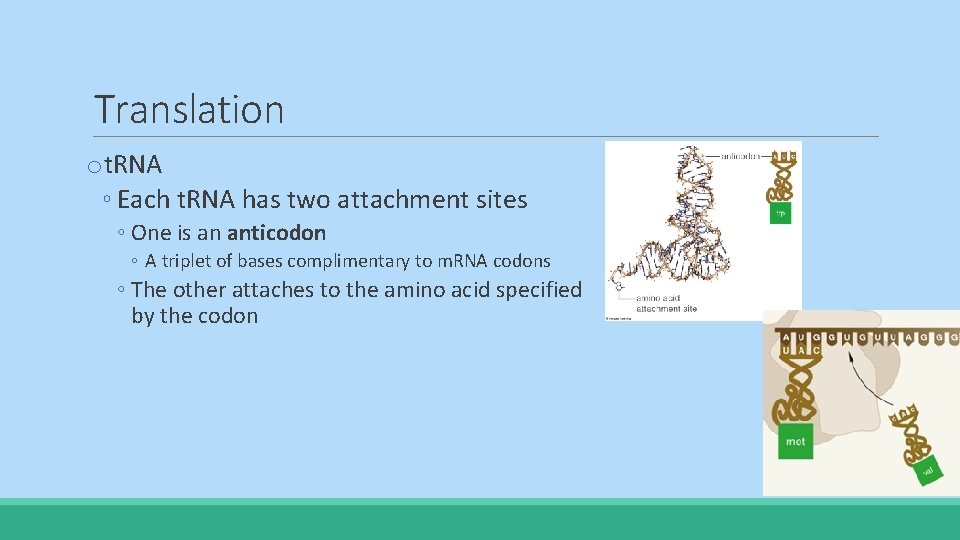
Translation ot. RNA ◦ Each t. RNA has two attachment sites ◦ One is an anticodon ◦ A triplet of bases complimentary to m. RNA codons ◦ The other attaches to the amino acid specified by the codon
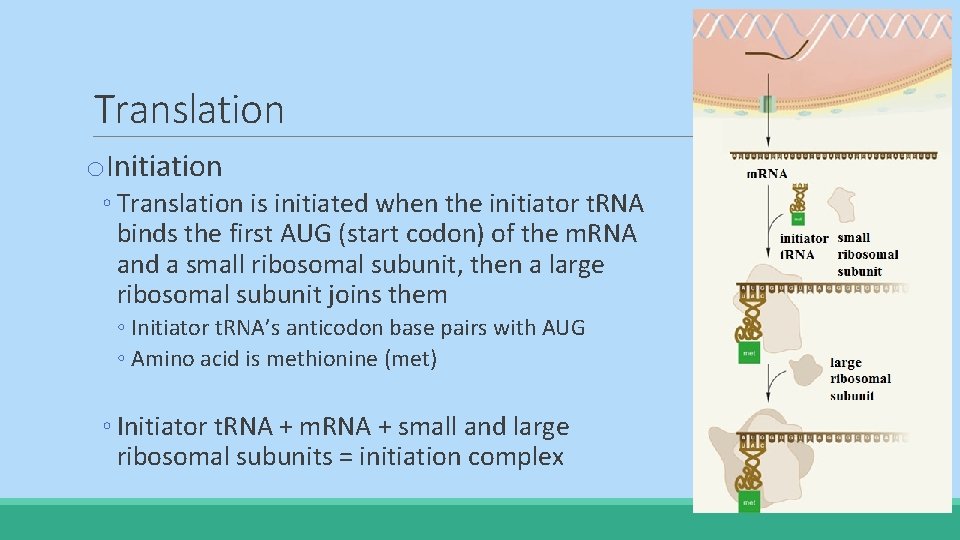
Translation o. Initiation ◦ Translation is initiated when the initiator t. RNA binds the first AUG (start codon) of the m. RNA and a small ribosomal subunit, then a large ribosomal subunit joins them ◦ Initiator t. RNA’s anticodon base pairs with AUG ◦ Amino acid is methionine (met) ◦ Initiator t. RNA + m. RNA + small and large ribosomal subunits = initiation complex
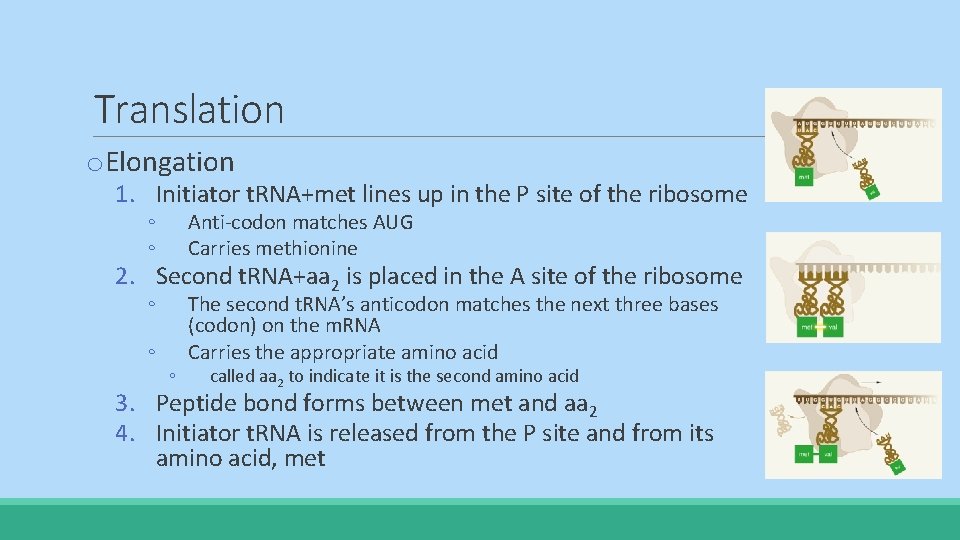
Translation o. Elongation 1. Initiator t. RNA+met lines up in the P site of the ribosome ◦ ◦ Anti-codon matches AUG Carries methionine ◦ The second t. RNA’s anticodon matches the next three bases (codon) on the m. RNA Carries the appropriate amino acid 2. Second t. RNA+aa 2 is placed in the A site of the ribosome ◦ ◦ called aa 2 to indicate it is the second amino acid 3. Peptide bond forms between met and aa 2 4. Initiator t. RNA is released from the P site and from its amino acid, met
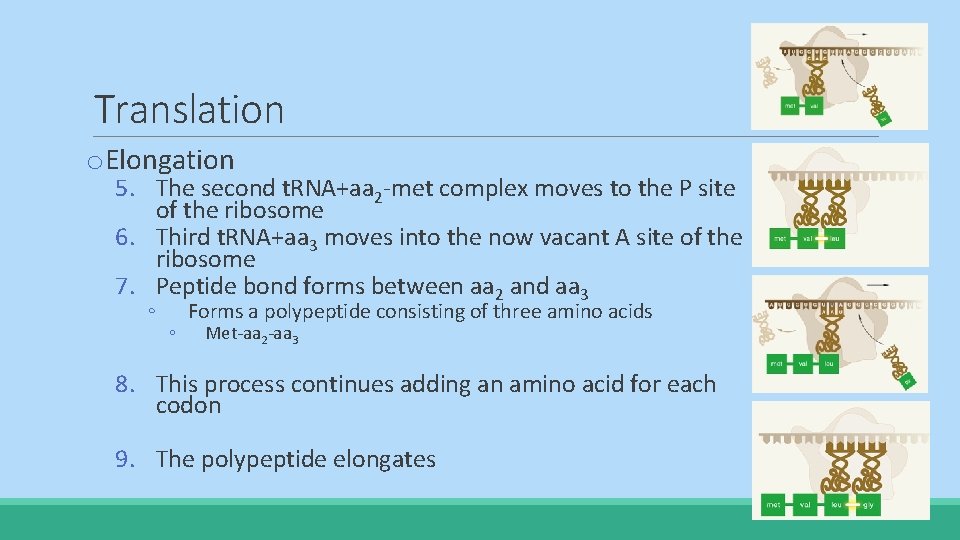
Translation o. Elongation 5. The second t. RNA+aa 2 -met complex moves to the P site of the ribosome 6. Third t. RNA+aa 3 moves into the now vacant A site of the ribosome 7. Peptide bond forms between aa 2 and aa 3 ◦ ◦ Forms a polypeptide consisting of three amino acids Met-aa 2 -aa 3 8. This process continues adding an amino acid for each codon 9. The polypeptide elongates
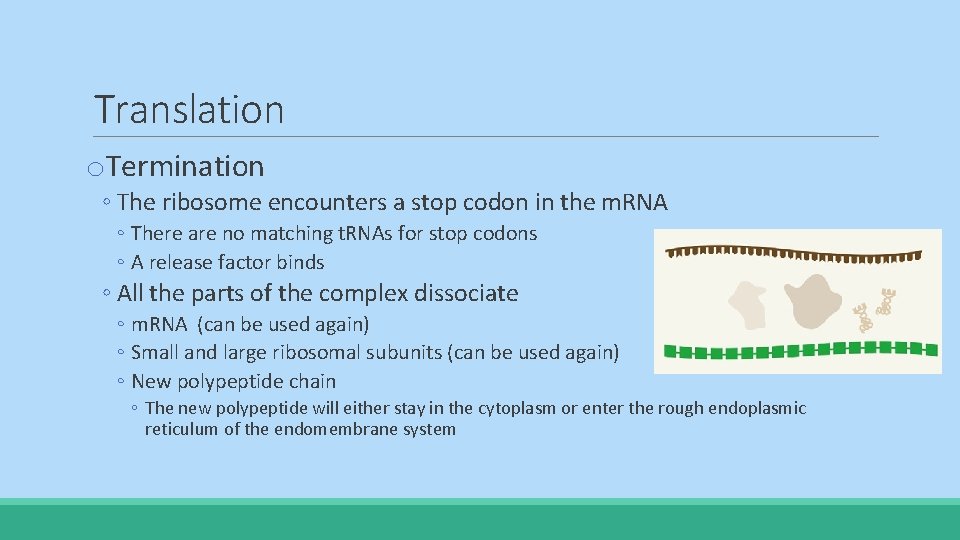
Translation o. Termination ◦ The ribosome encounters a stop codon in the m. RNA ◦ There are no matching t. RNAs for stop codons ◦ A release factor binds ◦ All the parts of the complex dissociate ◦ m. RNA (can be used again) ◦ Small and large ribosomal subunits (can be used again) ◦ New polypeptide chain ◦ The new polypeptide will either stay in the cytoplasm or enter the rough endoplasmic reticulum of the endomembrane system
Mutations o. Mutations are changes in the nucleotide sequence of DNA o. These can affect the sequence of amino acids in the encoded polypeptide thus affecting the function of the protein
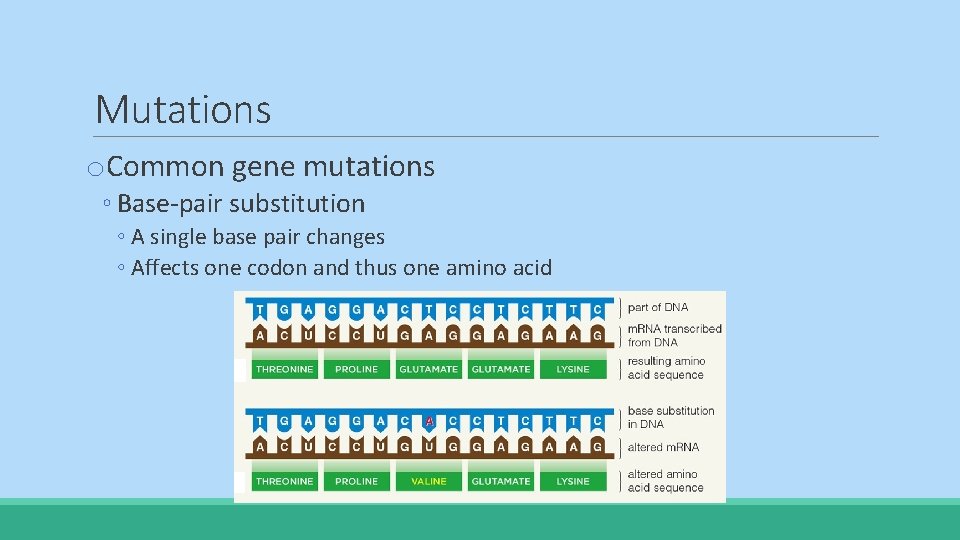
Mutations o. Common gene mutations ◦ Base-pair substitution ◦ A single base pair changes ◦ Affects one codon and thus one amino acid
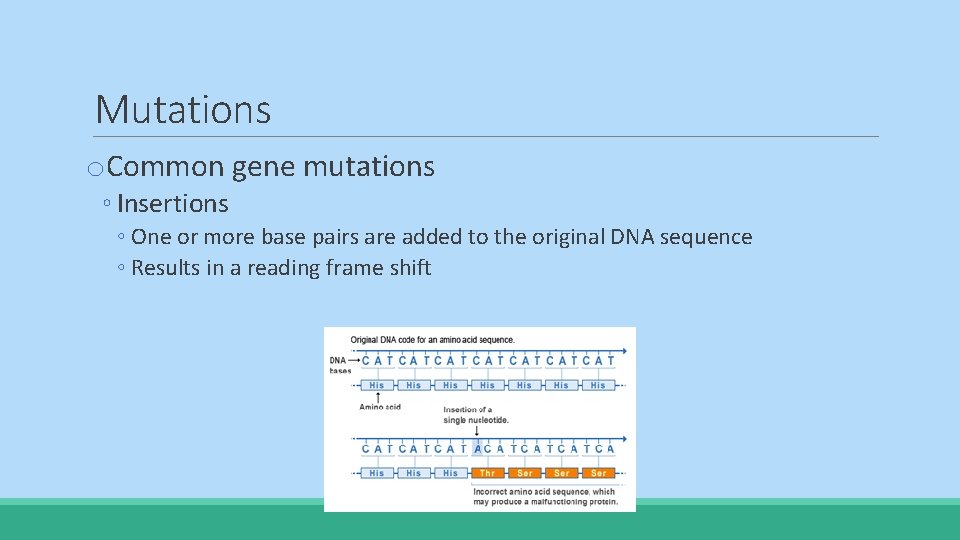
Mutations o. Common gene mutations ◦ Insertions ◦ One or more base pairs are added to the original DNA sequence ◦ Results in a reading frame shift
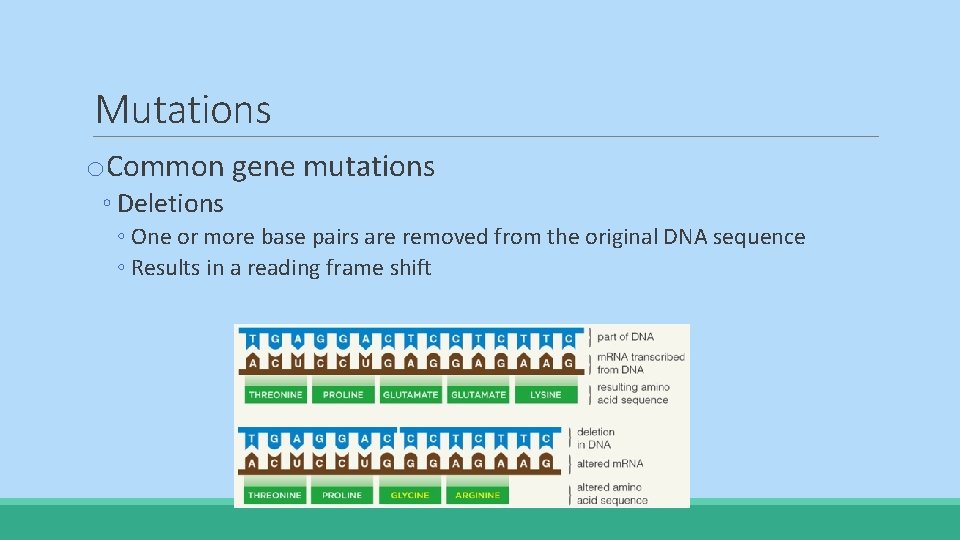
Mutations o. Common gene mutations ◦ Deletions ◦ One or more base pairs are removed from the original DNA sequence ◦ Results in a reading frame shift
Mutations o. Common gene mutations ◦ Frameshift (due to insertion or deletion) ◦ Shifts the 3 -bases-at-a-time reading frame ◦ Changes the amino acid sequence from the point of mutation on. ◦ The cat ate the rat ◦ Tec ata tet her at (deletion) ◦ Thr eca tat eth era t (insertion)
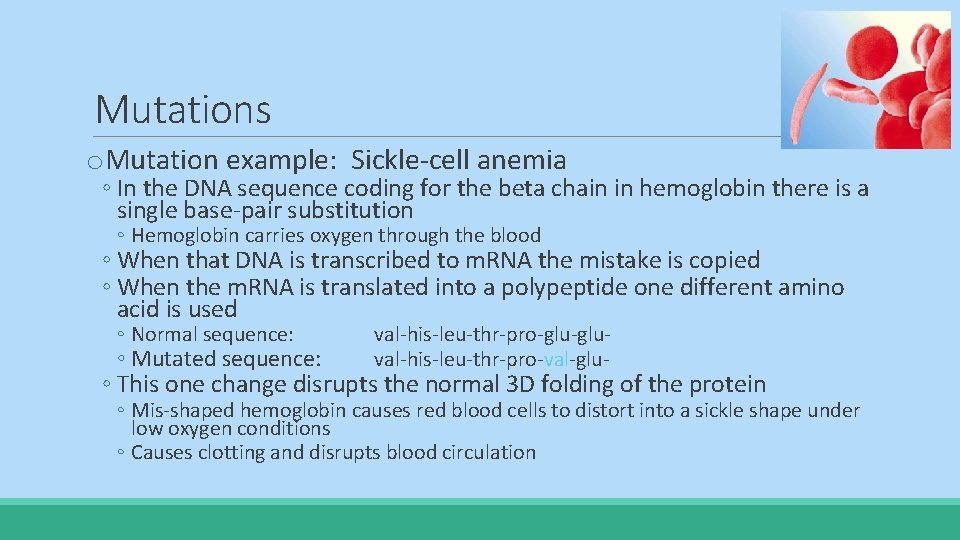
Mutations o. Mutation example: Sickle-cell anemia ◦ In the DNA sequence coding for the beta chain in hemoglobin there is a single base-pair substitution ◦ Hemoglobin carries oxygen through the blood ◦ When that DNA is transcribed to m. RNA the mistake is copied ◦ When the m. RNA is translated into a polypeptide one different amino acid is used ◦ Normal sequence: ◦ Mutated sequence: val-his-leu-thr-pro-gluval-his-leu-thr-pro-val-glu- ◦ This one change disrupts the normal 3 D folding of the protein ◦ Mis-shaped hemoglobin causes red blood cells to distort into a sickle shape under low oxygen conditions ◦ Causes clotting and disrupts blood circulation
Summary o. DNA expression ◦ Genes “code” for proteins and thus traits o. Transcription o. Translation ◦ Genetic code o. Gene Mutations
- Slides: 26