
Molecular Biochemical Adaptations to the Environment Dr Dee
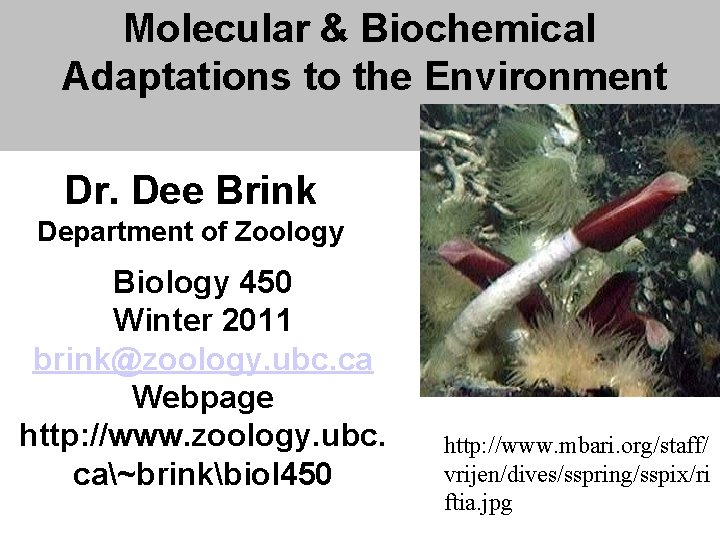
Molecular & Biochemical Adaptations to the Environment Dr. Dee Brink Department of Zoology Biology 450 Winter 2011 brink@zoology. ubc. ca Webpage http: //www. zoology. ubc. ca~brinkbiol 450 http: //www. mbari. org/staff/ vrijen/dives/sspring/sspix/ri ftia. jpg
Agenda Jan 11 2011 • What are your team members and the Journal Club topic you are doing… • When I have that info…I will make schedules. • Please notify me about the JC, IGP topic and TGP topic when you have sussed them out. • Option: choose your own IGP topic: clear it with me first. • Option: drop final; points for class participation…what do you think?
Terms Morphological Homoplasy Cognate species; cognate taxa Extant Cold Seep vs. Hot Vent
By the end of the session you can answer: What are some applications and limitations of molecular clocks; analysis of fossil records; and comparative anatomy? Are living hydrothermal vent organisms a “glimpse of antiquity? ” Why compare evidence from cold seeps with the taxa from hot vents?
Objective 1: evolution review • • Features and examples of adaptations Evidence and analysis used in evolutionary Biology… 1. Fossil record and 2. Molecular clocks 3. Comparative anatomy There are more methods but these are the ones for today’s discussion
Objective 2: features of abyssal organisms/communities • Identify the key species found at deep oceanic hydrothermal vents • Identify physical characteristics of thermal vent ecosystems • What are some adaptive features of these organisms that enable survival in this ecosystem?
Objective 3: test hypothesis Are hydrothermal vent animals living fossils (Paleozoic)? Vs Extinction/repopulation hypothesis • Evaluate fossil record and molecular clocks; comparative anatomy. • Why are vent taxa scientifically interesting and important?
Why are adaptations in deep oceanic organisms interesting to biologists? • Primary energy source is geochemical/geothermal (not solar) • deep-sea chemosynthetic environments might not be immune from global extinction events that affect diversity in the photic zone.
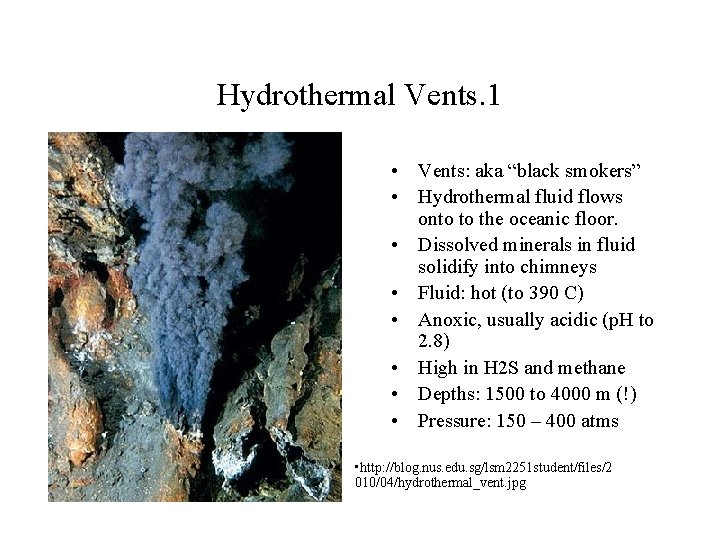
Hydrothermal Vents. 1 • Vents: aka “black smokers” • Hydrothermal fluid flows onto to the oceanic floor. • Dissolved minerals in fluid solidify into chimneys • Fluid: hot (to 390 C) • Anoxic, usually acidic (p. H to 2. 8) • High in H 2 S and methane • Depths: 1500 to 4000 m (!) • Pressure: 150 – 400 atms • http: //blog. nus. edu. sg/lsm 2251 student/files/2 010/04/hydrothermal_vent. jpg
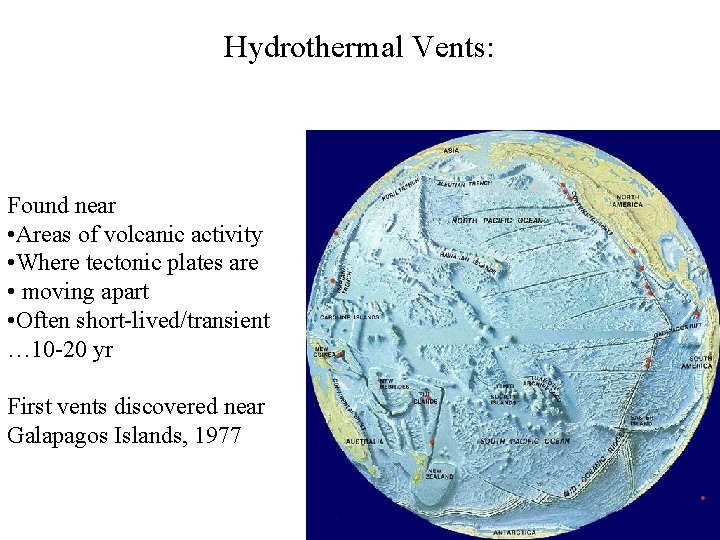
Hydrothermal Vents: Found near • Areas of volcanic activity • Where tectonic plates are • moving apart • Often short-lived/transient … 10 -20 yr First vents discovered near Galapagos Islands, 1977

Hydrocarbon Seeps aka cold seeps • Seeps are found around continental margins and subduction zones…areas where oceanic plates are being pushed under continents and ocean plates. Temperature: 2 C http: //www. scielo. cl/fbpe/img/gayana/v 67 n 2/f 1 ramire. jpg
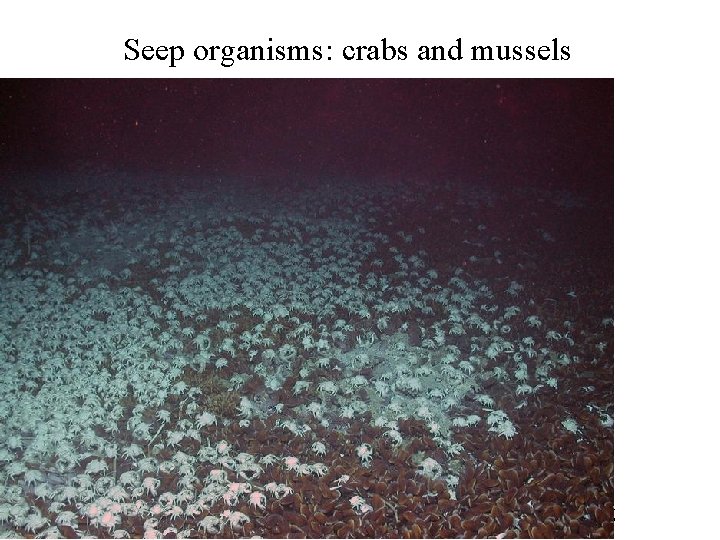
Seep organisms: crabs and mussels http: //www. scielo. cl/fbpe/img/gayana/v 67 n 2/f 1 ramire. jpg
• Other relevant sulphide-rich environments with cognate taxa: abyssal whale falls “Lost City” vents http: //www. whoi. edu/page. do? pid=7545&tid=441&cid=61528&ct =61&article=36806
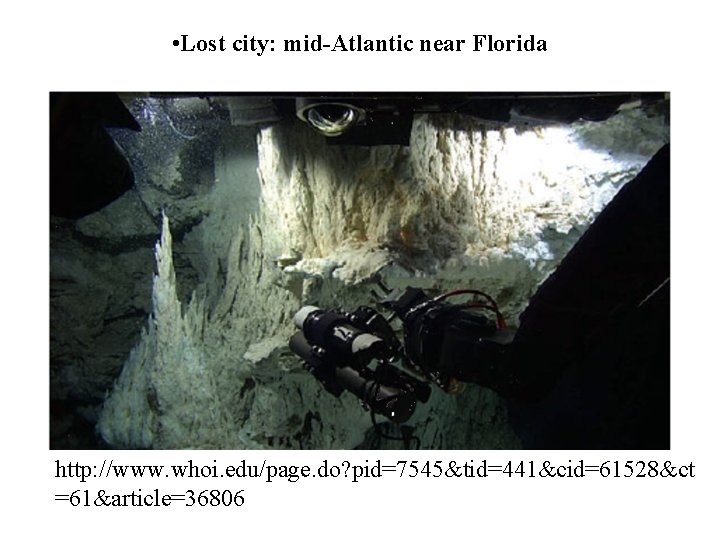
• Lost city: mid-Atlantic near Florida http: //www. whoi. edu/page. do? pid=7545&tid=441&cid=61528&ct =61&article=36806
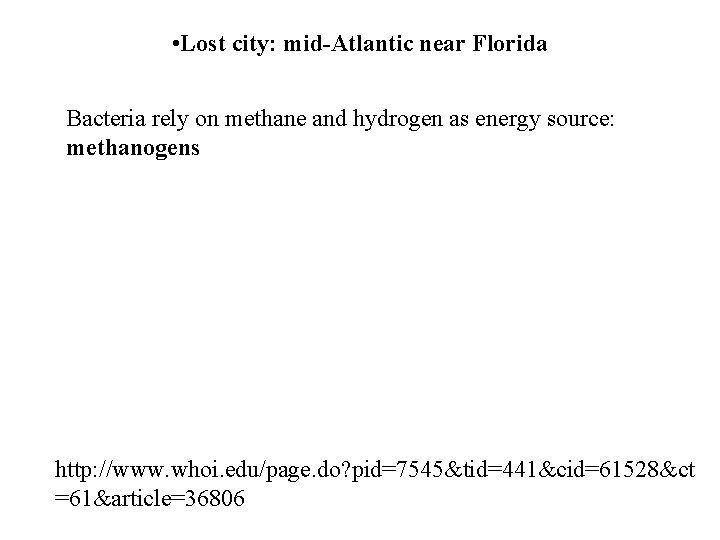
• Lost city: mid-Atlantic near Florida Bacteria rely on methane and hydrogen as energy source: methanogens http: //www. whoi. edu/page. do? pid=7545&tid=441&cid=61528&ct =61&article=36806
Comparing Vents vs. Seeps • SIMILARITIES • Enriched in geochemical energy sources CH 4 and H 2 S from CH 4 • Vents and seeps have several species, genera, families in common • Why compare these different environments?
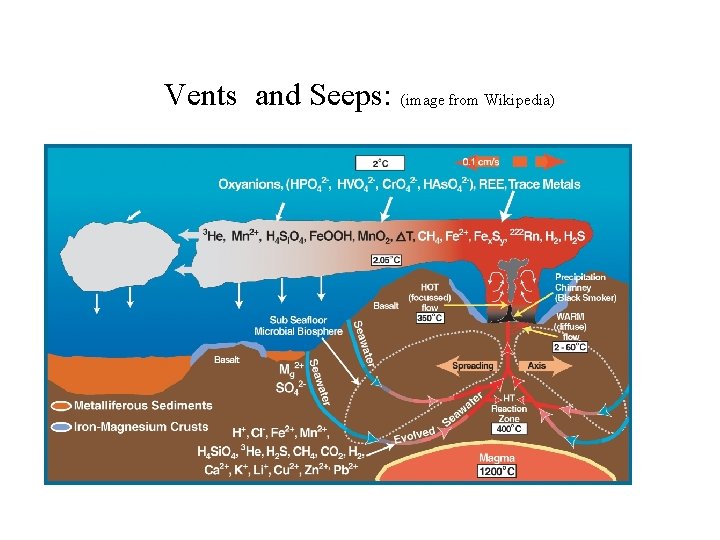
Vents and Seeps: (image from Wikipedia)
So why are deep oceanic taxa cool? • What do you think? Why bother looking into this research?
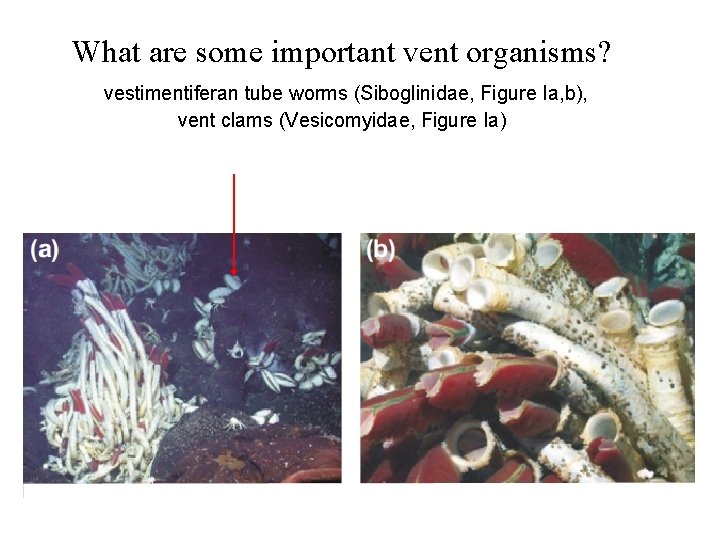
What are some important vent organisms? vestimentiferan tube worms (Siboglinidae, Figure Ia, b), vent clams (Vesicomyidae, Figure Ia)
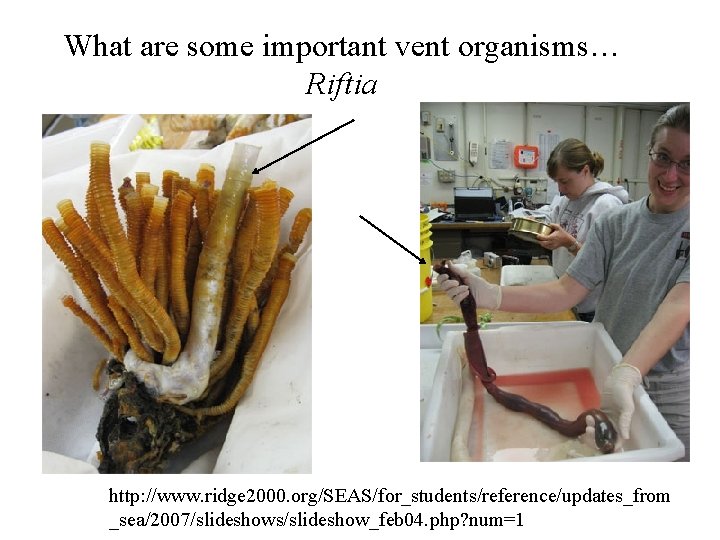
What are some important vent organisms… Riftia • http: //www. ridge 2000. org/SEAS/for_students/reference/updates_from _sea/2007/slideshows/slideshow_feb 04. php? num=1
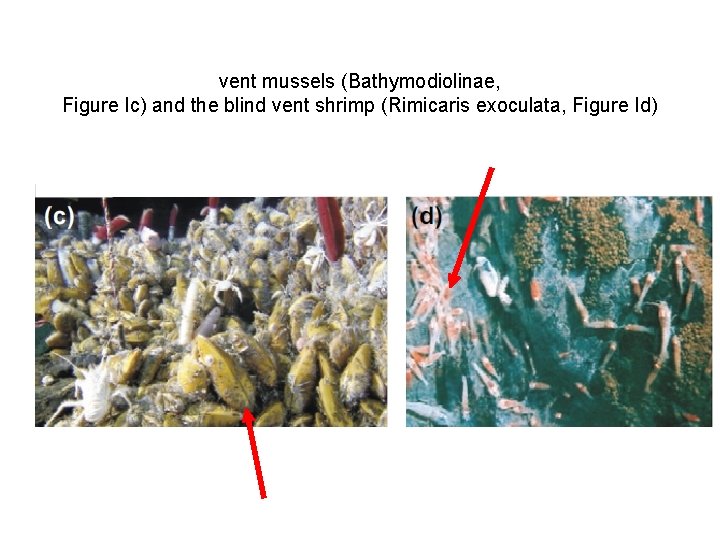
vent mussels (Bathymodiolinae, Figure Ic) and the blind vent shrimp (Rimicaris exoculata, Figure Id)
Riftia and endosymbiosis Riftia provides endosymbiotic bacteria with: 1) reduced sulphur compounds 2) Oxygen 3) CO 2 Rifita have enormous highly vascularized gills; have no gut Endosymbiotic bacteria provide: Chemoautotrophic…provide Riftia with nutrients Derive energy (generate ATP) by oxidizing Fe II to Fe. III
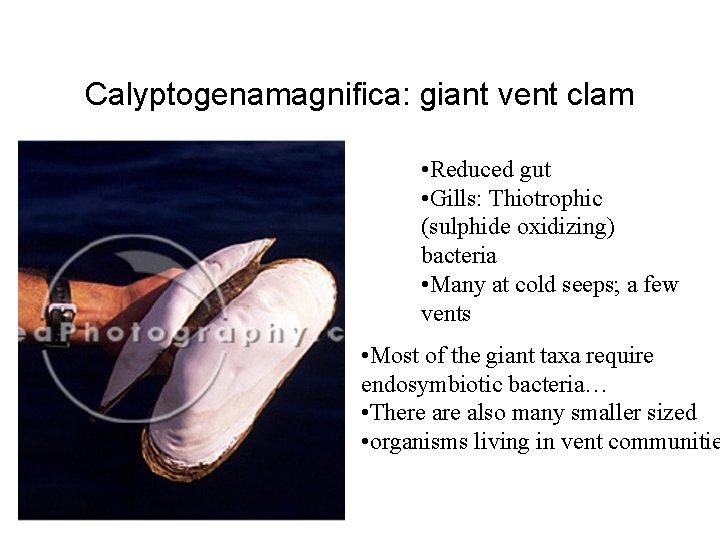
Calyptogenamagnifica: giant vent clam • Reduced gut • Gills: Thiotrophic (sulphide oxidizing) bacteria • Many at cold seeps; a few vents • Most of the giant taxa require endosymbiotic bacteria… • There also many smaller sized • organisms living in vent communitie
Are the H 2 S dependent taxa actually relic species (“living fossils”) • Idea put forward in 1985 • Newman, W. A. (1985) The abyssal hydrothermal vent invertebrate fauna. “A glimpse of antiquity? ” • Ancient: Paleozoic
Evidence: Comparative Anatomy/Physiology • Phylogenetic comparative analysis assumes that physical traits are heritable • Works with adaptive traits; correlated with environment of adaptation • Looks at similarity/dissimilarity and estimates degree of relatedness • use information on the evolutionary relationships of organisms (phylogenetic trees) to compare species • Pretty useful: useful both anatomy and physiology • Big problem: Morphological Homoplasy…
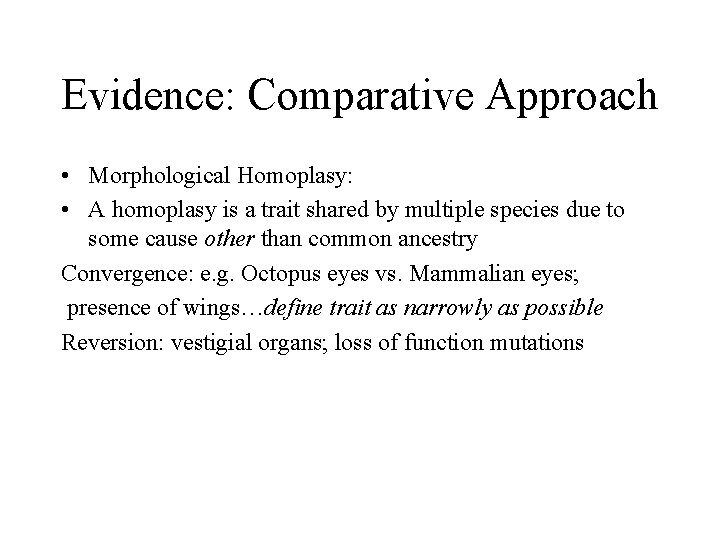
Evidence: Comparative Approach • Morphological Homoplasy: • A homoplasy is a trait shared by multiple species due to some cause other than common ancestry Convergence: e. g. Octopus eyes vs. Mammalian eyes; presence of wings…define trait as narrowly as possible Reversion: vestigial organs; loss of function mutations
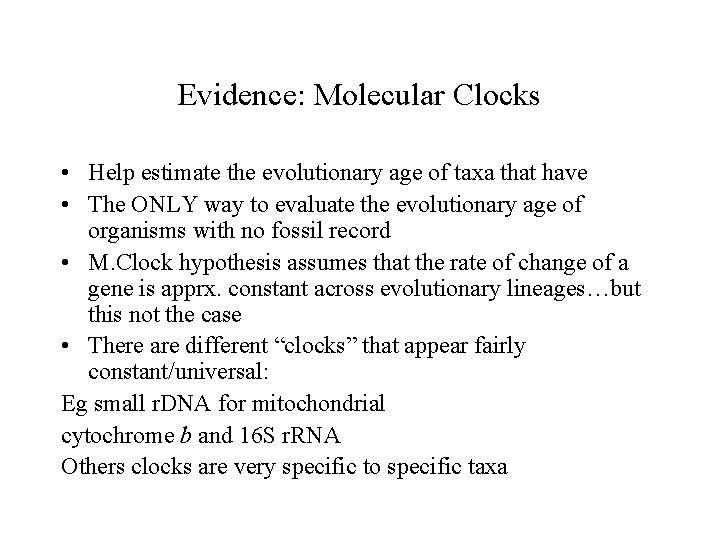
Evidence: Molecular Clocks • Help estimate the evolutionary age of taxa that have • The ONLY way to evaluate the evolutionary age of organisms with no fossil record • M. Clock hypothesis assumes that the rate of change of a gene is apprx. constant across evolutionary lineages…but this not the case • There are different “clocks” that appear fairly constant/universal: Eg small r. DNA for mitochondrial cytochrome b and 16 S r. RNA Others clocks are very specific to specific taxa
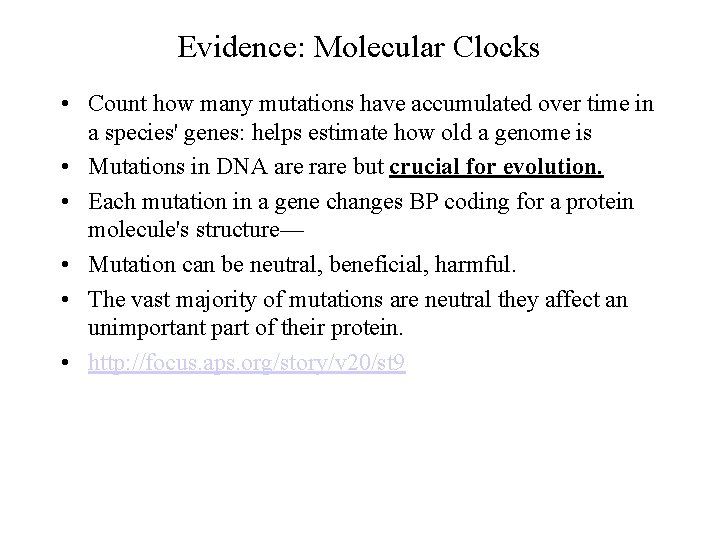
Evidence: Molecular Clocks • Count how many mutations have accumulated over time in a species' genes: helps estimate how old a genome is • Mutations in DNA are rare but crucial for evolution. • Each mutation in a gene changes BP coding for a protein molecule's structure— • Mutation can be neutral, beneficial, harmful. • The vast majority of mutations are neutral they affect an unimportant part of their protein. • http: //focus. aps. org/story/v 20/st 9
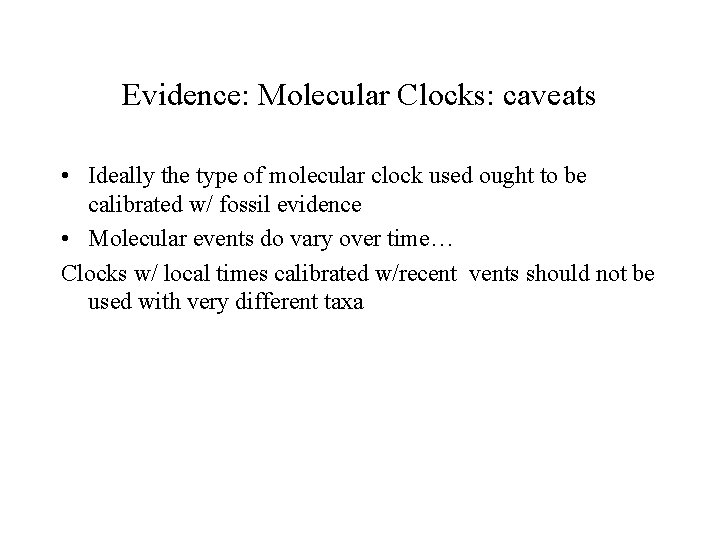
Evidence: Molecular Clocks: caveats • Ideally the type of molecular clock used ought to be calibrated w/ fossil evidence • Molecular events do vary over time… Clocks w/ local times calibrated w/recent vents should not be used with very different taxa
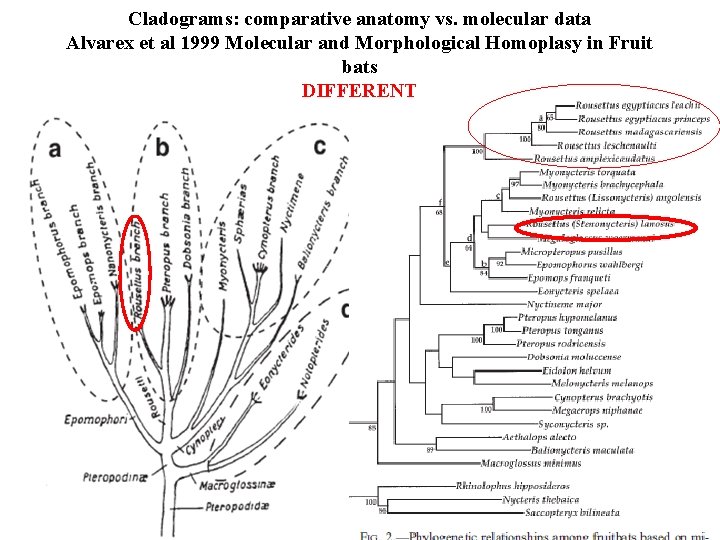
Cladograms: comparative anatomy vs. molecular data Alvarex et al 1999 Molecular and Morphological Homoplasy in Fruit bats DIFFERENT
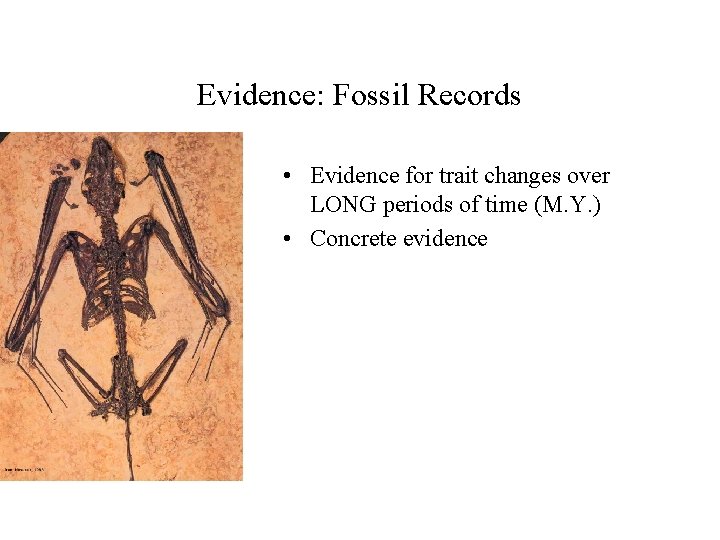
Evidence: Fossil Records • Evidence for trait changes over LONG periods of time (M. Y. ) • Concrete evidence
Evidence: Fossil Records caveats • Fossil taxa can be mis-identified: some soft-bodied animals are problematic or not identifiable • May underestimate age of organism: earlier fossils may not have been detected (sampling error) • Gaps • Geological events can cause fossil mis-location
Evidence summary • Best analysis comes from combining approaches: comparative, fossils and molecular clocks • All of these types of evidence require comparison, stats, and inferential reasoning
Are hydrothermal vent taxa living fossils? Based on the findings that: Many species are endemic to vents…”long and continuing evolutionary history”” Unusual chemosynthetic environments might have been refuges from taxa during major Paleozoic/Phanerozoic extinction events that severely decreased organismic diversity in the photic zone Idea: based mainly on anatomical characteristics shared between living vent animals and fossilized animals
Halt: • Hydrothermal vent taxa represent waves of population/repopulation from other taxa (both onshore and off-shore)
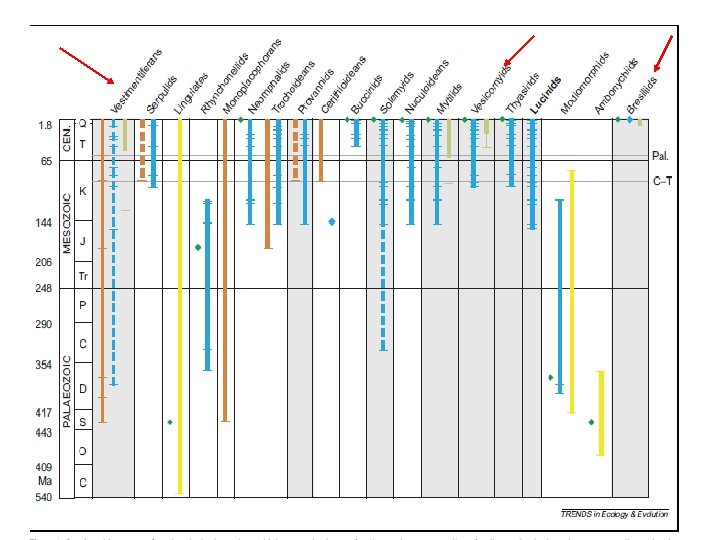
Halt: holds up …Fossil evidence in vent animals 19 vent fossil occurrences ranging from Eocene to the Silurian [18] (, 500– , 430 Mya). Uneven temporal distribution: lots of gaps in the record • Fossil vent taxa include vestimentiferan-like tube worms, brachiopods and molluscs. All fossils are preserved as external and sometimes internal moulds of pyrite, but the original shells and tubes are always missing Therefore some of the vent fossils hard to identify Can’t tell anything about associations with microbial chemoautotrophs impossible to SEEP fossils are much more diverse, better preserved
Halt: holds up…molecular evidence in vent animals Molecular evidence for tubeworms: based on mitochondrial cytochrome oxidase subunit I (COI) sequences and a vicariant event that intersected an eastern Pacific ridge system 28 -35 mya (populations became physically separated Molecular evidence, with conservative estimation places the origin of vestimentiferans (giant tube worms) in the mid-Mesozoic to early Cenozoic, rather than in the Palaeozoic.
Halt: holds up…molecular evidence in vent animals Tubeworms 5 -126 m. y. a Vent clams vesicomyids lived only 22– 44 Mya, during the Cenozoic. Bathymodiolin mussels origins in the mid Mesozoic to early Cenozoic. Bresiliid shrimp no fossil record, but COI nucleotide substitution suggests that vent taxa evolved, 20 mya
Halt: holds up…geological support Hot, hydrothermal vents are currently thought to be fairly transient structures, hence the composition vent communities can change quickly (10 to hundreds of years) Recolonization of new vents can occur pretty quickly from nearby vents as well as drift from the photic zone Thus, vents are NOT static at all, and living species likely represent dynamic population changes
What did you think of this paper? • How did you find this paper? • Useful? Not? • How did you work with this paper?
Why I was interested in this paper • Abyssal communities are cool! • I liked structure of the paper: review…formatted in terms of a testable hypothesis. • Posed answered a question • Identified the basic premises of the two main methods for testing the hypothesis: molecular clocks and fossil record • Identified weaknesses/strengths molecular clocks and fossil records • Useful background and references for a class in evolution • Got many citations… suggests it got lots of attention • It would have benefited from IMAGES of taxa and fossil evidence; schematic diagram of molecular clock http: //focus. aps. org/story/v 20/st 9
Things to think about… • Intrinsic value of these life forms seems obvious, as is the research/study of deep sea chemotrophic communities • How would you convince a politician or member or the business community to protect deep sea habitats? What types of arguments might motivate the non-science community to investigate and protect biodiversity at deep sea communities?
Research participation: for January 11 or 13, one mark • Identify three other non- abyssal organisms that rely on endosymbiotic bacteria • Report on mechanism for endosymbiotic reduction of Fe II to Fe III (cellular biology); include genus and species of bacterium • Do the same for Methanogens living at Lost City vent • Can you give an example of revenue generated (apprx. $2 billion US total) by an organism associated with hot, hydrothermal vents?
- Slides: 44