
Molecular and Gold Nanoparticles Supported NHeterocyclic Carbene SilverI
Molecular and Gold Nanoparticles Supported N-Heterocyclic Carbene Silver(I) Complexes – Synthesis, Characterization and Catalytic Applications 學 生 : 王趙增 指導老師 : 于淑君 博士 2009 / 07 / 20 Department of Chemistry & Biochemistry Chung Cheng University 1
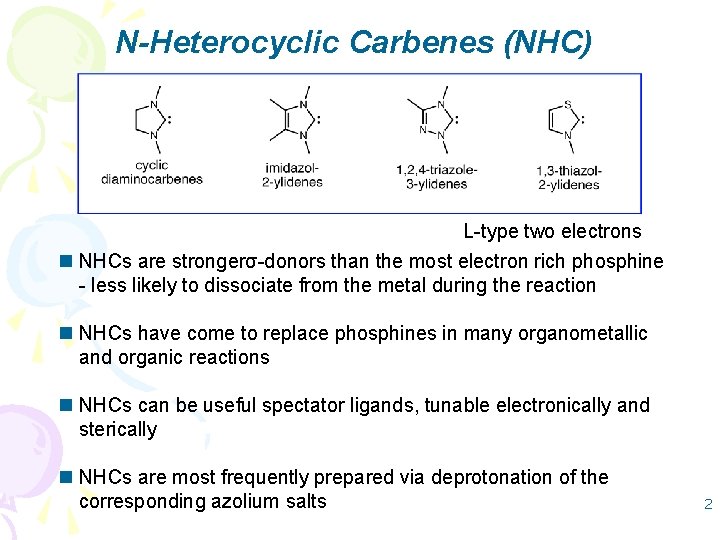
N-Heterocyclic Carbenes (NHC) L-type two electrons n NHCs are strongerσ-donors than the most electron rich phosphine - less likely to dissociate from the metal during the reaction n NHCs have come to replace phosphines in many organometallic and organic reactions n NHCs can be useful spectator ligands, tunable electronically and sterically n NHCs are most frequently prepared via deprotonation of the corresponding azolium salts 2
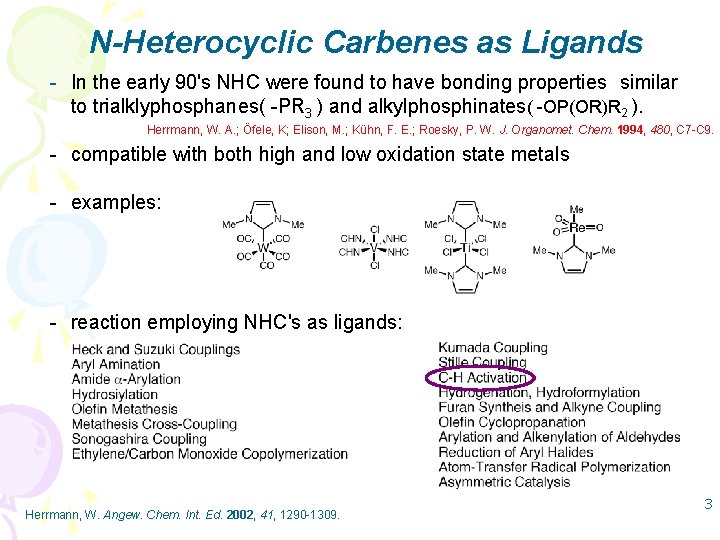
N-Heterocyclic Carbenes as Ligands - In the early 90's NHC were found to have bonding properties similar to trialklyphosphanes( -PR 3 ) and alkylphosphinates( -OP(OR)R 2 ). Herrmann, W. A. ; Öfele, K; Elison, M. ; Kühn, F. E. ; Roesky, P. W. J. Organomet. Chem. 1994, 480, C 7 -C 9. - compatible with both high and low oxidation state metals - examples: - reaction employing NHC's as ligands: Herrmann, W. Angew. Chem. Int. Ed. 2002, 41, 1290 -1309. 3
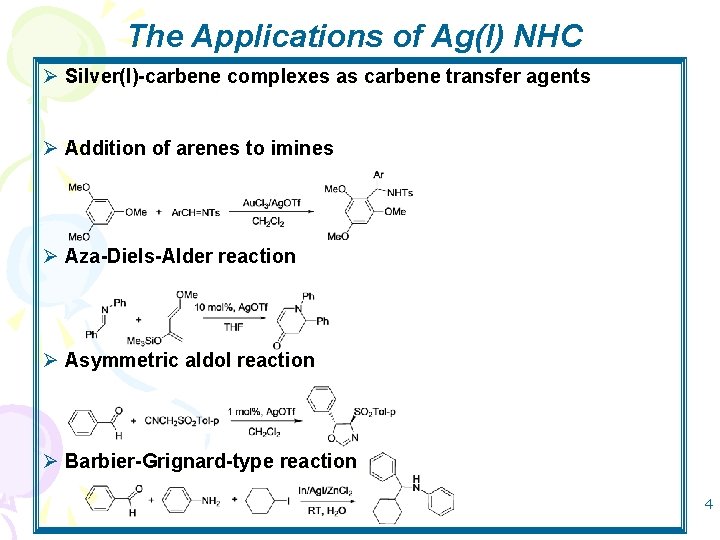
The Applications of Ag(I) NHC Ø Silver(I)-carbene complexes as carbene transfer agents Ø Addition of arenes to imines Ø Aza-Diels-Alder reaction Ø Asymmetric aldol reaction Ø Barbier-Grignard-type reaction 4
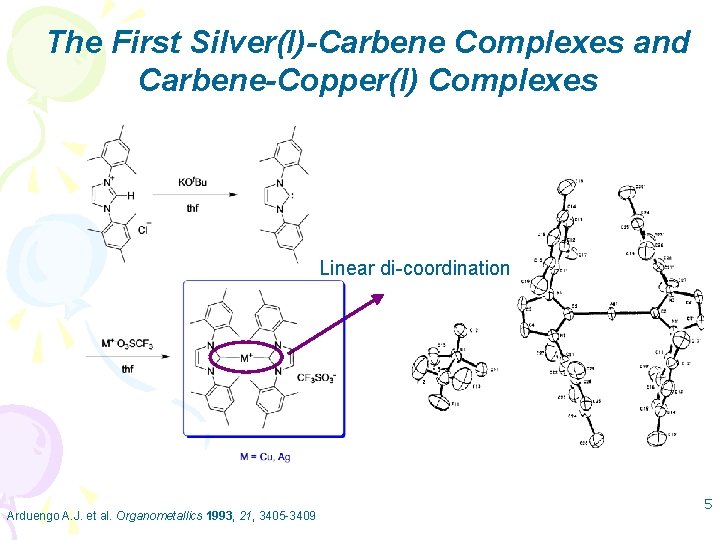
The First Silver(I)-Carbene Complexes and Carbene-Copper(I) Complexes Linear di-coordination Arduengo A. J. et al. Organometallics 1993, 21, 3405 -3409 5
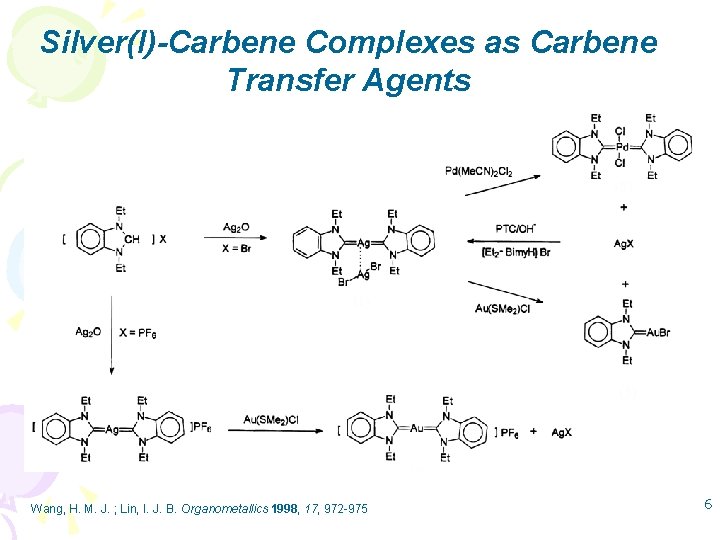
Silver(I)-Carbene Complexes as Carbene Transfer Agents Wang, H. M. J. ; Lin, I. J. B. Organometallics 1998, 17, 972 -975 6
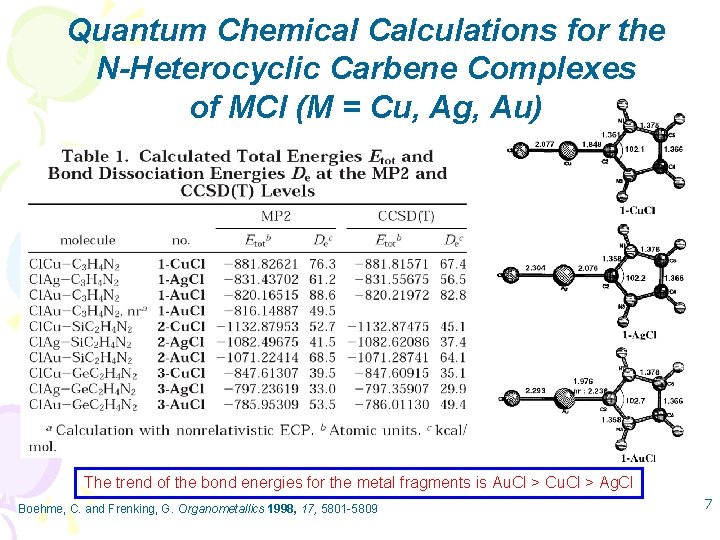
Quantum Chemical Calculations for the N-Heterocyclic Carbene Complexes of MCl (M = Cu, Ag, Au) The trend of the bond energies for the metal fragments is Au. Cl > Cu. Cl > Ag. Cl Boehme, C. and Frenking, G. Organometallics 1998, 17, 5801 -5809 7
Motivation u Using NHCs ligand to replace phosphine ligand in organomatallic catalysis. u In comparison with other transition metals (Cu, Au), silver has been virtually untouched as a catalyst for coupling reactions. u To promote silver-catalyzed three-component coupling of aldehyde, alkyne, and amine. u Easy recovered effectivetly recycled Immobilization of NHC-Ag(I) complexs onto Au Nanoparticles. 8
![Experimental Preparation of [Ag(hmim)2]PF 6 Complex 9](http://slidetodoc.com/presentation_image/56fddc5a662e6fbefc70b52ccd6bad23/image-9.jpg "Experimental Preparation of [Ag(hmim)2]PF 6 Complex 9")
Experimental Preparation of [Ag(hmim)2]PF 6 Complex 9
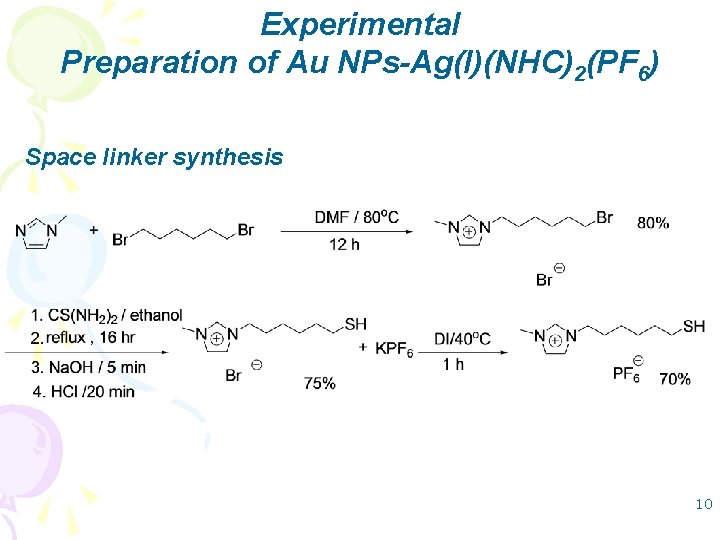
Experimental Preparation of Au NPs-Ag(I)(NHC)2(PF 6) Space linker synthesis 10
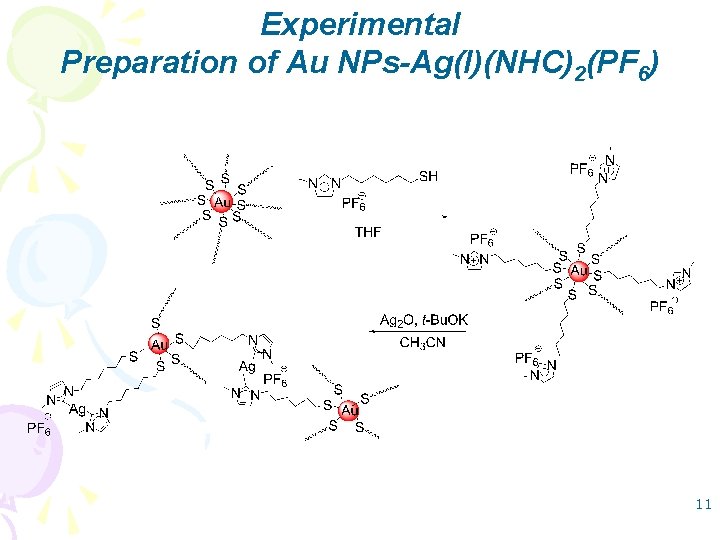
Experimental Preparation of Au NPs-Ag(I)(NHC)2(PF 6) 11
![1 H NMR Spectra of [Hmim]HPF 6 and [Ag(hmim)2]PF 6 2 H 12](http://slidetodoc.com/presentation_image/56fddc5a662e6fbefc70b52ccd6bad23/image-12.jpg "1 H NMR Spectra of [Hmim]HPF 6 and [Ag(hmim)2]PF 6 2 H 12")
1 H NMR Spectra of [Hmim]HPF 6 and [Ag(hmim)2]PF 6 2 H 12
![13 C NMR Spectra of [Hmim]HPF 6 and [Ag(hmim)2]PF 6 *DMSO Cc 13](http://slidetodoc.com/presentation_image/56fddc5a662e6fbefc70b52ccd6bad23/image-13.jpg "13 C NMR Spectra of [Hmim]HPF 6 and [Ag(hmim)2]PF 6 *DMSO Cc 13")
13 C NMR Spectra of [Hmim]HPF 6 and [Ag(hmim)2]PF 6 *DMSO Cc 13
![ESI-MS Spectrum of [Ag(hmim)2]PF 6 Experimental MS Data Calculated MS Data 14](http://slidetodoc.com/presentation_image/56fddc5a662e6fbefc70b52ccd6bad23/image-14.jpg "ESI-MS Spectrum of [Ag(hmim)2]PF 6 Experimental MS Data Calculated MS Data 14")
ESI-MS Spectrum of [Ag(hmim)2]PF 6 Experimental MS Data Calculated MS Data 14
![IR Spectra of [Hmim]HPF 6 and [Ag(hmim)2]PF 6 1225 cm-1 NHC H-C-C & H-C-N](http://slidetodoc.com/presentation_image/56fddc5a662e6fbefc70b52ccd6bad23/image-15.jpg "IR Spectra of [Hmim]HPF 6 and [Ag(hmim)2]PF 6 1225 cm-1 NHC H-C-C & H-C-N")
IR Spectra of [Hmim]HPF 6 and [Ag(hmim)2]PF 6 1225 cm-1 NHC H-C-C & H-C-N bending [Ag(hmim)2]PF 6 a (hmim)HPF 6 b 1168 cm-1 15
![UV Spectra of [Hmim]HPF 6 and [Ag(hmim)2] PF 6 b π a π* 210](http://slidetodoc.com/presentation_image/56fddc5a662e6fbefc70b52ccd6bad23/image-16.jpg "UV Spectra of [Hmim]HPF 6 and [Ag(hmim)2] PF 6 b π a π* 210")
UV Spectra of [Hmim]HPF 6 and [Ag(hmim)2] PF 6 b π a π* 210 nm [Ag(hmim)2]PF 6 a (hmim)2 PF 6 b 16
![Single-Crystal X-ray Structure of [Ag(hmim)2]PF 6 π π interaction Dihedral Angle 1. 802 o(221)](http://slidetodoc.com/presentation_image/56fddc5a662e6fbefc70b52ccd6bad23/image-17.jpg "Single-Crystal X-ray Structure of [Ag(hmim)2]PF 6 π π interaction Dihedral Angle 1. 802 o(221)")
Single-Crystal X-ray Structure of [Ag(hmim)2]PF 6 π π interaction Dihedral Angle 1. 802 o(221) bond lengths [Å] bond angles [deg] Ag(1)-C(1) 2. 083(3) C(2)-Ag(1)-C(11) 177. 16 Ag(1)-C(11) 2. 083(3) N(1)- C(1)-N(2) 104. 06 N(3)- C(11)-N(4) 104. 67 17
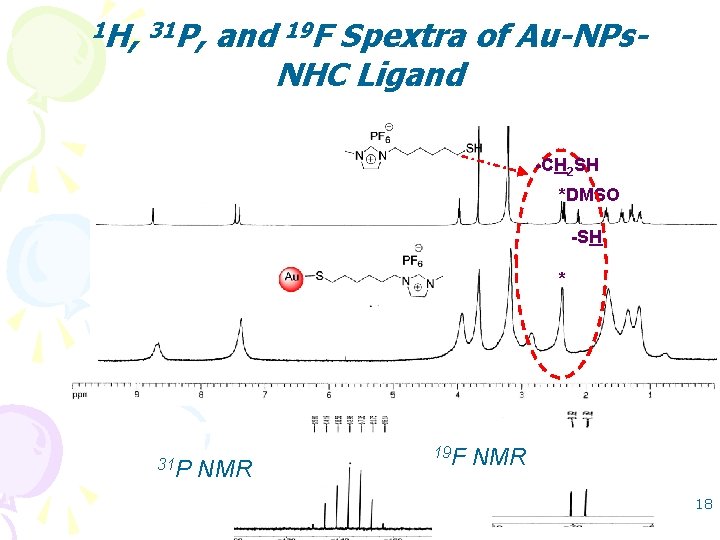
1 H, 31 P, and 19 F Spextra of Au-NPs. NHC Ligand -CH 2 SH *DMSO -SH * 31 P NMR 19 F NMR 18
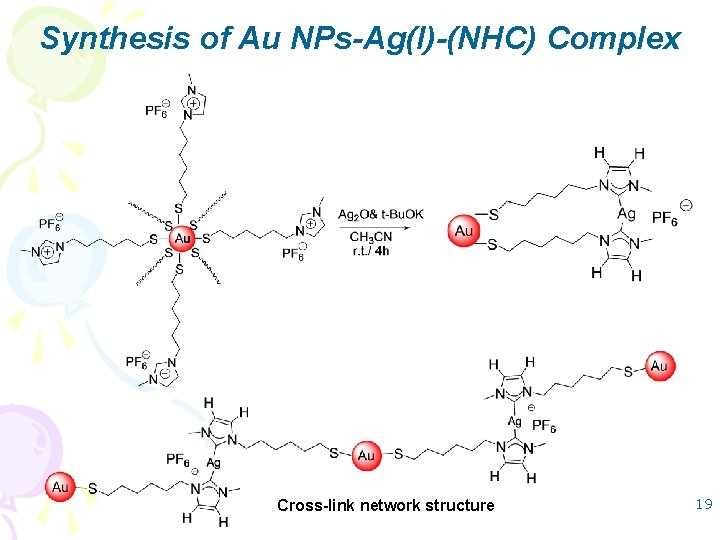
Synthesis of Au NPs-Ag(I)-(NHC) Complex Cross-link network structure 19
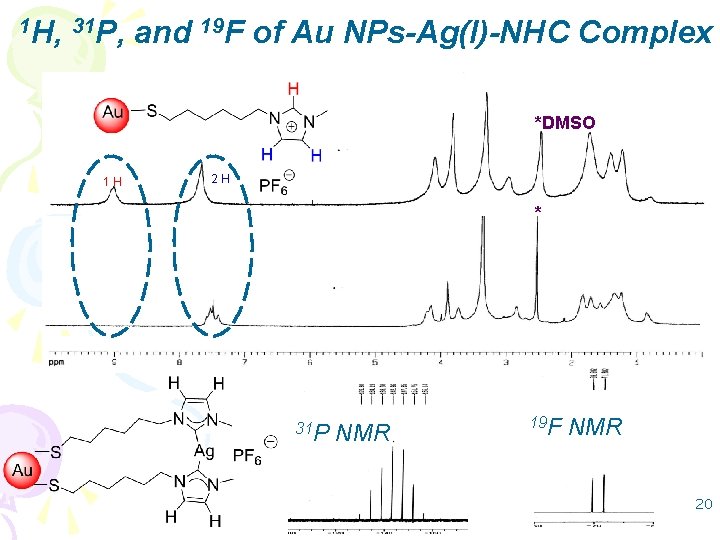
1 H, 31 P, and 19 F of Au NPs-Ag(I)-NHC Complex *DMSO 1 H 2 H * 31 P NMR 19 F NMR 20
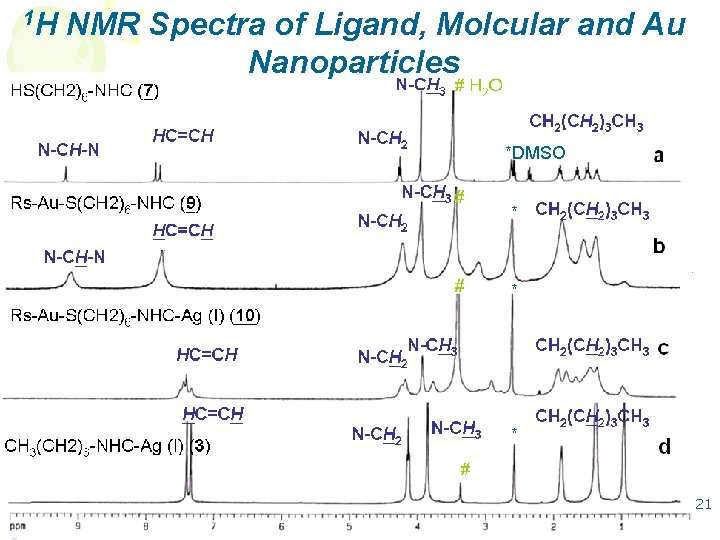
1 H NMR Spectra of Ligand, Molcular and Au Nanoparticles *DMSO * * * 21
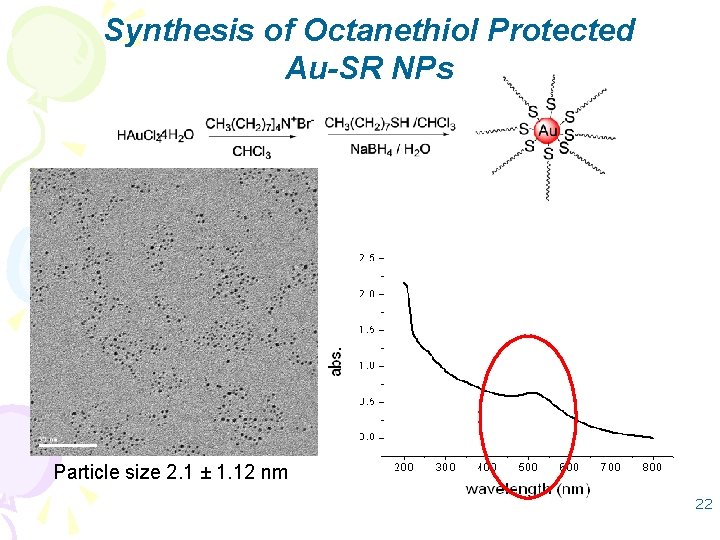
Synthesis of Octanethiol Protected Au-SR NPs Particle size 2. 1 ± 1. 12 nm 22
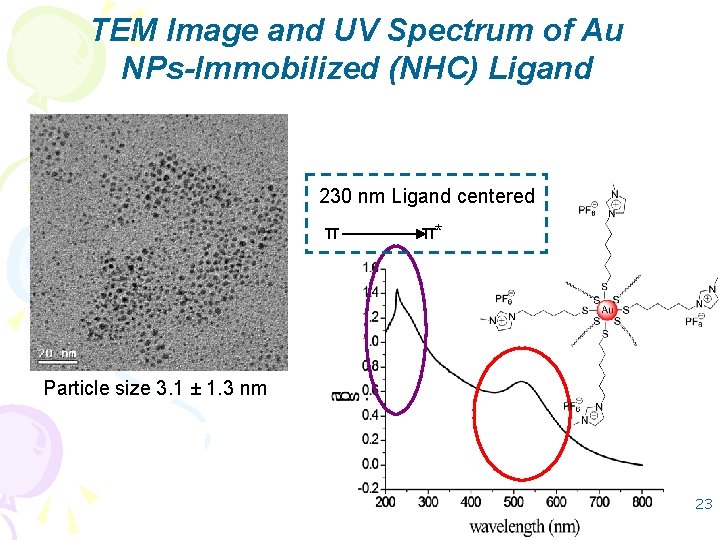
TEM Image and UV Spectrum of Au NPs-Immobilized (NHC) Ligand 230 nm Ligand centered π π* Particle size 3. 1 ± 1. 3 nm 23
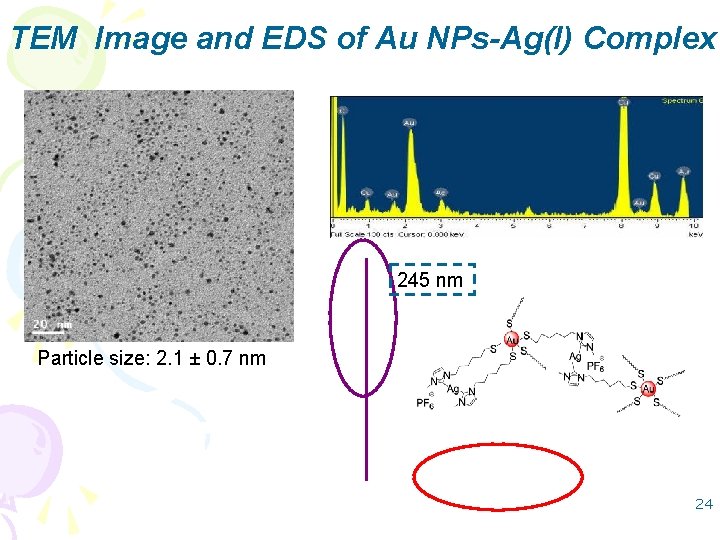
TEM Image and EDS of Au NPs-Ag(I) Complex 245 nm Particle size: 2. 1 ± 0. 7 nm 24
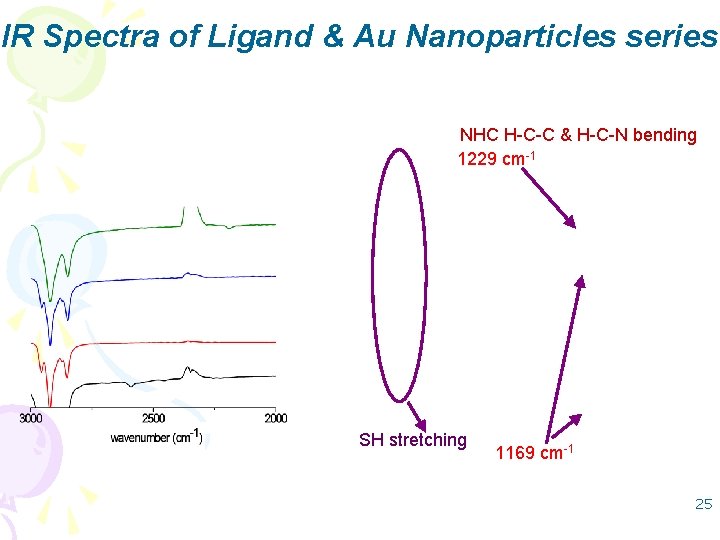
IR Spectra of Ligand & Au Nanoparticles series NHC H-C-C & H-C-N bending 1229 cm-1 SH stretching 1169 cm-1 25
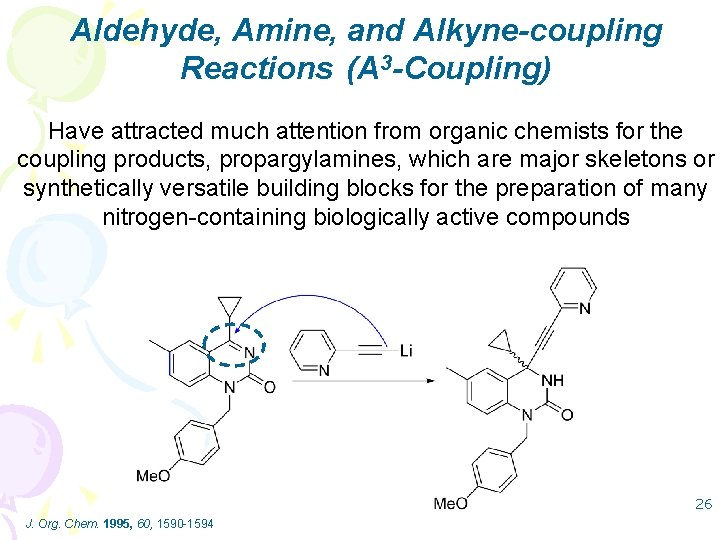
Aldehyde, Amine, and Alkyne-coupling Reactions (A 3 -Coupling) Have attracted much attention from organic chemists for the coupling products, propargylamines, which are major skeletons or synthetically versatile building blocks for the preparation of many nitrogen-containing biologically active compounds 26 J. Org. Chem. 1995, 60, 1590 -1594
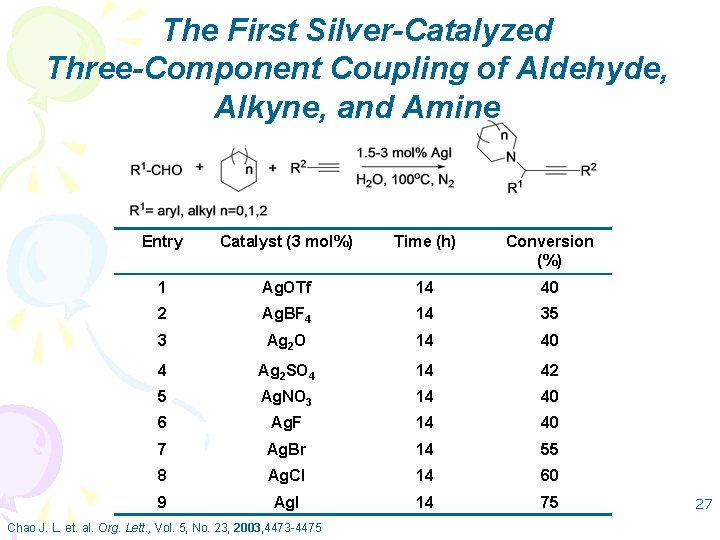
The First Silver-Catalyzed Three-Component Coupling of Aldehyde, Alkyne, and Amine Entry Catalyst (3 mol%) Time (h) Conversion (%) 1 Ag. OTf 14 40 2 Ag. BF 4 14 35 3 Ag 2 O 14 40 4 Ag 2 SO 4 14 42 5 Ag. NO 3 14 40 6 Ag. F 14 40 7 Ag. Br 14 55 8 Ag. Cl 14 60 9 Ag. I 14 75 Chao J. L. et. al. Org. Lett. , Vol. 5, No. 23, 2003, 4473 -4475 27
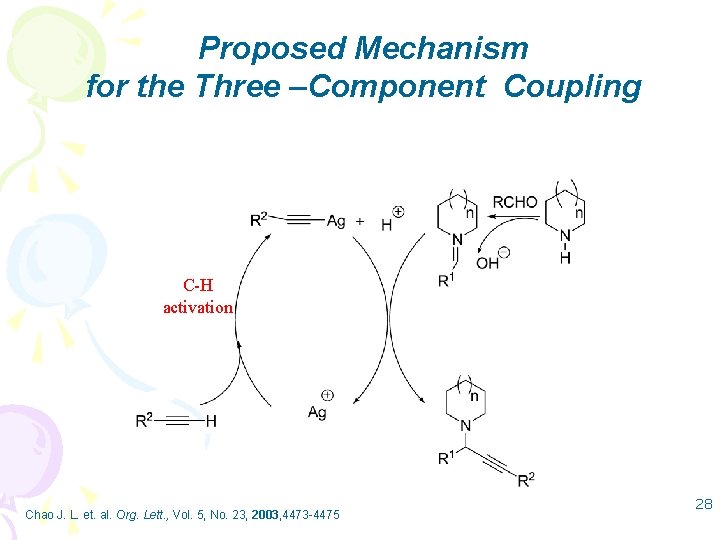
Proposed Mechanism for the Three –Component Coupling C-H activation Chao J. L. et. al. Org. Lett. , Vol. 5, No. 23, 2003, 4473 -4475 28
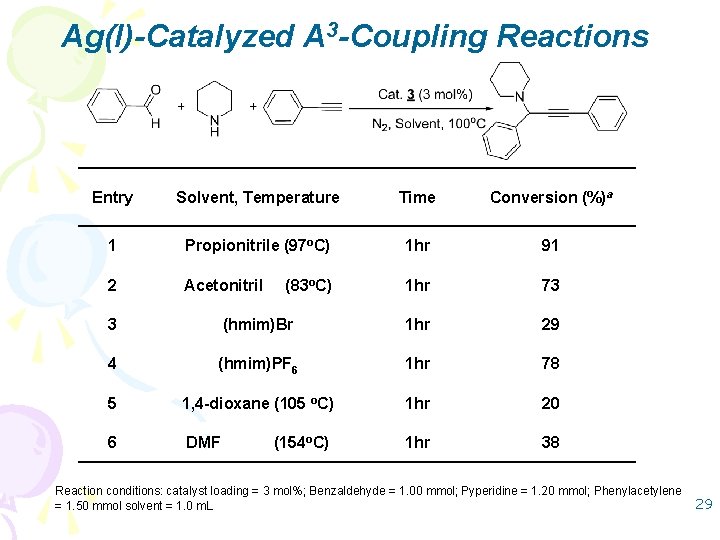
Ag(I)-Catalyzed A 3 -Coupling Reactions Entry Solvent, Temperature Time Conversion (%)a 1 Propionitrile (97 o. C) 1 hr 91 2 Acetonitril 1 hr 73 (83 o. C) 3 (hmim)Br 1 hr 29 4 (hmim)PF 6 1 hr 78 5 1, 4 -dioxane (105 o. C) 1 hr 20 6 DMF 1 hr 38 (154 o. C) Reaction conditions: catalyst loading = 3 mol%; Benzaldehyde = 1. 00 mmol; Pyperidine = 1. 20 mmol; Phenylacetylene = 1. 50 mmol solvent = 1. 0 m. L 29
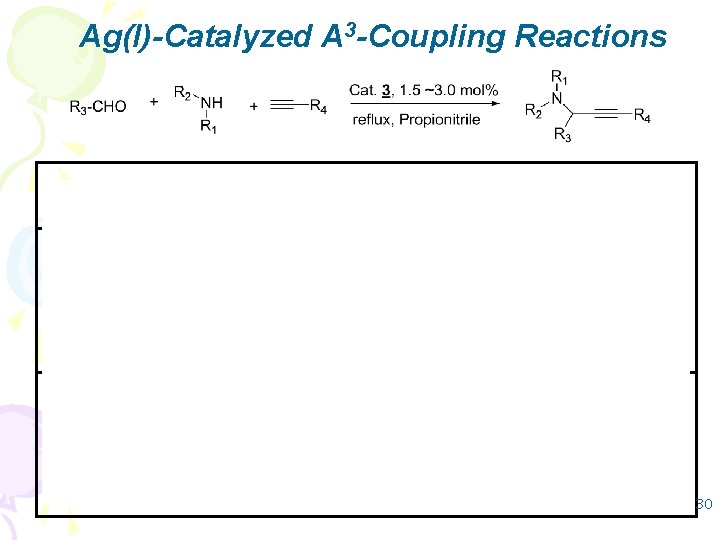
Ag(I)-Catalyzed A 3 -Coupling Reactions 30
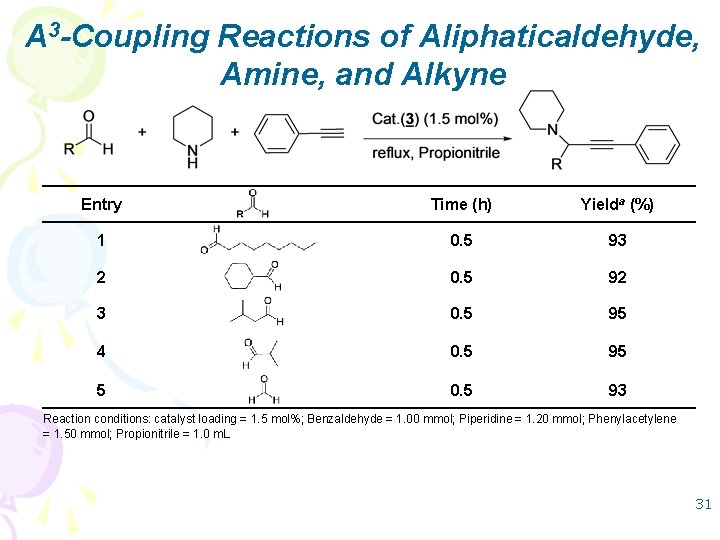
A 3 -Coupling Reactions of Aliphaticaldehyde, Amine, and Alkyne Entry Time (h) Yielda (%) 1 0. 5 93 2 0. 5 92 3 0. 5 95 4 0. 5 95 5 0. 5 93 Reaction conditions: catalyst loading = 1. 5 mol%; Benzaldehyde = 1. 00 mmol; Piperidine = 1. 20 mmol; Phenylacetylene = 1. 50 mmol; Propionitrile = 1. 0 m. L 31
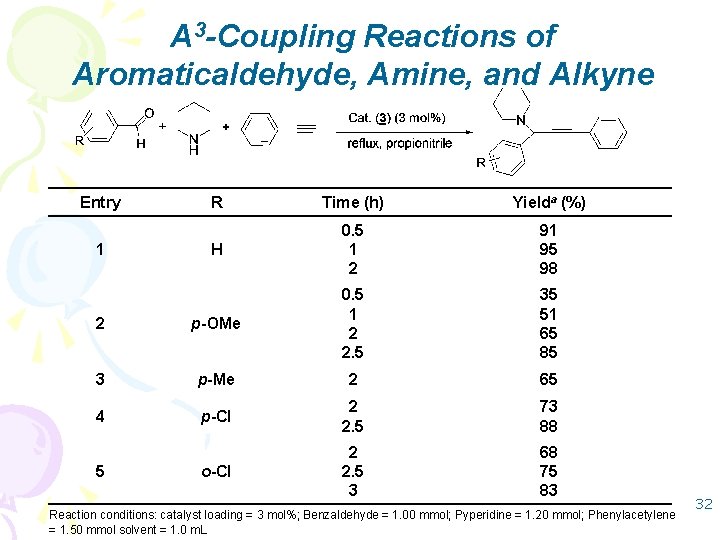
A 3 -Coupling Reactions of Aromaticaldehyde, Amine, and Alkyne Entry R Time (h) Yielda (%) H 0. 5 1 2 91 95 98 2 p-OMe 0. 5 1 2 2. 5 35 51 65 85 3 p-Me 2 65 4 p-Cl 2 2. 5 73 88 o-Cl 2 2. 5 3 68 75 83 1 5 Reaction conditions: catalyst loading = 3 mol%; Benzaldehyde = 1. 00 mmol; Pyperidine = 1. 20 mmol; Phenylacetylene = 1. 50 mmol solvent = 1. 0 m. L 32
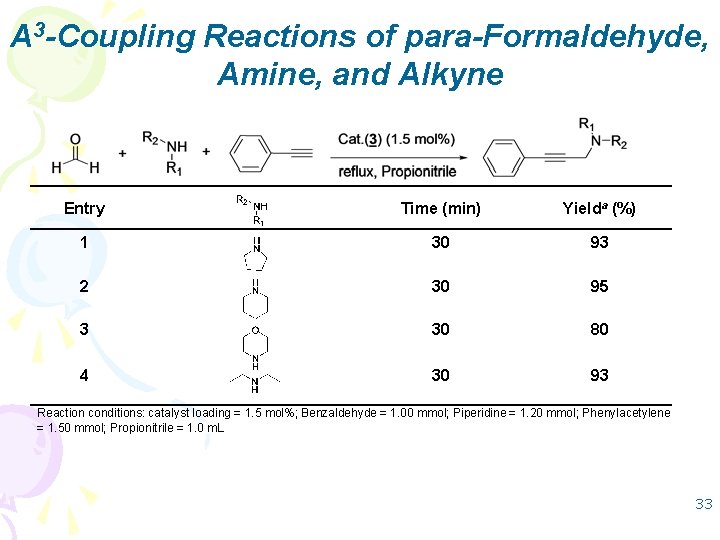
A 3 -Coupling Reactions of para-Formaldehyde, Amine, and Alkyne Entry Time (min) Yielda (%) 1 30 93 2 30 95 3 30 80 4 30 93 Reaction conditions: catalyst loading = 1. 5 mol%; Benzaldehyde = 1. 00 mmol; Piperidine = 1. 20 mmol; Phenylacetylene = 1. 50 mmol; Propionitrile = 1. 0 m. L 33
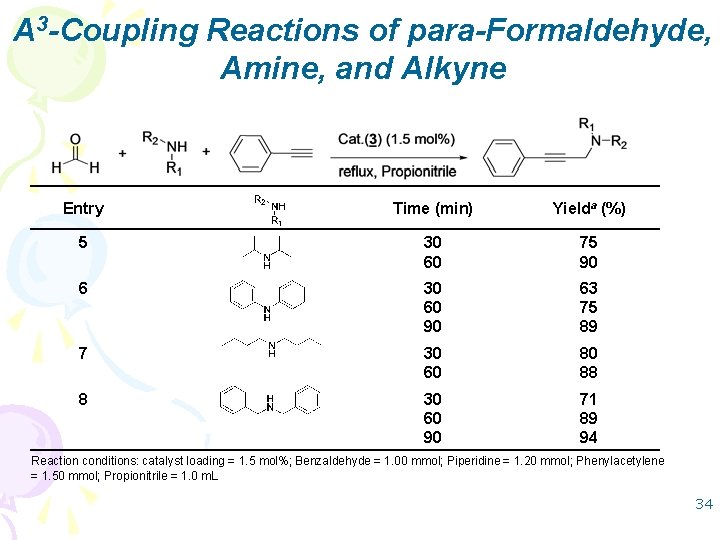
A 3 -Coupling Reactions of para-Formaldehyde, Amine, and Alkyne Entry Time (min) Yielda (%) 5 30 60 75 90 6 30 60 90 63 75 89 7 30 60 80 88 8 30 60 90 71 89 94 Reaction conditions: catalyst loading = 1. 5 mol%; Benzaldehyde = 1. 00 mmol; Piperidine = 1. 20 mmol; Phenylacetylene = 1. 50 mmol; Propionitrile = 1. 0 m. L 34
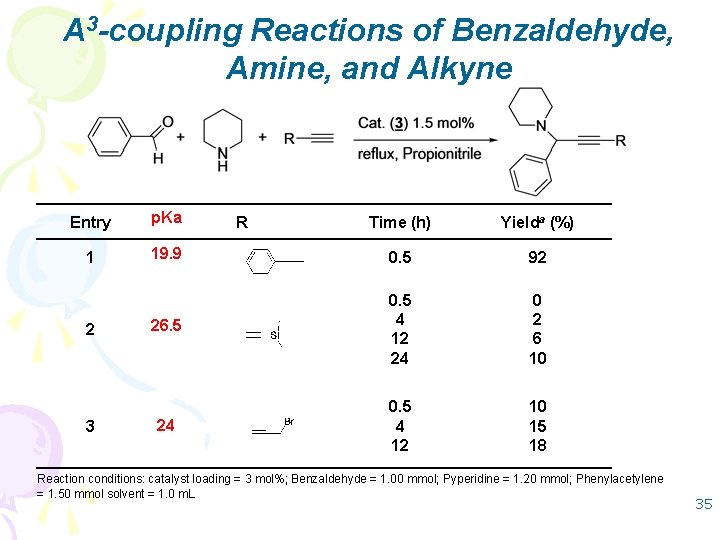
A 3 -coupling Reactions of Benzaldehyde, Amine, and Alkyne Entry p. Ka 1 2 3 R Time (h) Yielda (%) 19. 9 0. 5 92 26. 5 0. 5 4 12 24 0 2 6 10 24 0. 5 4 12 10 15 18 Reaction conditions: catalyst loading = 3 mol%; Benzaldehyde = 1. 00 mmol; Pyperidine = 1. 20 mmol; Phenylacetylene = 1. 50 mmol solvent = 1. 0 m. L 35
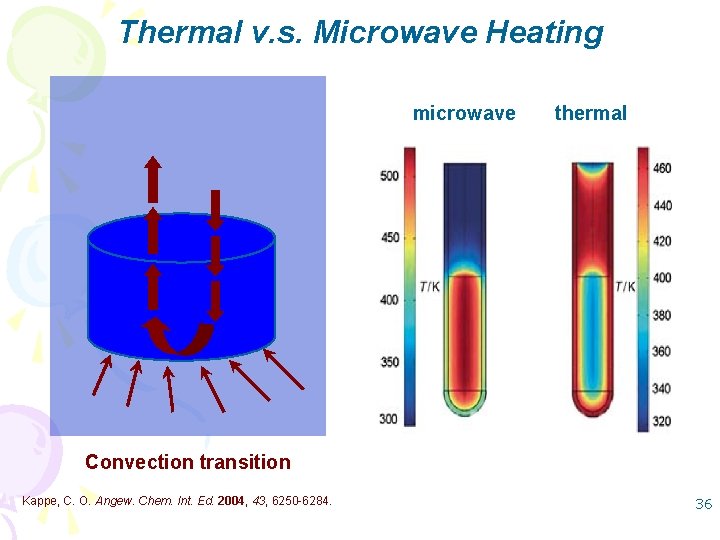
Thermal v. s. Microwave Heating microwave thermal Convection transition Kappe, C. O. Angew. Chem. Int. Ed. 2004, 43, 6250 -6284. 36
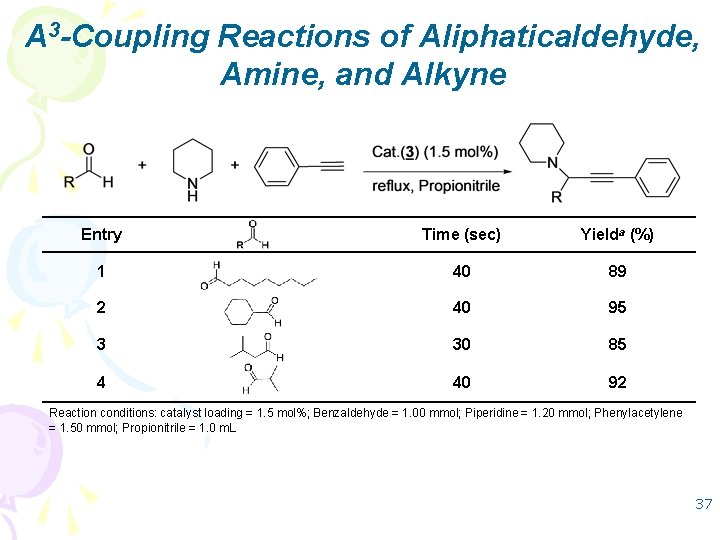
A 3 -Coupling Reactions of Aliphaticaldehyde, Amine, and Alkyne Entry Time (sec) Yielda (%) 1 40 89 2 40 95 3 30 85 4 40 92 Reaction conditions: catalyst loading = 1. 5 mol%; Benzaldehyde = 1. 00 mmol; Piperidine = 1. 20 mmol; Phenylacetylene = 1. 50 mmol; Propionitrile = 1. 0 m. L 37
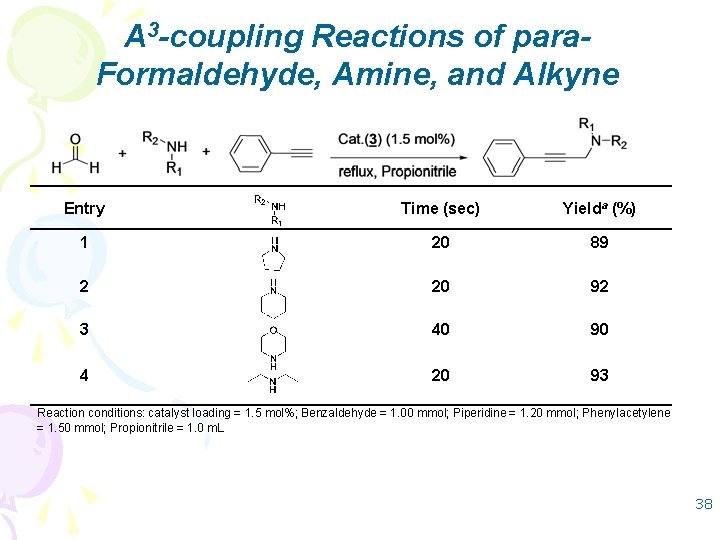
A 3 -coupling Reactions of para. Formaldehyde, Amine, and Alkyne Entry Time (sec) Yielda (%) 1 20 89 2 20 92 3 40 90 4 20 93 Reaction conditions: catalyst loading = 1. 5 mol%; Benzaldehyde = 1. 00 mmol; Piperidine = 1. 20 mmol; Phenylacetylene = 1. 50 mmol; Propionitrile = 1. 0 m. L 38
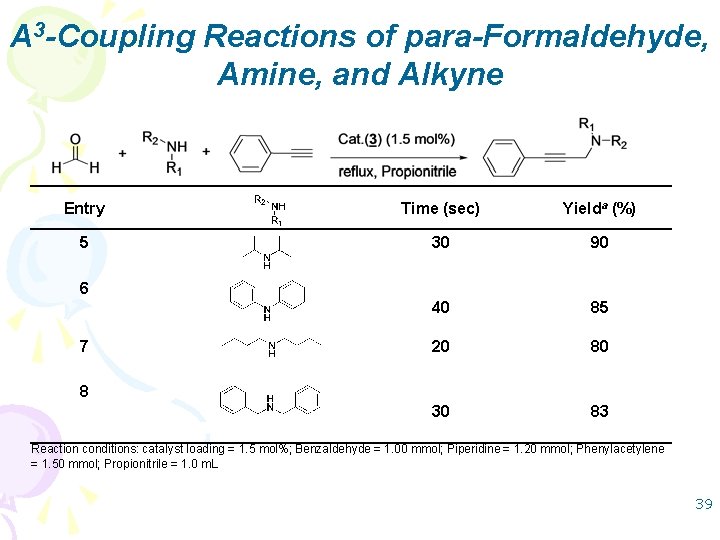
A 3 -Coupling Reactions of para-Formaldehyde, Amine, and Alkyne Entry Time (sec) Yielda (%) 5 30 90 40 85 20 80 30 83 6 7 8 Reaction conditions: catalyst loading = 1. 5 mol%; Benzaldehyde = 1. 00 mmol; Piperidine = 1. 20 mmol; Phenylacetylene = 1. 50 mmol; Propionitrile = 1. 0 m. L 39
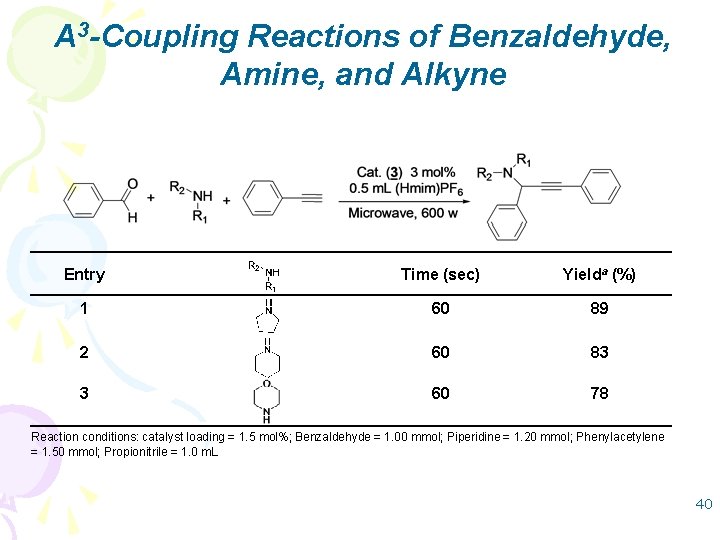
A 3 -Coupling Reactions of Benzaldehyde, Amine, and Alkyne Entry Time (sec) Yielda (%) 1 60 89 2 60 83 3 60 78 Reaction conditions: catalyst loading = 1. 5 mol%; Benzaldehyde = 1. 00 mmol; Piperidine = 1. 20 mmol; Phenylacetylene = 1. 50 mmol; Propionitrile = 1. 0 m. L 40
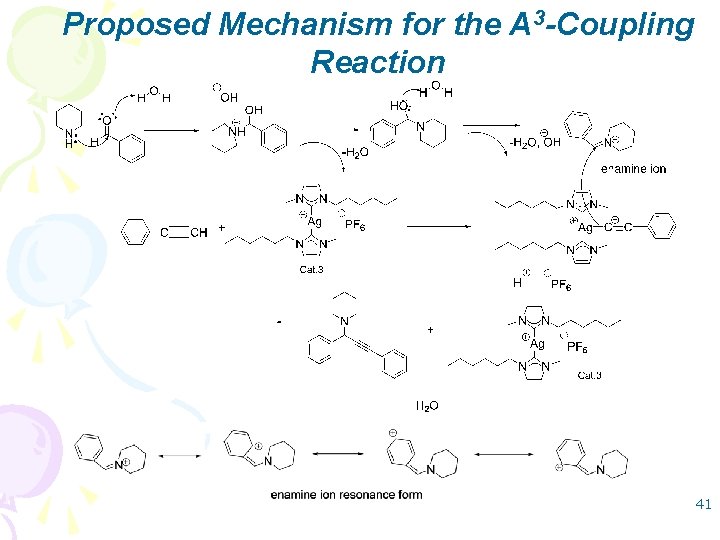
Proposed Mechanism for the A 3 -Coupling Reaction 41
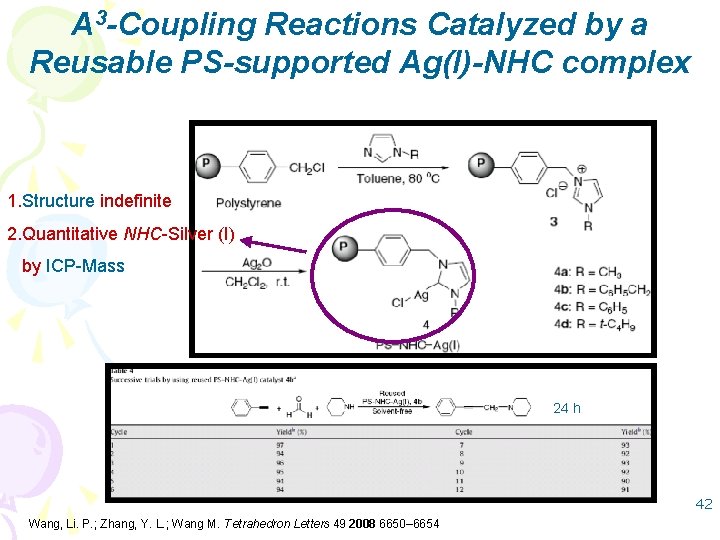
A 3 -Coupling Reactions Catalyzed by a Reusable PS-supported Ag(I)-NHC complex 1. Structure indefinite 2. Quantitative NHC-Silver (I) by ICP-Mass 24 h 42 Wang, Li. P. ; Zhang, Y. L. ; Wang M. Tetrahedron Letters 49 2008 6650– 6654
![4 H 2 H d 6 -DMSO Au-[hmim]2 Ag. PF 6: 9 mg 0.](http://slidetodoc.com/presentation_image/56fddc5a662e6fbefc70b52ccd6bad23/image-43.jpg "4 H 2 H d 6 -DMSO Au-[hmim]2 Ag. PF 6: 9 mg 0.")
4 H 2 H d 6 -DMSO Au-[hmim]2 Ag. PF 6: 9 mg 0. 25 : 0. 13 = X : 0. 03725 X = 0. 07164 mmol – lignad 0. 07164× 0. 5 = 0. 0358 mmol- metal center 0. 0358/9 = 0. 004 mol/g Quantitative by NMR 1, 2, 4, 5 -tetramethylbenzene: 5 mg AA analysis: 0. 0038 mol/g 需時 2 天 10 min ICP-Mass anlysis: 0. 0039 mol/g 送校外 43
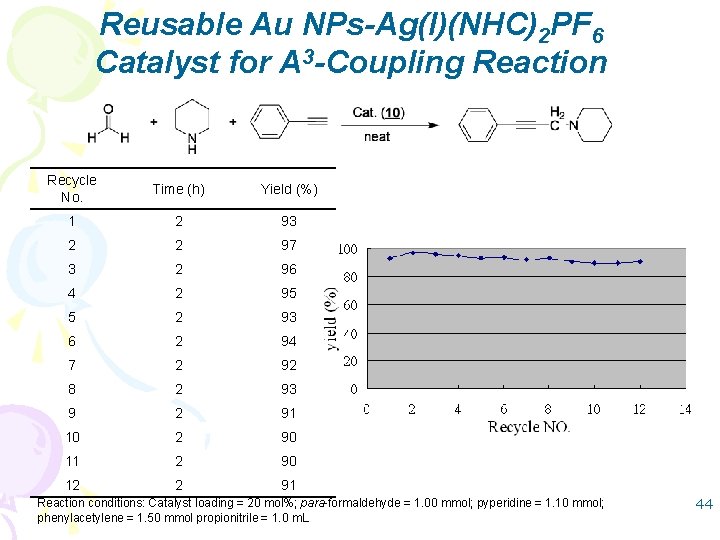
Reusable Au NPs-Ag(I)(NHC)2 PF 6 Catalyst for A 3 -Coupling Reaction Recycle No. Time (h) Yield (%) 1 2 93 2 2 97 3 2 96 4 2 95 5 2 93 6 2 94 7 2 92 8 2 93 9 2 91 10 2 90 11 2 90 12 2 91 Reaction conditions: Catalyst loading = 20 mol%; para-formaldehyde = 1. 00 mmol; pyperidine = 1. 10 mmol; phenylacetylene = 1. 50 mmol propionitrile = 1. 0 m. L 44
![Reactivity Comparision Between Au NPs. Ag(I)(NHC)(PF 6) and [Ag(hmim)2]PF 6 Entry Time (min) Cat.](http://slidetodoc.com/presentation_image/56fddc5a662e6fbefc70b52ccd6bad23/image-45.jpg "Reactivity Comparision Between Au NPs. Ag(I)(NHC)(PF 6) and [Ag(hmim)2]PF 6 Entry Time (min) Cat.")
Reactivity Comparision Between Au NPs. Ag(I)(NHC)(PF 6) and [Ag(hmim)2]PF 6 Entry Time (min) Cat. 3 Yield (%) Cat. 10 Yield (%) 1 10 20 30 65 83 92 > 99 2 10 20 30 52 78 93 44 67 88 3 10 20 30 68 81 93 61 77 91 4 10 20 30 69 82 92 58 74 93 Reaction conditions: catalyst loading = 1. 5 mol%; Benzaldehyde = 1. 00 mmol; Piperidine = 1. 20 mmol; Phenylacetylene = 1. 50 mmol; Propionitrile = 1. 0 m. L 45
![Conclusions 1. The air- and water-stable catalyst [Ag(hmim)2]PF 6 was synthesized and characterized by](http://slidetodoc.com/presentation_image/56fddc5a662e6fbefc70b52ccd6bad23/image-46.jpg "Conclusions 1. The air- and water-stable catalyst [Ag(hmim)2]PF 6 was synthesized and characterized by")
Conclusions 1. The air- and water-stable catalyst [Ag(hmim)2]PF 6 was synthesized and characterized by 1 H- and 13 C-NMR, ESI-MS, IR, UV, X-ray. 2. We have developed a methodology to successfully immobilize [Ag(hmim)2]PF 6 onto surfaces of Au NPs. The structure of the supported Ag(I)-NHC complex catalyst was characterized by 1 H-NMR, IR, TEM, UV, EDS, AA, ICP-Mass. 3. Since the Au NPs- Ag(I) hybrid catalysts are highly soluble in organic solvents, their structures and reactions were studied by simple solution NMR technique. 4. We have successfully demonstrated the catalytic activity of the Ag(I) complex for the three-component coupling reactions of aldehyde, alkyne, and amine. 5. The Au NPs- Ag(I) catalyst can be quantitatively recovered and effectively reused for many times without any loss of reactivity. 46
- Slides: 46