
Molar Mass Percent Composition The mass of 1

- Slides: 7
Molar Mass & Percent Composition
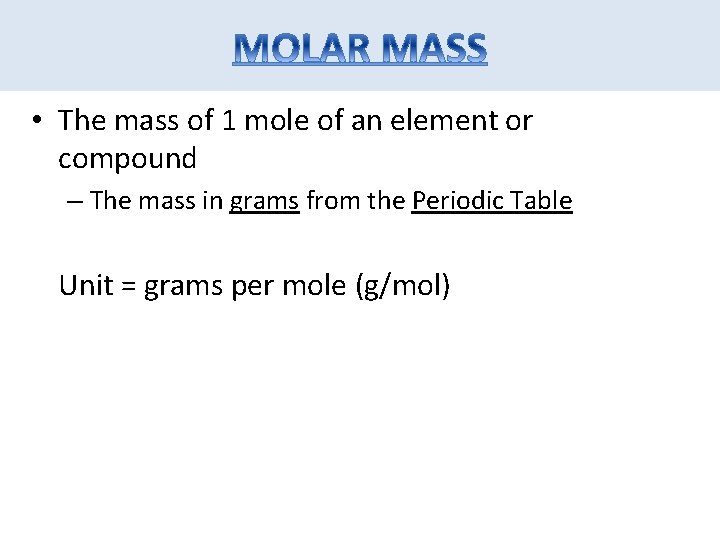
• The mass of 1 mole of an element or compound – The mass in grams from the Periodic Table Unit = grams per mole (g/mol)
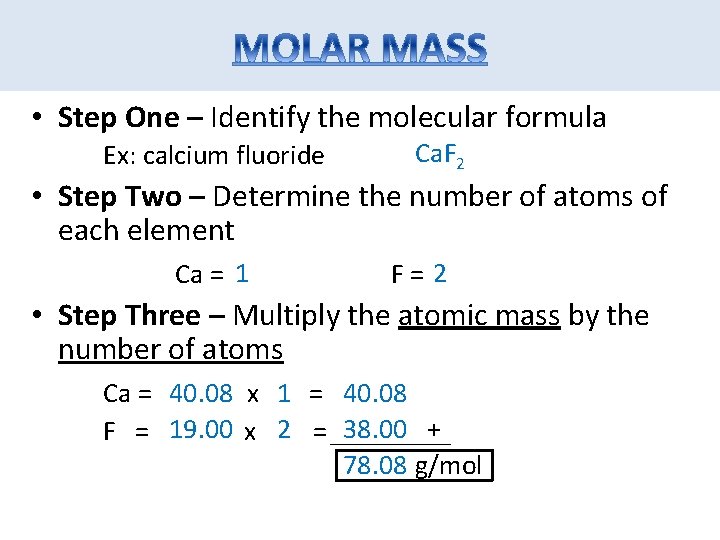
• Step One – Identify the molecular formula Ex: calcium fluoride Ca. F 2 • Step Two – Determine the number of atoms of each element Ca = 1 F= 2 • Step Three – Multiply the atomic mass by the number of atoms Ca = 40. 08 x 1 = 40. 08 F = 19. 00 x 2 = 38. 00 + 78. 08 g/mol
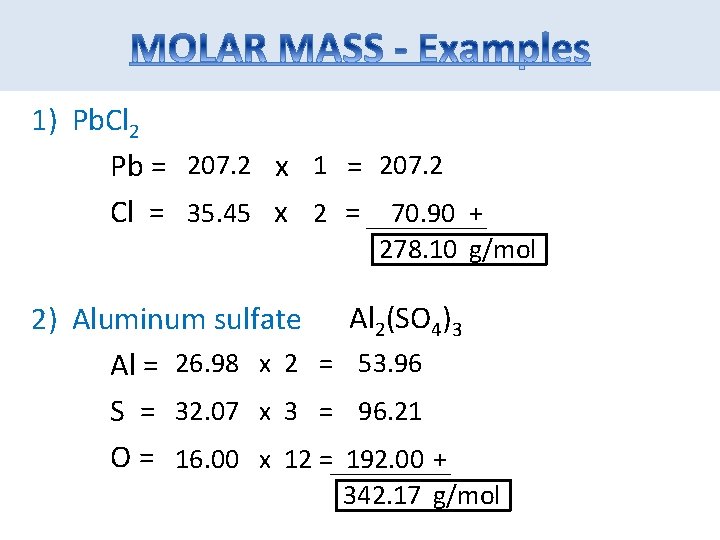
1) Pb. Cl 2 Pb = 207. 2 x 1 = 207. 2 Cl = 35. 45 x 2 = 70. 90 + 278. 10 g/mol 2) Aluminum sulfate Al = 26. 98 x 2 = S = 32. 07 x 3 = O = 16. 00 x 12 = Al 2(SO 4)3 53. 96 96. 21 192. 00 + 342. 17 g/mol
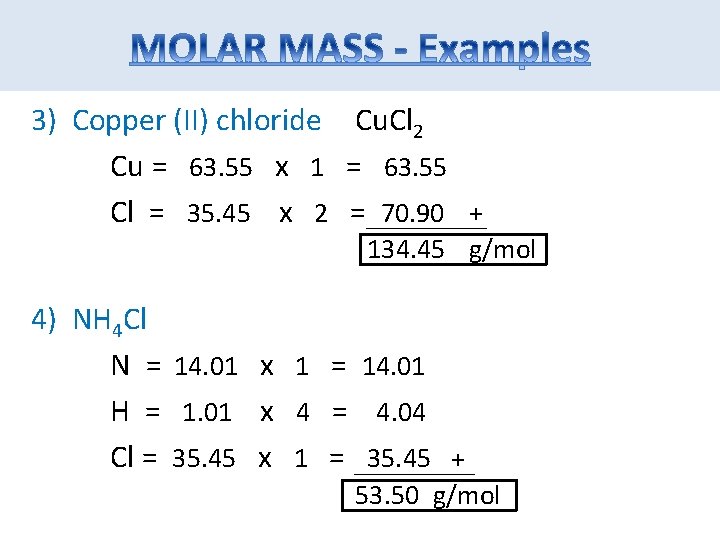
3) Copper (II) chloride Cu. Cl 2 Cu = 63. 55 x 1 = 63. 55 Cl = 35. 45 x 2 = 70. 90 + 134. 45 g/mol 4) NH 4 Cl N = 14. 01 x 1 = 14. 01 H = 1. 01 x 4 = 4. 04 Cl = 35. 45 x 1 = 35. 45 + 53. 50 g/mol
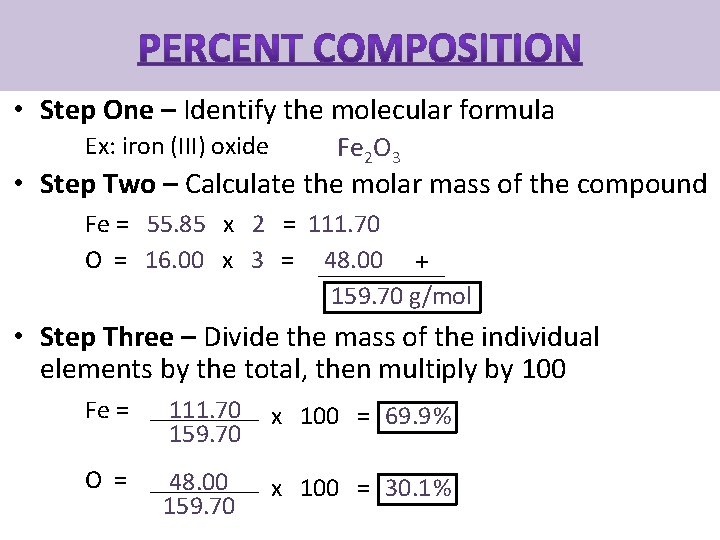
• Step One – Identify the molecular formula Ex: iron (III) oxide Fe 2 O 3 • Step Two – Calculate the molar mass of the compound Fe = 55. 85 x 2 = 111. 70 O = 16. 00 x 3 = 48. 00 + 159. 70 g/mol • Step Three – Divide the mass of the individual elements by the total, then multiply by 100 Fe = 111. 70 159. 70 x 100 = 69. 9% O = 48. 00 159. 70 x 100 = 30. 1%
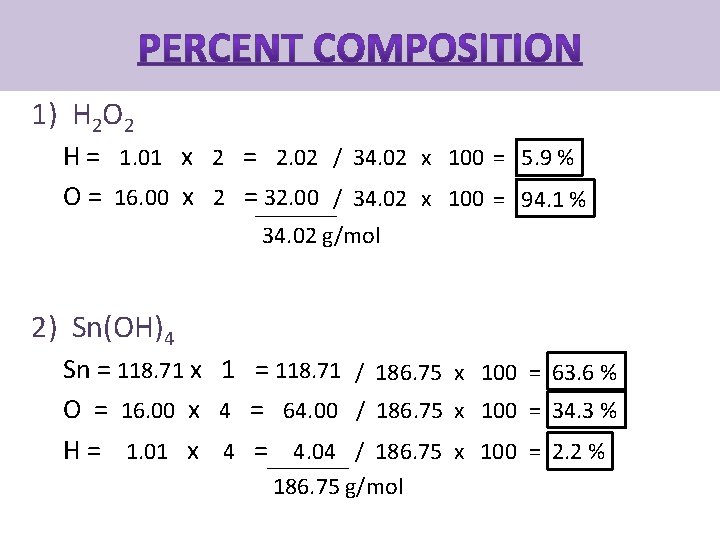
1) H 2 O 2 H = 1. 01 x 2 = 2. 02 / 34. 02 x 100 = 5. 9 % O = 16. 00 x 2 = 32. 00 / 34. 02 x 100 = 94. 1 % 34. 02 g/mol 2) Sn(OH)4 Sn = 118. 71 x 1 = 118. 71 / 186. 75 x 100 = 63. 6 % O = 16. 00 x 4 = 64. 00 / 186. 75 x 100 = 34. 3 % H = 1. 01 x 4 = 4. 04 / 186. 75 x 100 = 2. 2 % 186. 75 g/mol