
Modules on Sustainable Agriculture 14 MOSA Economic Viability
Modules on Sustainable Agriculture 14 MOSA Economic Viability What this means for agricultural enterprises and how it can be analysed
Learning objectives of this module Participants… • understand the characteristics of an economically viable farm / agricultural enterprise • know the elements to analyse the economic viability of a farm / agricultural enterprise • are able to critically appraise selected concepts of economic viability esp. with reference to short and long term considerations, scope, different sustainability concepts, and appropriateness of indicators for conditions in developing countries / emerging economies 2
Keywords of this module • Criteria of economic viability • Indicators for measuring economic viability • Concepts of assessing economic viability • Economic viability and sustainability • Economic profitability versus sustainability • Developing country conditions / perspective 3
Key content of this module 1. What is economic viability (EV) 2. EV - the broader view: tools dealing with the assessment of sustainability in agriculture 3. Farm management – EV in perspective 4. Specific topics relevant for farming enterprises 4
1. Economic Viability ? How would you describe an economic viable farm / agricultural enterprise? What topics do you think of? © Jan Grenz 5
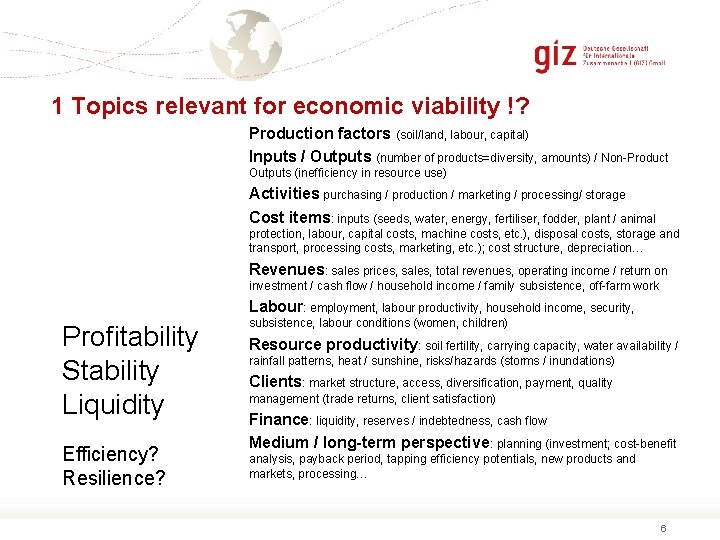
1 Topics relevant for economic viability !? Production factors (soil/land, labour, capital) Inputs / Outputs (number of products=diversity, amounts) / Non-Product Outputs (inefficiency in resource use) Activities purchasing / production / marketing / processing/ storage Cost items: inputs (seeds, water, energy, fertiliser, fodder, plant / animal protection, labour, capital costs, machine costs, etc. ), disposal costs, storage and transport, processing costs, marketing, etc. ); cost structure, depreciation… Revenues: sales prices, sales, total revenues, operating income / return on investment / cash flow / household income / family subsistence, off-farm work Labour: employment, labour productivity, household income, security, Profitability Stability Liquidity Efficiency? Resilience? subsistence, labour conditions (women, children) Resource productivity: soil fertility, carrying capacity, water availability / rainfall patterns, heat / sunshine, risks/hazards (storms / inundations) Clients: market structure, access, diversification, payment, quality management (trade returns, client satisfaction) Finance: liquidity, reserves / indebtedness, cash flow Medium / long-term perspective: planning (investment; cost-benefit analysis, payback period, tapping efficiency potentials, new products and markets, processing… 6
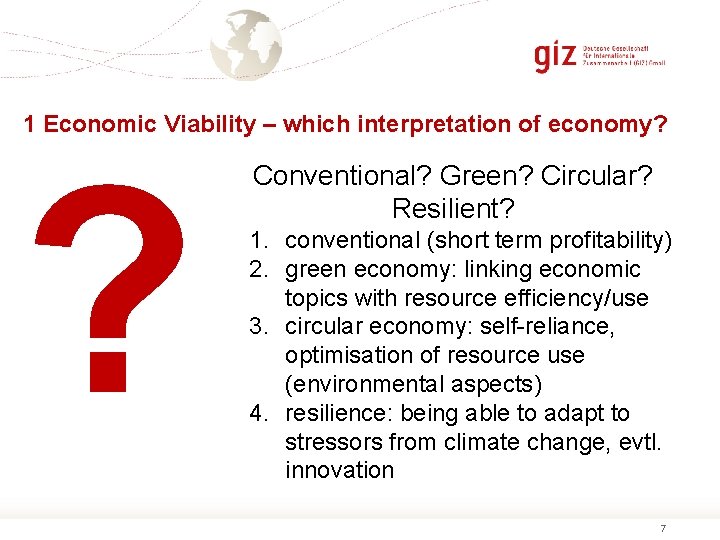
1 Economic Viability – which interpretation of economy? ? Conventional? Green? Circular? Resilient? 1. conventional (short term profitability) 2. green economy: linking economic topics with resource efficiency/use 3. circular economy: self-reliance, optimisation of resource use (environmental aspects) 4. resilience: being able to adapt to stressors from climate change, evtl. innovation © Jan Grenz 7
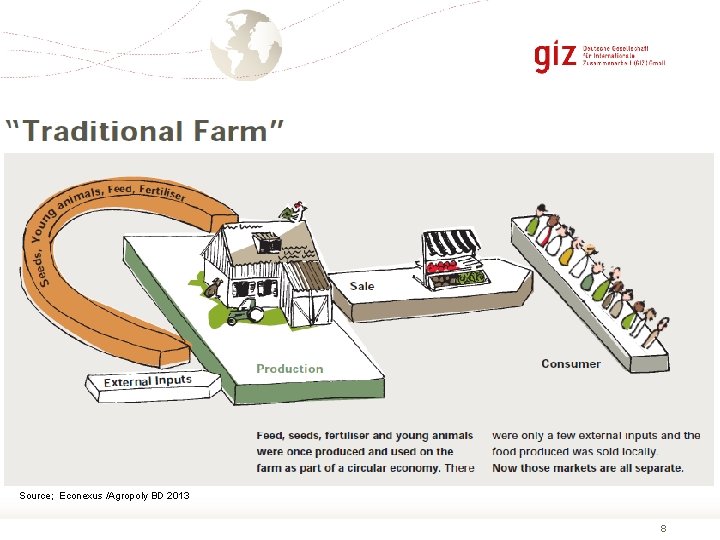
Source; Econexus /Agropoly BD 2013 8
Key content of this module 1. What is economic viability (EV) 2. EV - the broader view: tools dealing with the assessment of sustainability in agriculture 3. Farm management – EV in perspective 4. Specific topics relevant for farming enterprises 9
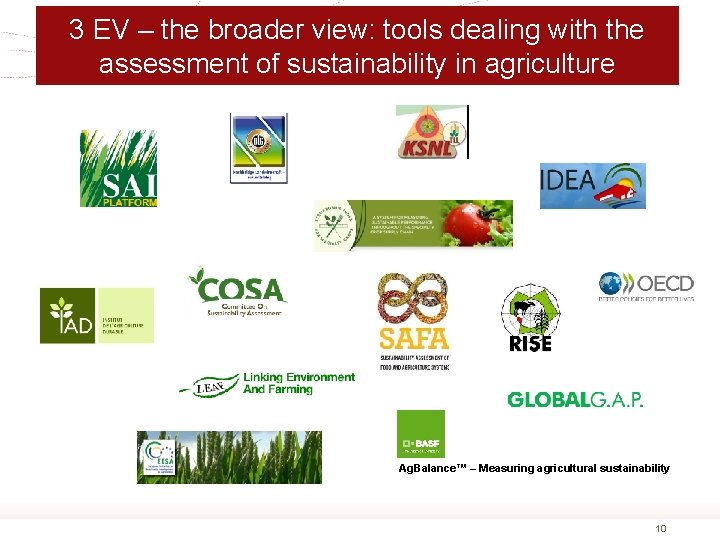
3 EV – the broader view: tools dealing with the assessment of sustainability in agriculture Ag. Balance™ – Measuring agricultural sustainability 10
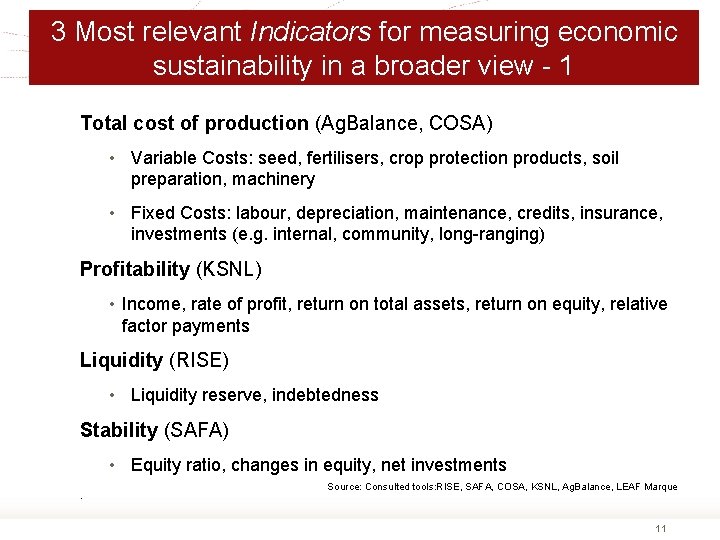
3 Most relevant Indicators for measuring economic sustainability in a broader view - 1 Total cost of production (Ag. Balance, COSA) • Variable Costs: seed, fertilisers, crop protection products, soil preparation, machinery • Fixed Costs: labour, depreciation, maintenance, credits, insurance, investments (e. g. internal, community, long-ranging) Profitability (KSNL) • Income, rate of profit, return on total assets, return on equity, relative factor payments Liquidity (RISE) • Liquidity reserve, indebtedness Stability (SAFA) • Equity ratio, changes in equity, net investments. Source: Consulted tools: RISE, SAFA, COSA, KSNL, Ag. Balance, LEAF Marque 11
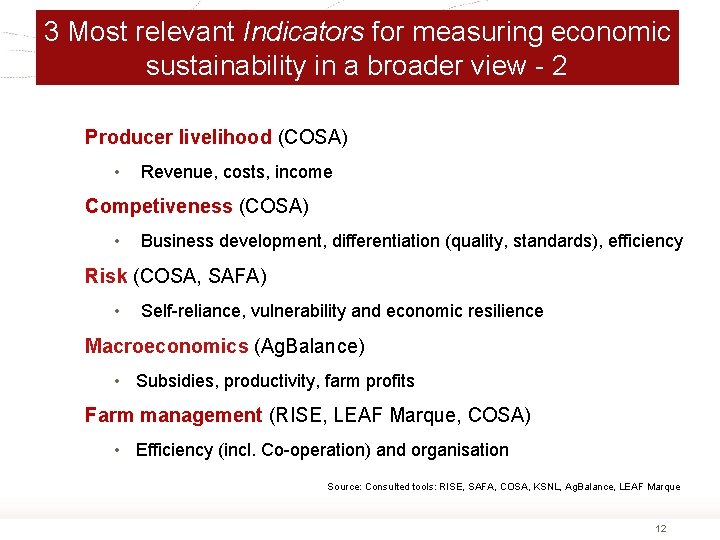
3 Most relevant Indicators for measuring economic sustainability in a broader view - 2 Producer livelihood (COSA) • Revenue, costs, income Competiveness (COSA) • Business development, differentiation (quality, standards), efficiency Risk (COSA, SAFA) • Self-reliance, vulnerability and economic resilience Macroeconomics (Ag. Balance) • Subsidies, productivity, farm profits Farm management (RISE, LEAF Marque, COSA) • Efficiency (incl. Co-operation) and organisation Source: Consulted tools: RISE, SAFA, COSA, KSNL, Ag. Balance, LEAF Marque 12
3 EV – Core Objectives Solvency, Profitability, Stability Solvency The farm enterprise must be capable of paying all debts, at any time. Profitability The cost-benefit relation has to allow for remuneration with which the people on the farm can fulfil basic needs and their wish for a good life, incl. ability to invest into one‘s own future and into that of the farm. Stability The farm enterprise has to remain solvent and profitable even in case of unforeseen problems. Source: RISE Response-Inducing Sustainability Evaluation 13
Key content of this module 1. What is economic viability (EV) 2. EV - the broader view: tools dealing with the assessment of sustainability in agriculture 3. Farm management – EV in perspective 4. Specific topics relevant for farming enterprises 14
4 EV in perspective - Farm management goals ! The goal of sustainable farm management is • to maintain and improve competitiveness in all areas (sales, inputs, personnel, finance) • which in turn is the precondition for generating financial surplus to safeguard farm operations in the long term. Source: RISE 15
4 Farm management goals are achieved through • the efficient employment of materials, personnel and capital, • reduction of negative impacts and the increase of positive impacts on society and environment; • and on the basis of a deliberately accepted responsibility for humankind and nature 16
Key content of this module 1. What is economic viability (EV) 2. EV - the broader view: tools dealing with the assessment of sustainability in agriculture 3. Farm management – EV in perspective 4. Specific topics relevant for farming enterprises 17
5 Specific topics relevant for farming enterprises 1. Four bottom lines, not one! 2. Efficiency: which one? Capital, labour, resource 18
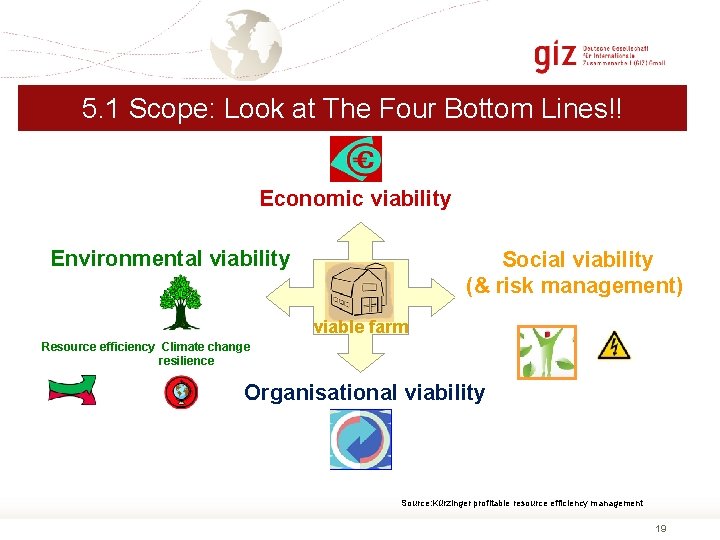
5. 1 Scope: Look at The Four Bottom Lines!! Economic viability Environmental viability Social viability (& risk management) viable farm Resource efficiency Climate change resilience Organisational viability Source: Kürzinger profitable resource efficiency management 19
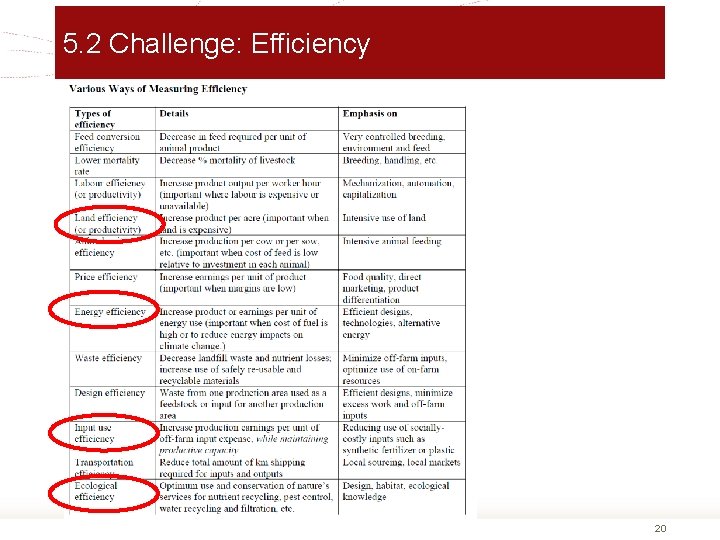
5. 2 Challenge: Efficiency 20
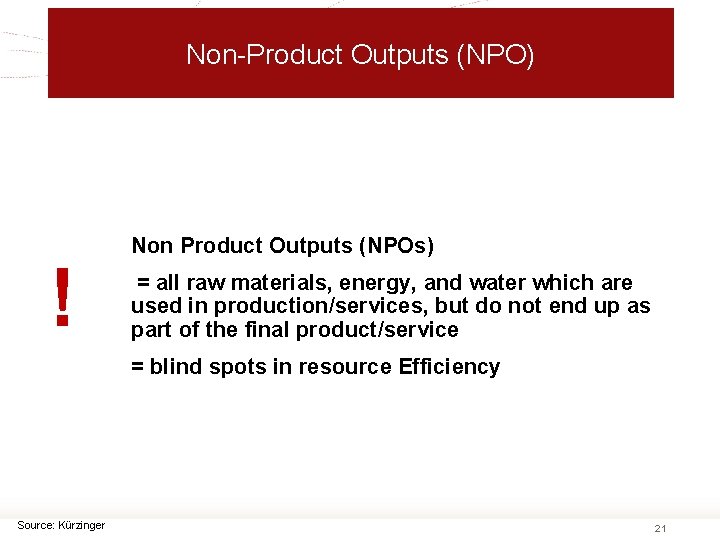
Non-Product Outputs (NPO) ! Non Product Outputs (NPOs) = all raw materials, energy, and water which are used in production/services, but do not end up as part of the final product/service = blind spots in resource Efficiency Source: Kürzinger 21
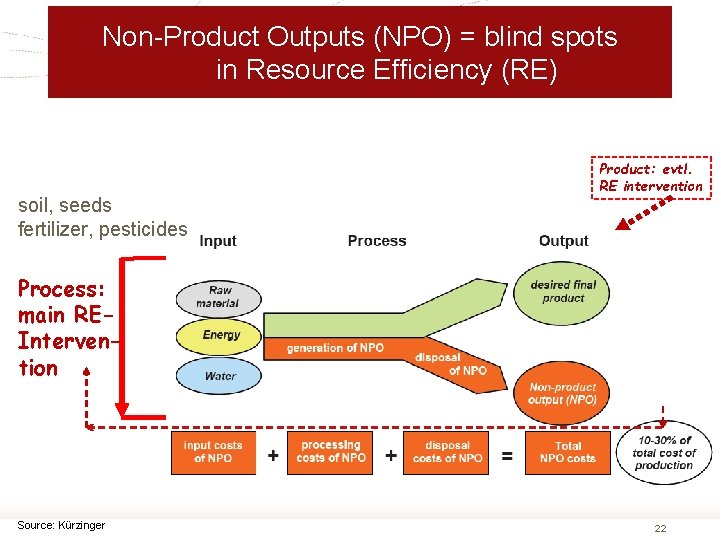
Non-Product Outputs (NPO) = blind spots in Resource Efficiency (RE) soil, seeds fertilizer, pesticides Product: evtl. RE intervention Process: main REIntervention Source: Kürzinger 22
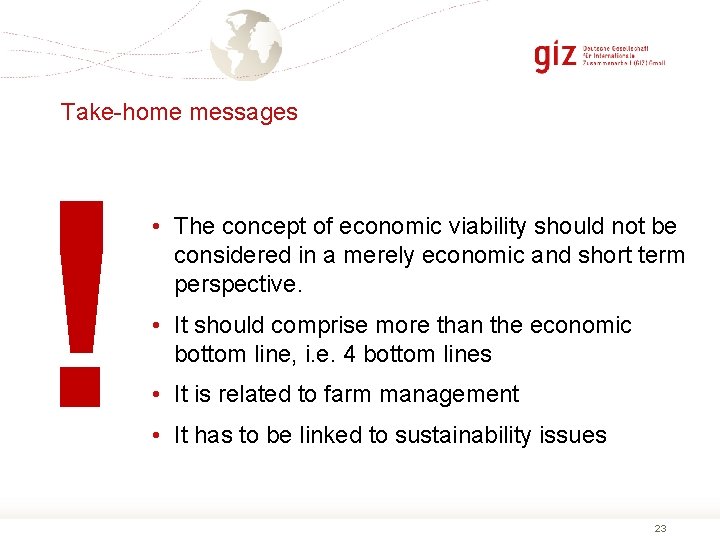
Take-home messages ! • The concept of economic viability should not be considered in a merely economic and short term perspective. • It should comprise more than the economic bottom line, i. e. 4 bottom lines • It is related to farm management • It has to be linked to sustainability issues 23
Application Exercise Imagine you have to analyse the economic viability of a farm. 1. Based on what criteria / indicators would you assess? 2. Which indicators would be the most important ones – a “must”? 3. Which indicators would be additional “nice to have”? http: //ecx. images-amazon. com/images/I/31 ew. GX 52 qq. L. jpg 24

Thank you for your attention! Do you have any further questions or comments? 25
Bibliography Ag. Balance (BASF): http: //www. agro. basf. com/agr/APInternet/en/content/sustainability/measuring_sustainability/agbalance/index BASF, (n. a. ), A clearer view on agricultural sustainability, http: //www. agro. basf. com/agr/APInternet/en/function/conversions: /publish/content/_internal_tools/files/assets/downloads/publication. pdf Breitschuh, G. / Eckart, H. / Strümpfel, J. , Criteria System of Sustainable Agriculture, CSSA-KSNL, Thüringer Landesanstalt für Landwirtschaft, Jena 2009 Committee on Sustainability Assessment: http: //thecosa. org/; http: //thecosa. org/wp-content/uploads/2014/01/The. COSA-Measuring-Sustainability-Report. pdf DLG-Sustainability Standard (Nachhaltigkeitsstandard): http: //www. nachhaltige-landwirtschaft. info/21. html DLG, Sustainable Agriculture, DLG Certificate, www. Nachhaltige-Landwirtschaft. info , p. 9 FAO-Rome (2013) SAFA – Sustainability Assessment of food and agriculture systems. Indicators FAO-Rome (2014) SAFA – Sustainability Assessment of food and agriculture systems. Guidelines; Tool. User Manual 2. 2. 40 http: //www. fao. org/nr/sustainability-assessments-safa/en/ (all 3 publications) Hoffmann, U. (2011), Effective Ways to overcome the food security crisis through eco-functional intensification and smallholder empowerment, in: Local Land & Soil News, no. 38/39 pp. 5 -9 KSNL-CSSA Criteria System of Sustainable Agriculture http: //www. thueringen. de/de/tll/oekologie/nachhaltige_landwirtschaft RISE: http: //www. shl. bfh. ch/index. php? id=249 ; Grenz, J. , Schoch, M. Stämpfli, A. , Thalmann, C. (2012), RISE 2. 0 Field Manual, School of Agricultural, Forest and Food Sciences, Bern Scott, J. , Coleman, R. (2008), Genuine Progress Index for Atlantic Canada (GPI), The GPI soils and agriculture account http: //www. organicagcentre. ca/Docs/GPI%20 Atlantic/Farm_viability 08_opt. pdf 26
- Slides: 26