
MODULE4 DELIVERING CUSTOMER VALUE MARKETING CHANNELS According to

- Slides: 24
MODULE-4 DELIVERING CUSTOMER VALUE
MARKETING CHANNELS: According to American marketing association ” A channel of distribution is a structure of intra-company organization, units and intra company agents and dealers, wholesalers and retailers through which a commodity product or services is marketed”. According to Philip Kotler “ every producer seeks to link together the set of marketing intermediaries that best fulfil the firms objectives “.
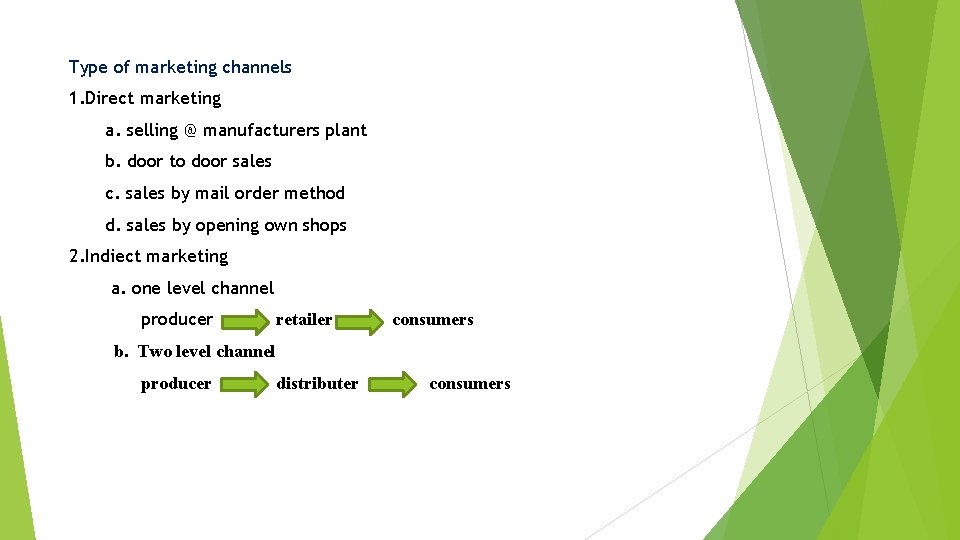
Type of marketing channels 1. Direct marketing a. selling @ manufacturers plant b. door to door sales c. sales by mail order method d. sales by opening own shops 2. Indiect marketing a. one level channel producer retailer consumers b. Two level channel producer distributer consumers
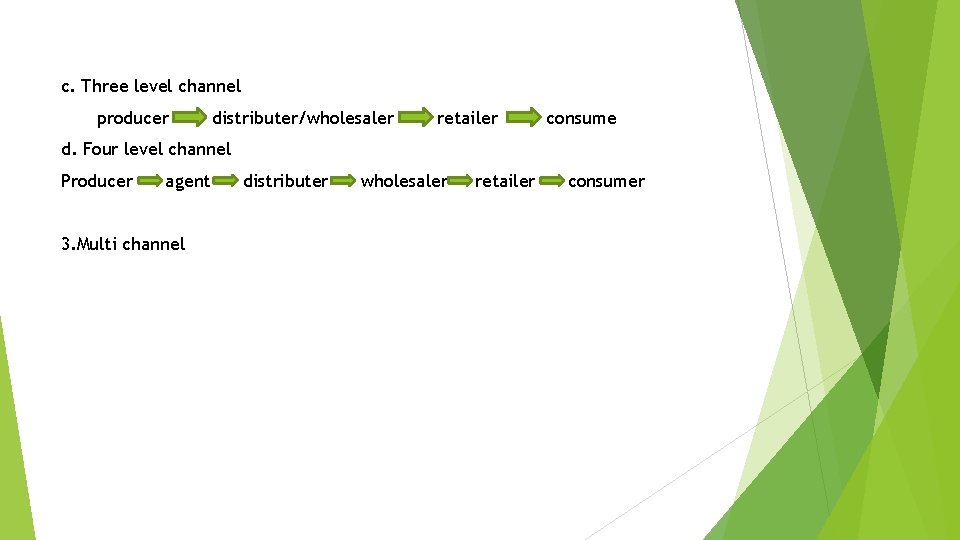
c. Three level channel producer distributer/wholesaler retailer consume d. Four level channel Producer agent 3. Multi channel distributer wholesaler retailer consumer
Members of marketing channels 1. Sole selling agent 2. C & F agent 3. Wholesalers 4. Semi-wholesalers 5. Retailers 6. Value added resellers 7. merchants
Factors affecting channels 1. Factor relating to product characteristics a. consumers product b. perishability c. unit value d. purchase frequency e. newness & market acceptance f. product breadth 2. Factors relating to company characteristics a. financial strength b. market policies c. size of company d. product mix
3. Factor relating to market characteristics a. consumer buying habits b. location of the market c. no. of consumers d. size of orders 4. Factors relating to middlemen considerartion a. sales volume potentials b. availability of middlemen c. services provided by middlemen d. cost of channel
5. Factors relating to environmental characteristics a. economic condition b. legal restrictions c. fiscal structure d. competitor’s channel
Channel design these are critical because they determine a product’s market presence and buyer’s accessibility to the product. Dimensions of channel design 1. Market dimensions a. market geography b. market size c. market density d. market behavior 2. product dimensions a. bulk & weight b. perishability c. unit value d. technical vs non technical e. newness
3. Company dimensions a. size b. financial capacity c. managerial expertise d. objectives and strategies 4. Intermediary dimensions a. availability b. cost c. services 5. environmental dimensions 6. Behavioral dimensions
Process of channel design 1. Defining the customer need 2. Defining channel objective 3. Channel alternatives 4. Evolutions of major alternatives 5. Idial channel structure Criteria for effective channel design 1. Effectiveness 2. Efficiency 3. Equity 4. Scalability 5. flexibility
Channel management decisions 1. Recruiting channel members 2. Selecting channel members 3. Training channel members 4. Motivating channel members 5. Evaluating channel members 6. Modifying channel arrangements 7. Managing relationships in channels
Channel of conflict It is a situation where one channel member perceives the behavior of the another channel member to be impeding the attainment of its goal or its effective functioning Reason for channel of conflict 1. Goal Incomplitability 2. Role ambiguity 3. Differences in perception of the market Types of channel conflict 1. Vertical level conflict 2. Horizontal level conflict 3. Multi channel level conflict
Stages in channel of conflict 1. Latent conflict a. attitudinal causes of conflict b. structural causes of conflict i. divergence in goals ii. Drives for autonomy iii. Fights over scares resources 2. Felt conflict 3. Manifest conflict
Impact of channel of conflict 1. Decreases in productivity 2. Violence 3. Members leave organization 4. Inspire creativity 5. Share and respect opinions 6. Improve future communications 7. Mental health concerns
Remedies of channel of conflict 1. Communication 2. Super ordinate goals 3. Persuation 4. Negotiation 5. Coalition 6. Mediation and arbitration 7. Lobbying and judicial appeal 8. withdrawal
Types of E-COMMERCE 1. B 2 B(business to business) 2. B 2 C(business to consumers) 3. C 2 C(customer to customer) 4. C 2 B(customer to business) 5. Mobile commerce Significance of e commerce 1. Reduced prices 2. Global market place 3. 24 -hours access 4. More choices 5. Quicker delivery 6. Information 7. Low cost advertising 8. low entry barriers
Scope of retailing 1. Store management 2. supply chain management 3. Vendor management 4. inventory management 5. Category management 6. customer relationship management Function of retailing 1. Sorting 2. Breaking bulk 3. Holding stock 4. Additional services 5. Channel of communication 6 transport and advertising functions.
Factor influencing retailing 1. Computerision 2. Communication 3. Fashion 4. consumerism
New retail environment 1. Increasing acceptance of rural markets 2. Emergence of wholesale clubs 3. Efficient buying 4. Hypermarkets 5. Commerce still rely on traditional concepts 6. Emmergence of private label brands 7. Category killer 8. Magnetic effect 9. Dollar stores 10 e retailing
Supply chain management SCM is the management of a network of interconnected business involved in the ultimate provision of product and services packages required by end users Features of SCM 1. Integrated behavior 2. Mutually sharing information 3. Mutually sharing channel risk and rewards 4. co-operation 5. Focus on serving customer 6. Integration of process 7. Partners to build and maintain long term relationships
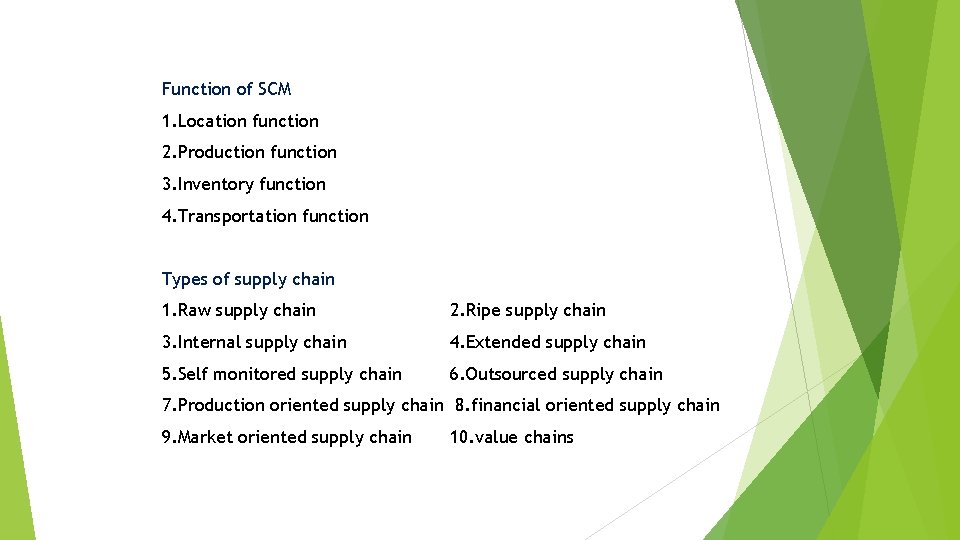
Function of SCM 1. Location function 2. Production function 3. Inventory function 4. Transportation function Types of supply chain 1. Raw supply chain 2. Ripe supply chain 3. Internal supply chain 4. Extended supply chain 5. Self monitored supply chain 6. Outsourced supply chain 7. Production oriented supply chain 8. financial oriented supply chain 9. Market oriented supply chain 10. value chains
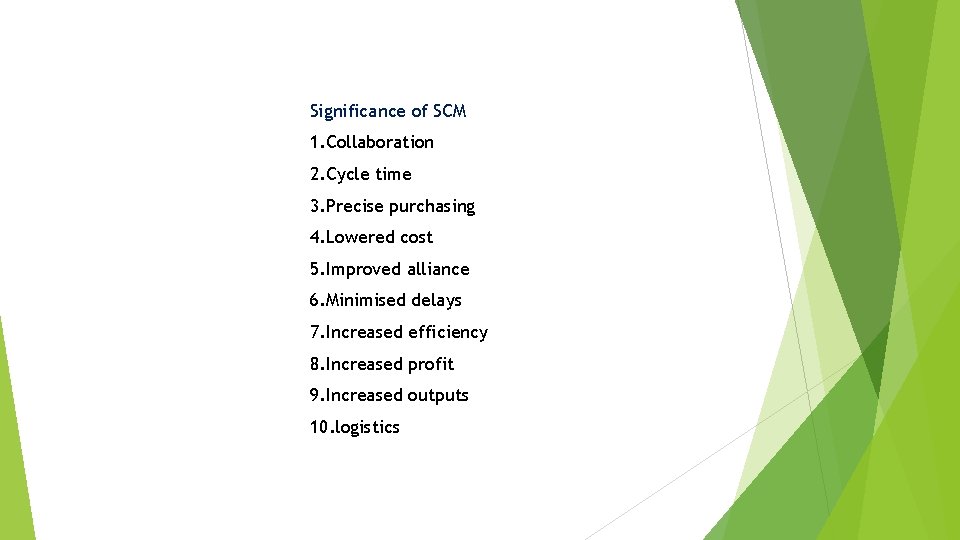
Significance of SCM 1. Collaboration 2. Cycle time 3. Precise purchasing 4. Lowered cost 5. Improved alliance 6. Minimised delays 7. Increased efficiency 8. Increased profit 9. Increased outputs 10. logistics
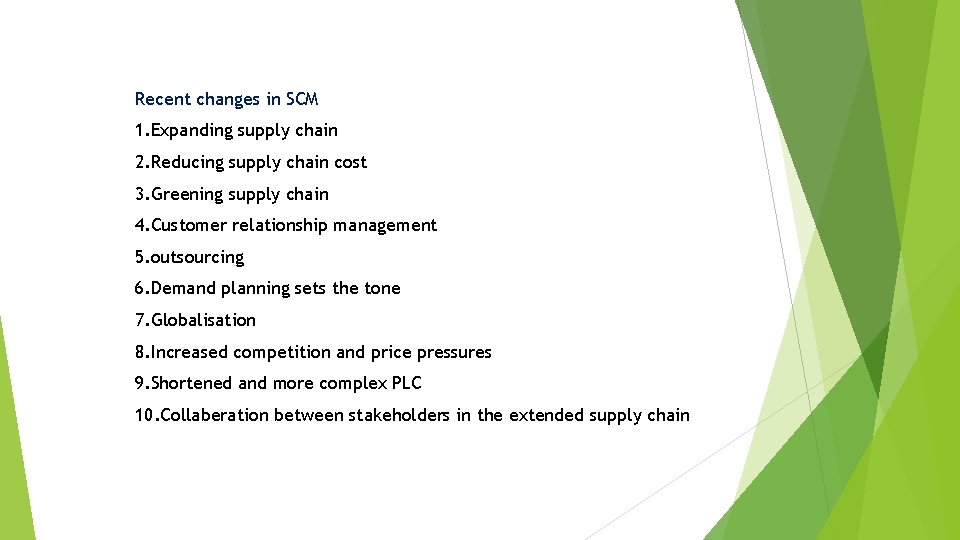
Recent changes in SCM 1. Expanding supply chain 2. Reducing supply chain cost 3. Greening supply chain 4. Customer relationship management 5. outsourcing 6. Demand planning sets the tone 7. Globalisation 8. Increased competition and price pressures 9. Shortened and more complex PLC 10. Collaberation between stakeholders in the extended supply chain