
Module Three Phonology Phonetics and Language Acquisition Theories



- Slides: 116
Module Three: Phonology, Phonetics, and Language Acquisition Theories EDU 601 -Language Acquisition Point Loma Nazarene University Micki Abercrombie-Donahue, Ed. D. Spring Quad II- 2016
Theories of First Language Acquisition Section One
The Main Stages Of First Language Acquisition 1. Pre-speech Stage. 2. Babbling Stage. 3. Combining Sounds and Words Stage 3
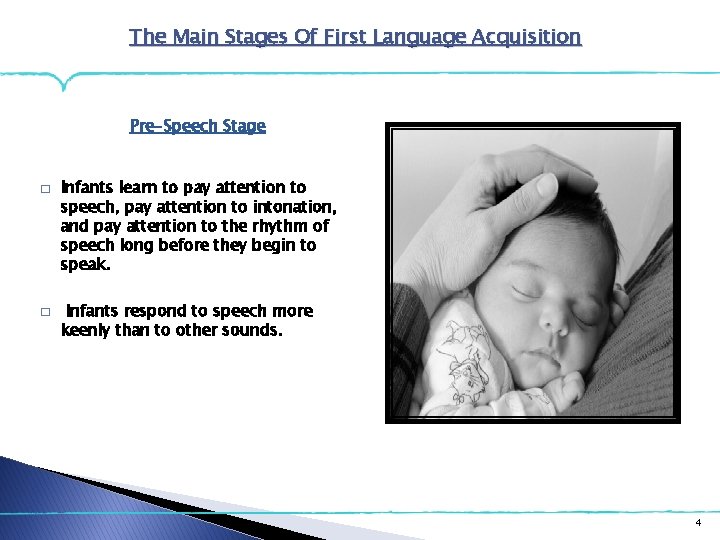
The Main Stages Of First Language Acquisition Pre-Speech Stage � � Infants learn to pay attention to speech, pay attention to intonation, and pay attention to the rhythm of speech long before they begin to speak. Infants respond to speech more keenly than to other sounds. 4
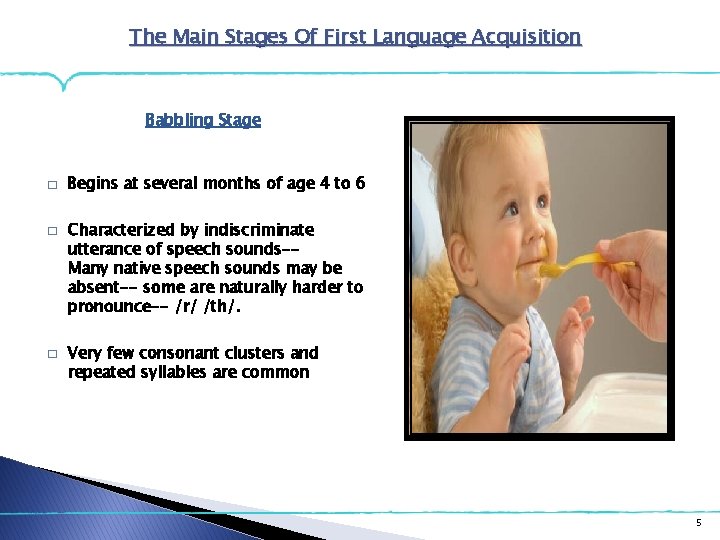
The Main Stages Of First Language Acquisition Babbling Stage � � � Begins at several months of age 4 to 6 Characterized by indiscriminate utterance of speech sounds-Many native speech sounds may be absent-- some are naturally harder to pronounce-- /r/ /th/. Very few consonant clusters and repeated syllables are common 5
The Main Stages Of First Language Acquisition One Word (Holophrastic) Stage � � � Infants may utter their first word as early as nine months: usually mama, dada (these words resemble babbling). Deaf babies whose parents use sign language begin making their first word/gestures around eight months. This stage is characterized by the production of actual speech signs. Often the words are simplified: "du" for duck, "ba" for bottle. 6
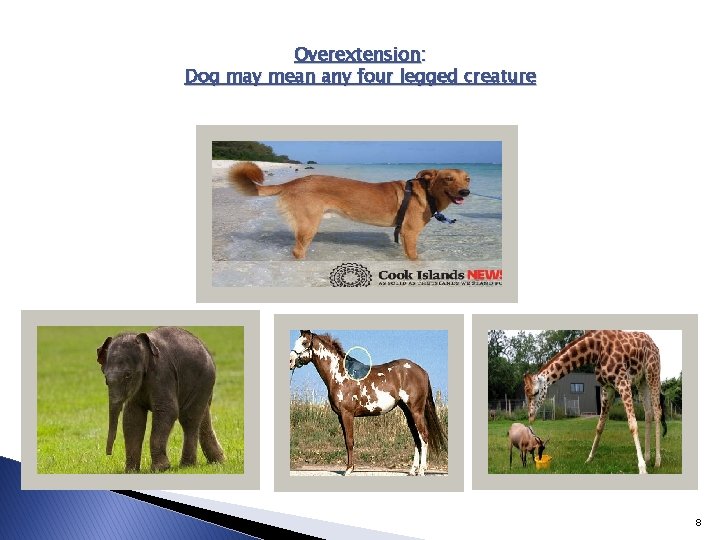
The Main Stages Of First Language Acquisition The First Fifty Words � � When the child has acquired about 50 words he develops regular pronunciation patterns. Children tend to perceive more phonemic contrasts than they are able to produce themselves. The first 50 words tend to be names of important persons, greetings, foods, highlights of the daily routine such as baths, ability to change their environment-give, take, go, up, down, open. The meaning of words may not correspond to that of adult language: overextension--. . bird may mean any flying object. 7
Overextension: Dog may mean any four legged creature 8
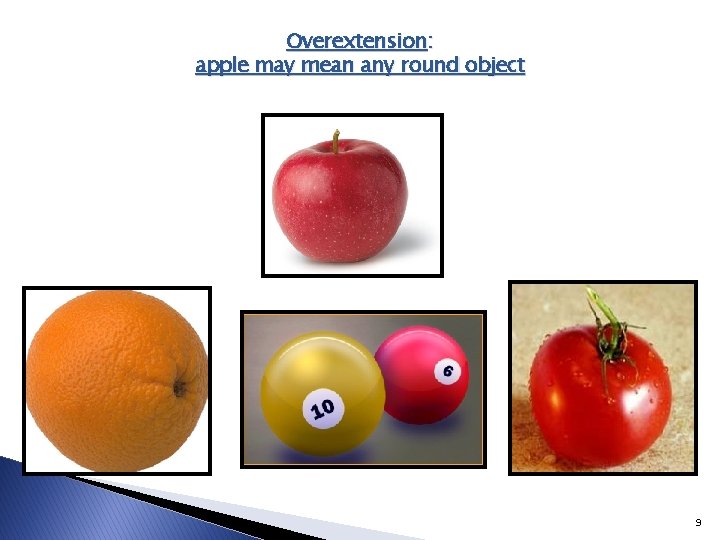
Overextension: apple may mean any round object 9
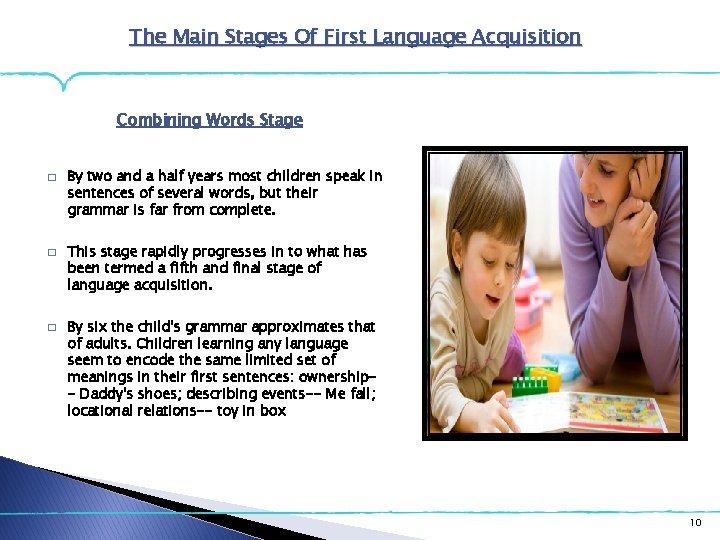
The Main Stages Of First Language Acquisition Combining Words Stage � � � By two and a half years most children speak in sentences of several words, but their grammar is far from complete. This stage rapidly progresses in to what has been termed a fifth and final stage of language acquisition. By six the child's grammar approximates that of adults. Children learning any language seem to encode the same limited set of meanings in their first sentences: ownership- Daddy's shoes; describing events-- Me fall; locational relations-- toy in box 10
The Main Stages Of First Language Acquisition Combining Words Stage � � � Sentences usually include two words. Children can repeat more complex sentences spoken by adults but cannot create them until later. The ends of words learned more quickly: -raff for giraff, -mato for tomato, -narna for banana. 11
The Main Stages Of First Language Acquisition Combining Words Stage � � � The rest of the acquisition of grammar is idiosyncratic-- some children repeat more, others create more. Some children produce a great number of words before beginning to combine them into sentences, while others immediately begin to make sentences. There may be several individual routes to mastering one's heritage language.
Theories of Second Language Acquisition Section Two
Theories of Second Language Acquisition � It is not only the study of the acquisition of a subsequent language and its comparison to the heritage language acquired in childhood but it also includes the study of the processes involved in learning any language.
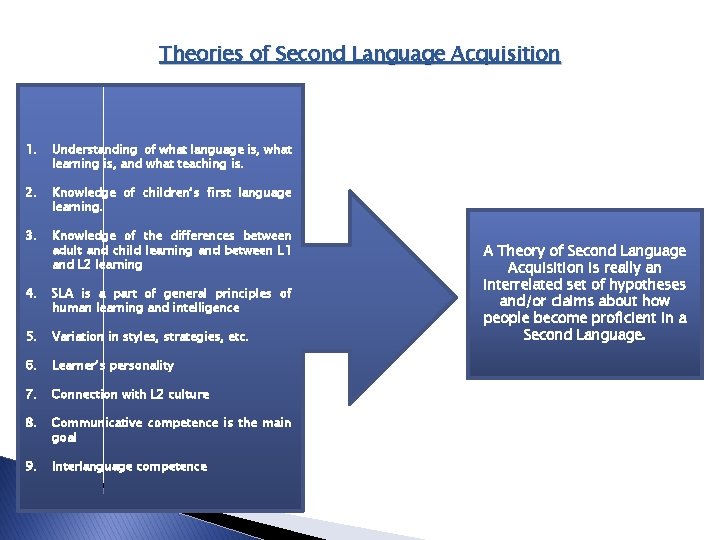
Theories of Second Language Acquisition 1. Understanding of what language is, what learning is, and what teaching is. 2. Knowledge of children’s first language learning. 3. Knowledge of the differences between adult and child learning and between L 1 and L 2 learning 4. SLA is a part of general principles of human learning and intelligence 5. Variation in styles, strategies, etc. 6. Learner’s personality 7. Connection with L 2 culture 8. Communicative competence is the main goal 9. Interlanguage competence A Theory of Second Language Acquisition is really an interrelated set of hypotheses and/or claims about how people become proficient in a Second Language.
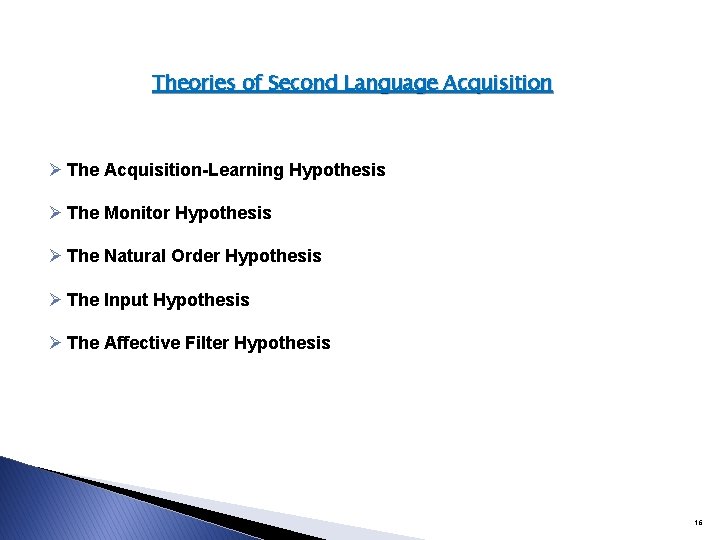
Theories of Second Language Acquisition Ø The Acquisition-Learning Hypothesis Ø The Monitor Hypothesis Ø The Natural Order Hypothesis Ø The Input Hypothesis Ø The Affective Filter Hypothesis 16
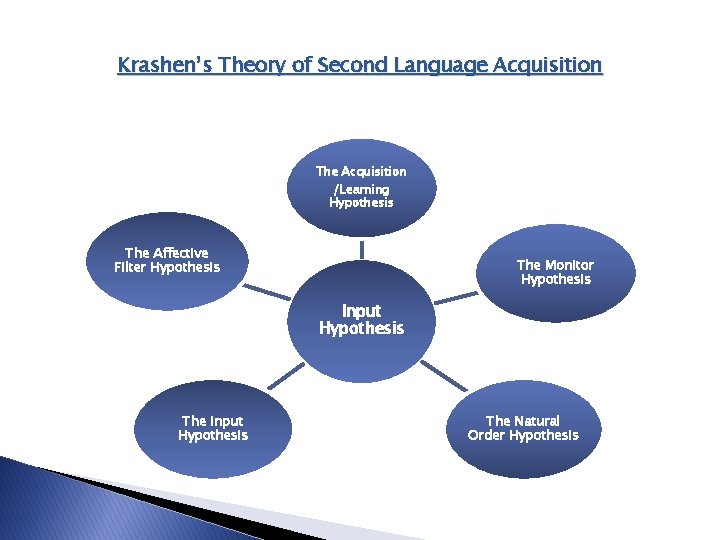
Krashen’s Theory of Second Language Acquisition The Acquisition /Learning Hypothesis The Affective Filter Hypothesis The Monitor Hypothesis Input Hypothesis The Natural Order Hypothesis
Language Acquisition-Learning Hypothesis Acquisition and Learning � � Acquisition is a sub-conscious process, as in the case of a child learning its own language or an adult 'picking up' a second language simply by living and working in a foreign country. Learning is the conscious process of developing a foreign language through language lessons and a focus on the grammatical features of that language.
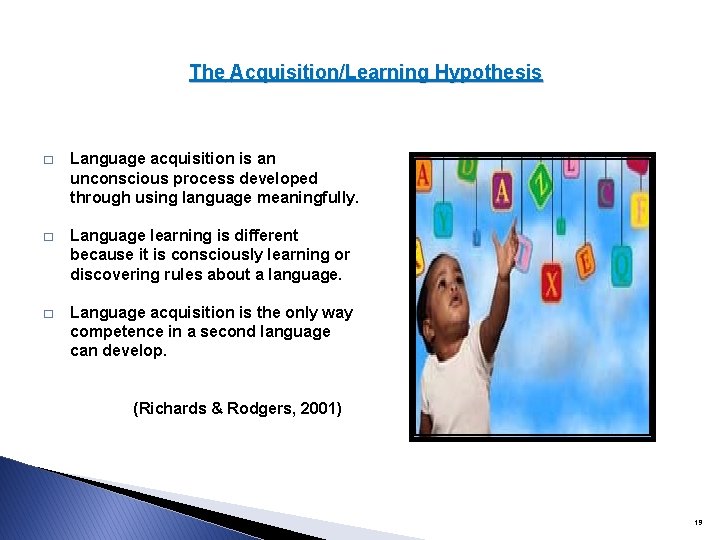
The Acquisition/Learning Hypothesis � Language acquisition is an unconscious process developed through using language meaningfully. � Language learning is different because it is consciously learning or discovering rules about a language. � Language acquisition is the only way competence in a second language can develop. (Richards & Rodgers, 2001) 19
Language Acquisition-Learning Hypothesis Language Acquisition vs. Language Learning � � Gass and Selinker (1994) criticize this hypothesis. They claim that it does not show evidence of the distinction between acquisition and learning as two separate systems. However, Krashen said that many can produce language fluently without having been taught any rules and there are many that know the rules but are unable to apply them whilst speaking (Lightbown and Spader, 1999).
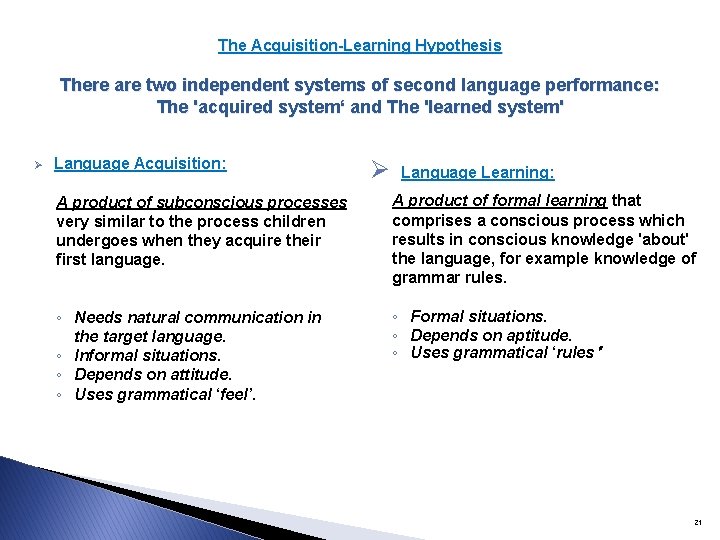
The Acquisition-Learning Hypothesis There are two independent systems of second language performance: The 'acquired system‘ and The 'learned system' Ø Language Acquisition: Ø Language Learning: A product of subconscious processes very similar to the process children undergoes when they acquire their first language. A product of formal learning that comprises a conscious process which results in conscious knowledge 'about' the language, for example knowledge of grammar rules. ◦ Needs natural communication in the target language. ◦ Informal situations. ◦ Depends on attitude. ◦ Uses grammatical ‘feel’. ◦ Formal situations. ◦ Depends on aptitude. ◦ Uses grammatical ‘rules’ 21
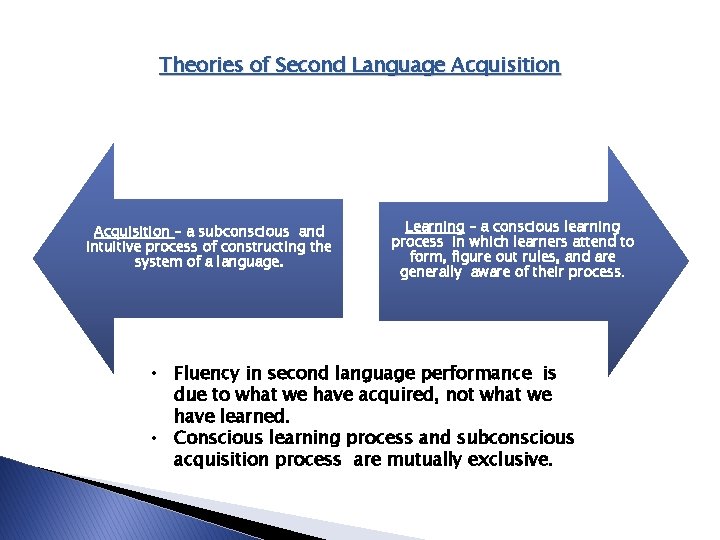
Theories of Second Language Acquisition – a subconscious and intuitive process of constructing the system of a language. Learning – a conscious learning process in which learners attend to form, figure out rules, and are generally aware of their process. • Fluency in second language performance is due to what we have acquired, not what we have learned. • Conscious learning process and subconscious acquisition process are mutually exclusive.
The Acquisition/Learning Hypothesis � This acquisition-focused approach sees communicative competence progressing through three stages: 1) Oral Comprehension, 2) Early speech production, and 3) Speech activities, all fostering "natural" language acquisition, much as a child would learn his/her native tongue. 4) Following an initial "silent period", comprehension should precede production in speech, as the latter should be allowed to emerge in natural stages or progressions. 23
Theories of Second Language Acquisition Natural Order Hypothesis � � Language is acquired in a predictable and natural order by all learners. The order of language acquisition does not depend on the apparent simplicity or complexity of the grammatical features involved. The natural order of acquisition cannot be influenced by direct teaching of features that the learner is not yet ready to acquire. The natural order of acquisition is very similar for a native-English child learning its own language and for an adult learning English as a foreign language
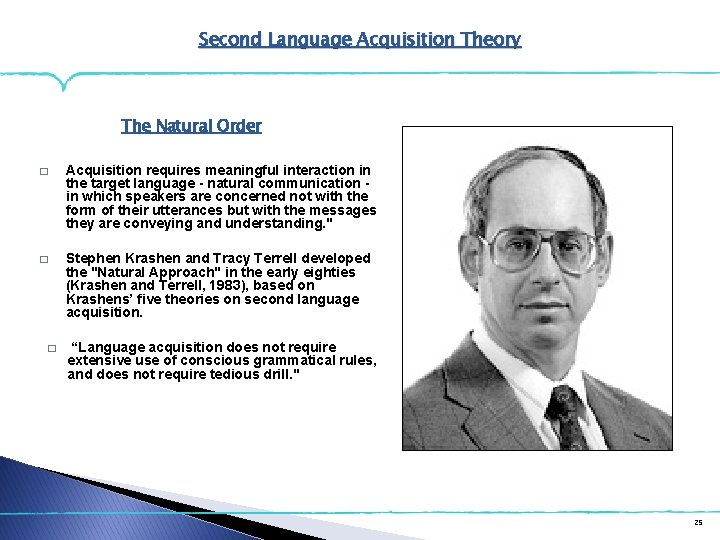
Second Language Acquisition Theory The Natural Order � Acquisition requires meaningful interaction in the target language - natural communication in which speakers are concerned not with the form of their utterances but with the messages they are conveying and understanding. " � Stephen Krashen and Tracy Terrell developed the "Natural Approach" in the early eighties (Krashen and Terrell, 1983), based on Krashens’ five theories on second language acquisition. � “Language acquisition does not require extensive use of conscious grammatical rules, and does not require tedious drill. " 25
Second Language Acquisition Theory Natural Order Hypothesis: � As Krashen points out, much of the frustration experienced by teachers and their students in grammar lessons results from the attempt to inculcate a grammatical form which the learner is not yet ready to acquire.
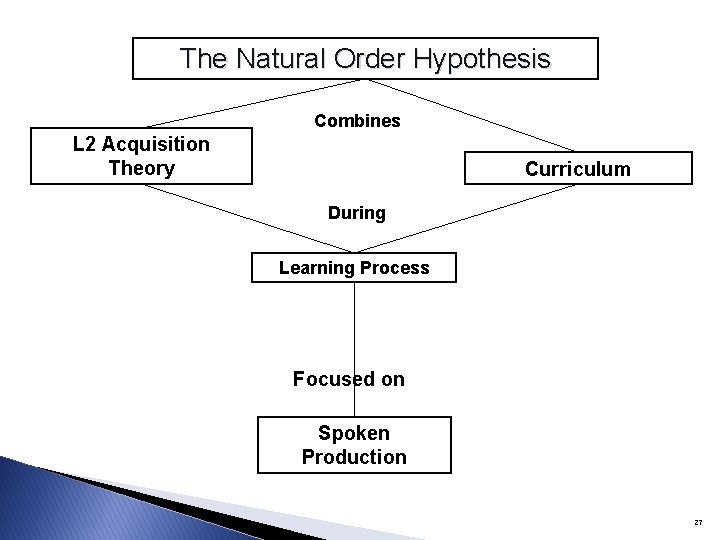
The Natural Order Hypothesis Combines L 2 Acquisition Theory Curriculum During Learning Process Focused on Spoken Production 27
Second Language Acquisition Theory Monitor Hypothesis • We are able to use what we have learned (in Krashen's sense) about the rules of a language in monitoring (or self-correcting) our language output. • Conscious editor or monitor works. • Clearly, this is possible in the correction of written work. It is much more difficult when engaging in regular talk.
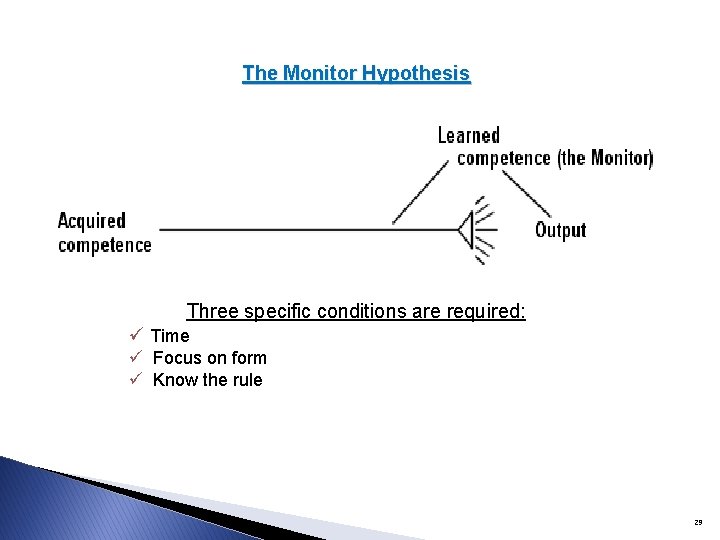
The Monitor Hypothesis Three specific conditions are required: ü Time ü Focus on form ü Know the rule 29
Second Language Acquisition Theory Monitor Hypothesis • Krashen states that it is often difficult to use the monitor correctly since the rules of a language can be extremely complex. • Even assuming the learner has a good knowledge of the rule in question, it is difficult to focus on grammar while simultaneously attempting to convey meaning (and possibly feeling). • Most normal conversation simply does not provide enough time to do so.
The Monitor Hypothesis � Individual variation in monitor use: 1) Monitor Over-users are learners who attempt “monitor” all the time. 2) Monitor Under-users are learners who prefer not to use their conscious knowledge. 3) Optimal Monitor users are learners who use the “monitor” appropriately. � According to Krashen, the role of the monitor is or should be minor. (Krashen, 1982) 31
Second Language Acquisition Theory Monitor Hypothesis � He claims that the learners who use the ‘monitor’ all the time are ‘over-users’, often producing stilted language, whereas ‘under-users’ will often speak quickly but with a lot of errors. � Learners who use the monitor appropriately are considered ‘optimal-users’. � These find a good balance between speed and accuracy, continuing to refer to want they have learned but acknowledging the importance of communication. � He emphasizes that lack of self-confidence is the major cause for the over-use of the ‘monitor’.
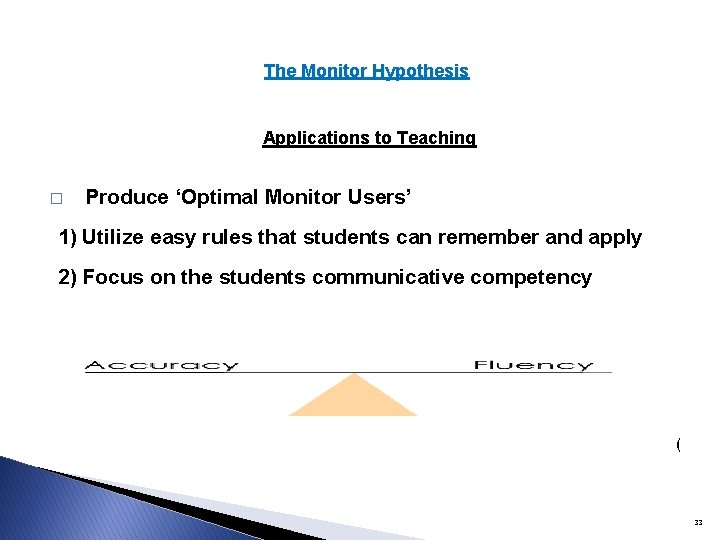
The Monitor Hypothesis Applications to Teaching � Produce ‘Optimal Monitor Users’ 1) Utilize easy rules that students can remember and apply 2) Focus on the students communicative competency ( 33
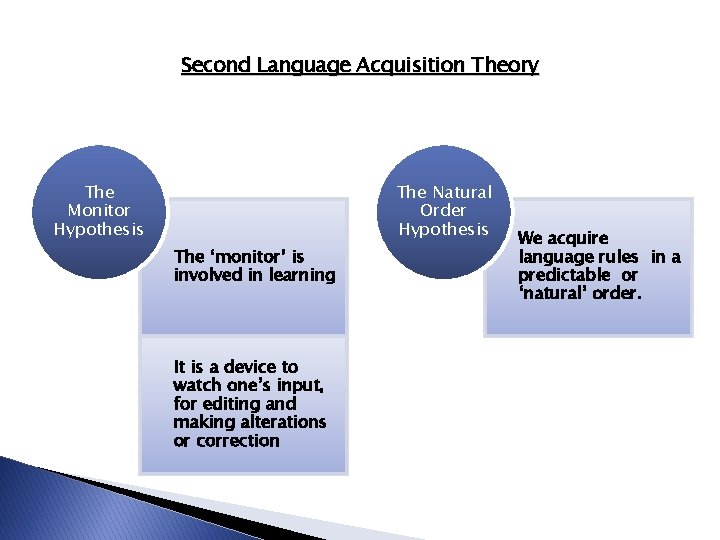
Second Language Acquisition Theory The Monitor Hypothesis The Natural Order Hypothesis The ‘monitor’ is involved in learning It is a device to watch one’s input, for editing and making alterations or correction We acquire language rules in a predictable or ‘natural’ order.
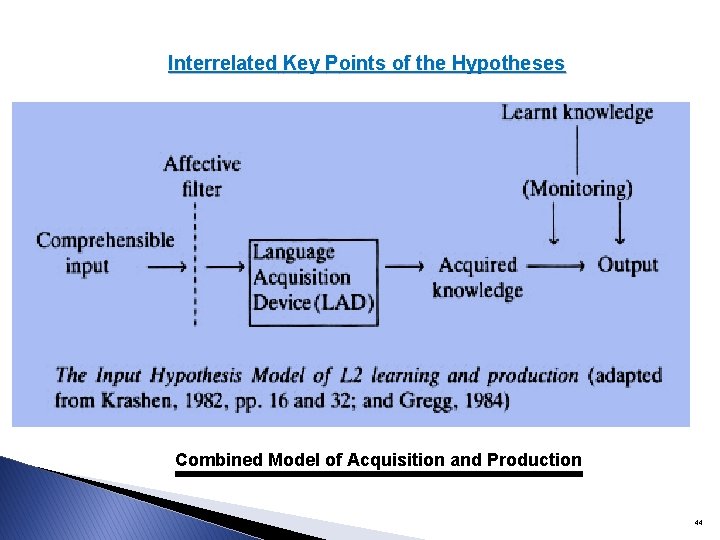
Second Language Acquisition Theory Input Hypothesis � We acquire language in one way only: when we are exposed to input (written or spoken language) that is comprehensible to us. � Comprehensible input is the necessary but also sufficient condition for language acquisition to take place. It requires no effort on the part of the learner.
Second Language Acquisition Theory Input Hypothesis • Krashen now refers to this as the Comprehension Hypothesis. • It states that learners acquire language when they are exposed to input at i+1, where i is the current state or stage of language proficiency. • Learners use their existing acquired linguistic competence together with their general world knowledge to make sense of the messages they receive in language just beyond where they currently are (the +1).
Second Language Acquisition Theory “Human acquires language in only way – by understanding messages, or by receiving comprehensible input” and Learners improve and progress along the ‘the natural order’ when they receive L 2 comprehensible input”. (Krashen, 1985) 37
Second Language Acquisition Teaching Applications � Vygotsky influenced Krashen’s second language acquisition theory – application of their theories to second language teaching produces similarities. Krashen's Input Hypothesis VS. Vygotsky's concept of zone of proximal development (ZPD) : Social Constructivism L 1: Baby talk (Accommodation Theory) links to Nature & Nurture between Function & Form 38
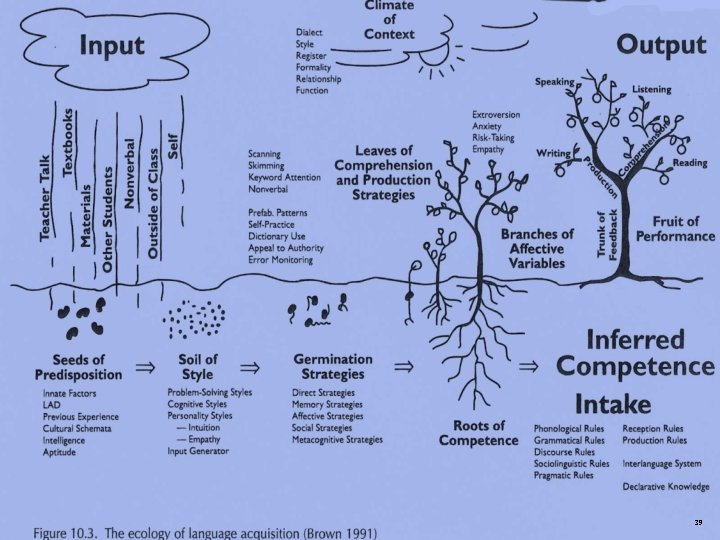
39
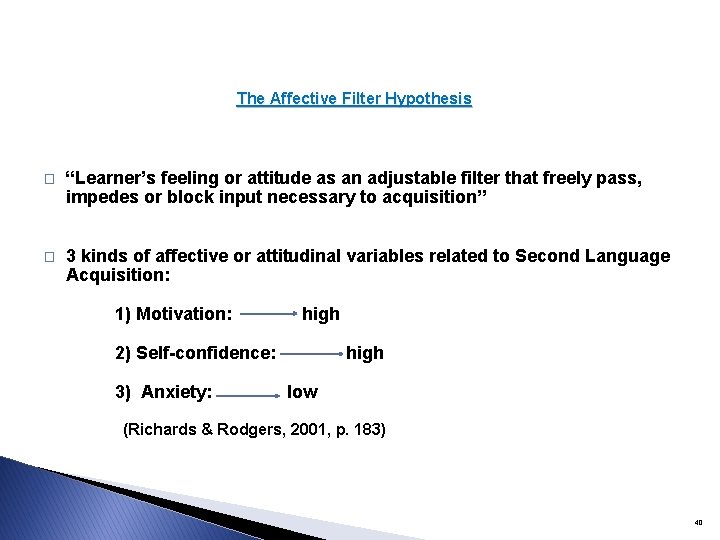
The Affective Filter Hypothesis � “Learner’s feeling or attitude as an adjustable filter that freely pass, impedes or block input necessary to acquisition” � 3 kinds of affective or attitudinal variables related to Second Language Acquisition: 1) Motivation: high 2) Self-confidence: 3) Anxiety: high low (Richards & Rodgers, 2001, p. 183) 40
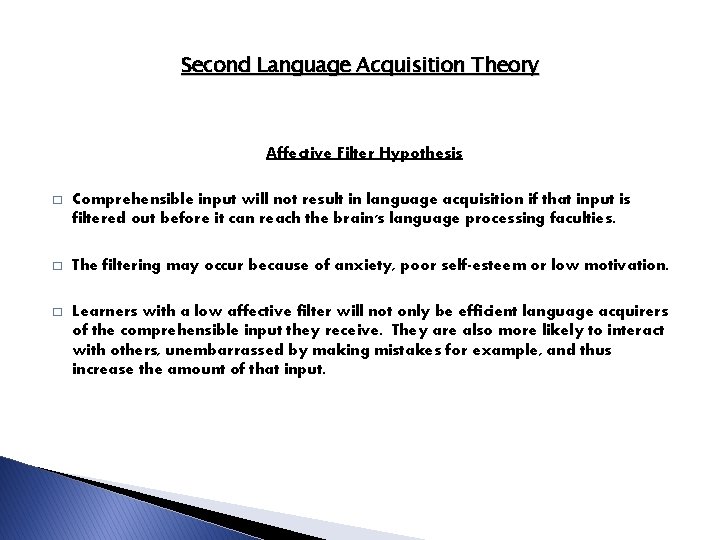
Second Language Acquisition Theory Affective Filter Hypothesis � Comprehensible input will not result in language acquisition if that input is filtered out before it can reach the brain's language processing faculties. � The filtering may occur because of anxiety, poor self-esteem or low motivation. � Learners with a low affective filter will not only be efficient language acquirers of the comprehensible input they receive. They are also more likely to interact with others, unembarrassed by making mistakes for example, and thus increase the amount of that input.
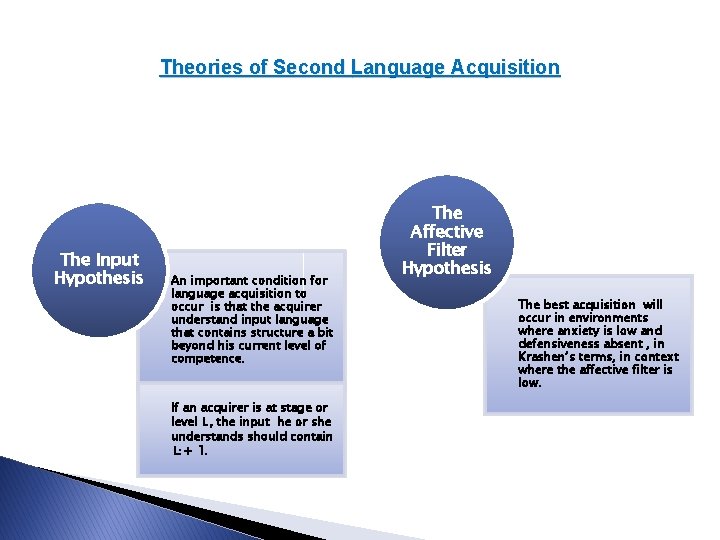
Theories of Second Language Acquisition The Input Hypothesis An important condition for language acquisition to occur is that the acquirer understand input language that contains structure a bit beyond his current level of competence. If an acquirer is at stage or level L , the input he or she understands should contain L: + 1. The Affective Filter Hypothesis The best acquisition will occur in environments where anxiety is low and defensiveness absent , in Krashen’s terms, in context where the affective filter is low.
The Affective Filter Hypothesis � Learners with a low affective filter: high motivation, selfconfidence, a good image, and a low level of anxiety are better equipped for success in Second Language Acquisition � Learners with a high affective filter: low self-esteem and a high level of anxiety form a mental block to language acquisition. � When the filter is high, it blocks language acquisition. 43
Interrelated Key Points of the Hypotheses Combined Model of Acquisition and Production 44
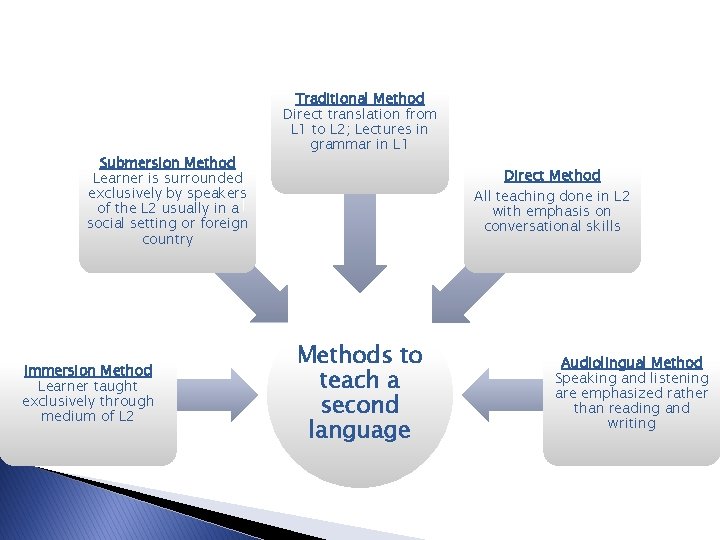
Submersion Method Learner is surrounded exclusively by speakers of the L 2 usually in a social setting or foreign country Immersion Method Learner taught exclusively through medium of L 2 Traditional Method Direct translation from L 1 to L 2; Lectures in grammar in L 1 Direct Method All teaching done in L 2 with emphasis on conversational skills Methods to teach a second language Audiolingual Method Speaking and listening are emphasized rather than reading and writing
What is the Importance of Phonetics and Phonology? Section Three
What is Phonetics? � Phonetics: The branch of linguistics concerned with the study of speech sounds with reference to their distribution and patterning. Adjective: phonological.
What is Phonetics? � Pho·net·ics 1. 2. n. (used with a sing. verb) The branch of linguistics that deals with the sounds of speech and their production, combination, description, and representation by written symbols. The system of sounds of a particular language.
What is a Phoneme? � Phoneme: The smallest sound unit in a language that is capable of conveying a distinct meaning, such as the s of sing and the r of ring. Adjective: phonemic.
What is Phonetics? � Phonetics is the study of speech sounds. ◦ Articulatory phonetics – how speech sounds are produced ◦ Acoustic phonetics – the transmission and physical properties of speech sounds ◦ Auditory phonetics – perception of speech sounds � Phonetic transcriptions – one sound = one symbol.
What is Phonology? The study of the properties of sound systems, the principles that govern the ways in which speakers of different languages organize speech sounds to express meanings. � Phonology: Source: Phonology - Critical Concepts in Linguistics by Charles W. Kreidler
What is Phonology? � � Phonology is how speech sounds are organized and affect one another in pronunciation. Key terms: 1) Phone – sound that is actually heard [ ] 2) Phoneme – more theoretical (idea) of a sound / / 3) Allophone – nondistinctive realization of the same phoneme � This organization is explained in phonological rules
The Difference between Phonetics and Phonology � � Phonology concerns itself with systems of phonemes, abstract cognitive units of speech sound or sign which distinguish the words of a language. Phonetics concerns itself with the production, transmission, and perception of the physical phenomena which are abstracted in the mind to constitute these speech sounds or signs.
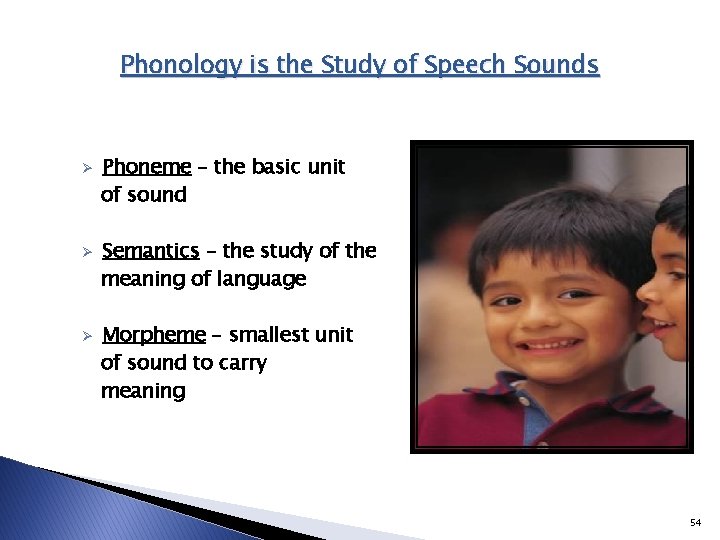
Phonology is the Study of Speech Sounds Ø Ø Ø Phoneme – the basic unit of sound Semantics – the study of the meaning of language Morpheme – smallest unit of sound to carry meaning 54
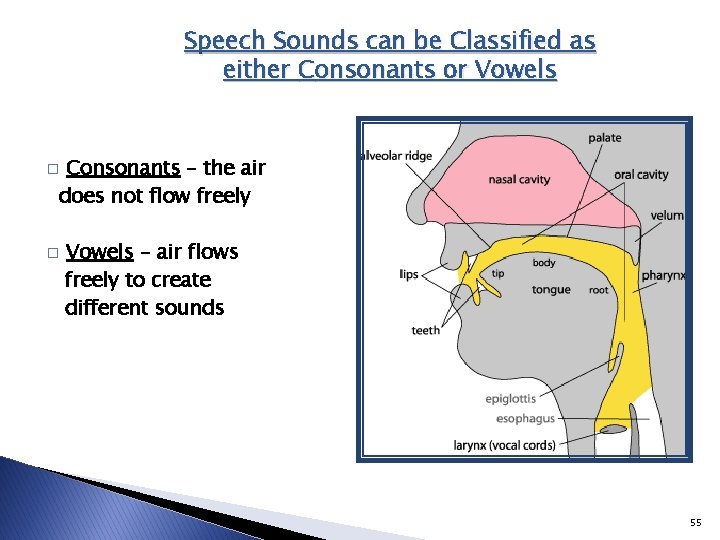
Speech Sounds can be Classified as either Consonants or Vowels Consonants – the air does not flow freely � � Vowels – air flows freely to create different sounds 55
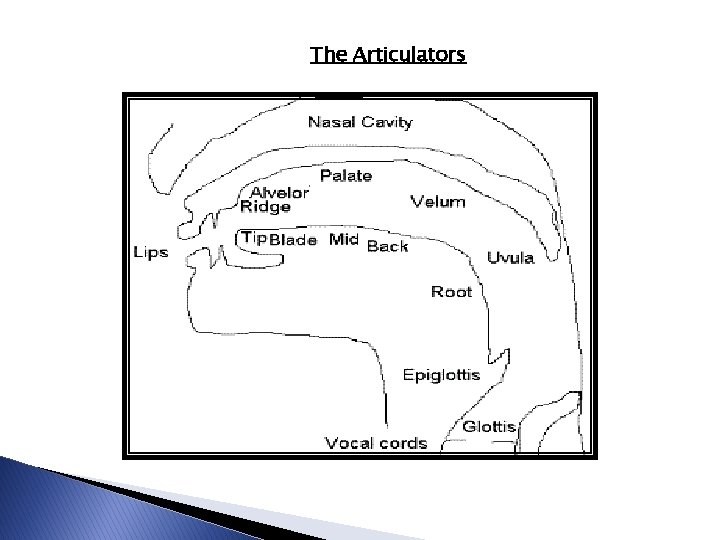
The Articulators
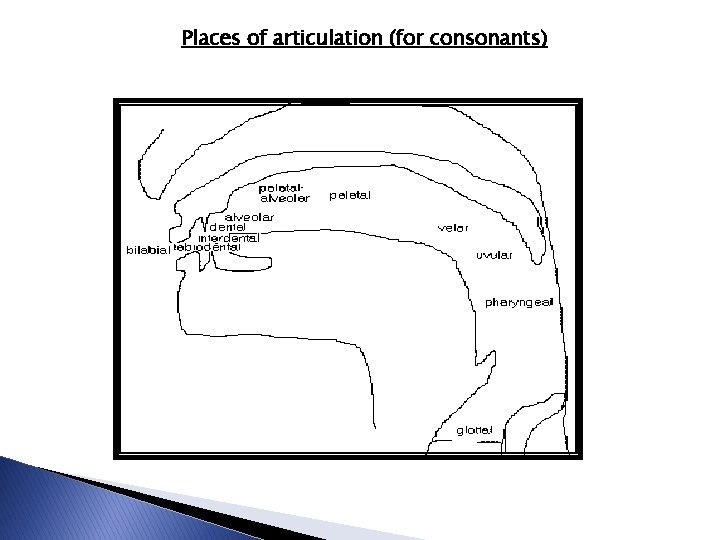
Places of articulation (for consonants)
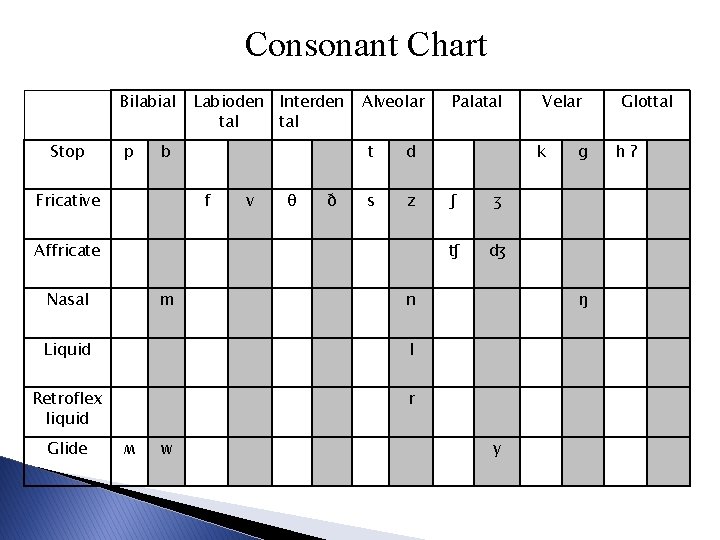
Consonant Chart Bilabial Stop p Labioden Interden tal b Fricative f v θ ð Alveolar t d s z Affricate Nasal m l Retroflex liquid r ʍ w Velar k ʃ ʒ ʧ ʤ n Liquid Glide Palatal g ŋ y Glottal hʔ
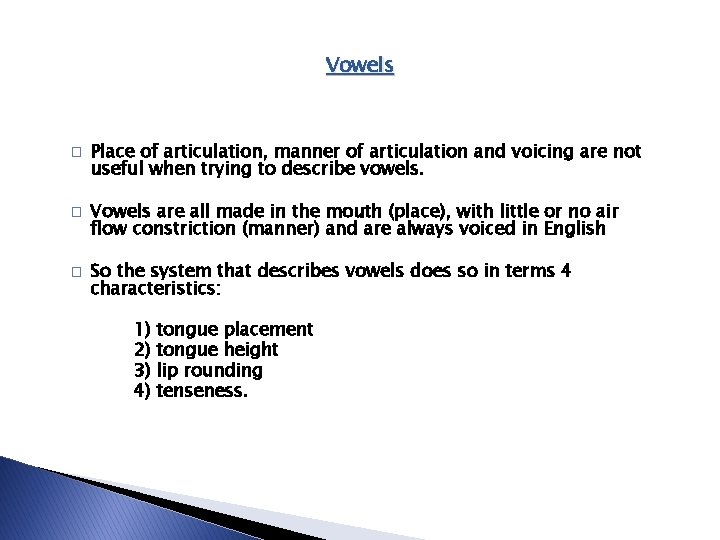
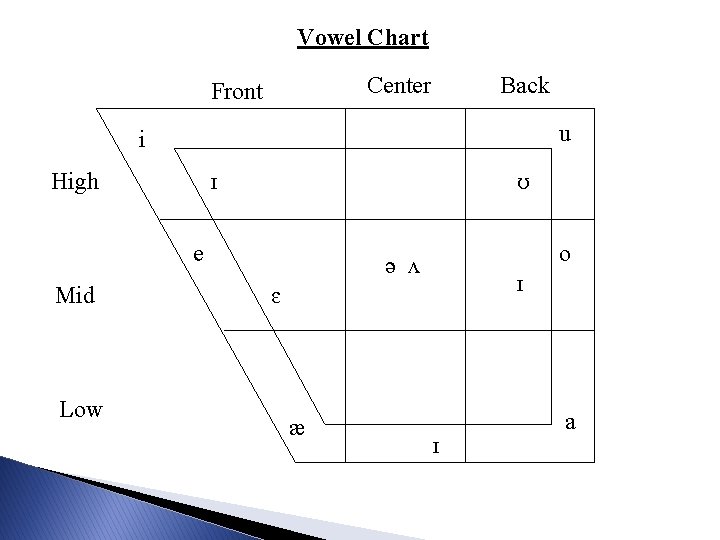
Vowels � � � Place of articulation, manner of articulation and voicing are not useful when trying to describe vowels. Vowels are all made in the mouth (place), with little or no air flow constriction (manner) and are always voiced in English So the system that describes vowels does so in terms 4 characteristics: 1) 2) 3) 4) tongue placement tongue height lip rounding tenseness.
Vowel Chart Center Front Back u i High ɪ ʊ e Mid Low o ə ʌ ɪ ɛ æ ɪ a
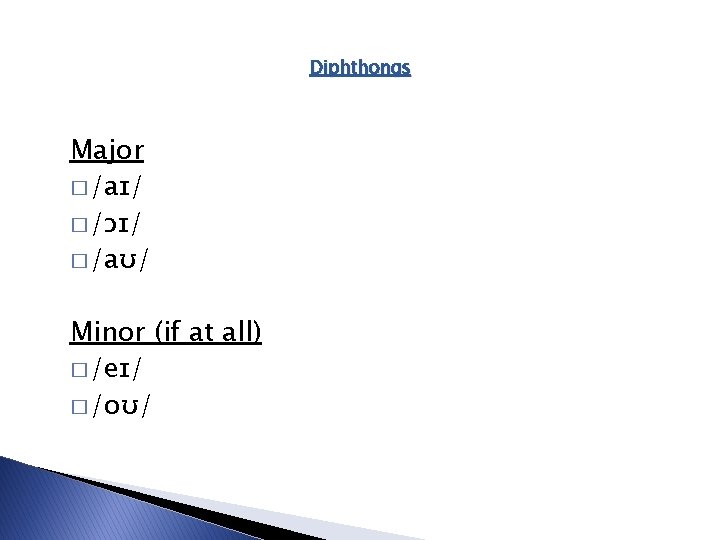
Diphthongs Major � /aɪ/ � /ɔɪ/ � /aʊ/ Minor (if at all) � /eɪ/ � /oʊ/
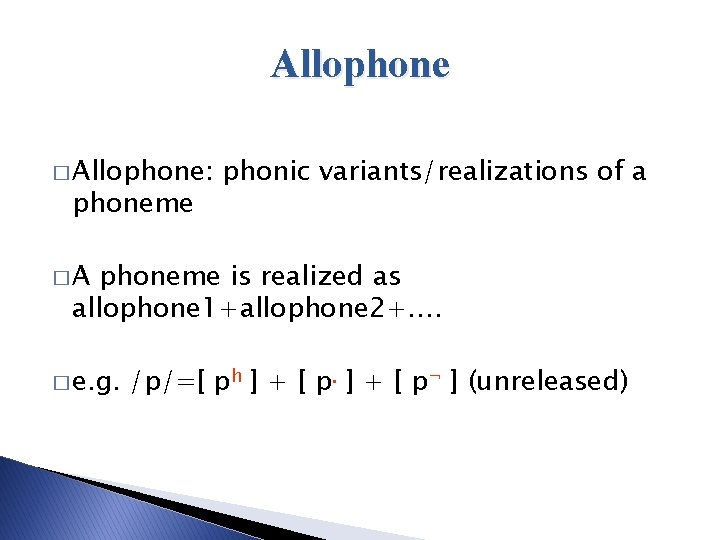
Allophone � Allophone: phoneme phonic variants/realizations of a �A phoneme is realized as allophone 1+allophone 2+…. � e. g. /p/=[ ph ] + [ p¬ ] (unreleased)
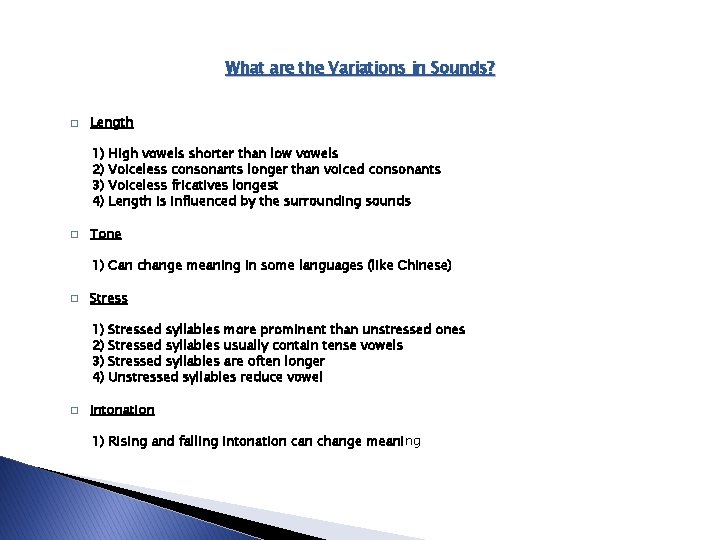
What are the Variations in Sounds? � Length 1) 2) 3) 4) � High vowels shorter than low vowels Voiceless consonants longer than voiced consonants Voiceless fricatives longest Length is influenced by the surrounding sounds Tone 1) Can change meaning in some languages (like Chinese) � Stress 1) 2) 3) 4) � Stressed syllables more prominent than unstressed ones Stressed syllables usually contain tense vowels Stressed syllables are often longer Unstressed syllables reduce vowel Intonation 1) Rising and falling intonation can change meaning
What is the Importance of Phonics? Section Four
What is the Importance of Phonics? Learning phonics will help you to learn to read and spell � � � Written language can be compared to a code, so knowing the sounds of letters and letter combinations will help you to translate words as you read. Knowing phonics will also help you know which letters to use as you write words. High-quality phonics teaching secures the vital skills of word recognition that, once mastered, enable you to read fluently and automatically. Once you are a fluent reader, you are able to concentrate.
What is the role of Phonics in a Balanced Reading Program? � � Phonics: The relationship between the letters (graphemes) of written language and the sounds (phonemes) of spoken language. Phonics Instruction: Phonics instruction is teaching children these letter-sound relationships.
What is Phonics? • Phonics: Is an understanding of the alphabetic principle (that letters either singly or in combination represent various sounds) and the ability to apply this knowledge in the decoding of unfamiliar words. (Mc. Ewan, 2009)
How can Phonics be used to Help Students to Read? � � Phonics: Children learn reading by associating the sounds of English and the letters or combination of letters that produce them. Whole-Language (Look and Say): Children learn reading by memorizing words as whole unit.
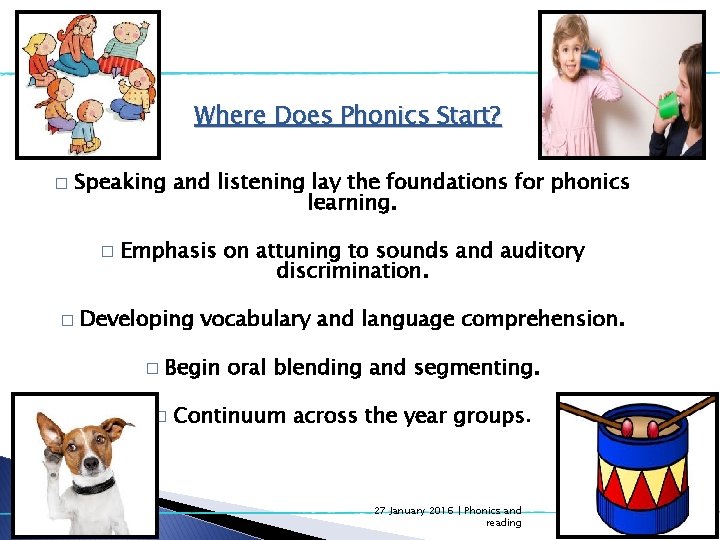
Where Does Phonics Start? � Speaking and listening lay the foundations for phonics learning. � � Emphasis on attuning to sounds and auditory discrimination. Developing vocabulary and language comprehension. � Begin oral blending and segmenting. � Continuum across the year groups. 27 January 2016 | Phonics and reading 69
What is Phonics? STAGES OF LEARNING PHONICS � � � First know the letters and sounds. Then, learn soft and hard sounds and short and long sounds, all the sounds of letters and letter combinations. Then, short and long vowels, consonant digraphs, vowels combination, decoding, making words. Then, practice reading and spelling words containing those letters and patterns.
What are the Principles of Effective Phonics Instruction? 1. Emphasis on phonological awareness activities. 2. Instruction in decoding (grapheme to phoneme) 3. Instruction in encoding (phoneme to grapheme) 4. Application of strategies to decodable text.
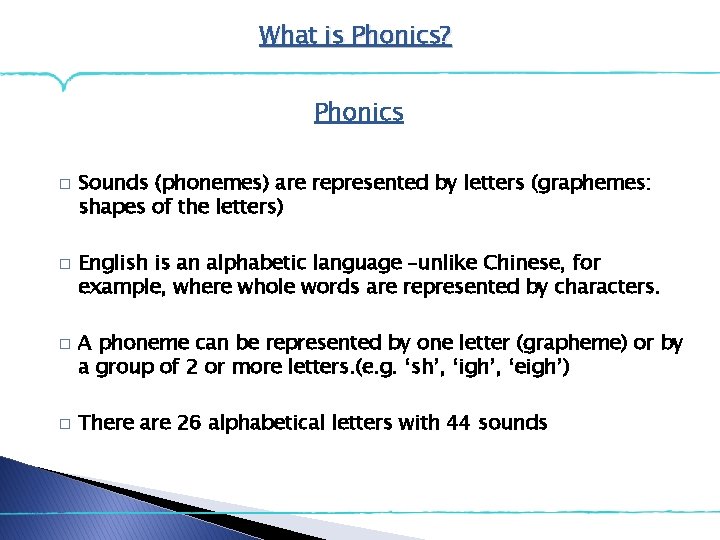
What is Phonics? Phonics � � Sounds (phonemes) are represented by letters (graphemes: shapes of the letters) English is an alphabetic language –unlike Chinese, for example, where whole words are represented by characters. A phoneme can be represented by one letter (grapheme) or by a group of 2 or more letters. (e. g. ‘sh’, ‘igh’, ‘eigh’) There are 26 alphabetical letters with 44 sounds
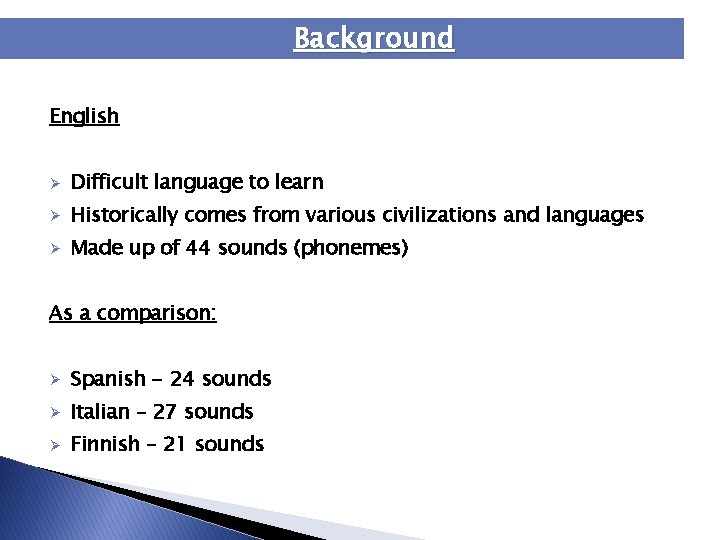
Background English Ø Difficult language to learn Ø Historically comes from various civilizations and languages Ø Made up of 44 sounds (phonemes) As a comparison: Ø Spanish - 24 sounds Ø Italian – 27 sounds Ø Finnish – 21 sounds
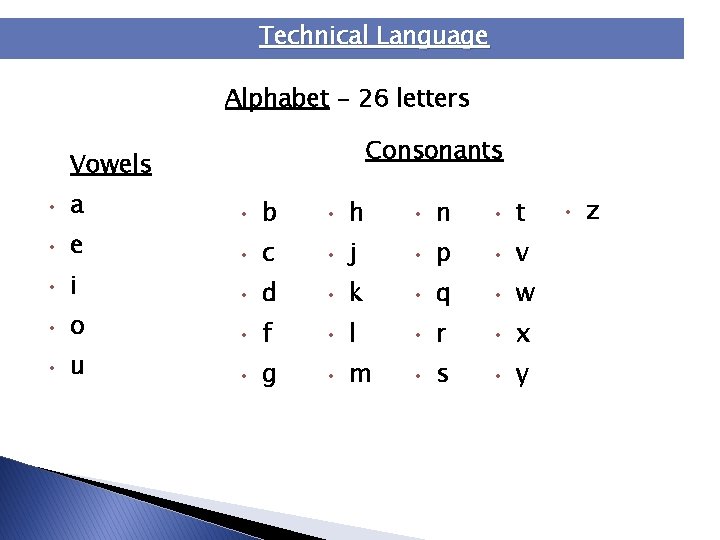
Technical Language Alphabet - 26 letters Consonants Vowels • a • • h • n • t • e b • • j • p • v • i c • • k • q • w • o d • • l • r • x • u f • g • m • s • y • z
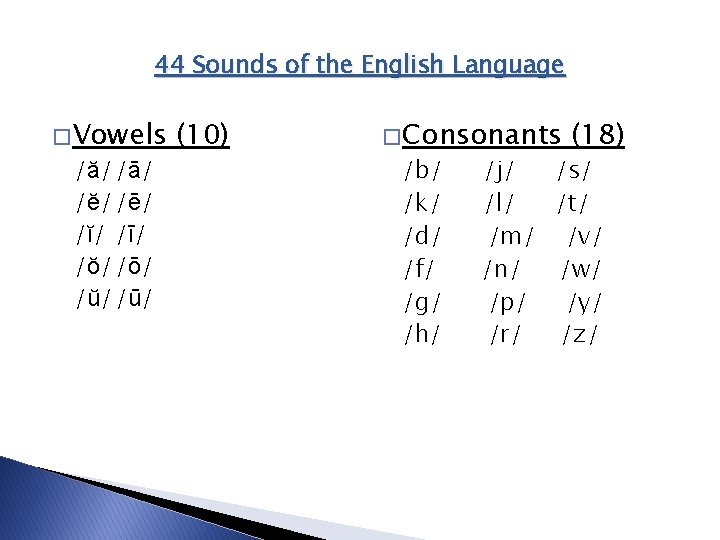
44 Sounds of the English Language � Vowels /ă/ /ā/ /ĕ/ /ē/ /ĭ/ /ī/ /ŏ/ /ō/ /ŭ/ /ū/ (10) � Consonants /b/ /k/ /d/ /f/ /g/ /h/ (18) /j/ /s/ /l/ /t/ /m/ /v/ /n/ /w/ /p/ /y/ /r/ /z/
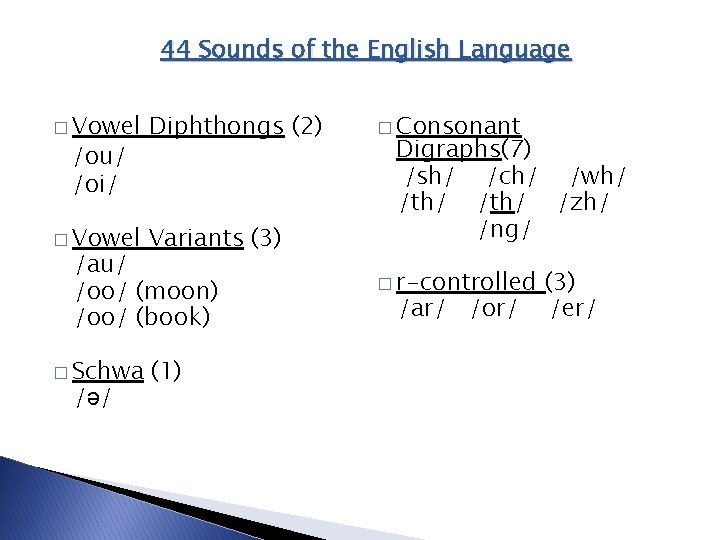
44 Sounds of the English Language � Vowel Diphthongs (2) � Vowel Variants (3) /ou/ /oi/ /au/ /oo/ (moon) /oo/ (book) � Schwa /ə/ (1) � Consonant Digraphs(7) /sh/ /ch/ /wh/ /th/ /zh/ /ng/ � r-controlled /ar/ /or/ (3) /er/
Technical Language Alphabet However we are not interested in the letter names … only their phonemes!
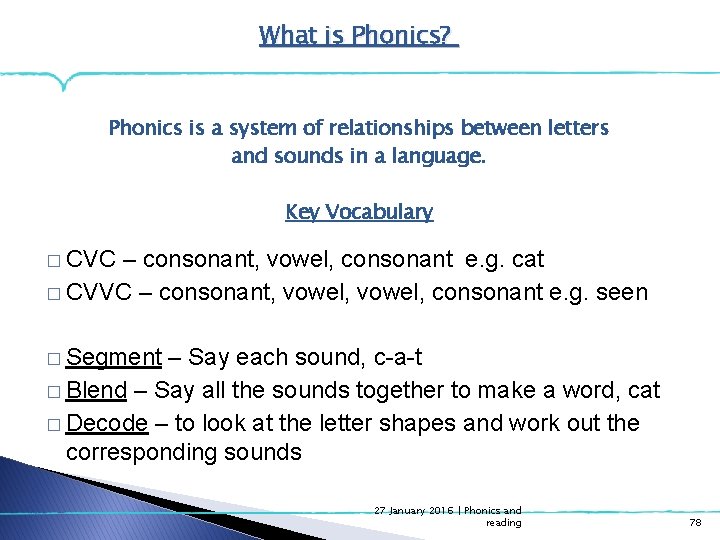
What is Phonics? Phonics is a system of relationships between letters and sounds in a language. Key Vocabulary � CVC – consonant, vowel, consonant e. g. cat � CVVC – consonant, vowel, consonant e. g. seen � Segment – Say each sound, c-a-t � Blend – Say all the sounds together to make a word, cat � Decode – to look at the letter shapes and work out the corresponding sounds 27 January 2016 | Phonics and reading 78
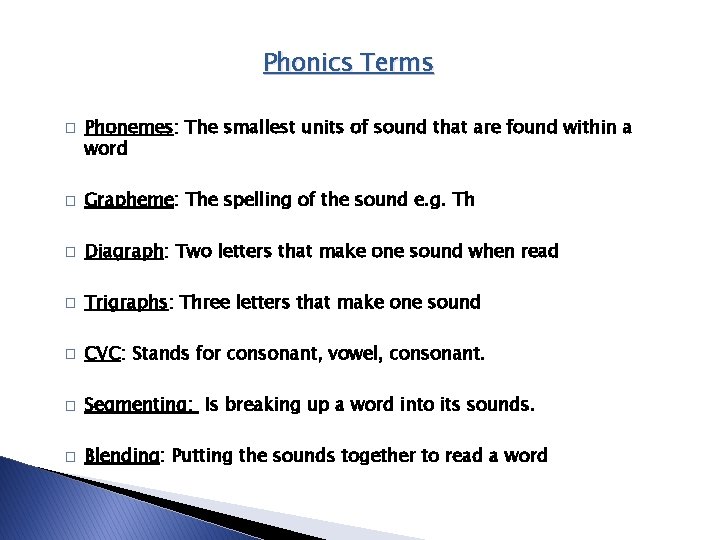
Phonics Terms � Phonemes: The smallest units of sound that are found within a word � Grapheme: The spelling of the sound e. g. Th � Diagraph: Two letters that make one sound when read � Trigraphs: Three letters that make one sound � CVC: Stands for consonant, vowel, consonant. � Segmenting: Is breaking up a word into its sounds. � Blending: Putting the sounds together to read a word
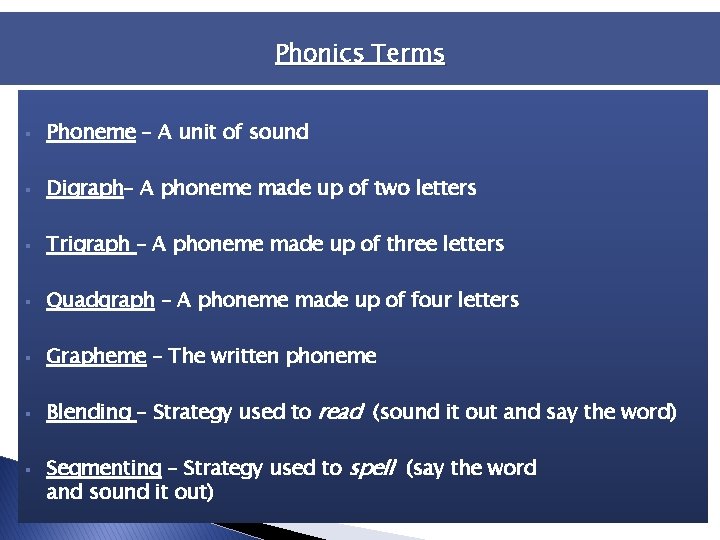
Phonics Terms § Phoneme – A unit of sound § Digraph– A phoneme made up of two letters § Trigraph – A phoneme made up of three letters § Quadgraph – A phoneme made up of four letters § Grapheme – The written phoneme § Blending – Strategy used to read (sound it out and say the word) § Segmenting – Strategy used to spell (say the word and sound it out)
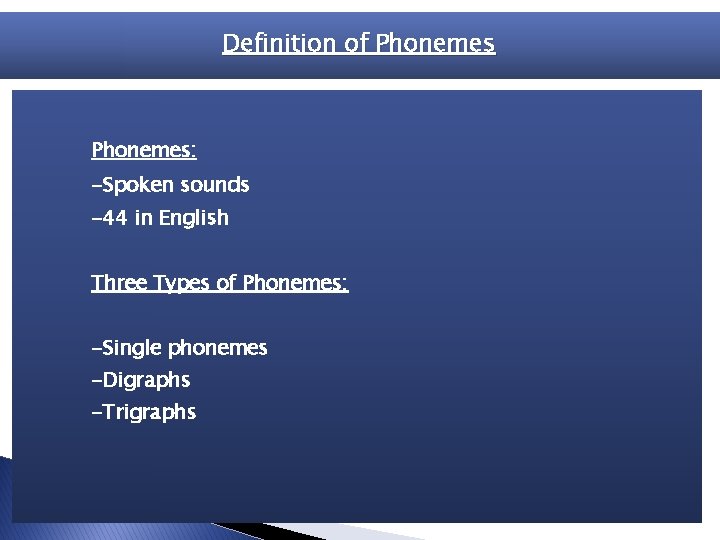
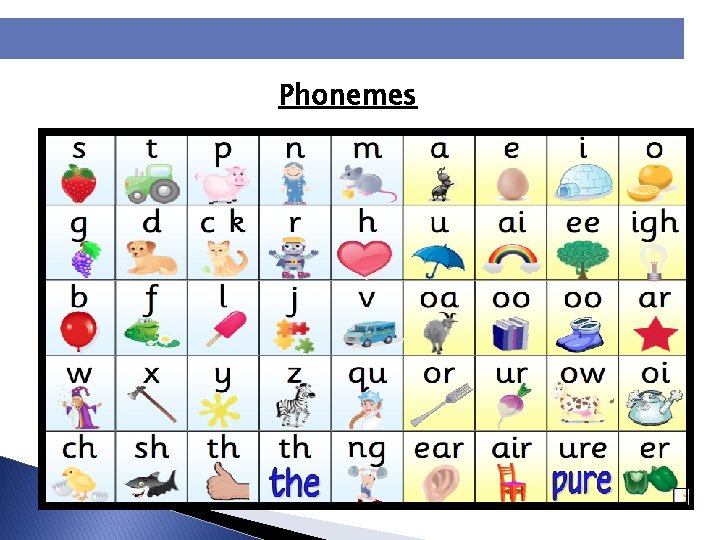
Definition of Phonemes: -Spoken sounds -44 in English Three Types of Phonemes: -Single phonemes -Digraphs -Trigraphs
Phonemes
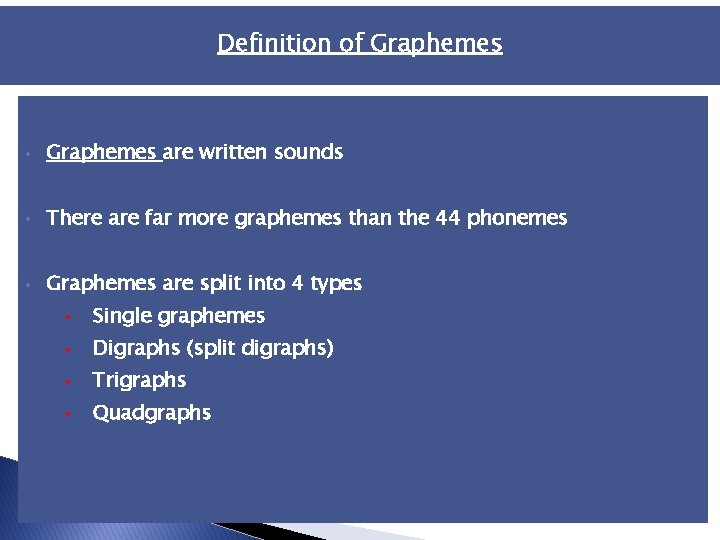
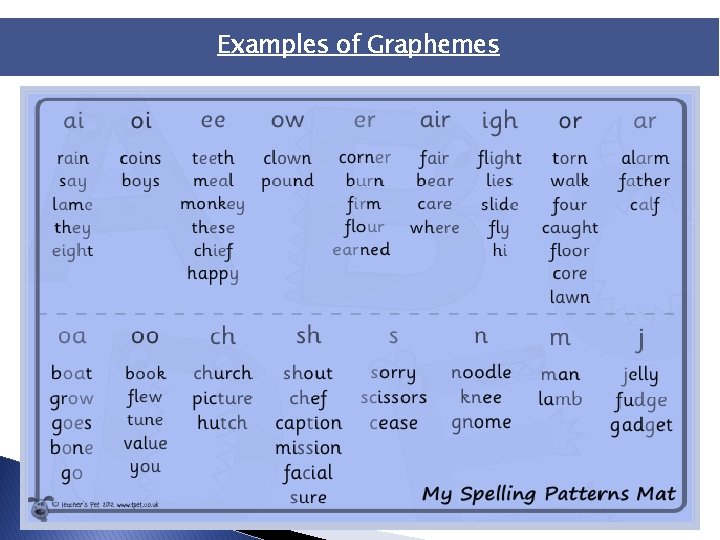
Definition of Graphemes • Graphemes are written sounds • There are far more graphemes than the 44 phonemes • Graphemes are split into 4 types • Single graphemes • Digraphs (split digraphs) • Trigraphs • Quadgraphs
Examples of Graphemes
Written Language � Reading and writing � Print awareness � Reading: decoding + comprehension � Sound – symbol connection [phonics] � Writing: spelling, handwriting, written expression [writing process]
Orthography: Written Language Orthography: Symbols � Alphabet (26 letters) � Represents Speech Sounds � Written / Visual � Spelling Patterns
Orthography: Written Language � Concepts of Print: Print Awareness • Book concepts • One-to-one correspondence • Directionality � Alphabet Knowledge: Print Awareness • Recognition • Identification • Formation of Words
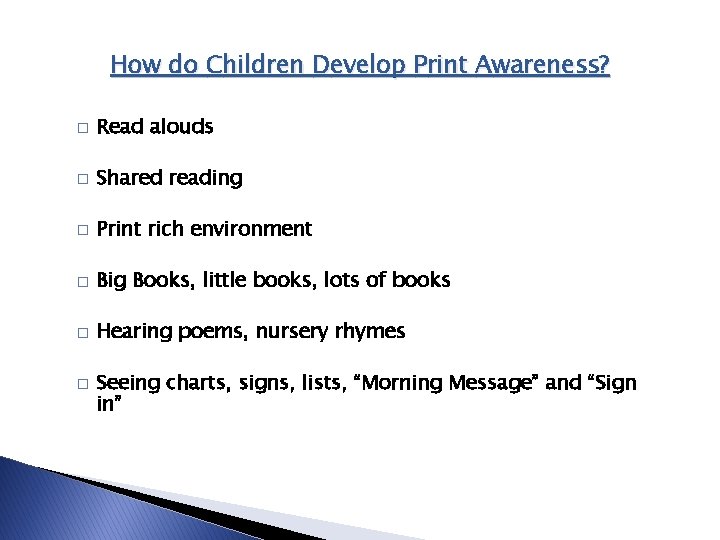
How do Children Develop Print Awareness? � Read alouds � Shared reading � Print rich environment � Big Books, little books, lots of books � Hearing poems, nursery rhymes � Seeing charts, signs, lists, “Morning Message” and “Sign in”
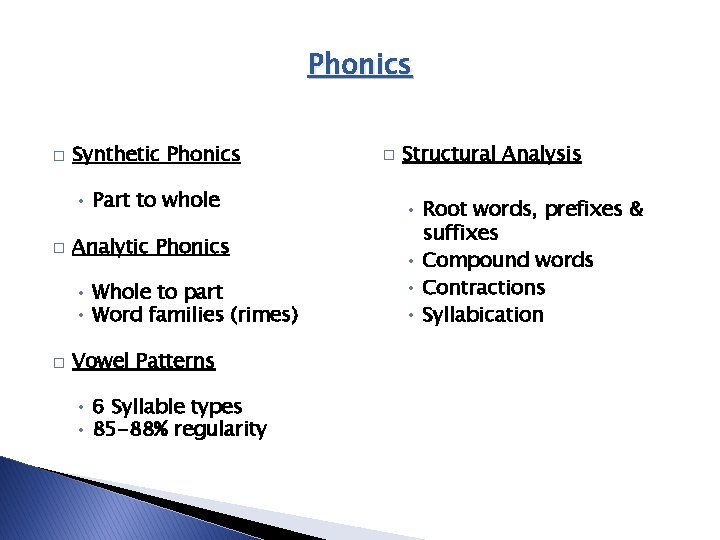
Phonics � Synthetic Phonics • Part to whole � Analytic Phonics • Whole to part • Word families (rimes) � Vowel Patterns • 6 Syllable types • 85 -88% regularity � Structural Analysis • Root words, prefixes & suffixes • Compound words • Contractions • Syllabication
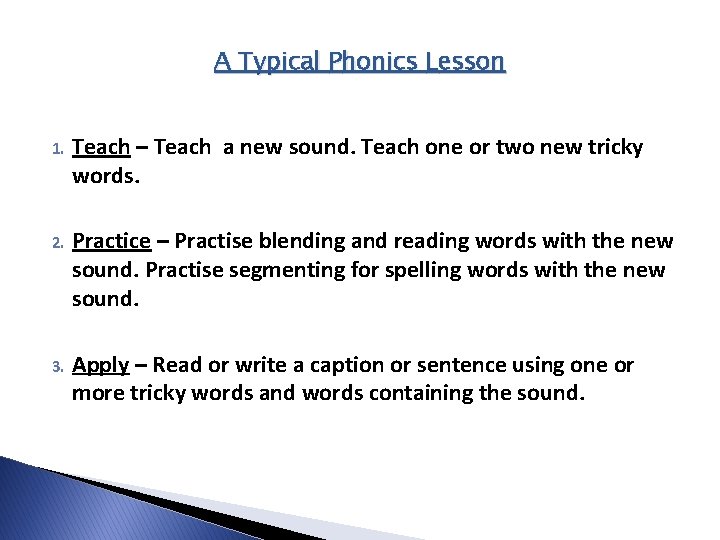
A Typical Phonics Lesson 1. Teach – Teach a new sound. Teach one or two new tricky words. 2. Practice – Practise blending and reading words with the new sound. Practise segmenting for spelling words with the new sound. 3. Apply – Read or write a caption or sentence using one or more tricky words and words containing the sound.
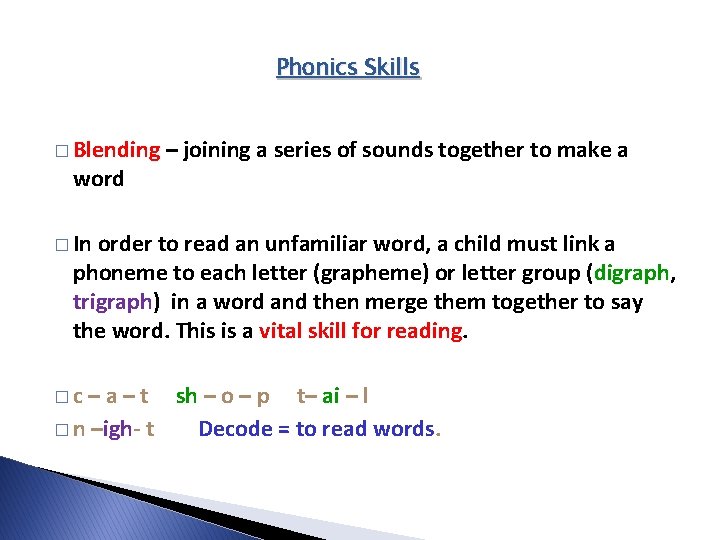
Phonics Skills � Blending word – joining a series of sounds together to make a � In order to read an unfamiliar word, a child must link a phoneme to each letter (grapheme) or letter group (digraph, trigraph) in a word and then merge them together to say the word. This is a vital skill for reading. �c – a – t sh – o – p t– ai – l � n –igh- t Decode = to read words.
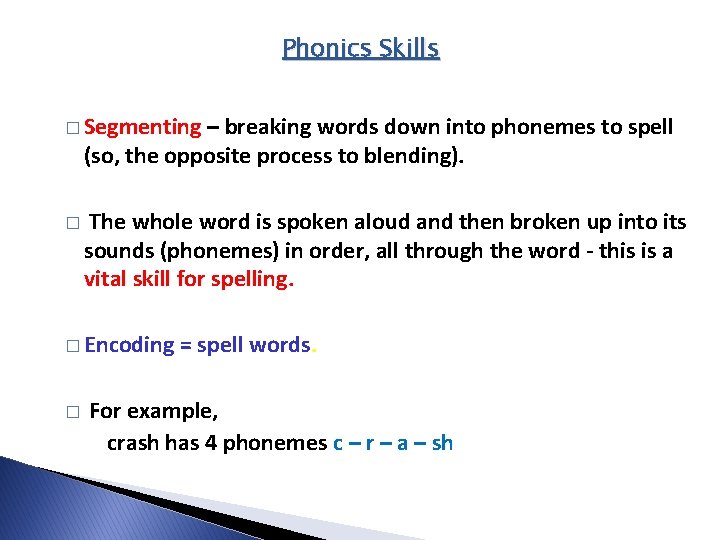
Phonics Skills � Segmenting – breaking words down into phonemes to spell (so, the opposite process to blending). � The whole word is spoken aloud and then broken up into its sounds (phonemes) in order, all through the word - this is a vital skill for spelling. � Encoding � = spell words. For example, crash has 4 phonemes c – r – a – sh
Phonics Instruction � Daily speaking and listening activities � A broad and rich language experience/environment � Story, rhyme, drama and songs are an essential part of the phase � Hearing sounds in the environment � Alliteration � Start segmenting words
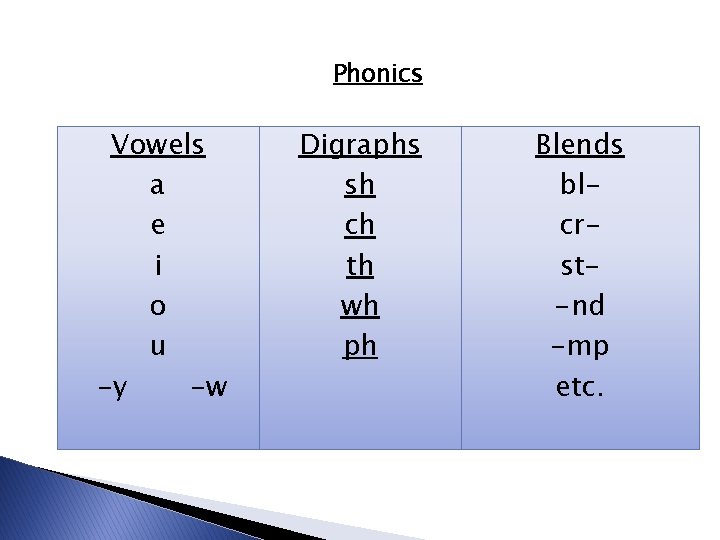
Phonics Vowels a e i o u -y -w Digraphs sh ch th wh ph Blends blcrst-nd -mp etc.
Orthography: Syllables � Six basic syllable types � 85 – 88% of English language � Vowel Patterns (syllable types) � Structure of our language � Alphabetic code
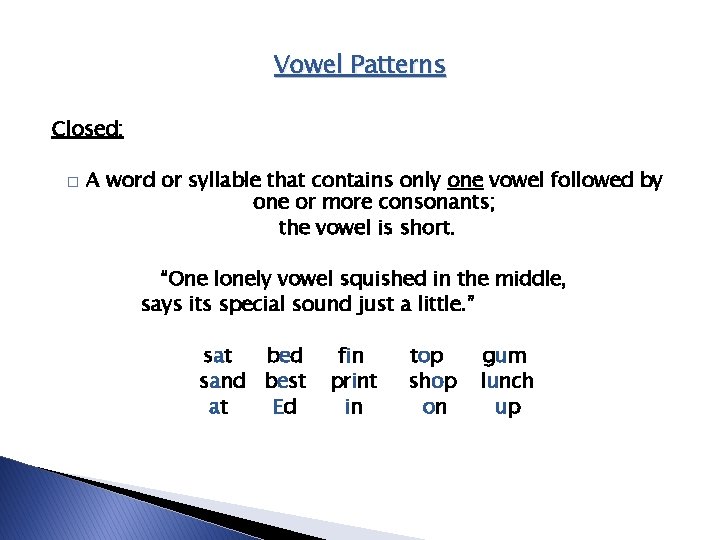
Vowel Patterns Closed: � A word or syllable that contains only one vowel followed by one or more consonants; the vowel is short. “One lonely vowel squished in the middle, says its special sound just a little. ” sat bed sand best at Ed fin print in top shop on gum lunch up
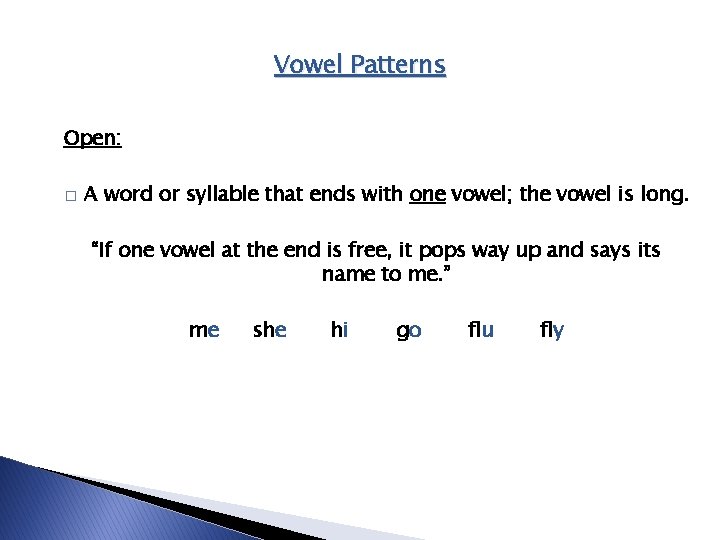
Vowel Patterns Open: � A word or syllable that ends with one vowel; the vowel is long. “If one vowel at the end is free, it pops way up and says its name to me. ” me she hi go flu fly
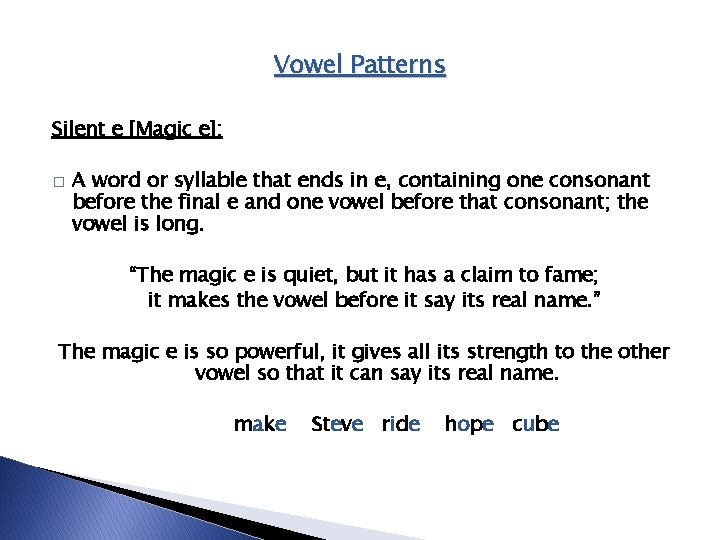
Vowel Patterns Silent e [Magic e]: � A word or syllable that ends in e, containing one consonant before the final e and one vowel before that consonant; the vowel is long. “The magic e is quiet, but it has a claim to fame; it makes the vowel before it say its real name. ” The magic e is so powerful, it gives all its strength to the other vowel so that it can say its real name. make Steve ride hope cube
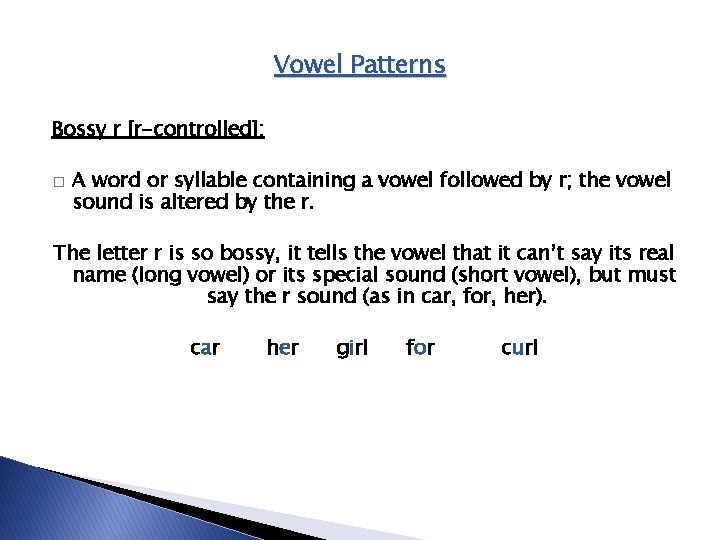
Vowel Patterns Bossy r [r-controlled]: � A word or syllable containing a vowel followed by r; the vowel sound is altered by the r. The letter r is so bossy, it tells the vowel that it can’t say its real name (long vowel) or its special sound (short vowel), but must say the r sound (as in car, for, her). car her girl for curl
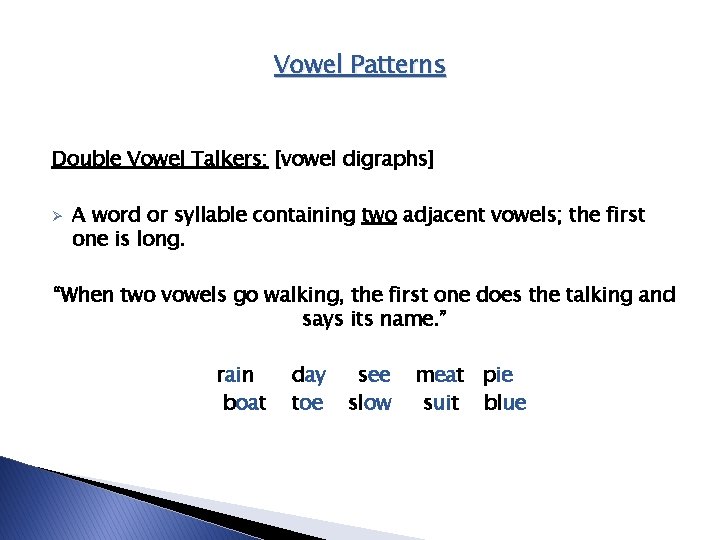
Vowel Patterns Double Vowel Talkers: [vowel digraphs] Ø A word or syllable containing two adjacent vowels; the first one is long. “When two vowels go walking, the first one does the talking and says its name. ” rain boat day toe see slow meat pie suit blue
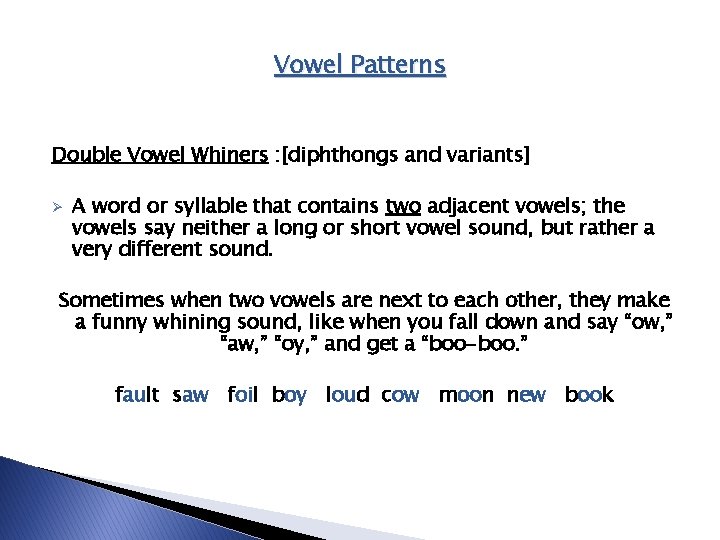
Vowel Patterns Double Vowel Whiners : [diphthongs and variants] Ø A word or syllable that contains two adjacent vowels; the vowels say neither a long or short vowel sound, but rather a very different sound. Sometimes when two vowels are next to each other, they make a funny whining sound, like when you fall down and say “ow, ” “aw, ” “oy, ” and get a “boo-boo. ” fault saw foil boy loud cow moon new book
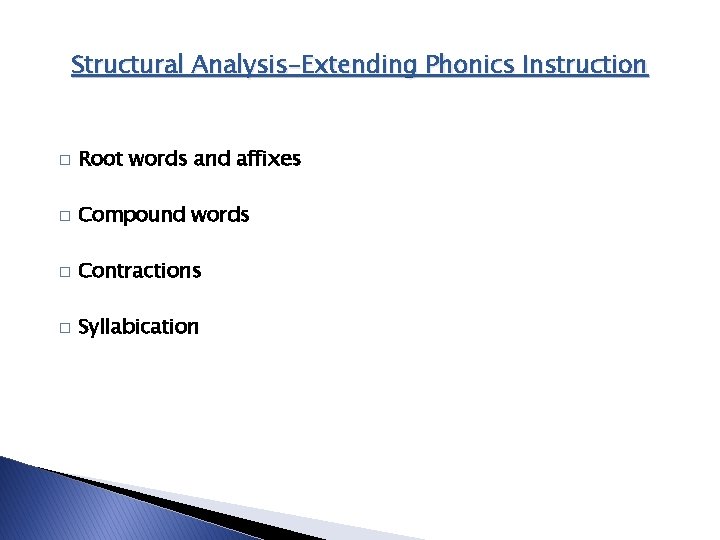
Structural Analysis-Extending Phonics Instruction � Root words and affixes � Compound words � Contractions � Syllabication
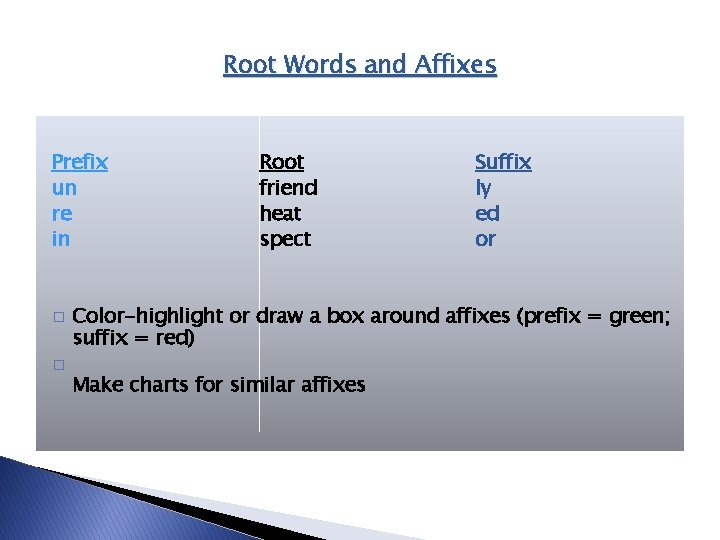
Root Words and Affixes Prefix un re in � � Root friend heat spect Suffix ly ed or Color-highlight or draw a box around affixes (prefix = green; suffix = red) Make charts for similar affixes
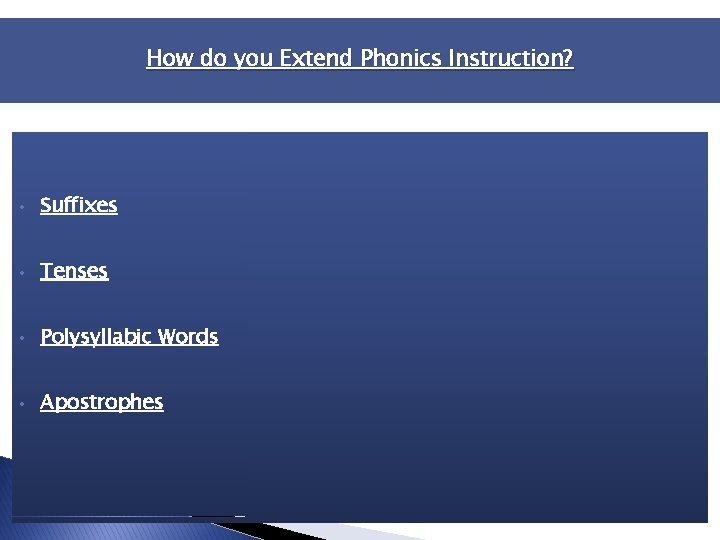
How do you Extend Phonics Instruction? • Suffixes • Tenses • Polysyllabic Words • Apostrophes
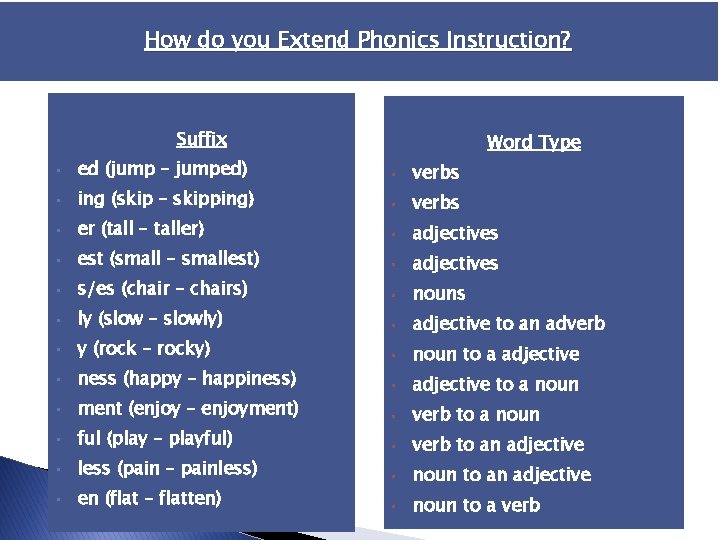
How do you Extend Phonics Instruction? Suffix Word Type • ed (jump – jumped) • • ing (skip – skipping) verbs • • er (tall – taller) verbs • • est (small – smallest) adjectives • • s/es (chair – chairs) adjectives • • ly (slow – slowly) nouns • • y (rock – rocky) adjective to an adverb • • ness (happy – happiness) noun to a adjective • • ment (enjoy – enjoyment) adjective to a noun • • ful (play – playful) verb to a noun • • less (pain – painless) verb to an adjective • • en (flat – flatten) noun to an adjective • noun to a verb
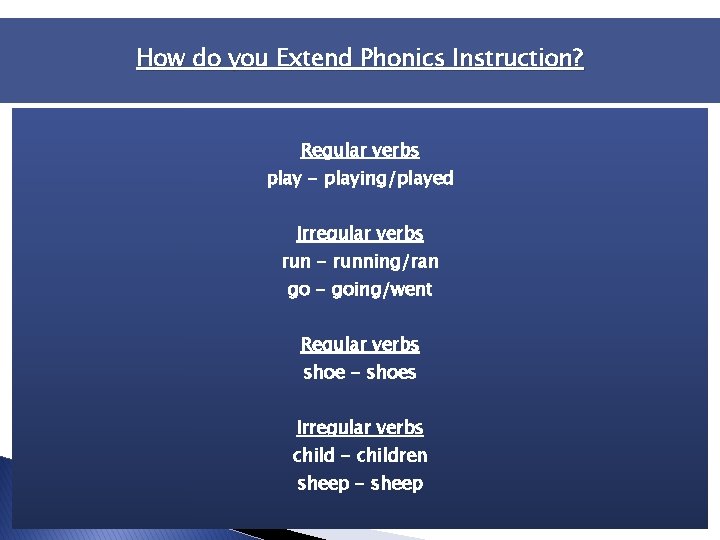
enses Howand do you. Plurals Extend Phonics Instruction? Regular verbs play - playing/played Irregular verbs run - running/ran go - going/went Regular verbs shoe - shoes Irregular verbs child - children sheep - sheep
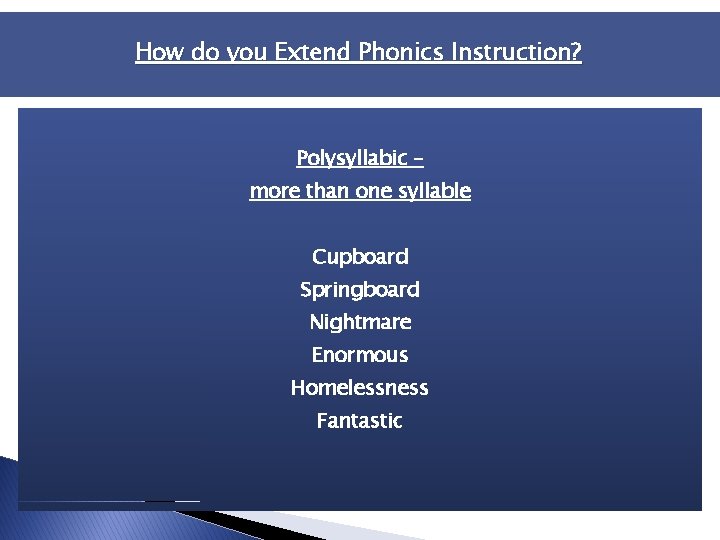
How do you Extend Phonics Instruction? Polysyllabic – more than one syllable Cupboard Springboard Nightmare Enormous Homelessness Fantastic
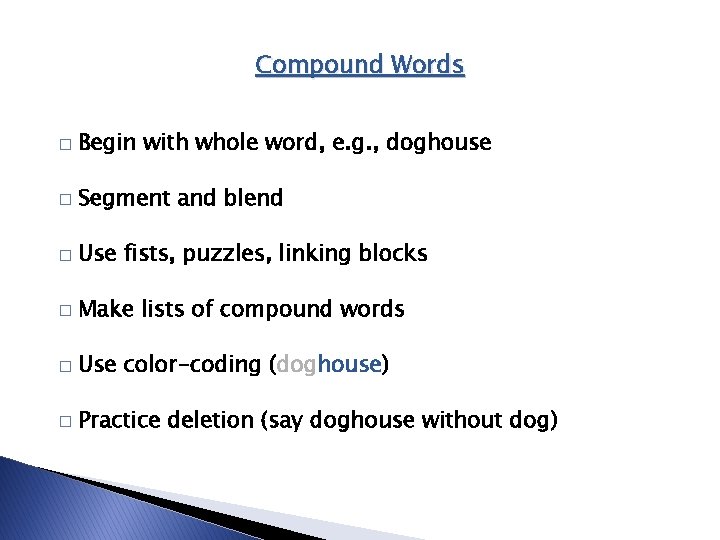
Compound Words � Begin with whole word, e. g. , doghouse � Segment and blend � Use fists, puzzles, linking blocks � Make lists of compound words � Use color-coding (doghouse) � Practice deletion (say doghouse without dog)
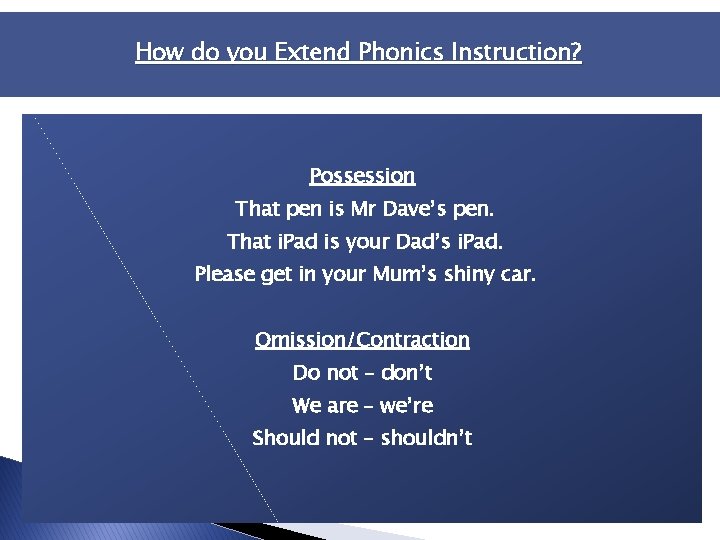
How do you Extend Phonics Instruction? Possession That pen is Mr Dave’s pen. That i. Pad is your Dad’s i. Pad. Please get in your Mum’s shiny car. Omission/Contraction Do not – don’t We are – we’re Should not – shouldn’t
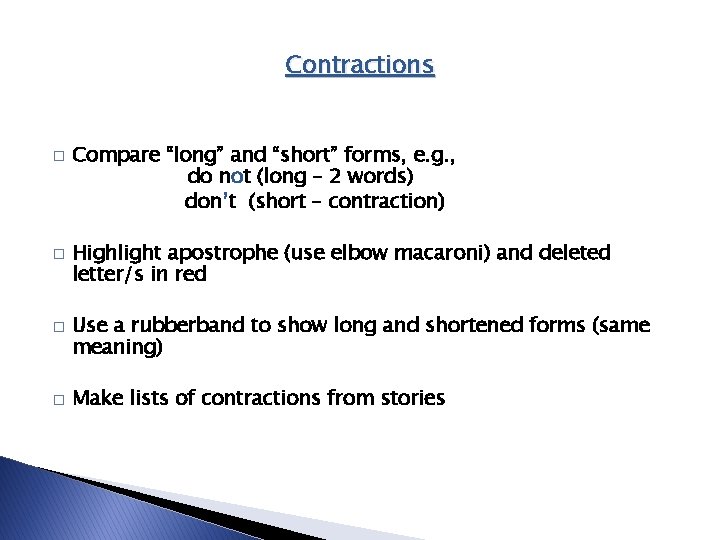
Contractions � � Compare “long” and “short” forms, e. g. , do not (long – 2 words) don’t (short – contraction) Highlight apostrophe (use elbow macaroni) and deleted letter/s in red Use a rubberband to show long and shortened forms (same meaning) Make lists of contractions from stories
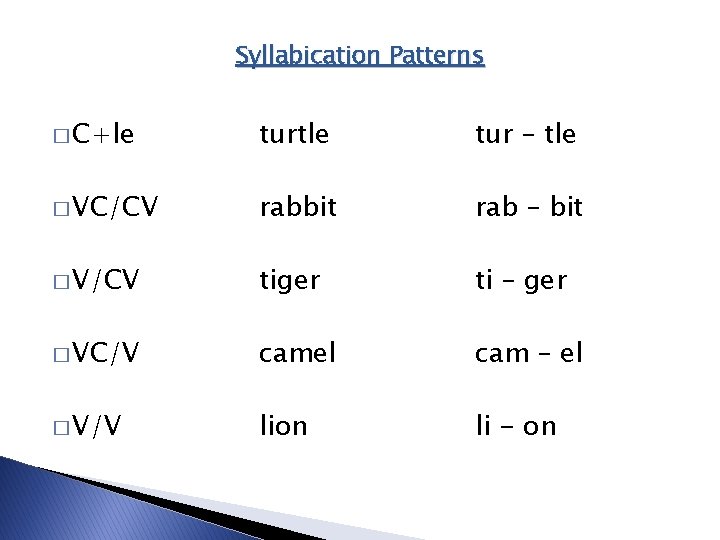
Syllabication Patterns � C+le turtle tur – tle � VC/CV rabbit rab – bit � V/CV tiger ti – ger � VC/V camel cam – el � V/V lion li - on
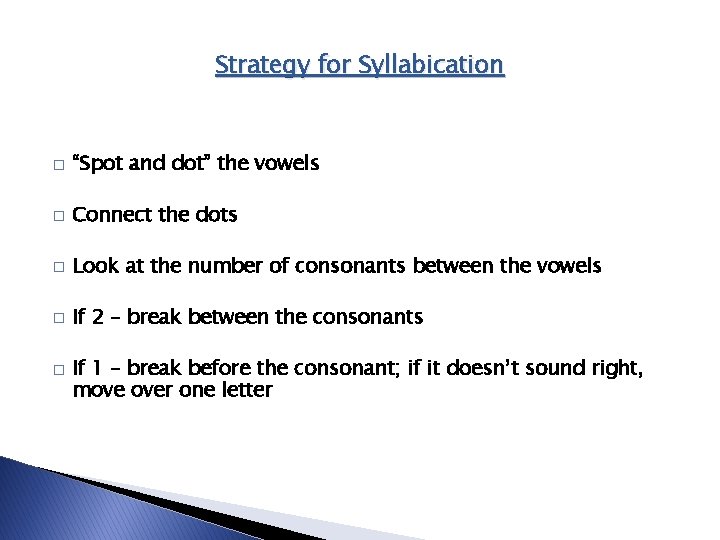
Strategy for Syllabication � “Spot and dot” the vowels � Connect the dots � Look at the number of consonants between the vowels � If 2 – break between the consonants � If 1 – break before the consonant; if it doesn’t sound right, move over one letter
Apply and Transfer � Provide many opportunities to use these skills and strategies, both in isolation and in connected text ◦ ◦ Fiction and non-fiction Poetry and songs Decodable text Learning games and activities
� � Phonics should be a meaningful and integrated part of our curriculum (reading program), with ample opportunities for learning, application and solving learning problems. Teaching must build on what students already know and give them space to see patterns and draw inferences. How can we use Phonics in a Literacy Program? A Balanced Literacy Program
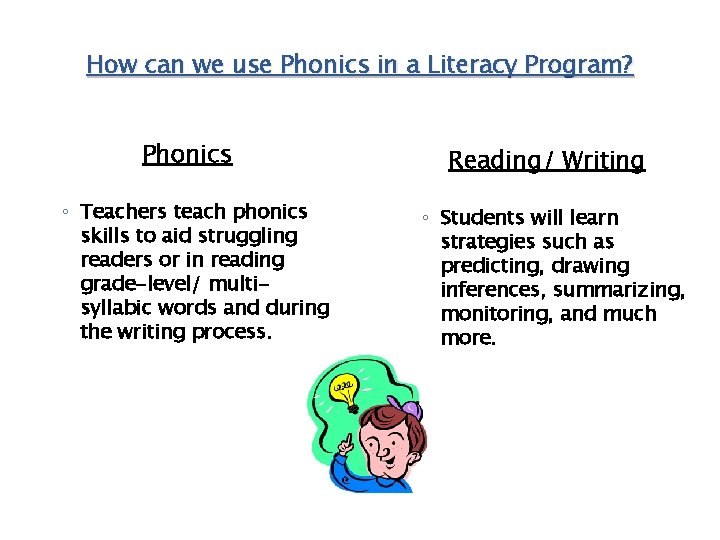
How can we use Phonics in a Literacy Program? Phonics ◦ Teachers teach phonics skills to aid struggling readers or in reading grade-level/ multisyllabic words and during the writing process. Reading/ Writing ◦ Students will learn strategies such as predicting, drawing inferences, summarizing, monitoring, and much more.
How can Phonics be used to Help Students to Read? The Four Ways to Read Words: 1. Contextual Guessing-guessing based on the context of the selection, usually using picture cues 2. Letter-Sound Decoding-connecting the letter seen to the sound, or phoneme 3. Analogy-reading a word by drawing an analogy to another known word in the student’s memory 4. Sight-the ultimate goal of reading is to be able to read the word on sight within a split second (Mc. Ewan, 2009)