
Module Radiation Length Goals Estimate the expected radiation





- Slides: 16
Module Radiation Length
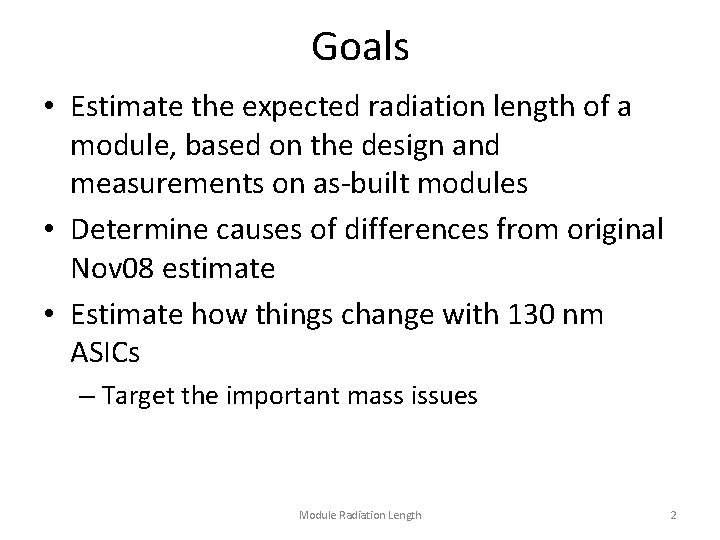
Goals • Estimate the expected radiation length of a module, based on the design and measurements on as-built modules • Determine causes of differences from original Nov 08 estimate • Estimate how things change with 130 nm ASICs – Target the important mass issues Module Radiation Length 2
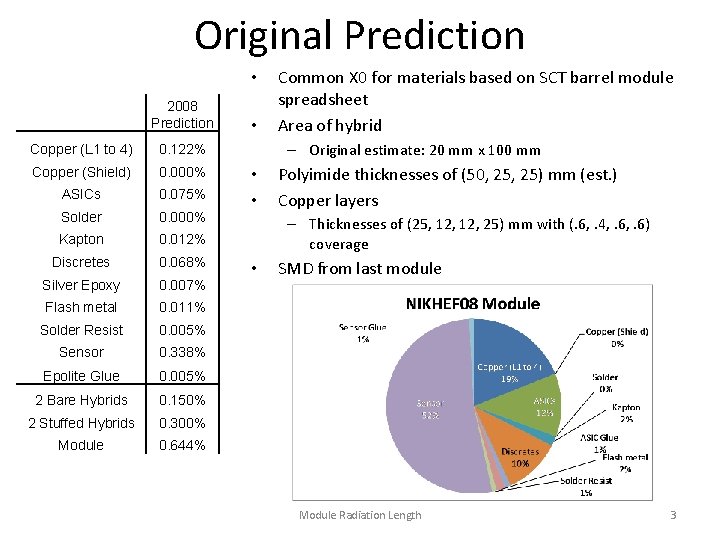
Original Prediction • 2008 Prediction Copper (L 1 to 4) 0. 122% Copper (Shield) 0. 000% ASICs 0. 075% Solder 0. 000% Kapton 0. 012% Discretes 0. 068% Silver Epoxy 0. 007% Flash metal 0. 011% Solder Resist 0. 005% Sensor 0. 338% Epolite Glue 0. 005% 2 Bare Hybrids 0. 150% 2 Stuffed Hybrids 0. 300% Module 0. 644% • Common X 0 for materials based on SCT barrel module spreadsheet Area of hybrid – Original estimate: 20 mm x 100 mm • • Polyimide thicknesses of (50, 25) mm (est. ) Copper layers – Thicknesses of (25, 12, 25) mm with (. 6, . 4, . 6) coverage • SMD from last module Module Radiation Length 3
Radiation Lengths Under Question Material Previous X 0 Previous Assumed Make New X 0 Current assumed Make-up (mm) Polyimide 357. 5 Epoxy 286 Polyimide Poly+adhsv 357. 5 Epoxy 286 Polyimide Ceramic Caps 54. 3 Ba. Ti. O 3 ( should be 19. 1) 18. 4 86% Ba. Ti. O 3, 8% Ni, 6% Sn SMD resistors 63. 3 Al 2 O 3 39 86% Al 2 O 3, 8% Ni, 6% Sn Silver Epoxy 85 10% Ag, 90% Epoxy 35 70% Ag, 30% Epoxy Solder N/A 8. 92 62% Sn, 2% Ag, 36% Pb Wire Bonds N/A 89 99% Al, 1% Si Past estimate for ceramic capacitors grossly understates importance for module’s radiation length. SMD resistors and silver epoxy are also underestimated but not a large fraction of module. Solder is a significant source of material not included in past estimates, will use for current as-built and future estimates. From weight measurement 0. 18 g per hybrid using re-flow SMD attach. Addition of wire bonds and change to polyimide are not significant addition of material. . Module Radiation Length 4
Polyimide Radiation Length • http: //rnc. lbl. gov/hft/hardware/docs/pixel_ra d_length. pdf – RL = 28. 6 cm • https: //confluencenew. slac. stanford. edu/download/attachments /12222/MMS_Density_Final_Update. pdf – RL = 28. 2 cm • http: //pdg. lbl. gov/2002/atomicrpp. pdf – RL = 28. 6 cm Module Radiation Length 5
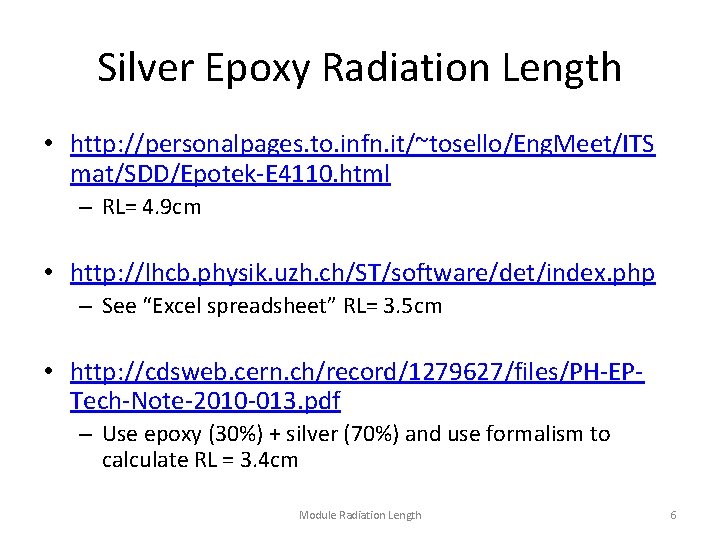
Silver Epoxy Radiation Length • http: //personalpages. to. infn. it/~tosello/Eng. Meet/ITS mat/SDD/Epotek-E 4110. html – RL= 4. 9 cm • http: //lhcb. physik. uzh. ch/ST/software/det/index. php – See “Excel spreadsheet” RL= 3. 5 cm • http: //cdsweb. cern. ch/record/1279627/files/PH-EPTech-Note-2010 -013. pdf – Use epoxy (30%) + silver (70%) and use formalism to calculate RL = 3. 4 cm Module Radiation Length 6
SMD Capacitors Radiation Length • Capacitors used (X 7 R) have a Ba. Ti 03 ceramic – RL=1. 9 cm (RAL RL calculator) – RL=1. 9 cm http: //personalpages. to. infn. it/~tosello/Eng. Meet/ITSmat/ SDD/SDD_Ba. Ti. O 3. html – Density of 5. 85 match measurements of components • With estimated solder-end materials (8% Ni, 2% Sn, 2% Cu) – http: //personalpages. to. infn. it/~tosello/Eng. Meet/ITSmat/ SDD/X 7 R_0805. html – RL = 1. 84 cm • For SMD resistors Al. O 3 with estimated solder-end materials (8% Ni, 6% Sn) – RL=3. 9 cm Module Radiation Length 7
With updated radiation lengths NIKHEF 08 Prediction (Correct X 0) Copper (L 1 to 4) 0. 122% Copper (Shield) 0. 000% ASICs 0. 075% Solder 0. 000% Kapton 0. 012% 0. 015% Discretes 0. 068% 0. 162% Silver Epoxy 0. 007% 0. 017% Flash metal 0. 011% Solder Resist 0. 005% 0. 006% Sensor 0. 338% Epolite Glue 0. 005% 2 Bare Hybrids 0. 150% 0. 153% 2 Stuffed Hybrids 0. 300% 0. 407% Module 0. 644% 0. 751% • Biggest difference is the discretes increasing by ~0. 1% per module Increase of 17% from original prediction Module Radiation Length 8
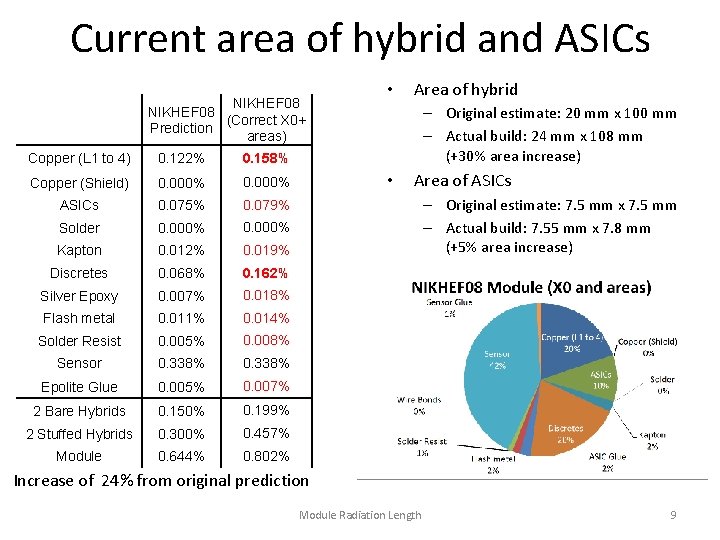
Current area of hybrid and ASICs NIKHEF 08 (Correct X 0+ Prediction areas) Copper (L 1 to 4) 0. 122% 0. 158% Copper (Shield) 0. 000% ASICs 0. 075% 0. 079% Solder 0. 000% Kapton 0. 012% 0. 019% Discretes 0. 068% 0. 162% Silver Epoxy 0. 007% 0. 018% Flash metal 0. 011% 0. 014% Solder Resist 0. 005% 0. 008% Sensor 0. 338% Epolite Glue 0. 005% 0. 007% 2 Bare Hybrids 0. 150% 0. 199% 2 Stuffed Hybrids 0. 300% 0. 457% Module 0. 644% 0. 802% • Area of hybrid – Original estimate: 20 mm x 100 mm – Actual build: 24 mm x 108 mm (+30% area increase) • Area of ASICs – Original estimate: 7. 5 mm x 7. 5 mm – Actual build: 7. 55 mm x 7. 8 mm (+5% area increase) Increase of 24% from original prediction Module Radiation Length 9
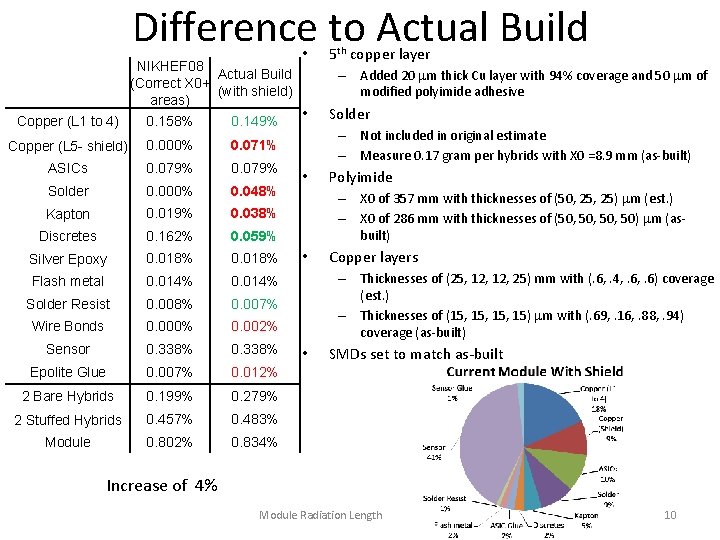
Difference to Actual Build NIKHEF 08 Actual Build (Correct X 0+ (with shield) areas) Copper (L 1 to 4) 0. 158% 0. 149% Copper (L 5 - shield) 0. 000% 0. 071% ASICs 0. 079% Solder 0. 000% 0. 048% Kapton 0. 019% 0. 038% Discretes 0. 162% 0. 059% Silver Epoxy 0. 018% Flash metal 0. 014% Solder Resist 0. 008% 0. 007% Wire Bonds 0. 000% 0. 002% Sensor 0. 338% Epolite Glue 0. 007% 0. 012% 2 Bare Hybrids 0. 199% 0. 279% 2 Stuffed Hybrids 0. 457% 0. 483% Module 0. 802% 0. 834% • 5 th copper layer – Added 20 mm thick Cu layer with 94% coverage and 50 mm of modified polyimide adhesive • Solder – Not included in original estimate – Measure 0. 17 gram per hybrids with X 0 =8. 9 mm (as-built) • Polyimide – X 0 of 357 mm with thicknesses of (50, 25) mm (est. ) – X 0 of 286 mm with thicknesses of (50, 50, 50) mm (asbuilt) • Copper layers – Thicknesses of (25, 12, 25) mm with (. 6, . 4, . 6) coverage (est. ) – Thicknesses of (15, 15, 15) mm with (. 69, . 16, . 88, . 94) coverage (as-built) • SMDs set to match as-built Increase of 4% Module Radiation Length 10
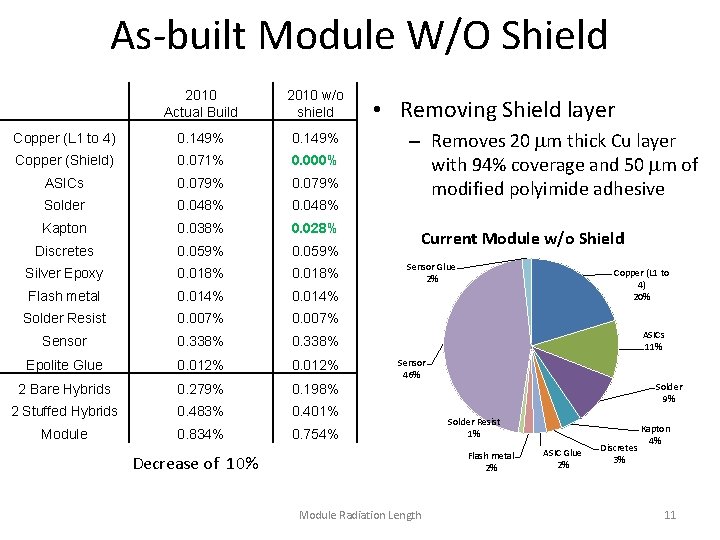
As-built Module W/O Shield 2010 Actual Build 2010 w/o shield Copper (L 1 to 4) 0. 149% Copper (Shield) 0. 071% 0. 000% ASICs 0. 079% Solder 0. 048% Kapton 0. 038% 0. 028% Discretes 0. 059% Silver Epoxy 0. 018% Flash metal 0. 014% Solder Resist 0. 007% Sensor 0. 338% Epolite Glue 0. 012% 2 Bare Hybrids 0. 279% 0. 198% 2 Stuffed Hybrids 0. 483% 0. 401% Module 0. 834% 0. 754% • Removing Shield layer – Removes 20 mm thick Cu layer with 94% coverage and 50 mm of modified polyimide adhesive Current Module w/o Shield Sensor Glue 2% Copper (L 1 to 4) 20% ASICs 11% Sensor 46% Solder 9% Solder Resist 1% Flash metal 2% Decrease of 10% Module Radiation Length ASIC Glue 2% Discretes 3% Kapton 4% 11
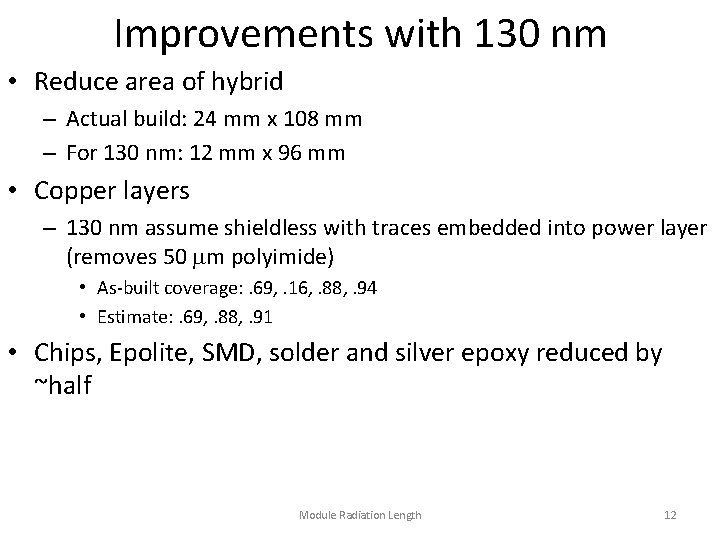
Improvements with 130 nm • Reduce area of hybrid – Actual build: 24 mm x 108 mm – For 130 nm: 12 mm x 96 mm • Copper layers – 130 nm assume shieldless with traces embedded into power layer (removes 50 mm polyimide) • As-built coverage: . 69, . 16, . 88, . 94 • Estimate: . 69, . 88, . 91 • Chips, Epolite, SMD, solder and silver epoxy reduced by ~half Module Radiation Length 12
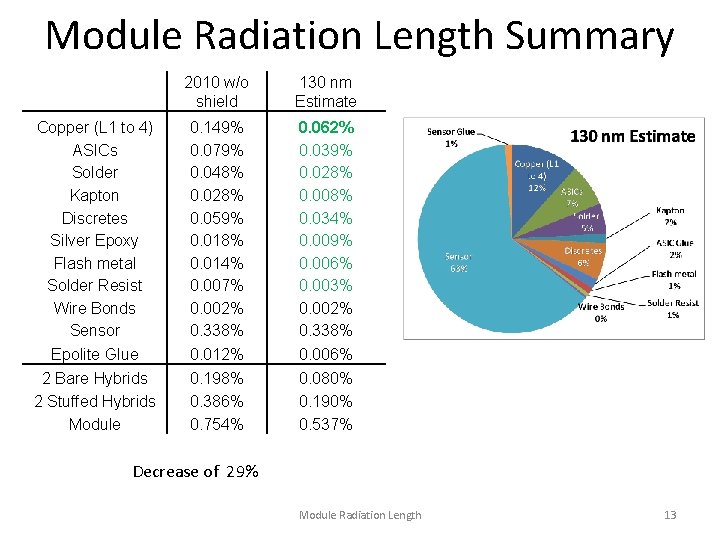
Module Radiation Length Summary Copper (L 1 to 4) ASICs Solder Kapton Discretes Silver Epoxy Flash metal Solder Resist Wire Bonds Sensor Epolite Glue 2 Bare Hybrids 2 Stuffed Hybrids Module 2010 w/o shield 130 nm Estimate 0. 149% 0. 079% 0. 048% 0. 028% 0. 059% 0. 018% 0. 014% 0. 007% 0. 002% 0. 338% 0. 012% 0. 198% 0. 386% 0. 754% 0. 062% 0. 039% 0. 028% 0. 008% 0. 034% 0. 009% 0. 006% 0. 003% 0. 002% 0. 338% 0. 006% 0. 080% 0. 190% 0. 537% Decrease of 29% Module Radiation Length 13
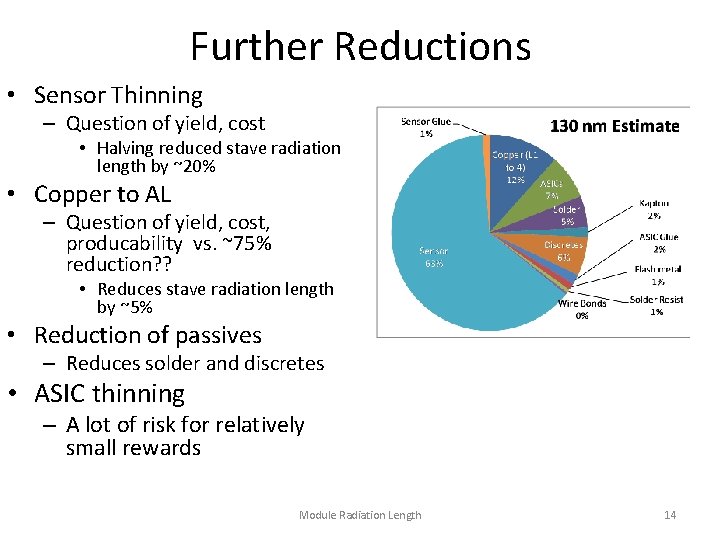
Further Reductions • Sensor Thinning – Question of yield, cost • Halving reduced stave radiation length by ~20% • Copper to AL – Question of yield, cost, producability vs. ~75% reduction? ? • Reduces stave radiation length by ~5% • Reduction of passives – Reduces solder and discretes • ASIC thinning – A lot of risk for relatively small rewards Module Radiation Length 14
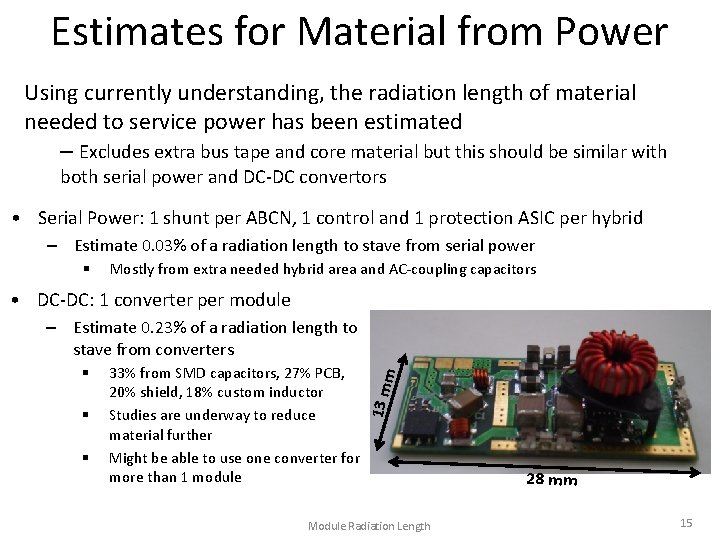
Estimates for Material from Power Using currently understanding, the radiation length of material needed to service power has been estimated – Excludes extra bus tape and core material but this should be similar with both serial power and DC-DC convertors • Serial Power: 1 shunt per ABCN, 1 control and 1 protection ASIC per hybrid – Estimate 0. 03% of a radiation length to stave from serial power § Mostly from extra needed hybrid area and AC-coupling capacitors • DC-DC: 1 converter per module § § 33% from SMD capacitors, 27% PCB, 20% shield, 18% custom inductor Studies are underway to reduce material further Might be able to use one converter for more than 1 module 13 m § m – Estimate 0. 23% of a radiation length to stave from converters Module Radiation Length 28 mm 15
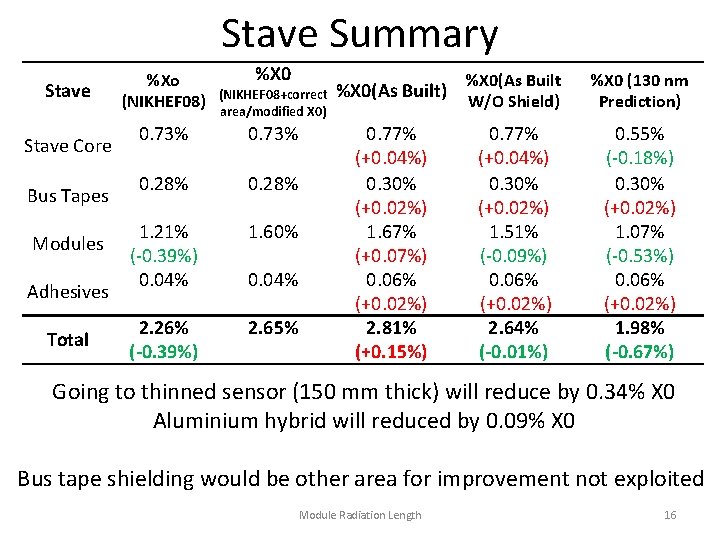
Stave Summary Stave Core Bus Tapes Modules Adhesives Total %Xo (NIKHEF 08) %X 0 (NIKHEF 08+correct area/modified X 0) 0. 73% 0. 28% 1. 21% (-0. 39%) 0. 04% 1. 60% 2. 26% (-0. 39%) 2. 65% 0. 04% %X 0(As Built) %X 0(As Built W/O Shield) %X 0 (130 nm Prediction) 0. 77% (+0. 04%) 0. 30% (+0. 02%) 1. 67% (+0. 07%) 0. 06% (+0. 02%) 2. 81% (+0. 15%) 0. 77% (+0. 04%) 0. 30% (+0. 02%) 1. 51% (-0. 09%) 0. 06% (+0. 02%) 2. 64% (-0. 01%) 0. 55% (-0. 18%) 0. 30% (+0. 02%) 1. 07% (-0. 53%) 0. 06% (+0. 02%) 1. 98% (-0. 67%) Going to thinned sensor (150 mm thick) will reduce by 0. 34% X 0 Aluminium hybrid will reduced by 0. 09% X 0 Bus tape shielding would be other area for improvement not exploited Module Radiation Length 16