
Module Occupational Exposure Limits PUBHEHS 5325 Principles of
Module Occupational Exposure Limits PUBHEHS 5325 Principles of Occupational Health Michael Bisesi, Ph. D, REHS, CIH Senior Assoc. Dean, Academic Affairs Professor & Chair (interim) Environmental Health Sciences
Learning Objectives § Upon completion of this module and related readings and problem set, learners will be able to: § define the major regulatory and non-regulatory types of occupational exposure limits (OELs); § calculate time-weighted averages (TWAs); § apply qualitative and quantitative principles of OELs and TWAs to determine if levels of personal and area exposure above or below allowable and recommended limits.
What are occupational exposure limits (OELs) and the major regulatory and non-regulatory agencies and organizations involved?

Occupational Exposure Limits (OELs) § Regulatory § OSHA- Permissible Exposure Limits (PELs) § https: //www. osha. gov/dsg/topics/pel/ § Non-Regulatory § ACGIH- Threshold Limit Values (TLVs) § http: //www. acgih. org/tlv/ § NIOSH- Recommended Exposure Levels (RELs) § http: //www. cdc. gov/niosh/npg/default. html

Permissible Exposure Limits (PELs) § Concentration of specific agent that nearly all workers can be exposed day after day without adverse health effects. § Set by OSHA § Regulatory limit. . . must not be exceeded § TWA= time-weighted average (i. e. , 8 -hr exposure)

Threshold Limit Values (TLVs) § Established by ACGIH § Similar to OSHA-PEL but is a professional guideline, not a regulatory limit. . . § Based on 8 -hr TWA or shorter exposure
What are time-weighted averages (TWAs)?
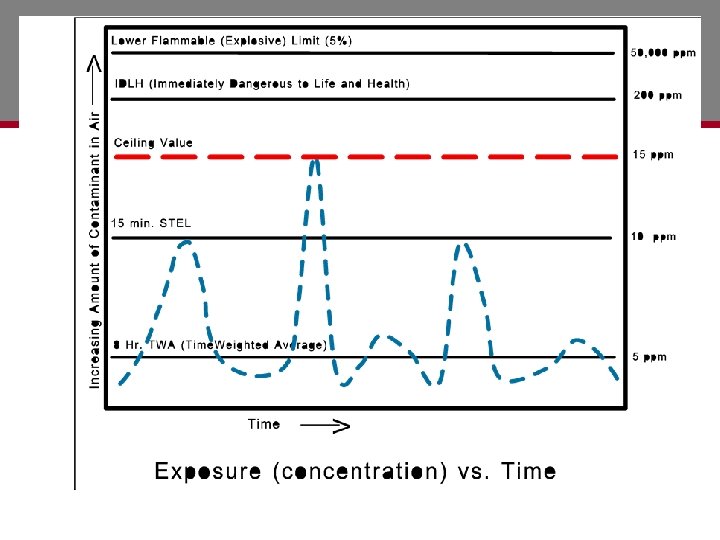
Time-Weighted Averages § OSHA PEL and ACGIH TLV-TWA § Represent the time-weighted average concentration for a normal 8 -hour workday and a 40 -hour work week to which nearly all workers may be repeatedly exposed, day after day, without adverse effect
What are some additional, timespecific and/or condition-specific, exposure limits?
Short Term Exposure Limit (STELs) § Concentration which workers may be exposed up to 15 minutes continuously without suffering from: § Irritation § Chronic or irreversible tissue damage § Narcosis § Represents a 15 -min TWA exposure which should not be exceeded at any time during the workday even if the 8 -hr TWA is within the PEL or TLV-TWA § Exposures above the PEL or TLV-TWA up to the STEL should not be longer than 15 min and should not occur more than 4 times per day. § There should be at least 60 minutes between successive exposures in this range. v NOTE: a 30 -min STEL may be specified instead of a 15 -min STEL
Ceiling (C) § The letter “C” when used in the context of workplace exposure limits, stands for “ceiling” § The concentration that should not be exceeded during any part of the working exposure even if the PEL or TLV-TWA is not exceeded § Exceeding a ceiling limit may result in adverse health effects
Immediate Danger to Life and Health (IDLH) § NIOSH- The maximum concentration from which, in the event of respirator failure, one could escape within 30 min without a respirator and without experiencing any escape-impairing or irreversible health effects. v. NOTE: IDLH is determined for the purpose of respirator selection § OSHA- an atmospheric concentration of any toxic, corrosive, or asphyxiant substance that poses an immediate threat to life or would interfere with an individual’s ability to escape from a dangerous atmosphere
Skin § When used in the context of workplace exposure, the term “skin” denotes the potential significant contribution to the overall exposure by the cutaneous (skin) route, including mucous membranes and the eyes. § This is either by contact with vapors or, of probable greater significance, by direct skin contact with the liquid or solid substances
- Slides: 14