
Module Objectives Upon completing this module you will
Module Objectives Upon completing this module, you will be able to: • Overview of PIR • Understand different Categories of PIR and their uses. • Different Levels of PIR Data • Pre-Requisite of PIR Master Data. • Important fields in PIR Master. • Maintenance of PIR Data • Create conditions in purchasing info records A © 2014 B. 1
Agenda • Overview of PIR • Functions and Pre-Requisite of PIR. • Difference between Time dependent & time independent conditions. • Info-Record Category. • Various Levels of Info-Record. • Creation & Maintenance of Purchasing Info record. A © 2014 B. 2
Overview of Purchase Info-Record • Purchasing Information Record is also known as “Info Record. ” • Material Master and Vendor Master Record are used to store material specific information and vendor specific details, respectively. • Whereas purchasing info record contains information about a specific material and a vendor supplying the material. • It can be maintained at purchasing organization level or plant specific, as per the business requirements. • The “Purchasing Info record” is used to store the combination of a Material and Vendor with the pricing details for the specific period of time, planned delivery time, etc. • It serves as a source of information for Purchasing. A © 2014 B. 3
Overview of Purchase Info-Record • When you create a purchase order, the system searches for info record for purchasing organization/plant combination. If there in no record for this combination, the system searches for purchasing organization only. • You can maintain info record manually or automatically from quotations, purchase orders or outline agreements. • Info record can be maintained for different procurement types • Standard • Subcontracting • Pipeline • Consignment A © 2014 B. 4
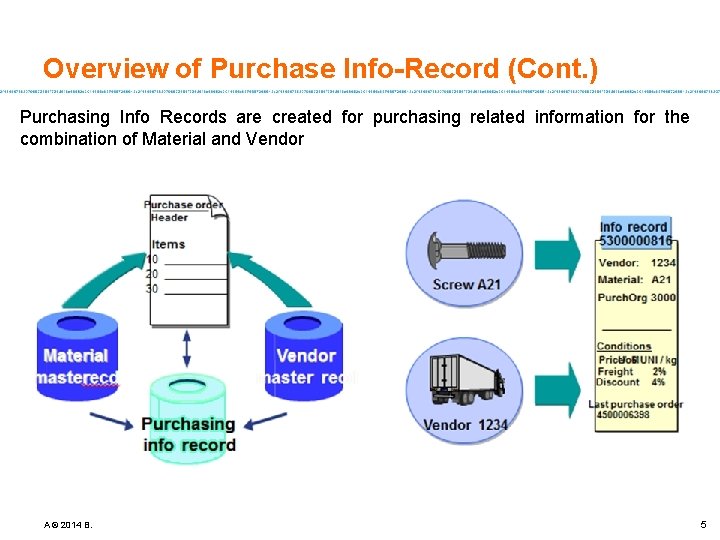
Overview of Purchase Info-Record (Cont. ) Purchasing Info Records are created for purchasing related information for the combination of Material and Vendor A © 2014 B. 5
Functions & Pre-Requisite of PIR is used as a Default Data during External Purchasing Document Processing: • PIR master Data is maintained combination of another Master Data which are the Pre-Requisite for PIR data Maintenance. a) b) Material Master. Vendor Master. • Following Default Data you can define for a Material & Vendor Combination within a Purchase Org and Plant (Optional) : • Price, Tax, Order unit • Planned Delivery Time, Tolerance, Conf. Control Data etc. A © 2014 B. 6
Conditions • Conditions: The conditions are used to represent pricing elements such as prices, discounts, surcharges, taxes, or delivery costs in the SAP System. • Conditions can be maintained when entering quotations, info records, outline agreements (contracts, scheduling agreements) and purchase orders. • Some examples of conditions are: – PB 00/PBXX – Gross Price – RA 01 - Discount – FRA 1 - Freight A © 2014 B. 7
Conditions (Contd. . ) There are three kinds of price in Purchasing: • Gross price : Price without taking any possible discounts and surcharges into account. (Actual price of material) • Net price: Price taking any applicable discounts and surcharges into account. • Effective price: Net price after deduction of cash discount, with allowance for any miscellaneous provisions, delivery costs, and non-deductible taxes. A © 2014 B. 8
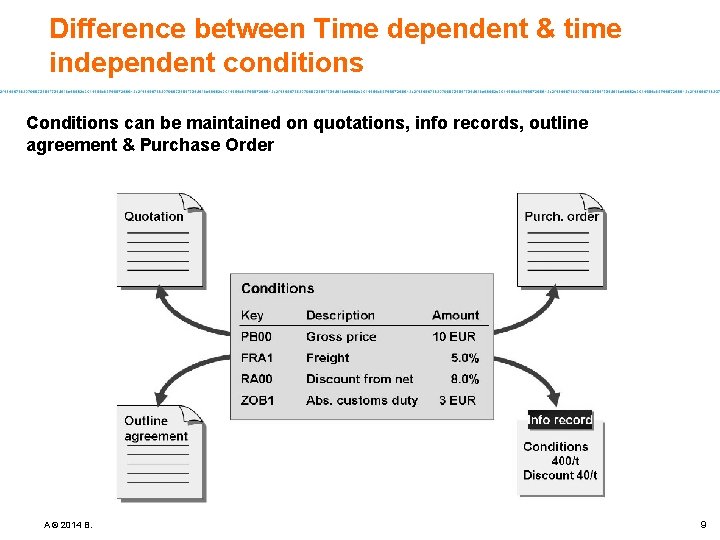
Difference between Time dependent & time independent conditions Conditions can be maintained on quotations, info records, outline agreement & Purchase Order A © 2014 B. 9
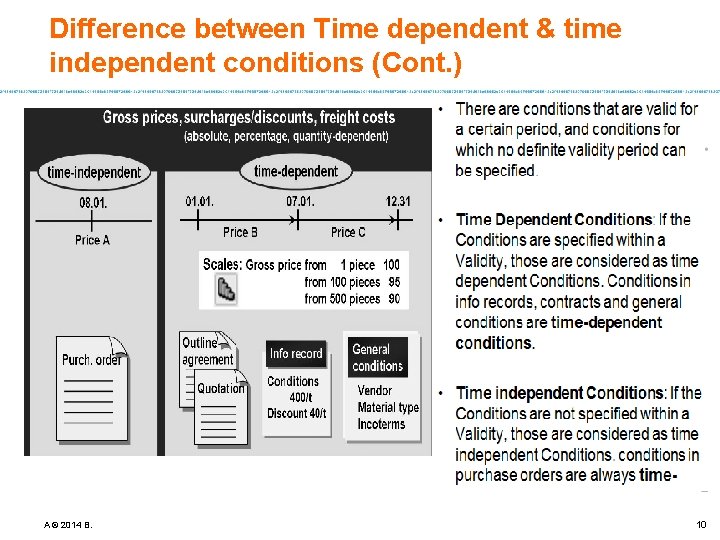
Difference between Time dependent & time independent conditions (Cont. ) A © 2014 B. 10
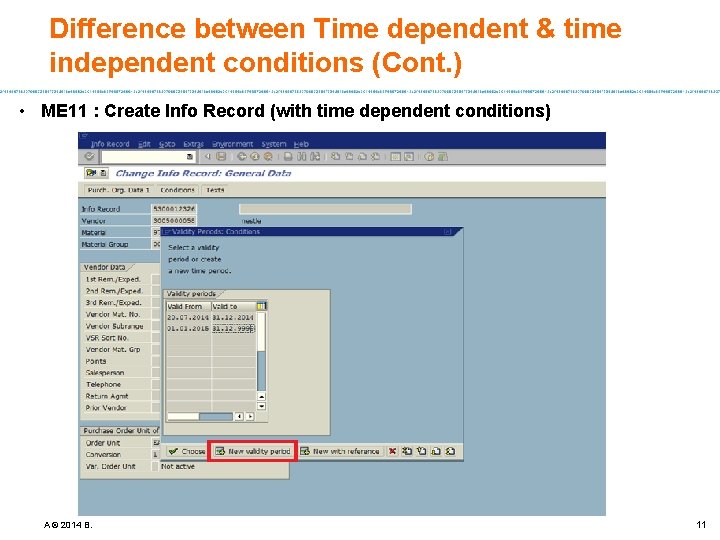
Difference between Time dependent & time independent conditions (Cont. ) • ME 11 : Create Info Record (with time dependent conditions) A © 2014 B. 11
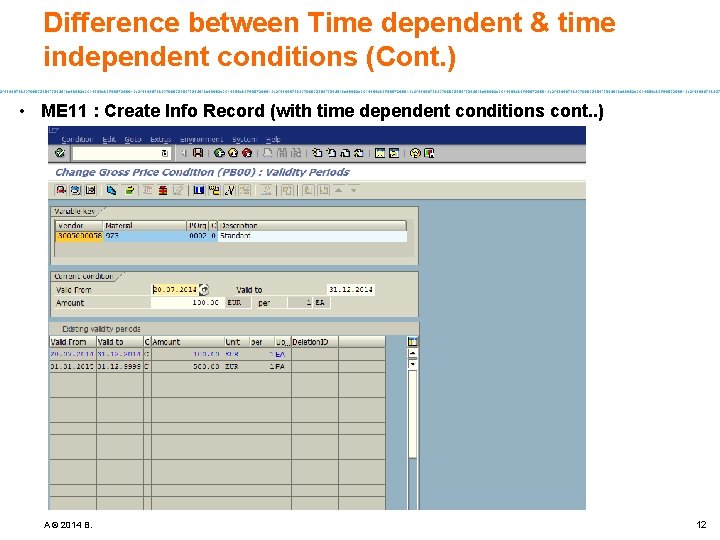
Difference between Time dependent & time independent conditions (Cont. ) • ME 11 : Create Info Record (with time dependent conditions cont. . ) A © 2014 B. 12
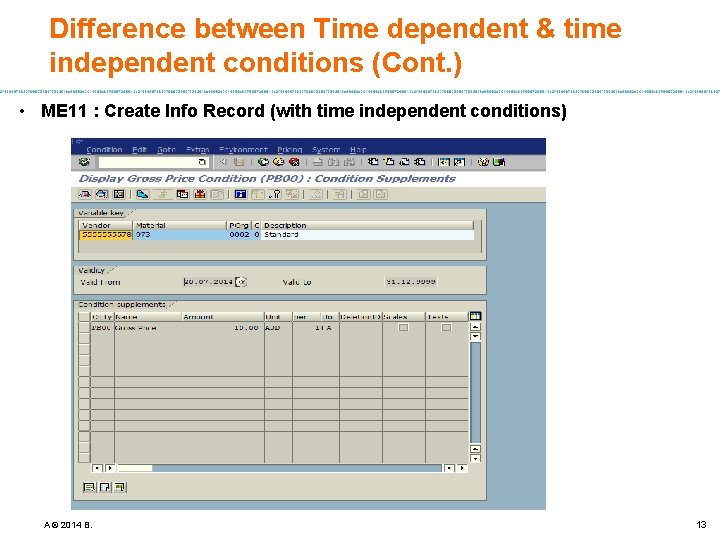
Difference between Time dependent & time independent conditions (Cont. ) • ME 11 : Create Info Record (with time independent conditions) A © 2014 B. 13
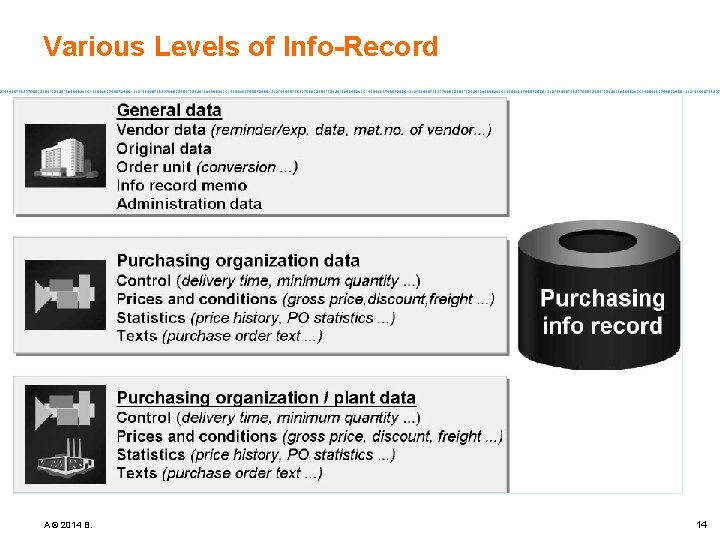
Various Levels of Info-Record A © 2014 B. 14
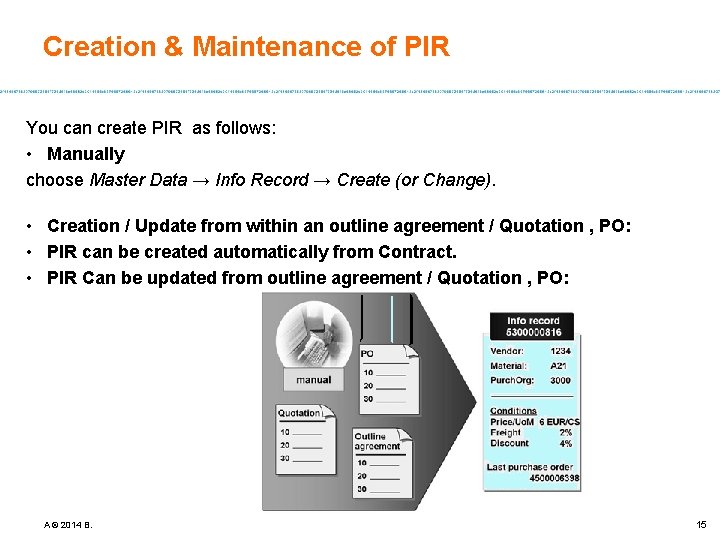
Creation & Maintenance of PIR You can create PIR as follows: • Manually choose Master Data → Info Record → Create (or Change). • Creation / Update from within an outline agreement / Quotation , PO: • PIR can be created automatically from Contract. • PIR Can be updated from outline agreement / Quotation , PO: A © 2014 B. 15
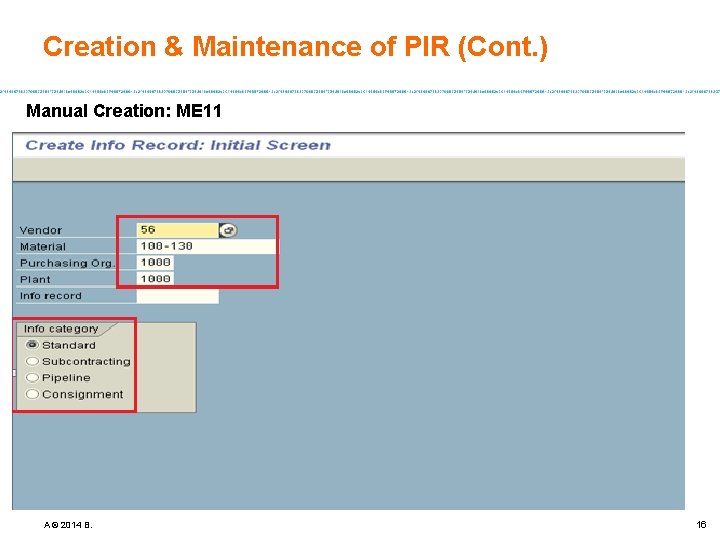
Creation & Maintenance of PIR (Cont. ) Manual Creation: ME 11 A © 2014 B. 16
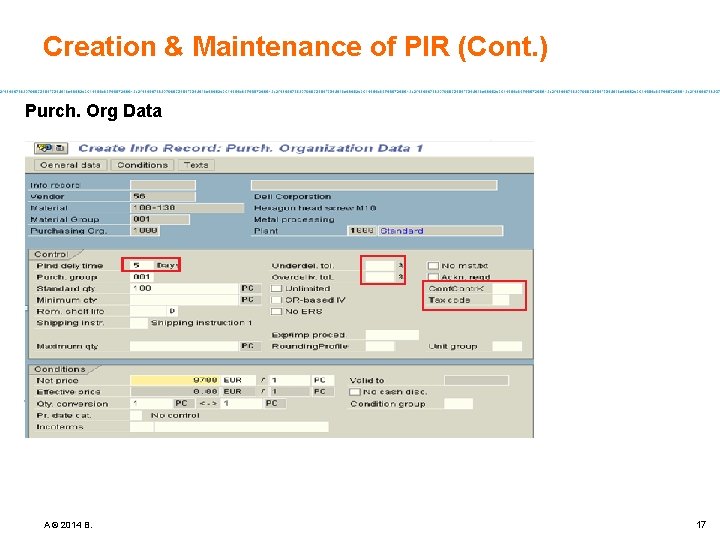
Creation & Maintenance of PIR (Cont. ) Purch. Org Data A © 2014 B. 17
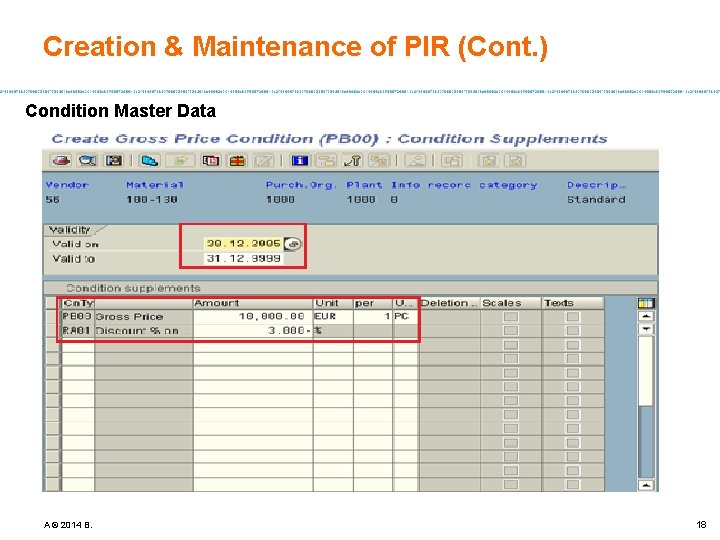
Creation & Maintenance of PIR (Cont. ) Condition Master Data A © 2014 B. 18
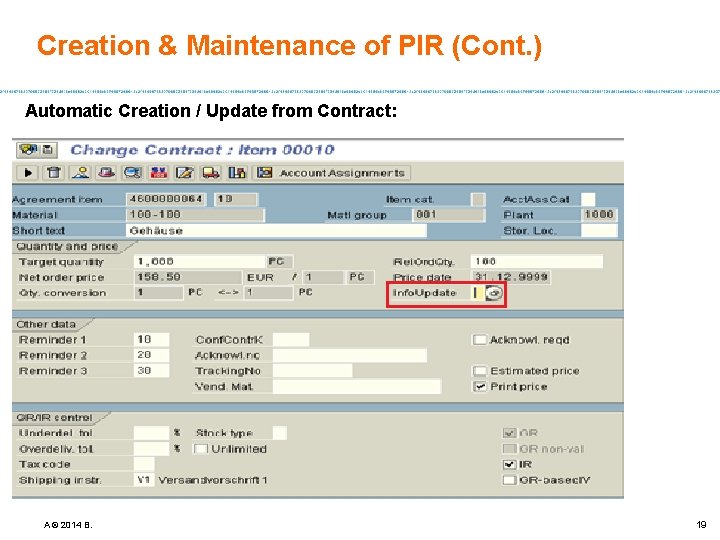
Creation & Maintenance of PIR (Cont. ) Automatic Creation / Update from Contract: A © 2014 B. 19
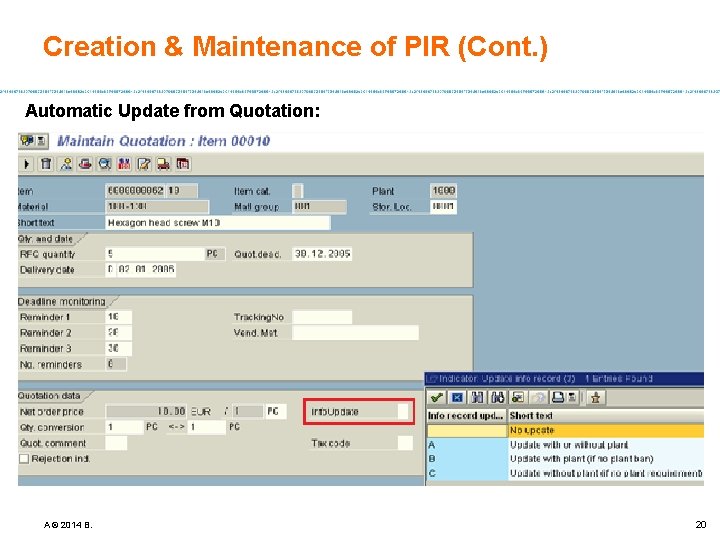
Creation & Maintenance of PIR (Cont. ) Automatic Update from Quotation: A © 2014 B. 20
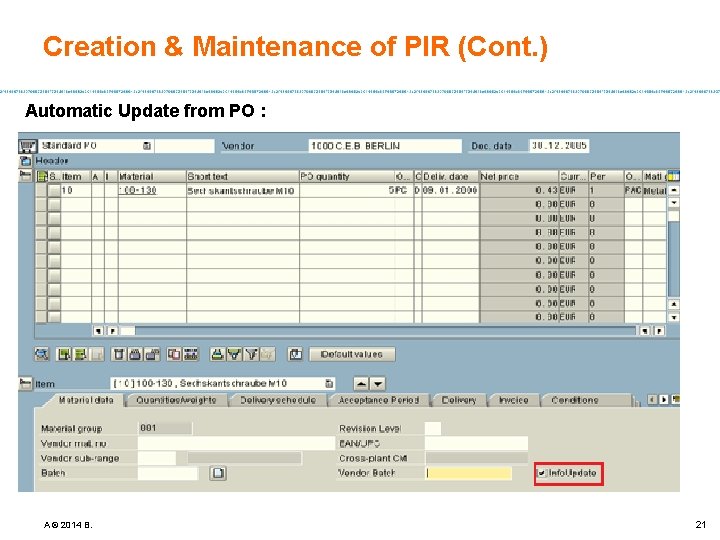
Creation & Maintenance of PIR (Cont. ) Automatic Update from PO : A © 2014 B. 21
Discussion • List the organizational levels relevant for purchasing info records • List the ways in which purchasing info records can be created A © 2014 B. 22
Checkpoint • • What types of Various purchasing information records we maintained in SAP? What are the different Organization Levels PIR are created? How PIR is useful in Procurement? What are the other options available to create PIR apart from Manual PIR Creation? A © 2014 B. 23
Module Summary You should now be able to: • Explain the significance PIR • Create and maintain PIR master records • Name the organizational levels that are important for the maintenance of PIR master records. A © 2014 B. 24
Questions and Comments • What questions or comments do you have? A © 2014 B. 25
Exercise 5 : Introduction to Info records (25 min. ) A © 2014 B. 26
- Slides: 26