
Module IX CommunityBased Substance Abuse Prevention Learning Objectives
Module IX: Community-Based Substance Abuse Prevention
Learning Objectives Health Care Professionals will have the opportunity to: u Define community-based prevention. u Discuss types and levels of prevention. u Compare frameworks for preventive interventions. u Identify risk and protective factors associated with substance use disorders. u Cite theories of behavioral change. u Discuss cultural influences on prevention. 2
Learning Objectives (continued) Health Care Professionals will have the opportunity to: u Define the role of the health care professional in prevention. u Discuss general and specific strategies for community-based prevention. u Identify evaluation aims for communitybased prevention programs. 3
Introduction u u u Substance use disorders take greater toll than any other preventable health problem. Substance use disorders occur across the lifespan. Communities are appropriate sites for preventive interventions. 4
Definition of Prevention is a proactive process that empowers individuals and systems to meet the challenge of life events and transitions by creating and reinforcing conditions that promote healthy behaviors and lifestyles. (CSAP, 1994) 5
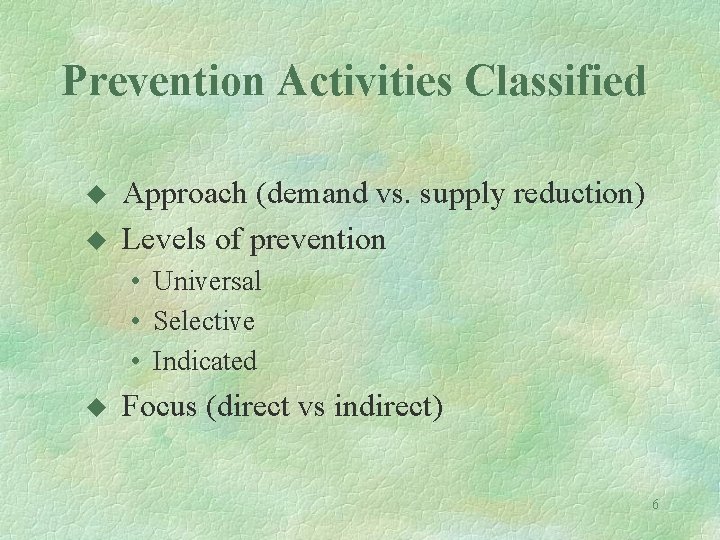
Prevention Activities Classified u u Approach (demand vs. supply reduction) Levels of prevention • Universal • Selective • Indicated u Focus (direct vs indirect) 6

Mental Health Approach to Prevention Universal Preventive Intervention • Desirable for everyone in eligible population. Selective Preventive Intervention • Targeted for individuals or subgroups at significantly higher risk than average. Indicated Preventive Intervention • Targeted for high-risk individuals with minimal but detectable signs/symptoms. 7
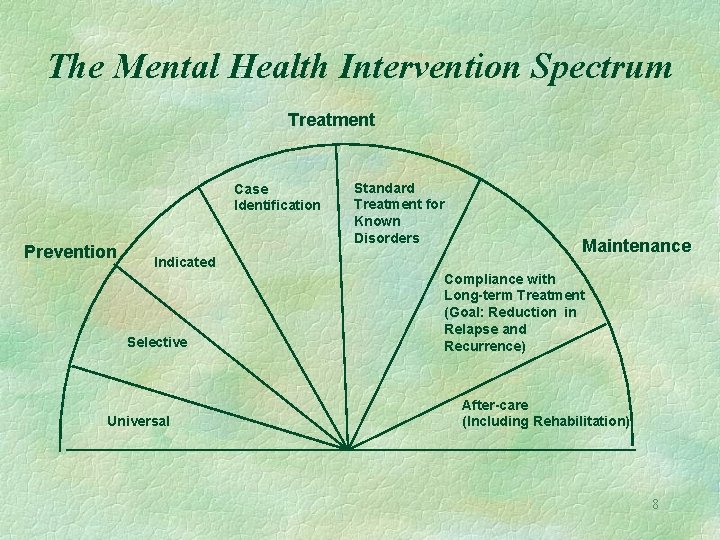
The Mental Health Intervention Spectrum Treatment Case Identification Prevention Indicated Selective Universal Standard Treatment for Known Disorders Maintenance Compliance with Long-term Treatment (Goal: Reduction in Relapse and Recurrence) After-care (Including Rehabilitation) 8
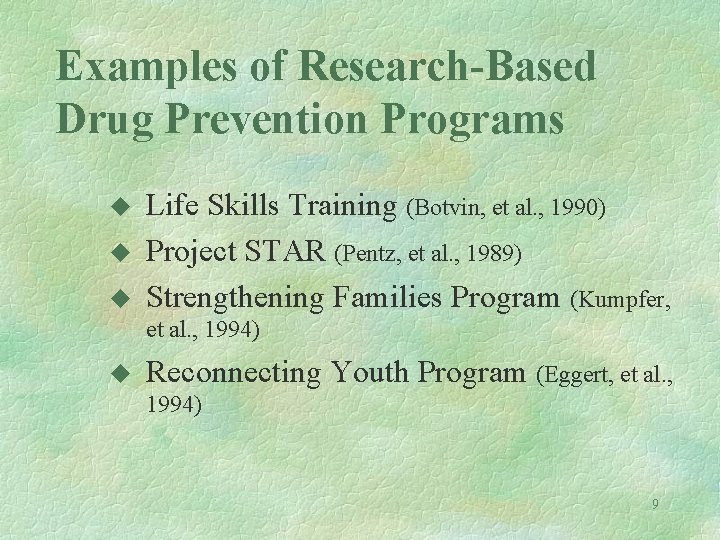
Examples of Research-Based Drug Prevention Programs u u u Life Skills Training (Botvin, et al. , 1990) Project STAR (Pentz, et al. , 1989) Strengthening Families Program (Kumpfer, et al. , 1994) u Reconnecting Youth Program (Eggert, et al. , 1994) 9

Approaches to Community-Based Prevention u Clinical perspective—focus on individual factors and lifestyle issues u Public health perspective—focus on law, policies and practices that affect production, marketing u Combined—Project Northland 10

Frameworks for Community. Based Prevention u Preventive Intervention Research Cycle u PRECEDE - PROCEED u SAMHSA Prevention Platform 11
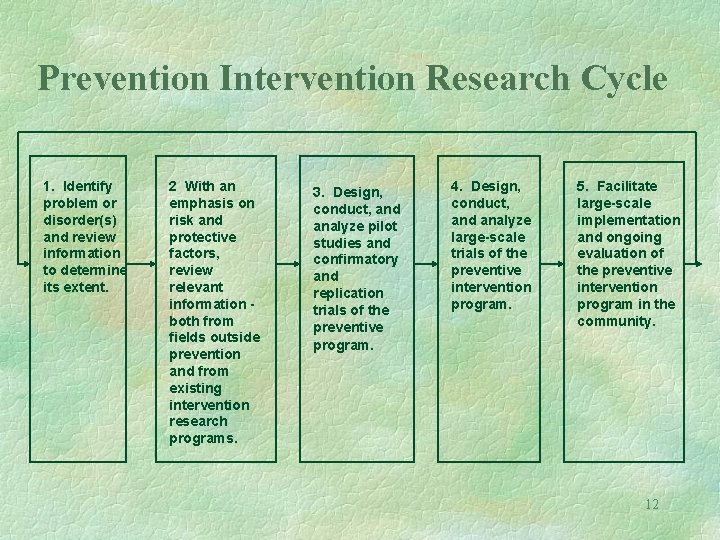
Prevention Intervention Research Cycle 1. Identify problem or disorder(s) and review information to determine its extent. 2 With an emphasis on risk and protective factors, review relevant information both from fields outside prevention and from existing intervention research programs. 3. Design, conduct, and analyze pilot studies and confirmatory and replication trials of the preventive program. 4. Design, conduct, and analyze large-scale trials of the preventive intervention program. 5. Facilitate large-scale implementation and ongoing evaluation of the preventive intervention program in the community. 12
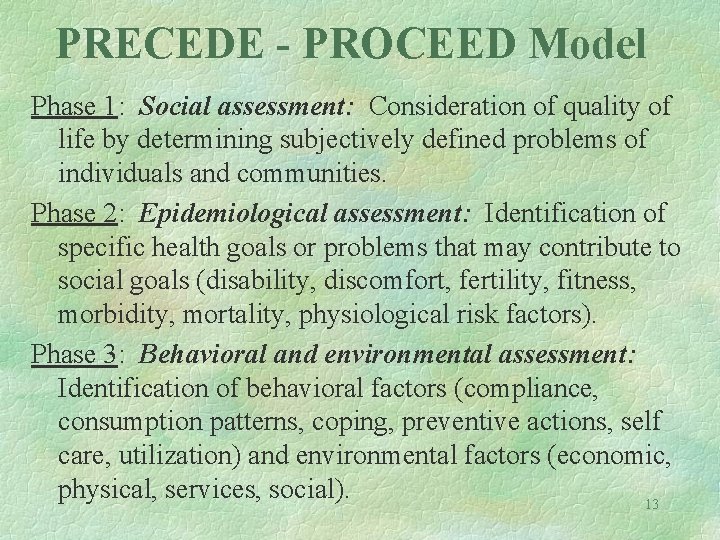
PRECEDE - PROCEED Model Phase 1: Social assessment: Consideration of quality of life by determining subjectively defined problems of individuals and communities. Phase 2: Epidemiological assessment: Identification of specific health goals or problems that may contribute to social goals (disability, discomfort, fertility, fitness, morbidity, mortality, physiological risk factors). Phase 3: Behavioral and environmental assessment: Identification of behavioral factors (compliance, consumption patterns, coping, preventive actions, self care, utilization) and environmental factors (economic, physical, services, social). 13
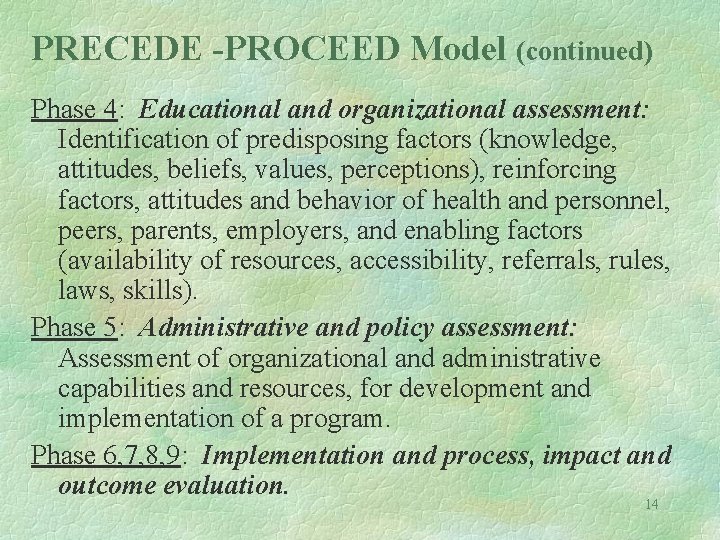
PRECEDE -PROCEED Model (continued) Phase 4: Educational and organizational assessment: Identification of predisposing factors (knowledge, attitudes, beliefs, values, perceptions), reinforcing factors, attitudes and behavior of health and personnel, peers, parents, employers, and enabling factors (availability of resources, accessibility, referrals, rules, laws, skills). Phase 5: Administrative and policy assessment: Assessment of organizational and administrative capabilities and resources, for development and implementation of a program. Phase 6, 7, 8, 9: Implementation and process, impact and outcome evaluation. 14

SAMHSA Prevention Platform The SAMHSA Prevention Platform is an online resource designed to assist professionals and community volunteers to engage in substance abuse prevention. The framework includes the following areas: • • • Assessment – determining your prevention needs. Capacity – improving your capabilities. Planning – developing a strategic plan. Implementation – putting your plan into action. Evaluation – documenting the outcomes of your work. Http: //preventionplatform. samhsa. gov 15

Model 16
Lessons from Prevention Research Sixteen Evidence-Based Principles 17
Principle 1 Prevention programs should enhance protective factors and reverse or reduce risk factors 18
Principle 2 Prevention programs should address all forms of substance abuse alone or in combination 19
Principle 3 Prevention programs should address the type of drug abuse problem in the local community, target modifiable risk factors, and strengthen identified protective factors 20
Principle 4 Prevention programs should be tailored to address risks specific to population or audience characteristics 21
Principle 5 Family-based prevention programs should enhance family bonding and relationships and include parenting skills; practice in developing, discussing, and enforcing family policies on substance abuse; and training in drug education and information 22
Principle 6 Prevention programs can be designed to intervene as early as preschool to address risk factors for drug abuse, such as aggressive behavior, poor social skills, and academic difficulties 23
Principle 7 Prevention programs for elementary school children should target improving academic and social-emotional learning to address risk factors for drug abuse, such as early aggression, academic failure, and school dropout. Education should focus on the following skills 24
Principle 7 (continued) u self-control; u emotional awareness; u communication; u social problem-solving; and u academic support, especially in reading 25
Principle 8 Prevention programs for middle or junior high and high school students should increase academic and social competence with the following skills 26
Principle 8 (continued) study habits and academic support; u communication; u peer relationships; u self-efficacy and assertiveness; u drug resistance skills; u reinforcement of anti-drug attitudes; and u strengthening of personal commitments against drug abuse. u 27
Principle 9 Prevention programs aimed at general populations at key transition points, such as the transition to middle school, can produce beneficial effects even among high-risk families and children. Such interventions do not single out risk populations and, therefore, reduce labeling and promote bonding to school and community 28
Principle 10 Community prevention programs that combine two or more effective programs, such as family-based and school-based programs, can be more effective than a single program alone 29
Principle 11 Community prevention programs reaching populations in multiple settings —for example, schools, clubs, faithbased organizations, and the media—are most effective when they present consistent, community-wide messages in each setting 30
Principle 12 When communities adapt programs to match their needs, community norms, or differing cultural requirements, they should retain core elements of the original research-based intervention 31
Principle 13 Prevention programs should be long-term with repeated interventions (i. e. , booster programs) to reinforce the original prevention goals. Research shows that the benefits from middle school prevention programs diminish without follow-up programs in high school 32
Principle 14 Prevention programs should include teacher training on good classroom management practices, such as rewarding appropriate student behavior. Such techniques help to foster students’ positive behavior, achievement, academic motivation, and school bonding 33
Principle 15 Prevention programs are most effective when they employ interactive techniques, such as peer discussion groups and parent roleplaying, that allow for active involvement in learning about drug abuse and reinforcing skills 34
Principle 16 Research-based prevention programs can be cost-effective. Similar to earlier research, recent research shows that for each dollar invested in prevention, a savings of up to $10 in treatment for alcohol or other substance abuse can be seen 35
Risk and Protection Factors 36
Risks Factors u Indicators for potential problem occurrence or vulnerability u Characteristics that occur more often for those who develop substance use problems (NCADI, 1990) 37
Protective Factors u Presence of positive influences u Not merely absence or opposite of risk factors (NCADI, 1990) 38
Resilience u u u An ability to recover from or adjust easily to misfortune or change (Webster) Successful adaptation despite risk and adversity (Wolin and Wolin, 1995) Protective factors lead to resilience 39
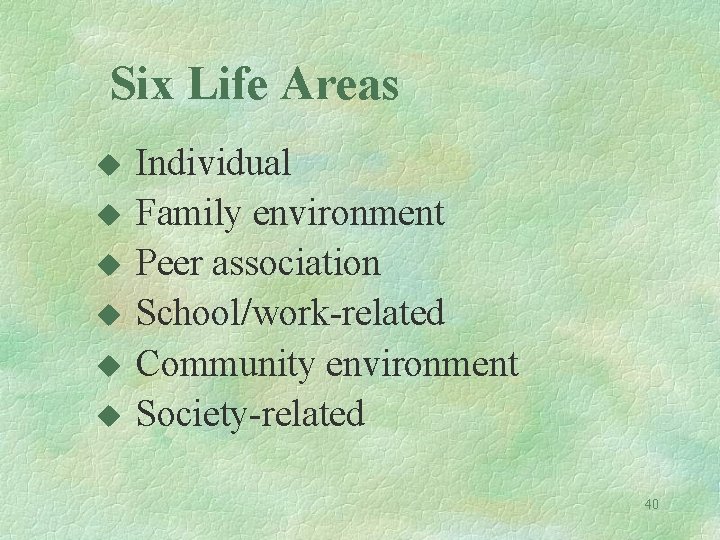
Six Life Areas u u u Individual Family environment Peer association School/work-related Community environment Society-related 40
Risk Factors Personal/Individual Genetic/biomedical factors u Attitudes and predispositions u Perception of risk u 41
Risk Factors (continued) Personal/Individual Other predispositions • Impulsivity • Hostility • Rebelliousness Deficits in social skills • Early aggression • Alienation 42
Risk Factors (continued) Personal/Individual Problem Behaviors: • Juvenile delinquency • Violence • Teen pregnancy • Dropping out of school 43
Protective Factors Personal/Individual u u u u Good social skills Caring and cooperative Positive sense of self Problem-solving skills Sense of humor Autonomy and purpose Genetics/biomedical factors Pro-social bonding 44
Protective Factors (continued) Personal/Individual u u Genetically controlled variation of aldehyde hydrogenase (ALDH 2), called ALDH 2 -2, in 10% of Asians creates intense reaction to alcohol. Lower alcoholism risk is also associated with genetically controlled variants of alcohol dehydrogenase (ADH 2, ADH 3) in Asians and several other ethnic groups (Schuckit, 1999) 45
Risk Factors Family u u u Abusive or conflict-ridden families Economic deprivation Reduced supervision Limited formal controls Limited social supports Poor family discipline, and problemsolving 46
Risk Factors (continued) Family Parental use of alcohol and drugs u Parental positive attitudes toward substance use u 47
Protective Factors Family u u u u Positive bonding Lack of severe criticism Basic trust High parental expectations Clear rules Parental involvement in activities Involvement in religious institutions 48
Risk Factors School Substandard academic environment u A negative, disorderly, and unsafe school climate u Low teacher expectations of student achievement u 49
Protective Factors School u u Caring and support High expectations Clear standards and rules Youth participation in tasks and decisions 50
Risk Factors Peer Group u u u Negative influence of peers Involvement with friends who use alcohol and drugs Involvement with peers who engage in other risky behaviors 51
Protective Factors Peer Group u u Positive peer group activities Positive peer group norms Peer groups with skills to resist negative influences Peer groups with good decision-making skills 52
Risk Factors Community norms that promote or permit substance use u Poverty u Community disorganization u Cultural disenfranchisement u 53
Risk Factors (continued) Community u u Customs/policies that encourage substance use Pro-use messages in the general media. Pro-use targeted promotion High availability of substances 54
Protective Factors Community u u u Caring and support High expectations Opportunities for participation Presence of effective prevention programs Laws/norms that discourage substance use 55
Risk Factors Societal u u Availability of substances National conditions • Poor economy and unemployment • Discrimination and marginalization u Media messages 56
Protective Factors Societal u u u Teaching children about media messages Counter-advertising messages Decreasing substance availability/accessibility 57
Risk Factors for the Elderly u Polypharmacy Increased biologic sensitivity to substances Negative coping responses Change in role status Change in health status u Loss u u 58
Risk Factors for the Elderly (continued) u Loneliness u Boredom u Lack of social support u Depression (Marcus, 1993, Schonfeld & Dupree, 1991; Fingerhood, 2000) 59
Protective Factors for the Elderly u u Positive coping responses to life changes Supportive family Supportive social networks Aware of drug interactions and potential for biologic sensitivity to substances (Welte & Mirand, 1995; Simoneau & Bergeron, 2000) 60
Role of the Health Care Practitioner In the clinical area: u To identify people who have risk factors; u To build protective factors by giving healthy prevention messages; u To set up the office space to promote health and prevent substance use problems. 61
Role of the Health Care Practitioner (continued) In the community: u u u To participate in community and school activities; To utilize home visits; To work in professional organizations to promote prevention activities; To advocate with government officials on all levels to change laws/policies; To promote Healthy People 2010 objectives. 62
Designing Effective Prevention Programs u Promote protective factors u Reduce risk factors u Consider theories of behavioral change u Include strategies that enhance clientprovider interaction and participation u Consider cultural factors 63
Theories of Change u u u Social cognitive theory (Bandura, 1986) Problem-based theory (Jessor & Jessor, 1997) Peer cluster theory (Oetting & Beauvois, 1986) Theory of ethnic identity (Phinney, 1990) Transtheoretical model (Prochaska & Di. Clemente. 1983) 64
Cultural Competence u Link between cultural competence and success or failure of preventive interventions u Successful programs take into account dominant and non-dominant cultures n which individuals live u Growing body of literature to guide the practitioner/researcher in developing cultural competence programs 65
General Prevention Strategies u u u Information dissemination Development of life-coping skills Provision of alternatives Community development Advocacy for a healthy environment Problem identification (CSAP, 1999) 66
Elements of Effective Programs u u Standardized training materials Social learning theory methods Periodic booster sessions Techniques to extend program beyond the setting. (Pentz, 1999) 67
Combined Strategies in Communities are Most Effective u u u Curriculum in schools Parent involvement Support by community leaders and health professionals Enforcement of policies Use of mass media to enforce messages (Pentz, 1999) 68
Settings for Community. Based Strategies u u u u Schools Religious organizations Community centers Youth organizations Family centers Senior centers Libraries and other community facilities 69
Community-Based Participatory Approaches u Participatory Action research u Community-based participatory research u Action research 70
Community-Based Participatory Approaches u Assure that programs are tailored to community u Increase community capacity to deliver interventions u Result in increased knowledge and social change u Involve interactions between researcher and stakeholders 71
Evaluation Rationale u. A systematic way to monitor clients’ outcomes that result from intervention. u Feedback that reflects the need to make adjustments. u Evidence that the program works and is cost effective. u Findings that contribute to the development of “best practices” in prevention efforts. u A method to disseminate findings to others in the field. (Prevention Programs for Youth, 1998) 72
Evaluation u Process • Documenting all aspects of implementation of the program u Outcomes • Short-term benefits: new knowledge, improved skills and changed attitudes • Long-term benefits: changed behaviors, reduced risks and enhanced protective factors. 73
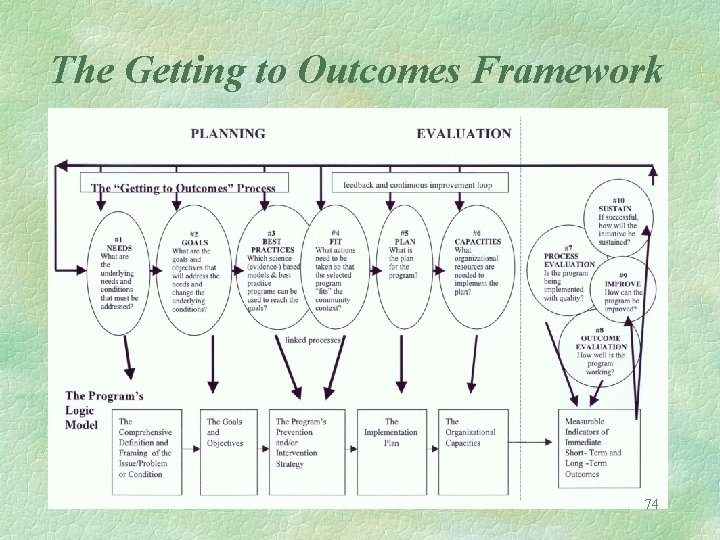
The Getting to Outcomes Framework 74
Summary Community-based substance abuse prevention u Complex, multifaceted process u Domain of health care professionals 75
- Slides: 75