
Module IV Memory Organization COMPUTER MEMORY SYSTEM OVERVIEW
- Slides: 13
Module IV Memory Organization
COMPUTER MEMORY SYSTEM OVERVIEW
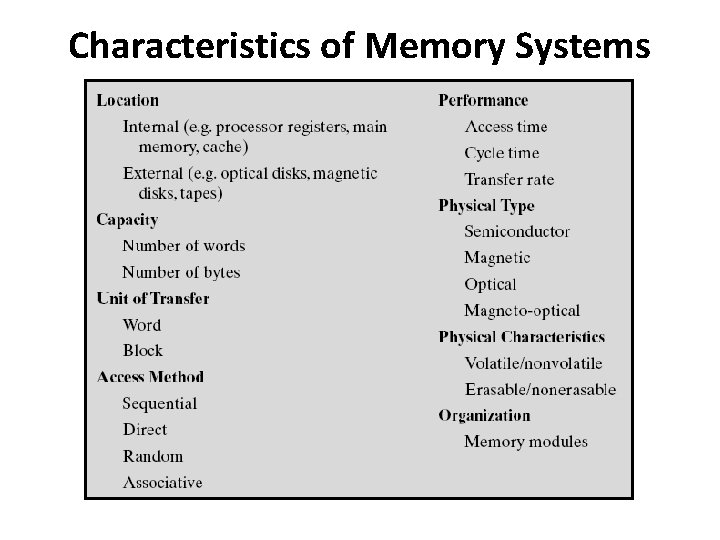
Characteristics of Memory Systems
Location • Location refers to whether memory is internal and external to the computer. • Internal memory includes – Main memory – Internal registers – Control unit memory – Cache memory • External memory are accessible to processor via I/O controllers. • It consists of peripheral storage devices such as disk and tape
Capacity • For Internal memory, – expressed in terms of bytes (1 byte 8 bits) or words. Common word lengths are 8, 16, and 32 bits. • For External memory, – expressed in terms of bytes.
Unit of Transfer • For internal memory, the unit of transfer is equal to the number of electrical lines into and out of the memory module. – This may be equal to the word length such as 64, 128, or 256 bits. • For external memory, data is transferred in larger units than a word referred to as blocks.
Method of Access • Sequential access: – Memory is organized into units of data called records. – Access must be made in a specific linear sequence – The time to access an arbitrary record is highly variable. – E. g Tape units
Method of Access • Direct access: – individual blocks or records have a unique address based on physical location. – Access is accomplished by direct access to reach a general vicinity plus sequential searching to reach the final location. – Access time is variable. – E. g. Disk units
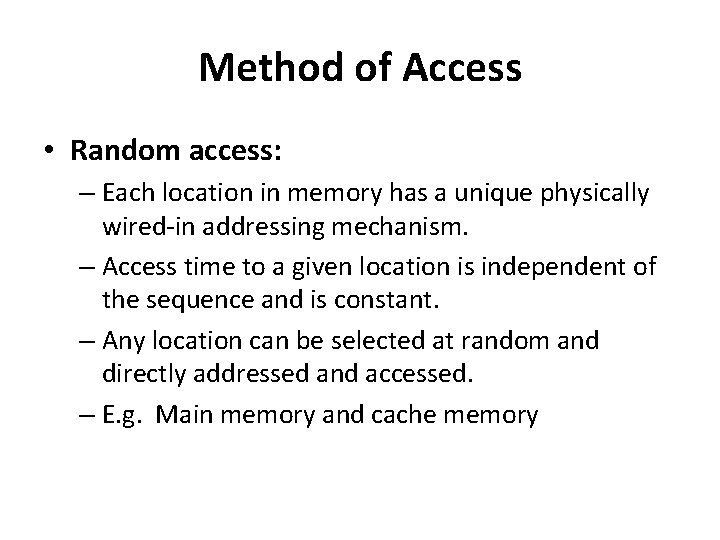
Method of Access • Random access: – Each location in memory has a unique physically wired-in addressing mechanism. – Access time to a given location is independent of the sequence and is constant. – Any location can be selected at random and directly addressed and accessed. – E. g. Main memory and cache memory
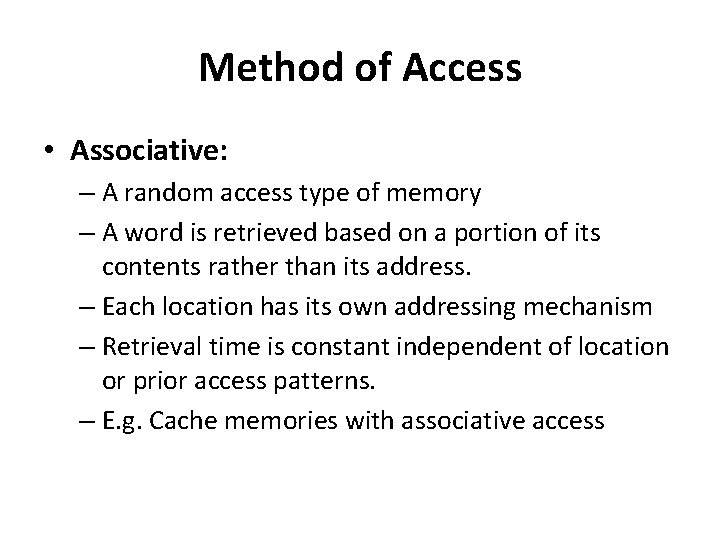
Method of Access • Associative: – A random access type of memory – A word is retrieved based on a portion of its contents rather than its address. – Each location has its own addressing mechanism – Retrieval time is constant independent of location or prior access patterns. – E. g. Cache memories with associative access
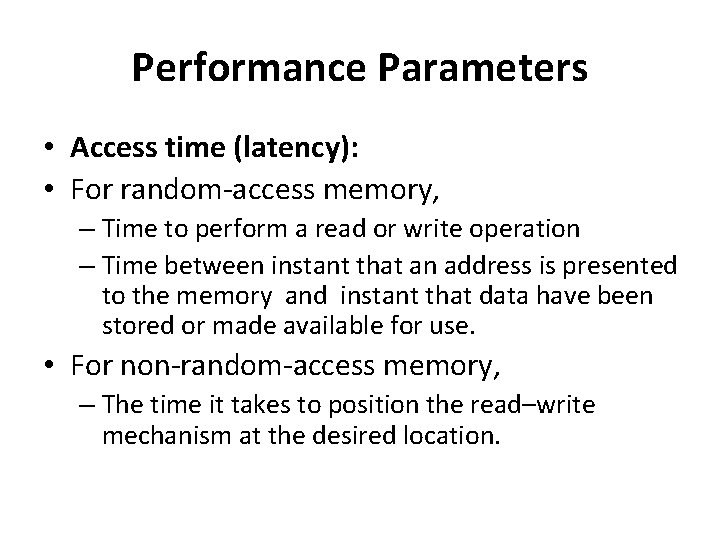
Performance Parameters • Access time (latency): • For random-access memory, – Time to perform a read or write operation – Time between instant that an address is presented to the memory and instant that data have been stored or made available for use. • For non-random-access memory, – The time it takes to position the read–write mechanism at the desired location.
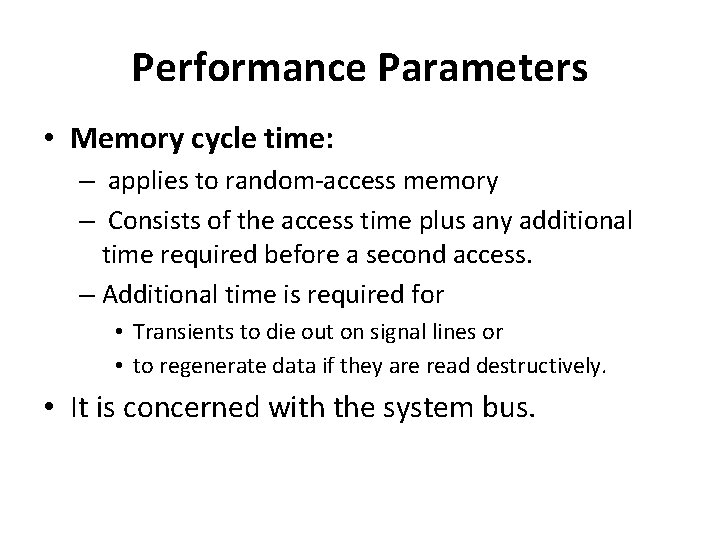
Performance Parameters • Memory cycle time: – applies to random-access memory – Consists of the access time plus any additional time required before a second access. – Additional time is required for • Transients to die out on signal lines or • to regenerate data if they are read destructively. • It is concerned with the system bus.
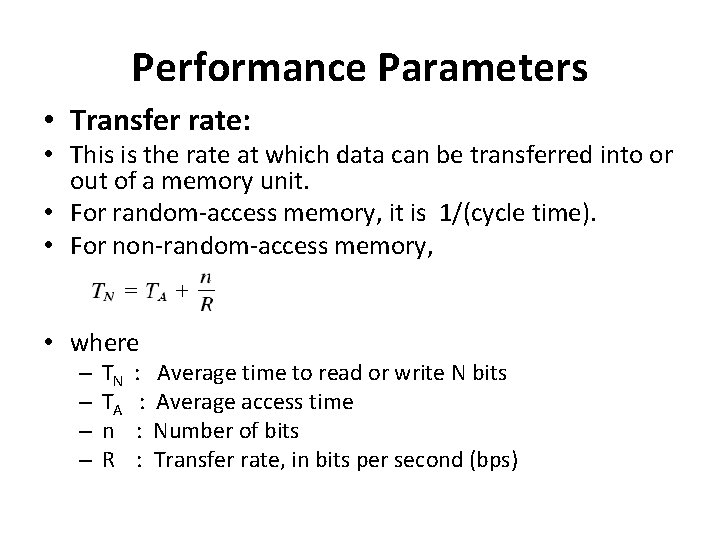
Performance Parameters • Transfer rate: • This is the rate at which data can be transferred into or out of a memory unit. • For random-access memory, it is 1/(cycle time). • For non-random-access memory, • where – – TN TA n R : : Average time to read or write N bits Average access time Number of bits Transfer rate, in bits per second (bps)