
Module III Profiling Health Care Providers A Multilevel





- Slides: 56
Module III: Profiling Health Care Providers – A Multi-level Model Application Instructor: Elizabeth Johnson Course Developed: Francesca Dominici and Michael Griswold Johns Hopkins University Bloomberg School of Public Health 2006 Summer Epi/Bio Institute 1
Outline n What is profiling? ¨ Definitions ¨ Statistical challenges ¨ Centrality of multi-level analysis n Fitting Multilevel Models with Winbugs: ¨ n A toy example on institutional ranking Profiling medical care providers: a case-study ¨ Hierarchical logistic regression model ¨ Performance measures ¨ Comparison with standard approaches 2006 Summer Epi/Bio Institute 2
What is profiling? Profiling is the process of comparing quality of care, use of services, and cost with normative or community standards n Profiling analysis is developing and implementing performance indices to evaluate physicians, hospitals, and care -providing networks n 2006 Summer Epi/Bio Institute 3
Objectives of profiling n Estimate provider-specific performance measures: ¨ measures of utilization ¨ patients outcomes ¨ satisfaction of care n Compare these estimates to a community or a normative standard 2006 Summer Epi/Bio Institute 4
2006 Summer Epi/Bio Institute 5
Evaluating hospital performance n n Health Care Financing Administration (HCFA) evaluated hospital performance in 1987 by comparing observed and expected mortality rates for Medicare patients Expected Mortality rates within each hospital were obtained by : ¨ Estimating a patient-level model of mortality ¨ Averaging the model-based probabilities of mortality for all patients within each hospital n Hospitals with higher-than-expected mortality rates were flagged as institutions with potential quality problems 2006 Summer Epi/Bio Institute 6
Statistical Challenges n n Hospital profiling needs to take into account ¨ Patients characteristics ¨ Hospital characteristics ¨ Correlation between outcomes of patients within the same hospital ¨ Number of patients in the hospital These data characteristics motivate the centrality of multi-level data analysis 2006 Summer Epi/Bio Institute 7
“Case-mix” bias n Estimating hospital specific mortality rates without taking into account patient characteristics ¨ Suppose that older and sicker patients with multiple diseases have different needs for health care services and different health outcomes independent of the quality of care they receive. In this case, physicians who see such patients may appear to provide lower quality of care than those who see younger and healthier patients n Develop patient-level regression models to control for different case-mixes 2006 Summer Epi/Bio Institute 8
Within cluster correlation Hospital practices may induce a strong correlation among patient outcomes within hospitals even after accounting for patients characteristics n Extend standard regression models to multi-level models that take into account the clustered nature of the data n 2006 Summer Epi/Bio Institute 9
Health care quality data are multilevel! n Data are clustered at multiple-levels ¨ Patients clustered by providers, physicians, hospitals, HMOs ¨ Providers clustered by health care systems, market areas, geographic areas n n n Provider sizes may vary substantially Covariates at different levels of aggregation: patient-level, provider level Statistical uncertainty of performance estimates need to take into account: ¨ Systematic and random variation ¨ Provider-specific measures of utilization, costs 2006 Summer Epi/Bio Institute 10
Sampling variability versus systematic variability n n n “Sampling variability”: statistical uncertainty of the hospital-specific performance measures “Systematic variability” : variability between hospitals performances that can be possibly explained by hospital-specific characteristics (aka “natural variability”) Develop multi-level models that incorporate both patient-level and hospital-level characteristics 2006 Summer Epi/Bio Institute 11
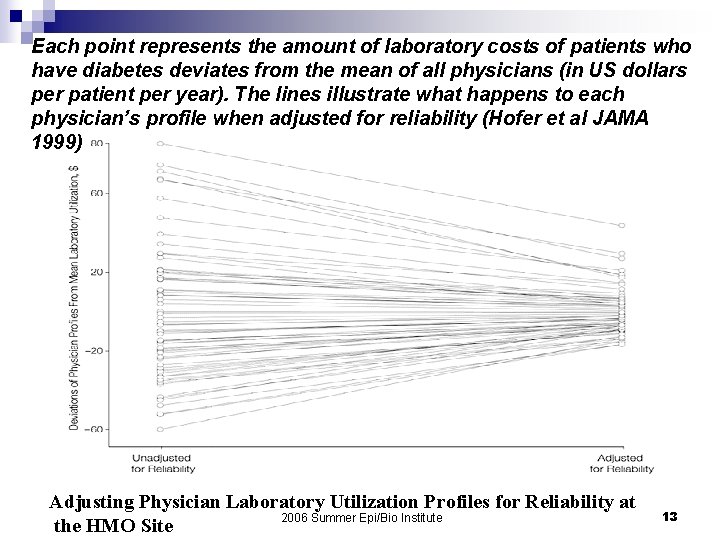
Borrowing strength n n Reliability of hospital-specific estimates: ¨ because of difference in hospital sample sizes, the precision of the hospital-specific estimates may vary greatly. Large differences between observed and expected mortality rates at hospitals with small sample sizes may be due primarily to sampling variability Implement shrinkage estimation methods: hospitals performances with small sample size will be shrunk toward the mean more heavily 2006 Summer Epi/Bio Institute 12
Each point represents the amount of laboratory costs of patients who have diabetes deviates from the mean of all physicians (in US dollars per patient per year). The lines illustrate what happens to each physician’s profile when adjusted for reliability (Hofer et al JAMA 1999) Adjusting Physician Laboratory Utilization Profiles for Reliability at 2006 Summer Epi/Bio Institute the HMO Site 13
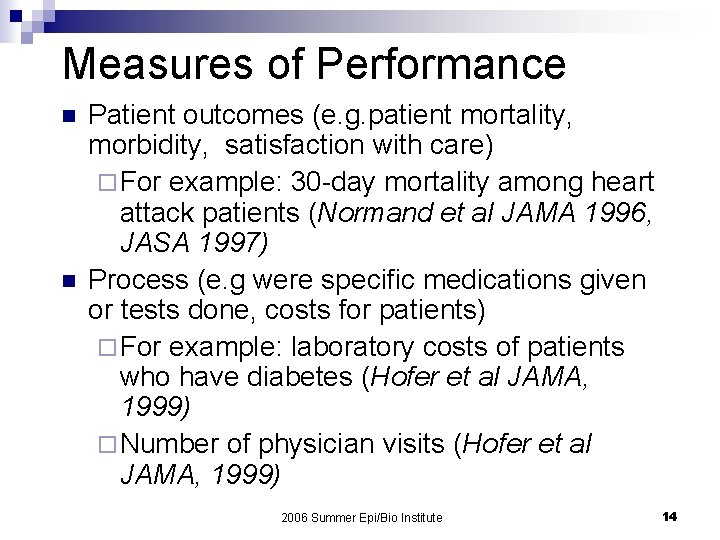
Measures of Performance n n Patient outcomes (e. g. patient mortality, morbidity, satisfaction with care) ¨ For example: 30 -day mortality among heart attack patients (Normand et al JAMA 1996, JASA 1997) Process (e. g were specific medications given or tests done, costs for patients) ¨ For example: laboratory costs of patients who have diabetes (Hofer et al JAMA, 1999) ¨ Number of physician visits (Hofer et al JAMA, 1999) 2006 Summer Epi/Bio Institute 14
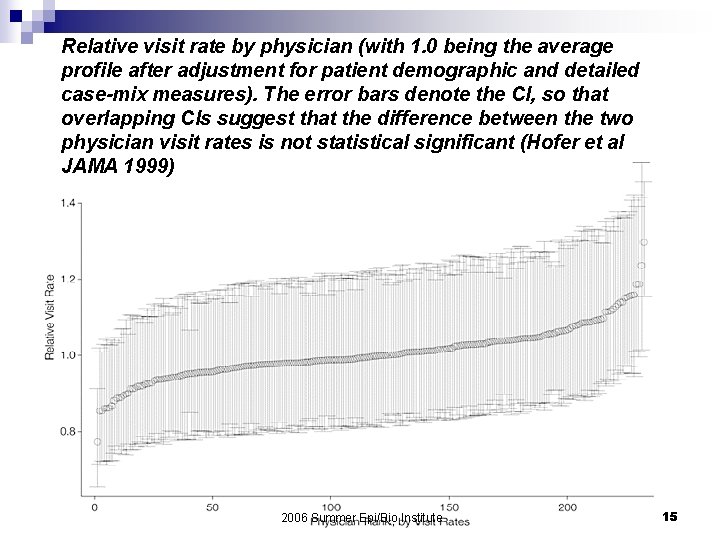
Relative visit rate by physician (with 1. 0 being the average profile after adjustment for patient demographic and detailed case-mix measures). The error bars denote the CI, so that overlapping CIs suggest that the difference between the two physician visit rates is not statistical significant (Hofer et al JAMA 1999) 2006 Summer Epi/Bio Institute 15
Fitting Multilevel Models in Winbugs A Toy example in institutional ranking 2006 Summer Epi/Bio Institute 16
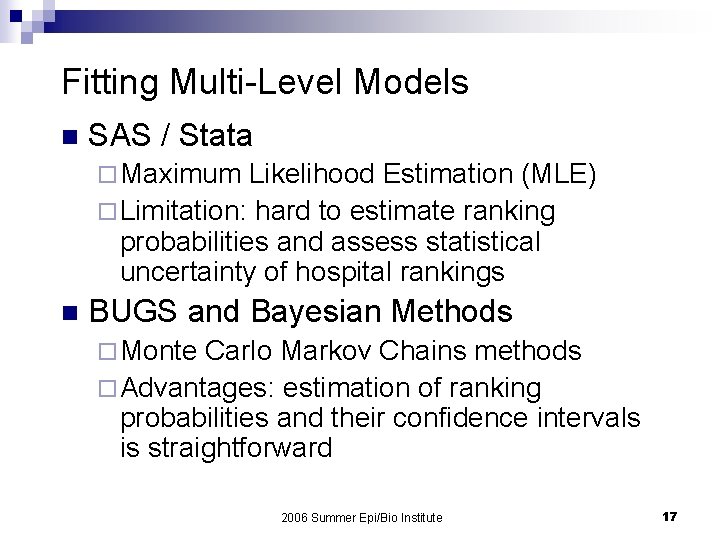
Fitting Multi-Level Models n SAS / Stata ¨ Maximum Likelihood Estimation (MLE) ¨ Limitation: hard to estimate ranking probabilities and assess statistical uncertainty of hospital rankings n BUGS and Bayesian Methods ¨ Monte Carlo Markov Chains methods ¨ Advantages: estimation of ranking probabilities and their confidence intervals is straightforward 2006 Summer Epi/Bio Institute 17
2006 Summer Epi/Bio Institute 18
2006 Summer Epi/Bio Institute 19
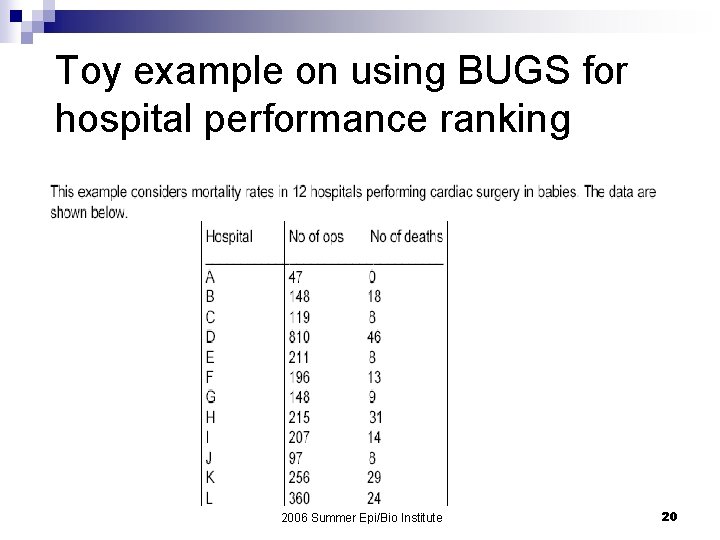
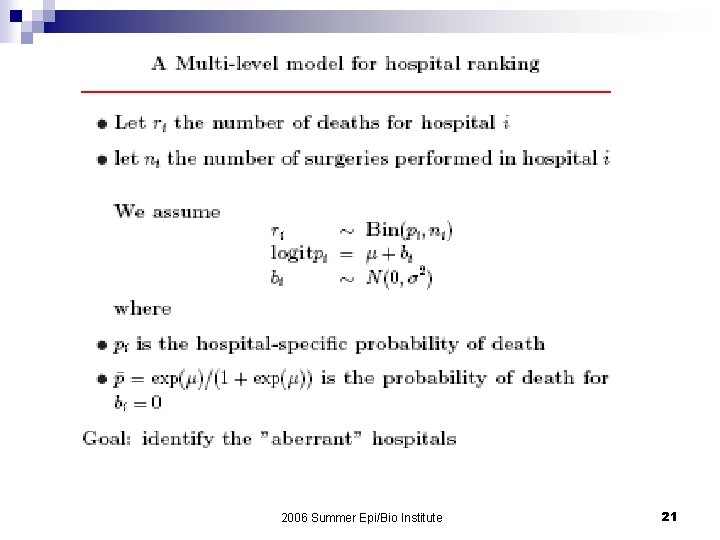
Toy example on using BUGS for hospital performance ranking 2006 Summer Epi/Bio Institute 20
2006 Summer Epi/Bio Institute 21
BUGS Model specification 2006 Summer Epi/Bio Institute 22
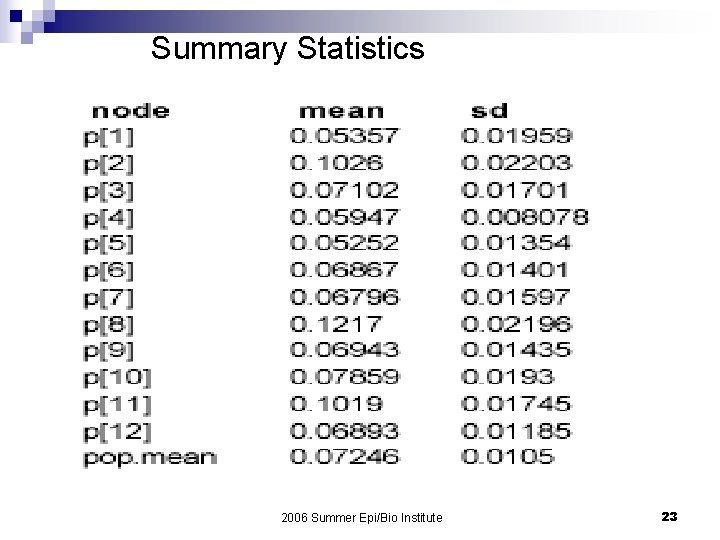
Summary Statistics 2006 Summer Epi/Bio Institute 23
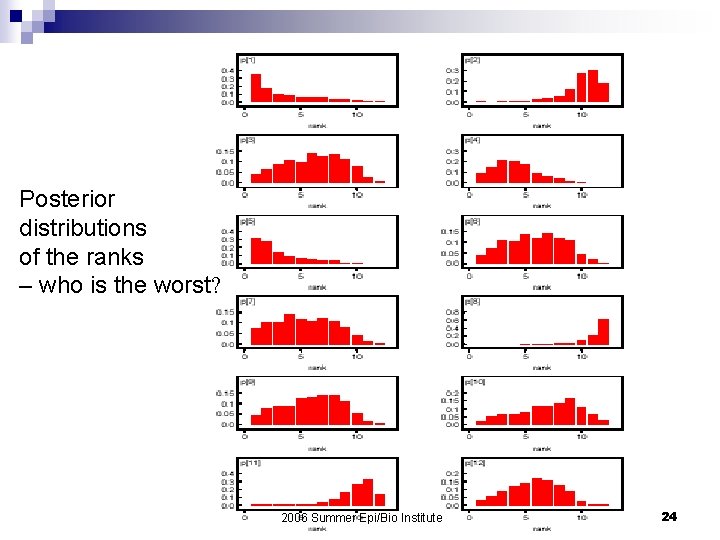
Posterior distributions of the ranks – who is the worst? 2006 Summer Epi/Bio Institute 24
Hospital Profiling of Mortality Rates for Acute Myocardial Infarction Patients (Normand et al JAMA 1996, JASA 1997) Data characteristics n Scientific goals n Multi-level logistic regression model n Definition of performance measures n Estimation n Results n Discussion n 2006 Summer Epi/Bio Institute 25
Data Characteristics The Cooperative Cardiovascular Project (CCP) involved abstracting medical records for patients discharged from hospitals located in Alabama, Connecticut, Iowa, and Wisconsin (June 1992 - May 1993) n 3, 269 patients hospitalized in 122 hospitals in four US States for Acute Myocardial Infarction n 2006 Summer Epi/Bio Institute 26
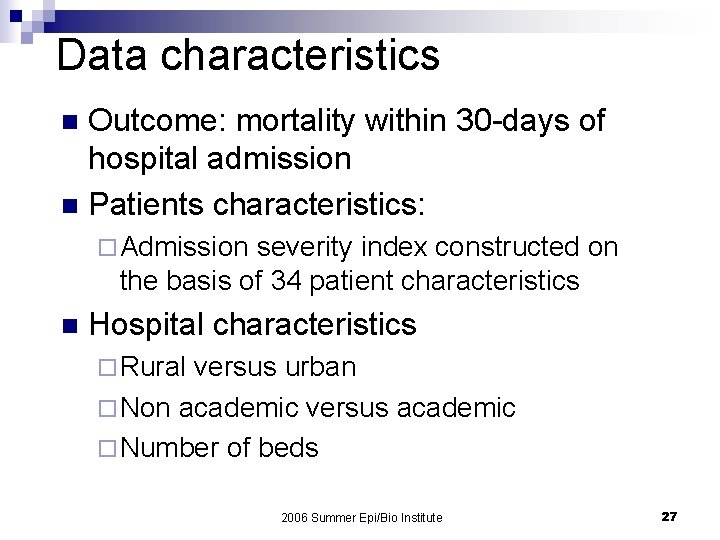
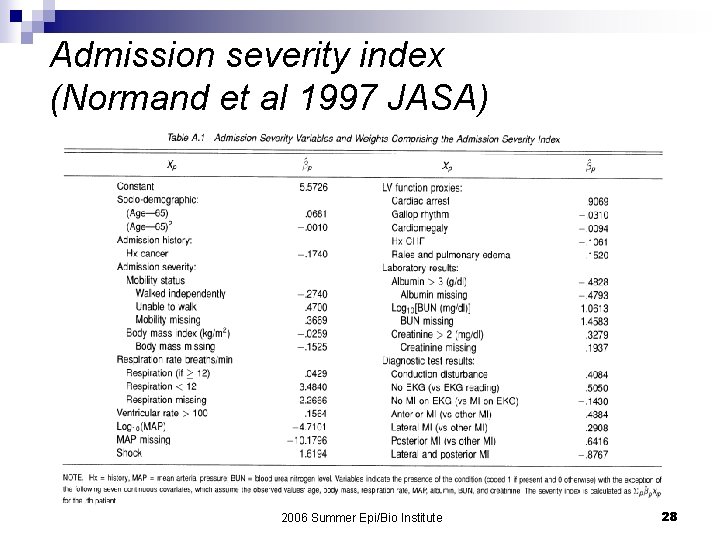
Data characteristics Outcome: mortality within 30 -days of hospital admission n Patients characteristics: n ¨ Admission severity index constructed on the basis of 34 patient characteristics n Hospital characteristics ¨ Rural versus urban ¨ Non academic versus academic ¨ Number of beds 2006 Summer Epi/Bio Institute 27
Admission severity index (Normand et al 1997 JASA) 2006 Summer Epi/Bio Institute 28
Scientific Goals: Identify “aberrant” hospitals in terms of several performance measures n Report the statistical uncertainty associated with the ranking of the “worst hospitals” n Investigate if hospital characteristics explain heterogeneity of hospitalspecific mortality rates n 2006 Summer Epi/Bio Institute 29
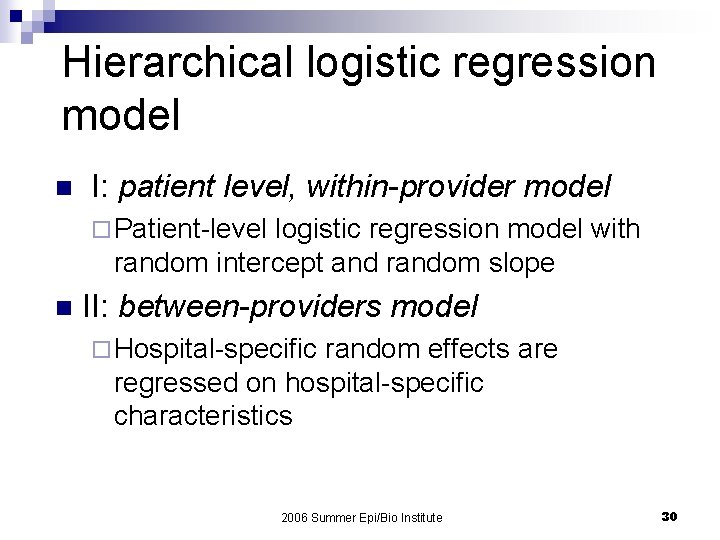
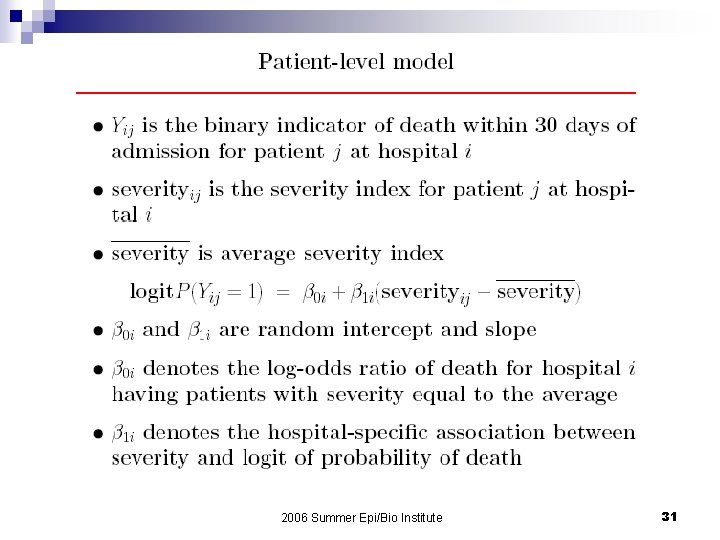
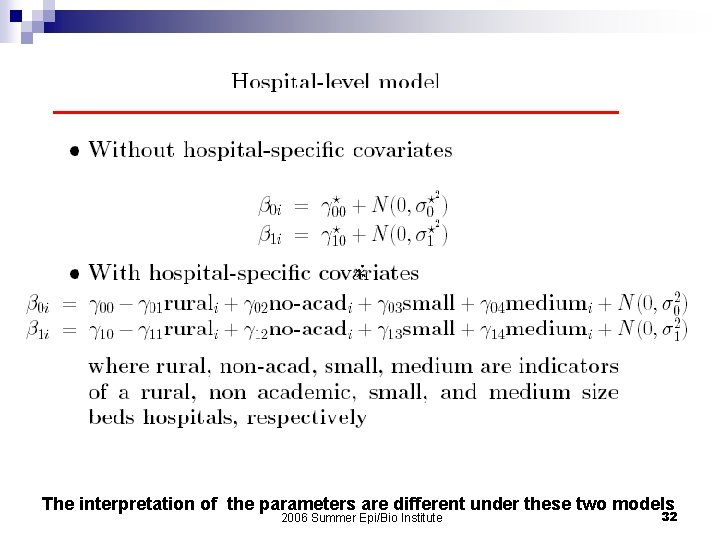
Hierarchical logistic regression model n I: patient level, within-provider model ¨ Patient-level logistic regression model with random intercept and random slope n II: between-providers model ¨ Hospital-specific random effects are regressed on hospital-specific characteristics 2006 Summer Epi/Bio Institute 30
2006 Summer Epi/Bio Institute 31
The interpretation of the parameters are different under these two models 2006 Summer Epi/Bio Institute 32
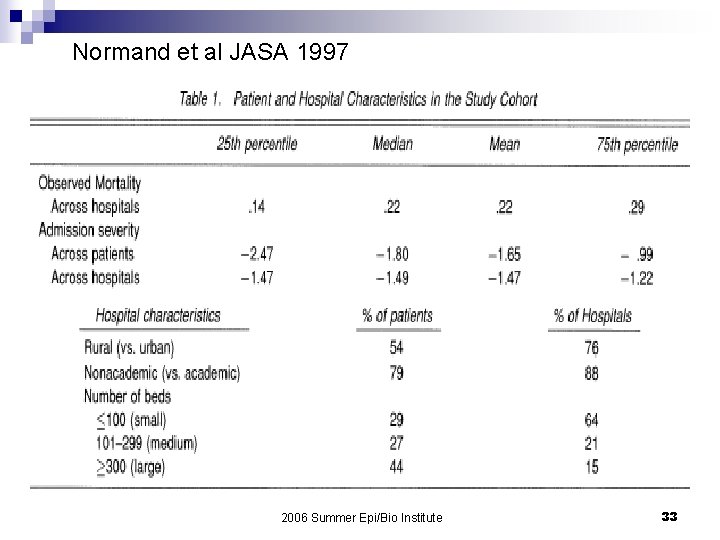
Normand et al JASA 1997 2006 Summer Epi/Bio Institute 33
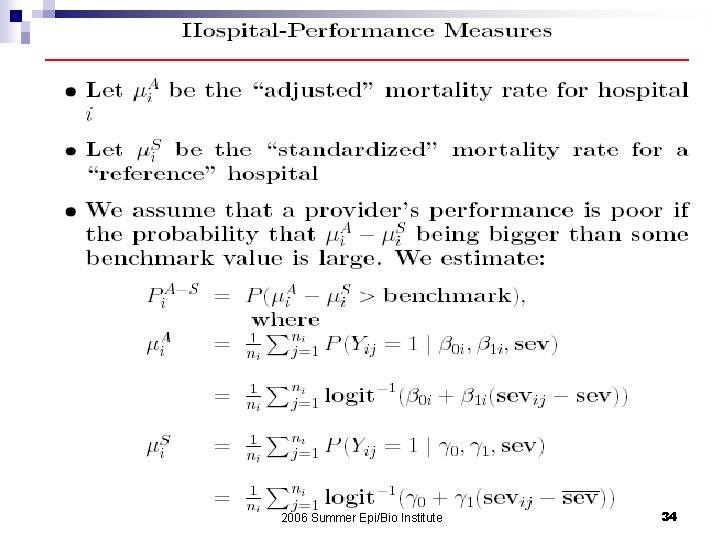
2006 Summer Epi/Bio Institute 34
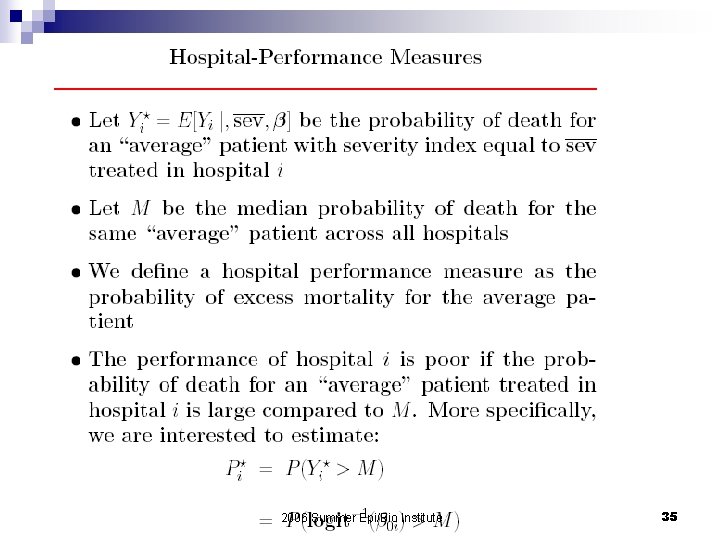
2006 Summer Epi/Bio Institute 35
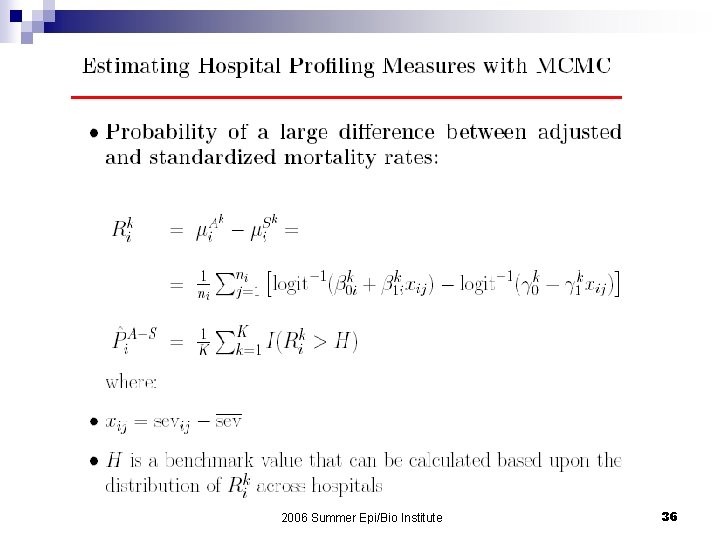
2006 Summer Epi/Bio Institute 36
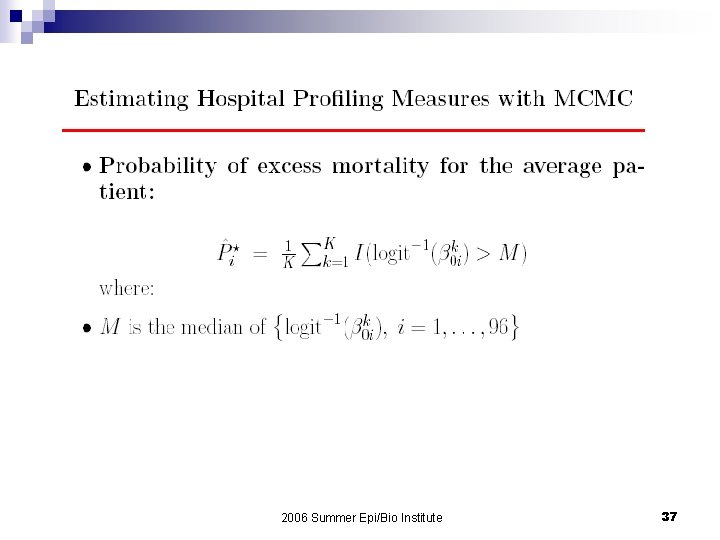
2006 Summer Epi/Bio Institute 37
2006 Summer Epi/Bio Institute 38
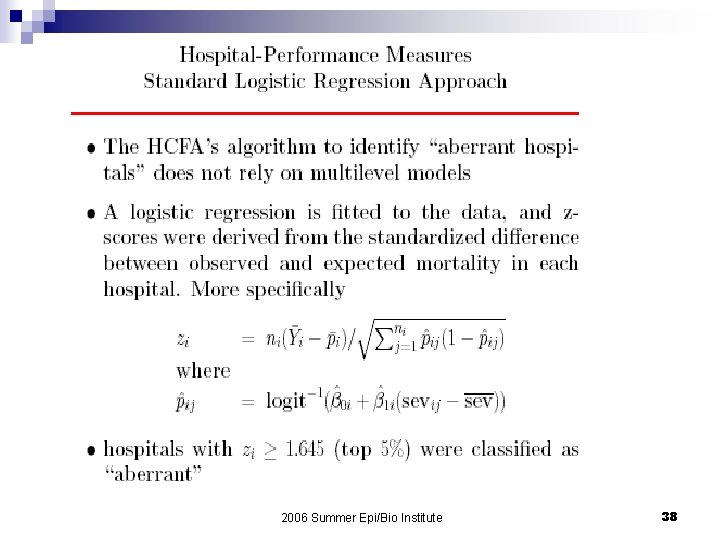
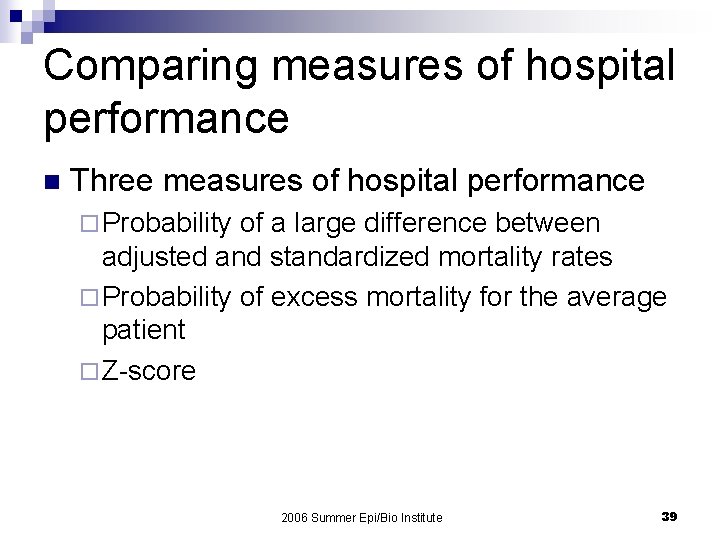
Comparing measures of hospital performance n Three measures of hospital performance ¨ Probability of a large difference between adjusted and standardized mortality rates ¨ Probability of excess mortality for the average patient ¨ Z-score 2006 Summer Epi/Bio Institute 39
Results n Estimates of regression coefficients under three models: ¨ Random intercept only ¨ Random intercept and random slope ¨ Random intercept, random slope, and hospital covariates n Hospital performance measures 2006 Summer Epi/Bio Institute 40
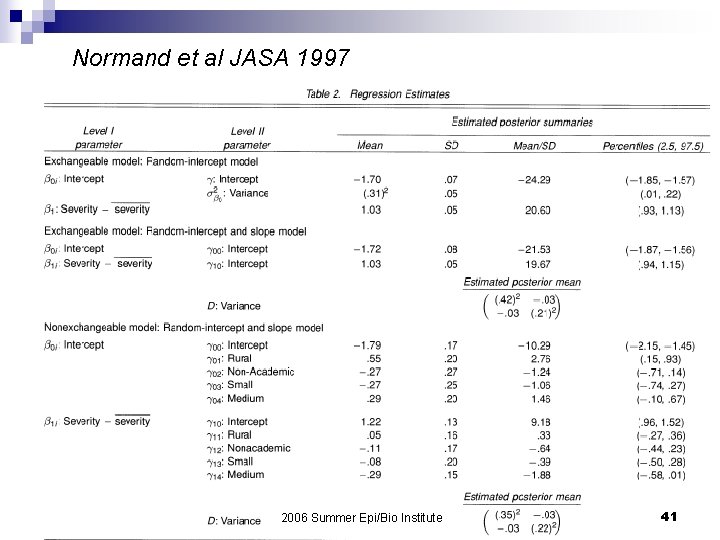
Normand et al JASA 1997 2006 Summer Epi/Bio Institute 41
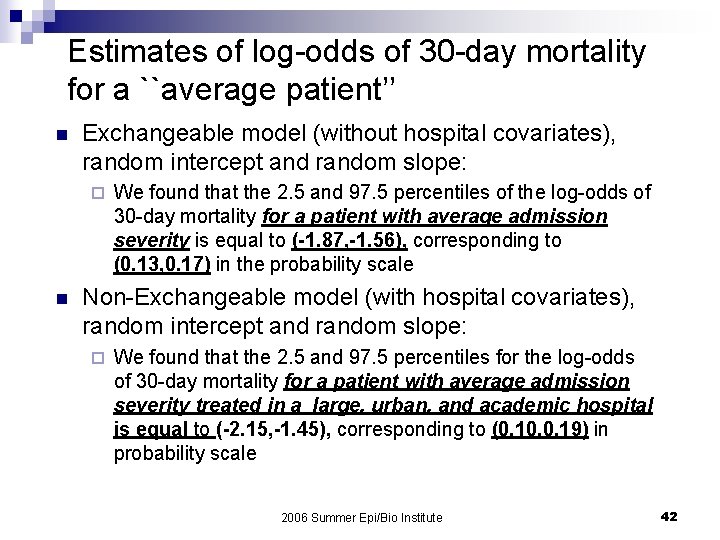
Estimates of log-odds of 30 -day mortality for a ``average patient’’ n Exchangeable model (without hospital covariates), random intercept and random slope: ¨ n We found that the 2. 5 and 97. 5 percentiles of the log-odds of 30 -day mortality for a patient with average admission severity is equal to (-1. 87, -1. 56), corresponding to (0. 13, 0. 17) in the probability scale Non-Exchangeable model (with hospital covariates), random intercept and random slope: ¨ We found that the 2. 5 and 97. 5 percentiles for the log-odds of 30 -day mortality for a patient with average admission severity treated in a large, urban, and academic hospital is equal to (-2. 15, -1. 45), corresponding to (0. 10, 0. 19) in probability scale 2006 Summer Epi/Bio Institute 42
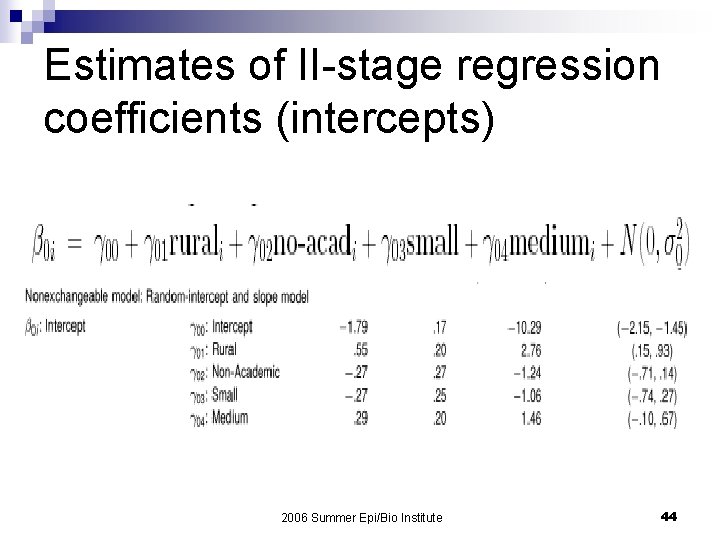
Effect of hospital characteristics on baseline log-odds of mortality Rural hospitals have higher odds ratio of mortality than urban hospitals for an average patient n This is an indication of inter-hospital differences in the baseline mortality rates n 2006 Summer Epi/Bio Institute 43
Estimates of II-stage regression coefficients (intercepts) 2006 Summer Epi/Bio Institute 44
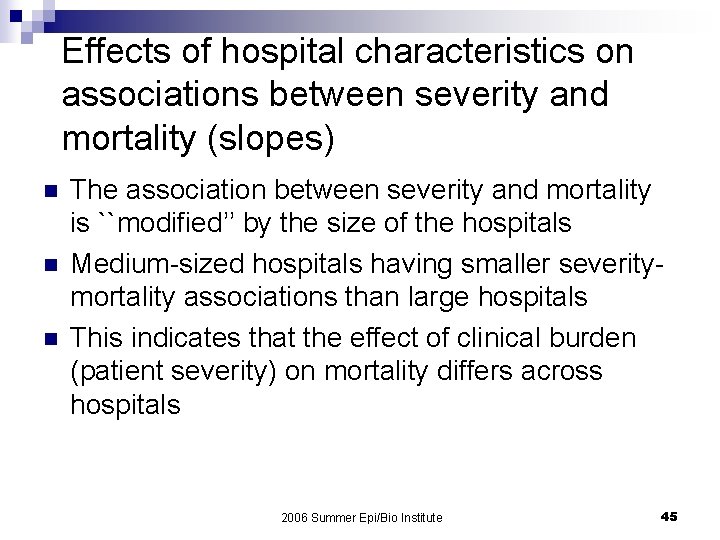
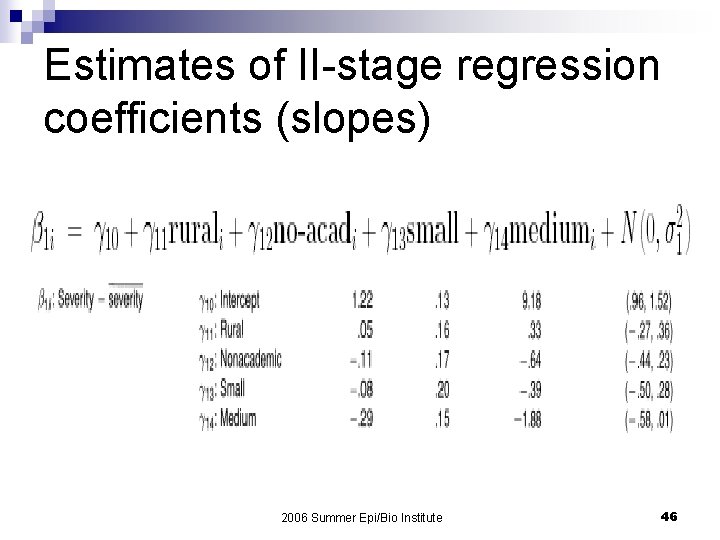
Effects of hospital characteristics on associations between severity and mortality (slopes) n n n The association between severity and mortality is ``modified’’ by the size of the hospitals Medium-sized hospitals having smaller severitymortality associations than large hospitals This indicates that the effect of clinical burden (patient severity) on mortality differs across hospitals 2006 Summer Epi/Bio Institute 45
Estimates of II-stage regression coefficients (slopes) 2006 Summer Epi/Bio Institute 46
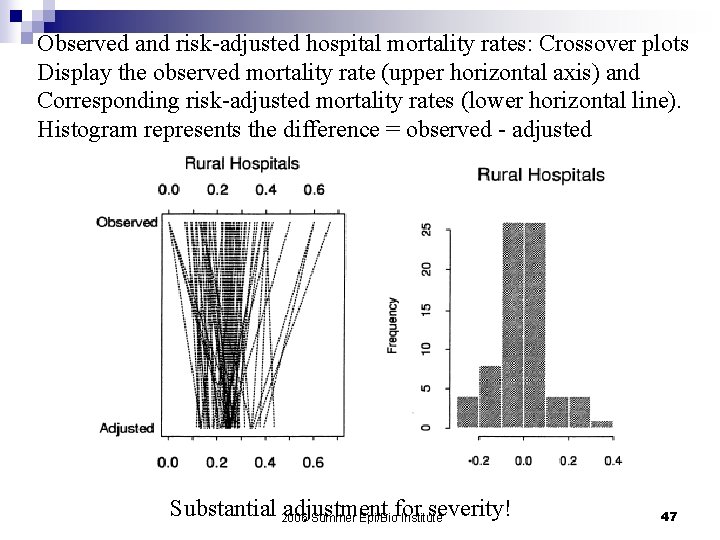
Observed and risk-adjusted hospital mortality rates: Crossover plots Display the observed mortality rate (upper horizontal axis) and Corresponding risk-adjusted mortality rates (lower horizontal line). Histogram represents the difference = observed - adjusted Substantial 2006 adjustment for severity! Summer Epi/Bio Institute 47
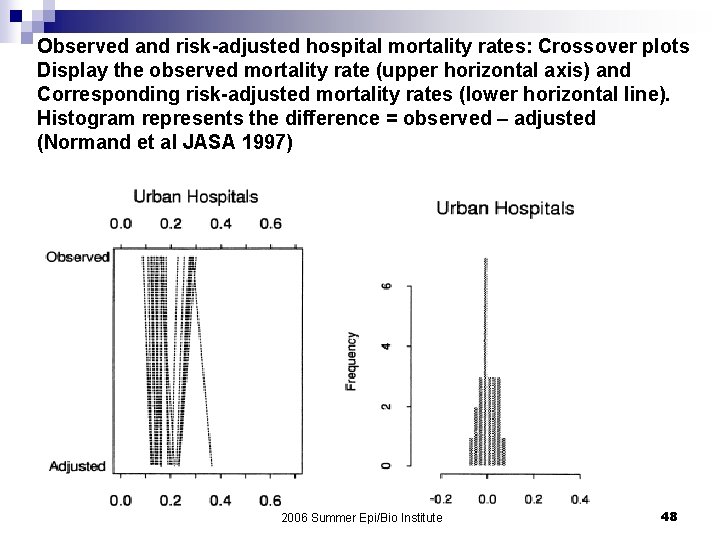
Observed and risk-adjusted hospital mortality rates: Crossover plots Display the observed mortality rate (upper horizontal axis) and Corresponding risk-adjusted mortality rates (lower horizontal line). Histogram represents the difference = observed – adjusted (Normand et al JASA 1997) 2006 Summer Epi/Bio Institute 48
What are these pictures telling us? Adjustment for severity on admission is substantial (mortality rate for an urban hospital moves from 29% to 37% when adjusted for severity) n There appears to be less variability in changes between the observed and the adjusted mortality rates for urban hospitals than for rural hospitals n 2006 Summer Epi/Bio Institute 49
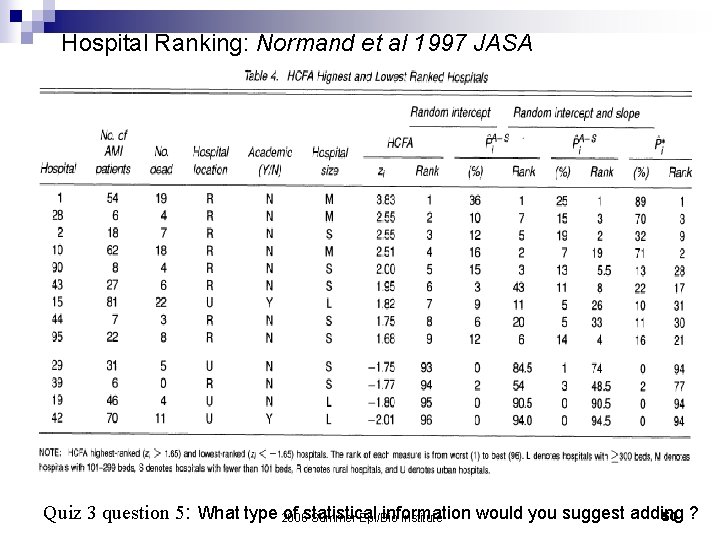
Hospital Ranking: Normand et al 1997 JASA Quiz 3 question 5: What type 2006 of statistical information would you suggest adding 50 ? Summer Epi/Bio Institute
Ranking of hospitals There was moderate disagreement among the criteria for classifying hospitals as ``aberrant” n Despite this, hospital 1 is ranked as the worst. This hospital is rural, medium sized non-academic with an observed mortality rate of 35%, and adjusted rate of 28% n 2006 Summer Epi/Bio Institute 51
Discussion n n Profiling medical providers is a multi-faced and data intensive process with significant implications for health care practice, management, and policy Major issues include data quality and availability, choice of performance measures, formulation of statistical analyses, and development of approaches to reporting results of profiling analyses 2006 Summer Epi/Bio Institute 52
Discussion n n Performance measures were estimated using a unifying statistical approach based on multilevel models Multi-level models: ¨ take into account the hierarchical structure usually present in data for profiling analyses ¨ Provide a flexible framework for analyzing a variety of different types of response variables and for incorporating covariates at different levels of hierarchal structure 2006 Summer Epi/Bio Institute 53
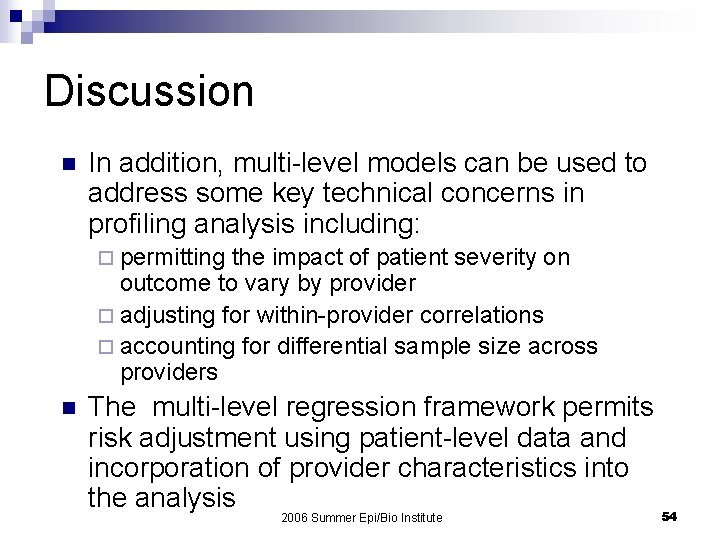
Discussion n In addition, multi-level models can be used to address some key technical concerns in profiling analysis including: ¨ permitting the impact of patient severity on outcome to vary by provider ¨ adjusting for within-provider correlations ¨ accounting for differential sample size across providers n The multi-level regression framework permits risk adjustment using patient-level data and incorporation of provider characteristics into the analysis 2006 Summer Epi/Bio Institute 54
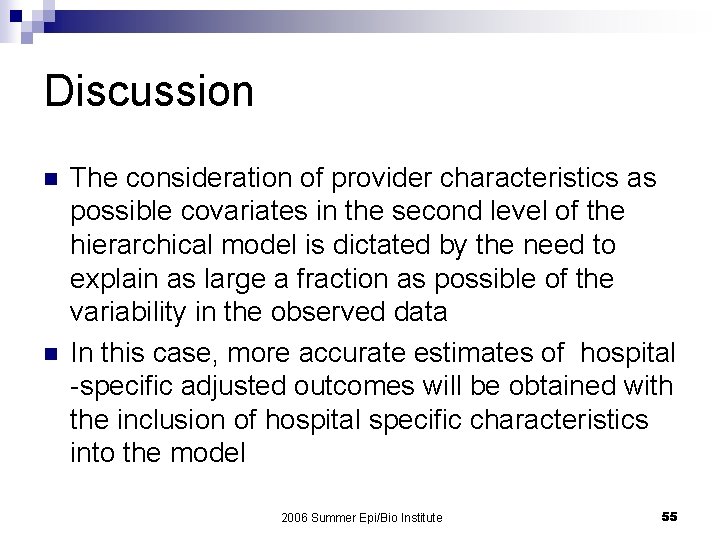
Discussion n n The consideration of provider characteristics as possible covariates in the second level of the hierarchical model is dictated by the need to explain as large a fraction as possible of the variability in the observed data In this case, more accurate estimates of hospital -specific adjusted outcomes will be obtained with the inclusion of hospital specific characteristics into the model 2006 Summer Epi/Bio Institute 55
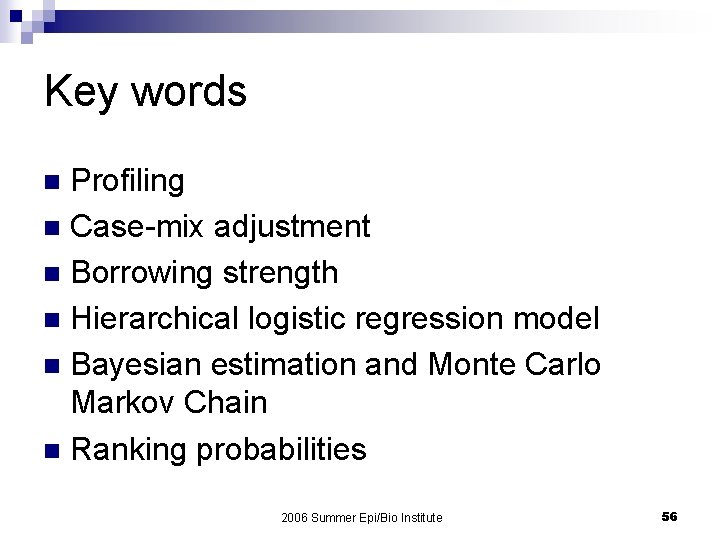
Key words Profiling n Case-mix adjustment n Borrowing strength n Hierarchical logistic regression model n Bayesian estimation and Monte Carlo Markov Chain n Ranking probabilities n 2006 Summer Epi/Bio Institute 56