
Module IIA IEC Organizational and Governance Structure Module



- Slides: 35
Module II-A: IEC Organizational and Governance Structure
Module II-A: Learning Objectives n This module provides an overview of the International Electrotechnical Commission: - Membership - Policy and management groups - Technical committee structure - Liaison categories Module II-A | USNC Slide 2
Module II-A: Disclaimer n The information contained in this self-taught learning module is intended as a summary of documents and procedures frequently used within the IEC and the USNC/IEC. n For additional information about content addressed in this module, please contact the USNC/IEC Staff (usnc@ansi. org). n Additional information is also available via ANSI Education and Training Services. Module II-A | USNC Slide 3
Reference Materials & Source Documents n ISO/IEC Directives, Part 1: 2017 Procedures for the technical work n ISO/IEC Directives, Part 2: 2016 Rules for the structure and drafting of International Standards n ISO/IEC Directives, Part 1: 2017 + IEC Supplement: 2017 Procedures specific to IEC n IEC Statutes and Rules of Procedures IEC membership and participation procedures n USNC Statutes and Rules of Procedure: 2005 n Model Operating Procedures for USNC/IEC TAGS: 2014 n Guide for U. S. Delegates to meetings of ISO and the IEC Module II-A | USNC Slide 4
Objectives of the IEC n Meet the requirements of the global market efficiently n Ensure primacy and maximum world-wide use of its standards and conformity assessment schemes n Assess and improve the quality of products and services covered by its standards n Establish the conditions for the interoperability of complex systems n Increase the efficiency of industrial processes n Contribute to the improvement of human health and safety n Contribute to the protection of the environment Module II-A | USNC Slide 5
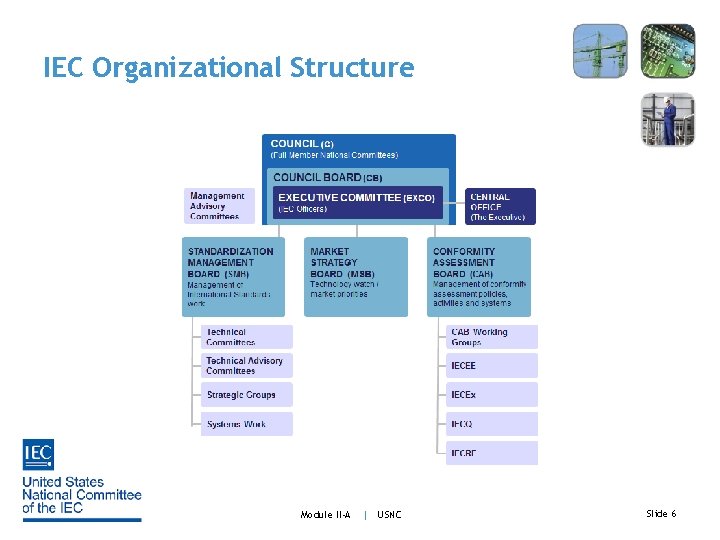
IEC Organizational Structure Module II-A | USNC Slide 6
Dues and Budget n IEC derives its income from: - annual dues paid by its members - the sale of publications - other sources (as approved by the Council) Module II-A | USNC Slide 7
Dues and Budget (cont) n The Council determines the annual budget, including the annual dues of its members, which are divided as: - Group A: Those NCs that pays the highest fixed percentage of the total dues - The remainder from all other Full Member National Committees Module II-A | USNC Slide 8
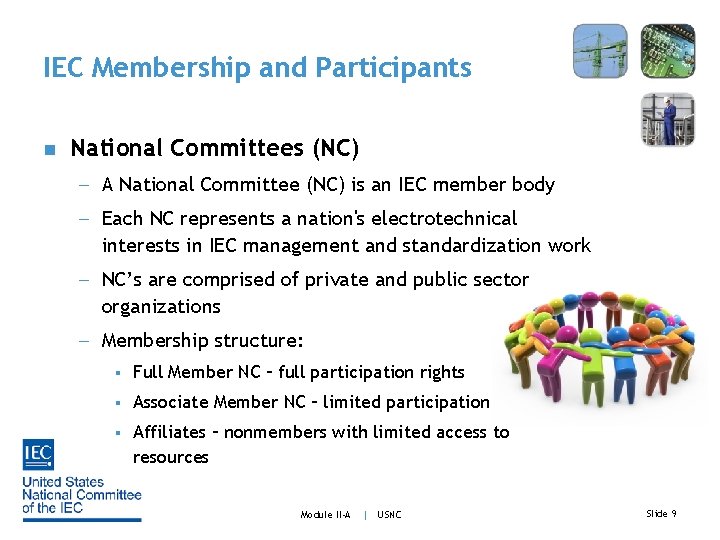
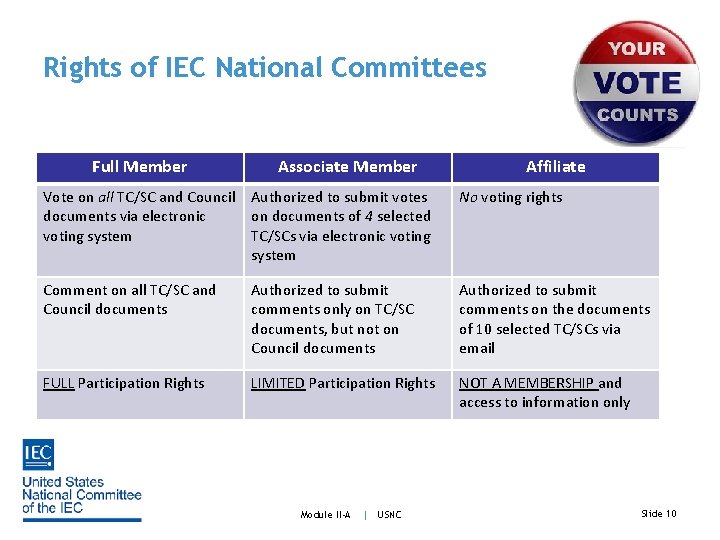
IEC Membership and Participants n National Committees (NC) - A National Committee (NC) is an IEC member body - Each NC represents a nation's electrotechnical interests in IEC management and standardization work - NC’s are comprised of private and public sector organizations - Membership structure: § Full Member NC – full participation rights § Associate Member NC – limited participation § Affiliates – nonmembers with limited access to resources Module II-A | USNC Slide 9
Rights of IEC National Committees Full Member Associate Member Affiliate Vote on all TC/SC and Council Authorized to submit votes documents via electronic on documents of 4 selected voting system TC/SCs via electronic voting system No voting rights Comment on all TC/SC and Council documents Authorized to submit comments only on TC/SC documents, but not on Council documents Authorized to submit comments on the documents of 10 selected TC/SCs via email FULL Participation Rights LIMITED Participation Rights NOT A MEMBERSHIP and access to information only Module II-A | USNC Slide 10
National Committee Participation: TCs and SCs n National committees have the right to participate in the work of every IEC TC and SC*. They may register as either a Participating (P) or an Observer (O) Member. All Members should: - Organize efficient and timely votes and comments on all matters coming before the committee(s) in which they participate § Take into account all relevant interests at their national level - Provide input at the earliest possible time so as to mitigate duplication, overlap and redundancy *Associate members may participate, under certain conditions, in a limited number of committees Module II-A | USNC Slide 11
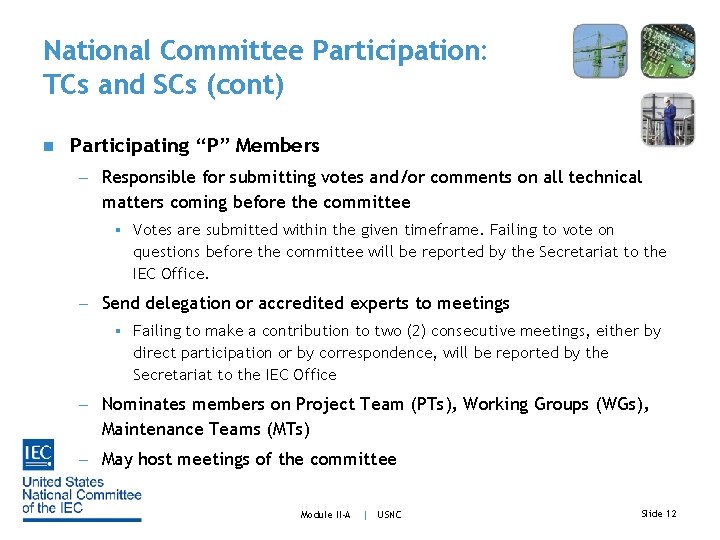
National Committee Participation: TCs and SCs (cont) n Participating “P” Members - Responsible for submitting votes and/or comments on all technical matters coming before the committee § Votes are submitted within the given timeframe. Failing to vote on questions before the committee will be reported by the Secretariat to the IEC Office. - Send delegation or accredited experts to meetings § Failing to make a contribution to two (2) consecutive meetings, either by direct participation or by correspondence, will be reported by the Secretariat to the IEC Office - Nominates members on Project Team (PTs), Working Groups (WGs), Maintenance Teams (MTs) - May host meetings of the committee Module II-A | USNC Slide 12
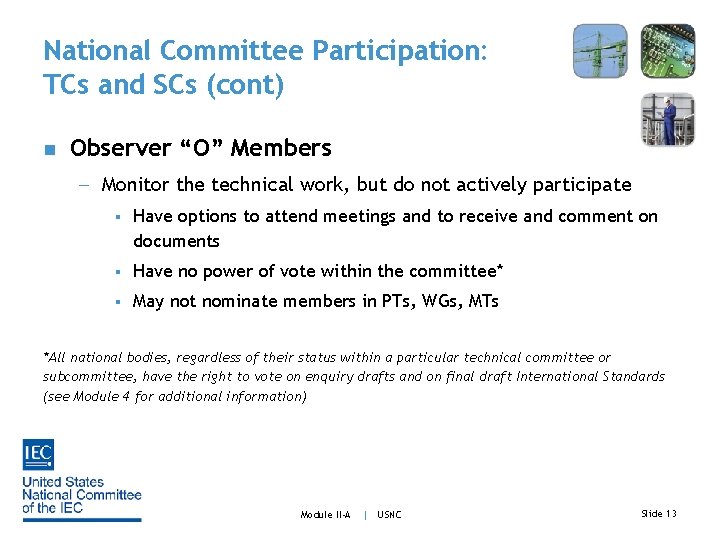
National Committee Participation: TCs and SCs (cont) n Observer “O” Members - Monitor the technical work, but do not actively participate § Have options to attend meetings and to receive and comment on documents § Have no power of vote within the committee* § May not nominate members in PTs, WGs, MTs *All national bodies, regardless of their status within a particular technical committee or subcommittee, have the right to vote on enquiry drafts and on final draft International Standards (see Module 4 for additional information) Module II-A | USNC Slide 13
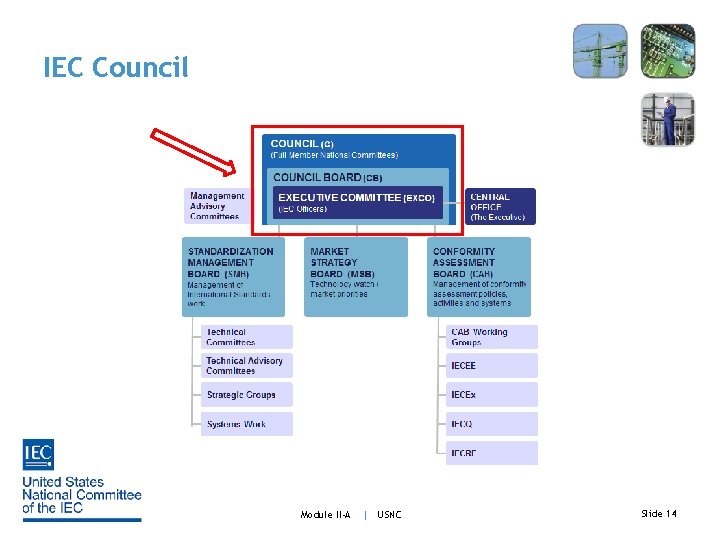
IEC Council Module II-A | USNC Slide 14
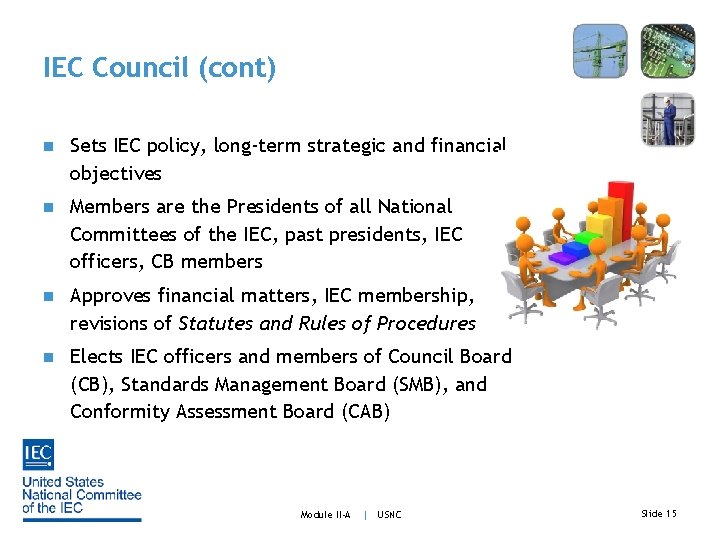
IEC Council (cont) n Sets IEC policy, long-term strategic and financial objectives n Members are the Presidents of all National Committees of the IEC, past presidents, IEC officers, CB members n Approves financial matters, IEC membership, revisions of Statutes and Rules of Procedures n Elects IEC officers and members of Council Board (CB), Standards Management Board (SMB), and Conformity Assessment Board (CAB) Module II-A | USNC Slide 15
IEC Council Board n Works for the good of the whole Commission and its constituency - Implements the IEC Council policy and makes policy recommendations - Comprised of IEC Officers and 15 voting members elected by Council - CB reports all of its decisions to Council Module II-A | USNC Slide 16
IEC Council Board (cont) n Members are elected on their professional qualifications - Some permanent elected members are appointed from those National Committees in financial Group A - The other individual members are from the Full Member National Committees Module II-A | USNC Slide 17
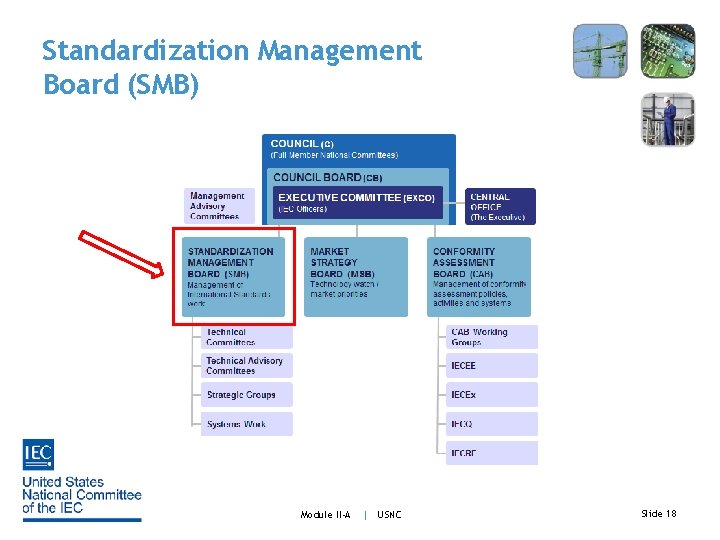
Standardization Management Board (SMB) Module II-A | USNC Slide 18
Standardization Management Board (cont) n The Standardization Management Board (SMB) is responsible for management of the activities of the IEC Technical Committees n Oversees operation of Advisory Committees - Electricity transmission and distribution (ACTAD) - Infrastructure of telecommunications networks (ACTEL) - Safety (ACOS) - Electromagnetic compatibility (ACEC) - Environmental aspects (ACEA) Module II-A | USNC Slide 19
Standardization Management Board (cont) n Manages the technical work through TC/SC Reports/Strategic Policy Statement (SPS) and data prepared by IEC Central Office (CO) n Reviews the functioning of TC/SCs and proposed changes n Approves nominations for Chairpersons and Secretariats of TCs and SCs n Creates/disbands new TCs, ratifies creation/disbanding of new SCs n Develops rules for standards development process - ISO/IEC Directives and the IEC Supplement n Reports to the Council Board Module II-A | USNC Slide 20
Standardization Management Board (cont) n Comprised of 15 members - Chairman Elected by Council - Secretariat held by the IEC Central Office (CO) - USNC is one of the permanent members of the SMB n Meets 3 times a year n Documents, comments and votes normally handled electronically - Decisions require a two-thirds majority of those members voting; if less than eight members vote, the decision must be deferred to the next meeting of the SMB Module II-A | USNC Slide 21
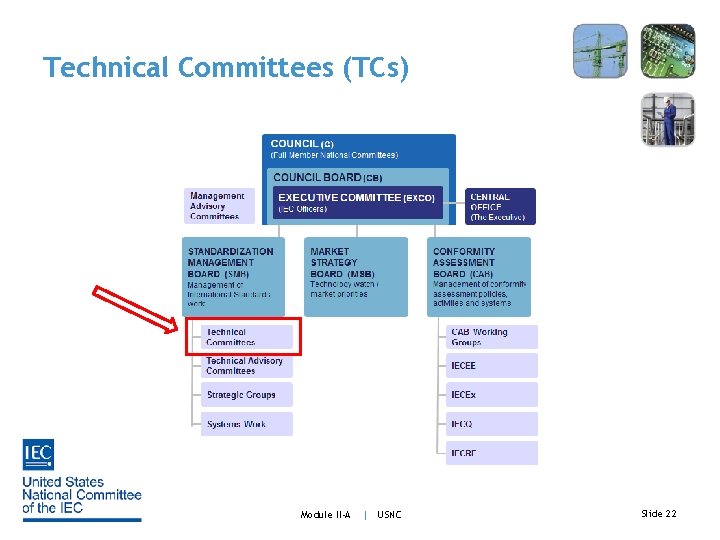
Technical Committees (TCs) Module II-A | USNC Slide 22
Technical Committees (cont) n Responsible for conducting technical work of IEC - Formed when new area of technical work is identified and if § at least two thirds majority of the IEC national committee submitting votes in favor § at least five IEC national committees express their intention to actively participate - Established (including title and scope) by the Standardization Management Board - Title and Scope determined by SMB Module II-A | USNC Slide 23
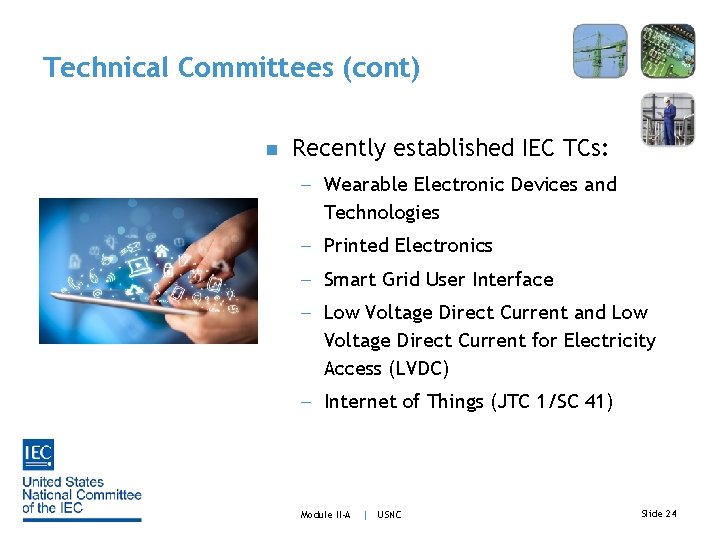
Technical Committees (cont) n Recently established IEC TCs: - Wearable Electronic Devices and Technologies - Printed Electronics - Smart Grid User Interface - Low Voltage Direct Current and Low Voltage Direct Current for Electricity Access (LVDC) - Internet of Things (JTC 1/SC 41) Module II-A | USNC Slide 24
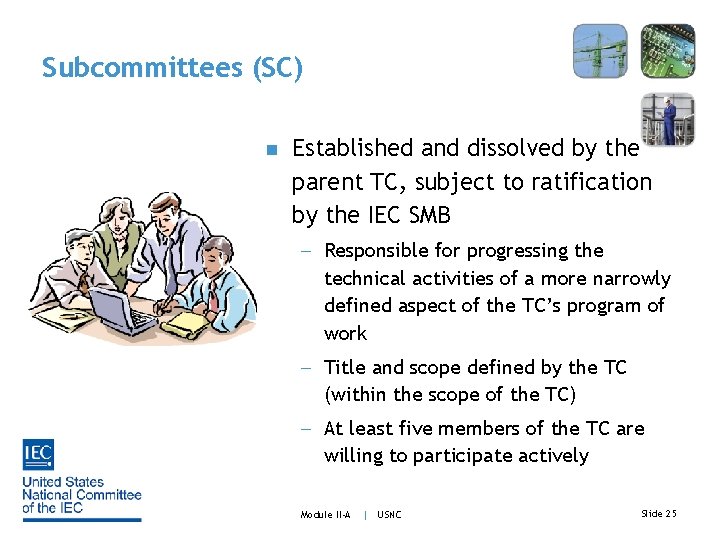
Subcommittees (SC) n Established and dissolved by the parent TC, subject to ratification by the IEC SMB - Responsible for progressing the technical activities of a more narrowly defined aspect of the TC’s program of work - Title and scope defined by the TC (within the scope of the TC) - At least five members of the TC are willing to participate actively Module II-A | USNC Slide 25
Project Teams (PT), Working Groups (WG), and Maintenance Teams (MT) n Created if necessary by TC or SC for further defined focus - WGs are responsible for a grouping of related projects - PTs are responsible for a single project - MTs work on a revision project n § New edition § Amendment Conveners (i. e. the chair of the PT, WG or MT) are appointed by the parent TC or SC Module II-A | USNC Slide 26
IEC Standards Development n IEC standards development work is conducted within this technical committee structure - To facilitate the most broad participation possible, most development work is undertaken “virtually” (e. g. , via e-mail correspondence, online development, video- and teleconferences, etc. ) - Meetings of IEC technical committees are held only when work cannot be conducted by other means - Agenda and documents must be circulated at least four months before a meeting to allow adequate time for review by the National Committee delegates Module II-A | USNC Slide 27
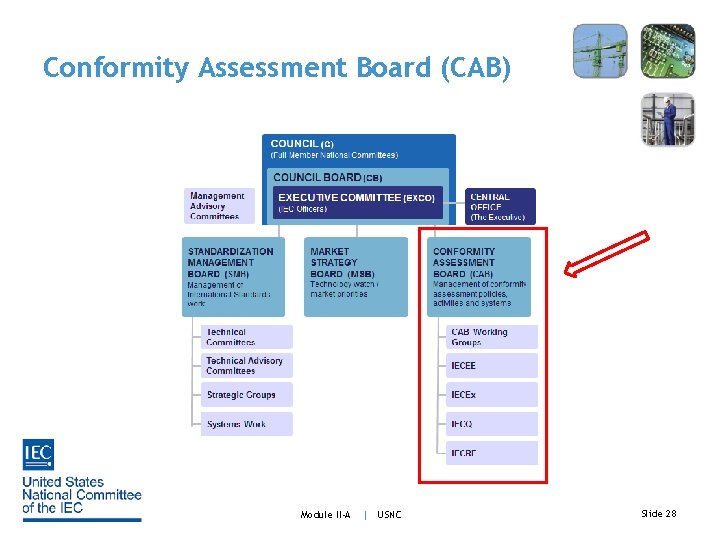
Conformity Assessment Board (CAB) Module II-A | USNC Slide 28
Conformity Assessment Board (cont) n The Conformity Assessment Board (CAB) is responsible for the overall management of the IEC’s conformity assessment activities - Comprised of a Chairman, 12 voting members (and alternates) who are elected by Council, one representative from each IEC conformity assessment scheme, the IEC Treasurer and General Secretary - It reports all its decisions to the Council Board Module II-A | USNC Slide 29
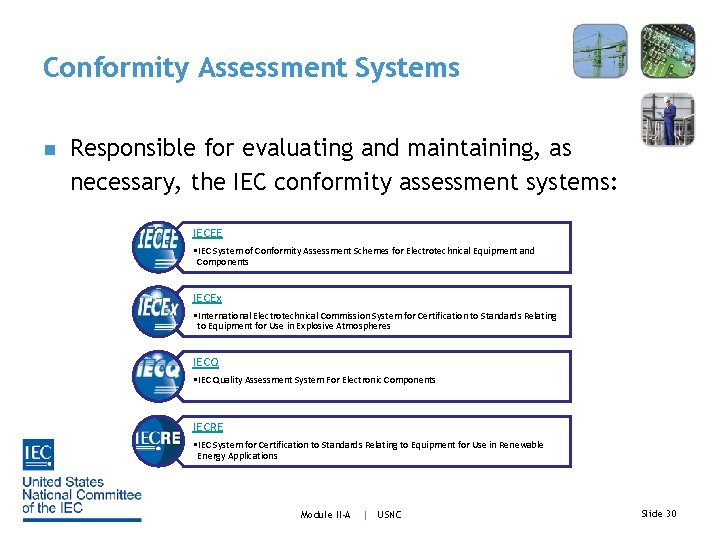
Conformity Assessment Systems n Responsible for evaluating and maintaining, as necessary, the IEC conformity assessment systems: IECEE • IEC System of Conformity Assessment Schemes for Electrotechnical Equipment and Components IECEx • International Electrotechnical Commission System for Certification to Standards Relating to Equipment for Use in Explosive Atmospheres IECQ • IEC Quality Assessment System For Electronic Components IECRE • IEC System for Certification to Standards Relating to Equipment for Use in Renewable Energy Applications Module II-A | USNC Slide 30
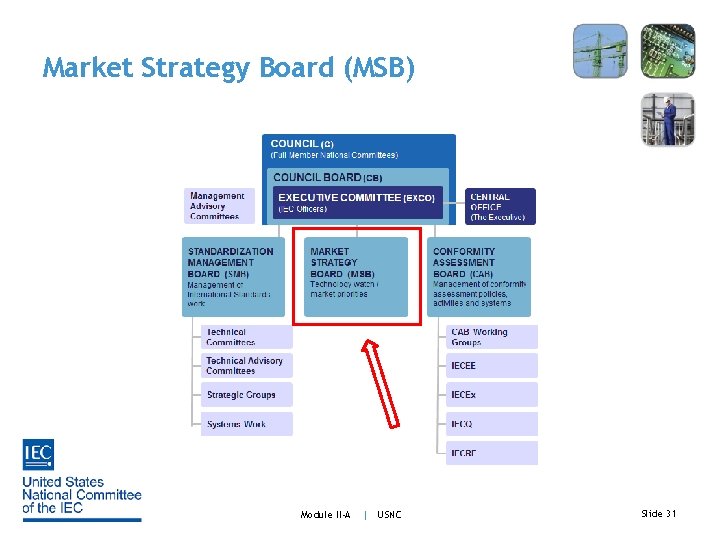
Market Strategy Board (MSB) Module II-A | USNC Slide 31
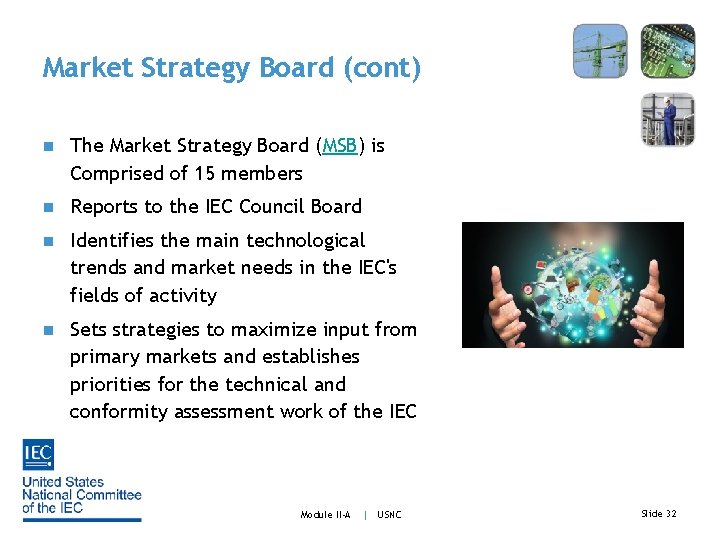
Market Strategy Board (cont) n The Market Strategy Board (MSB) is Comprised of 15 members n Reports to the IEC Council Board n Identifies the main technological trends and market needs in the IEC's fields of activity n Sets strategies to maximize input from primary markets and establishes priorities for the technical and conformity assessment work of the IEC Module II-A | USNC Slide 32
Market Strategy Board (cont) n The MSB meets at least once a year n It is composed of: - A chairperson - 15 high level technology expert members appointed from industry - IEC Officers Module II-A | USNC Slide 33
USNC Constituent Training Program Module II-A Complete Module II-A | USNC Slide 34
USNC Staff Contact Information Joe Tretler Vice President, International Policy jtretler@ansi. org 212. 642. 4977 Tony Zertuche Director, International Policy & USNC General Secretary tzertuche@ansi. org 212 -642 -4892 Kevin Sullivan USNC Program Administrator ksullivan@ansi. org 212. 642. 4963 Kendall Szulewski-Francis USNC Program Administrator ksfrancis@ansi. org 212 -642 -4965 Samuel Roods USNC Program Administrator sroods@ansi. org 212 -642 -4964 Jiin Park USNC Program Administrator jgpark@ansi. org 212 -642 -4939 Debra Negron USNC Meeting Coordinator dnegron@ansi. org 212. 642. 4936