
Module I International Standardization Introduction and Overview Module
- Slides: 33
Module I International Standardization Introduction and Overview
Module I: Learning Objectives § This module provides a general overview of international standardization, including: • Definition of basic terms and concepts • An overview of the benefits of participation in international standardization • An introduction to the: i. Role of the U. S. National Committee of the International Electrotechnical Commission (USNC/IEC) ii. Key international standards organizations iii. Key regional standards organizations © 2020 Slid e 2
Module I: Disclaimer § The information contained in this self-taught learning module is intended as a summary of documents and procedures frequently used within the IEC and the USNC/IEC. § For additional information about content addressed in this module, please contact the USNC staff (usnc@ansi. org). § Additional information is also available via USNC/IEC Education & Training. © 2020 Slid e 3
Reference Materials & Source Documents § ISO/IEC Directives, Part 1: 2021 § ISO/IEC Directives, Part 2: 2021 § ISO/IEC Directives, Part 1: 2021 + IEC Supplement: 2021 Procedures specific to IEC § IEC Statutes and Rules of Procedures § USNC Statutes: 2018 § USNC Rules of Procedure: 2005 § Model Operating Procedures for USNC/IEC TAGS: 2019 § Guide for U. S. Delegates to meetings of ISO and the IEC § IEC Code of Conduct (Patent Policy included) § IEC Diversity Statement Procedures for the technical work Rules for the structure and drafting of International Standards IEC membership and participation procedures © 2020 Slid e 4
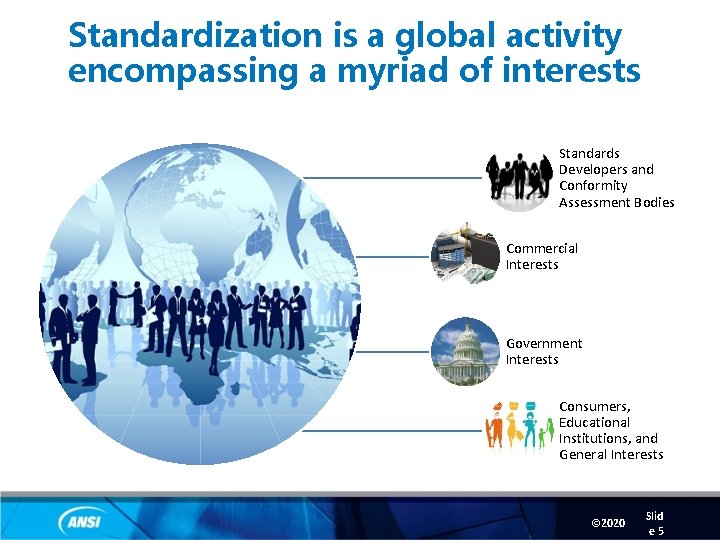
Standardization is a global activity encompassing a myriad of interests Standards Developers and Conformity Assessment Bodies Commercial Interests Government Interests Consumers, Educational Institutions, and General Interests © 2020 Slid e 5
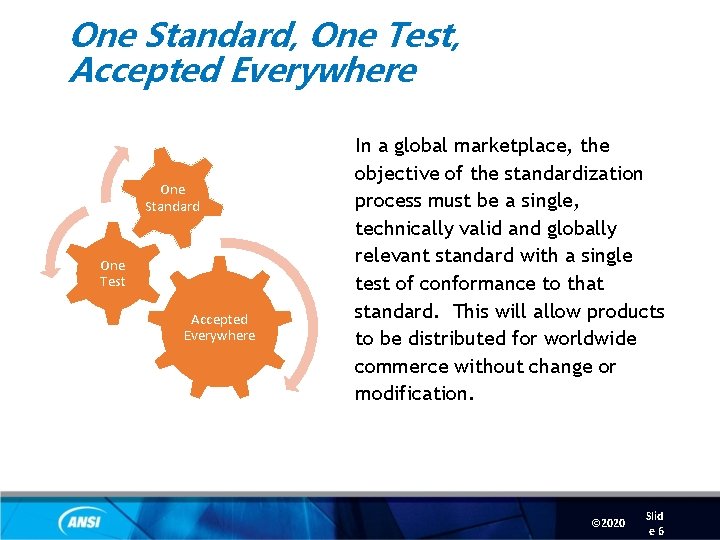
One Standard, One Test, Accepted Everywhere One Standard One Test Accepted Everywhere In a global marketplace, the objective of the standardization process must be a single, technically valid and globally relevant standard with a single test of conformance to that standard. This will allow products to be distributed for worldwide commerce without change or modification. © 2020 Slid e 6
Definitions § Standards • Formal technical documents for generally accepted products, procedures, and policies § Standardization • Use of common products, processes, procedures, and policies to facilitate attainment of business objectives § Conformity Assessment • A process whereby a product, process, service, or system is evaluated against a standard © 2020 Slid e 7
Definitions (cont. ) § Consensus • General agreement, characterized by the absence of sustained opposition to substantial issues by any important part of the concerned interests and by a process that involves seeking to take into account the views of all parties concerned and to reconcile any conflicting arguments. Guide 2 Source: ISO/IEC IMPORTANT NOTE: Consensus does not imply unanimity © 2020 Slid e 8
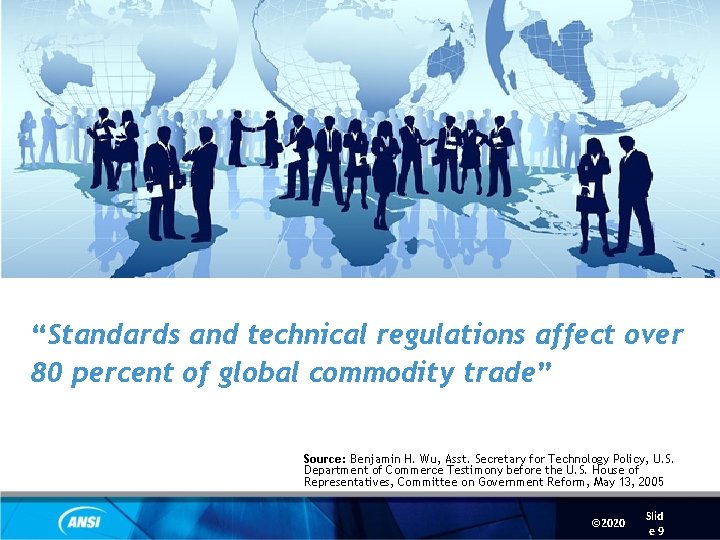
“Standards and technical regulations affect over 80 percent of global commodity trade” Source: Benjamin H. Wu, Asst. Secretary for Technology Policy, U. S. Department of Commerce Testimony before the U. S. House of Representatives, Committee on Government Reform, May 13, 2005 © 2020 Slid e 9
Did you know… § In accordance with the World Trade Organization’s Technical Barriers to Trade Agreement, International Standards are: • developed within procedures intended to ensure global consensus • developed and applied on a voluntary basis, but are increasingly adopted or referenced by governmental bodies § These standards shall be globally relevant and not “give preference to characteristics or requirements of specific countries or regions when different needs or interests exist in other countries or regions. ” § The World Trade Organization (WTO) fosters international trade based on, among others, conformity assessment practices that balance regulated public protection and heightened industrial competition. © 2020 Slid e 10
Q: Why should one participate in the development of international standards? § To facilitate the adoption of globally-accepted standards that will promote interoperability and commercial acceptance across the electrotechnical industry § To gain access to international markets; promote the protection of consumers by improving safety and health standards in the electrotechnical industry; safeguard the environment § To anticipate emerging standards and their impact on technology and global markets © 2020 Slid e 11
Q: Why should one participate in the development of international standards? (cont) § Standards are strategic business tools which help develop new global markets for electrical and electro-technology-related products and services. § U. S. participation helps ensure international market access to U. S. technology and helps to eliminate nontariff trade barriers. § International standards are frequently adopted as, or used as the basis for, national and regional electrotechnical standards. § Participation keeps one on the cutting edge of current technology and market trends. © 2020 Slid e 12
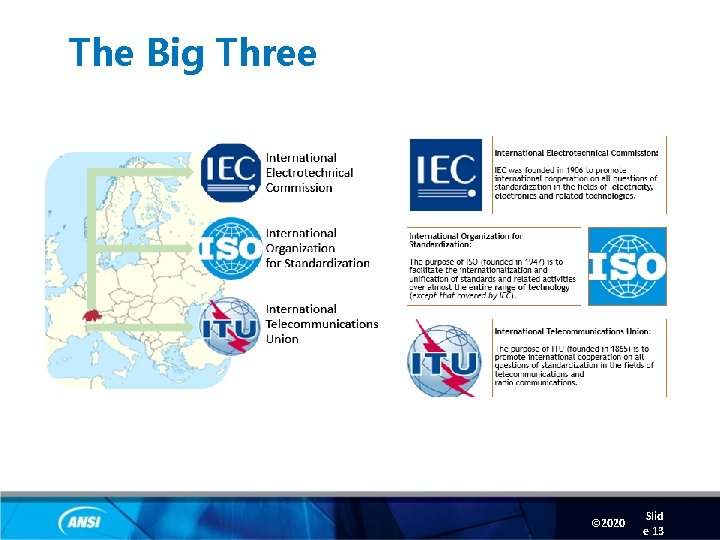
The Big Three © 2020 Slid e 13
International Electrotechnical Commission § The International Electrotechnical Commission (IEC), based in Geneva, Switzerland, is a global nongovernmental organization that prepares and publishes international standards for all electrical, electronic and related technologies. § Through its members, which are known as “National Committees”, the IEC promotes international cooperation on all questions of electrotechnical standardization and related matters, including the assessment of conformity to standards. © 2020 Slid e 14
International Organization for Standardization § The IEC’s sister organization, ISO, is a nongovernmental organization and network of the national standards bodies of countries, one member per country, with a Central Secretariat in Geneva, Switzerland, that coordinates the system. § ISO acts as a bridging organization in which a consensus can be reached on standards and conformity assessment solutions that meet both the requirements of business and the broader needs of society, such as the needs of stakeholder groups like consumers and users. © 2020 Slid e 15
International Telecommunications Union § ITU is a world-wide organization which brings governments and industry together to coordinate the establishment and operation of global telecommunication networks and services. § ITU is responsible for standardization, coordination and development of international telecommunications including radio communications, as well as the harmonization of national policies. § The ITU differs from ISO and IEC in that it was founded on the principle of cooperation between governments and the private sector. © 2020 Slid e 16
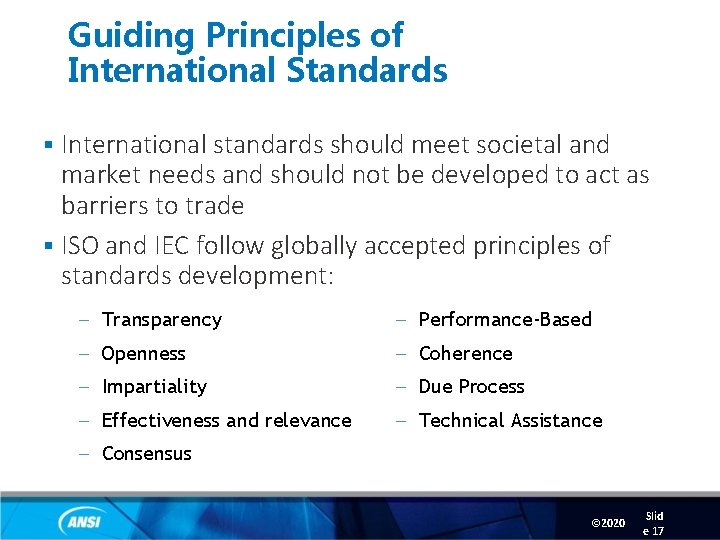
Guiding Principles of International Standards International standards should meet societal and market needs and should not be developed to act as barriers to trade § ISO and IEC follow globally accepted principles of standards development: § - Transparency - Performance-Based - Openness - Coherence - Impartiality - Due Process - Effectiveness and relevance - Technical Assistance - Consensus © 2020 Slid e 17
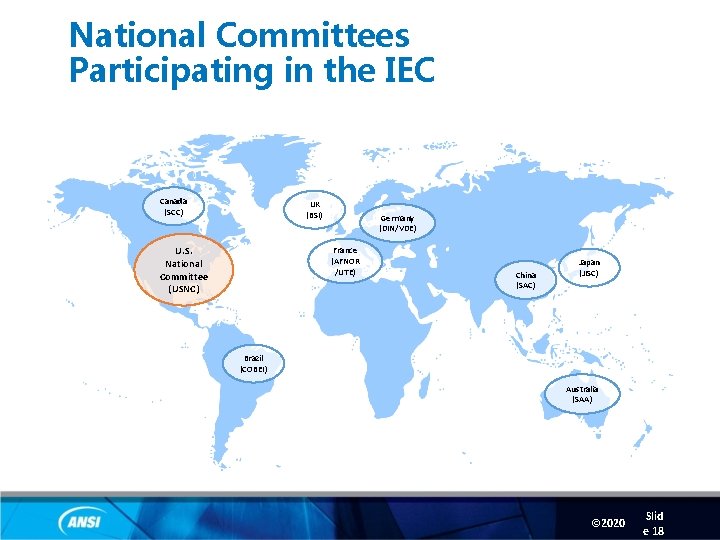
National Committees Participating in the IEC Canada (SCC) UK (BSI) U. S. National Committee (USNC) Germany (DIN/VDE) France (AFNOR /UTE) China (SAC) Japan (JISC) Brazil (COBEI) Australia (SAA) © 2020 Slid e 18
U. S. National Committee of the IEC § The U. S. National Committee of the International Electrotechnical Commission (USNC/IEC) is a committee of the American National Standards Institute (ANSI). § The USNC serves as the official U. S. member of the IEC and represents and coordinates the U. S. involvement in electrotechnical bodies associated with the IEC on behalf of ANSI. © 2020 Slid e 19
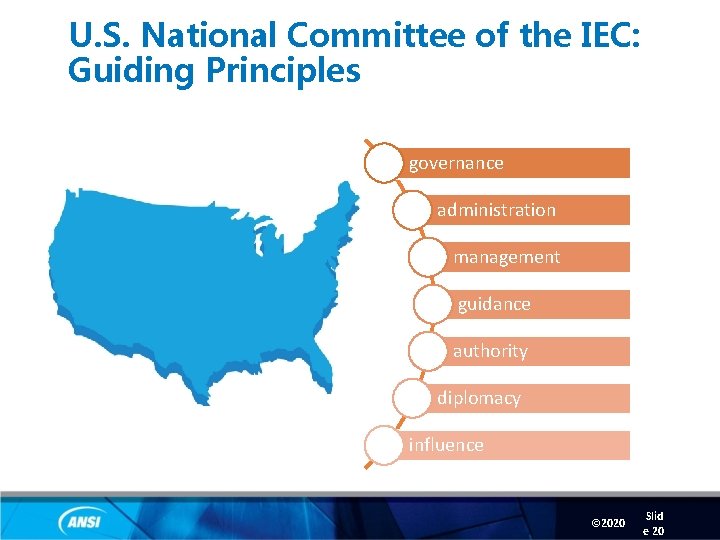
U. S. National Committee of the IEC: Guiding Principles governance administration management guidance authority diplomacy influence © 2020 Slid e 20
USNC/IEC’s Mission The USNC/IEC mission is to coordinate the effective participation in the development of IEC standards and conformity assessment systems to facilitate trade and to promote global safety, efficiency, reliability, and interoperability in the fields of all electrotechnologies. Provides a framework for USNC stakeholders to advocate for U. S. interests in international and regional electrotechnical-related matters. © 2020 Slid e 21
U. S. National Committee of the IEC § Represents the U. S. in the development, promulgation and use of globally-relevant standards for the electrotechnical industry § Engages in the assessment of conformance to standards such as testing, certification and accreditation § Serves as a conduit to the global standards-setting community § Is a totally integrated committee of the American National Standards Institute (ANSI) • ANSI provides administrative support to the USNC © 2020 Slid e 22
USNC/IEC’s Scope of Work § Electrotechnologies • Electronics • Magnetics and electromagnetics • Electroacoustics • Multimedia • Telecommunication • Energy production and distribution § Associated general disciplines • Safety, security, and the environment • Dependability, design and development • Measurement and performance • Terminology and symbols • Electromagnetic compatibility © 2020 Slid e 23
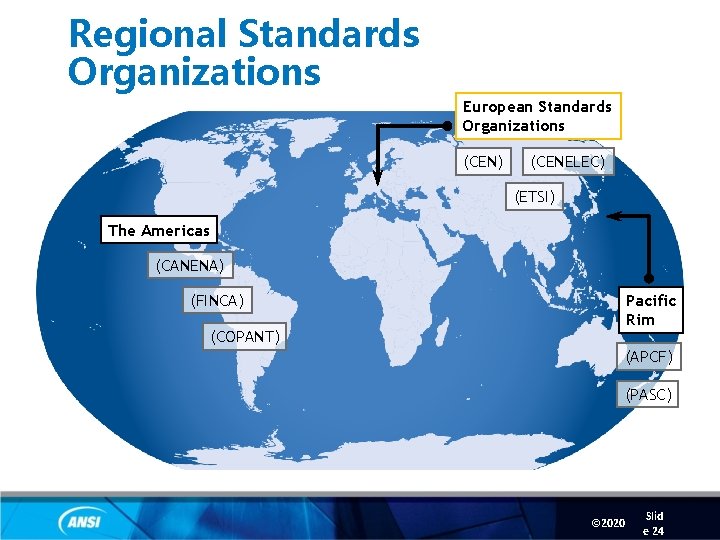
Regional Standards Organizations European Standards Organizations (CEN) (CENELEC) (ETSI) The Americas (CANENA) (FINCA) Pacific Rim (COPANT) (APCF) (PASC) © 2020 Slid e 24
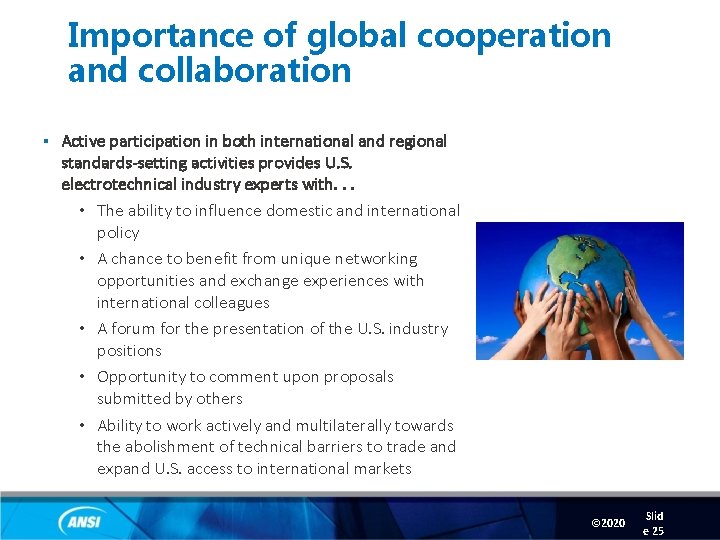
Importance of global cooperation and collaboration § Active participation in both international and regional standards-setting activities provides U. S. electrotechnical industry experts with. . . • The ability to influence domestic and international policy • A chance to benefit from unique networking opportunities and exchange experiences with international colleagues • A forum for the presentation of the U. S. industry positions • Opportunity to comment upon proposals submitted by others • Ability to work actively and multilaterally towards the abolishment of technical barriers to trade and expand U. S. access to international markets © 2020 Slid e 25
Join Us! § The USNC operates over 170 IEC Technical Advisory Groups (TAGs) § Over 2, 000 experts are currently involved in TAG activities in the U. S. § Every year hundreds of U. S. experts participate in international IEC Technical Committee meetings, directly affecting the development of international standards § Get involved!!! Contact the USNC staff to learn how to join a TAG and make a difference (usnc@ansi. org). © 2020 Slid e 26
Internet Resources International IEC – International Electrotechnical Commission ISO – International Organization for Standardization United States USNC – United States National Committee of the IEC ANSI – American National Standards Institute © 2020 Slid e 27
Internet Resources (cont) Regional CANENA - Council for Harmonization of Electrotechnical Standards of the Nations of the Americas COPANT - Pan American Standards Commission FINCA - Forum of IEC National Committees of the Americas CENELEC - European Committee for Electrotechnical Standardization ETSI - European Telecommunications Standards Institute PASC - Pacific Area Standards Congress APCF - Asia-Pacific Cooperation Forum © 2020 Slid e 28
Further Training Activities The USNC holds Instructor-Led Training Courses throughout the year. Contact the USNC staff (usnc@ansi. org) to find out when and where the next one is taking place. © 2020 Slid e 29
USNC Constituent Training Program Module I Complete © 2020 Slid e 30
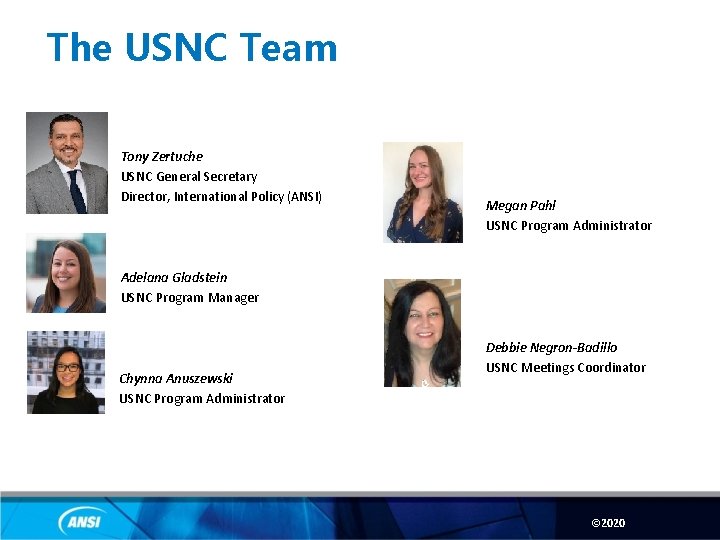
The USNC Team Tony Zertuche USNC General Secretary Director, International Policy (ANSI) Megan Pahl USNC Program Administrator Adelana Gladstein USNC Program Manager Chynna Anuszewski USNC Program Administrator Debbie Negron-Badillo USNC Meetings Coordinator © 2020
USNC Staff Contact Information Joe Tretler Vice President, International Policy jtretler@ansi. org (202) 331 -3618 Chynna Anuszewski Program Administrator canuszewski@ansi. org (212) 642 -8927 Tony Zertuche Director, International Policy & USNC General Secretary tzertuche@ansi. org (212) 642 -4892 Megan Pahl Program Administrator mpahl@ansi. org (212) 642 -8907 Adelana Gladstein Program Manager agladstein@ansi. org (212) 642 -4965 Debra Negron-Badillo USNC Meetings Coordinator dnegron@ansi. org (212) 642 -4936 © 2020
USNC of the IEC American National Standards Institute 25 West 43 rd Street Fourth Floor New York, NY 10036 usnc@ansi. org www. ansi. org/unc |www. ansi. org | webstore. ansi. org