
Module I Basics of a Lifestyle Entrepreneur This
Module I „Basics of a Lifestyle Entrepreneur“ This project has been funded with support the European Commission. This publication reflects the views only of the author, and the Commission cannot be held for any use which may be made of the information contained therein. No 2015 -1 -LT 01 -KA 204 -013404
The aim of Module I The aim of this Module is to develop the competences of adult educators to offer high-quality training on Lifestyle Enterpreneurship for disadvantaged learners, with special emphasis on competences such as the sense of initiative and Entrepreneurship and being an advisor/counsellor/facilitator. No 2015 -1 -LT 01 -KA 204 -013404
Module I Objectives Analyze the definition of Entrepreneurship and Lifestyle Entrepreneurship Develop a basic understanding of how to evaluate the possibility of learners becoming LSE Introduce business principles in Lifestyle Entrepreneurship Gain practical knowledge about LSE as a useful alternative for self employment for disadvantaged learners and review the different styles of Entrepreneurship. Analyze the strategies and methods to work on social and civic competence development (personal development) of learners as a key to success for LSE Develop a basic understanding of the role of an advisor /counselor/ facilitator in promoting LSE for disadvantaged learners including further support to them to explore their business ideas No 2015 -1 -LT 01 -KA 204 -013404
The Structure of Module I Within this Module adult educators will gain practical knowledge about LSE as a useful alternative to self-employment for disadvantaged people. Module is presented in 6 sub-modules, coherent with the main objectives of the Module itself: Main The principles of Entrepreneurship and LSE; possibility of becoming a Lifestyle entrepreneur; Business principles in LSE; Different styles of LSE as a useful alternative to self-employment for disadvantaged people; Personal development – key to success in LSE; The new role of Adult Educator as a facilitator in promoting LSE for disadvantaged learners. No 2015 -1 -LT 01 -KA 204 -013404
Sub-module 1 Main principles of Entrepreneurship and Lifestyle Entrepreneurship Group discussion What is Entrepreneurship? What are the main characteristics of Entrepreneurship? What is Lifestyle Entrepreneurship? What specifics of LSE? What are the similarities and differences between traditional Entrepreneurship and LSE? No 2015 -1 -LT 01 -KA 204 -013404
Sub-module 1 Outcomes of group discussion LSE is a process of discovering new opportunities for self-employment around one’s passions, hobbies and Lifestyle skills, the ability to express oneself and create financial and social profit and improve the quality of one’s own Lifestyle. It is different from traditional Entrepreneurship, which aims at financial profit and huge risk. LSE has a very strong social aspect which helps to solve the various problems of disadvantaged people e. g. social, economic, health, isolation, unemployment. No 2015 -1 -LT 01 -KA 204 -013404
Sub-module 2 The possibility of becoming a Lifestyle Entrepreneur Review and assessment of competences Who can become a Lifestyle Entrepreneur? What skills hobbies and competences would learners need to become a Lifestyle Entrepreneur? What practical life and work experience would learners need? What is Entre Comp? No 2015 -1 -LT 01 -KA 204 -013404
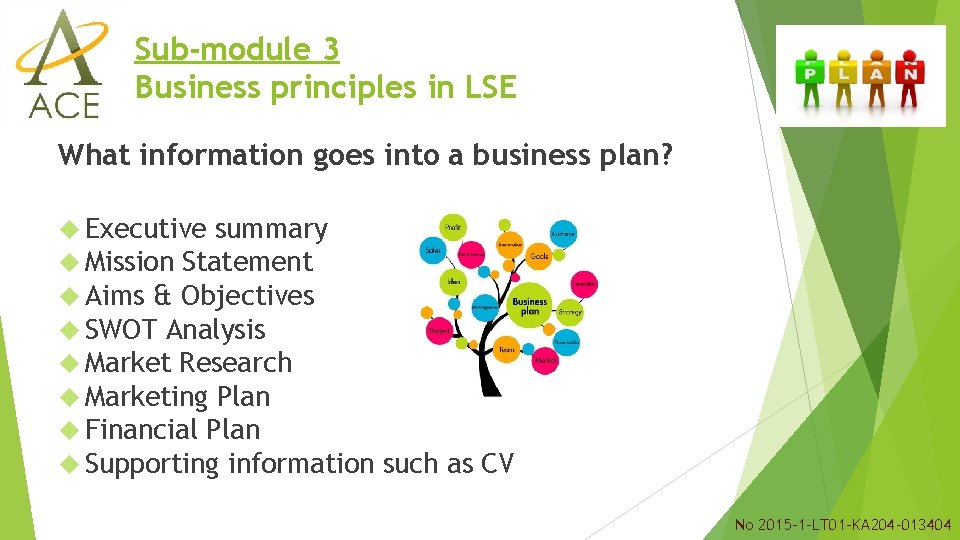
Sub-module 3 Business principles in LSE What information goes into a business plan? Executive summary Mission Statement Aims & Objectives SWOT Analysis Market Research Marketing Plan Financial Plan Supporting information such as CV No 2015 -1 -LT 01 -KA 204 -013404
Sub-module 3 What is the Mission Statement? A statement that describes the nature of your business It will state clearly: the reason why the business exists; what standards or ethics the business has; what the business is about (its key features). The Mission Statement will determine how others see the business, including customers and competitors. No 2015 -1 -LT 01 -KA 204 -013404
Sub-module 3 What is the Mission Statement? Examples The Women's Organisation: “The Women's Organisation is an innovative women’s organisation that provides quality enterprise and employment services and influences policy in order to improve the economic position of women. ” The Body Shop: “To passionately campaign for the protection of the environment, human and civil rights, and against animal testing within the cosmetics and toiletries industry. ” No 2015 -1 -LT 01 -KA 204 -013404
Sub-module 3 SWOT Analysis A list of your personal and business: Strengths Weaknesses Opportunities Threats Takes into consideration factors such as: the current economic climate � social trends � personal experience � No 2015 -1 -LT 01 -KA 204 -013404
Sub-module 3 Points to remember Be honest about your own strengths and weaknesses. Consider both your personal SWOT and that of your business idea. Consider external influences such as the economic climate and social trends. Use a SWOT Action Plan to help you address those areas you have identified as weaknesses or threats. No 2015 -1 -LT 01 -KA 204 -013404
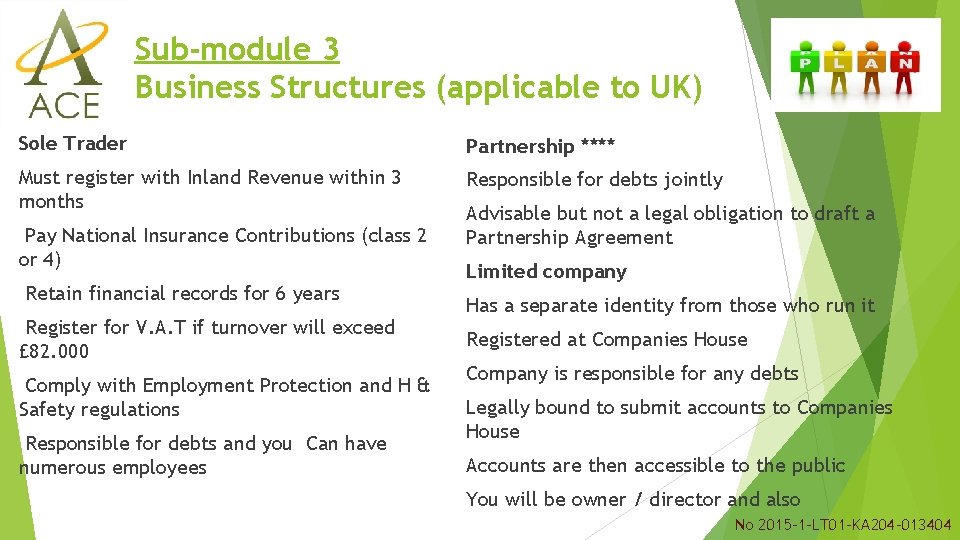
Sub-module 3 Business Structures (applicable to UK) Sole Trader Partnership **** Must register with Inland Revenue within 3 months Responsible for debts jointly Pay National Insurance Contributions (class 2 or 4) Retain financial records for 6 years Register for V. A. T if turnover will exceed £ 82. 000 Comply with Employment Protection and H & Safety regulations Responsible for debts and you Can have numerous employees Advisable but not a legal obligation to draft a Partnership Agreement Limited company Has a separate identity from those who run it Registered at Companies House Company is responsible for any debts Legally bound to submit accounts to Companies House Accounts are then accessible to the public You will be owner / director and also No 2015 -1 -LT 01 -KA 204 -013404
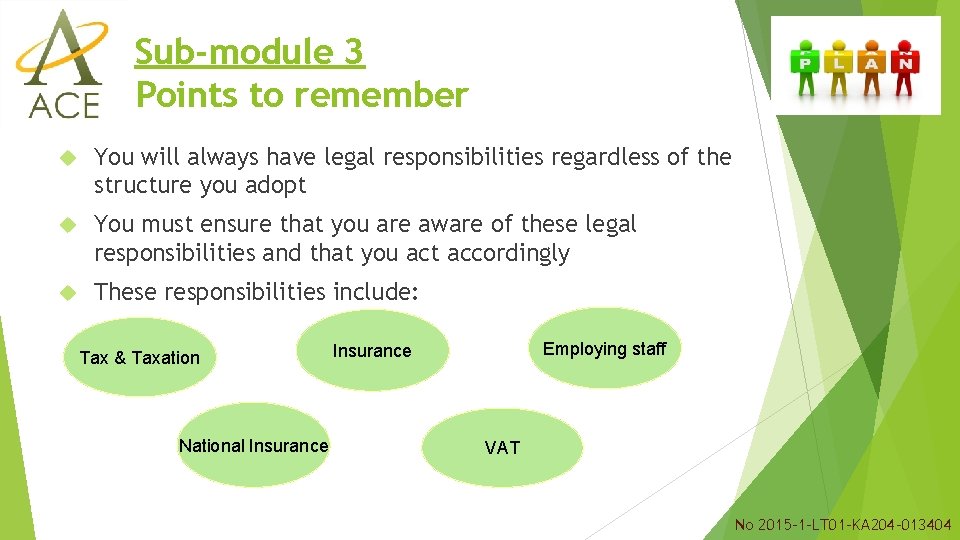
Sub-module 3 Points to remember You will always have legal responsibilities regardless of the structure you adopt You must ensure that you are aware of these legal responsibilities and that you act accordingly These responsibilities include: Tax & Taxation National Insurance Employing staff Insurance VAT No 2015 -1 -LT 01 -KA 204 -013404
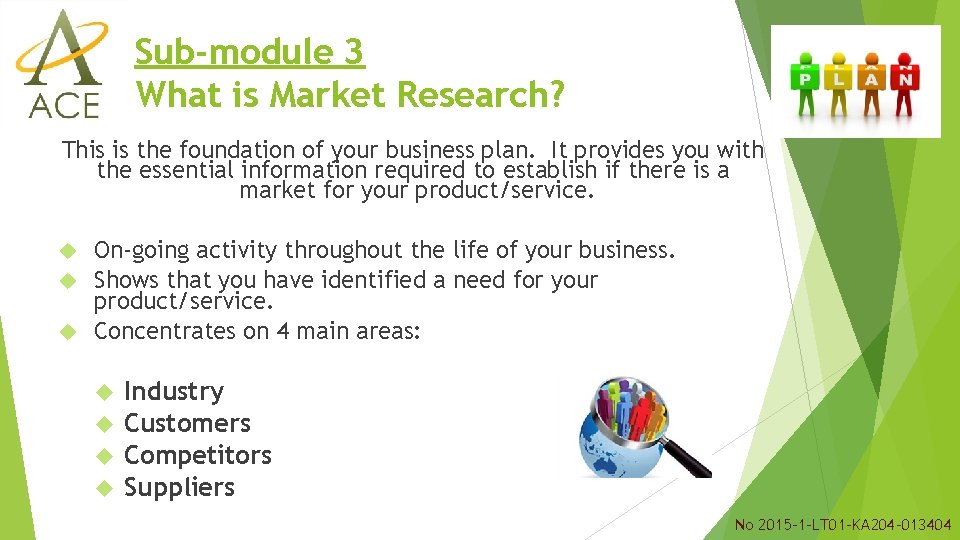
Sub-module 3 What is Market Research? This is the foundation of your business plan. It provides you with the essential information required to establish if there is a market for your product/service. On-going activity throughout the life of your business. Shows that you have identified a need for your product/service. Concentrates on 4 main areas: Industry Customers Competitors Suppliers No 2015 -1 -LT 01 -KA 204 -013404

Sub-module 3 Industry Background What is projected for the future of the industry (growth or decline)? Including relevant statistics to support this. What difficulties or barriers are there to entering the market? How does the industry operate? Is there a governing body or association? What are the new, recent and growing areas within the industry? Anything that has recently been reported by the media that could affect your industry, e. g. food/health/political issues? No 2015 -1 -LT 01 -KA 204 -013404
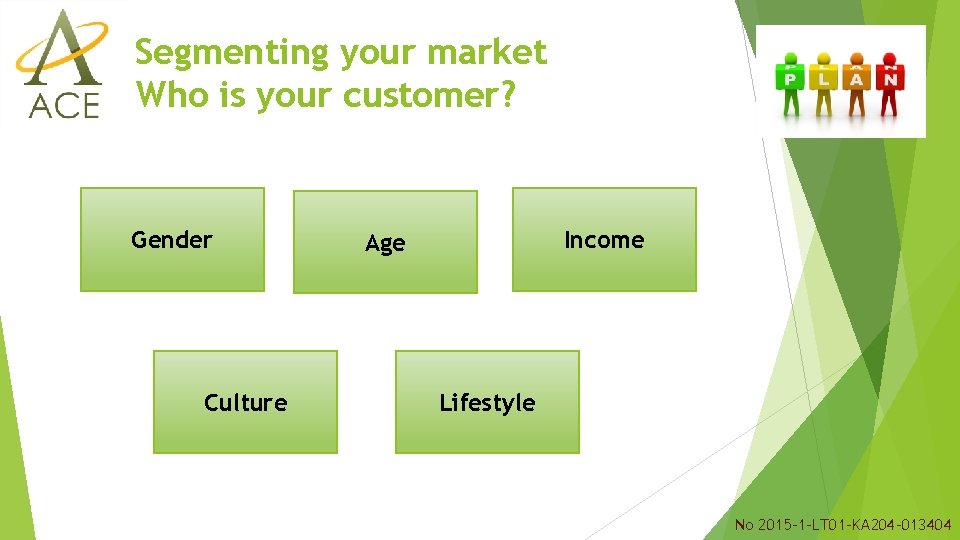
Segmenting your market Who is your customer? Gender Culture Income Age Lifestyle No 2015 -1 -LT 01 -KA 204 -013404
Market Research: How? Desk research Internet Newspapers Journals Magazines Field research Visits Focus groups Questionnaire Sit off / Foot slog No 2015 -1 -LT 01 -KA 204 -013404
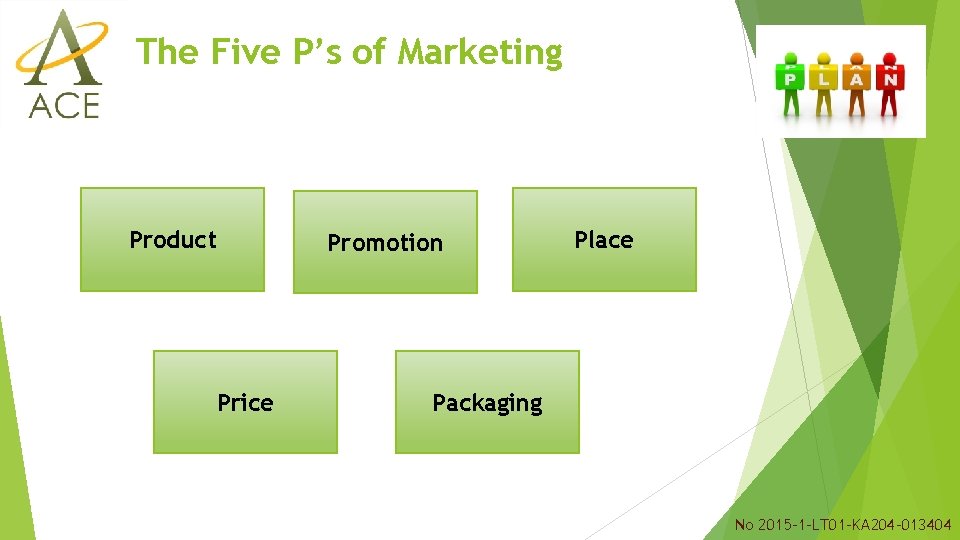
The Five P’s of Marketing Product Promotion Price Place Packaging No 2015 -1 -LT 01 -KA 204 -013404
Sub-module 3 What is Business Finance? This is the amount of money you need to cover your business start-up costs. Investigating what sources of finance are available will help you to assess the feasibility of your business idea. Eligibility will depend on your circumstances, nature of your business, location of your business, number of jobs to be created etc. These costs may include: Ø Equipment Ø Insurance Ø Rent Ø Stock Ø Stationery Ø Marketing materials No 2015 -1 -LT 01 -KA 204 -013404
Sub-module 3 Financial Planning Personal Budget Sales Forecast Cash flow Forecast and assumptions Profit and Loss Forecast Balance Sheet Forecast No 2015 -1 -LT 01 -KA 204 -013404
Sub-module 4 Different styles of LSE as a useful alternative to self employment Why people choose LSE No 2015 -1 -LT 01 -KA 204 -013404
Sub-module 4 Benefits of Lifestyle Entrepreneurship can provide an opportunity to spend time and generate an income undertaking an activity that you really enjoy. No 2015 -1 -LT 01 -KA 204 -013404
Sub-module 4 Potential barriers facing the LSE ü ü ü ü ü Lack of management skills Inadequate capital Underestimation of competition Inadequate planning Location Personnel problems Economic conditions Legal problems Accounting problems No 2015 -1 -LT 01 -KA 204 -013404
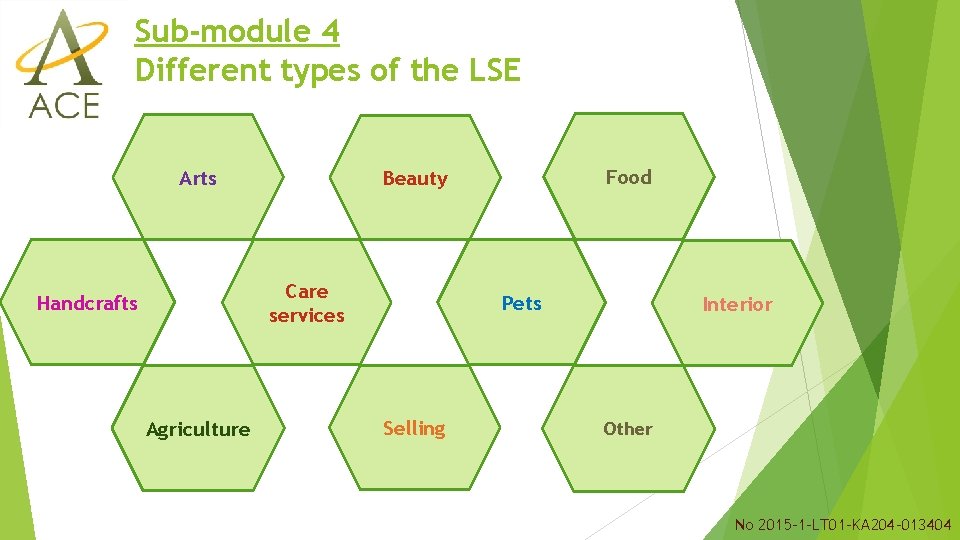
Sub-module 4 Different types of the LSE Arts Care services Handcrafts Agriculture Food Beauty Pets Selling Interior Other No 2015 -1 -LT 01 -KA 204 -013404
Sub-module 5 Personal Development – Key to success in LSE Personal development is an ongoing and life-long process during which everyone can improve their life quality by discovering themselves, developing their own talents and potential, skills increasing the chances of achieving important goals and dreams Personal development goals are set very individually They differ from person to person and require specific approach while defining them No 2015 -1 -LT 01 -KA 204 -013404
Sub-module 5 Personal Development – Key to success in LSE Challenges that Lifestyle entrepreneurs face (Meager et al, 2011): insufficient lack self-awareness of own skill needs; of self-assessment as “business people”; lack of business experience and/or lack of relevant business training, with particular reference to skills such as cash flow/financial management, marketing/winning business, creating and management business systems; insufficient lack “soft” skills, including interpersonal skills; of staff management skills. No 2015 -1 -LT 01 -KA 204 -013404
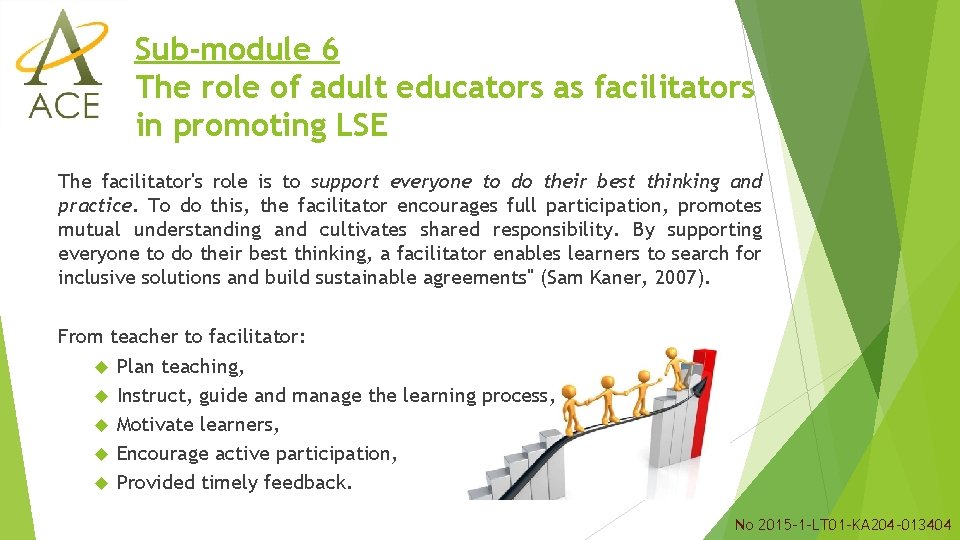
Sub-module 6 The role of adult educators as facilitators in promoting LSE The facilitator's role is to support everyone to do their best thinking and practice. To do this, the facilitator encourages full participation, promotes mutual understanding and cultivates shared responsibility. By supporting everyone to do their best thinking, a facilitator enables learners to search for inclusive solutions and build sustainable agreements" (Sam Kaner, 2007). From teacher to facilitator: Plan teaching, Instruct, guide and manage the learning process, Motivate learners, Encourage active participation, Provided timely feedback. No 2015 -1 -LT 01 -KA 204 -013404
- Slides: 28