
Module Four Session 4 Interpretation of financial statements
- Slides: 19
Module Four: Session 4 Interpretation of financial statements – Financial Position Module 4: Session 4 1 9/17/2021
The objectives of the session: 1. To enable participants understand the balance sheet figures and interpret them 2. To explain to participants the importance of investor ratios and key ratios to investors. 3. To explain drawbacks and limitations of ratios 4. To highlight going concern issues Module 4: Session 4 2 9/17/2021
Understanding financial position A statement of a company's position at a given period of time systematically presented to show its wealth. A balance sheet is divided into two main sections, one that records assets and one that shows how those assets are financed (liabilities). Assets are broken down into capital assets and working capital. Working capital is current assets less current liabilities. The total assets equal the total liabilities. Module 2: Session 3 3 9/17/2021
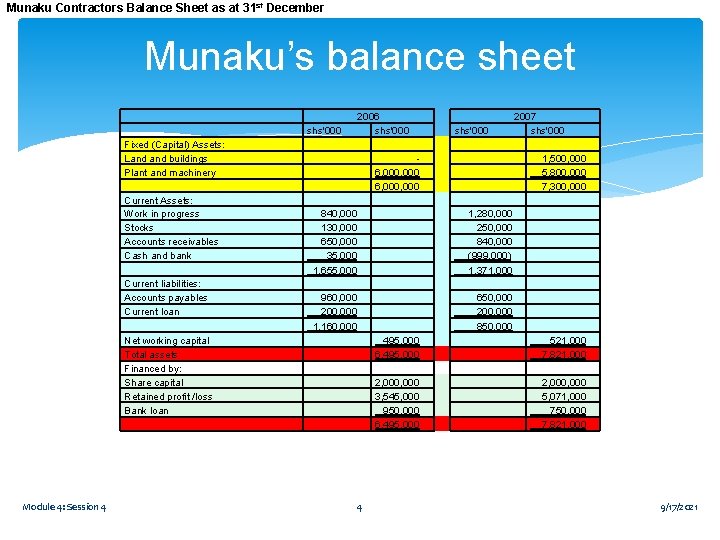
Munaku Contractors Balance Sheet as at 31 st December Munaku’s balance sheet shs'000 2006 shs'000 Fixed (Capital) Assets: Land buildings Plant and machinery Current Assets: Work in progress Stocks Accounts receivables Cash and bank Current liabilities: Accounts payables Current loan 6, 000, 000 1, 280, 000 250, 000 840, 000 (999, 000) 1, 371, 000 960, 000 200, 000 1, 160, 000 650, 000 200, 000 850, 000 4 2007 shs'000 1, 500, 000 5, 800, 000 7, 300, 000 840, 000 130, 000 650, 000 35, 000 1, 655, 000 Net working capital Total assets Financed by: Share capital Retained profit /loss Bank loan Module 4: Session 4 shs'000 495, 000 6, 495, 000 521, 000 7, 821, 000 2, 000 3, 545, 000 950, 000 6, 495, 000 2, 000 5, 071, 000 750, 000 7, 821, 000 9/17/2021
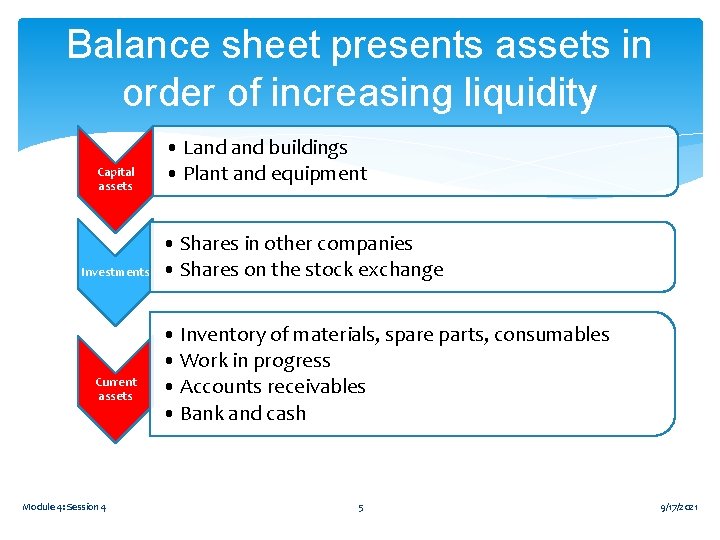
Balance sheet presents assets in order of increasing liquidity Capital assets Investments Current assets Module 4: Session 4 • Land buildings • Plant and equipment • Shares in other companies • Shares on the stock exchange • Inventory of materials, spare parts, consumables • Work in progress • Accounts receivables • Bank and cash 5 9/17/2021
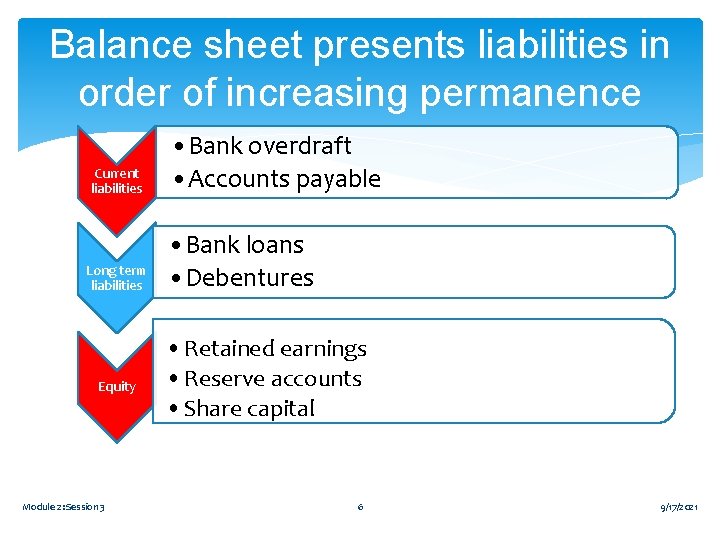
Balance sheet presents liabilities in order of increasing permanence Current liabilities Long term liabilities Equity Module 2: Session 3 • Bank overdraft • Accounts payable • Bank loans • Debentures • Retained earnings • Reserve accounts • Share capital 6 9/17/2021
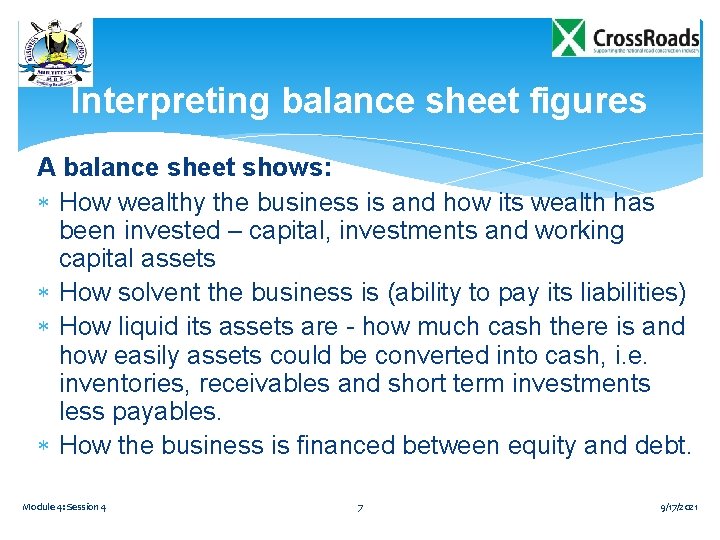
Interpreting balance sheet figures A balance sheet shows: How wealthy the business is and how its wealth has been invested – capital, investments and working capital assets How solvent the business is (ability to pay its liabilities) How liquid its assets are - how much cash there is and how easily assets could be converted into cash, i. e. inventories, receivables and short term investments less payables. How the business is financed between equity and debt. Module 4: Session 4 7 9/17/2021
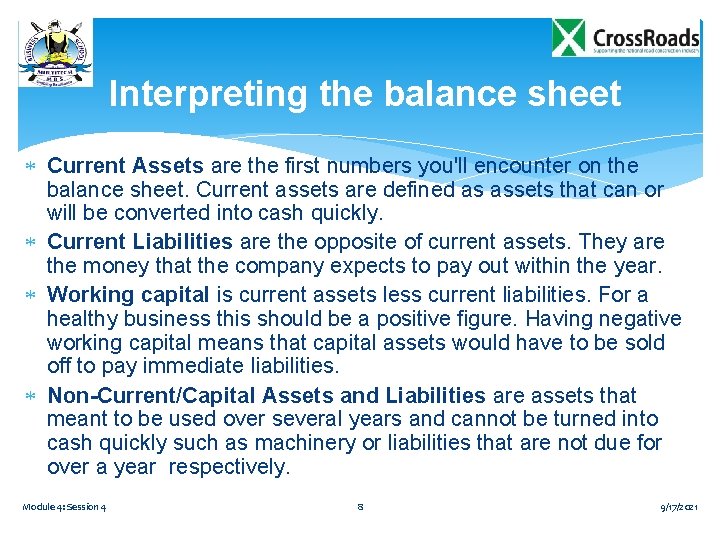
Interpreting the balance sheet Current Assets are the first numbers you'll encounter on the balance sheet. Current assets are defined as assets that can or will be converted into cash quickly. Current Liabilities are the opposite of current assets. They are the money that the company expects to pay out within the year. Working capital is current assets less current liabilities. For a healthy business this should be a positive figure. Having negative working capital means that capital assets would have to be sold off to pay immediate liabilities. Non-Current/Capital Assets and Liabilities are assets that meant to be used over several years and cannot be turned into cash quickly such as machinery or liabilities that are not due for over a year respectively. Module 4: Session 4 8 9/17/2021
Ratio analysis – solvency and liquidity Current Ratio: Current assets divided by current liabilities. If this number is greater than one, then the company has enough current assets to cover its short term liabilities. Quick ratio also called the acid test: Immediate current assets divided by current liabilities. Inventory and doubtful accounts receivables are excluded from current assets first as they may not be converted to cash easily. This ratio should be about one to one. These two ratios indicate the ability of the business to meet its obligations as they fall due. Module 4: Session 4 9 9/17/2021
Ratio analysis – liquidity management Collection period ratio – (Trade accounts receivable x 365)divided by annual credit sales. This is the average collection period of accounts receivable. It shows how well the business is managing its trade debtors. The shorter the period the better for cash management. Inventory holding period ratio – (Inventory x 365) divided by the annual cost of works. Indicates the average period the business hold inventory and work in progress before it turns to revenue. The shorter the period the better for the business. Payment period ratio – ( Trade accounts payable x 365) divided by the annual credit purchases. Shows the average period taken to pay suppliers. The longer the period the better for cash management. Module 4: Session 4 10 9/17/2021
Ratio analysis - activity Turnover ratios: The turnover ratios are used to determine how many times a company "turns over" its assets in a given year. Inventory turnover: It is calculated by taking the cost of goods sold and dividing by the average inventory for the period Fixed assets turnover: It is calculated by revenue divided by fixed assets. Working capital turnover: Revenue divided by working capital. The higher the turnover the better efficiently the resources of the business are being utilized to generate income for it. Module 4: Session 4 11 9/17/2021
Leverage ratios Leverage/gearing: Financial leverage/gearing is a measure of how much debt the company has assumed in order to finance its assets. Equity/Debt. The equity/debt ratio measures how much of the company is financed by owners. It is given as 2: 1 format Debt/Asset ratio: The debt/asset ratio can show you what percentage of the company's assets are financed through debt. Interest coverage. It is income before tax and interest divided by interest. The ratio measures a company's ability to meet its interest obligations with income earned from the firm's primary source of business. It is an indicator of financial leverage/gearing. The higher the figure the easier for the company to pay interest and to attract lenders. Module 4: Session 4 12 9/17/2021
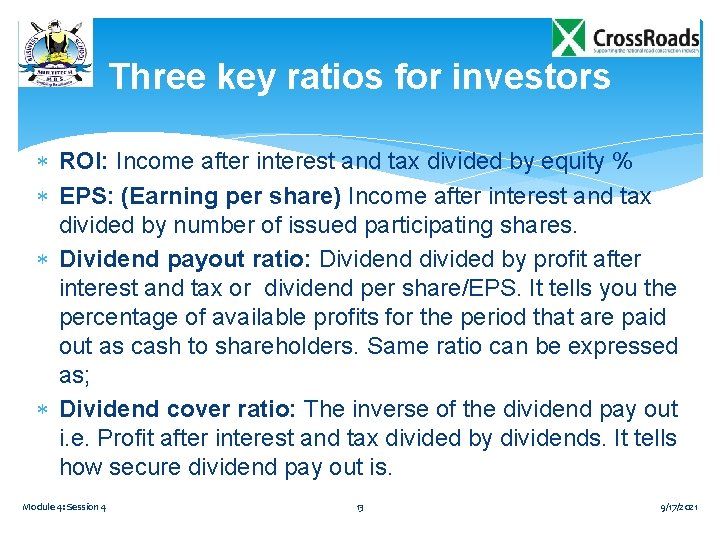
Three key ratios for investors ROI: Income after interest and tax divided by equity % EPS: (Earning per share) Income after interest and tax divided by number of issued participating shares. Dividend payout ratio: Dividend divided by profit after interest and tax or dividend per share/EPS. It tells you the percentage of available profits for the period that are paid out as cash to shareholders. Same ratio can be expressed as; Dividend cover ratio: The inverse of the dividend pay out i. e. Profit after interest and tax divided by dividends. It tells how secure dividend pay out is. Module 4: Session 4 13 9/17/2021
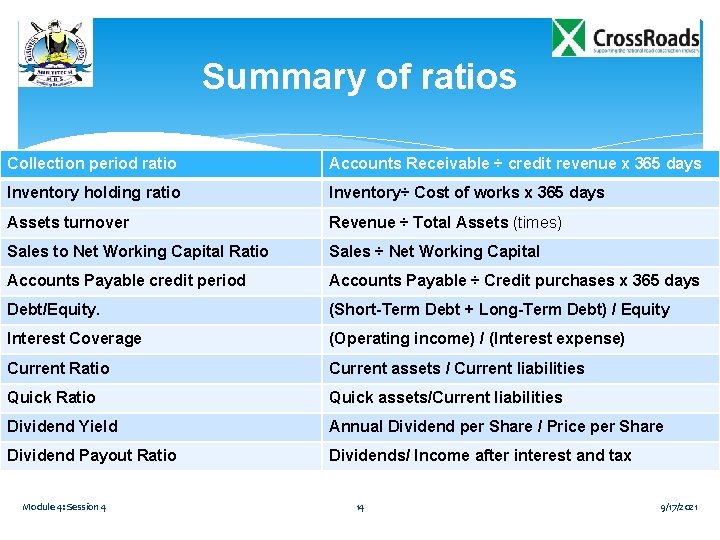
Summary of ratios Collection period ratio Accounts Receivable ÷ credit revenue x 365 days Inventory holding ratio Inventory÷ Cost of works x 365 days Assets turnover Revenue ÷ Total Assets (times) Sales to Net Working Capital Ratio Sales ÷ Net Working Capital Accounts Payable credit period Accounts Payable ÷ Credit purchases x 365 days Debt/Equity. (Short-Term Debt + Long-Term Debt) / Equity Interest Coverage (Operating income) / (Interest expense) Current Ratio Current assets / Current liabilities Quick Ratio Quick assets/Current liabilities Dividend Yield Annual Dividend per Share / Price per Share Dividend Payout Ratio Dividends/ Income after interest and tax Module 4: Session 4 14 9/17/2021
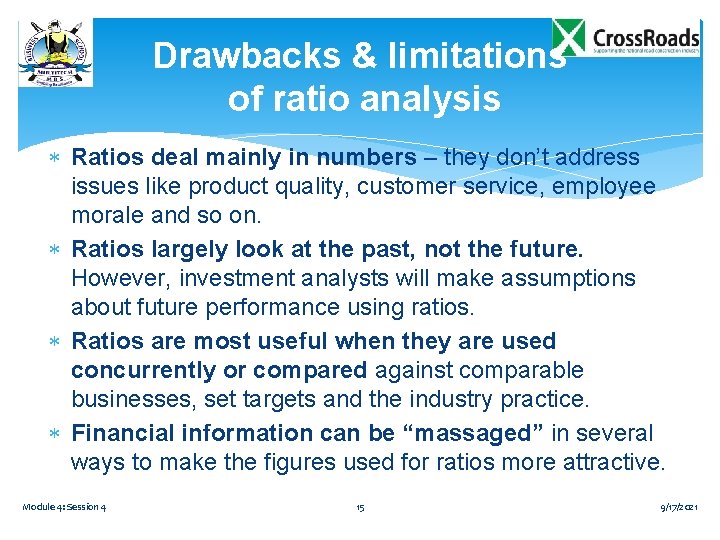
Drawbacks & limitations of ratio analysis Ratios deal mainly in numbers – they don’t address issues like product quality, customer service, employee morale and so on. Ratios largely look at the past, not the future. However, investment analysts will make assumptions about future performance using ratios. Ratios are most useful when they are used concurrently or compared against comparable businesses, set targets and the industry practice. Financial information can be “massaged” in several ways to make the figures used for ratios more attractive. Module 4: Session 4 15 9/17/2021
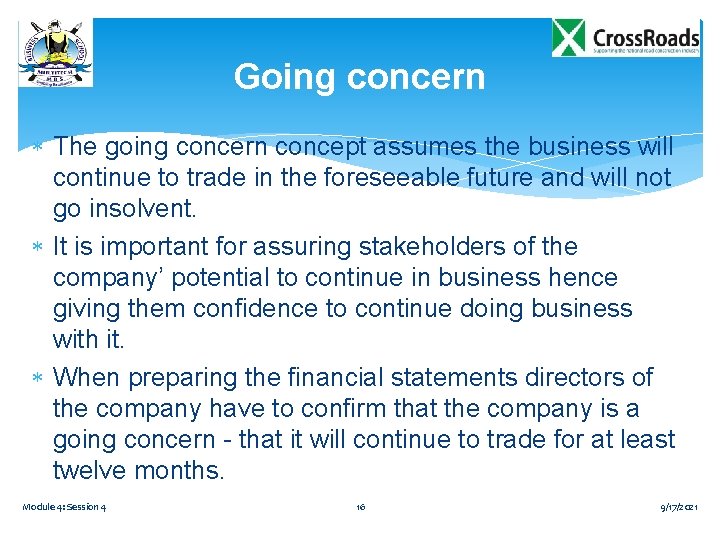
Going concern The going concern concept assumes the business will continue to trade in the foreseeable future and will not go insolvent. It is important for assuring stakeholders of the company’ potential to continue in business hence giving them confidence to continue doing business with it. When preparing the financial statements directors of the company have to confirm that the company is a going concern - that it will continue to trade for at least twelve months. Module 4: Session 4 16 9/17/2021
Indicators of going concern problems Cash flow constraints Poor solvency and liquidity ratios, heavy overdrafts and loans accompanied by low interest cover. Overtrading. Loss of key contracts, customers or suppliers. Loss of key employees that drive the company forward. A downturn in activity and major loss of market share. Cumulative or continued trading losses. Looking at financial statements in totality plus knowledge of the operations of the business can make one raise the going concern question. Module 4: Session 4 17 9/17/2021
Group Activity 1. Explain what ratios you should look at as a supplier of material to a road contractor. 2. What kind of information would you look at if you were a bank approached by a road contractor for a loan? 3. “Understanding of past performance is a prerequisite for anticipating the future” Discuss. 4. If you were to invest in Munaku Contractors Ltd, what ratios would you look out for? 5. Discuss Munaku Contractors Ltd as a going concern. Module 4: Session 4 18 9/17/2021
END Q&A Module 4: Session 4 19 9/17/2021